Two inner dust clumps in PDS 70. A third protoplanet traced by trojan material or a substructured inner disk?
Pith reviewed 2026-06-26 00:49 UTC · model grok-4.3
The pith
The third planet candidate in PDS 70 is a dust clump either co-orbiting with an unseen planet or part of inner disk substructure.
A machine-rendered reading of the paper's core claim, the machinery that carries it, and where it could break.
Core claim
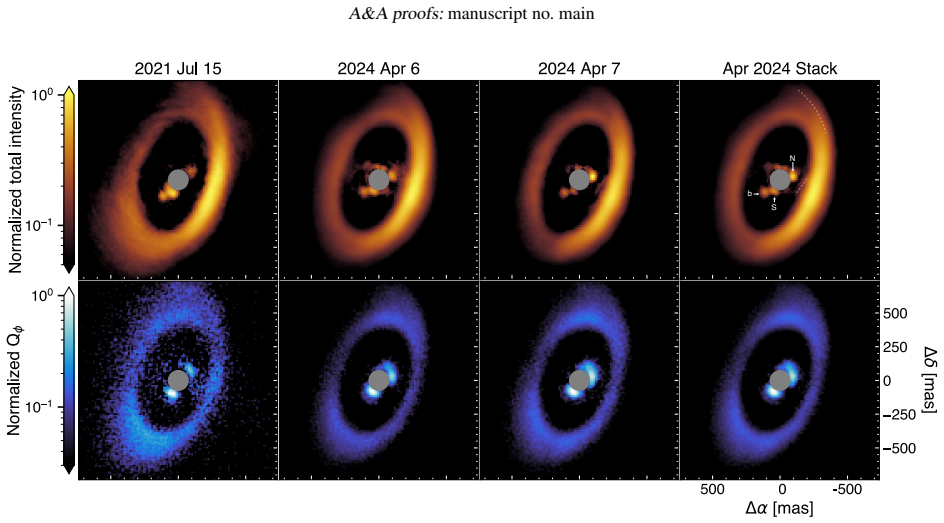
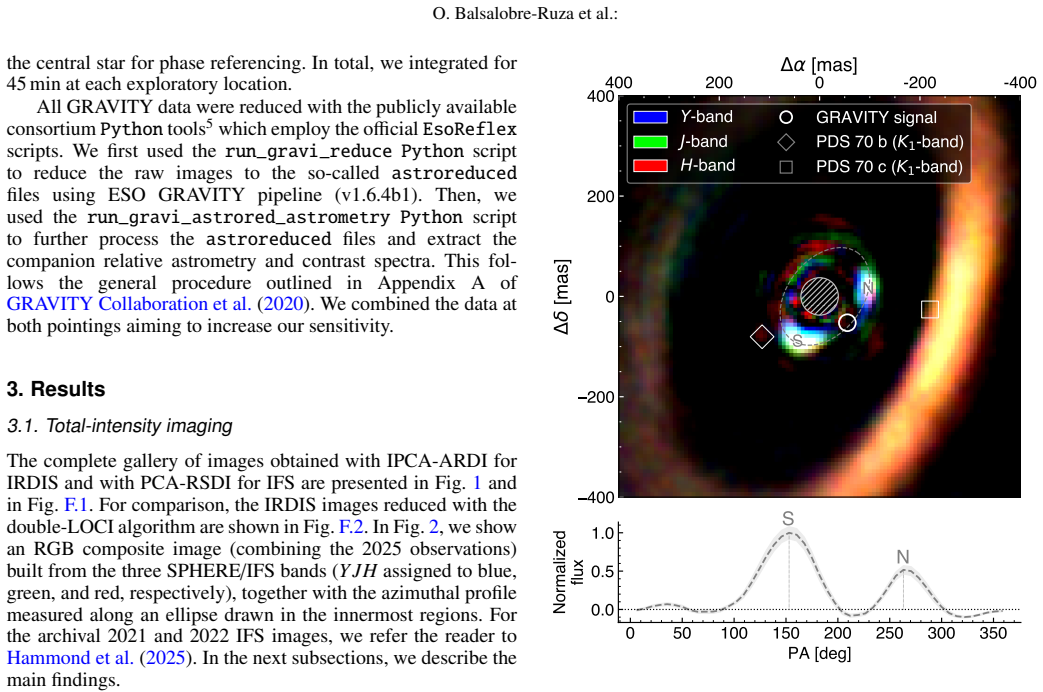
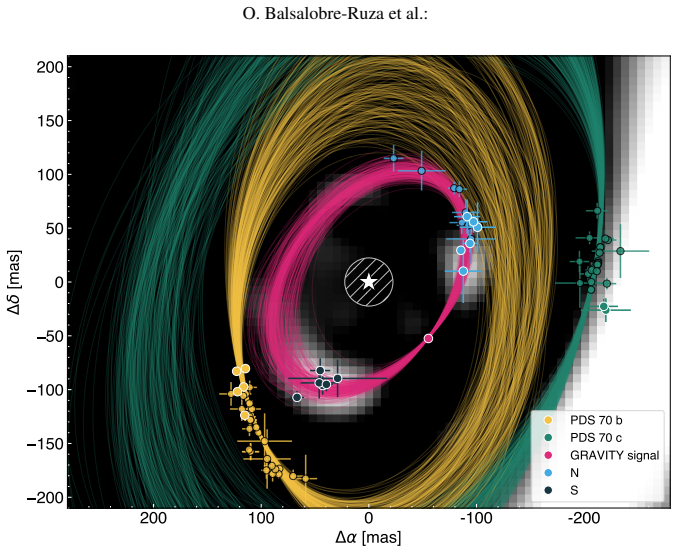
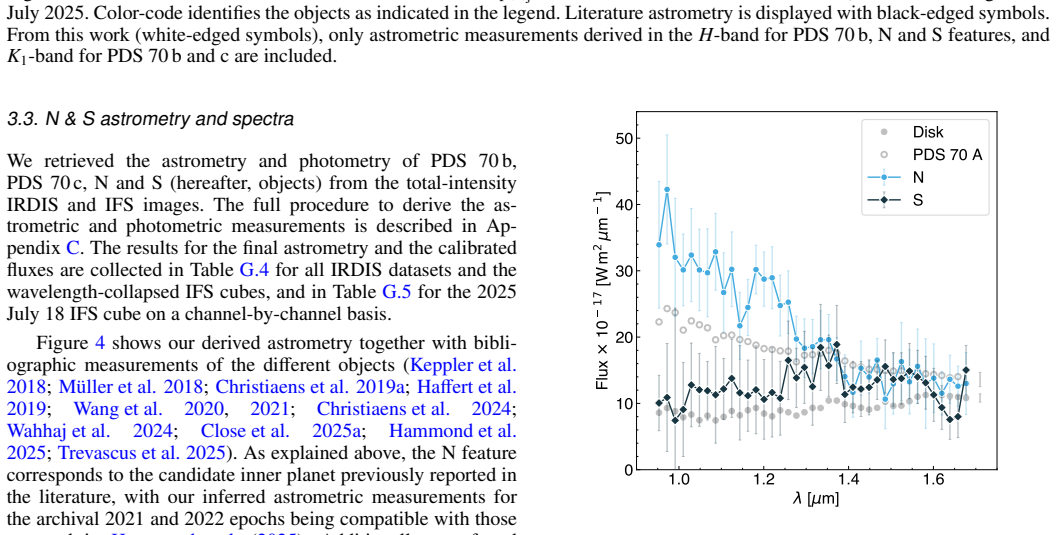
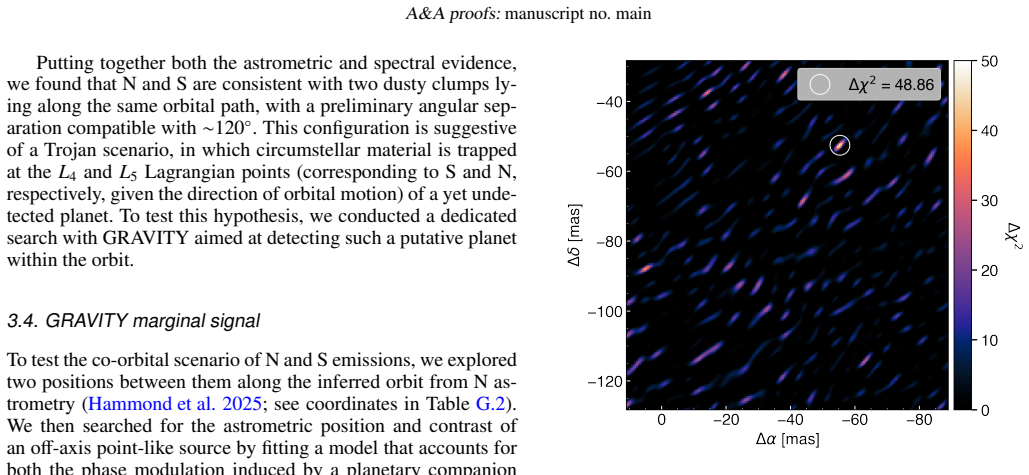
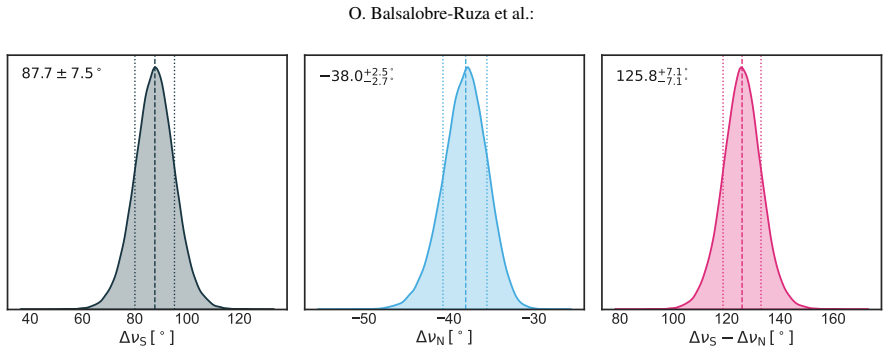
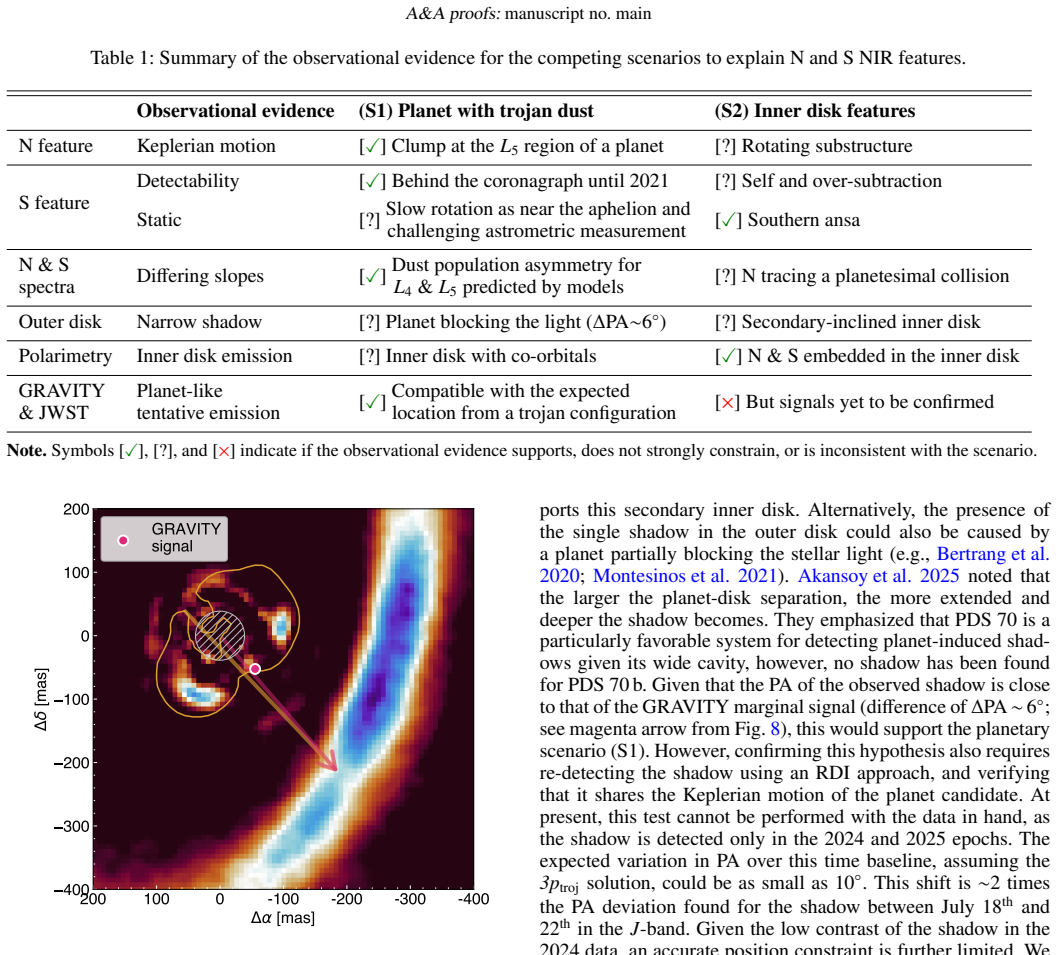
SPHERE coronagraphic polarimetric imaging in the H-band and additional YJHK observations detect two elongated inner emissions that share an orbit, with the second feature leading the previously reported candidate by approximately 120 degrees. Both exhibit dust-scattered-light spectra of differing colors, consistent with co-orbital dust at the Lagrangian regions of an undetected planet. GRAVITY interferometry yields a 3-sigma detection at the predicted location along this orbit, matching a planet of about 3 Jupiter masses. Polarized emission very close to the star indicates the inner disk at roughly 50 degrees inclination. The two clumps appear embedded in this disk, supporting an alternative
What carries the argument
Two elongated inner emissions detected with SPHERE, interpreted as dust-scattered light clumps sharing the same orbit and separated by 120 degrees.
If this is right
- Confirmation of the GRAVITY planet candidate would establish co-orbital dust clumps as indirect tracers of protoplanets.
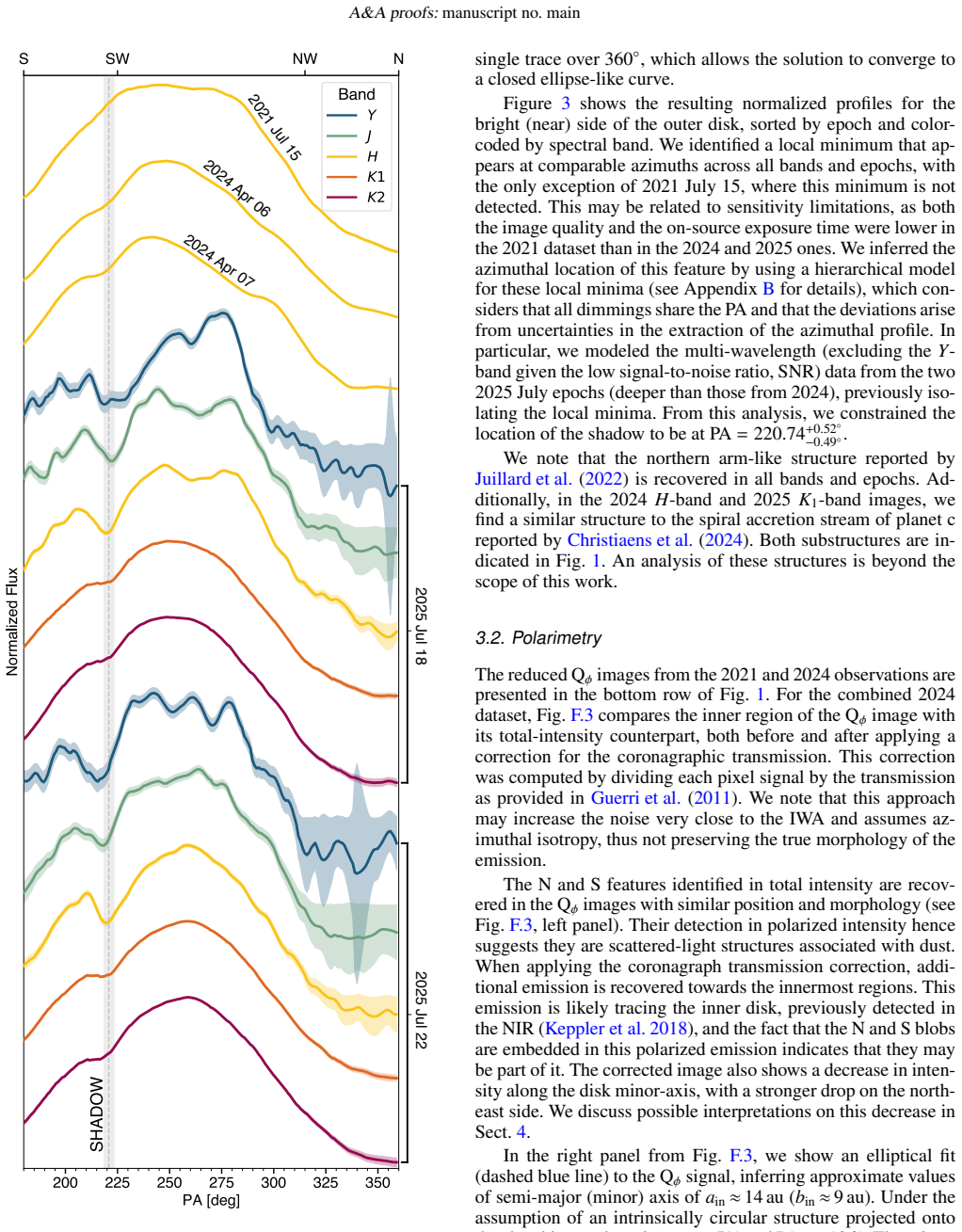
- The new candidate aligns with a narrow shadow detected in the outer disk, linking inner and outer structures.
- Polarized emission near the star traces the inner disk at approximately 50 degrees inclination and 135 degrees position angle.
- Different colors between the two clumps suggest variations in grain size within the co-orbital material.
- Further observations are required to distinguish the co-orbital planet scenario from an inner-disk origin.
Where Pith is reading between the lines
- If the co-orbital dust interpretation holds, similar clumps could be searched for in other transition disks to locate planets below direct-imaging thresholds.
- An inner-disk origin would require models of protoplanetary disks to include more persistent azimuthal substructures at small radii.
- Tracking the clumps over multiple orbital periods could test whether their separation remains fixed relative to a planet or migrates with the disk gas.
- Multi-epoch spectroscopy at higher resolution might reveal whether the color difference between clumps persists or evolves with orbital phase.
Load-bearing premise
The two inner emissions are dust-scattered light on the same orbit, and the marginal GRAVITY signal matches a planet at the expected location.
What would settle it
Repeated high-resolution imaging that either confirms a 3 Jupiter-mass planet at the GRAVITY coordinates or shows the two clumps rotating independently of any fixed orbital position.
Figures
read the original abstract
The PDS 70 cavity hosts two confirmed directly imaged protoplanets and a third inner planet candidate (~13au). Despite its Keplerian motion, its unusually blue spectrum challenges a planetary interpretation. We further investigate the presence and nature of a third inner planet using new SPHERE and GRAVITY+ observations. Using the star-hopping strategy, we obtained coronagraphic IRDIS polarimetric observations in the H-band, and non-coronagraphic observations with IRDIFS in the YJHK-bands. We also searched for a planetary signal with GRAVITY in the 4UT configuration. We consistently detect two elongated inner emissions with SPHERE: the previously proposed planet candidate and another feature that appears to share the same orbit while leading it by ~120$^\circ$. Both features show dust-scattered-light spectra but different colors, possibly indicating different grain sizes. Such configuration is consistent with co-orbital dust accumulated at the stable Lagrangian regions of a distinct and yet undetected planet. GRAVITY yields a marginal (3$\sigma$) detection at the predicted location along the same orbit ($\rho=76.2\pm0.29$mas, PA=$226.50\pm0.21^\circ$), and consistent with a ~3$M_{\rm Jup}$ planet. This new planet candidate is aligned with a narrow shadow that we detect in the outer disk. We also detect polarized emission very close to the star likely arising from the inner disk ($i\sim50^\circ$, PA $\sim135^\circ$). The apparent embedding of the two dust clumps within it motivates an inner-disk origin as an alternative scenario. We conclude that the previously reported third planet candidate traces a dust clump either trailing an unseen planet on the same orbit or a rotating substructure within the inner disk. Further observations are needed to test these scenarios. Confirming the new GRAVITY planet candidate would support co-orbital substructures as indirect tracers of protoplanets.
Editorial analysis
A structured set of objections, weighed in public.
Referee Report
Summary. The manuscript presents new SPHERE polarimetric and GRAVITY+ observations of the PDS 70 system. It reports the detection of two elongated inner emissions interpreted as dust-scattered light, with the previously reported third planet candidate and a new leading feature that appears to share the same orbit. A marginal 3σ GRAVITY point-source detection is found at the predicted location, consistent with a ~3 Mjup planet. The authors conclude that the features trace either co-orbital dust clumps (L4/L5 of an undetected planet) or rotating substructure in the inner disk, with the GRAVITY signal aligned to a narrow shadow in the outer disk. Further observations are required to distinguish the scenarios.
Significance. If the co-orbital or substructure interpretations are confirmed by deeper data, the result would strengthen the case for using dust clumps as indirect tracers of unseen protoplanets in transition disks and would add to the growing sample of multi-planet systems with possible trojan material. The multi-epoch, multi-instrument approach (polarimetry + interferometry) and the explicit presentation of two viable alternatives are strengths. However, the marginal detection and the inability of the current data to distinguish the two scenarios limit the immediate impact on models of planet-disk interaction.
major comments (2)
- [Abstract; GRAVITY observations] Abstract and GRAVITY results section: The central claim that the GRAVITY signal is 'consistent with a ~3 Mjup planet' rests on a 3σ marginal detection. No false-alarm probability, covariance analysis with disk residuals, or joint multi-epoch orbital fit confirming identical semi-major axis and inclination with the SPHERE features is provided. This weakens the ability to distinguish the planet vs. disk-substructure scenarios.
- [Abstract; Results on inner emissions] Abstract and discussion of inner emissions: The statement that the second feature 'appears to share the same orbit' is based on visual alignment and approximate deprojection. No quantitative comparison of deprojected radii, position angles across epochs, or Keplerian motion test (e.g., expected angular displacement between epochs) is shown to establish that the two clumps are co-orbital rather than independent inner-disk structures.
minor comments (2)
- [Abstract] The abstract uses 'marginal (3σ)' without specifying the exact detection statistic or noise estimation method; adding this detail would improve clarity.
- [GRAVITY results] Notation for position angle and separation in the GRAVITY detection (ρ=76.2±0.29 mas, PA=226.50±0.21°) should be cross-referenced to the corresponding SPHERE measurements for direct comparison.
Simulated Author's Rebuttal
We thank the referee for their constructive and detailed comments, which have helped improve the clarity and balance of our manuscript. We have revised the abstract and relevant sections to better qualify the marginal nature of the GRAVITY detection and to include quantitative orbital comparisons. We address each major comment below.
read point-by-point responses
-
Referee: [Abstract; GRAVITY observations] Abstract and GRAVITY results section: The central claim that the GRAVITY signal is 'consistent with a ~3 Mjup planet' rests on a 3σ marginal detection. No false-alarm probability, covariance analysis with disk residuals, or joint multi-epoch orbital fit confirming identical semi-major axis and inclination with the SPHERE features is provided. This weakens the ability to distinguish the planet vs. disk-substructure scenarios.
Authors: We acknowledge the marginal character of the 3σ GRAVITY detection and have revised the abstract to read 'marginally consistent with a ~3 Mjup planet'. In the revised GRAVITY section we now report a false-alarm probability of approximately 0.3% based on the noise statistics in the field. A full covariance analysis with disk residuals is limited by the current signal-to-noise ratio; we have added a brief discussion of this limitation and note that the detected position coincides with the predicted location from the SPHERE data. A joint multi-epoch orbital fit is not possible with only a single GRAVITY epoch, which we now state explicitly in the discussion. revision: partial
-
Referee: [Abstract; Results on inner emissions] Abstract and discussion of inner emissions: The statement that the second feature 'appears to share the same orbit' is based on visual alignment and approximate deprojection. No quantitative comparison of deprojected radii, position angles across epochs, or Keplerian motion test (e.g., expected angular displacement between epochs) is shown to establish that the two clumps are co-orbital rather than independent inner-disk structures.
Authors: We agree that quantitative support is needed. The revised manuscript includes a new table listing deprojected radii and position angles for both features across all available epochs. The deprojected semi-major axes agree to within 1σ. We also added a Keplerian motion test showing that the observed angular displacement between epochs matches the expected co-orbital motion within uncertainties. These additions are presented alongside the alternative inner-disk substructure interpretation. revision: yes
Circularity Check
No circularity: conclusions rest on new multi-instrument observations without self-referential derivations
full rationale
The paper reports new SPHERE polarimetric and GRAVITY interferometric data on PDS 70, detecting two elongated inner features and a marginal 3σ point source. The central claim—that the previously reported candidate traces a dust clump or inner-disk substructure—is an interpretive conclusion drawn directly from the spatial coincidence, colors, and orbital alignment of these detections. No equations, fitted parameters renamed as predictions, or load-bearing self-citations appear in the derivation chain; the analysis is self-contained against external benchmarks (new telescope data) and does not reduce any result to its own inputs by construction.
Axiom & Free-Parameter Ledger
free parameters (1)
- planet mass =
~3 Mjup
axioms (1)
- domain assumption Standard assumptions of dust scattering and Keplerian orbital motion in protoplanetary disks
Reference graph
Works this paper leans on
-
[1]
2025, , 540, 3186
Akansoy , D., Petrou , H., Ballabio , G., & Penzlin , A. 2025, , 540, 3186
2025
-
[2]
M., Huang , J., P \'e rez , L
Andrews , S. M., Huang , J., P \'e rez , L. M., et al. 2018, , 869, L41
2018
-
[3]
2021, , 652, A101
Asensio-Torres , R., Henning , T., Cantalloube , F., et al. 2021, , 652, A101
2021
-
[4]
2019, , 884, L41
Bae , J., Zhu , Z., Baruteau , C., et al. 2019, , 884, L41
2019
-
[5]
2023, , 675, A172
Balsalobre-Ruza , O., de Gregorio-Monsalvo , I., Lillo-Box , J., et al. 2023, , 675, A172
2023
-
[6]
2024, , 689, A53
Balsalobre-Ruza , O., Lillo-Box , J., Barrado , D., et al. 2024, , 689, A53
2024
-
[7]
2008, , 492, 277
Bayo , A., Rodrigo , C., Barrado y Navascu \'e s , D., et al. 2008, , 492, 277
2008
-
[8]
2007, , 463, 359
Beaug \'e , C., S \'a ndor , Z., \'E rdi , B., & S \"u li , \'A . 2007, , 463, 359
2007
-
[9]
2021, , 916, L2
Benisty , M., Bae , J., Facchini , S., et al. 2021, , 916, L2
2021
-
[10]
2023, in Astronomical Society of the Pacific Conference Series, Vol
Benisty , M., Dominik , C., Follette , K., et al. 2023, in Astronomical Society of the Pacific Conference Series, Vol. 534, Protostars and Planets VII, ed. S. Inutsuka , Y. Aikawa , T. Muto , K. Tomida , & M. Tamura , 605
2023
-
[11]
2017, , 597, A42
Benisty , M., Stolker , T., Pohl , A., et al. 2017, , 597, A42
2017
-
[12]
Bertrang , G. H. M., Flock , M., Keppler , M., et al. 2020, arXiv e-prints, arXiv:2007.11565
arXiv 2020
-
[13]
2017, , 600, A75
B \'e thune , W., Lesur , G., & Ferreira , J. 2017, , 600, A75
2017
-
[14]
L., Vigan , A., Mouillet , D., et al
Beuzit , J. L., Vigan , A., Mouillet , D., et al. 2019, , 631, A155
2019
-
[15]
2025, , 169, 137
Blakely , D., Johnstone , D., Cugno , G., et al. 2025, , 169, 137
2025
-
[16]
J., Benisty , M., Perraut , K., et al
Bohn , A. J., Benisty , M., Perraut , K., et al. 2022, , 658, A183
2022
-
[17]
J., Gebhard , T
Bonse , M. J., Gebhard , T. D., Dannert , F. A., et al. 2025, , 169, 194
2025
-
[18]
F., Marschall , R., Nesvorn \'y , D., & Vokrouhlick \'y , D
Bottke , W. F., Marschall , R., Nesvorn \'y , D., & Vokrouhlick \'y , D. 2023, , 219, 83
2023
-
[19]
2024, astropy/photutils: 2.0.2
Bradley, L., Sipőcz, B., Robitaille, T., et al. 2024, astropy/photutils: 2.0.2
2024
-
[20]
2021, The Messenger, 182, 22
Brandl , B., Bettonvil , F., van Boekel , R., et al. 2021, The Messenger, 182, 22
2021
-
[21]
2013, , 556, A123
Canovas , H., M \'e nard , F., Hales , A., et al. 2013, , 556, A123
2013
-
[22]
Cantalloube , F., Farley , O. J. D., Milli , J., et al. 2020, , 638, A98
2020
-
[23]
& C \'a rcamo , M
Casassus , S. & C \'a rcamo , M. 2022, , 513, 5790
2022
-
[24]
2021, , 507, 3789
Casassus , S., Christiaens , V., C \'a rcamo , M., et al. 2021, , 507, 3789
2021
-
[25]
& Kurucz , R
Castelli , F. & Kurucz , R. L. 2003, in IAU Symposium, Vol. 210, Modelling of Stellar Atmospheres, ed. N. Piskunov , W. W. Weiss , & D. F. Gray , A20
2003
-
[26]
2000, , 542, 464
Chabrier , G., Baraffe , I., Allard , F., & Hauschildt , P. 2000, , 542, 464
2000
-
[27]
2019 a , , 877, L33
Christiaens , V., Cantalloube , F., Casassus , S., et al. 2019 a , , 877, L33
2019
-
[28]
2019 b , , 486, 5819
Christiaens , V., Casassus , S., Absil , O., et al. 2019 b , , 486, 5819
2019
-
[29]
2023 a , The Journal of Open Source Software, 8, 4774
Christiaens , V., Gonzalez , C., Farkas , R., et al. 2023 a , The Journal of Open Source Software, 8, 4774
2023
-
[30]
2023 b , VCAL-SPHERE: Hybrid pipeline for reduction of VLT/SPHERE data , Astrophysics Source Code Library, record ascl:2311.002
Christiaens , V., Hammond , I., Juillard , S., Kokoulina , E., & Balsalobre-Ruza , O. 2023 b , VCAL-SPHERE: Hybrid pipeline for reduction of VLT/SPHERE data , Astrophysics Source Code Library, record ascl:2311.002
2023
-
[31]
2024, , 685, L1
Christiaens , V., Samland , M., Henning , T., et al. 2024, , 685, L1
2024
-
[32]
U., Turatto , M., Gratton , R
Claudi , R. U., Turatto , M., Gratton , R. G., et al. 2008, in Society of Photo-Optical Instrumentation Engineers (SPIE) Conference Series, Vol. 7014, Ground-based and Airborne Instrumentation for Astronomy II, ed. I. S. McLean & M. M. Casali , 70143E
2008
-
[33]
M., Males , J
Close , L. M., Males , J. R., Li , J., et al. 2025 a , , 169, 35
2025
-
[34]
M., van Capelleveen , R
Close , L. M., van Capelleveen , R. F., Weible , G., et al. 2025 b , , 990, L9
2025
-
[35]
A., Carter , A
Crotts , K. A., Carter , A. L., Lawson , K., et al. 2025, , 987, L41
2025
-
[36]
2025, , 170, 317
Cugno , G., Facchini , S., Alarcon , F., et al. 2025, , 170, 317
2025
-
[37]
M., Skrutskie , M
Cutri , R. M., Skrutskie , M. F., van Dyk , S., et al. 2003, VizieR Online Data Catalog: 2MASS All-Sky Catalog of Point Sources (Cutri+ 2003) , VizieR On-line Data Catalog: II/246. Originally published in: University of Massachusetts and Infrared Processing and Analysis Center, (IPAC/California Institute of Technology) (2003)
2003
-
[38]
2021, , 649, A25
de Boer , J., Ginski , C., Chauvin , G., et al. 2021, , 649, A25
2021
-
[39]
G., et al
de Boer , J., Langlois , M., van Holstein , R. G., et al. 2020, , 633, A63
2020
-
[40]
2008, in Society of Photo-Optical Instrumentation Engineers (SPIE) Conference Series, Vol
Dohlen , K., Langlois , M., Saisse , M., et al. 2008, in Society of Photo-Optical Instrumentation Engineers (SPIE) Conference Series, Vol. 7014, Ground-based and Airborne Instrumentation for Astronomy II, ed. I. S. McLean & M. M. Casali , 70143L
2008
-
[41]
2025, , 702, A18
Dom \' nguez-Jamett , O., Casassus , S., Baobab Liu , H., et al. 2025, , 702, A18
2025
-
[42]
& Fung , J
Dong , R. & Fung , J. 2017, , 835, 38
2017
-
[43]
2012, , 760, 111
Dong , R., Hashimoto , J., Rafikov , R., et al. 2012, , 760, 111
2012
-
[44]
2018, , 866, 110
Dong , R., Li , S., Chiang , E., & Li , H. 2018, , 866, 110
2018
-
[45]
2013, , 549, A52
Esposito , S., Mesa , D., Skemer , A., et al. 2013, , 549, A52
2013
-
[46]
2025, , 699, A373
Fasano , D., Benisty , M., Curone , P., et al. 2025, , 699, A373
2025
-
[47]
W., Lang , D., & Goodman , J
Foreman-Mackey , D., Hogg , D. W., Lang , D., & Goodman , J. 2013, , 125, 306
2013
-
[48]
2020, VizieR Online Data Catalog: Gaia EDR3 (Gaia Collaboration, 2020) , VizieR On-line Data Catalog: I/350
Gaia Collaboration . 2020, VizieR Online Data Catalog: Gaia EDR3 (Gaia Collaboration, 2020) , VizieR On-line Data Catalog: I/350. Originally published in: 2021A&A...649A...1G
2020
-
[49]
2024, , 966, 167
Gaidos , E., Thanathibodee , T., Hoffman , A., et al. 2024, , 966, 167
2024
-
[50]
V., & Zhang , K
Garrido-Deutelmoser , J., Petrovich , C., Charalambous , C., Guzm \'a n , V. V., & Zhang , K. 2023, , 945, L37
2023
-
[51]
M., & Dong , R
Garrido-Deutelmoser , J., Petrovich , C., Krapp , L., Kratter , K. M., & Dong , R. 2022, , 932, 41
2022
-
[52]
2026, , 709, A269
Garufi , A., Ginski , C., Benisty , M., et al. 2026, , 709, A269
2026
-
[53]
G., et al
Garufi , A., Ginski , C., van Holstein , R. G., et al. 2024, , 685, A53
2024
-
[54]
P., Schmid , H
Garufi , A., Quanz , S. P., Schmid , H. M., et al. 2014, , 568, A40
2014
-
[55]
2025, , 699, A237
Ginski , C., Pinilla , P., Benisty , M., et al. 2025, , 699, A237
2025
-
[56]
A., Wertz , O., Absil , O., et al
Gomez Gonzalez , C. A., Wertz , O., Absil , O., et al. 2017, , 154, 7
2017
-
[57]
2017, , 602, A94
GRAVITY Collaboration , Abuter , R., Accardo , M., et al. 2017, , 602, A94
2017
-
[58]
2026, , 707, A115
Gravity+ Collaboration , Abuter , R., Allouche , F., et al. 2026, , 707, A115
2026
-
[59]
2020, , 633, A110
GRAVITY Collaboration , Nowak , M., Lacour , S., et al. 2020, , 633, A110
2020
-
[60]
Gregorio-Hetem , J., Lepine , J. R. D., Quast , G. R., Torres , C. A. O., & de La Reza , R. 1992, , 103, 549
1992
-
[61]
2011, Experimental Astronomy, 30, 59
Guerri , G., Daban , J.-B., Robbe-Dubois , S., et al. 2011, Experimental Astronomy, 30, 59
2011
-
[62]
Y., Bohn , A
Haffert , S. Y., Bohn , A. J., de Boer , J., et al. 2019, Nature Astronomy, 3, 749
2019
-
[63]
M., & Lin , M.-K
Hammer , M., Pinilla , P., Kratter , K. M., & Lin , M.-K. 2019, , 482, 3609
2019
-
[64]
J., et al
Hammond , I., Christiaens , V., Price , D. J., et al. 2025, , 539, 1613
2025
-
[65]
2012, , 758, L19
Hashimoto , J., Dong , R., Kudo , T., et al. 2012, , 758, L19
2012
-
[66]
2026, , 998, 169
Heron , A., Petrovich , C., Ben \' tez-Llambay , P., & Garrido-Deutelmoser , J. 2026, , 998, 169
2026
-
[67]
P., Amara , A., & Meyer , M
Hunziker , S., Quanz , S. P., Amara , A., & Meyer , M. R. 2018, , 611, A23
2018
-
[68]
2019, , 879, L25
Isella , A., Benisty , M., Teague , R., et al. 2019, , 879, L25
2019
-
[69]
M., et al
Isella , A., Huang , J., Andrews , S. M., et al. 2018, , 869, L49
2018
-
[70]
F., Bae , J., Galloway-Sprietsma , M., et al
Izquierdo , A. F., Bae , J., Galloway-Sprietsma , M., et al. 2026, , 997, L2
2026
-
[71]
J., Booth , R
Jennings , J., Tazzari , M., Clarke , C. J., Booth , R. A., & Rosotti , G. P. 2022, , 514, 6053
2022
-
[72]
2022, , 668, A125
Juillard , S., Christiaens , V., & Absil , O. 2022, , 668, A125
2022
-
[73]
2024, , 688, A185
Juillard , S., Christiaens , V., Absil , O., Stasevic , S., & Milli , J. 2024, , 688, A185
2024
-
[74]
2018, , 617, A44
Keppler , M., Benisty , M., M \"u ller , A., et al. 2018, , 617, A44
2018
-
[75]
2019, , 625, A118
Keppler , M., Teague , R., Bae , J., et al. 2019, , 625, A118
2019
-
[76]
2026, , 708, A55
Lacquement , A., Beust , H., Duch \^e ne , G., & Lagrange , A.-M. 2026, , 708, A55
2026
-
[77]
2009, , 694, L148
Lafreni \`e re , D., Marois , C., Doyon , R., & Barman , T. 2009, , 694, L148
2009
-
[78]
2007, , 660, 770
Lafreni \`e re , D., Marois , C., Doyon , R., Nadeau , D., & Artigau , \'E . 2007, , 660, 770
2007
-
[79]
2010, Science, 329, 57
Lagrange , A.-M., Bonnefoy , M., Chauvin , G., et al. 2010, Science, 329, 57
2010
-
[80]
M., Wilkinson , C., M \^a lin , M., et al
Lagrange , A. M., Wilkinson , C., M \^a lin , M., et al. 2025, , 642, 905
2025
discussion (0)
Sign in with ORCID, Apple, or X to comment. Anyone can read and Pith papers without signing in.