Input Convex Neural Network as a Surrogate in Stability-Constrained Optimization for IBR-dominated Power Systems
Pith reviewed 2026-06-26 00:57 UTC · model grok-4.3
The pith
ICNN stability surrogates in power-system optimization lose their convexity benefits under generic Big-M encodings or reversed inequalities.
A machine-rendered reading of the paper's core claim, the machinery that carries it, and where it could break.
Core claim
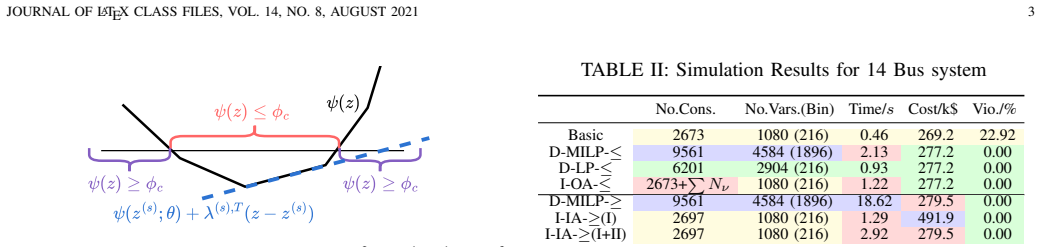
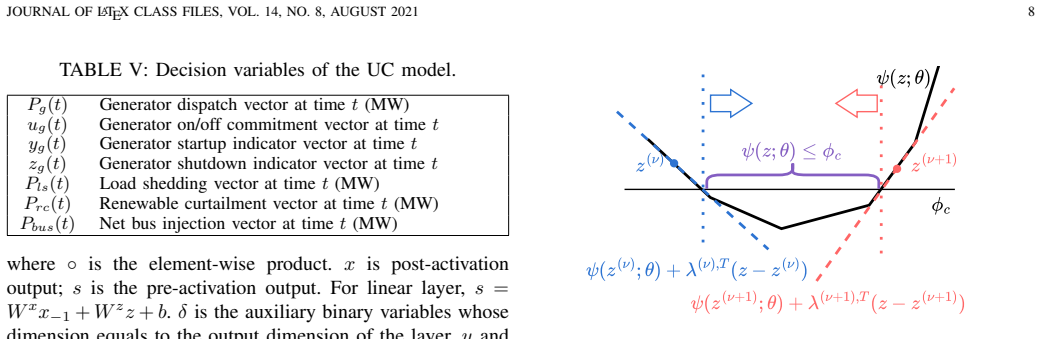
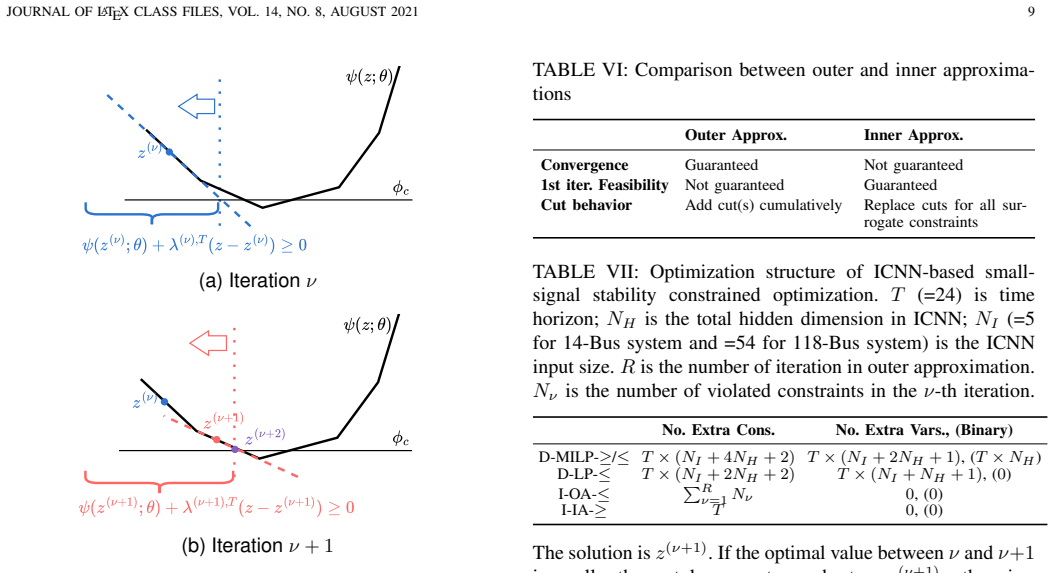
Input convex neural networks can serve as surrogates for stability indices in optimization only when the constraint is kept in sublevel-set form; generic Big-M encodings add superfluous binaries while sign reversal produces nonconvex superlevel sets that break cut-based global convergence. Exact LP-based epigraph reformulations and tailored outer- and inner-approximation schemes restore the lost properties.
What carries the argument
The epigraph reformulation of ReLU-ICNN sublevel constraints into linear inequalities, together with outer-approximation cuts (sublevel) and inner-approximation cuts (superlevel).
If this is right
- Unit commitment problems with stability constraints become solvable by linear programming when the exact epigraph reformulation is used.
- Cut-based methods recover global convergence guarantees only under the sublevel convention.
- The inner-approximation scheme maintains feasibility even when engineering requirements force the superlevel convention.
Where Pith is reading between the lines
- The same LP epigraph approach could be tested on other convex neural surrogates beyond ReLU-ICNNs.
- Numerical experiments on systems larger than 118 buses would show whether the approximation gaps stay small under realistic operating conditions.
- Alternative convex surrogate architectures might sidestep the superlevel nonconvexity issue without needing inner approximations.
Load-bearing premise
The stability index itself must be a convex function of the decision variables under the chosen input encoding.
What would settle it
A concrete instance in which a cut-based solver applied to a superlevel ICNN constraint either fails to converge to the known global optimum or declares infeasibility while a feasible point exists.
Figures
read the original abstract
Input convex neural networks (ICNNs) are increasingly used as surrogates for stability indices and embedded as constraints in power-system optimization. This letter clarifies two recurring formulation limitations that can negate ICNN convexity benefits: (i) applying generic Big-$M$ mixed-integer reformulations introduces auxiliary binaries that are unnecessary for enforcing ICNN sublevel constraints; and (ii) reversing the stability inequality transforms a convex sublevel set into a generally nonconvex superlevel set, invalidating global-convergence guarantees of cut-based methods. After clarifying the limitations, we provide (i) an exact LP-based epigraph reformulation for ReLU-ICNNs, (ii) an outer-approximation scheme with global guarantees under the sublevel convention, and (iii) a feasibility-preserving inner-approximation scheme for the superlevel convention, with simulations on IEEE 14- and 118-bus unit commitment instances.
Editorial analysis
A structured set of objections, weighed in public.
Referee Report
Summary. The paper identifies two common pitfalls when embedding ICNN surrogates for stability indices in power-system optimization: generic Big-M mixed-integer reformulations that introduce unnecessary auxiliary binaries for sublevel constraints, and reversal of the stability inequality that converts a convex sublevel set into a generally nonconvex superlevel set. It supplies an exact LP epigraph reformulation for ReLU-ICNNs, an outer-approximation algorithm with global guarantees under the sublevel convention, a feasibility-preserving inner-approximation for the superlevel case, and numerical results on IEEE 14- and 118-bus unit commitment instances.
Significance. If the reformulations are exact and the global guarantees hold, the work is significant because it directly addresses formulation choices that can erase the convexity benefits of ICNN surrogates in stability-constrained optimization for IBR-dominated grids. Credit is due for the explicit LP epigraph reformulation, the approximation schemes with stated convergence properties, and the simulations on standard test systems.
major comments (2)
- [Abstract] Abstract and reformulation sections: the claim of an 'exact LP-based epigraph reformulation for ReLU-ICNNs' is central to the contribution, yet the manuscript supplies no derivation, proof sketch, or verification that the epigraph remains exact for arbitrary ReLU-ICNN architectures without hidden Big-M terms.
- [Main text] Outer-approximation scheme (global-guarantees paragraph): the global-convergence claim under the sublevel convention requires the underlying stability index (e.g., small-signal margin or critical eigenvalue) to be convex in the decision variables under the chosen input encoding; no argument, reference, or empirical check is provided for this property, which is load-bearing for both the convexity preservation and the outer-approximation guarantees.
minor comments (1)
- [Numerical results] Simulations section: the description of ICNN training data generation, architecture depth/width, and the precise mapping from decision variables to ICNN inputs is too brief for full reproducibility of the IEEE 14- and 118-bus results.
Simulated Author's Rebuttal
Thank you for the constructive review. We address the two major comments point-by-point below, indicating planned revisions where appropriate.
read point-by-point responses
-
Referee: [Abstract] Abstract and reformulation sections: the claim of an 'exact LP-based epigraph reformulation for ReLU-ICNNs' is central to the contribution, yet the manuscript supplies no derivation, proof sketch, or verification that the epigraph remains exact for arbitrary ReLU-ICNN architectures without hidden Big-M terms.
Authors: We agree that an explicit derivation would strengthen the central claim. The LP epigraph is constructed recursively: each ReLU layer output z_l = max(0, W_l z_{l-1} + b_l) is replaced by the pair of linear inequalities z_l >= 0, z_l >= W_l z_{l-1} + b_l, which together define the epigraph of the layer without auxiliary binaries. Because each step preserves convexity and the overall ICNN is a composition of such layers, the final epigraph remains an exact LP representation for any finite depth and width. In the revised manuscript we will insert a short derivation subsection (with a two-layer verification example) immediately after the reformulation statement. revision: yes
-
Referee: [Main text] Outer-approximation scheme (global-guarantees paragraph): the global-convergence claim under the sublevel convention requires the underlying stability index (e.g., small-signal margin or critical eigenvalue) to be convex in the decision variables under the chosen input encoding; no argument, reference, or empirical check is provided for this property, which is load-bearing for both the convexity preservation and the outer-approximation guarantees.
Authors: The global-convergence guarantees of the outer-approximation scheme are stated for the optimization problem that employs the ICNN surrogate under the sublevel convention; they follow from standard cutting-plane theory applied to a convex feasible set defined by the surrogate and do not require the true stability index to be convex. The ICNN itself supplies the convexity by construction, so the algorithm converges to the global optimum of the surrogate-constrained problem regardless of the convexity properties of the underlying physical index. We will revise the global-guarantees paragraph to make this distinction explicit and to note that any mismatch between the true index and its convex surrogate is a modeling choice outside the scope of the algorithmic guarantees. revision: partial
Circularity Check
No significant circularity; derivations rely on standard ICNN and convex-optimization properties
full rationale
The paper identifies two formulation issues with ICNN surrogates in stability-constrained optimization and supplies LP epigraph reformulations plus outer/inner approximation schemes. These rest on known ReLU convexity and mixed-integer epigraph properties rather than any self-referential fit, self-citation chain, or renaming. No equation or claim reduces by construction to a fitted parameter or prior author result; the sublevel-convention guarantees follow directly from the cited convex-analysis facts. The convexity assumption on the underlying stability index is an external modeling choice, not a circular derivation step.
Axiom & Free-Parameter Ledger
axioms (2)
- standard math ReLU-ICNNs define convex functions when the weight matrices satisfy the input-convexity conditions stated in the referenced ICNN literature.
- domain assumption The stability index can be represented as the sublevel set of the ICNN surrogate.
Reference graph
Works this paper leans on
-
[1]
Data-driven security and stability rule in high renewable penetrated power system operation,
N. Zhang, H. Jia, Q. Hou, Z. Zhang, T. Xia, X. Cai, and J. Wang, “Data-driven security and stability rule in high renewable penetrated power system operation,”Proceedings of the IEEE, vol. 111, no. 7, pp. 788–805, 2022
2022
-
[2]
Learning-augmented power system operations: A unified optimization view,
W. Xu, Z. Chu, and F. Teng, “Learning-augmented power system operations: A unified optimization view,” 2026. [Online]. Available: https://arxiv.org/abs/2505.05203
arXiv 2026
-
[3]
Input convex neural networks,
B. Amos, L. Xu, and J. Z. Kolter, “Input convex neural networks,” in International conference on machine learning. PMLR, 2017, pp. 146– 155
2017
-
[4]
Regional frequency-constrained planning for the optimal sizing of power systems via enhanced input convex neural networks,
Y . Wang and G. Strbac, “Regional frequency-constrained planning for the optimal sizing of power systems via enhanced input convex neural networks,”IEEE Transactions on Sustainable Energy, 2025
2025
-
[5]
Transient stability-constrained unit commitment using input convex neural network,
T. Wu and J. Wang, “Transient stability-constrained unit commitment using input convex neural network,”IEEE Transactions on Neural Networks and Learning Systems, 2023
2023
-
[6]
Small signal stability analysis of multi-infeed power electronic systems based on grid strength assessment,
W. Dong, H. Xin, D. Wu, and L. Huang, “Small signal stability analysis of multi-infeed power electronic systems based on grid strength assessment,”IEEE Transactions on Power Systems, vol. 34, no. 2, pp. 1393–1403, 2019
2019
-
[7]
Generalized operational short-circuit ratio for grid strength assessment in power systems with high renewable penetration,
C. Liu, H. Xin, D. Wu, H. Gao, H. Yuan, and Y . Zhou, “Generalized operational short-circuit ratio for grid strength assessment in power systems with high renewable penetration,”IEEE Transactions on Power Systems, 2023
2023
-
[8]
On the incorporation of stability constraints into sequential operational scheduling,
W. Xu, Z. Chu, F. Capitanescu, and F. Teng, “On the incorporation of stability constraints into sequential operational scheduling,” in2025 IEEE Power & Energy Society General Meeting (PESGM), 2025, pp. 1–5
2025
-
[9]
Boyd and L
S. Boyd and L. Vandenberghe,Convex optimization. Cambridge university press, 2004
2004
-
[10]
E. N. Pistikopoulos, M. C. Georgiadis, and V . Dua,Multi-parametric programming: theory, algorithms and applications. Wiley, 2007
2007
-
[11]
A. J. Conejo and L. Baringo,Power system operations. Springer, 2018, vol. 11
2018
-
[12]
Availability adversarial attack and countermeasures for deep learning-based load forecasting,
W. Xu and F. Teng, “Availability adversarial attack and countermeasures for deep learning-based load forecasting,” in2023 IEEE Belgrade PowerTech, 2023, pp. 01–06
2023
-
[13]
On the effectiveness of interval bound propagation for training verifiably robust models,
S. Gowal, K. Dvijotham, R. Stanforth, R. Bunel, C. Qin, J. Uesato, R. Arandjelovic, T. Mann, and P. Kohli, “On the effectiveness of interval bound propagation for training verifiably robust models,”arXiv preprint arXiv:1810.12715, 2018
arXiv 2018
-
[14]
A. J. Conejo, E. Castillo, R. Minguez, and R. Garcia-Bertrand,De- composition techniques in mathematical programming: engineering and science applications. Springer, 2006
2006
-
[15]
Pytorch: An imperative style, high-performance deep learning library,
A. Paszke, S. Gross, F. Massa, A. Lerer, J. Bradbury, G. Chanan, T. Killeen, Z. Lin, N. Gimelshein, L. Antigaet al., “Pytorch: An imperative style, high-performance deep learning library,”Advances in neural information processing systems, vol. 32, 2019
2019
-
[16]
A synthetic texas power system with time-series weather-dependent spatiotemporal profiles,
J. Lu, X. Li, H. Li, T. Chegini, C. Gamarra, Y . E. Yang, M. Cook, and G. Dillingham, “A synthetic texas power system with time-series weather-dependent spatiotemporal profiles,”Sustainable Energy, Grids and Networks, p. 101774, 2025
2025
discussion (0)
Sign in with ORCID, Apple, or X to comment. Anyone can read and Pith papers without signing in.