NeuraDock Visual Cognitive Load Agent Tutorial: A Quality-Gated Open-Source EEG Workflow for Alpha Dynamics and Real-Time Applications
Pith reviewed 2026-06-26 05:30 UTC · model grok-4.3
The pith
An open-source EEG agent supplies a quality-gated workflow that extracts Alpha dynamics for visual cognitive load and exposes them through a real-time API.
A machine-rendered reading of the paper's core claim, the machinery that carries it, and where it could break.
Core claim
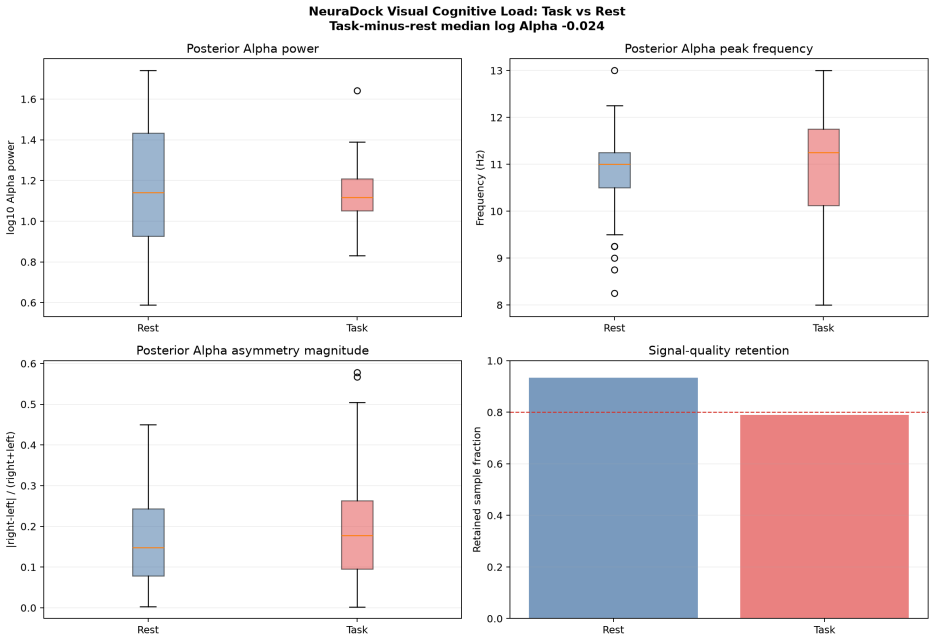
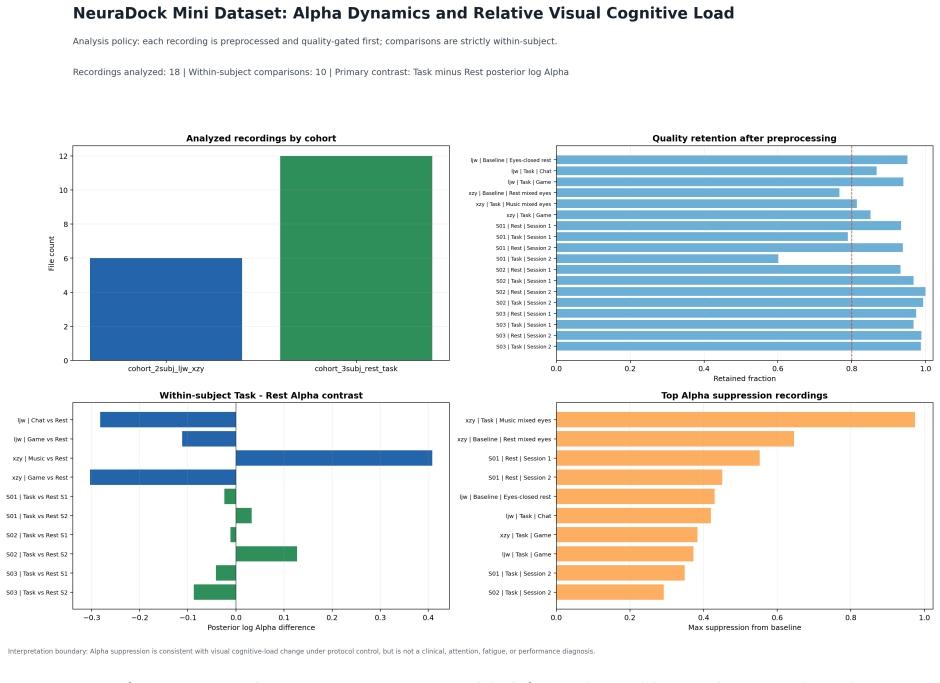
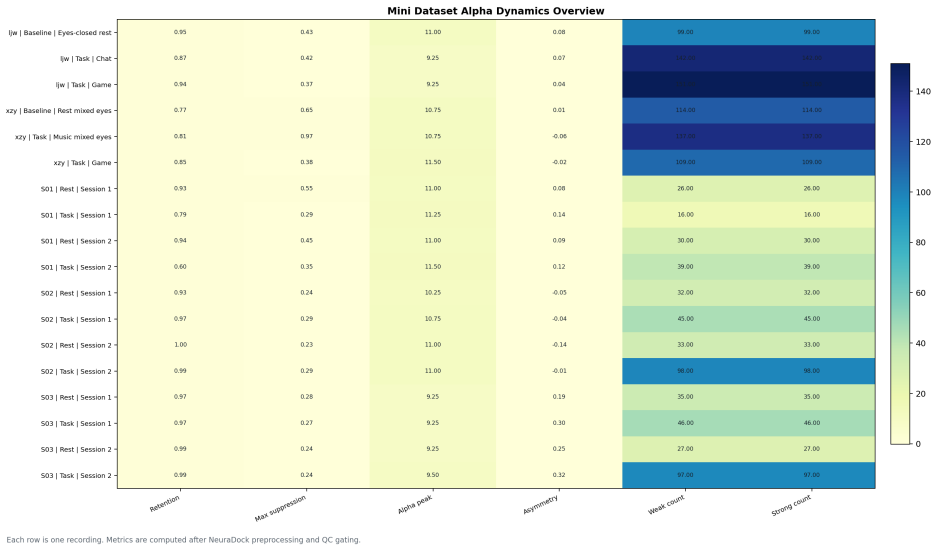
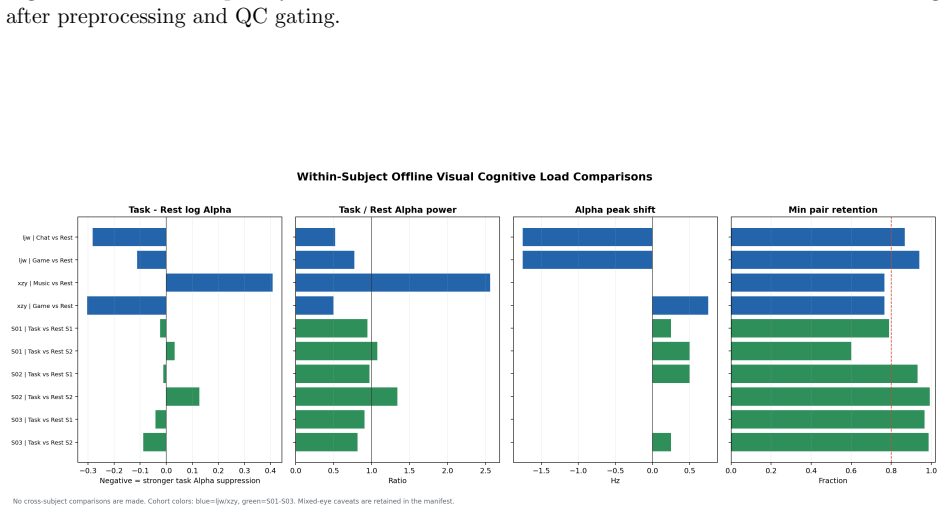
The NeuraDock Agent implements a quality-gated workflow in which downstream Alpha dynamics and visual cognitive-load metrics are computed only after preprocessing and quality-control gating. On the supplied mini-dataset the agent processed 18 recordings, produced 10 within-subject comparisons, observed task-related posterior Alpha suppression in 7 of 10 contrasts, generated initial evidence of within-subject repeatability, and benchmarked local online API latency, thereby demonstrating a complete, reproducible route from raw EEG files to real-time applications.
What carries the argument
The quality-gated workflow that gates all Alpha and workload metrics behind preprocessing and QC rather than computing them directly from raw EEG.
If this is right
- Users following the tutorial can reproduce the mini-dataset result of Alpha suppression in 7 of 10 within-subject contrasts.
- The agent directly supports launching an online dashboard and calling its real-time API from external applications.
- An integrated LLM layer supplies natural-language explanations of quality risks for each processed recording.
- The complete pipeline from installation through QC-gated Alpha extraction is fully documented and executable locally.
Where Pith is reading between the lines
- The same gating structure could be applied to other EEG frequency bands or cognitive tasks without altering the core quality-control step.
- Integration with standard BCI hardware acquisition streams would allow the QC gate to operate continuously rather than on pre-recorded files.
- If within-subject repeatability holds in larger cohorts, the workflow could support longitudinal monitoring of cognitive-load changes in applied settings.
- The open-source release lowers the barrier for teams that previously had to assemble separate preprocessing, QC, and web-API components by hand.
Load-bearing premise
The mini-dataset and the chosen quality-gating rules are representative enough that the observed Alpha suppression rate and repeatability estimates will hold for new recordings collected under the same protocol.
What would settle it
Processing a fresh set of recordings under the identical protocol and finding task-related posterior Alpha suppression in fewer than half of the within-subject contrasts, or markedly higher API latency, would falsify the reported performance.
Figures
read the original abstract
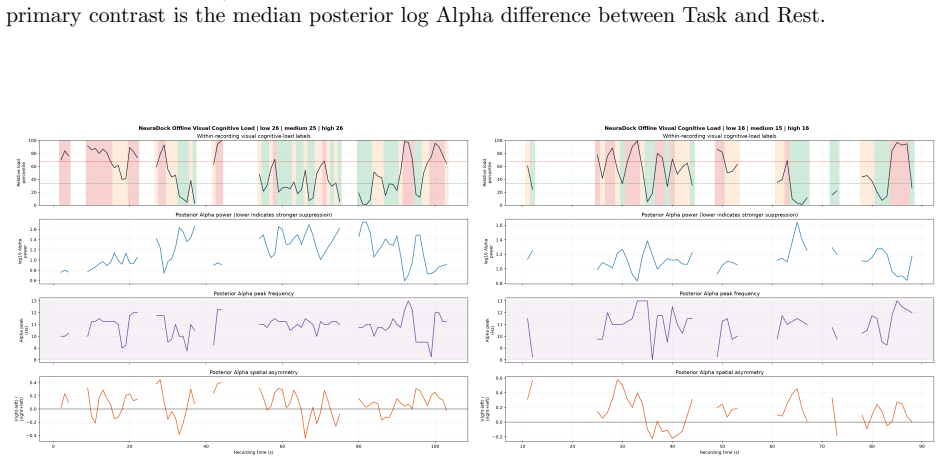
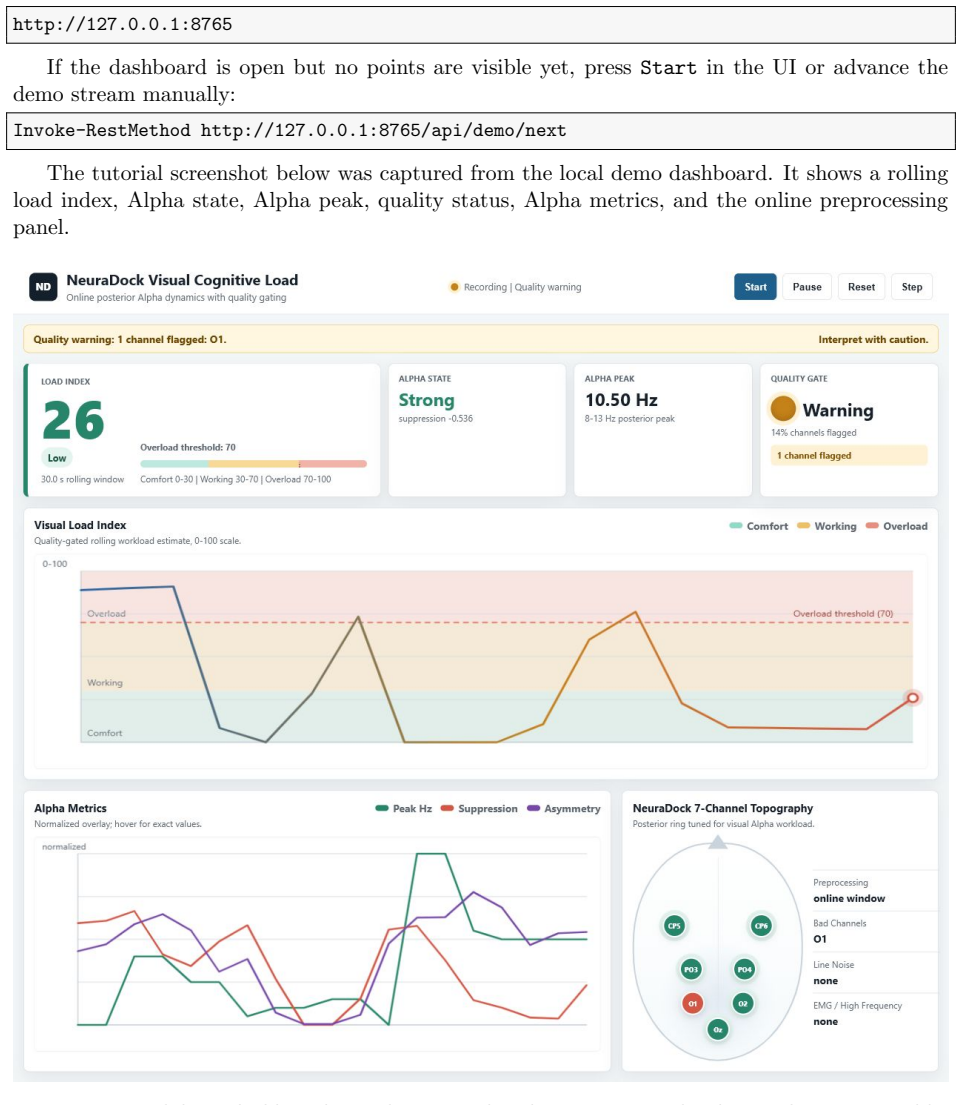
This tutorial paper provides a step-by-step, reproducible walkthrough of NeuraDock Agent, an open-source EEG agent focused on Alpha dynamics and visual cognitive-load analysis. The goal is practical: a reader should be able to install the agent, run EEG preprocessing and quality control, generate Alpha dynamics figures, perform within-subject Rest/Task visual cognitive-load comparison, run the public mini-dataset analyses and compare them with the reference validation summary, start an online dashboard, call the real-time API from an external application, and use the LLM interpretation layer to explain quality risks. Existing EEG toolkits provide excellent offline analysis, but assembling a real-time, quality-gated cognitive-load pipeline often requires manually bridging acquisition, custom QC, Alpha feature extraction, and a web API; this tutorial closes that offline-to-online gap. The tutorial uses a quality-gated workflow: downstream Alpha and workload metrics are computed only after preprocessing and QC gating rather than directly from raw EEG. In the included mini-dataset validation, the agent processed 18 recordings, generated 10 within-subject comparisons, observed task-related posterior Alpha suppression in 7 of 10 contrasts, estimated initial evidence of within-subject repeatability, and benchmarked local online API latency. The tutorial is intended for researchers, developers, and applied teams who want a transparent path from EEG files to real-time visual cognitive-load prototypes.
Editorial analysis
A structured set of objections, weighed in public.
Referee Report
Summary. This tutorial paper presents NeuraDock Agent, an open-source EEG workflow for quality-gated preprocessing, alpha dynamics extraction, within-subject visual cognitive-load comparisons (rest vs. task), and real-time API deployment with an LLM interpretation layer. The central descriptive claim is that on the included mini-dataset the agent processed 18 recordings, produced 10 within-subject contrasts, observed task-related posterior alpha suppression in 7 of 10 cases, provided initial evidence of within-subject repeatability, and benchmarked local API latency.
Significance. If the workflow operates as described, the paper supplies a practical, reproducible bridge between existing offline EEG toolkits and real-time, quality-gated cognitive-load prototypes. The emphasis on gating downstream metrics behind explicit QC steps and the provision of both a dashboard and external API are useful contributions for applied EEG research in cs.AI and human-computer interaction.
minor comments (2)
- The abstract is lengthy and mixes tutorial instructions with validation results; a shorter abstract focused on the workflow and a separate validation paragraph would improve clarity.
- The validation description reports counts (18 recordings, 7/10 suppression) but does not state the precise QC thresholds or the exact definition of 'within-subject repeatability' used; adding these in the methods or results section would aid replication without altering the descriptive nature of the claim.
Simulated Author's Rebuttal
We thank the referee for the positive summary and recommendation of minor revision. No specific major comments were raised in the report.
Circularity Check
No significant circularity detected
full rationale
The paper is a tutorial paper whose central content is a descriptive walkthrough of an open-source workflow and a factual report of outcomes produced by running that workflow on its included mini-dataset (18 recordings processed, 10 within-subject contrasts, posterior alpha suppression observed in 7 of 10). No equations, fitted parameters, predictions, or first-principles derivations are present that could reduce to the authors' own inputs by construction. The reported counts and observations are direct outputs of the described agent applied to the provided data, not derived claims. No self-citation chains, uniqueness theorems, or ansatzes are invoked as load-bearing support for any result. The mini-dataset is external to the tool in the sense that the tutorial simply documents what the agent produced when applied to it.
Axiom & Free-Parameter Ledger
Reference graph
Works this paper leans on
-
[1]
MNE-Python documentation.https://mne.tools/stable/index.html
-
[2]
Frontiers in Neuroscience7(2013) https: //doi.org/10.3389/fnins.2013.00267 24
Gramfort A, Luessi M, Larson E, et al. MEG and EEG data analysis with MNE-Python. Frontiers in Neuroscience. 2013.https://doi.org/10.3389/fnins.2013.00267
-
[3]
BrainFlow documentation.https://brainflow.readthedocs.io/
-
[4]
EEGLAB documentation.https://eeglab.org/
-
[5]
Delorme A, Makeig S. EEGLAB: an open source toolbox for analysis of single-trial EEG dy- namics including independent component analysis.Journal of Neuroscience Methods. 2004. https://doi.org/10.1016/j.jneumeth.2003.10.009
-
[6]
Emotiv Cortex API documentation.https://emotiv.gitbook.io/cortex-api/ 22
-
[7]
Neurosity documentation.https://docs.neurosity.co/
-
[8]
Alpha-band oscillations, attention, and controlled access to stored information
Klimesch W. Alpha-band oscillations, attention, and controlled access to stored information. Trends in Cognitive Sciences. 2012.https://doi.org/10.1016/j.tics.2012.10.007
-
[9]
Jensen O, Mazaheri A. Shaping functional architecture by oscillatory Alpha activity: gating by inhibition.Frontiers in Human Neuroscience. 2010.https://doi.org/10.3389/fnhum.2010. 00186 23
discussion (0)
Sign in with ORCID, Apple, or X to comment. Anyone can read and Pith papers without signing in.