Photon-Assisted Tunneling in Double Quantum Dot: Application of Scattering Theory
Pith reviewed 2026-06-26 03:50 UTC · model grok-4.3
The pith
Scattering theory applied to an oscillating quantum dot level produces resonant tunneling through polariton states at energies offset by integer multiples of the photon energy.
A machine-rendered reading of the paper's core claim, the machinery that carries it, and where it could break.
Core claim
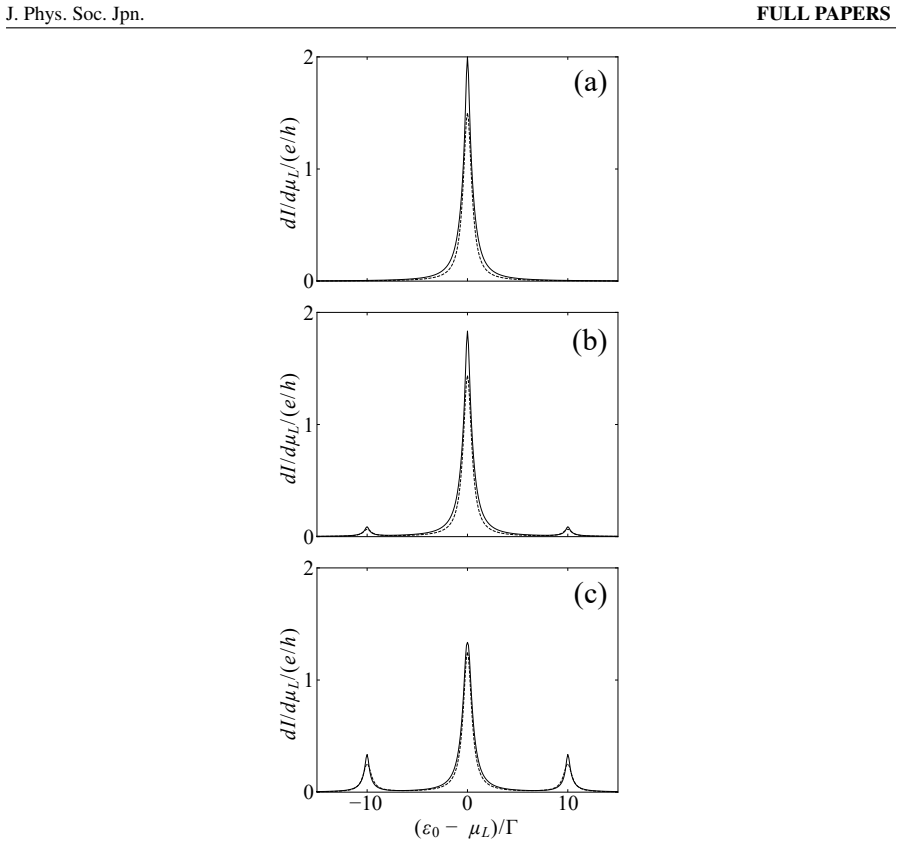
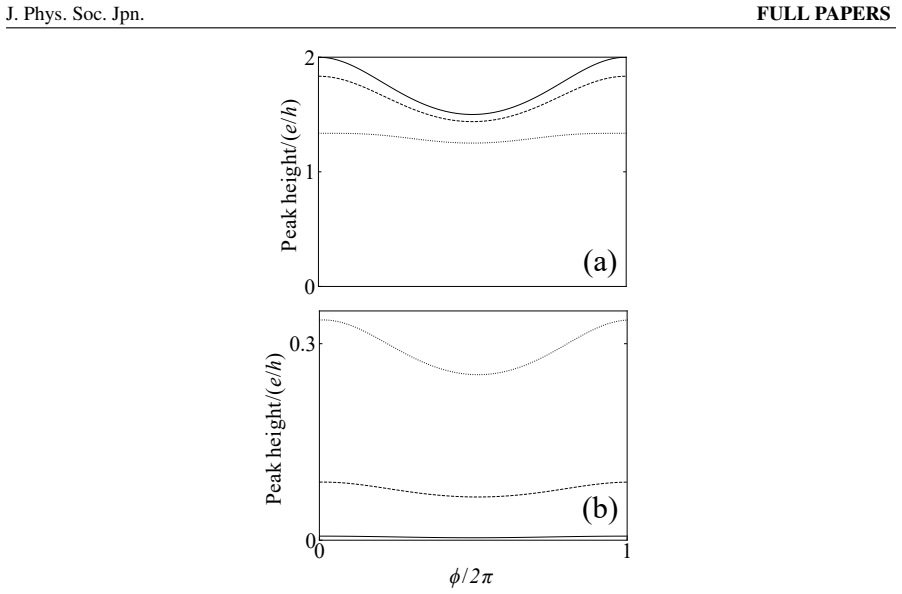
The central claim is that the Aharonov-Bohm effect is observed not only in the main peak (N=0) but also in subpeaks (N ≠ 0), indicating coherent transport through the polariton states.
What carries the argument
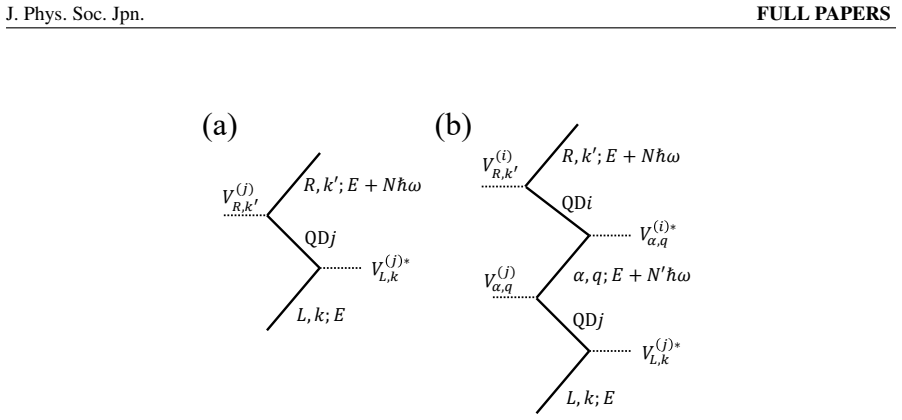
Scattering theory applied to the time-dependent Schrödinger equation for a quantum dot with oscillating level ε(t) = ε0 + eVAC cos ωt, which yields resonant transmission at the polariton energies ε0 + N ħω when Γ ≪ ħω.
If this is right
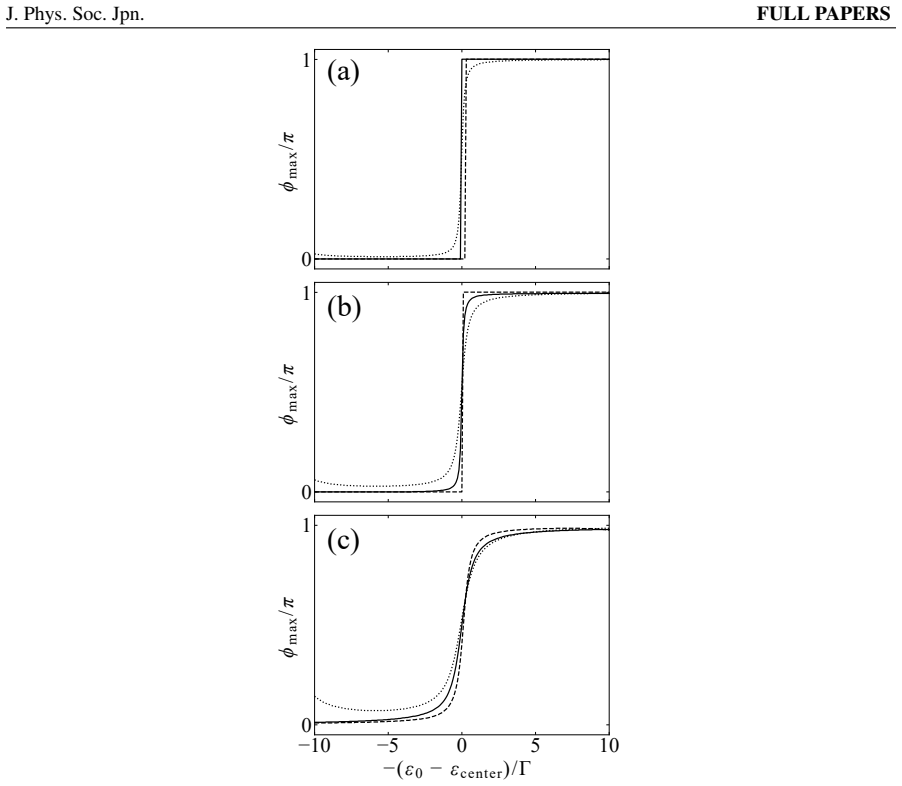
- The phase of the transmission amplitude shifts continuously from 0 to π around every side peak exactly as it does around the main peak.
- The same scattering formulation extends directly to a three-terminal double-dot geometry for phase extraction through the irradiated dot.
- Coherent interference survives the AC drive provided the tunnel rate remains smaller than the drive frequency.
Where Pith is reading between the lines
- If the side-peak interference is confirmed, light could be used to tune the effective path length in mesoscopic interferometers without changing geometry.
- The polariton ladder offers a discrete set of coherent channels whose relative phases could be addressed by changing drive frequency or amplitude.
Load-bearing premise
Scattering theory remains valid for the time-dependent Schrödinger equation when the quantum-dot level oscillates and the tunnel broadening is much smaller than the oscillation frequency.
What would settle it
An experiment that measures conductance versus magnetic flux through the double dot and finds no Aharonov-Bohm oscillations at the photon side peaks (N ≠ 0) would falsify the claim of coherent polariton transport.
Figures
read the original abstract
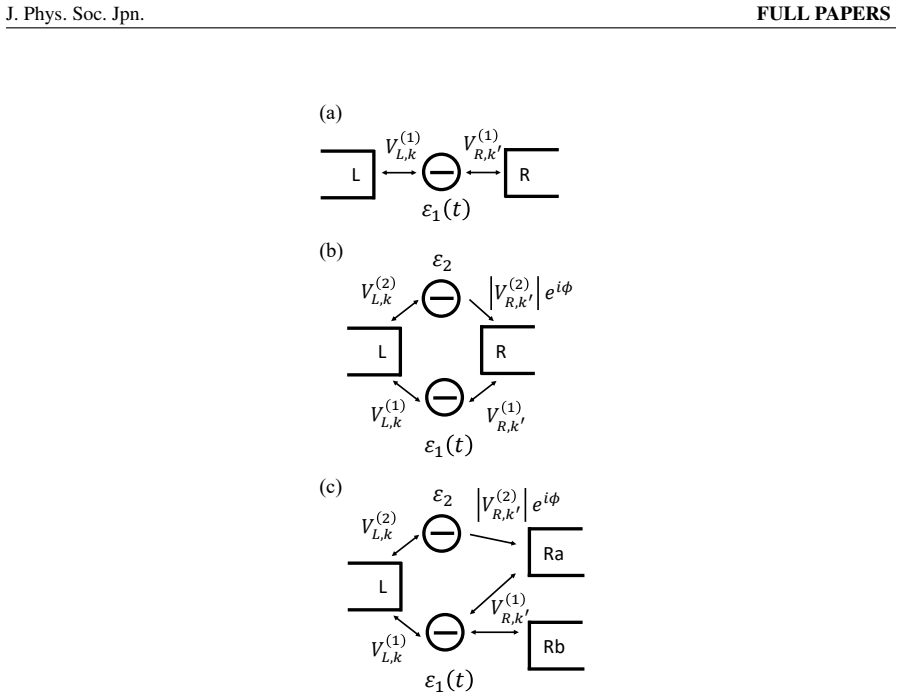
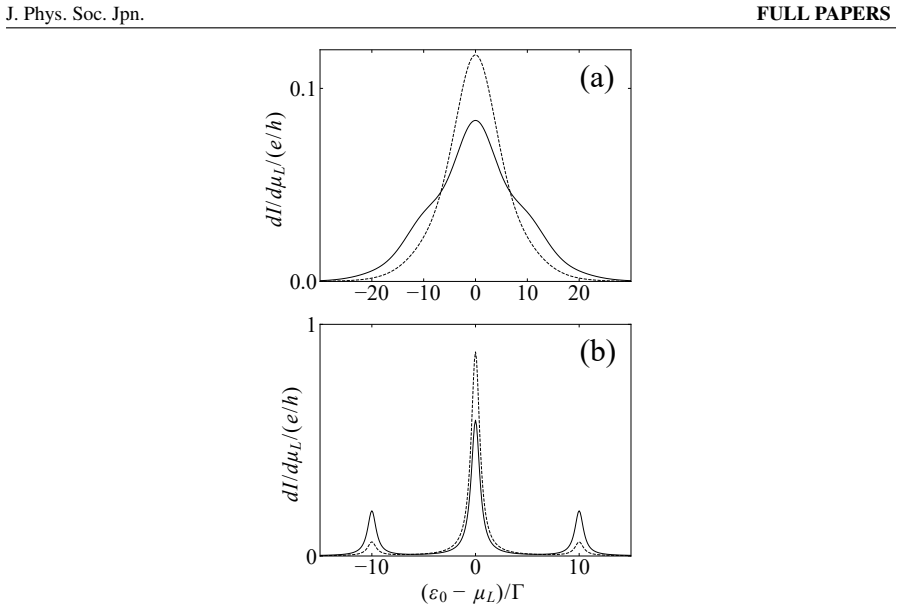
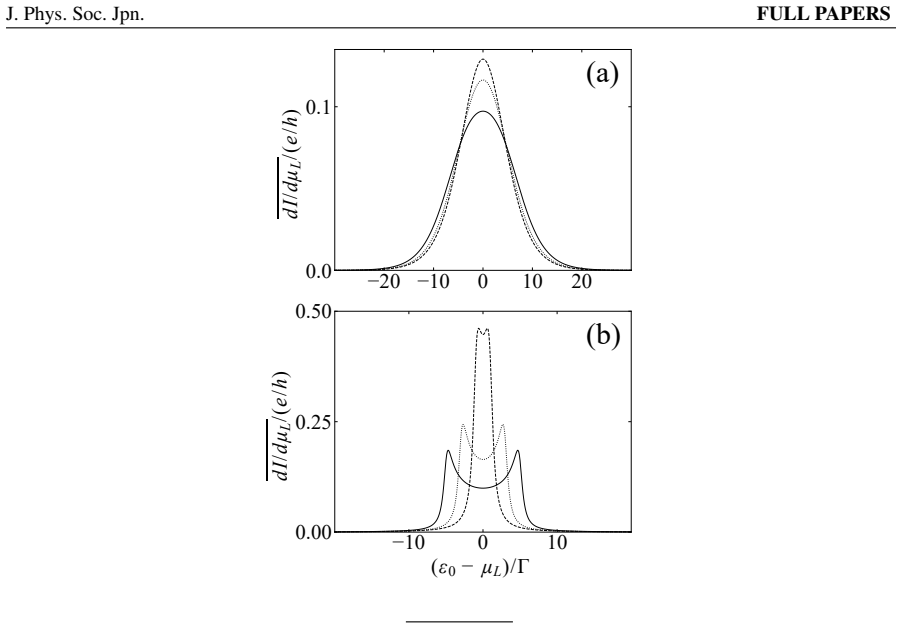
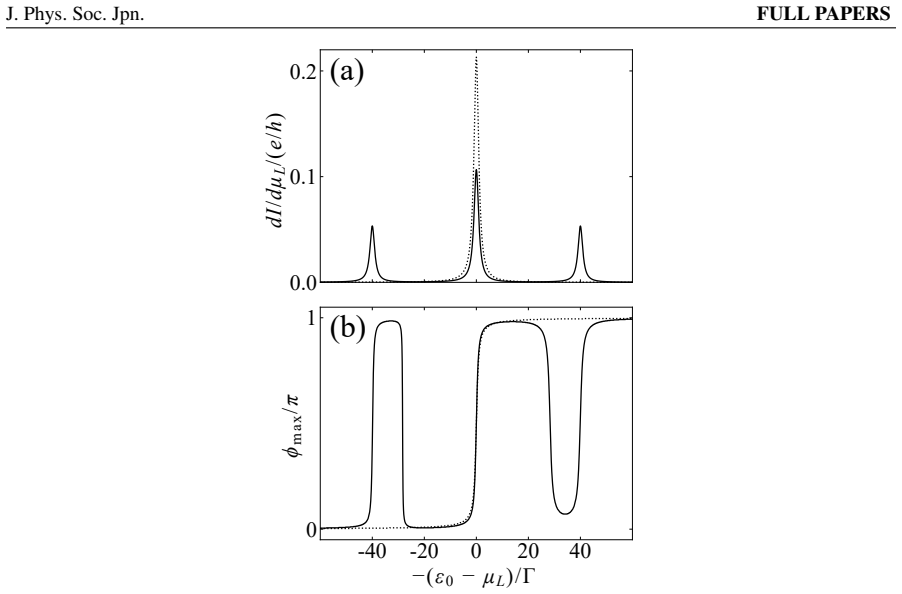
We theoretically examine the photon-assisted tunneling (PAT) in a double quantum dot (DQD) in parallel when one of the quantum dots (QDs) is irradiated by an AC field. First, we formulate the PAT in a single QD by solving the time-dependent Schr\"odinger equation using the scattering theory. The QD has an oscillating energy level, $\varepsilon(t)=\varepsilon_0+eV_{\mathrm{AC}}\cos\omega t$, and is connected to two leads by the tunnel coupling $\Gamma$. We show that the resonant tunneling takes place through energy levels of the polariton, $\varepsilon_0+N\hbar\omega$ ($N=0,\pm 1, \pm 2, \cdots$), when $\Gamma \ll \hbar\omega$ (PAT) and through the energy level $\varepsilon(t)$ when $\Gamma \gg \hbar\omega$ (adiabatic transport). Then, the scattering theory is applied to the PAT in the DQD in the presence of magnetic flux penetrating between the QDs. We observe the Aharonov--Bohm effect not only in the main peak ($N=0$) but also in subpeaks ($N \ne 0$), indicating coherent transport through the polariton states. Our theory is also applicable to the DQD in the three-terminal geometry. We demonstrate the phase measurement through the irradiated QD and show that the measured phase shift changes continuously from 0 to $\pi$ around both the main peak and subpeaks.
Editorial analysis
A structured set of objections, weighed in public.
Referee Report
Summary. The manuscript formulates photon-assisted tunneling (PAT) for a single quantum dot with time-dependent level ε(t)=ε₀ + eV_AC cos(ωt) by solving the time-dependent Schrödinger equation via scattering theory, obtaining resonances at polariton energies ε₀ + Nħω when Γ ≪ ħω. It then applies the same framework to a parallel double quantum dot pierced by magnetic flux, reporting Aharonov-Bohm oscillations in both the N=0 main peak and the N≠0 subpeaks, and extends the approach to three-terminal geometries to extract continuous phase shifts from 0 to π around both main and side peaks.
Significance. If the single-dot construction is valid, the demonstration that AB oscillations persist in the subpeaks would constitute direct evidence of phase-coherent transport through polariton states, a result of interest for driven mesoscopic systems. The three-terminal phase measurement is a concrete experimental implication.
major comments (1)
- [single-QD PAT formulation] Abstract and single-QD PAT section: the scattering-theory solution for the driven dot must be shown to recover the standard Tien-Gordon sideband weights |J_N(eV_AC/ħω)|^2 (or equivalent transmission amplitudes) in the Γ ≪ ħω limit; without this explicit check the subsequent claim that AB oscillations in the N≠0 subpeaks demonstrate coherent polariton transport in the DQD+flux geometry rests on an unverified foundation.
minor comments (2)
- Notation for the tunnel coupling Γ and the AC amplitude should be introduced with explicit units or dimensionless ratios at first use.
- Figure captions for the DQD transmission plots should state the value of Γ/ħω used and whether the curves are for zero temperature.
Simulated Author's Rebuttal
We thank the referee for the careful reading and constructive feedback. We address the single major comment below.
read point-by-point responses
-
Referee: [single-QD PAT formulation] Abstract and single-QD PAT section: the scattering-theory solution for the driven dot must be shown to recover the standard Tien-Gordon sideband weights |J_N(eV_AC/ħω)|^2 (or equivalent transmission amplitudes) in the Γ ≪ ħω limit; without this explicit check the subsequent claim that AB oscillations in the N≠0 subpeaks demonstrate coherent polariton transport in the DQD+flux geometry rests on an unverified foundation.
Authors: We agree that an explicit verification against the Tien-Gordon sideband weights is required to confirm the scattering-theory construction. Although the manuscript derives the resonance condition at polariton energies ε₀ + Nħω, it does not contain a direct comparison of the transmission amplitudes to |J_N(eV_AC/ħω)|^2. In the revised manuscript we will add this check (either in the main text or an appendix) for the single-QD case in the Γ ≪ ħω limit, thereby placing the subsequent DQD results on a firmer foundation. revision: yes
Circularity Check
No circularity: derivation starts from TDSE and applies scattering theory without self-referential reductions.
full rationale
The paper formulates PAT for a single QD by solving the time-dependent Schrödinger equation with scattering theory for an oscillating level ε(t), then extends the same framework to the DQD+AB geometry. No equations reduce to their own inputs by construction, no parameters are fitted to data and relabeled as predictions, and no load-bearing claims rest on self-citations or imported uniqueness theorems. The observation of AB oscillations in N≠0 subpeaks follows directly from the polariton resonance construction under Γ ≪ ħω without circular redefinition. This is the standard case of an independent first-principles derivation.
Axiom & Free-Parameter Ledger
axioms (2)
- domain assumption Scattering theory can be used to solve the time-dependent Schrödinger equation for a quantum dot with oscillating energy level.
- domain assumption The regime distinction based on comparison of tunnel coupling Γ and ħω determines PAT vs adiabatic transport.
Reference graph
Works this paper leans on
-
[1]
A. H. Dayem and R. J. Martin. Quantum Interaction of Microwave Radiation with Tun- neling Between Superconductors.Phys. Rev. Lett., V ol. 8, pp. 246–248, 1962
1962
-
[2]
P. K. Tien and J. P. Gordon. Multiphoton Process Observed in the Interaction of Mi- crowave Fields with the Tunneling between Superconductor Films.Phys. Rev., V ol. 129, pp. 647–651, 1963
1963
-
[3]
Platero and R
G. Platero and R. Aguado. Photon-assisted transport in semiconductor nanostructures. Phys. Rep., V ol. 395, pp. 1–157, 2004
2004
-
[4]
L. P. Kouwenhoven, C. M. Marcus, P. L. McEuen, S. Tarucha, R. M. Westervelt, and N. S. Wingreen, inMesoscopic Electron Transport, ed. L. L. Sohn, L. P. Kouwenhoven, and G. Sch ¨on (Springer, Dordrecht, 1997) NATO Science Series E: Applied Sciences, V ol. 345, p. 105
1997
-
[5]
L. P. Kouwenhoven, S. Jauhar, K. McCormick, D. Dixon, P. L. McEuen, Yu. V . Nazarov, N. C. van der Vaart, and C. T. Foxon. Photon-assisted tunneling through a quantum dot. Phys. Rev. B, V ol. 50, pp. 2019(R)–2022(R), 1994
2019
-
[6]
L. P. Kouwenhoven, S. Jauhar, J. Orenstein, P. L. McEuen, Y . Nagamune, J. Motohisa, and H. Sakaki. Observation of Photon-Assisted Tunneling through a Quantum Dot. Phys. Rev. Lett., V ol. 73, pp. 3443–3446, 1994
1994
-
[7]
R. H. Blick, R. J. Haug, D. W. van der Weide, K. von Klitzing, and K. Eberl. Photon- assisted tunneling through a quantum dot at high microwave frequencies.Appl. Phys. Lett., V ol. 67, pp. 3924–3926, 1995
1995
-
[8]
Fujisawa and S
T. Fujisawa and S. Tarucha. Photon assisted tunnelling in single and coupled quantum dot systems.Superlattices Microstruct., V ol. 21, pp. 247–254, 1997
1997
-
[9]
T. H. Oosterkamp, L. P. Kouwenhoven, A. E. A. Koolen, N. C. van der Vaart, and C. J. P. M. Harmans. Photon Sidebands of the Ground State and First Excited State of a Quantum Dot.Phys. Rev. Lett., V ol. 78, pp. 1536–1539, 1997
1997
-
[10]
T. H. Oosterkamp, T. Fujisawa, W. G. van der Wiel, K. Ishibashi, R. V . Hijman, S. Tarucha, and L. P. Kouwenhoven. Microwave spectroscopy of a quantum-dot molecule.Nature, V ol. 395, pp. 873–876, 1998
1998
-
[11]
Kawano, T
Y . Kawano, T. Fuse, S. Toyokawa, T. Uchida, and K. Ishibashi. Terahertz photon- assisted tunneling in carbon nanotube quantum dots.J. Appl. Phys., V ol. 103, p. 034307, 2008. 24/27 J. Phys. Soc. Jpn.FULL PAPERS
2008
-
[12]
Shibata, A
K. Shibata, A. Umeno, K. M. Cha, and K. Hirakawa. Photon-Assisted Tunneling through Self-Assembled InAs Quantum Dots in the Terahertz Frequency Range.Phys. Rev. Lett., V ol. 109, p. 077401, 2012
2012
-
[13]
Yoshida, K
K. Yoshida, K. Shibata, and K. Hirakawa. Terahertz Field Enhancement and Photon- Assisted Tunneling in Single-Molecule Transistors.Phys. Rev. Lett., V ol. 115, p. 138302, 2015
2015
-
[14]
L. J. Geerligs, V . F. Anderegg, P. A. M. Holweg, J. E. Mooij, H. Pothier, D. Esteve, C. Urbina, and M. H. Devoret. Frequency-locked turnstile device for single electrons. Phys. Rev. Lett., V ol. 64, pp. 2691–2694, 1990
1990
-
[15]
L. P. Kouwenhoven, A. T. Johnson, N. C. van der Vaart, C. J. P. M. Harmans, and C. T. Foxon. Quantized current in a quantum-dot turnstile using oscillating tunnel barriers. Phys. Rev. Lett., V ol. 67, pp. 1626–1629, 1991
1991
-
[16]
J. P. Pekola, O.-P. Saira, V . F. Maisi, A. Kemppinen, M. M¨ott¨onen, Y . A. Pashkin, and D. V . Averin. Single-electron current sources: Toward a refined definition of the ampere. Rev. Mod. Phys., V ol. 85, pp. 1421–1472, 2013
2013
-
[17]
Kaestner and V
B. Kaestner and V . Kashcheyevs. Non-adiabatic quantized charge pumping with tunable-barrier quantum dots: a review of current progress.Rep. Prog. Phys., V ol. 78, No. 10, p. 103901, 2015
2015
-
[18]
Zhang, K
Y . Zhang, K. Shibata, N. Nagai, C. Ndebeka-Bandou, G. Bastard, and K. Hirakawa. Terahertz Intersublevel Transitions in Single Self-Assembled InAs Quantum Dots with Variable Electron Numbers.Nano Lett., V ol. 15, pp. 1166–1170, 2015
2015
-
[19]
Walther, B
H. Walther, B. T. H. Varcoe, B.-G. Englert, and T. Becker. Cavity quantum electrody- namics.Rep. Prog. Phys., V ol. 69, p. 1325, 2006
2006
-
[20]
Reiserer and G
A. Reiserer and G. Rempe. Cavity-based quantum networks with single atoms and optical photons.Rev. Mod. Phys., V ol. 87, pp. 1379–1418, 2015
2015
-
[21]
A. C. Hewson.The Kondo Problem to Heavy Fermions. Cambridge Studies in Mag- netism. Cambridge University Press, Cambridge, U.K., 1993
1993
-
[22]
J. J. Sakurai and J. Napolitano.Modern Quantum Mechanics. Cambridge University Press, Cambridge, U.K., 2021
2021
-
[23]
Jauho, N
A.-P. Jauho, N. S. Wingreen, and Y . Meir. Time-dependent transport in interacting and noninteracting resonant-tunneling systems.Phys. Rev. B, V ol. 50, pp. 5528–5544, 1994. 25/27 J. Phys. Soc. Jpn.FULL PAPERS
1994
-
[24]
Kohler, J
S. Kohler, J. Lehmann, and P. H¨anggi. Driven quantum transport on the nanoscale.Phys. Rep., V ol. 406, pp. 379–443, 2005
2005
-
[25]
A. W. Holleitner, C. R. Decker, H. Qin, K. Eberl, and R. H. Blick. Coherent Coupling of Two Quantum Dots Embedded in an Aharonov-Bohm Interferometer.Phys. Rev. Lett., V ol. 87, p. 256802, 2001
2001
-
[26]
Hatano, M
T. Hatano, M. Stopa, W. Izumida, T. Yamaguchi, T. Ota, and S. Tarucha. Gate-voltage dependence of inter dot coupling and Aharanov–Bohm oscillation in laterally coupled vertical double dot.Physica E, V ol. 22, pp. 534–537, 2004
2004
-
[27]
Kubala and J
B. Kubala and J. K ¨onig. Flux-dependent level attraction in double-dot Aharonov-Bohm interferometers.Phys. Rev. B, V ol. 65, p. 245301, 2002
2002
-
[28]
Bai, M.-F
Z.-M. Bai, M.-F. Yang, and Y .-C. Chen. Effect of inhomogeneous magnetic flux on double-dot Aharonov–Bohm interferometer.J. Phys.: Condens. Matter, V ol. 16, No. 12, p. 2053, 2004
2053
-
[29]
H. Lu, R. Lu, and B. Zhu. Fano effect through parallel-coupled double Coulomb islands. J. Phys.: Condens. Matter, V ol. 18, No. 39, p. 8961, 2006
2006
-
[30]
Tokura, H
Y . Tokura, H. Nakano, and T. Kubo. Interference through quantum dots.New J. Phys., V ol. 9, p. 113, 2007
2007
-
[31]
F. Li, H. J. Jiao, H. Wang, J. Y . Luo, and X.-Q. Li. Coulomb blockade double-dot Aharonov–Bohm interferometer: Harmonic decomposition of the interference pattern. Physica E, V ol. 41, pp. 521–524, 2009
2009
-
[32]
H ¨artle, G
R. H ¨artle, G. Cohen, D. R. Reichman, and A. J. Millis. Decoherence and lead-induced interdot coupling in nonequilibrium electron transport through interacting quantum dots: A hierarchical quantum master equation approach.Phys. Rev. B, V ol. 88, p. 235426, 2013
2013
-
[33]
Zhang, R
Y . Zhang, R. Sakano, and M. Eto. Kondo Effect and Phase Measurement in Double Quantum Dot in Parallel.J. Phys. Soc. Jpn., V ol. 91, No. 1, p. 014703, 2022
2022
-
[34]
Yacoby, M
A. Yacoby, M. Heiblum, D. Mahalu, and H. Shtrikman. Coherence and Phase Sensitive Measurements in a Quantum Dot.Phys. Rev. Lett., V ol. 74, pp. 4047–4050, 1995
1995
-
[35]
Schuster, E
R. Schuster, E. Buks, M. Heiblum, D. Mahalu, V . Umansky, and H. Shtrikman. Phase measurement in a quantum dot via a double-slit interference experiment.Nature, V ol. 385, pp. 417–420, 1997. 26/27 J. Phys. Soc. Jpn.FULL PAPERS
1997
-
[36]
W. G. van der Wiel, S. De Franceschi, T. Fujisawa, J. M. Elzerman, S. Tarucha, and L. P. Kouwenhoven. The Kondo Effect in the Unitary Limit.Science, V ol. 289, pp. 2105–2108, 2000
2000
-
[37]
Y . Ji, M. Heiblum, D. Sprinzak, D. Mahalu, and H. Shtrikman. Phase Evolution in a Kondo-Correlated System.Science, V ol. 290, pp. 779–783, 2000
2000
-
[38]
Takada, C
S. Takada, C. B ¨auerle, M. Yamamoto, K. Watanabe, S. Hermelin, T. Meunier, A. Alex, A. Weichselbaum, J. von Delft, A. Ludwig, A. D. Wieck, and S. Tarucha. Transmission Phase in the Kondo Regime Revealed in a Two-Path Interferometer.Phys. Rev. Lett., V ol. 113, p. 126601, 2014
2014
-
[39]
Avinun-Kalish, M
M. Avinun-Kalish, M. Heiblum, O. Zarchin, D. Mahalu, and V . Umansky. Crossover from ‘mesoscopic’ to ‘universal’ phase for electron transmission in quantum dots.Na- ture, V ol. 436, pp. 529–533, 2005
2005
-
[40]
Karrasch, T
C. Karrasch, T. Hecht, A. Weichselbaum, Y . Oreg, J. von Delft, and V . Meden. Meso- scopic to Universal Crossover of the Transmission Phase of Multilevel Quantum Dots. Phys. Rev. Lett., V ol. 98, p. 186802, 2007
2007
-
[41]
G. Floquet. Sur les ´equations diff´erentielles lin ´eaires `a coefficients p´eriodiques.Ann. Sci. Ec. Norm. Super ., V ol. 12, pp. 47–88, 1883
-
[42]
L. H. Eliasson. Floquet solutions for the 1-dimensional quasi-periodic Schr¨odinger equa- tion.Commun. Math. Phys., V ol. 146, pp. 447–482, 1992
1992
-
[43]
Ishizuka and N
H. Ishizuka and N. Nagaosa. Local photo-excitation of shift current in noncentrosym- metric systems.New J. Phys., V ol. 19, p. 033015, 2017
2017
-
[44]
T. Kubo, Y . Tokura, T. Hatano, and S. Tarucha. Electron transport through Aharonov- Bohm interferometer with laterally coupled double quantum dots.Phys. Rev. B, V ol. 74, p. 205310, 2006
2006
-
[45]
Eto and R
M. Eto and R. Sakano. Fano-Kondo resonance versus Kondo plateau in an Aharonov- Bohm ring with an embedded quantum dot.Phys. Rev. B, V ol. 102, p. 245402, 2020
2020
-
[46]
8(a) withε 2 −µ L =70Γ,ϕ max changes abruptly (gradually) around a subpeak at ε0 −µ L =−ℏω(ℏω)
In Fig. 8(a) withε 2 −µ L =70Γ,ϕ max changes abruptly (gradually) around a subpeak at ε0 −µ L =−ℏω(ℏω). If we chooseε 2 −µ L =−70Γ,ϕ max changes abruptly (gradually) around a subpeak atε 0 −µ L =ℏω(−ℏω). 27/27
discussion (0)
Sign in with ORCID, Apple, or X to comment. Anyone can read and Pith papers without signing in.