Reviving Reflection-in-Action: Instilling Designerly Thinking in AI-Supported Ideation through Multimodal Prompting
Pith reviewed 2026-06-26 03:43 UTC · model grok-4.3
The pith
Sketch input to AI design tools tends to increase the number of ideas generated compared with text input alone.
A machine-rendered reading of the paper's core claim, the machinery that carries it, and where it could break.
Core claim
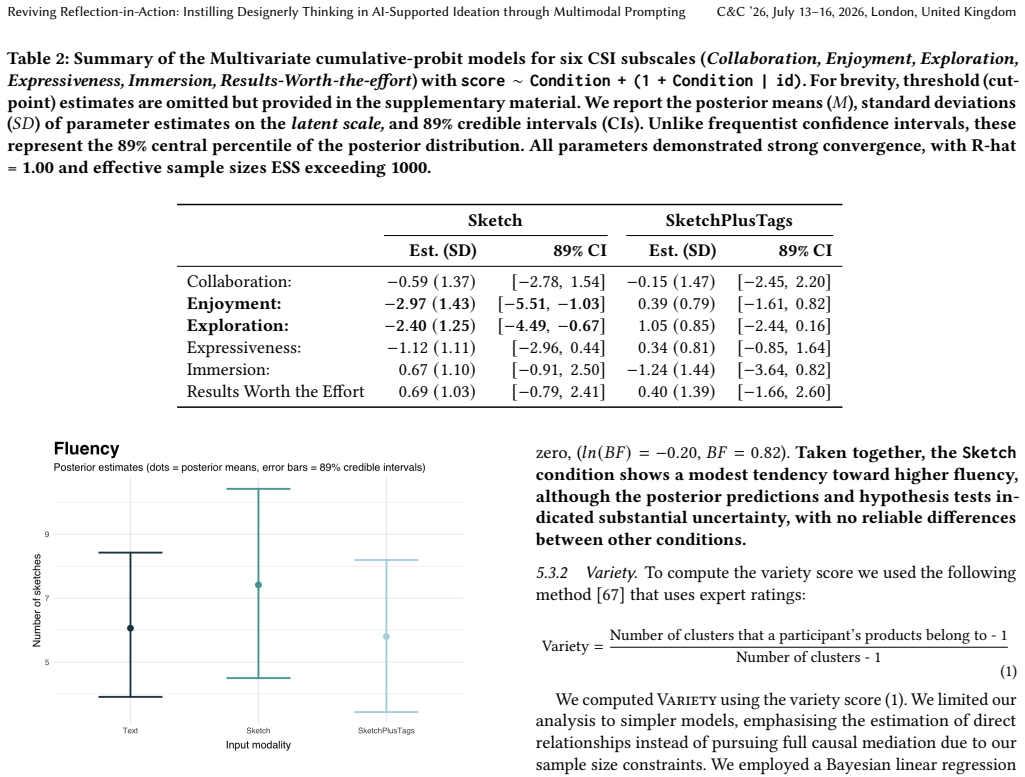
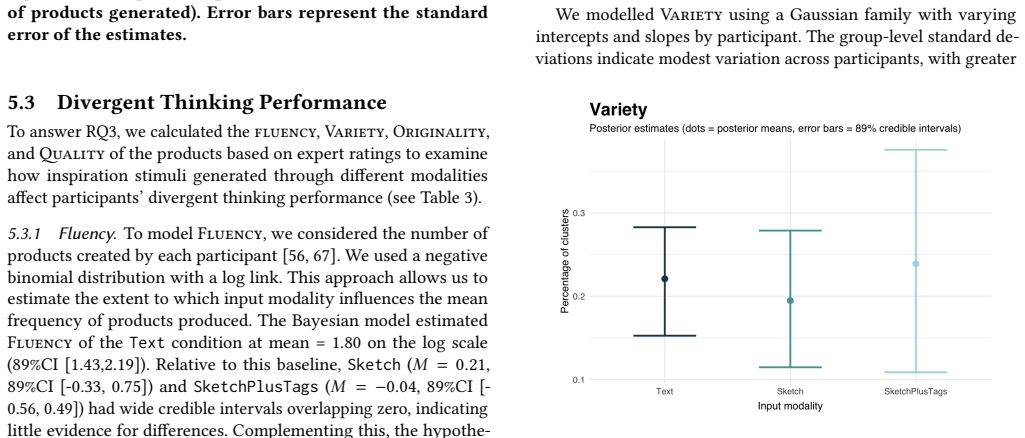
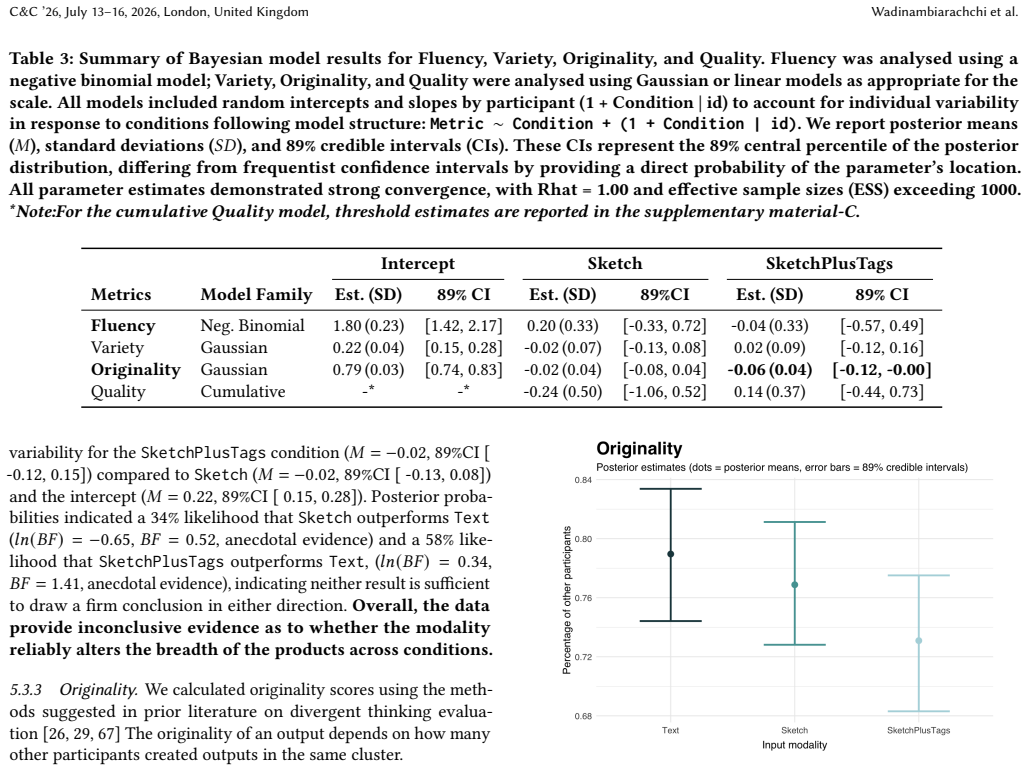
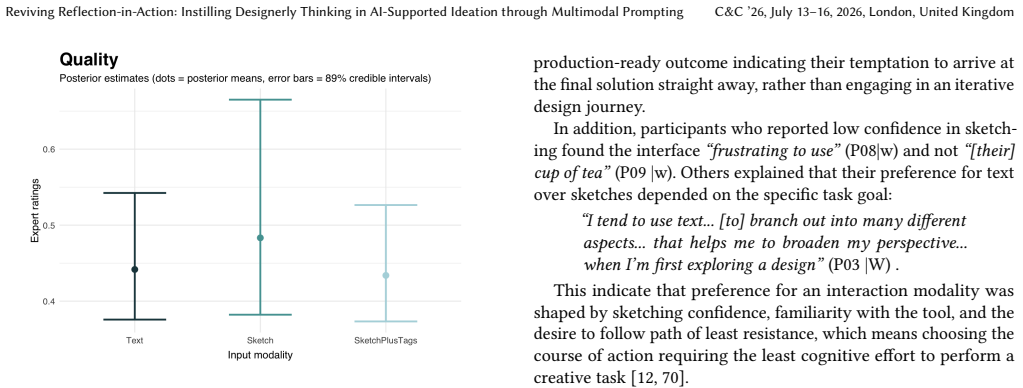
By comparing text, sketch, and sketch-plus-tags input in the SketchifAI prototype, the study shows that the sketch modality tended to enhance fluency in divergent thinking tasks while evidence for effects on variety, originality, or quality remained inconclusive; at the same time participants strongly preferred text prompting, leading the authors to propose that AI tools can be deliberately designed to revive reflection-through-sketching and thereby sustain essential designerly thinking skills.
What carries the argument
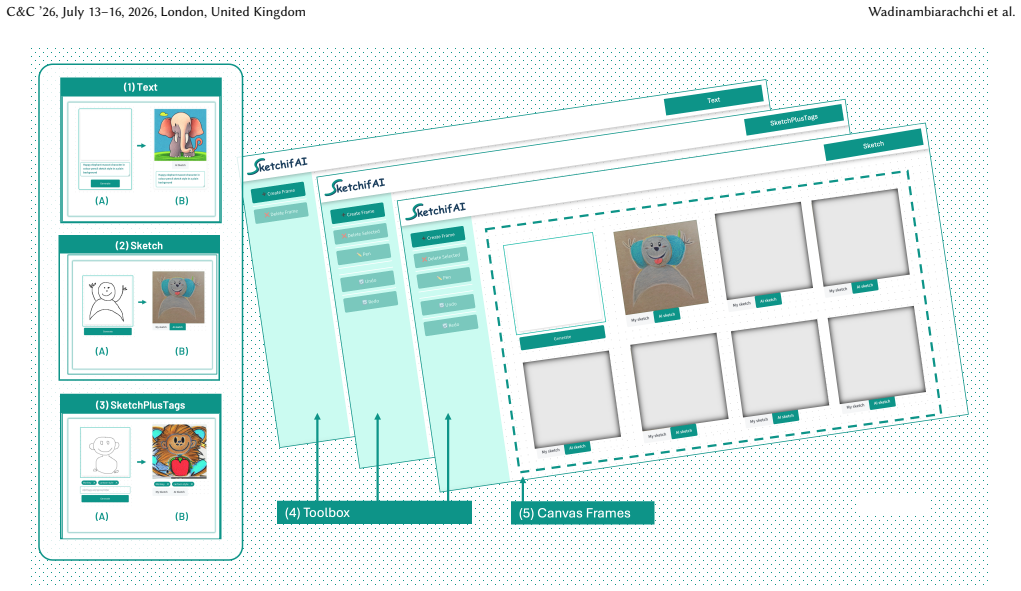
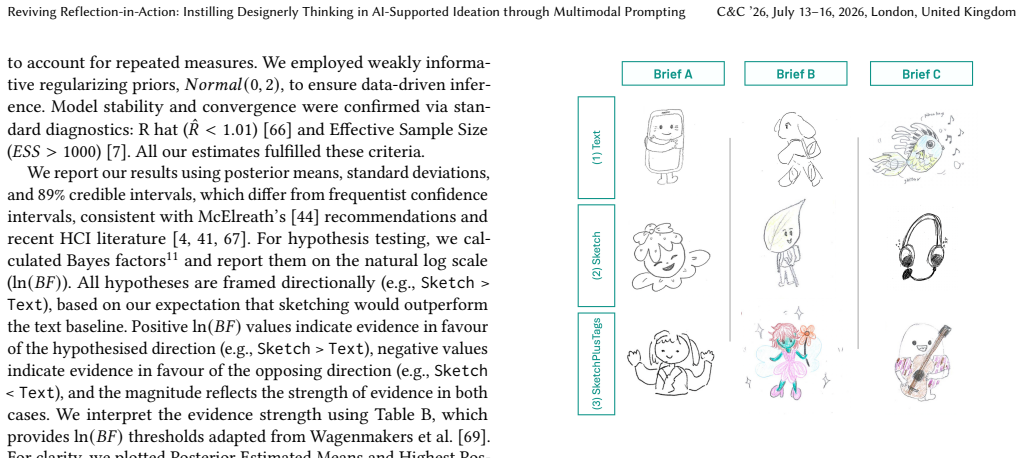
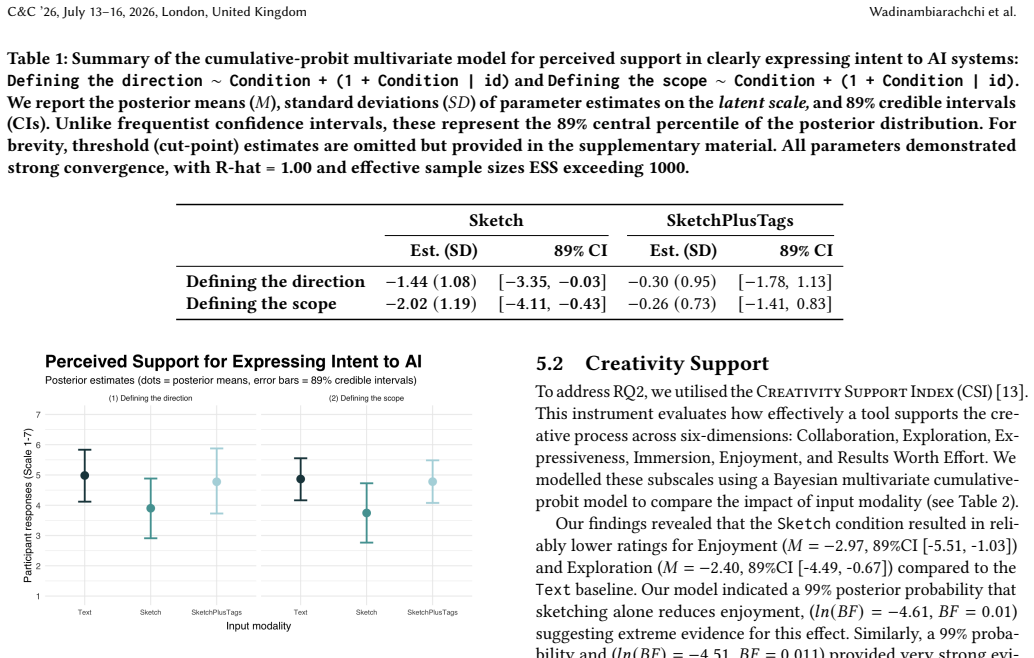
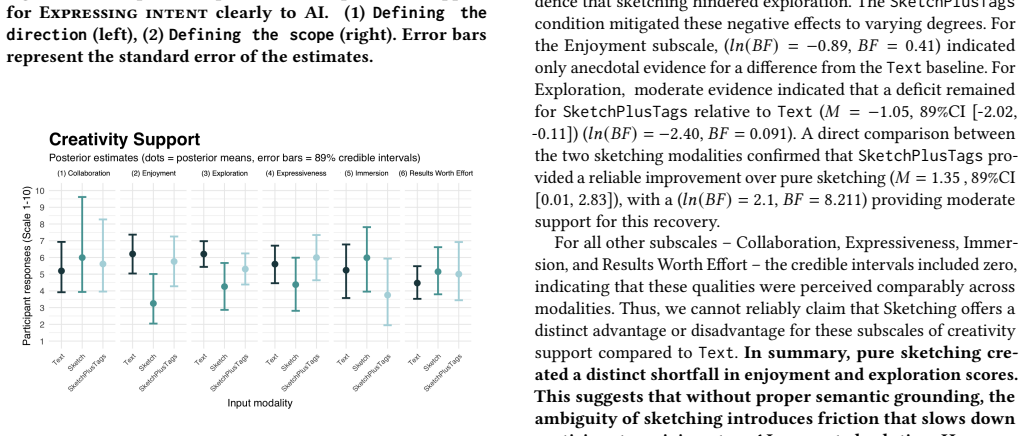
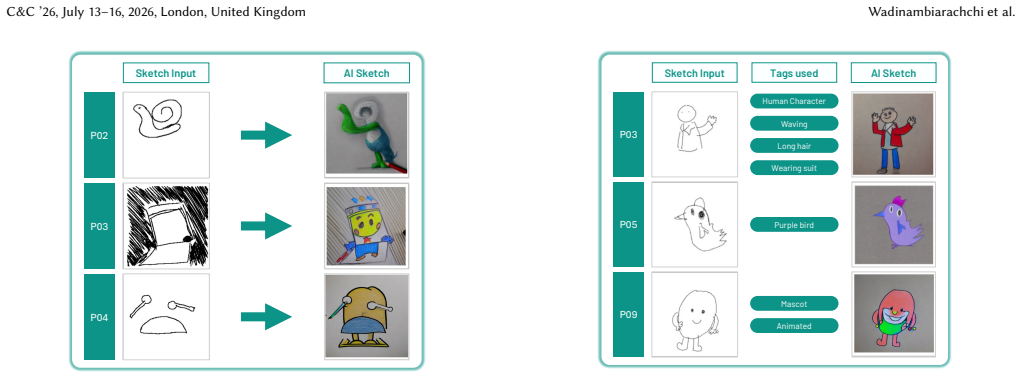
The SketchifAI prototype that accepts text, sketch, or sketch-plus-tags as prompts to an AI image generator, evaluated through a mixed-methods within-participants comparison of perceived intent expression, creativity-support ratings, and divergent-thinking performance.
If this is right
- AI creativity support tools can be engineered to favor sketch input in order to increase the sheer number of ideas produced during ideation.
- Design education using AI should retain sketching interfaces to keep reflection-in-action active rather than letting text-only prompting dominate.
- Multimodal prompting offers a practical route to maintain divergent thinking skills when students work with generative AI.
- Tool designers can add lightweight tagging to sketches without losing the fluency benefit observed in the sketch-only condition.
Where Pith is reading between the lines
- If sketching forces slower, more deliberate prompting, the same friction could be introduced in other creative domains such as writing or music composition.
- A longitudinal study tracking whether repeated sketch prompting improves students' unaided sketching skill would test whether the benefit transfers beyond the AI session.
- Sequencing modalities, for example starting with text then switching to sketch for refinement, might capture both the preference for text and the fluency gain from sketching.
Load-bearing premise
The specific study setup with SketchifAI and its participant pool sufficiently isolates the effect of input modality from order, familiarity, or prototype limitations.
What would settle it
A larger or better-controlled replication that finds no fluency advantage for sketch input over text input would undermine the central claim.
Figures
read the original abstract
Current AI-powered creativity support tools (AI-CSTs) primarily use text prompting to generate solution-oriented outputs. However, the potential value of multimodal prompting in designer-AI interaction, specifically the introduction of productive friction to encourage iteration and reflection, has not been fully explored. To address this, we developed SketchifAI, a prototype AI-CST, and evaluated it with design students. In a mixed-methods, within-participants study, we examined how different input modalities (text, sketch, and sketch-plus-tags) affected design students' perceived ability to express their intent, their perception of creativity support, and their divergent thinking performance. Our preliminary findings suggest that the sketch modality tended to enhance fluency, with inconclusive evidence for differences in variety, originality, or quality compared to text modality. Yet, paradoxically, participants showed a strong preference for text prompting. We discuss how AI tools might be designed to reintroduce reflection-through-sketching, ensuring that designer-AI interaction supports, rather than erodes, essential design skills in students.
Editorial analysis
A structured set of objections, weighed in public.
Referee Report
Summary. The paper introduces SketchifAI, a prototype AI creativity support tool enabling multimodal input (text, sketch, sketch-plus-tags), and reports results from a mixed-methods within-participants study with design students. It claims that the sketch modality tended to enhance fluency in divergent thinking tasks relative to text, with inconclusive differences on variety, originality, and quality, yet participants paradoxically preferred text prompting; the authors conclude that multimodal designs can reintroduce productive friction to support reflection-in-action and preserve designerly skills.
Significance. If the modality effects prove robust after addressing design confounds, the work would usefully extend HCI research on AI-CSTs by demonstrating how input modality can influence reflection and divergent thinking, offering concrete guidance for tools that avoid eroding core design practices. The mixed-methods framing and focus on preliminary user data are appropriate strengths for an early-stage exploration.
major comments (2)
- [Methods] Methods section: The within-participants comparison of text vs. sketch vs. sketch-plus-tags modalities does not report counterbalancing of presentation order, washout procedures, or any statistical tests for sequence or carryover effects. This directly threatens the causal interpretation of the reported fluency advantage and the text-preference paradox, as these could arise from order, differential sketching familiarity, or prototype rendering differences rather than modality per se.
- [Results] Results and Abstract: The central empirical claims rest on 'preliminary findings' with several inconclusive measures and a paradoxical preference result, yet the manuscript provides no full statistical details, raw data, error bars, or participant-level breakdowns. Without these, the fluency enhancement claim and the overall pattern cannot be verified or assessed for practical significance.
minor comments (2)
- [Discussion] The connection between the observed preference paradox and Schön's reflection-in-action framework is asserted in the discussion but would benefit from a more explicit mapping to specific study measures or participant quotes.
- [Figures] Figure captions and axis labels for any divergent-thinking metrics (fluency, variety, etc.) should explicitly state the scoring rubric and inter-rater reliability to allow readers to interpret the inconclusive results.
Simulated Author's Rebuttal
We thank the referee for their thoughtful and constructive comments on our manuscript. We address each major point below and will revise the paper to improve clarity and transparency.
read point-by-point responses
-
Referee: [Methods] Methods section: The within-participants comparison of text vs. sketch vs. sketch-plus-tags modalities does not report counterbalancing of presentation order, washout procedures, or any statistical tests for sequence or carryover effects. This directly threatens the causal interpretation of the reported fluency advantage and the text-preference paradox, as these could arise from order, differential sketching familiarity, or prototype rendering differences rather than modality per se.
Authors: We agree that these procedural details are necessary to support causal claims in a within-participants design. The study used a balanced Latin square to counterbalance modality order across participants. No dedicated washout period was included because tasks were short and independent, but short breaks were provided between conditions. We will add a complete description of the counterbalancing procedure to the Methods section and report the results of statistical checks for order and carryover effects (which showed no significant impact on fluency or preference outcomes). revision: yes
-
Referee: [Results] Results and Abstract: The central empirical claims rest on 'preliminary findings' with several inconclusive measures and a paradoxical preference result, yet the manuscript provides no full statistical details, raw data, error bars, or participant-level breakdowns. Without these, the fluency enhancement claim and the overall pattern cannot be verified or assessed for practical significance.
Authors: We accept that the current Results section is too abbreviated for full verification. In revision we will add complete statistical reporting (including exact test statistics, p-values, effect sizes, and confidence intervals), include error bars on all relevant figures, and provide anonymized participant-level summaries or breakdowns for the key measures. We will also expand discussion of the inconclusive results and the preference paradox. Raw participant data will be made available upon reasonable request subject to consent constraints, but the analysis pipeline will be fully documented. revision: yes
Circularity Check
Empirical user study with no derivation chain or self-referential predictions
full rationale
The paper reports a mixed-methods within-participants study of the SketchifAI prototype, comparing input modalities on measures of fluency, variety, originality, quality, and preference. No equations, fitted parameters, uniqueness theorems, or predictions appear in the text. All claims rest on collected participant data and thematic analysis rather than any reduction of outputs to inputs by construction. Self-citations, if present, are not load-bearing for any central result. This matches the default expectation for non-circular empirical work.
Axiom & Free-Parameter Ledger
Reference graph
Works this paper leans on
-
[1]
Alipour and M
L. Alipour and M. Faizi. 2016. A new strategy to reduce design fixation: The middle sketching stage. In4th International Conference on Design Creativ- ity, ICDC 2016. Design Society, Georgia Institute of Technology, Atlanta, GA, Reviving Reflection-in-Action: Instilling Designerly Thinking in AI-Supported Ideation through Multimodal Prompting C&C ’26, Jul...
2016
-
[2]
2015.Design sprint: A practi- cal guidebook for building great digital products
Richard Banfield, C Todd Lombardo, and Trace Wax. 2015.Design sprint: A practi- cal guidebook for building great digital products. O’Reilly Media, Inc., Sebastopol, CA
2015
-
[3]
Margaret A. Boden. 2009. Conceptual Spaces.Knowledge and Space2 (2009), 235–243. doi:10.1007/978-1-4020-9877-2_13
-
[5]
2022.Thematic analysis: a practical guide
Virginia Braun and Victoria Clarke. 2022.Thematic analysis: a practical guide. SAGE Publications Inc., Thousand Oaks, California,United states. 108 pages
2022
-
[6]
John Brooke. 1996. SUS: A Quick and Dirty Usability Scale. InUsability Evaluation in Industry, Patrick W. Jordan, Bruce Thomas, Bernard A. Weerd- meester, and Ian L. McClelland (Eds.). Taylor & Francis, London, 189–194. doi:10.1201/9781498710411-35
-
[7]
Paul-Christian Burkner. 2017. brms: An R Package for Bayesian Multilevel Models Using Stan.Journal of Statistical Software80, 1 (2017), 1–28. doi:10.18637/jss. v080.i01
-
[8]
2010.Sketching user experiences: getting the design right and the right design
Bill Buxton. 2010.Sketching user experiences: getting the design right and the right design. Morgan kaufmann, San Francisco, CA
2010
-
[9]
Bob Carpenter, Andrew Gelman, Matthew D Hoffman, Daniel Lee, Ben Goodrich, Michael Betancourt, Marcus A Brubaker, Jiqiang Guo, Peter Li, and Allen Riddell
-
[10]
Stan: A probabilistic programming language.Journal of statistical software 76 (2017), 1–32. doi:10.18637/jss.v076.i01
-
[11]
Hernan Casakin and Gabriela Goldschmidt. 1999. Expertise and the use of visual analogy: implications for design education.Design Studies20, 2 (3 1999), 153–175. doi:10.1016/S0142-694X(98)00032-5
-
[12]
Zeya Chen and Ruth Schmidt. 2024. Exploring a Behavioral Model of “Positive Friction” in Human-AI Interaction. InDesign, User Experience, and Usability, Aaron Marcus, Elizabeth Rosenzweig, and Marcelo M. Soares (Eds.). Springer Nature Switzerland, Cham, 3–22. doi:10.1007/978-3-031-61353-1_1
-
[13]
Peiyao Cheng, Ruth Mugge, and Jan P.L. Schoormans. 2014. A new strategy to reduce design fixation: Presenting partial photographs to designers.Design Studies35, 4 (2014), 374–391. doi:10.1016/J.DESTUD.2014.02.004
-
[14]
Erin Cherry and Celine Latulipe. 2014. Quantifying the Creativity Support of Digital Tools through the Creativity Support Index.ACM Trans. Comput.-Hum. Interact.21, 4, Article 21 (June 2014), 25 pages. doi:10.1145/2617588
-
[15]
Laureline Chiapello and Rabah Bousbaci. 2022. It’s complicated: Dewey, Schön and reflection-in-action. InProceedings of DRS2022. Design Research Society, Bilbao, 15 pages. doi:10.21606/drs.2022.349
-
[16]
DaEun Choi, Sumin Hong, Jeongeon Park, John Joon Young Chung, and Juho Kim. 2024. CreativeConnect: Supporting Reference Recombination for Graphic Design Ideation with Generative AI. InProceedings of the 2024 CHI Conference on Human Factors in Computing Systems(Honolulu, HI, USA)(CHI ’24). Association for Computing Machinery, New York, NY, USA, Article 105...
arXiv 2024
-
[17]
DaEun Choi, Kihoon Son, HyunJoon Jung, and Juho Kim. 2025. Expandora: Broadening Design Exploration with Text-to-Image Model. InProceedings of the Extended Abstracts of the CHI Conference on Human Factors in Computing Systems (CHI EA ’25). Association for Computing Machinery, New York, NY, USA, Article 232, 10 pages. doi:10.1145/3706599.3720189
-
[18]
Anna L. Cox, Sandy J.J. Gould, Marta E. Cecchinato, Ioanna Iacovides, and Ian Renfree. 2016. Design Frictions for Mindful Interactions: The Case for Mi- croboundaries. InProceedings of the 2016 CHI Conference Extended Abstracts on Human Factors in Computing Systems(San Jose, California, USA)(CHI EA ’16). Association for Computing Machinery, New York, NY, ...
-
[19]
Nigel Cross. 2023. Design thinking: What just happened?Design Studies86 (2023), 101187. doi:10.1016/j.destud.2023.101187
-
[20]
Peter Dalsgaard. 2025. Thinking through Prompting: Cognitive Mediation in Human–AI Interaction. InProceedings of the 36th Annual Conference of the Euro- pean Association of Cognitive Ergonomics (ECCE ’25). Association for Computing Machinery, New York, NY, USA, Article 24, 6 pages. doi:10.1145/3746175.3747192
-
[21]
Richard Lee Davis, Kevin Fred Mwaita, Livia Müller, Daniel C. Tozadore, Alek- sandra Novikova, Tanja Käser, and Thiemo Wambsganss. 2025. SketchAI: A "Sketch-First" Approach to Incorporating Generative AI into Fashion Design. In Proceedings of the Extended Abstracts of the CHI Conference on Human Factors in Computing Systems (CHI EA ’25). Association for C...
-
[22]
Sebastian Deterding, Jonathan Hook, Rebecca Fiebrink, Marco Gillies, Jeremy Gow, Memo Akten, Gillian Smith, Antonios Liapis, and Kate Compton. 2017. Mixed-Initiative Creative Interfaces. InProceedings of the 2017 CHI Conference Extended Abstracts on Human Factors in Computing Systems(Denver, Colorado, USA)(CHI EA ’17). Association for Computing Machinery,...
-
[23]
Anil R. Doshi and Oliver P. Hauser. 2024. Generative AI enhances individual creativity but reduces the collective diversity of novel con- tent.Science Advances10, 28 (2024), eadn5290. doi:10.1126/sciadv.adn5290 arXiv:https://www.science.org/doi/pdf/10.1126/sciadv.adn5290
-
[24]
Denis Dumas and Kevin N. Dunbar. 2014. Understanding Fluency and Originality: A latent variable perspective.Thinking Skills and Creativity14 (12 2014), 56–67. doi:10.1016/J.TSC.2014.09.003
-
[25]
Courtney Lynn Gallagher. 2017. Sketching for Ideation: A Structured Approach for Increasing Divergent Thinking. InProceedings of the 2017 CHI Conference Extended Abstracts on Human Factors in Computing Systems(Denver, Colorado, USA)(CHI EA ’17). Association for Computing Machinery, New York, NY, USA, 106–111. doi:10.1145/3027063.3048424
-
[26]
Gabriela Goldschmidt. 2017. Manual Sketching: Why Is It Still Relevant?Phi- losophy of Engineering and Technology28 (2017), 77–97. doi:10.1007/978-3-319- 56466-1_4
-
[27]
Joy Paul Guilford. 1956. The structure of intellect.Psychological bulletin53, 4 (1956), 267–293. doi:10.1037/h0040755
-
[28]
Tracy Hammond and Paul Taele. 2019. Sketching Cognition and Creativity: Leveraging Sketch Interfaces for Enhancing Creativity and Cognition. InProceed- ings of the 2019 on Creativity and Cognition. ACM, San Diego CA USA, 708–713. doi:10.1145/3325480.3326552
-
[29]
Marius Hoggenmueller, Maria Luce Lupetti, and Willem Van Der Maden. 2023. Creative AI for HRI Design Explorations. InHRI ’23: Companion of the 2023 ACM/IEEE International Conference on Human-Robot Interaction. Association for Computing Machinery, New York, NY, USA, 40–50. doi:10.1145/3568294.3580035
-
[30]
David G. Jansson and Steven M. Smith. 1991. Design fixation.Design Studies12, 1 (1 1991), 3–11. doi:10.1016/0142-694X(91)90003-F
-
[31]
Martin Jonsson and Jakob Tholander. 2022. Cracking the code: Co-coding with AI in creative programming education. InProceedings of the 14th Conference on Creativity and Cognition(Venice, Italy)(C&C ’22). Association for Computing Machinery, New York, NY, USA, 5–14. doi:10.1145/3527927.3532801
-
[32]
Pegah Karimi, Jeba Rezwana, Safat Siddiqui, Mary Lou Maher, and Nasrin Dehbo- zorgi. 2020. Creative sketching partner: an analysis of human-AI co-creativity. InProceedings of the 25th International Conference on Intelligent User Interfaces (Cagliari, Italy)(IUI ’20). Association for Computing Machinery, New York, NY, USA, 221–230. doi:10.1145/3377325.3377522
-
[33]
Matthew Kay, Gregory L. Nelson, and Eric B. Hekler. 2016. Researcher-Centered Design of Statistics: Why Bayesian Statistics Better Fit the Culture and Incentives of HCI. InProceedings of the 2016 CHI Conference on Human Factors in Comput- ing Systems(San Jose, California, USA)(CHI ’16). Association for Computing Machinery, New York, NY, USA, 4521–4532. do...
-
[34]
Majeed Kazemitabaar, Oliver Huang, Sangho Suh, Austin Z Henley, and Tovi Grossman. 2025. Exploring the Design Space of Cognitive Engagement Tech- niques with AI-Generated Code for Enhanced Learning. InProceedings of the 30th International Conference on Intelligent User Interfaces (IUI ’25). Association for Computing Machinery, New York, NY, USA, 695–714. ...
-
[35]
Aaron Kozbelt and Yana Durmysheva. 2007. Understanding Creativity Judgments of Invented Alien Creatures: The Roles of Invariants and Other Predictors*. The Journal of Creative Behavior41, 4 (12 2007), 223–248. doi:10.1002/J.2162- 6057.2007.TB01072.X
-
[36]
Linda Nhu Laursen and Louise Møller Haase. 2019. The shortcomings of design thinking when compared to designerly thinking.The Design Journal22, 6 (2019), 813–832. doi:10.1080/14606925.2019.1652531
-
[37]
Tomas Lawton, Francisco J Ibarrola, Dan Ventura, and Kazjon Grace. 2023. Draw- ing with Reframer: Emergence and Control in Co-Creative AI. InProceedings of the 28th International Conference on Intelligent User Interfaces(Sydney, NSW, Australia)(IUI ’23). Association for Computing Machinery, New York, NY, USA, 264–277. doi:10.1145/3581641.3584095
-
[38]
Seung Won Lee, Tae Hee Jo, Semin Jin, Jiin Choi, Kyungwon Yun, Sergio Bromberg, Seonghoon Ban, and Kyung Hoon Hyun. 2024. The Impact of Sketch- guided vs. Prompt-guided 3D Generative AIs on the Design Exploration Process. InProceedings of the 2024 CHI Conference on Human Factors in Computing Systems (Honolulu, HI, USA)(CHI ’24). Association for Computing ...
-
[39]
James R. Lewis, Brian S. Utesch, and Deborah E. Maher. 2013. UMUX-LITE: when there’s no time for the SUS. InProceedings of the SIGCHI Conference on Human Factors in Computing Systems(Paris, France)(CHI ’13). Association for Computing Machinery, New York, NY, USA, 2099–2102. doi:10.1145/2470654.2481287
-
[40]
Makayla Lewis. 2023. AIxArtist: A First-Person Tale of Interacting with Artificial Intelligence to Escape Creative Block. doi:10.48550/arXiv.2308.11424
-
[41]
Jie Li, Hancheng Cao, Laura Lin, Youyang Hou, Ruihao Zhu, and Abdallah El Ali
-
[43]
Tinghui Li, Eduardo Velloso, Anusha Withana, and Zhanna Sarsenbayeva. 2025. Estimating the Effects of Encumbrance and Walking on Mixed Reality Interaction. InProceedings of the 2025 CHI Conference on Human Factors in Computing Systems (CHI ’25). Association for Computing Machinery, New York, NY, USA, Article 1153, 24 pages. doi:10.1145/3706598.3713492
-
[44]
Kang, Nikolas Martelaro, Aniket Kittur, Yan- Ying Chen, and Matthew K
David Chuan-En Lin, Hyeonsu B. Kang, Nikolas Martelaro, Aniket Kittur, Yan- Ying Chen, and Matthew K. Hong. 2025. Inkspire: Supporting Design Exploration with Generative AI through Analogical Sketching. InProceedings of the 2025 CHI Conference on Human Factors in Computing Systems (CHI ’25). Association for Computing Machinery, New York, NY, USA, Article ...
arXiv 2025
-
[45]
Nicolai Marquardt, Asta Roseway, Hugo Romat, Payod Panda, Michel Pahud, Gonzalo Ramos, Steven M. Drucker, Andrew D. Wilson, Ken Hinckley, and Nathalie Riche. 2025. ImaginationVellum: Generative-AI Ideation Canvas with Spatial Prompts, Generative Strokes, and Ideation History. InProceedings of the 38th Annual ACM Symposium on User Interface Software and Te...
-
[46]
2020.Statistical rethinking: A Bayesian course with examples in R and Stan (2e)
Richard McElreath. 2020.Statistical rethinking: A Bayesian course with examples in R and Stan (2e). Chapman and Hall/CRC, New York, United States. doi:10. 1201/9780429029608
2020
-
[47]
Dave Murray-Rust, Iohanna Nicenboim, and Dan Lockton. 2022. Metaphors for designers working with AI. InProceedings of the Design Research Society Conference (DRS2022). DRS Digital Library, Bilbao, Spain. doi:10.21606/drs.2022. 667
-
[48]
Brent A Nelson, Jamal O Wilson, David Rosen, and Jeannette Yen. 2009. Refined metrics for measuring ideation effectiveness.Design Studies30, 6 (2009), 737–743. doi:10.1016/j.destud.2009.07.002
-
[49]
Rivka Oxman. 1999. Educating the designerly thinker.Design studies20, 2 (1999), 105–122. doi:10.1016/S0142-694X(98)00029-5
-
[50]
Hyerim Park, Malin Eiband, Andre Luckow, and Michael Sedlmair. 2025. Ex- ploring Visual Prompts: Refining Images with Scribbles and Annotations in Generative AI Image Tools. InProceedings of the Extended Abstracts of the CHI Conference on Human Factors in Computing Systems (CHI EA ’25). Asso- ciation for Computing Machinery, New York, NY, USA, Article 257...
-
[51]
We Are Visual Thinkers, Not Verbal Thinkers!
Hyerim Park, Joscha Eirich, Andre Luckow, and Michael Sedlmair. 2024. "We Are Visual Thinkers, Not Verbal Thinkers!": A Thematic Analysis of How Professional Designers Use Generative AI Image Generation Tools. InProceedings of the 13th Nordic Conference on Human-Computer Interaction(Uppsala, Sweden)(NordiCHI ’24). Association for Computing Machinery, New ...
-
[52]
Xiaohan Peng, Janin Koch, and Wendy E. Mackay. 2024. DesignPrompt: Using Multimodal Interaction for Design Exploration with Generative AI. InProceedings of the 2024 ACM Designing Interactive Systems Conference(Copenhagen, Denmark) (DIS ’24). Association for Computing Machinery, New York, NY, USA, 804–818. doi:10.1145/3643834.3661588
-
[53]
Peinuan Qin, Chi-Lan Yang, Jingshu Li, Jing Wen, and Yi-Chieh Lee. 2025. Timing Matters: How Using LLMs at Different Timings Influences Writers’ Perceptions and Ideation Outcomes in AI-Assisted Ideation. InProceedings of the 2025 CHI Conference on Human Factors in Computing Systems (CHI ’25). Association for Computing Machinery, New York, NY, USA, Article...
arXiv 2025
-
[54]
Jeba Rezwana and Mary Lou Maher. 2023. Designing Creative AI Partners with COFI: A Framework for Modeling Interaction in Human-AI Co-Creative Systems.ACM Trans. Comput.-Hum. Interact.30, 5, Article 67 (Sept. 2023), 28 pages. doi:10.1145/3519026
-
[55]
Jeba Rezwana and Mary Lou Maher. 2023. User Perspectives on Ethical Chal- lenges in Human-AI Co-Creativity: A Design Fiction Study. InProceedings of the 15th Conference on Creativity and Cognition(Virtual Event, USA)(C&C ’23). Association for Computing Machinery, USA, 62–74. https://doi.org/10.1145/ 3591196.3593364
arXiv 2023
-
[56]
2021.New Statistics for the Design Researchers
Martin Schmettow. 2021.New Statistics for the Design Researchers. Springer International Publishing, Cham, Switzerland. doi:10.1007/978-3-030-46380-9
-
[57]
2017.The reflective practitioner: How professionals think in action
Donald A Schön. 2017.The reflective practitioner: How professionals think in action. Routledge, London
2017
-
[58]
Shah, Noe Vargas-Hernandez, and Steve M
Jami J. Shah, Noe Vargas-Hernandez, and Steve M. Smith. 2003. Metrics for measuring ideation effectiveness.Design Studies24, 2 (3 2003), 111–134. doi:10. 1016/S0142-694X(02)00034-0
2003
-
[59]
Jacob Sheahan, David Chatting, Robert Collins, Jessica Bley, Alexander Eriksson, Nick Taylor, and Marco C. Rozendaal. 2024. Designing with Friction: Inverting Notions of Seamless Technology. InAdjunct Proceedings of the 2024 Nordic Confer- ence on Human-Computer Interaction(Uppsala, Sweden)(NordiCHI ’24 Adjunct). Association for Computing Machinery, New Y...
-
[60]
Hanshu Shen, Lyukesheng Shen, Wenqi Wu, and Kejun Zhang. 2025. IdeationWeb: Tracking the Evolution of Design Ideas in Human-AI Co-Creation. InProceedings of the 2025 CHI Conference on Human Factors in Computing Systems (CHI ’25). Association for Computing Machinery, New York, NY, USA, Article 146, 19 pages. doi:10.1145/3706598.3713375
-
[61]
Donghoon Shin, Alice Gao, Rock Yuren Pang, Jaewook Lee, Katharina Reinecke, and Emily Tseng. 2026. Interrogating Design Homogenization in Web Vibe Coding. arXiv:2603.13036 [cs.HC] https://arxiv.org/abs/2603.13036
arXiv 2026
-
[62]
Ben Shneiderman. 2007. Creativity support tools: accelerating discovery and innovation.Commun. ACM50, 12 (12 2007), 20–32. doi:10.1145/1323688.1323689
-
[63]
Macy Takaffoli, Sijia Li, and Ville Mäkelä. 2024. Generative AI in User Experience Design and Research: How Do UX Practitioners, Teams, and Companies Use GenAI in Industry?. InProceedings of the 2024 ACM Designing Interactive Sys- tems Conference(Copenhagen, Denmark)(DIS ’24). Association for Computing Machinery, New York, NY, USA, 1579–1593. doi:10.1145/...
-
[64]
2021.Essentials of thematic analysis.American Psycho- logical Association, Washington, DC
G Terry and N Hayfield. 2021.Essentials of thematic analysis.American Psycho- logical Association, Washington, DC. doi:10.1037/0000238-000
-
[65]
Severi Uusitalo, Antti Salovaara, Tero Jokela, and Marja Salmimaa. 2024. “Clay to Play With”’: Generative AI Tools in UX and Industrial Design Practice. InPro- ceedings of the 2024 ACM Designing Interactive Systems Conference(Copenhagen, Denmark)(DIS ’24). Association for Computing Machinery, New York, NY, USA, 1566–1578. doi:10.1145/3643834.3661624
-
[66]
Vera van der Burg, Gijs de Boer, Alkim Almila Akdag Salah, Senthil Chan- drasegaran, and Peter Lloyd. 2023. Objective Portrait: A practice-based inquiry to explore Al as a reflective design partner. InProceedings of the 2023 ACM Design- ing Interactive Systems Conference(Pittsburgh, PA, USA)(DIS ’23). Association for Computing Machinery, New York, NY, USA...
-
[67]
Vasconcelos and Nathan Crilly
Luis A. Vasconcelos and Nathan Crilly. 2016. Inspiration and fixation: Questions, methods, findings, and challenges.Design Studies42 (1 2016), 1–32. doi:10.1016/ J.DESTUD.2015.11.001
2016
-
[68]
Aki Vehtari, Andrew Gelman, Daniel Simpson, Bob Carpenter, and Paul-Christian Bürkner. 2021. Rank-Normalization, Folding, and Localization: An Improved b𝑅 for Assessing Convergence of MCMC (with Discussion).Bayesian Analysis16, 2 (2021), 667 – 718. doi:10.1214/20-BA1221
-
[69]
Samangi Wadinambiarachchi, Ryan M. Kelly, Saumya Pareek, Qiushi Zhou, and Eduardo Velloso. 2024. The Effects of Generative AI on Design Fixation and Divergent Thinking. InProceedings of the 2024 CHI Conference on Human Factors in Computing Systems(Honolulu, HI, USA)(CHI ’24). Association for Computing Machinery, New York, NY, USA, Article 380, 18 pages. d...
-
[70]
Samangi Wadinambiarachchi, Jenny Waycott, Yvonne Rogers, and Greg Wadley
-
[71]
InProceedings of the 37th Australian Conference on Human-Computer Interaction (OzCHI ’25)
Imagining Design Workflows in Agentic AI Futures. InProceedings of the 37th Australian Conference on Human-Computer Interaction (OzCHI ’25). Associa- tion for Computing Machinery, New York, NY, USA, 19–35. doi:10.1145/3764687. 3764719
-
[72]
Eric-Jan Wagenmakers, Ruud Wetzels, Denny Borsboom, and Han LJ Van Der Maas. 2011. Why psychologists must change the way they analyze their data: the case of psi: comment on Bem (2011).Journal of Personality and Social Psychology100, 3 (2011), 426–432. doi:10.1037/a0022790
-
[73]
T. B. Ward. 1994. Structured Imagination: the Role of Category Structure in Exemplar Generation.Cognitive Psychology27, 1 (8 1994), 1–40. doi:10.1006/ COGP.1994.1010
arXiv 1994
-
[74]
Selina Weiss and Oliver Wilhelm. 2022. Is Flexibility More than Fluency and Originality?Journal of Intelligence10, 4 (12 2022), 96. doi:10.3390/ JINTELLIGENCE10040096
2022
-
[75]
J. Xu, H. Lu, and Y. Jiang. 2021. Differences between beginning and advanced students using specific analogical stimuli during design-by-analogy. InProceed- ings of the Design Society(Gothenburg, Sweden), Vol. 1. The Design Society, Gothenburg, Sweden, 1273–1282. doi:10.1017/pds.2021.127
-
[76]
Robert J. Youmans. 2011. The effects of physical prototyping and group work on the reduction of design fixation.Design Studies32, 2 (3 2011), 115–138. doi:10.1016/J.DESTUD.2010.08.001
-
[77]
Youmans and Tomasz Arciszewski
Robert J. Youmans and Tomasz Arciszewski. 2014. Design Fixation: A Cloak of Many Colors. InDesign Computing and Cognition ’12. Springer, Dordrecht, 115–129. doi:10.1007/978-94-017-9112-0_7
-
[78]
Lvmin Zhang, Anyi Rao, and Maneesh Agrawala. 2023. Adding Conditional Control to Text-to-Image Diffusion Models. InProceedings of the IEEE International Conference on Computer Vision. Institute of Electrical and Electronics Engineers Inc., Paris, France, 3813–3824. doi:10.1109/ICCV51070.2023.00355 Reviving Reflection-in-Action: Instilling Designerly Think...
discussion (0)
Sign in with ORCID, Apple, or X to comment. Anyone can read and Pith papers without signing in.