State-Specific Respiratory Signatures for Affective and Stress Recognition: Interpretable Respiratory Markers, Autocorrelation Lags, and Compact CNN Models
Pith reviewed 2026-06-26 03:07 UTC · model grok-4.3
The pith
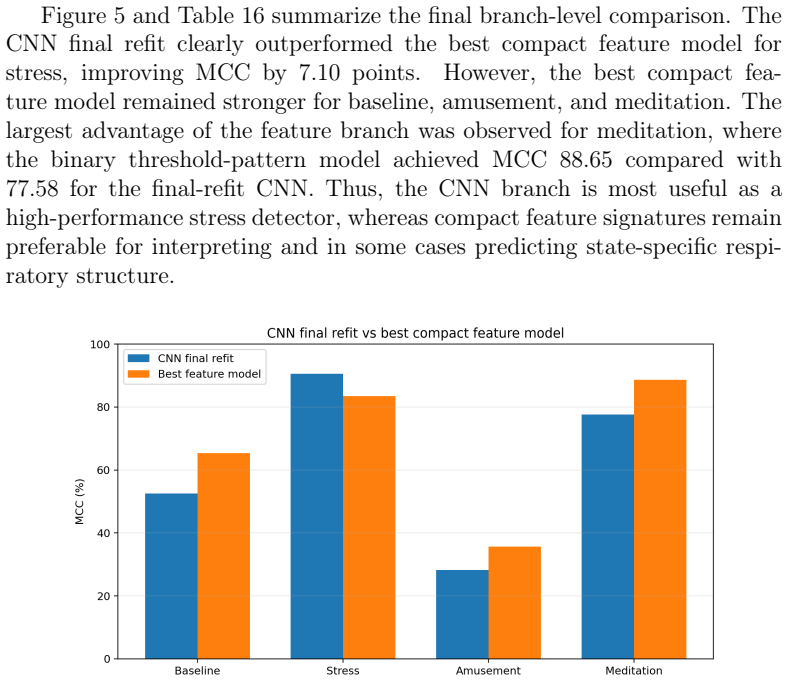
Respiratory signals yield state-specific markers where raw-signal CNNs reach 96.72 percent accuracy on stress detection while handcrafted features perform better on meditation and other states.
A machine-rendered reading of the paper's core claim, the machinery that carries it, and where it could break.
Core claim
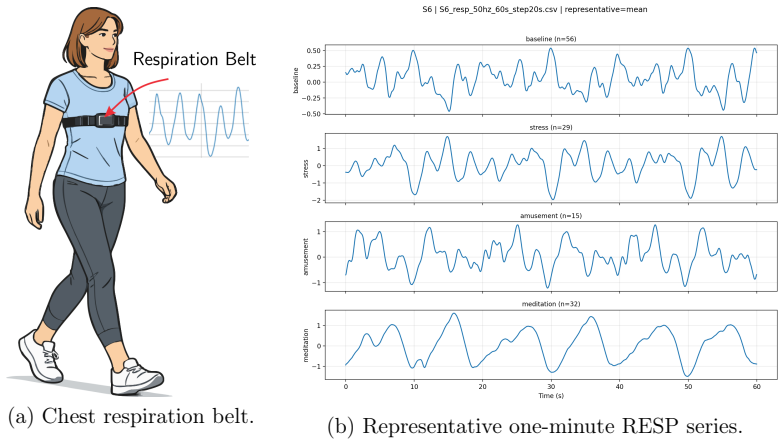
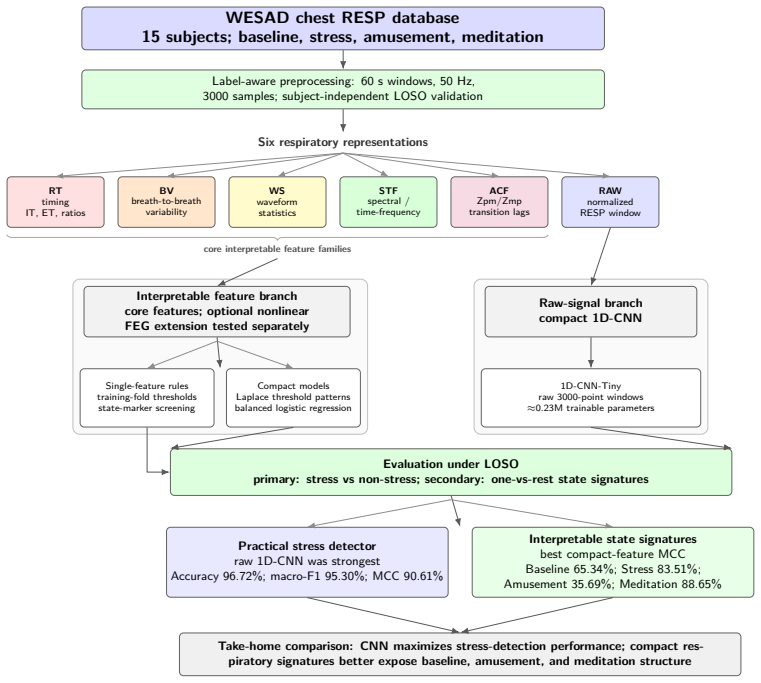
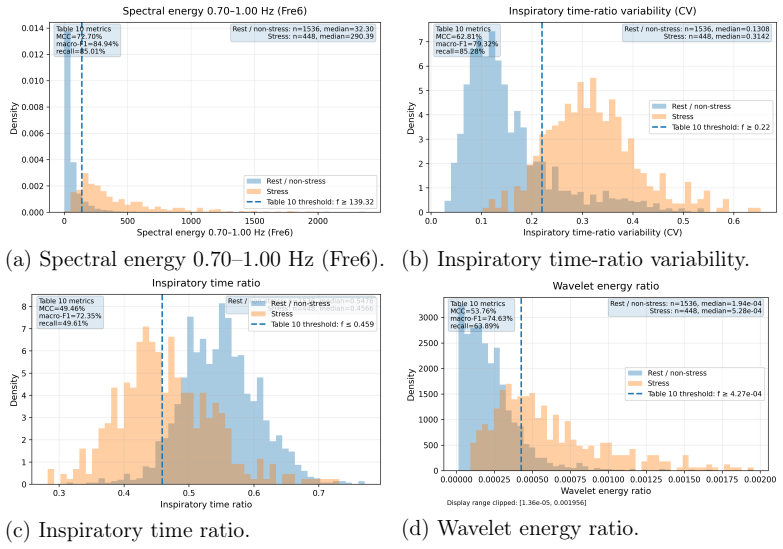
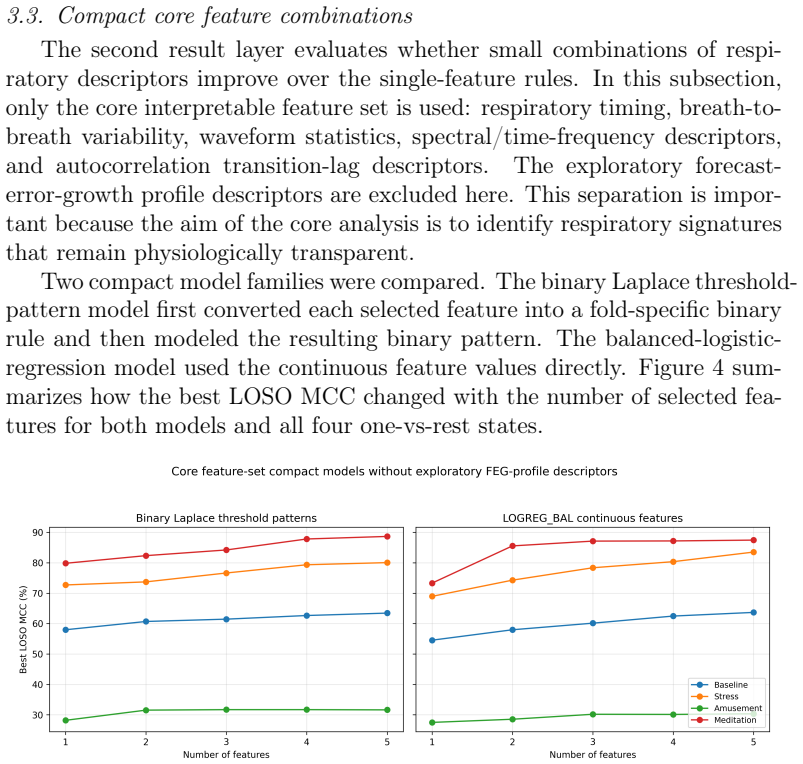
Using the chest respiratory channel of the WESAD dataset, 60 s windows, and leave-one-subject-out validation, raw-signal 1D-CNNs achieve 96.72 percent accuracy, 95.30 percent macro-F1, and 90.61 percent MCC for binary stress versus non-stress detection. Compact handcrafted feature models instead give higher MCC values for baseline (65.34 percent), amusement (35.69 percent), and meditation (88.65 percent). The feature space is partitioned into respiratory timing, variability, waveform statistics, spectral and time-frequency descriptors, and autocorrelation/nonlinear predictability descriptors, with autocorrelation transition lags introduced as markers of respiratory correlation scale.
What carries the argument
Autocorrelation transition lags (Zpm/Zmp) as interpretable markers of respiratory correlation scale, used together with physically grouped handcrafted signatures and raw-signal 1D-CNNs on 60 s windows.
If this is right
- Raw-signal CNNs supply the strongest practical stress detector.
- Interpretable respiratory signatures supply stronger markers for baseline, amusement, and especially meditation.
- State-specific analysis shows that different respiratory properties dominate each affective condition.
- Compact grouped-feature models deliver physiological transparency with competitive performance on several non-stress tasks.
Where Pith is reading between the lines
- The same autocorrelation lags could be tested on other wearable signals such as heart-rate intervals to check whether correlation-scale effects generalize.
- A hybrid model that routes the CNN branch to stress detection and the feature branch to the remaining states might raise overall multi-class accuracy.
- Shorter or longer analysis windows than 60 s might shift which states are best captured by raw versus feature representations.
- If the markers remain stable across sensor types they could support real-time affective-state feedback in consumer wearables.
Load-bearing premise
The patterns extracted from 60-second windows in this dataset will appear consistently in new users and everyday conditions without shifts from sensor placement or labeling differences.
What would settle it
Running the identical CNN and feature pipelines on an independent respiration dataset collected with different hardware or subjects and observing stress-detection accuracy fall below 80 percent.
Figures
read the original abstract
Respiratory activity is a direct and interpretable physiological channel for wearable stress and affective-state recognition, yet many studies emphasize classification accuracy without identifying which respiratory properties separate different states. This work reframes RESP-based recognition as a joint predictive and explanatory problem. Using the chest respiratory channel of the WESAD dataset, we analyze 60 s windows under leave-one-subject-out validation and combine two complementary branches: compact raw-signal one-dimensional convolutional neural networks (1D-CNNs) and physically grouped handcrafted respiratory signatures. The primary application task is binary stress versus non-stress detection, while baseline, stress, amusement, and meditation are additionally analyzed in a one-vs-rest setting to reveal state-specific respiratory markers. The feature space is organized into respiratory timing, breath-to-breath variability, waveform statistics, spectral/time-frequency descriptors, and autocorrelation/nonlinear predictability descriptors, with the raw 60 s signal treated as a sixth representation for the CNN branch. We introduce autocorrelation transition lags (Zpm/Zmp) as interpretable markers of respiratory correlation scale and separately evaluate exploratory FEG-Pro/Lyapunov-like descriptors. In the final CNN refit setting, the raw-signal model achieved the strongest stress-vs-rest performance, with accuracy 96.72 percent, macro-F1 95.30 percent, and MCC 90.61 percent. In contrast, compact feature models were stronger for baseline, with MCC 65.34 percent, amusement, with MCC 35.69 percent, and especially meditation, with MCC 88.65 percent. These results show that CNNs are most useful for the practical stress detector, whereas interpretable respiratory signatures provide stronger and more physiologically transparent state-specific markers for several non-stress conditions.
Editorial analysis
A structured set of objections, weighed in public.
Referee Report
Summary. The manuscript reframes respiratory-signal classification on the WESAD chest RESP channel as a joint predictive/explanatory task. Using 60 s windows and leave-one-subject-out (LOSO) validation, it compares compact 1D-CNNs operating on raw signals against handcrafted feature sets (timing, breath-to-breath variability, waveform statistics, spectral/time-frequency, autocorrelation/nonlinear descriptors) for binary stress-vs-rest detection and one-vs-rest classification of baseline, amusement, and meditation. The headline result is that the raw-signal CNN attains 96.72 % accuracy, 95.30 % macro-F1 and 90.61 % MCC “in the final CNN refit setting,” while the interpretable feature models are reported stronger for the non-stress states.
Significance. If the reported LOSO numbers are verifiably out-of-sample, the work supplies both a practical stress detector and physiologically grounded, state-specific respiratory markers (including the introduced autocorrelation transition lags) that could be useful for wearable affective computing. The explicit separation of CNN versus feature-model strengths across states is a constructive contribution.
major comments (2)
- [Abstract and §4] Abstract and §4 (Results): the performance figures 96.72 % / 95.30 % / 90.61 % are stated for the “final CNN refit setting” under the LOSO protocol. The manuscript must explicitly state whether these metrics were obtained on a fresh held-out partition after refitting on the union of all folds, or whether they reflect performance on the same data used for refitting. If the latter, the numbers do not constitute evidence of generalization and the central claim is unsupported.
- [§3] §3 (Methods): the 1D-CNN architecture, hyper-parameters, training schedule, and precise definition of the “final refit” procedure are not supplied at a level that permits independent verification or reproduction of the quoted accuracy/F1/MCC values.
minor comments (2)
- [Tables and §4] Table captions and §4 should report the number of subjects, total windows, and any statistical tests or confidence intervals accompanying the MCC and F1 figures.
- [§2] The autocorrelation transition lags (Zpm/Zmp) are introduced as novel markers; a short derivation or explicit formula in §2 would improve interpretability.
Simulated Author's Rebuttal
We thank the referee for the constructive feedback on validation clarity and reproducibility. We address each major comment below and will revise the manuscript accordingly.
read point-by-point responses
-
Referee: [Abstract and §4] Abstract and §4 (Results): the performance figures 96.72 % / 95.30 % / 90.61 % are stated for the “final CNN refit setting” under the LOSO protocol. The manuscript must explicitly state whether these metrics were obtained on a fresh held-out partition after refitting on the union of all folds, or whether they reflect performance on the same data used for refitting. If the latter, the numbers do not constitute evidence of generalization and the central claim is unsupported.
Authors: The 'final CNN refit setting' metrics are obtained after refitting on the union of all LOSO folds and evaluating on that same combined data; they are not from a fresh held-out partition. The primary evidence of generalization remains the LOSO results reported throughout the paper. We agree the current phrasing risks implying additional out-of-sample validation and will revise the abstract and §4 to explicitly distinguish the refit numbers (as final-model performance) from the LOSO generalization results, which we will emphasize as the central claim. revision: yes
-
Referee: [§3] §3 (Methods): the 1D-CNN architecture, hyper-parameters, training schedule, and precise definition of the “final refit” procedure are not supplied at a level that permits independent verification or reproduction of the quoted accuracy/F1/MCC values.
Authors: We agree that the manuscript does not currently provide sufficient detail on the 1D-CNN architecture, hyperparameters, training schedule, or the exact 'final refit' procedure. We will expand §3 with a complete specification including layer counts and types, kernel sizes, strides, activation functions, dropout rates, optimizer, learning rate schedule, batch size, epoch limits, early stopping, and the precise sequence of operations for the post-LOSO refit. This will enable independent reproduction. revision: yes
Circularity Check
No significant circularity; empirical ML results on public dataset with standard LOSO validation
full rationale
The paper reports classification performance for 1D-CNN and handcrafted respiratory feature models on the WESAD chest RESP channel using 60 s windows and leave-one-subject-out validation. The quoted metrics (including the 96.72% accuracy in the 'final CNN refit setting') are presented as outcomes of this protocol without any mathematical derivation chain, self-definitional equations, or load-bearing self-citations that reduce the claimed results to fitted inputs by construction. The work is self-contained as an empirical evaluation; no steps match the enumerated circularity patterns.
Axiom & Free-Parameter Ledger
Reference graph
Works this paper leans on
-
[1]
A concept model of mHealth sensorics for digital assistance of human cogni- tive resilience
Meigal A, Gerasimova-Meigal L, Korzun D. A concept model of mHealth sensorics for digital assistance of human cogni- tive resilience. In: Proceedings of the 34th Conference of Open Innovations Association (FRUCT); 2023. p. 100–107. doi:10.23919/FRUCT60429.2023.10328167
-
[2]
Breathing rhythms and emo- tions
Homma I, Masaoka Y. Breathing rhythms and emo- tions. Experimental Physiology. 2008;93(9):1011–1021. doi:10.1113/expphysiol.2008.042424
-
[3]
Zaccaro A, Piarulli A, Laurino M, Garbella E, Menicucci D, Neri B, Gemignani A. How breath-control can change your life: a systematic review on psycho-physiological correlates of slow breathing. Frontiers in Human Neuroscience. 2018;12:353. doi:10.3389/fnhum.2018.00353. 38
-
[4]
Noble DJ, Hochman S. Hypothesis: pulmonary afferent activity pat- terns during slow, deep breathing contribute to the neural induc- tion of physiological relaxation. Frontiers in Physiology. 2019;10:1176. doi:10.3389/fphys.2019.01176
-
[5]
Van Diest I, Verstappen K, Aubert AE, Widjaja D, Vansteenwegen D, Vlemincx E. Inhalation/exhalation ratio modulates the effect of slow breathing on heart rate variability and relaxation. Applied Psy- chophysiology and Biofeedback. 2014;39:171–180. doi:10.1007/s10484- 014-9253-x
-
[6]
Kral TRA, Weng HY, Mitra V, Imhoff-Smith T, Azemi E, Goldman R, RosenkranzMA,WuS,ChenA,DavidsonRJ.Slowerrespirationrateis associated with higher self-reported well-being after wellness training. Scientific Reports. 2023;13:17126. doi:10.1038/s41598-023-43176-w
-
[7]
Hernando A, Lazaro J, Gil E, Arza A, Garzon-Rey JM, Lopez-Anton R, de la Camara C, Laguna P, Aguilo J, Bailon R. Inclusion of res- piratory frequency information in heart rate variability analysis for stress assessment. IEEE Journal of Biomedical and Health Informat- ics. 2016;20(4):1016–1025. doi:10.1109/JBHI.2016.2553578
-
[8]
Chand K, Chandra S, Dutt V. A comprehensive evalua- tion of linear and non-linear HRV parameters between paced breathing and stressful mental state. Heliyon. 2024;10:e32195. doi:10.1016/j.heliyon.2024.e32195
-
[9]
WE- SAD: a multimodal dataset for wearable stress and affect detection
Schmidt P, Reiss A, Duerichen R, Marberger C, Van Laerhoven K. WE- SAD: a multimodal dataset for wearable stress and affect detection. In: Proceedings of the 20th ACM International Conference on Multimodal Interaction; 2018. p. 400–408. doi:10.1145/3242969.3242985
-
[10]
Stress detection with machine learning and deep learning using multimodal physiological data
Bobade P, Vani M. Stress detection with machine learning and deep learning using multimodal physiological data. In: Proceedings of the 2020 Second International Conference on Inventive Research in Com- puting Applications (ICIRCA); 2020. p. 51–57
2020
-
[11]
Ghosh S, Kim S, Ijaz MF, Singh PK, Mahmud M. Classification of mental stress from wearable physiological sensors using image- encoding-based deep neural network. Biosensors. 2022;12(12):1153. doi:10.3390/bios12121153. 39
-
[12]
Kumar S, Chauhan AR, Kumar A, Yang G. Resp-BoostNet: men- tal stress detection from biomarkers measurable by smartwatches us- ing boosting neural network technique. IEEE Access. 2024;12:149861– 149874. doi:10.1109/ACCESS.2024.3476777
-
[13]
Respiratory signal and human stress: non- contact detection of stress with a low-cost depth sensing camera
Shan Y, Li S, Chen T. Respiratory signal and human stress: non- contact detection of stress with a low-cost depth sensing camera. Inter- national Journal of Machine Learning and Cybernetics. 2020;11:1825–
2020
-
[14]
doi:10.1007/s13042-020-01070-4
-
[15]
Enhancement of stress analysis performance using res- piration information
Barik S, Pal S. Enhancement of stress analysis performance using res- piration information. In: Proceedings of the 2023 IEEE 3rd Applied Signal Processing Conference (ASPCON); 2023. p. 216–221
2023
-
[16]
Physiologically explainable ensemble framework for stress classification via respiratory signals
Yang C, Wei S, Li J, Liu C. Physiologically explainable ensemble framework for stress classification via respiratory signals. Technologies. 2025;13(9):411. doi:10.3390/technologies13090411
-
[17]
Breath rate variability: a novel measure to study the meditation effects
Soni R, Muniyandi M. Breath rate variability: a novel measure to study the meditation effects. International Journal of Yoga. 2019;12(1):45–54. doi:10.4103/ijoy.ijoy_27_17
-
[18]
Oku Y. Temporal variations in the pattern of breathing: techniques, sources, andapplicationstotranslationalsciences.TheJournalofPhys- iological Sciences. 2022;72:32. doi:10.1186/s12576-022-00847-z
-
[19]
It’s about time- breathing dynamics modulate emotion and cognition
Goheen J, Catal Y, MacPhee I, Call TM, Carson C, Ali R, Khan R, Weche K, Anderson JAE, Northoff G. It’s about time- breathing dynamics modulate emotion and cognition. Psychophysiol- ogy. 2025;62:e70149. doi:10.1111/psyp.70149
-
[20]
Review on psychological stress detection using biosig- nals
Giannakakis G, Grigoriadis D, Giannakaki K, Simantiraki O, Roniotis A, Tsiknakis M. Review on psychological stress detection using biosig- nals. IEEE Transactions on Affective Computing. 2022;13(1):440–460. doi:10.1109/TAFFC.2019.2927337
-
[21]
Wearable- based affect recognition: a review
Schmidt P, Reiss A, Duerichen R, Van Laerhoven K. Wearable- based affect recognition: a review. Sensors. 2019;19(19):4079. doi:10.3390/s19194079. 40
-
[22]
A review on mental stress detection using wearable sensors and machine learning techniques
Gedam S, Paul S. A review on mental stress detection using wearable sensors and machine learning techniques. IEEE Access. 2021;9:84045– 84066. doi:10.1109/ACCESS.2021.3085502
-
[23]
Personalized stress de- tection using biosignals from wearables: a scoping review
Bolpagni M, Pardini S, Dianti M, Gabrielli S. Personalized stress de- tection using biosignals from wearables: a scoping review. Sensors. 2024;24(10):3221. doi:10.3390/s24103221
-
[24]
Chatzaki C, Tsiknakis M. An overview of stress analysis based on phys- iological signals: systematic review of open datasetsand current trends. Sensors. 2025;25:7108. doi:10.3390/s25237108
-
[25]
Iqbal T, Redon-Lurbe P, Simpkin A, Elahi A, Ganly S, Wijns W, Shahzad A. A sensitivity analysis of biophysiological responses of stress for wearable sensors in connected health. IEEE Access. 2021;9:93567– 93579. doi:10.1109/ACCESS.2021.3082423
-
[26]
Li J, Washington PY. A comparison of personalized and generalized approaches to emotion recognition using consumer wearable devices: machine learning study. JMIR AI. 2023;3:e52171. doi:10.2196/52171
-
[27]
Pradhan A, Srivastava S. Hierarchical extreme puzzle learning machine-based emotion recognition using multimodal physiological signals. Biomedical Signal Processing and Control. 2023;83:104624. doi:10.1016/j.bspc.2023.104624
-
[28]
Kumar S, Govarthan K, Aleem A, Gadda S, Ganapathy N, Fredo J, Ronickom A, Kumar P. Deep learning-based automated emotion recognition using multimodal physiological signals and time-frequency methods. IEEE Transactions on Instrumentation and Measurement. 2024;73:1–12. doi:10.1109/TIM.2024.3420349
-
[29]
Dynamic alignment and fusion of multimodal physiological patterns for stress recognition
Zhang X, Wei X, Zhou Z, Zhao Q, Zhang S, Yang Y, Li R, Hu B. Dynamic alignment and fusion of multimodal physiological patterns for stress recognition. IEEE Transactions on Affective Computing. 2024;15(2):685–696. doi:10.1109/TAFFC.2023.3290177
-
[30]
Machine and deep learning models for stress detection using multimodal physiological data
Abdelfattah E, Joshi S, Tiwari S. Machine and deep learning models for stress detection using multimodal physiological data. IEEE Access. 2025;13:4597–4608. doi:10.1109/ACCESS.2024.3525459. 41
-
[31]
Yang S, Gao Y, Zhu Y, Zhang L, Xie Q, Lu X, Wang F, Zhang Z. A deep learning approach to stress recognition through multimodal physi- ological signal image transformation. Scientific Reports. 2025;15:12712. doi:10.1038/s41598-025-01228-3
-
[32]
Wang Y, Xu C, Na W, Liu D, Yan J, Yao S, Wu Q. Hierarchical transformer with auxiliary learning for subject-independent respira- tion emotion recognition. IEEE Sensors Journal. 2025;25:31290–31301. doi:10.1109/JSEN.2025.3587271
-
[33]
Towards wearable respiration monitor- ing: 1D-CRNN-based breathing detection in smart textiles
Steinmetzer T, Michel S. Towards wearable respiration monitor- ing: 1D-CRNN-based breathing detection in smart textiles. Sensors. 2025;25:6832. doi:10.3390/s25226832
-
[34]
Exploring edge ma- chine learning-based stress prediction using wearable devices
Sim S-H, Paranjpe T, Roberts N, Zhao M. Exploring edge ma- chine learning-based stress prediction using wearable devices. In: Proceedings of the 21st IEEE International Conference on Ma- chine Learning and Applications (ICMLA); 2022. p. 1266–1273. doi:10.1109/ICMLA55696.2022.00203
-
[35]
Gibbs M, Woodward K, Kanjo E. Combining multiple tiny ma- chine learning models for multimodal context-aware stress recogni- tion on constrained microcontrollers. IEEE Micro. 2024;44(1):67–75. doi:10.1109/MM.2023.3329218
-
[36]
TinyStressNet: on-device stress assessment with wearable sensors on edge devices
Jaiswal D, Mukhopadhyay S, Sharma V. TinyStressNet: on-device stress assessment with wearable sensors on edge devices. In: Pro- ceedings of the IEEE PerCom Workshops; 2024. p. 166–171. doi:10.1109/PERCOMWORKSHOPS59983.2024.10502631
work page doi:10.1109/percomworkshops59983.2024.10502631 2024
-
[37]
BioEdgeNet: a com- pact deep residual network for stress recognition on edge de- vices
Cvetkovic S, Stankovic S, Nikolic SV. BioEdgeNet: a com- pact deep residual network for stress recognition on edge de- vices. Biomedical Signal Processing and Control. 2025;102:107361. doi:10.1016/j.bspc.2024.107361
-
[38]
Deployment of TinyML-based stress clas- sification using computational constrained health wearable
Abu-Samah A, Ghaffa D, Abdullah NF, Kamal N, Nordin R, Dela Cruz JC, Magwili G, Mercado RJ. Deployment of TinyML-based stress clas- sification using computational constrained health wearable. Electron- ics. 2025;14(4):687. doi:10.3390/electronics14040687. 42
-
[39]
Ghose D, Chatterjee A, Balapuwaduge IAM, Lin Y, Dash S. Investi- gating lightweight and interpretable machine learning models for ef- ficient and explainable stress detection. Frontiers in Digital Health. 2025;7:1523381. doi:10.3389/fdgth.2025.1523381
-
[40]
Breathing rhythm and patternandtheirinfluenceonemotion.AnnualReviewofNeuroscience
Ashhad S, Kam K, Del Negro CD, Feldman JL. Breathing rhythm and patternandtheirinfluenceonemotion.AnnualReviewofNeuroscience. 2022;45:223–247. doi:10.1146/annurev-neuro-090121-014424
-
[41]
From lung to brain: respiration modulates neural and mental activity
Goheen J, Anderson JAE, Zhang J, Northoff G. From lung to brain: respiration modulates neural and mental activity. Neuroscience Bul- letin. 2023;39:1577–1590. doi:10.1007/s12264-023-01070-5
-
[42]
Brief structured respiration prac- tices enhance mood and reduce physiological arousal
Balban MY, Neri E, Kogon MM, Weed L, Nouriani B, Jo B, Holl G, Zeitzer J, Spiegel D, Huberman A. Brief structured respiration prac- tices enhance mood and reduce physiological arousal. Cell Reports Medicine. 2023;4:100895. doi:10.1016/j.xcrm.2022.100895
-
[43]
Ef- fect of breathwork on stress and mental health: a meta-analysis of randomised-controlled trials
Fincham GW, Strauss C, Montero-Marin J, Cavanagh K. Ef- fect of breathwork on stress and mental health: a meta-analysis of randomised-controlled trials. Scientific Reports. 2023;13:432. doi:10.1038/s41598-022-27247-y
-
[44]
Slow breathing for reducing stress: the effect of extending exhale
Birdee G, Nelson K, Wallston K, Nian H, Diedrich A, Paranjape SY, Abraham R, Gamboa A. Slow breathing for reducing stress: the effect of extending exhale. Complementary Therapies in Medicine. 2023;73:102937. doi:10.1016/j.ctim.2023.102937
-
[45]
Gazi A, Wittbrodt M, Harrison AB, Sundararaj S, Gurel N, Nye J, Shah AJ, Vaccarino V, Bremner D, Inan OT. Robust estimation of respiratory variability uncovers correlates of limbic brain activity and transcutaneous cervical vagus nerve stimulation in the context of traumatic stress. IEEE Transactions on Biomedical Engineering. 2022;69(2):849–859. doi:10.1...
-
[46]
Heart and breathing rate variations as biomarkers for anxiety detection
Ritsert F, Elgendi M, Galli V, Menon C. Heart and breathing rate variations as biomarkers for anxiety detection. Bioengineering. 2022;9(11):711. doi:10.3390/bioengineering9110711
-
[47]
Exploring respiratory parameters related to psy- chophysiological indexes of mental health
Suzuki M, Sato H. Exploring respiratory parameters related to psy- chophysiological indexes of mental health. In: Proceedings of the IEEE 43 International Symposium on Medical Measurements and Applications (MeMeA); 2023. p. 1–6. doi:10.1109/MeMeA57477.2023.10171945
-
[48]
Breathing rate complexity features for in-the-wild stress and anxiety measurement
Tiwari A, Narayanan SS, Falk TH. Breathing rate complexity features for in-the-wild stress and anxiety measurement. In: Proceedings of the 27th European Signal Processing Conference (EUSIPCO); 2019. p. 1–5. doi:10.23919/EUSIPCO.2019.8902700
-
[49]
Velichko A, N’Gbo N, Carpentieri B, Shams M. FEG-Pro: forecast-error growth profiling for finite-horizon instability anal- ysis of nonlinear time series. arXiv:2605.17282 [nlin.CD]. 2026. doi:10.48550/arXiv.2605.17282. 44
work page internal anchor Pith review Pith/arXiv arXiv doi:10.48550/arxiv.2605.17282 2026
discussion (0)
Sign in with ORCID, Apple, or X to comment. Anyone can read and Pith papers without signing in.