Magnetic moments of decuplet baryons in isospin asymmetric magnetized strange matter
Pith reviewed 2026-06-26 04:17 UTC · model grok-4.3
The pith
In-medium masses from a chiral quark mean-field model feed into a constituent quark model to compute magnetic moments of decuplet baryons under combined density, temperature, isospin asymmetry, and magnetic field effects.
A machine-rendered reading of the paper's core claim, the machinery that carries it, and where it could break.
Core claim
The in-medium masses of decuplet baryons obtained from the CQMF model, incorporating Dirac sea effects, Landau quantization, and anomalous magnetic moments, are used as input to the chiCQM to evaluate their magnetic moments including valence, sea, and orbital contributions in isospin asymmetric magnetized strange matter at finite temperature.
What carries the argument
The two-stage chiral framework that first solves the CQMF model for density-, temperature-, asymmetry-, and field-dependent masses of quarks and baryons, then inserts those masses into the chiCQM to sum valence, sea-polarization, and orbital contributions to the magnetic moments.
If this is right
- Magnetic moments of all four decuplet species decrease or increase depending on the sign of the isospin asymmetry and the strength of the magnetic field.
- The orbital contribution from the quark sea grows with temperature while the sea polarization term is suppressed by the Landau levels.
- The Omega-minus moment remains the least affected because it contains only strange quarks whose masses are modified mainly by the zeta field.
- At fixed density the moments show a non-monotonic dependence on magnetic field once anomalous magnetic moments are retained in the mass formula.
Where Pith is reading between the lines
- The same mass inputs could be reused to compute electric dipole moments or transition moments once the chiCQM is extended to include explicit photon coupling.
- If the CQMF masses are replaced by those from a different model such as the NJL model, the resulting moments would test the sensitivity of the chiCQM output to the underlying mass-generation mechanism.
- The framework supplies a concrete prediction for how the ratio of Delta-plus to Delta-minus moments evolves with magnetic field strength, a quantity that could be extracted from heavy-ion data.
Load-bearing premise
The chiral SU(3) quark mean-field model correctly captures the combined medium modifications from density, temperature, isospin asymmetry, and magnetic field when including Dirac sea effects and Landau quantization of charged particles.
What would settle it
A measurement or lattice calculation of the magnetic moment of any decuplet baryon at finite density and magnetic field that deviates systematically from the mass-dependent values produced by feeding CQMF masses into the chiCQM.
Figures
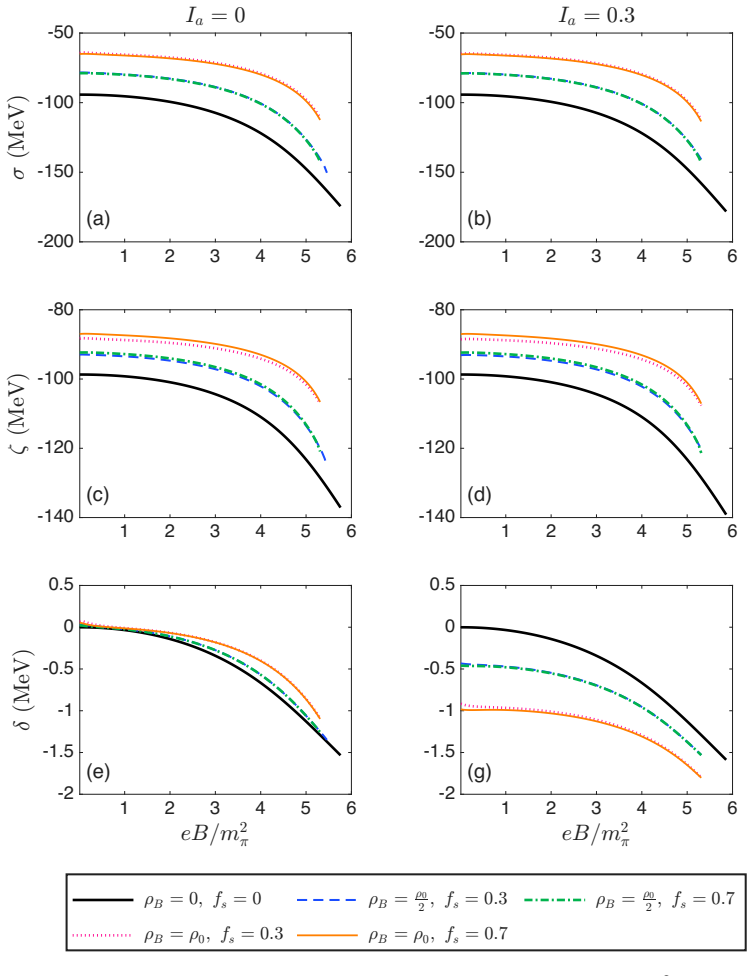
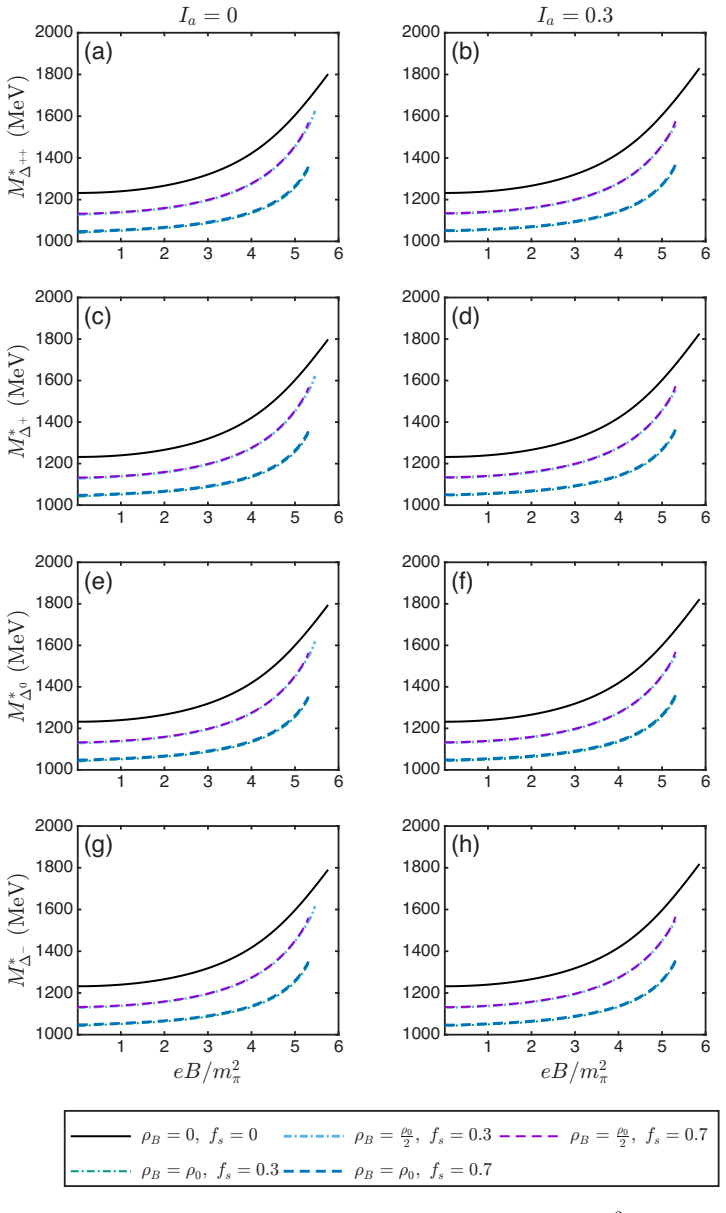
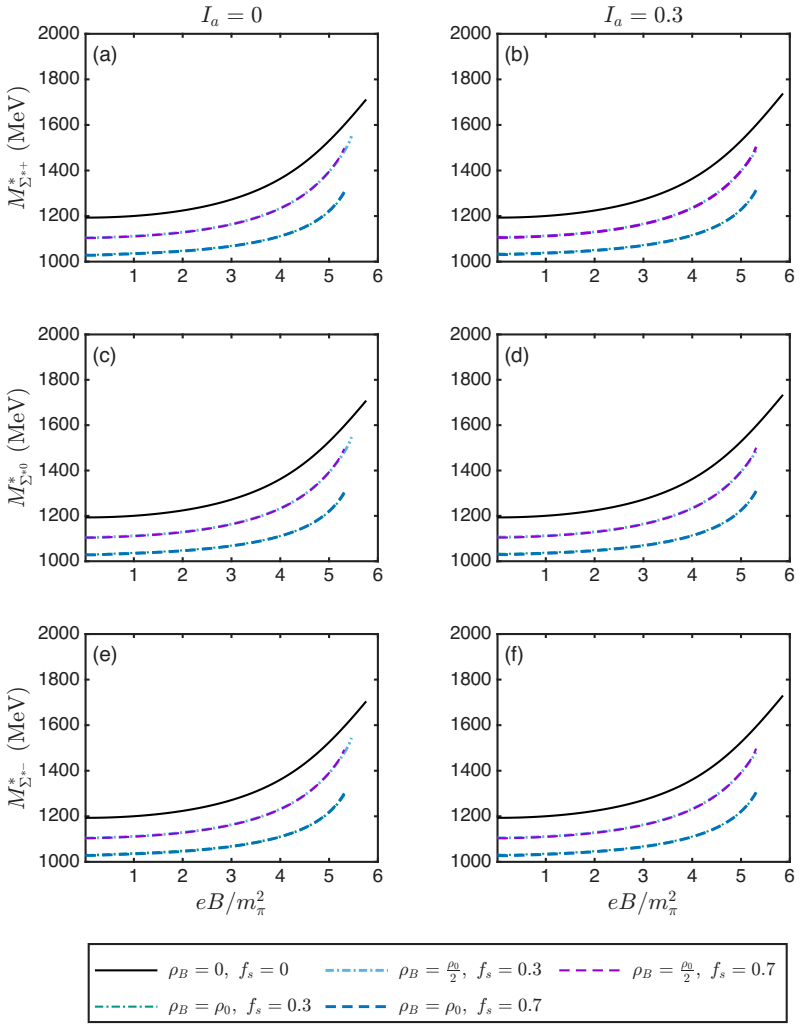
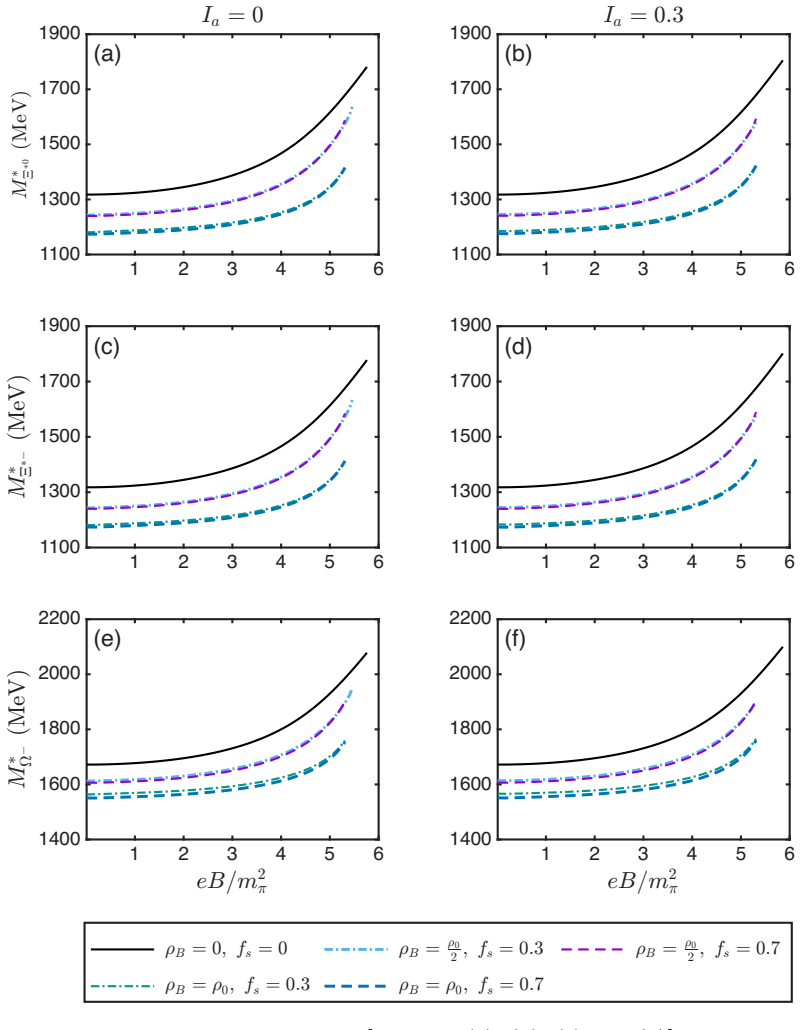
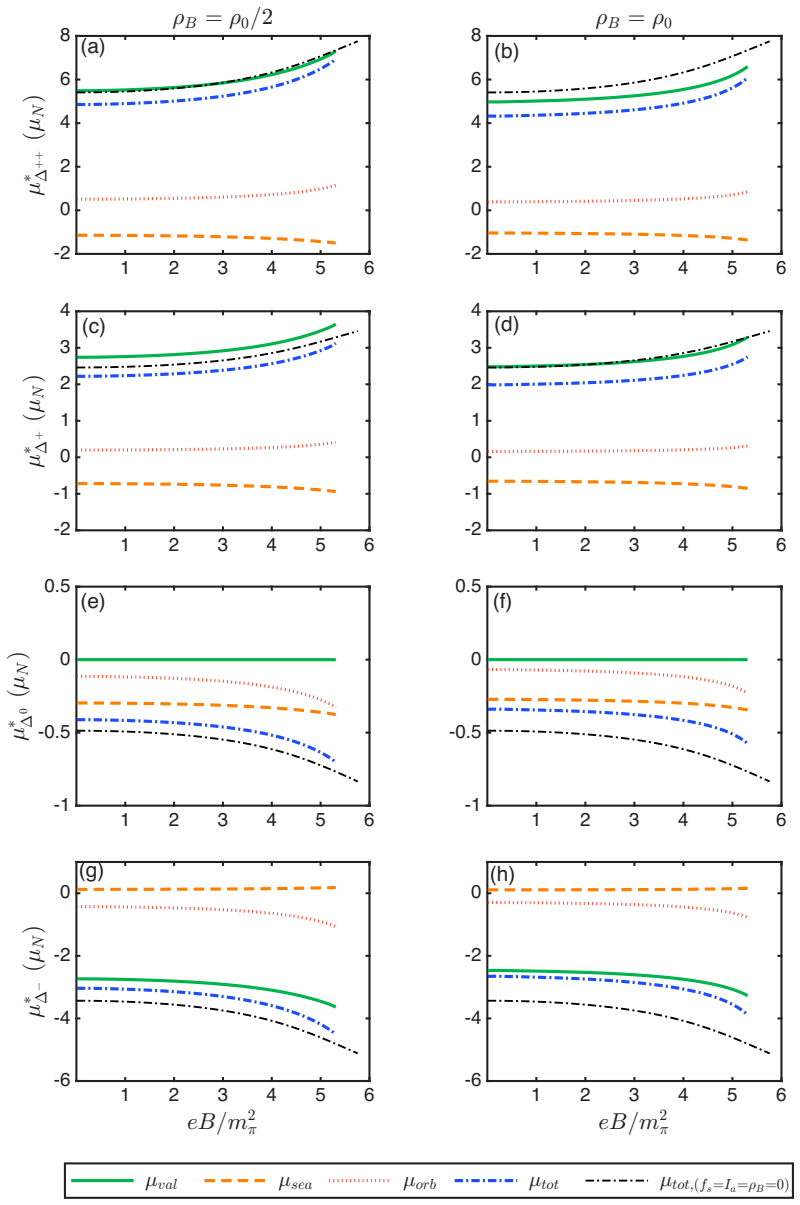
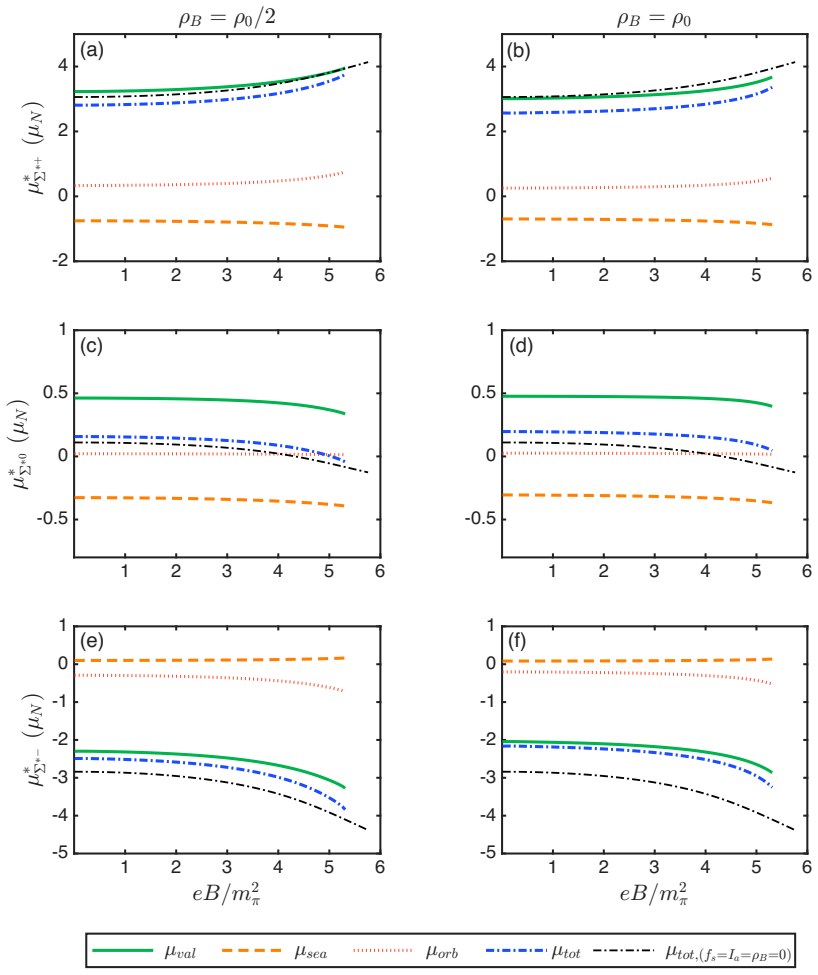
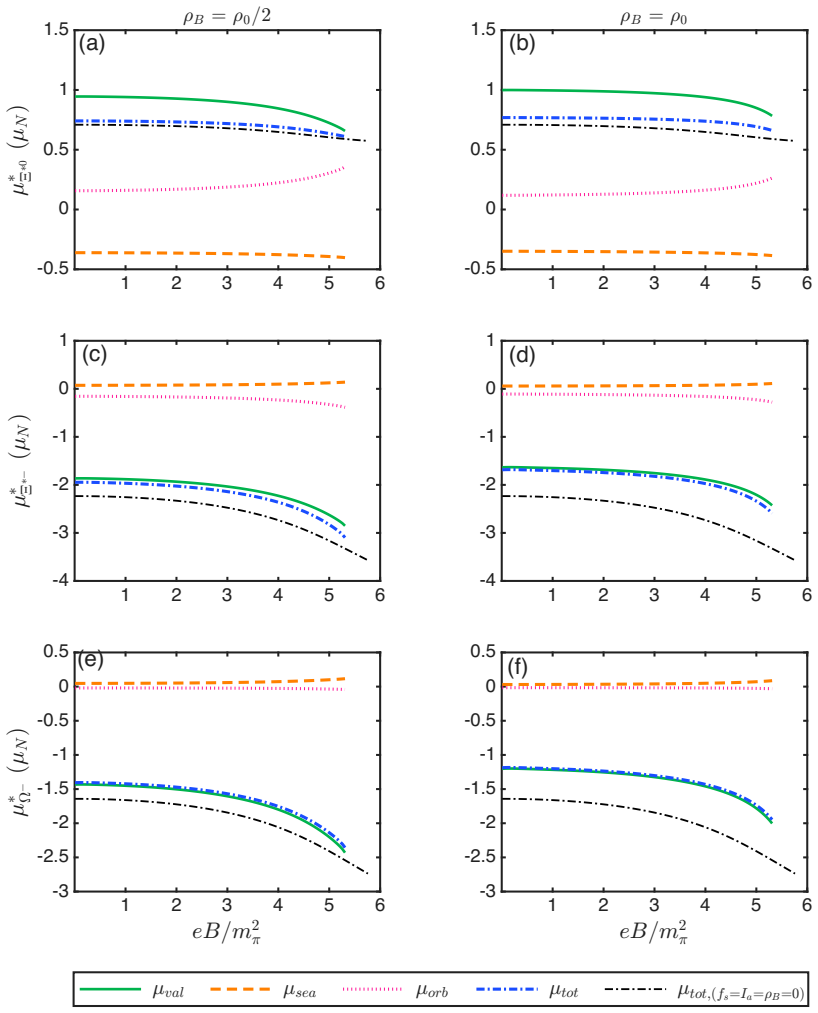
read the original abstract
We investigate the in-medium masses and magnetic moments of decuplet baryons $(\Delta,\Sigma^*,\Xi^*,\Omega^-)$ in isospin asymmetric magnetized strange matter at finite temperature within a unified chiral effective framework. Medium modifications of baryons are implemented using the chiral SU(3) quark mean-field (CQMF) model, where constituent quarks interact via scalar ($\sigma$, $\zeta$, $\delta$) and vector ($\omega$, $\rho$, $\phi$) meson fields considering the Dirac sea effects. The external magnetic field is incorporated through Landau quantization of charged particles together with anomalous magnetic moments (AMM) of baryons. The resulting in-medium mass of constituent quarks and decuplet baryons obtained from the CQMF model are subsequently employed as input to the chiral constituent quark model ($\chi$CQM) to evaluate magnetic moments of baryons. Contributions from valence quarks, sea quark spin polarizations, and orbital angular momentum of the quark sea are taken into account. Our results provide a systematic understanding of how dense, hot, and magnetized environments influence the magnetic properties of decuplet baryons.
Editorial analysis
A structured set of objections, weighed in public.
Referee Report
Summary. The paper claims to compute in-medium masses of decuplet baryons (Δ, Σ*, Ξ*, Ω-) in isospin-asymmetric magnetized strange matter at finite temperature via the chiral SU(3) quark mean-field (CQMF) model, incorporating Dirac-sea effects, Landau quantization of charged particles, and anomalous magnetic moments; these masses are then inserted as input into the chiral constituent quark model (χCQM) to obtain magnetic moments that include valence-quark, sea-quark spin-polarization, and orbital contributions.
Significance. If the transfer of CQMF masses into χCQM remains valid, the calculation supplies a concrete, systematic prediction for how combined density, temperature, isospin asymmetry, and magnetic-field effects modify decuplet magnetic moments; the explicit inclusion of Dirac-sea, Landau-level, and AMM contributions in the mass sector is a technical strength that could be falsifiable against future lattice or heavy-ion data.
major comments (1)
- [methodology section on χCQM application] The transfer step from CQMF to χCQM (described after the CQMF mass calculation): sea-polarization and orbital coefficients are taken unchanged from vacuum or simpler-medium fits and applied directly to the CQMF-derived constituent masses that already encode isospin asymmetry plus Landau quantization. No sensitivity test or re-adjustment is shown for the altered Fermi surfaces or level degeneracies; this assumption is load-bearing for all reported magnetic-moment values.
minor comments (2)
- Notation for the isospin-asymmetry parameter and the magnetic-field strength should be introduced once with explicit symbols rather than repeated descriptive phrases.
- [abstract] The abstract states a 'unified chiral effective framework' while the body employs two distinct models (CQMF then χCQM); a brief clarifying sentence on how the frameworks are linked would improve readability.
Simulated Author's Rebuttal
We thank the referee for their careful reading of the manuscript and for identifying this important methodological point. We respond below.
read point-by-point responses
-
Referee: [methodology section on χCQM application] The transfer step from CQMF to χCQM (described after the CQMF mass calculation): sea-polarization and orbital coefficients are taken unchanged from vacuum or simpler-medium fits and applied directly to the CQMF-derived constituent masses that already encode isospin asymmetry plus Landau quantization. No sensitivity test or re-adjustment is shown for the altered Fermi surfaces or level degeneracies; this assumption is load-bearing for all reported magnetic-moment values.
Authors: The sea-polarization and orbital coefficients in the χCQM are determined from the chiral symmetry breaking pattern and are fixed by fits to vacuum magnetic moments of the octet baryons; they are not readjusted for each medium. In the present hybrid framework the CQMF calculation already incorporates the full medium dependence (density, temperature, isospin asymmetry, Landau quantization, and AMM) into the constituent quark masses that serve as the sole input to the χCQM. This separation of scales—medium effects absorbed entirely in the masses, with polarization coefficients held fixed—is the standard procedure used in earlier χCQM studies of in-medium magnetic moments. Nevertheless, the referee correctly notes that no explicit sensitivity test with respect to the altered Fermi surfaces or Landau-level structure is presented. In the revised manuscript we will add a dedicated paragraph and a supplementary figure showing the variation of the decuplet magnetic moments when the sea-polarization and orbital coefficients are varied within the range allowed by their vacuum uncertainties. revision: yes
Circularity Check
No significant circularity; sequential model chain is self-contained
full rationale
The paper computes in-medium masses via the CQMF model (incorporating scalar/vector fields, Dirac sea, Landau levels, and AMM) and then inserts those masses as inputs into the χCQM formulas for valence+sea+orbital magnetic moments. No quoted equation or self-citation reduces the final magnetic-moment expressions to the CQMF inputs by algebraic identity or by re-using the same fitted parameters as the output. The two models are distinct effective frameworks; the transfer of constituent masses does not constitute a fitted-input-called-prediction or self-definitional loop. The derivation therefore remains non-circular on the paper's own terms.
Axiom & Free-Parameter Ledger
free parameters (1)
- meson-baryon coupling constants
axioms (1)
- domain assumption Chiral SU(3) symmetry governs the quark-meson interactions in the medium
Reference graph
Works this paper leans on
-
[1]
D. E. Kharzeev, L. D. McLerran, H. J. Warringa, Nucl. Phys. A803(2008) 227
2008
-
[2]
Skokov, A
V. Skokov, A. Illarionov, V. Toneev, Int. J. Mod. Phys. A24(2009) 5925
2009
-
[3]
Voronyuk,et al., Phys
V. Voronyuk,et al., Phys. Rev. C83(2011) 054911
2011
-
[4]
Bzdak, V
A. Bzdak, V. Skokov, Phys. Lett. B710(2012) 171
2012
-
[5]
Deng, X.-G
W.-T. Deng, X.-G. Huang, Phys. Rev. C85(2012) 044907
2012
-
[6]
Bloczynski, X.-G
J. Bloczynski, X.-G. Huang, X. Zhang, J. Liao, Phys. Lett. B718(2013) 1529
2013
-
[7]
McLerran, V
L. McLerran, V. Skokov, Nucl. Phys. A929(2014) 184
2014
-
[8]
Tuchin, Phys
K. Tuchin, Phys. Rev. C93(2016) 014905
2016
-
[9]
Chen, X.-L
Y. Chen, X.-L. Sheng, G.-L. Ma, Nucl. Phys. A1011(2021) 122199
2021
-
[10]
Fukushima, D
K. Fukushima, D. E. Kharzeev, H. J. Warringa, Phys. Rev. D78(2008) 074033
2008
-
[11]
G. S. Bali, F. Bruckmann, G. Endrodi, F. Gruber, A. Schafer, JHEP04(2013) 130
2013
-
[12]
D. E. Kharzeev, D. T. Son, Phys. Rev. Lett.106(2011) 062301
2011
-
[13]
D. E. Kharzeev, J. Liao, S. A. Voloshin, G. Wang, Prog. Part. Nucl. Phys.88(2016) 1
2016
-
[14]
D. E. Kharzeev, J. Liao, Nat. Rev. Phys.3(2021) 55
2021
-
[15]
Huang, Rep
X.-G. Huang, Rep. Prog. Phys.79(2016) 076302
2016
-
[16]
V. P. Gusynin, V. A. Miransky, I. A. Shovkovy, Nucl. Phys. B462(1996) 249
1996
-
[17]
V. A. Miransky, I. A. Shovkovy, Phys. Rev. D66(2002) 045006
2002
-
[18]
G. S. Bali,et al., Phys. Rev. D86(2012) 071502
2012
-
[19]
W. Li, G. Wang, Annu. Rev. Nucl. Part. Sci.70(2020) 293
2020
-
[20]
Huang,et al., Phys
A. Huang,et al., Phys. Rev. C107(2023) 034901
2023
-
[21]
Fukushima, Prog
K. Fukushima, Prog. Part. Nucl. Phys.107(2019) 167. 30
2019
-
[22]
I. A. Shovkovy, Particles5(2022) 442
2022
-
[23]
Taya, Phys
H. Taya, Phys. Rev. D92(2015) 014038
2015
-
[24]
N. O. Agasian, S. M. Fedorov, Phys. Lett. B663(2008) 445
2008
-
[25]
G. S. Bali,et al., JHEP02(2012) 044
2012
-
[26]
E. J. Ferrer,et al., Phys. Rev. D89(2014) 085034
2014
-
[27]
Fayazbakhsh,et al., Phys
S. Fayazbakhsh,et al., Phys. Rev. D90(2014) 105030
2014
-
[28]
E. S. Fraga, L. F. Palhares, C. Villavicencio, Phys. Rev. D109(11) (2024) 116018
2024
-
[29]
Fajfer, R
S. Fajfer, R. J. Oakes, Phys. Rev. D28(1983) 2881
1983
-
[30]
A. E. Broderick, M. Prakash, J. M. Lattimer, Phys. Lett. B531(2002) 167
2002
-
[31]
Sinha, B
M. Sinha, B. Mukhopadhyay, A. Sedrakian, Nucl. Phys. A898(2013) 43
2013
-
[32]
Rabhi, P
A. Rabhi, P. K. Panda, C. Providencia, Phys. Rev. C84(2011) 035803
2011
-
[33]
D. P. Menezes,et al., Phys. Rev. C79(2009) 035807
2009
-
[34]
Moreira, P
J. Moreira, P. Costa, T. E. Restrepo, Eur. Phys. J. A57(2021) 123
2021
-
[35]
Wang, X.-J
Y. Wang, X.-J. Wen, Phys. Rev. D105(2022) 074034
2022
-
[36]
P. Yue, H. Shen, Phys. Rev. C77(2008) 045804
2008
-
[37]
Dexheimer, R
V. Dexheimer, R. Negreiros, S. Schramm, Eur. Phys. J. A48(2012) 189
2012
-
[38]
Chahal, S
N. Chahal, S. Dutt, A. Kumar, Phys. Rev. C107(2023) 045203
2023
-
[39]
P. C. Chu,et al., Phys. Lett. B778(2018) 447
2018
-
[40]
D. P. Menezes,et al., Phys. Rev. C80(2009) 065805
2009
-
[41]
Haber, F
A. Haber, F. Preis, A. Schmitt, Phys. Rev. D90(2014) 125036
2014
-
[42]
Mukherjee, S
A. Mukherjee, S. Ghosh, M. Mandal,et al., Phys. Rev. D98(2018) 056024
2018
-
[43]
R. M. Aguirre, A. L. De Paoli, Eur. Phys. J. A52(2016) 343
2016
-
[44]
R. M. Aguirre, Phys. Rev. C100(2019) 065203
2019
-
[45]
M. J. Savage, Nucl. Phys. A700(2002) 359
2002
-
[46]
D. B. Leinweber, T. Draper, R. M. Woloshyn, Phys. Rev. D46(1992) 3067
1992
-
[47]
Alexandrou, T
C. Alexandrou, T. Korzec, G. Koutsou, T. Leontiou, Phys. Rev. D79(2009) 014507
2009
-
[48]
Tsushima, K
K. Tsushima, K. Saito, J. Haidenbauer, A. W. Thomas, Nucl. Phys. A630(1998) 691
1998
-
[49]
Tsushima, Prog
K. Tsushima, Prog. Theor. Exp. Phys.2022(2022) 043D02
2022
-
[50]
L. S. Geng, J. M. Camalich, M. J. V. Vacas, Phys. Rev. D80(2009) 034027
2009
-
[51]
Flores Mendieta, Phys
R. Flores Mendieta, Phys. Rev. D80(2009) 094014
2009
-
[52]
F. X. Lee, R. Kelly, L. Zhou, W. Wilcox, Phys. Lett. B627(2005) 71. 31
2005
-
[53]
Singh, A
H. Singh, A. Kumar, H. Dahiya, Chinese Phys. C41(2017) 094104
2017
-
[54]
Singh, A
H. Singh, A. Kumar, H. Dahiya, Eur. Phys. J. Plus134(2019) 128
2019
-
[55]
Singh, A
H. Singh, A. Kumar, H. Dahiya, Eur. Phys. J. A54(2018) 120
2018
-
[56]
Singh, A
H. Singh, A. Kumar, H. Dahiya, Eur. Phys. J. Plus135(2020) 422
2020
-
[57]
Sharma,et al., Phys
N. Sharma,et al., Phys. Rev. D81(2010) 073001
2010
-
[58]
Gridhar, H
A. Gridhar, H. Dahiya, M. Randhawa, Phys. Rev. D92(2015) 033012
2015
-
[59]
A. Kaur, A. Upadhyay, Eur. Phys. J. A52(2016) 105
2016
-
[60]
Rezaei, Int
Z. Rezaei, Int. J. Mod. Phys. E27(2018) 1850011
2018
-
[61]
C. Y. Ryu, K. S. Kim, Phys. Rev. C82(2010) 025804
2010
-
[62]
Fu, B.-D
D. Fu, B.-D. Sun, Y. Dong, Phys. Rev. D105(2022) 096002
2022
-
[63]
Wen, Y.-K
L.-Z. Wen, Y.-K. Chen, L. Meng, S.-L. Zhu, Eur. Phys. J. C85(2025) 1210
2025
-
[64]
Manohar, H
A. Manohar, H. Georgi, Nucl. Phys. B234(1984) 189
1984
-
[65]
T. P. Cheng, L.-F. Li, Phys. Rev. Lett.80(1998) 2789
1998
-
[66]
Bernard, N
V. Bernard, N. Kaiser, U.-G. Meissner, Int. J. Mod. Phys. E4(1995) 193
1995
-
[67]
R. K. Sahoo, A. R. Panda, A. Nath, Phys. Rev. D52(1995) 4099
1995
-
[68]
A. J. Buchmann, E. M. Henley, Phys. Rev. D65(2002) 073017
2002
-
[69]
Ledwig, A
T. Ledwig, A. Silva, M. Vanderhaeghen, Phys. Rev. D79(2009) 094025
2009
-
[70]
Bosshard,et al., Phys
A. Bosshard,et al., Phys. Rev. D44(1991) 1962
1991
-
[71]
H. T. Diehl,et al., Phys. Rev. Lett.67(1991) 804
1991
-
[72]
N. B. Wallace,et al., Phys. Rev. Lett.74(1995) 3732
1995
-
[73]
Kotulla,et al., Phys
M. Kotulla,et al., Phys. Rev. Lett.89(2002) 272001
2002
-
[74]
Schlumpf, Phys
F. Schlumpf, Phys. Rev. D48(1993) 4478
1993
-
[75]
F. X. Lee, Phys. Rev. D57(1998) 1801
1998
-
[76]
Linde, T
J. Linde, T. Ohlsson, H. Snellman, Phys. Rev. D57(1998) 452
1998
-
[77]
Dahiya, M
H. Dahiya, M. Gupta, Phys. Rev. D67(2003) 114015
2003
-
[78]
Dahiya, JPS Conf
H. Dahiya, JPS Conf. Proc.26(2019) 021019
2019
-
[79]
Kumar, S
A. Kumar, S. Dutt, H. Dahiya, Eur. Phys. J. A60(2024) 4
2024
- [80]
discussion (0)
Sign in with ORCID, Apple, or X to comment. Anyone can read and Pith papers without signing in.