Controlled chemical vapor deposition for synthesis of emerging Mo(W)Te2 systems
Pith reviewed 2026-06-26 03:49 UTC · model grok-4.3
The pith
A confined-space CVD method produces high-quality Mo(W)Te2 single crystals, alloys, and heterostructures with sharp interfaces at lower temperatures.
A machine-rendered reading of the paper's core claim, the machinery that carries it, and where it could break.
Core claim
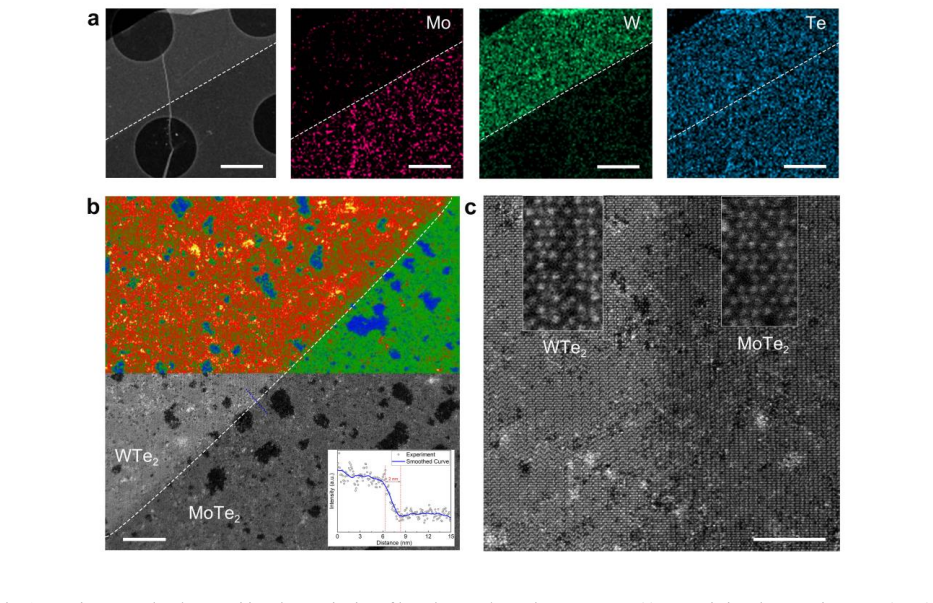
The authors establish that confining the reaction space during chemical vapor deposition, combined with tailored precursor configurations and stepwise thermal ramps, enables deterministic growth of high-quality Mo(W)Te2 crystals and heterostructures. Atomic-resolution STEM imaging of lattice-matched lateral heterostructures reveals seamless, compositionally sharp boundaries. Scanning tunneling microscopy and spectroscopy further map the real-space distribution of local density of states across these boundaries, confirming the method creates clean, reproducible heterointerfaces suitable for quantum and topological studies.
What carries the argument
The confined-space chemical vapor deposition strategy with tailored precursor configurations and stepwise thermal ramps that together lower the growth temperature and control crystal formation.
If this is right
- Reproducible fabrication of clean heterointerfaces becomes possible without the limitations of exfoliated samples.
- An in-situ experimental system is created for studying crystalline Te-based structures with controlled geometry and stacking.
- Direct imaging of seamless boundaries and their local density of states distributions is enabled by STM and STS.
- A scalable route is opened for engineering transition metal ditelluride platforms aimed at quantum and topological devices.
Where Pith is reading between the lines
- The temperature reduction could make integration with temperature-sensitive substrates or existing device layers more feasible.
- Sharp lateral interfaces might host new boundary-localized electronic states that could be probed for topological signatures.
- If the precursor and ramp controls generalize, similar confined-space methods might address synthesis challenges in other polymorphic 2D tellurides.
Load-bearing premise
The chosen combination of confined geometry, precursor placement, and heating profiles will reliably produce high-quality crystals and atomically sharp interfaces without introducing defects or thickness variations.
What would settle it
Repeated observation of thickness nonuniformity, diffuse composition boundaries, or uncontrolled defects in multiple batches grown under the described conditions would falsify the deterministic high-quality synthesis claim.
Figures
read the original abstract
The Group-VI transition metal ditellurides offer a rich platform for correlated and topological phenomena, yet their structural polymorphism and instability complicate the creation of single crystals and heterointerfaces. Here, we introduce a confined-space chemical vapor deposition (CVD) strategy that lowers the growth temperature window and, when combined with tailored precursor configurations and stepwise thermal ramps, enables the deterministic synthesis of high-quality single crystals, alloys, and lateral/vertical heterostructures. High-resolution aberration-corrected STEM provides atomic characterization of lattice-matched Mo(W)Te2 lateral heterostructure, revealing nearly atomically sharp, compositionally well-defined seamless boundaries. This approach avoids the thickness nonuniformity and structural limitations commonly associated with exfoliated samples, enabling reproducible fabrication of clean heterointerfaces and establishing a nearly ideal in-situ experimental system. Furthermore, scanning tunneling microscopy and spectroscopy (STM and STS) enable direct imaging of the seamless boundaries in Mo(W)Te2 lateral heterostructures, while uncovering their distinct real-space distributions of the local density of states. Our results establish a scalable pathway for engineering crystalline Te-based structures with controlled geometry and stacking, providing an essential step toward quantum and topological device platforms based on the transition metal ditellurides family.
Editorial analysis
A structured set of objections, weighed in public.
Referee Report
Summary. The manuscript presents a confined-space CVD growth strategy for Mo(W)Te2 that lowers the temperature window via tailored precursor placement and stepwise thermal ramps. This is claimed to enable deterministic, high-quality synthesis of single crystals, alloys, and lateral/vertical heterostructures with atomically sharp interfaces, as verified by aberration-corrected STEM (lattice-matched boundaries) and STM/STS (local density of states). The approach is positioned as overcoming exfoliation-related nonuniformity and providing a scalable route to clean Te-based heterointerfaces for quantum devices.
Significance. If the reproducibility and interface quality claims hold, the work would supply a practical in-situ route to polymorphic and heterostructured ditellurides that are otherwise difficult to prepare cleanly, directly supporting experimental studies of correlated and topological states in this family. The explicit use of atomic-resolution STEM and STS for boundary characterization is a concrete strength.
major comments (2)
- [Abstract, §3] Abstract and §3 (growth strategy): the central claim that the specific combination of confined-space geometry, precursor configurations, and thermal ramps produces 'deterministic' high-quality crystals and 'atomically sharp' interfaces without uncontrolled defects or thickness variations is load-bearing, yet no quantitative reproducibility metrics (growth yield, defect-density histograms across ≥10 samples, batch variation, or direct comparison to standard CVD) are provided to anchor this reliability.
- [§4] §4 (characterization): while STEM images show lattice-matched boundaries, the manuscript does not report statistical measures of interface sharpness (e.g., composition profiles averaged over multiple boundaries or rms roughness values) or thickness uniformity statistics, leaving the 'nearly atomically sharp' and 'seamless' descriptors without the quantitative support required for the deterministic-synthesis claim.
minor comments (2)
- [Methods, Figure 2] Figure captions and methods: precursor masses, ramp rates, and confined-space dimensions should be tabulated with explicit ranges rather than qualitative descriptions to allow reproduction.
- [Throughout] Notation: 'Mo(W)Te2' is used inconsistently for both alloys and heterostructures; a clearer distinction in the text and figures would reduce ambiguity.
Simulated Author's Rebuttal
We thank the referee for the constructive and detailed review. We address the two major comments point by point below, agreeing that additional quantitative metrics will strengthen the manuscript.
read point-by-point responses
-
Referee: [Abstract, §3] Abstract and §3 (growth strategy): the central claim that the specific combination of confined-space geometry, precursor configurations, and thermal ramps produces 'deterministic' high-quality crystals and 'atomically sharp' interfaces without uncontrolled defects or thickness variations is load-bearing, yet no quantitative reproducibility metrics (growth yield, defect-density histograms across ≥10 samples, batch variation, or direct comparison to standard CVD) are provided to anchor this reliability.
Authors: We agree that the manuscript would benefit from explicit quantitative reproducibility metrics. In the revised version we will add growth-yield statistics compiled from multiple independent runs, defect-density histograms derived from STEM images of at least ten samples, batch-to-batch variation data, and, where direct experimental comparison is feasible, a side-by-side assessment against standard CVD conditions. These additions will be placed in the main text or as supplementary material to better anchor the deterministic-synthesis claim. revision: yes
-
Referee: [§4] §4 (characterization): while STEM images show lattice-matched boundaries, the manuscript does not report statistical measures of interface sharpness (e.g., composition profiles averaged over multiple boundaries or rms roughness values) or thickness uniformity statistics, leaving the 'nearly atomically sharp' and 'seamless' descriptors without the quantitative support required for the deterministic-synthesis claim.
Authors: We concur that statistical quantification of interface sharpness and thickness uniformity is needed to support the descriptors used. The revised manuscript will include averaged composition profiles obtained from multiple heterostructure boundaries, rms roughness values extracted at the interfaces, and thickness-uniformity statistics across the crystals. These metrics will be generated from re-analysis of the existing aberration-corrected STEM datasets together with any additional measurements required. revision: yes
Circularity Check
No circularity: experimental synthesis description with no derivations or self-referential predictions
full rationale
The manuscript is a purely experimental report on a confined-space CVD growth protocol for Mo(W)Te2 crystals and heterostructures. The abstract and provided text contain no equations, fitted parameters, uniqueness theorems, ansatzes, or predictions that reduce to prior inputs by construction. The central claim rests on reported growth conditions plus STEM/STM characterization; no derivation chain exists that could be circular. Self-citations are absent from the excerpt, and the work is self-contained against external benchmarks of material quality.
Axiom & Free-Parameter Ledger
axioms (1)
- domain assumption Standard assumptions in chemical vapor deposition for 2D transition metal dichalcogenides regarding precursor volatility and substrate interactions
Reference graph
Works this paper leans on
-
[1]
Zhou, J., et al., Nature 556 (2018) 355
2018
-
[2]
Manzeli, S., et al., Nat. Rev. Mater. 2 (2017) 17033
2017
-
[3]
Today 20 (2017) 116
Choi, W., et al., Mater. Today 20 (2017) 116
2017
-
[4]
Qian, X., et al., Science 346 (2014) 1344
2014
-
[5]
Deng, Y., et al., ACS Nano 15 (2021) 12465
2021
-
[6]
A., et al., Nature 527 (2015) 495
Soluyanov, A. A., et al., Nature 527 (2015) 495
2015
-
[7]
Zhou, J., et al., Adv. Mater. 29 (2017) 1603471
2017
-
[8]
Wang, Z., et al., Phys. Rev. Lett. 117 (2016) 056805
2016
-
[9]
Kang, K., et al., Nature 628 (2024) 522
2024
-
[10]
Singh, S., et al., Phys. Rev. Lett. 125 (2020) 046402
2020
-
[11]
Jia, Y., et al., Nat. Phys. 18 (2022) 87
2022
-
[12]
Li, P., et al., Nat. Commun. 8 (2017) 2150
2017
-
[13]
Fei, Z., et al., Nat. Phys. 13 (2017) 677
2017
-
[14]
N., et al., Nature 514 (2014) 205
Ali, M. N., et al., Nature 514 (2014) 205
2014
-
[15]
Wang, Y., et al., Nature 550 (2017) 487
2017
-
[16]
Kang, K., et al., Nat. Mater. 18 (2019) 324
2019
-
[17]
Wang, W., et al., Science 368 (2020) 534
2020
-
[18]
Ohfuchi, M., and Sekine, A., ACS Applied Nano Materials 6 (2023) 2020
2023
-
[19]
L., et al., Nat
Hart, J. L., et al., Nat. Commun. 14 (2023) 4803
2023
-
[20]
G., and Bullett, D
Dawson, W. G., and Bullett, D. W., J. Phys. C: Solid State Physics 20 (1987) 6159
1987
-
[21]
Kim, H.-J., et al., Phys. Rev. B 95 (2017) 180101
2017
-
[22]
Li, M.-Y., et al., Science 349 (2015) 524
2015
-
[23]
Nanotechnol
Zhang, C., et al., Nat. Nanotechnol. 13 (2018) 152
2018
-
[24]
Chen, J., et al., ACS Nano 11 (2017) 3282
2017
-
[25]
Peng, L., et al., Nat. Commun. 8 (2017) 659. Fig. 1. Synthesis and morphologies of diverse Mo(W)Te 2 systems. (a) Schematic illustration of three types of precursor configurations for synthesizing Mo(W)Te2 systems. (b-e) Typical optical images and corresponding atomic structural models (viewed from top and front directions) of synthesized single crystal f...
2017
discussion (0)
Sign in with ORCID, Apple, or X to comment. Anyone can read and Pith papers without signing in.