Rashba and Electrostatic Control of Charge-Visible Spin Demons in Two-Dimensional d-Wave Altermagnets
Pith reviewed 2026-06-26 03:17 UTC · model grok-4.3
The pith
Rashba spin-orbit coupling combined with electrostatic gating gives spin demons finite charge visibility while preserving their dominant spin character.
A machine-rendered reading of the paper's core claim, the machinery that carries it, and where it could break.
Core claim
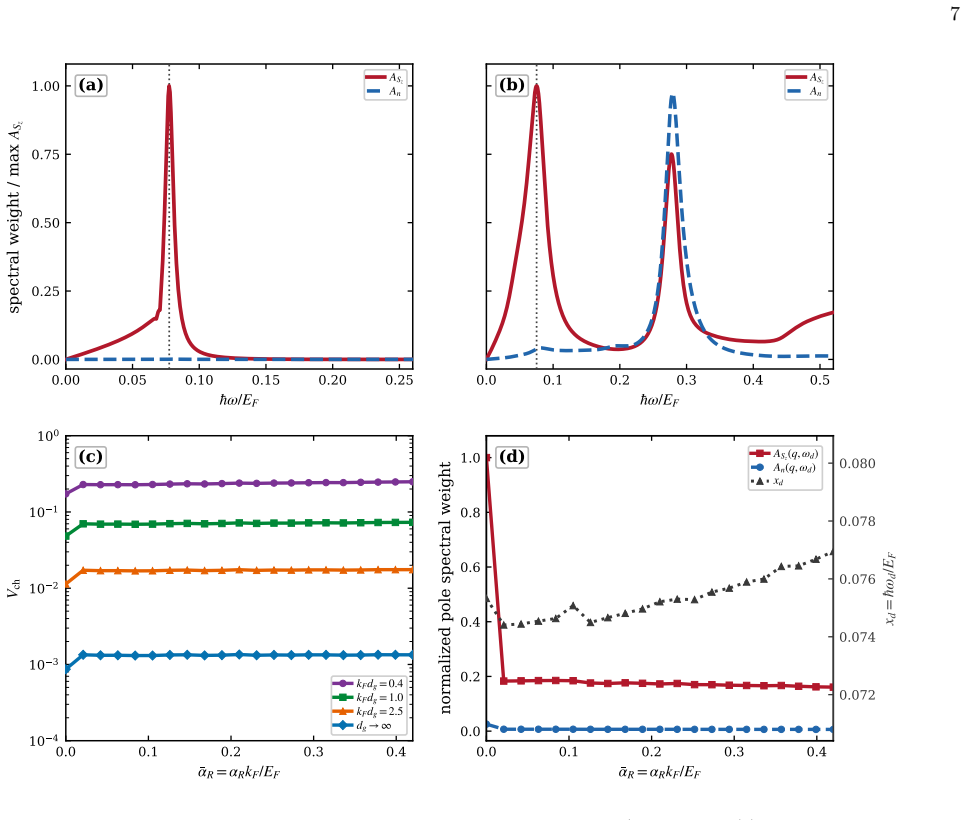
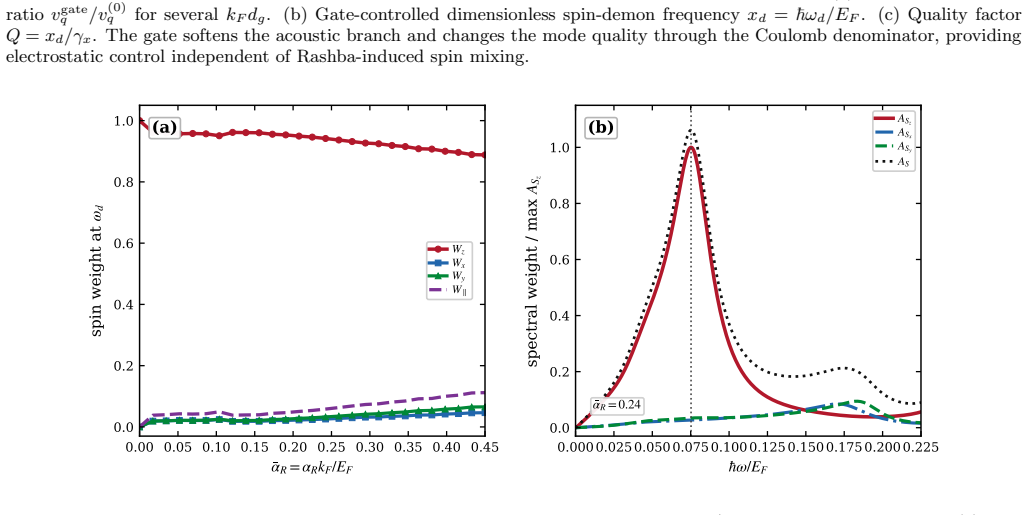
Within a Rashba-altermagnetic continuum model and random phase approximation, the originally charge-dark longitudinal spin demon acquires finite charge spectral weight while remaining predominantly spin-like; electrostatic gate screening provides independent control of the Coulomb feedback that tunes the collective-mode dispersion and quality factor, with parameter scans revealing regimes where the excitation stays underdamped yet more accessible to charge probes.
What carries the argument
Rashba-altermagnetic continuum model plus random-phase approximation for mixed density-spin susceptibilities, in which Rashba terms convert the spin-conserving problem into a generalized charge-spin response problem.
If this is right
- The spin-demon ridge survives moderate spin-orbit mixing.
- It develops a finite charge-visibility ratio.
- It retains dominant Sz character over the relevant control range.
- A trade-off appears between charge visibility and mode quality factor.
- Regimes exist where the mode remains underdamped while becoming accessible to charge probes.
Where Pith is reading between the lines
- The same control knobs could be tested in other altermagnetic lattices once lattice effects are added to the model.
- Charge-visible spin demons might couple to nearby superconducting or magnetic layers in heterostructures.
- Gate-tunable dispersion offers a route to match the mode frequency to external microwave or optical probes.
Load-bearing premise
The continuum model and random-phase approximation capture the essential mixed charge-spin susceptibilities and mode stability without lattice effects or higher-order interactions.
What would settle it
Direct computation or measurement of the charge susceptibility showing a ridge with finite charge weight at the predicted wave-vectors and frequencies for moderate Rashba strength and finite gate distance.
Figures
read the original abstract
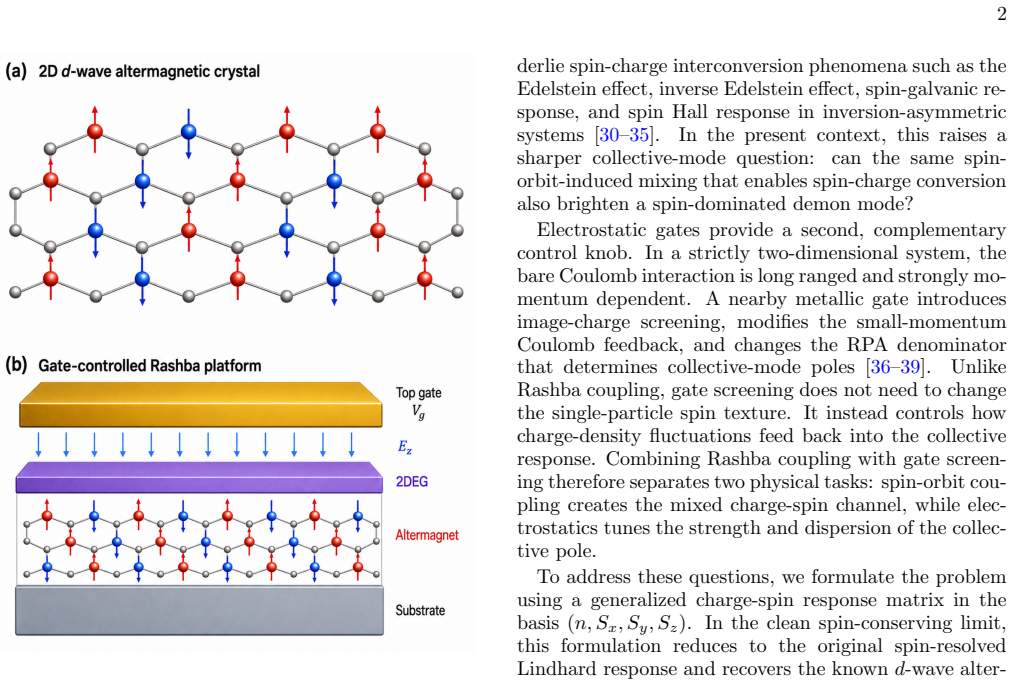
Spin demons in d-wave altermagnets are acoustic collective modes formed by nearly out-of-phase oscillations of spin-split quasiparticle populations. Their weak net charge fluctuation makes them long lived, but also makes them difficult to access with charge-sensitive probes. We propose a route to tune and brighten these modes in a two-dimensional d-wave altermagnet by combining Rashba spin-orbit coupling with electrostatic gate screening. Rashba coupling converts the spin-conserving problem into a generalized charge-spin response problem, in which mixed susceptibilities between density and spin channels become finite. As a result, the originally charge-dark longitudinal spin demon acquires finite charge spectral weight while remaining predominantly spin-like. Electrostatic gate screening provides an independent control of the Coulomb feedback and tunes the collectivemode dispersion and quality factor. Within a Rashba-altermagnetic continuum model and randomphase approximation, we show that the spin-demon ridge survives moderate spin-orbit mixing, develops a finite charge-visibility ratio, and retains dominant Sz character over the relevant control range. Parameter scans in Rashba strength and gate distance reveal a trade-off between charge visibility and mode quality, identifying regimes where the excitation remains underdamped while becoming more accessible to charge probes. These results establish Rashba spin-orbit coupling and electrostatic screening as control mechanisms for tunable, charge-visible spin demons in twodimensional altermagnetic platforms.
Editorial analysis
A structured set of objections, weighed in public.
Referee Report
Summary. The manuscript proposes Rashba spin-orbit coupling combined with electrostatic gate screening as a means to impart finite charge visibility to spin-demon collective modes in two-dimensional d-wave altermagnets while preserving their predominantly spin-like character. Within a Rashba-altermagnetic continuum model treated in the random phase approximation, parameter scans over Rashba strength and gate distance are used to show that the spin-demon ridge survives moderate spin-orbit mixing, acquires a finite charge-visibility ratio, and remains underdamped in identifiable regimes.
Significance. If the model calculations hold, the work supplies a concrete, tunable route to make spin demons accessible to charge-sensitive probes without destroying their spin character or stability. The explicit demonstration of a visibility-quality trade-off via two independent control parameters (Rashba strength and gate distance) constitutes a strength, offering falsifiable predictions that can guide subsequent microscopic calculations or experiments in altermagnetic platforms.
minor comments (3)
- The abstract and introduction refer to 'charge-visibility ratio' and 'dominant Sz character' without defining the precise observables (e.g., the ratio of charge to spin spectral weights or the integrated Sz weight) that are plotted or tabulated later; a short definitions paragraph or equation reference would improve clarity.
- Figure captions and axis labels should explicitly state the units and normalization used for the susceptibility components and the quality factor; this is especially important for the parameter scans in Rashba strength and gate distance.
- A brief statement on the range of validity of the continuum approximation (e.g., relative to lattice scale or Fermi wavelength) would help readers assess the applicability of the reported dispersions.
Simulated Author's Rebuttal
We thank the referee for the positive assessment of our manuscript and for recommending minor revision. The referee's summary accurately reflects the central results on Rashba-enabled charge visibility of spin demons and the independent tuning via gate screening. No specific major comments were raised in the report.
Circularity Check
No significant circularity detected
full rationale
The paper's claims are scoped explicitly to numerical results obtained inside a Rashba-altermagnetic continuum model treated in RPA. No load-bearing step reduces by construction to a fitted parameter, self-definition, or self-citation chain; the mixed susceptibilities and mode properties follow directly from the stated model Hamiltonian and approximation without circular renaming or imported uniqueness theorems. The derivation chain is therefore self-contained against external benchmarks.
Axiom & Free-Parameter Ledger
free parameters (2)
- Rashba strength
- gate distance
axioms (2)
- domain assumption Random phase approximation suffices to capture the charge-spin response functions
- domain assumption Continuum model captures the essential physics of 2D d-wave altermagnets
Reference graph
Works this paper leans on
-
[1]
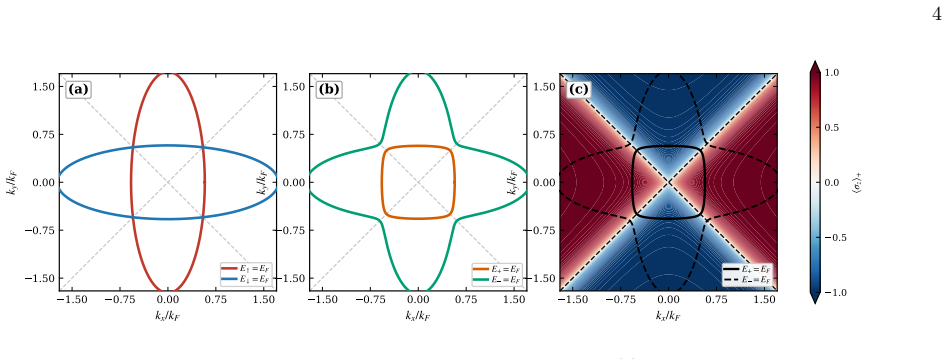
This sign-changingd- wave structure is the origin of the rotated spin-resolved Fermi contours and of the angular separation between the particle-hole continua
Clean two-dimensionald-wave altermagnet The spin-conserving reference Hamiltonian is H0(k) =ϵ 0(k)I+ ∆ d(k)σz,(A1) with ϵ0(k) = ℏ2k2 2m0 ,∆ d(k) = ℏ2 2m∗ (k2 x −k 2 y).(A2) In the absence of Rashba coupling,σ z is conserved and the two spin-resolved dispersions are Eσ(k) = ℏ2k2 2m0 +σ ℏ2 2m∗ (k2 x −k 2 y), σ=±1.(A3) Writingk=k(cosφ,sinφ) gives k2 x −k 2 y...
-
[2]
We use it to define the reference Fermi wave vector, Fermi velocity, and density of states per spin, kF = √2mDOSEF ℏ , v F = ℏkF mDOS , N 0 = mDOS 2πℏ2
Reference scales and dimensionless variables The two-dimensional density-of-states mass associated with either spin ellipse is mDOS =pmσxmσy = m0m∗ p (m∗)2 −m 2 0 .(A10) This quantity is independent ofσbecause the two spin ellipses have the same area in the rescaled momentum coordinates. We use it to define the reference Fermi wave vector, Fermi velocity,...
-
[3]
Therefore the Rashba-altermagnetic band energies are Eλ(k) =ϵ 0(k) +λ q ∆2 d(k) +α 2 Rk2, λ=±1.(A25) We now rewrite Eq
Rashba-coupled Hamiltonian The Rashba-extended model is H(k) =ϵ 0(k)I+ ∆ d(k)σz +α R(kyσx −k xσy).(A20) Equivalently, H(k) =ϵ 0(k)I+d(k)·σ,(A21) with d(k) = (αRky,−α Rkx,∆ d(k)).(A22) The magnitude of this vector is d(k) =|d(k)|= q ∆2 d(k) +α 2 Rk2.(A23) Since the traceless part obeys [d(k)·σ] 2 =d 2(k)I,(A24) its eigenvalues areλd(k), withλ=±1. Therefore...
-
[4]
Band projectors and spin texture The projectors onto the two Rashba bands are Pλ(k) = 1 2 h I+λ ˆd(k)·σ i , ˆd(k) = d(k) d(k) .(A30) These projectors are used later to write the charge-spin coherence factors in a basis-independent form. The spin expectation value in bandλis ⟨σ⟩λ = Tr [Pλ(k)σ] =λ ˆd(k).(A31) Therefore, ⟨σx⟩λ =λ αRkyp ∆2 d +α 2 Rk2 , ⟨σy⟩λ ...
-
[5]
(A29), this condition is 1 =A 0κ2 +λ q A2 dκ4 cos2 2φ+ ¯α2 Rκ2.(A36) Lettingy=κ 2, Eq
Rashba-modified Fermi contours The Rashba Fermi contours satisfy Eλ(k) =E F .(A35) Using Eq. (A29), this condition is 1 =A 0κ2 +λ q A2 dκ4 cos2 2φ+ ¯α2 Rκ2.(A36) Lettingy=κ 2, Eq. (A36) can be written as 1−A 0y=λ q A2 dy2 cos2 2φ+ ¯α2 Ry.(A37) Squaring both sides gives (1−A 0y)2 =A 2 dy2 cos2 2φ+ ¯α2 Ry.(A38) After collecting powers ofy, one obtains A2 0 ...
-
[6]
With ck denoting a two-component spinor in spin space, the corresponding generalized density operator is ρa(q) = X k c† k+qΓack.(B2) Fora=n, this is the ordinary density operator
Charge-spin operators We use the four vertices Γn =I,Γ x =σ x,Γ y =σ y,Γ z =σ z.(B1) The indexa∈ {n, x, y, z}therefore labels either the charge channel or one of the three spin channels. With ck denoting a two-component spinor in spin space, the corresponding generalized density operator is ρa(q) = X k c† k+qΓack.(B2) Fora=n, this is the ordinary density ...
-
[7]
Ex- panding Eq
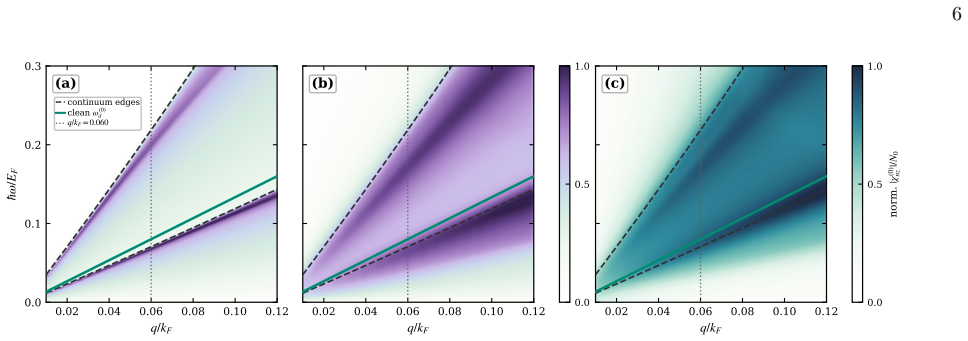
Bare generalized susceptibility Let|u λk⟩be the eigenstate of the Rashba-altermagnet Hamiltonian in bandλ=±1, with energyE λ(k). Ex- panding Eq. (B2) in the band basis gives the generalized bare Lindhard function χ(0) ab (q, ω) = 1 A X k,λ,λ′ f[E λ(k)]−f[E λ′(k+q)] ℏω+E λ(k)−E λ′(k+q) +iΓ ×M ab λλ′(k,q). (B4) HereAis the sample area,f(E) is the Fermi func...
-
[8]
To avoid gauge-dependent expres- sions, we evaluate the coherence factors using band pro- jectors
Gauge-invariant coherence factors The explicit phases of the Rashba spinors are not phys- ically meaningful. To avoid gauge-dependent expres- sions, we evaluate the coherence factors using band pro- jectors. With Pλ(k) = 1 2 h I+λ ˆd(k)·σ i ,(B9) the coherence factor can be written as M ab λλ′(k,q) = Tr [Pλ(k)ΓaPλ′(k+q)Γ b].(B10) Define n= ˆd(k),n ′ = ˆd(...
-
[9]
This iden- tity is useful for checking the numerical implementation
Symmetry and clean-limit checks The response functions satisfy the retarded-response relation χ(0) ab (q, ω) = h χ(0) ba (−q,−ω) i∗ (B20) when the same broadening convention is used. This iden- tity is useful for checking the numerical implementation. In the limitα R →0, the eigenstates become eigen- states ofσ z away from the nodal lines. The generalized...
-
[10]
Therefore, in the basis (n, x, y, z), Vab(q) =v q δanδbn.(B23) Herev q can be the bare two-dimensional Coulomb inter- action or the gate-screened interaction
RPA response in the charge-spin basis The Coulomb interaction couples to charge density only. Therefore, in the basis (n, x, y, z), Vab(q) =v q δanδbn.(B23) Herev q can be the bare two-dimensional Coulomb inter- action or the gate-screened interaction. The RPA Dyson equation is χRPA =χ (0) +χ (0)V χRPA.(B24) Solving this matrix equation gives χRPA = h I−χ...
-
[11]
Recovery of the clean spin-demon response The matrix formula also reproduces the spin- conserving result. Define S=χ (0) ↑ +χ (0) ↓ , D=χ (0) ↑ −χ (0) ↓ .(B33) In the clean limit, χ(0) nn =S, χ (0) zz =S, χ (0) nz =χ (0) zn =D.(B34) Equation (B31) then becomes χRPA zz =S+ vqD2 1−v qS .(B35) Using D2 −S 2 =−4χ (0) ↑ χ(0) ↓ ,(B36) we obtain χRPA zz = S−4v q...
-
[12]
At an extracted spin-demon fre- quencyω d, the charge-visibility ratio is Vch = An(q, ωd) ASz(q, ωd) .(B40) A small value ofV ch corresponds to a nearly charge- dark spin demon
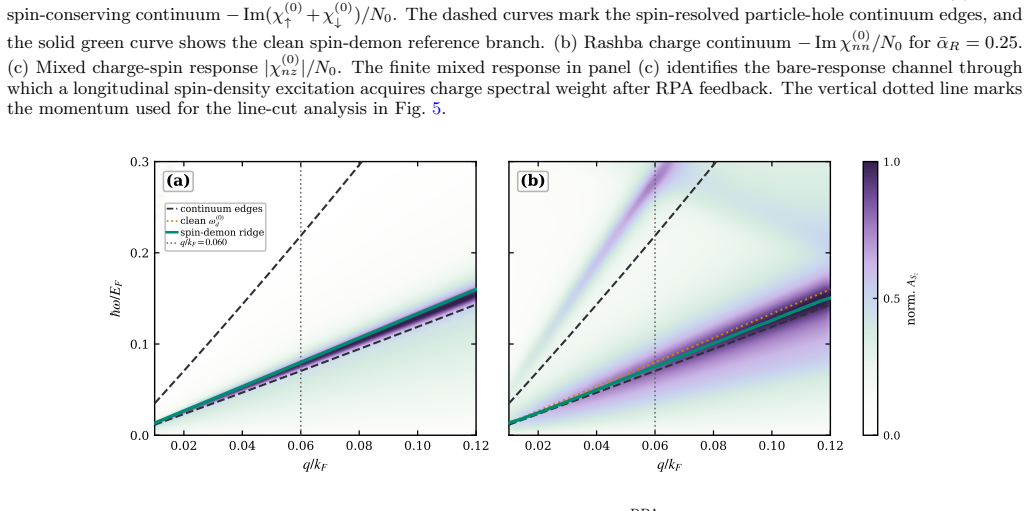
Spectral functions used in the figures The spin spectral functions are ASi(q, ω) =−Imχ RPA ii (q, ω), i=x, y, z,(B38) and the charge spectral function is An(q, ω) =−Imχ RPA nn (q, ω).(B39) The primary spin-demon signal isA Sz, whileA n mea- sures how much of the same collective mode is visible in the charge channel. At an extracted spin-demon fre- quencyω...
-
[13]
Projected momentum and clean two-dimensional continuum In the spin-conserving limit, the spin-resolved disper- sion can be mapped to an isotropic parabolic form by the momentum rescaling introduced in Appendix A. For a perturbation momentum q=q(cosθ,sinθ),(C1) the spin-dependent projected momentum is q′ σ =q η σ(θ),(C2) where ησ(θ) = mDOS mσx cos2 θ+ mDOS...
-
[14]
For later comparison, define ηmin(θ) = min[η↑(θ), η↓(θ)], ηmax(θ) = max[η↑(θ), η↓(θ)]
Clean RPA spin-demon benchmark The clean two-dimensional Coulomb interaction is written as v(0) q = e2 2ϵ0ϵrq .(C11) In the spin-conserving limit, the dielectric function is ϵ(q, ω) = 1−v (0) q h χ(0) ↑ (q, ω) +χ (0) ↓ (q, ω) i .(C12) The spin-demon pole is obtained from Reϵ(q, ω d) = 0,(C13) provided the damping is sufficiently weak. For later comparison...
-
[15]
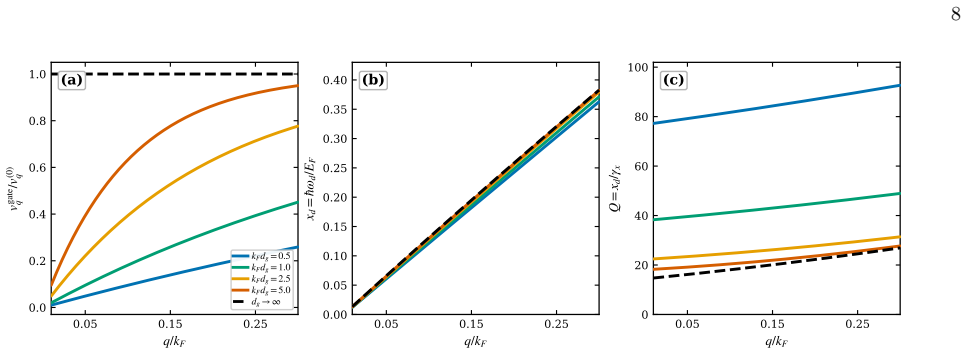
Forqd g ≪ 1, one may expand 1−e −2qdg ≃2qd g,(C21) so that vgate q ≃ e2dg ϵ0ϵr .(C22) The gate therefore cuts off the long-range 1/qsingularity at small momentum
Gate-screened Coulomb interaction A metallic gate at distanced g from the two- dimensional layer modifies the Coulomb interaction through the image-charge factor vgate q = e2 2ϵ0ϵrq 1−e −2qdg .(C19) Thus vgate q v(0) q = 1−e −2qdg .(C20) Forqd g ≫1, the exponential term is negligible and the bare two-dimensional interaction is recovered. Forqd g ≪ 1, one ...
-
[16]
Gate-only analytical control formula Whenα R = 0 butd g is finite, the band structure remains spin conserving while the RPA denominator is modified by the screened interaction. In the long- wavelength analytical approximation, define Cg = 2 + 1 αgate , u g = Cgq C2g −1 .(C28) The gate-controlled dimensionless spin-demon frequency is xgate d = 2 q kF ugηmi...
-
[17]
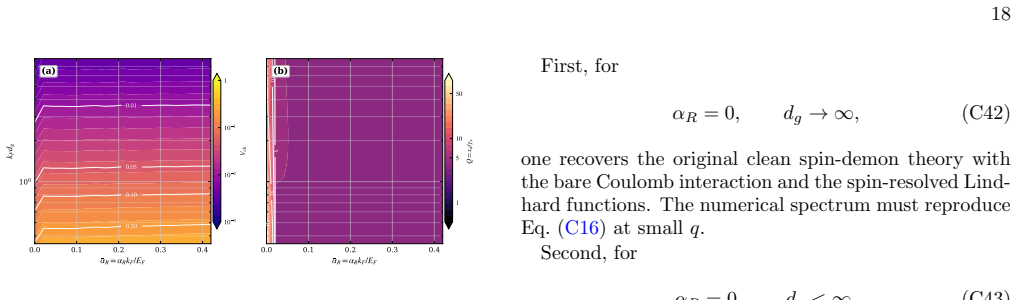
Mode extraction and damping in the full calculation In the full Rashba-plus-gate calculation, the spin de- mon is extracted from the spectral function ASz(q, ω) =−Imχ RPA zz (q, ω).(C31) At fixedq, the spin-demon frequency is extracted from the low-energy acoustic branch. Numerically, this is done by locating the maximum ofA Sz(q, ω) within a search windo...
-
[18]
Rashba coupling and gate screening can increase this ratio by changing the spin texture, the mixed charge-spin response, and the RPA denominator
Charge visibility and spin-character diagnostics The charge spectral function is An(q, ω) =−Imχ RPA nn (q, ω).(C36) At the spin-demon pole, the charge-visibility ratio is Vch = An(q, ωd) ASz(q, ωd) .(C37) The clean spin demon hasV ch ≪1, reflecting its nearly charge-neutral character. Rashba coupling and gate screening can increase this ratio by changing ...
-
[19]
First, for αR = 0, d g → ∞,(C42) one recovers the original clean spin-demon theory with the bare Coulomb interaction and the spin-resolved Lind- hard functions
Limiting cases and validation checks The full theory must reduce to four limiting cases. First, for αR = 0, d g → ∞,(C42) one recovers the original clean spin-demon theory with the bare Coulomb interaction and the spin-resolved Lind- hard functions. The numerical spectrum must reproduce Eq. (C16) at smallq. Second, for αR = 0, d g <∞,(C43) spin remains co...
-
[20]
Bohm and D
D. Bohm and D. Pines, A collective description of elec- tron interactions: III. Coulomb interactions in a degen- erate electron gas, Physical Review92, 609 (1953)
1953
-
[21]
Ehrenreich and M
H. Ehrenreich and M. H. Cohen, Self-consistent field ap- proach to the many-electron problem, Physical Review 115, 786 (1959)
1959
-
[22]
Lindhard, On the properties of a gas of charged particles, Kongelige Danske Videnskabernes Selskab, Matematisk-fysiske Meddelelser28, 1 (1954)
J. Lindhard, On the properties of a gas of charged particles, Kongelige Danske Videnskabernes Selskab, Matematisk-fysiske Meddelelser28, 1 (1954)
1954
-
[23]
Stern, Polarizability of a two-dimensional electron gas, Physical Review Letters18, 546 (1967)
F. Stern, Polarizability of a two-dimensional electron gas, Physical Review Letters18, 546 (1967)
1967
-
[24]
A. L. Fetter and J. D. Walecka,Quantum Theory of Many-Particle Systems(McGraw-Hill, New York, 1971)
1971
-
[25]
G. F. Giuliani and G. Vignale,Quantum Theory of the Electron Liquid(Cambridge University Press, Cam- bridge, 2005)
2005
-
[26]
Pines, Electron interaction in solids, Canadian Journal of Physics34, 1379 (1956)
D. Pines, Electron interaction in solids, Canadian Journal of Physics34, 1379 (1956)
1956
-
[27]
A. A. Husainet al., Pines’ demon observed as a 3d acous- tic plasmon in sr 2ruo4, Nature621, 66 (2023)
2023
-
[28]
Agarwal, M
A. Agarwal, M. Polini, G. Vignale, and M. E. Flatt’e, Long-lived spin plasmons in a spin-polarized two- 19 dimensional electron gas, Physical Review B90, 155409 (2014)
2014
-
[29]
Kreil, F
D. Kreil, F. Hummel, F. G. Eich,et al., Excitations in a spin-polarized two-dimensional electron gas, Physical Review B92, 205426 (2015)
2015
-
[30]
ˇSmejkal, J
L. ˇSmejkal, J. Sinova, and T. Jungwirth, Beyond conven- tional ferromagnetism and antiferromagnetism: A phase with nonrelativistic spin and crystal rotation symmetry, Physical Review X12, 031042 (2022)
2022
-
[31]
ˇSmejkal, J
L. ˇSmejkal, J. Sinova, and T. Jungwirth, Emerging re- search landscape of altermagnetism, Physical Review X 12, 040501 (2022)
2022
-
[32]
I. I. Mazin and T. P. Editors, Editorial: Altermagnetism—a new punch line of fundamental magnetism, Physical Review X12, 040002 (2022)
2022
-
[33]
ˇSmejkal, R
L. ˇSmejkal, R. Gonz’alez-Hern’andez, T. Jungwirth, and J. Sinova, Crystal time-reversal symmetry breaking and spontaneous hall effect in collinear antiferromagnets, Sci- ence Advances6, eaaz8809 (2020)
2020
-
[34]
Gonz’alez-Hern’andez, L
R. Gonz’alez-Hern’andez, L. ˇSmejkal, K. V’yborn’y, Y. Yahagi, J. Sinova, T. Jungwirth, and J. ˇZelezn’y, Efficient electrical spin splitter based on nonrelativis- tic collinear antiferromagnetism, Physical Review Letters 126, 127701 (2021)
2021
-
[35]
Jungwirth, X
T. Jungwirth, X. Marti, P. Wadley, and J. Wunderlich, Antiferromagnetic spintronics, Nature Nanotechnology 11, 231 (2016)
2016
-
[36]
Baltz, A
V. Baltz, A. Manchon, M. Tsoi, T. Moriyama, T. Ono, and Y. Tserkovnyak, Antiferromagnetic spintronics, Re- views of Modern Physics90, 015005 (2018)
2018
-
[37]
ˇZuti’c, J
I. ˇZuti’c, J. Fabian, and S. Das Sarma, Spintronics: Fun- damentals and applications, Reviews of Modern Physics 76, 323 (2004)
2004
-
[38]
Krempask’y, L
J. Krempask’y, L. ˇSmejkal, S. W. D’Souza,et al., Alter- magnetic lifting of kramers spin degeneracy, Nature626, 517 (2024)
2024
-
[39]
Reimers, L
S. Reimers, L. Odenbreit, L. ˇSmejkal,et al., Direct obser- vation of altermagnetic band splitting in crsb thin films, Nature Communications15, 2116 (2024)
2024
-
[40]
G. Yang, Z. Li,et al., Three-dimensional mapping of the altermagnetic spin splitting in crsb, Nature Communica- tions16, 1442 (2025)
2025
-
[41]
Fedchenko, J
O. Fedchenko, J. Min’ar, Akashdeep,et al., Observation of time-reversal symmetry breaking in the band structure of altermagnetic ruo 2, Science Advances10, eadj4883 (2024)
2024
-
[42]
O. J. Aminet al., Nanoscale imaging and control of al- termagnetism in mnte, Nature636, 348 (2024)
2024
-
[43]
Z. Liu, M. Ozeki, S. Asai, S. Itoh, and T. Masuda, Chi- ral split magnon in altermagnetic mnte, Physical Review Letters133, 156702 (2024)
2024
-
[44]
P. M. Gunnink, J. Sinova, and A. Mook, Spin demons ind-wave altermagnets, Physical Review Letters135, 126701 (2025)
2025
-
[45]
Y. A. Bychkov and E. I. Rashba, Properties of a 2d elec- tron gas with lifted spectral degeneracy, JETP Letters 39, 78 (1984)
1984
-
[46]
Nitta, T
J. Nitta, T. Akazaki, H. Takayanagi, and T. Enoki, Gate control of spin-orbit interaction in an in- verted in∗0.53ga∗0.47as/in∗0.52al∗0.48as heterostruc- ture, Physical Review Letters78, 1335 (1997)
1997
-
[47]
Manchon, H
A. Manchon, H. C. Koo, J. Nitta, S. M. Frolov, and R. A. Duine, New perspectives for rashba spin-orbit coupling, Nature Materials14, 871 (2015)
2015
-
[48]
Bihlmayer, P
G. Bihlmayer, P. No”el, D. V. Vyalikh, E. V. Chulkov, and A. Manchon, Rashba-like physics in condensed mat- ter, Nature Reviews Physics4, 642 (2022)
2022
-
[49]
V. M. Edelstein, Spin polarization of conduction elec- trons induced by electric current in two-dimensional asymmetric electron systems, Solid State Communica- tions73, 233 (1990)
1990
-
[50]
S. D. Ganichev, E. L. Ivchenko, V. V. Bel’kov, S. A. Tarasenko, M. Sollinger, D. Weiss, W. Wegscheider, and W. Prettl, Spin-galvanic effect, Nature417, 153 (2002)
2002
-
[51]
Sinova, D
J. Sinova, D. Culcer, Q. Niu, N. A. Sinitsyn, T. Jung- wirth, and A. H. MacDonald, Universal intrinsic spin Hall effect, Physical Review Letters92, 126603 (2004)
2004
-
[52]
K. Shen, G. Vignale, and R. Raimondi, Microscopic the- ory of the inverse edelstein effect, Physical Review Letters 112, 096601 (2014)
2014
-
[53]
Bercioux and P
D. Bercioux and P. Lucignano, Quantum transport in rashba spin-orbit materials: A review, Reports on Progress in Physics78, 106001 (2015)
2015
-
[54]
Johansson, B
A. Johansson, B. G”obel, J. Henk, M. Bibes, and I. Mertig, Spin and orbital Edelstein effects in a two- dimensional electron gas: Theory and application to SrTiO3 interfaces, Physical Review Research3, 013275 (2021)
2021
-
[55]
Das Sarma and A
S. Das Sarma and A. Madhukar, Collective modes of spatially separated, two-component, two-dimensional plasma in solids, Physical Review B23, 805 (1981)
1981
-
[56]
A. V. Chaplik, Possible crystallization of charge carriers in low-density inversion layers, Soviet Physics JETP35, 395 (1972)
1972
-
[57]
Torre, L
I. Torre, L. Vieira de Castro, B. Van Duppen, D. Bar- cons Ruiz, F. M. Peeters, F. H. L. Koppens, and M. Polini, Acoustic plasmons at the crossover between the collisionless and hydrodynamic regimes in two- dimensional electron liquids, Physical Review B99, 144307 (2019)
2019
-
[58]
A. A. Zabolotnykh and V. A. Volkov, Interaction of gated and ungated plasmons in two-dimensional electron sys- tems, Physical Review B99, 165304 (2019)
2019
-
[59]
Kubo, Statistical-mechanical theory of irreversible processes
R. Kubo, Statistical-mechanical theory of irreversible processes. I. general theory and simple applications to magnetic and conduction problems, Journal of the Phys- ical Society of Japan12, 570 (1957)
1957
-
[60]
G. D. Mahan,Many-Particle Physics, 3rd ed. (Kluwer Academic/Plenum Publishers, New York, 2000)
2000
discussion (0)
Sign in with ORCID, Apple, or X to comment. Anyone can read and Pith papers without signing in.