Discrete Space-Time Wave Kernels on Regular Trees
Pith reviewed 2026-06-26 01:31 UTC · model grok-4.3
The pith
Explicit formulas express the two fundamental wave kernels on regular trees via discrete I-Bessel functions under a nonnegativity assumption.
A machine-rendered reading of the paper's core claim, the machinery that carries it, and where it could break.
Core claim
Under the natural nonnegativity assumption on this operator, we derive explicit formulas for the two fundamental wave kernels. The formulas are given in terms of discrete I-Bessel functions and yield convolution representations for solutions with general initial conditions. In the boundary case corresponding to the bottom of the spectrum, we obtain another explicit representation of the wave kernel in terms of discrete J-Bessel functions. This representation leads to a discrete analogue of the classical I↔J relation. The wave kernels are expressed as finite sums; hence, the propagation formulas remain finite for every discrete time.
What carries the argument
The two-parameter generalized Laplacian on the (q+1)-regular tree, with discrete I-Bessel functions providing the explicit finite-sum form of the wave kernels.
If this is right
- Solutions with general initial conditions are obtained directly as convolutions against the kernels.
- Propagation formulas stay finite sums at every discrete time step.
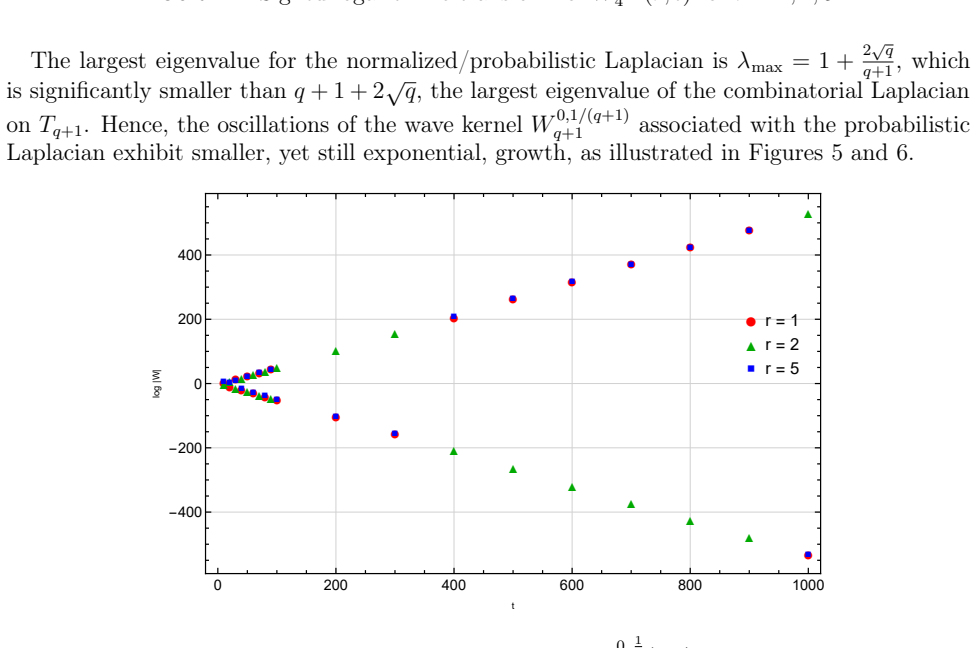
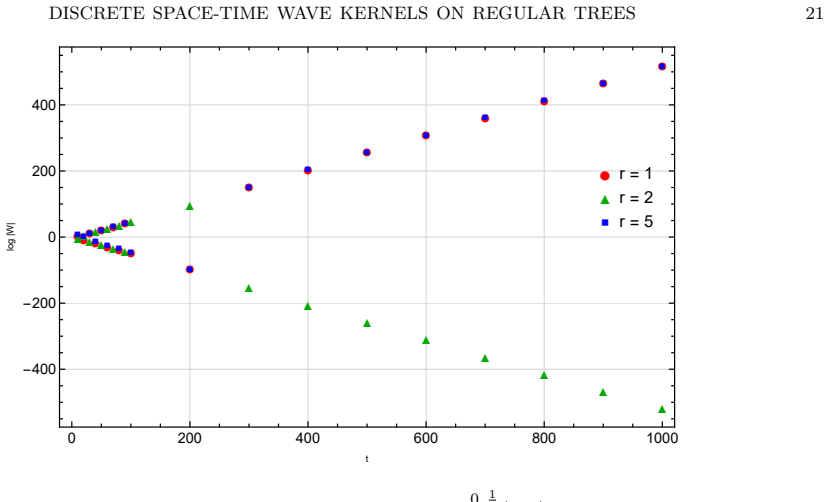
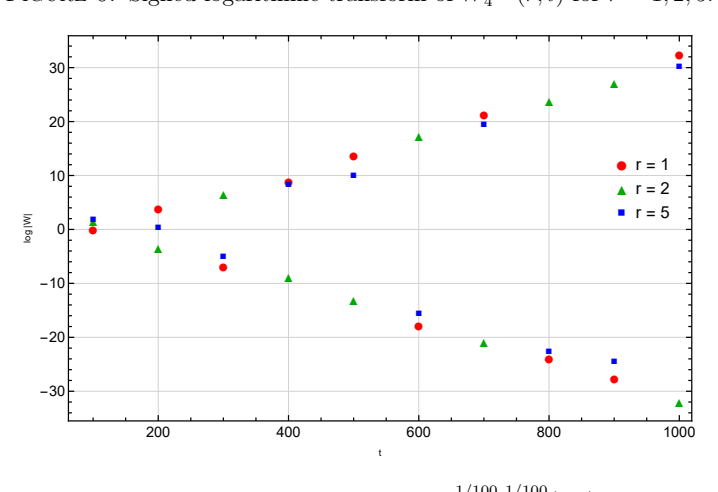
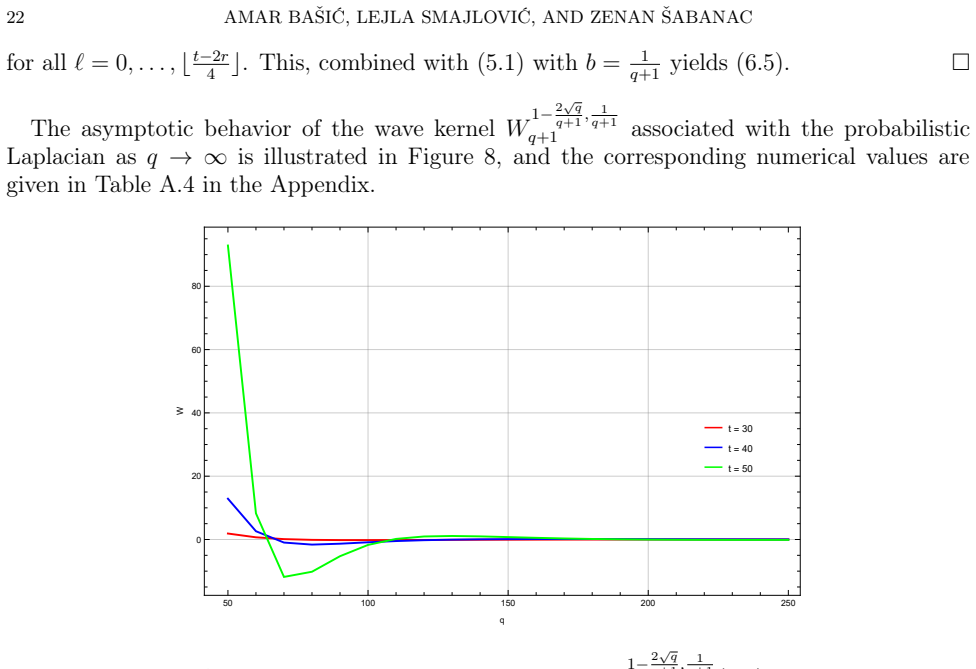
- Asymptotic expansions hold for large radial distance, large time, and large tree degree.
- A discrete version of the classical I to J Bessel relation appears at the spectral bottom.
Where Pith is reading between the lines
- The finite-sum property could support exact long-time evolution without truncation on finite subtrees.
- The same Bessel-based approach might adapt to wave problems on other vertex-transitive graphs with similar radial symmetry.
- The explicit kernels may connect to counting problems or generating functions on trees in combinatorics.
Load-bearing premise
The two-parameter generalized Laplacian must satisfy the natural nonnegativity assumption for the explicit kernel formulas to hold.
What would settle it
Numerical solution of the wave equation on a small regular tree with chosen parameters satisfying nonnegativity, compared term-by-term to the proposed I-Bessel formula, would falsify the claim if the two disagree at any time step.
Figures
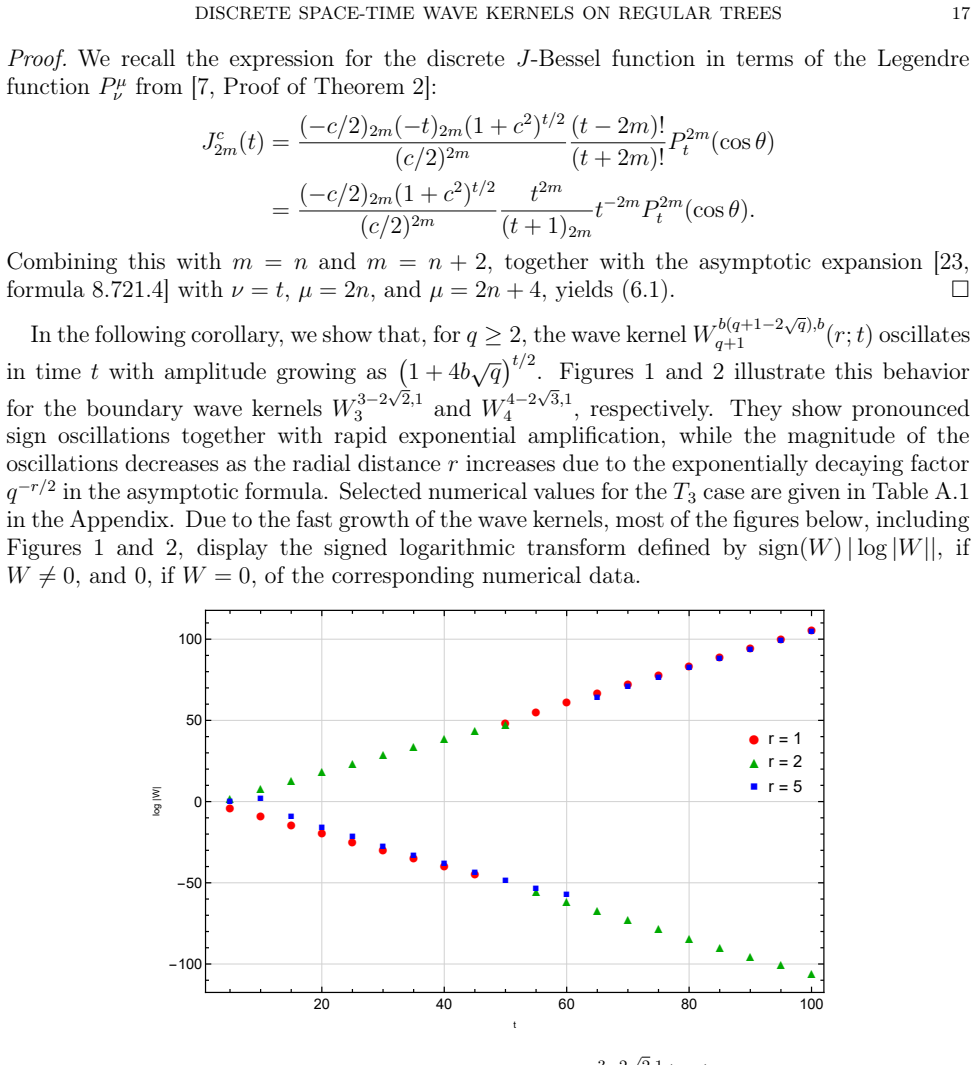
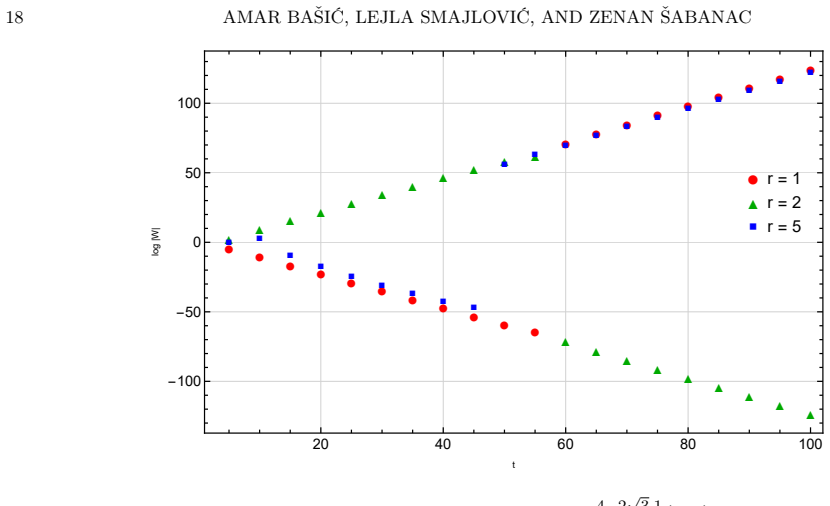
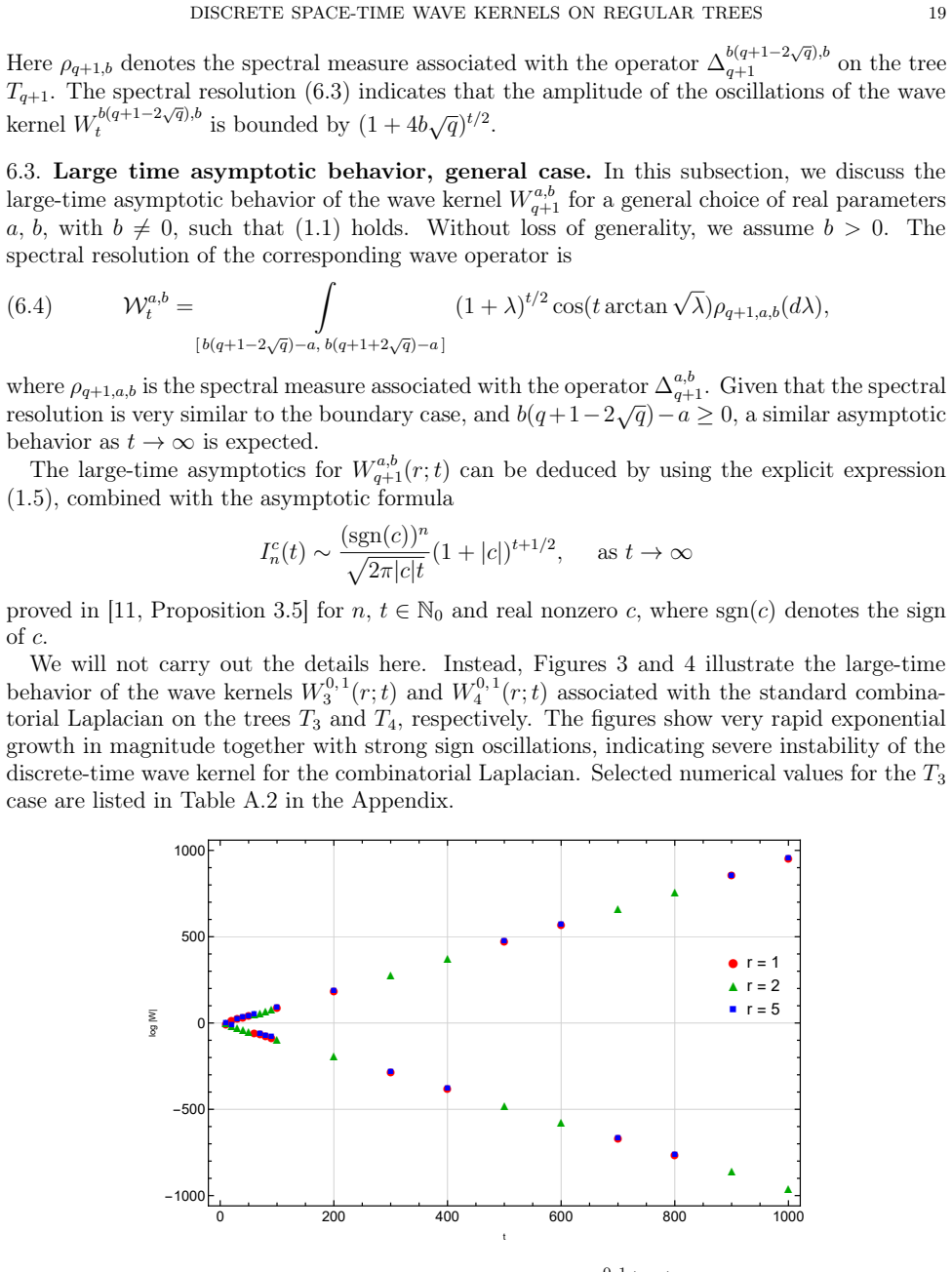
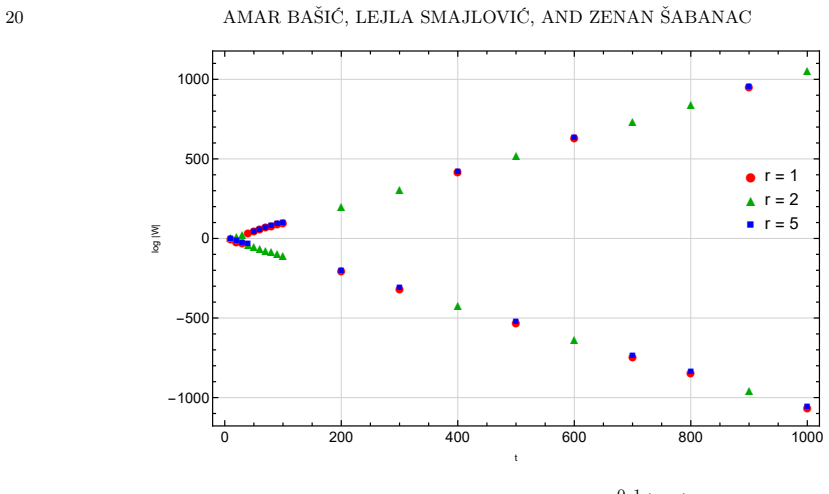
read the original abstract
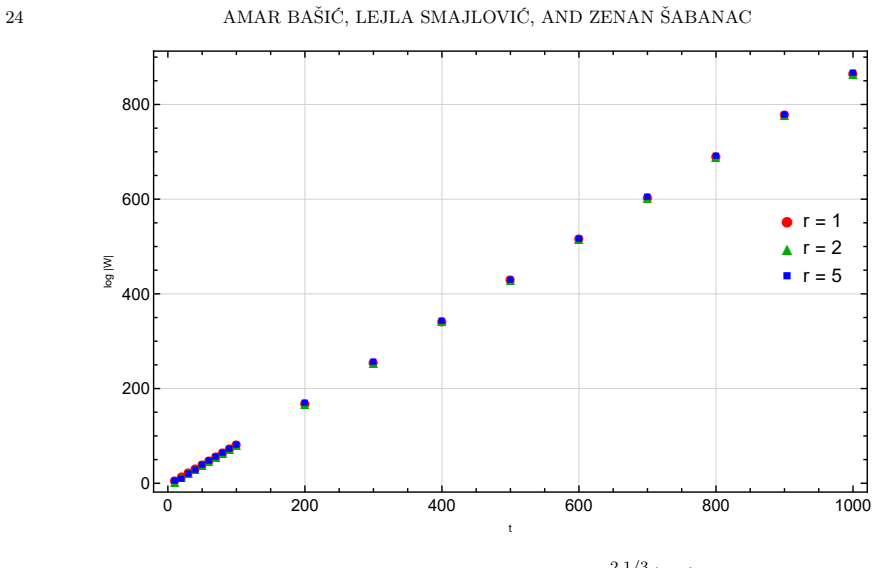
We study the forward discrete space-time wave equation on the homogeneous $(q+1)$-regular tree $T_{q+1}$ associated with a two-parameter generalized Laplacian. Under the natural nonnegativity assumption on this operator, we derive explicit formulas for the two fundamental wave kernels. The formulas are given in terms of discrete $I$-Bessel functions and yield convolution representations for solutions with general initial conditions. In the boundary case corresponding to the bottom of the spectrum, we obtain another explicit representation of the wave kernel in terms of discrete $J$-Bessel functions. This representation leads to a discrete analogue of the classical $I\!\leftrightarrow\!J$ relation. We also perform both analytic and numerical studies of the asymptotic behavior of the wave kernels, including large radial distance, large time, and large degree of the tree. An important feature of our analysis is that the wave kernels are expressed as finite sums; hence, the propagation formulas remain finite for every discrete time.
Editorial analysis
A structured set of objections, weighed in public.
Referee Report
Summary. The paper derives explicit finite-sum formulas for the two fundamental wave kernels associated to the discrete space-time wave equation on the (q+1)-regular tree T_{q+1} for a two-parameter generalized Laplacian. Under the stated nonnegativity assumption on the operator, the kernels are expressed via discrete I-Bessel functions and yield convolution representations for general initial data. In the boundary case at the bottom of the spectrum, an explicit J-Bessel representation is obtained, producing a discrete analogue of the classical I↔J identity. Analytic and numerical asymptotics are provided for large radial distance, large time, and large degree q, with emphasis on the fact that the finite-sum expressions keep the propagation formulas exact at every discrete time.
Significance. If the derivations hold, the explicit finite-sum kernels constitute a concrete advance for spectral theory on infinite regular graphs and discrete wave equations. The convolution representations and the discrete I-J identity are useful structural results, while the finite-sum property enables exact computation without truncation error at finite times. The combination of analytic asymptotics with numerical verification strengthens the contribution for applications in discrete PDEs and graph Laplacians.
minor comments (3)
- [§2] The precise definition of the two-parameter generalized Laplacian and the exact statement of the nonnegativity assumption should be recalled at the beginning of the derivation section (currently referenced only in the abstract) to make the domain of validity of the I-Bessel formulas immediately clear.
- [§3] Notation for the discrete I-Bessel and J-Bessel functions should be introduced with a short self-contained definition or reference to the precise recurrence they satisfy, rather than assuming familiarity from prior literature on discrete Bessel functions.
- [§5] In the asymptotic analysis, the transition between the large-time and large-distance regimes could be stated more explicitly; currently the error terms in the large-q expansion are described qualitatively but without an explicit remainder estimate.
Simulated Author's Rebuttal
We thank the referee for the positive and detailed summary of our work, the assessment of its significance, and the recommendation of minor revision. No specific major comments appear in the report, so we have no individual points to address point-by-point. We remain ready to incorporate any minor editorial or clarification changes the editor or referee may suggest in a subsequent round.
Circularity Check
No significant circularity detected
full rationale
The paper derives explicit finite-sum formulas for the wave kernels directly from the spectral properties of the two-parameter generalized Laplacian on the regular tree, under an explicitly stated nonnegativity assumption that defines the regime of validity. These formulas are expressed via discrete I-Bessel functions and yield convolution representations; the boundary-case J-Bessel form produces a discrete I↔J identity as a consequence. No step reduces by construction to a fitted input, self-definition, or load-bearing self-citation chain; the derivations are presented as analytic consequences of the operator and remain finite for each discrete time. The manuscript is self-contained against external benchmarks with independent analytic and numerical asymptotics.
Axiom & Free-Parameter Ledger
axioms (1)
- domain assumption natural nonnegativity assumption on the two-parameter generalized Laplacian
Reference graph
Works this paper leans on
-
[1]
Abadias, E
L. Abadias, E. Alvarez, S. Díaz, Subordination principle, Wright functions and large-time behavior for the discrete in time fractional diffusion equation,J. Math. Anal. Appl.507(2022), no. 1, Article ID 125741, 23 p
2022
-
[2]
Abadias, J
L. Abadias, J. González–Camus, S. Rueda, Time-step heat problem on the mesh: asymptotic behavior and decay rates,Forum Math.35(2023), no. 6, 1563–1582
2023
-
[3]
Abramowitz and A
M. Abramowitz and A. Irene Stegun,Handbook of mathematical functions with formulas, graphs, and mathematical tables, Tenth Edition, National Bureau of Standards Applied Mathematics Series, No. 55 U. S. Government Printing Office, Washington, D.C., 1972
1972
-
[4]
J. -P. Anker, P. Martinot, E. Pedon, and A. G. Setti,The shifted wave equation on Damek-Ricci spaces and on homogeneous trees, Trends in harmonic analysis, 1–25, Springer INdAM Ser., 3, Springer, Milan, 2013
2013
-
[5]
Anantharaman, M
N. Anantharaman, M. Sabri, Quantum ergodicity on graphs: from spectral to spatial delocalization,Ann. of Math.(2)189(2019), no. 3, 753–835
2019
-
[6]
R. Banerjee, N. Delporte, S. Sen, R. Toriumi, Critical Phenomena on the Bethe Lattice, arXiv:2601.01961 (2026)
arXiv 2026
-
[7]
Bašić, L
A. Bašić, L. Smajlović, Z. Šabanac, Discrete Bessel functions and discrete wave equation,Results Math. 79(2024), no. 5, paper no. 216, 25 pp
2024
-
[8]
Bohner and T
M. Bohner and T. Cuchta, The Bessel difference equation,Proc. Am. Math. Soc.145(2017), no. 4, 1567– 1580
2017
-
[9]
Bohner and A
M. Bohner and A. Peterson,Dynamic Equations on Time Scales: An Introduction with Applications, Birkhüser, Boston, 2001
2001
-
[10]
Brooks, E
S. Brooks, E. Lindenstrauss, Non-localization of eigenfunctions on large regular graphs,Israel J. Math. 193(2013), no. 1, 1–14
2013
-
[11]
C. A. Cadavid, P. Hoyos, J. Jorgenson, L. Smajlović, and J. D. Vélez, Discrete diffusion-type equation on regular graphs and its applications,J. Difference Equ. Appl.29(2023), no. 4, 455–488
2023
-
[12]
V. L. Chernyshev, V. E. Nazaikinskii, A. V. Tsvetkova, Lattice equations and semiclassical asymptotics, Russ. J. Math. Phys.30(2023), no. 2, 152–164
2023
-
[13]
Chitour, G
Y. Chitour, G. Mazanti, M. Sigalotti, Stability of non-autonomous difference equations with applications to transport and wave propagation on networks,Netw. Heterog. Media11(2016), no. 4, 563–601
2016
-
[14]
Choi, A condition for blow-up solutions to discrete semilinear wave equations on networks,Appl
M.-J. Choi, A condition for blow-up solutions to discrete semilinear wave equations on networks,Appl. Anal.101(2022), no. 6, 2008–2018
2022
-
[15]
J. M. Cohen and M. Pagliacci, Explicit solutions for the wave equation on homogeneous trees,Adv. in Appl. Math.15(1994), no. 4, 390–403
1994
-
[16]
DISCRETE SPACE-TIME W A VE KERNELS ON REGULAR TREES 25
T.Cuchta,Discrete analogues of some classical special functions, DoctoralDissertation, MissouriUniversity of Science and Technology, 2015. DISCRETE SPACE-TIME W A VE KERNELS ON REGULAR TREES 25
2015
-
[17]
Cvetković, P
D. Cvetković, P. Rowlinson, S. K. Simić, Signless Laplacians of finite graphs,Linear Algebra Appl.423 (2007), no. 1, 155–171
2007
- [18]
-
[19]
S. Díaz, J. González–Camus, S. Rueda, Almost Automorphic Solutions for the Heat Equation Involving the Discrete Fractional Laplacian in Continuous and Discrete Time,Math. Meth. Appl. Sci.(2026), 1–13
2026
-
[20]
Dörfler, J
F. Dörfler, J. W. Simpson-Porco, F. Bullo, Electrical Networks and Algebraic Graph Theory: Models, Properties, and Applications,Proc. IEEE,106(2018), no. 5, 977–1005
2018
-
[21]
González-Camus, Representation of solution for fractional damped heat and wave equation on an infinite lattice via subordination techniques and Banach algebras,J
J. González-Camus, Representation of solution for fractional damped heat and wave equation on an infinite lattice via subordination techniques and Banach algebras,J. Math. Anal. Appl.552(2025), no. 1, Article ID 129742, 21 p
2025
-
[22]
González-Camus, C
J. González-Camus, C. Lizama, P. J. Miana, Fundamental solutions for semidiscrete evolution equations via Banach algebras,Adv. Difference Equ.2021(2021), Paper no. 35, 32 p
2021
-
[23]
I. S. Gradshteyn and I. M. Ryzhik,Table of integrals, series, and products, Translated from the Russian. Revised and extended by Daniel Zwillinger and Victor Moll, Eighth edition, Elsevier/Academic Press, Amsterdam, 2014
2014
-
[24]
’t Hooft, How quantization of gravity leads to a discrete space-time,J
G. ’t Hooft, How quantization of gravity leads to a discrete space-time,J. Phys. Conf. Ser.701(2016), 012014
2016
-
[25]
S. A. R. Horsley, S. Bugler-Lamb, Negative frequencies in wave propagation: A microscopic model,Phys. Rev. A,93, no. 6, (2016), 063828, 11 pp
2016
-
[26]
Kan and K
N. Kan and K. Shiraishi, Discrete time heat kernel and UV modified propagators with Dimensional De- construction,Journal of Physics A: Mathematical and Theoretical,56(2023), no. 24, 245401, 16 pp
2023
-
[27]
Korotyaev and N
E. Korotyaev and N. Saburova, Schrödinger operators on periodic discrete graphs,J. Math. Anal. Appl. 420(2014), 576–611
2014
-
[28]
Lizama, M
C. Lizama, M. Murillo–Arcila, The semidiscrete damped wave equation with a fractional Laplacian,Proc. Am. Math. Soc.151(2023), no. 5, 1987–1999
2023
-
[29]
Lizama, M
C. Lizama, M. Murillo–Arcila, On semidiscrete models dominated by the heat, wave and Laplace equations, Discrete Contin. Dyn. Syst.44(2024), no. 8, 2368–2386
2024
-
[30]
Medolla and A
G. Medolla and A. G. Setti, The wave equation on homogeneous trees,Ann. Mat. Pura Appl.(4)176 (1999), 1–27
1999
-
[31]
Medolla, Asymptotic energy equipartition for the wave equation on homogeneous trees,Monatsh
G. Medolla, Asymptotic energy equipartition for the wave equation on homogeneous trees,Monatsh. Math. 127(1999), no. 1, 43–53
1999
-
[32]
Mohar, W
B. Mohar, W. Woess, A survey on spectra of infinite graphs,Bull. London Math. Soc.21(1989), no. 3, 209–234
1989
-
[33]
Pagliacci, Heat and wave equations on homogeneous trees,Boll
M. Pagliacci, Heat and wave equations on homogeneous trees,Boll. Un. Mat. Ital. A(7)7(1993), no. 1, 37–45
1993
-
[34]
Slavík, Discrete-space systems of partial dynamic equations and discrete-space wave equation,Qual
A. Slavík, Discrete-space systems of partial dynamic equations and discrete-space wave equation,Qual. Theory Dyn. Syst.16(2017), no. 2, 299–315
2017
-
[35]
Slavík, Discrete Bessel functions and partial difference equations,J
A. Slavík, Discrete Bessel functions and partial difference equations,J. Difference Equ. Appl.24(2018), no. 3, 425–437
2018
-
[36]
A. V. Tsvetkova and A. I. Shafarevich, The Cauchy problem for the wave equation on a homogeneous tree, Mat. Zametki100(2016), no. 6, 923–931; translation inMath. Notes100(2016), no. 5–6, 862–869
2016
-
[37]
J. Valein, E. Zuazua, Stabilization of the wave equation on 1-D networks,SIAM J. Control Optim.48 (2009), no. 4, 2771–2797. 26 AMAR BAŠIĆ, LEJLA SMAJLOVIĆ, AND ZENAN ŠABANAC AppendixA.Selected numerical tables This appendix contains selected numerical tables illustrating the main asymptotic regimes discussed in Section 6. Table A.1.Numerical values ofW 3−...
arXiv 2009
discussion (0)
Sign in with ORCID, Apple, or X to comment. Anyone can read and Pith papers without signing in.