A Process Harness for Uplifting Legacy Workflows to Agentic BPM: Design and Realization in CUGA FLO
Pith reviewed 2026-06-26 04:16 UTC · model grok-4.3
The pith
A process harness adds a policy-governed agentic layer around legacy workflow engines to enable reasoning at control points while the engine keeps structural authority.
A machine-rendered reading of the paper's core claim, the machinery that carries it, and where it could break.
Core claim
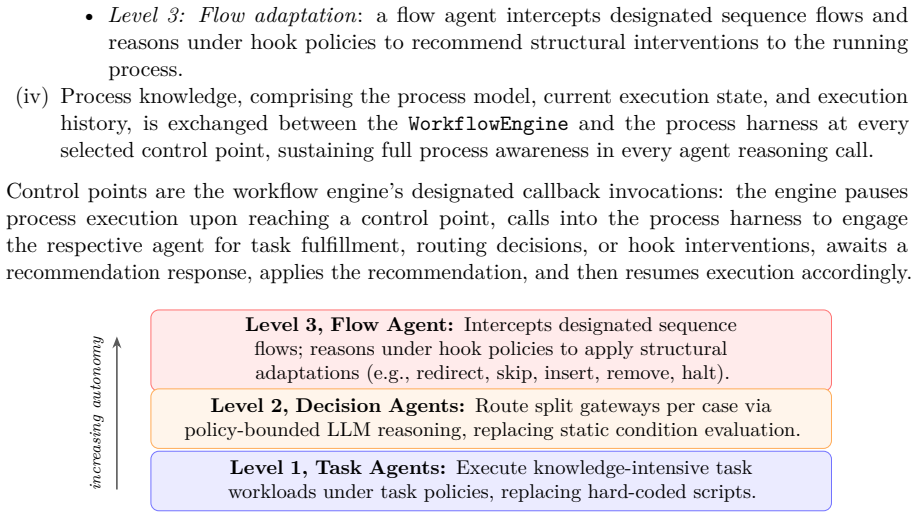
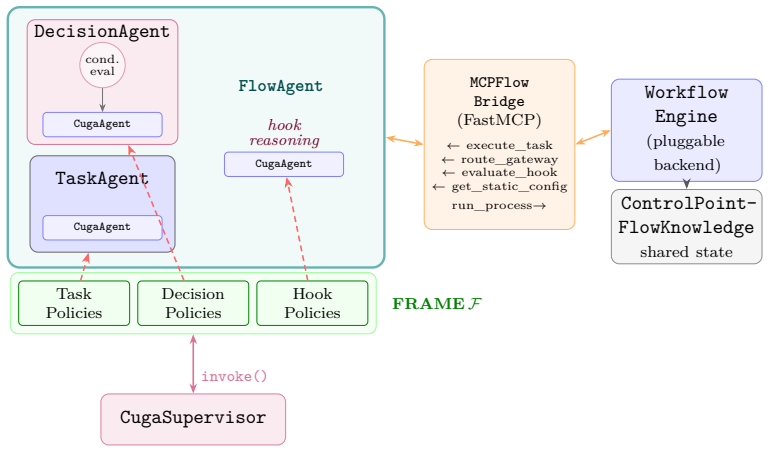
The process harness places a policy-governed agentic layer around a deterministic workflow engine, intercepting designated control points to contribute reasoning, adaptation, and oversight while the engine retains structural authority over the process. The harness is defined through the Task-Decision-Flow model, which specifies a data schema and execution semantics that decompose LLM reasoning across a TaskAgent for knowledge-intensive execution, a DecisionAgent for gateway routing, and a FlowAgent for runtime adaptation via a principled hook mechanism. All agents reason inside policies drawn from the process FRAME. The design is implemented in CUGA FLO and exercised on a loan approval workf
What carries the argument
The process harness, which places a policy-governed agentic layer around a deterministic workflow engine and intercepts designated control points.
If this is right
- Existing workflow engines can gain agentic capabilities at selected points without replacement or loss of compliance guarantees.
- Policy sets can govern task execution, per-case routing decisions, and runtime flow adaptations through the three defined agent types.
- Hook mechanisms allow principled overrides, such as regulatory interventions, while the deterministic engine remains the final authority.
- The TDF model supplies explicit data schemas and execution semantics that make the agentic additions reproducible across different engines.
- Demonstrations on workflows like loan approval show the harness handling mixed imperative and normative requirements in one run.
Where Pith is reading between the lines
- Organizations could introduce agentic features incrementally by starting with a few control points and expanding the harness coverage over time.
- The same harness pattern might apply to non-business domains that already run deterministic pipelines, such as scientific data processing or logistics scheduling.
- Different policy frames could be swapped or versioned independently of the workflow definition, allowing experiments with oversight rules.
Load-bearing premise
Intercepting control points with agents under policy will not create irresolvable conflicts with the workflow engine's rules or undermine its structural authority.
What would settle it
A test case in which a policy instruction directs an agent to route a process instance in a way that violates a mandatory structural constraint in the original workflow definition, then observe whether the engine enforces its rule or accepts the agent change.
Figures


read the original abstract
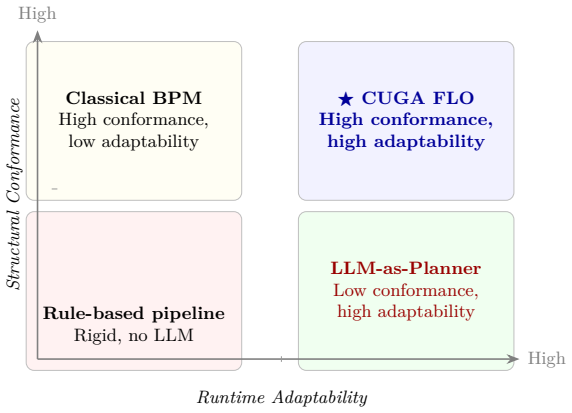
We introduce the process harness, a new mechanism for uplifting legacy workflows into Agentic Business Process Management (Agentic BPM) without replacing the underlying workflow engine. A process harness places a policy-governed agentic layer around a deterministic workflow engine, intercepting designated control points to contribute reasoning, adaptation, and oversight while the engine retains structural authority over the process. To define the process harness rigorously, we develop the Task-Decision-Flow (TDF) model, specifying both its data schema and its execution semantics. TDF decomposes LLM reasoning across three policy-governed agent types: a TaskAgent for knowledge-intensive task execution, a DecisionAgent for per-case gateway routing, and a FlowAgent that governs runtime flow adaptation through a principled hook mechanism. Each agent reasons within an explicit policy drawn from the process FRAME, the aggregate policy set governing all LLM calls in the system. We then present CUGA FLO as the design and implementation realization of the TDF model, and demonstrate it on a loan approval workflow that exercises all three agent types and hook-driven regulatory override. The process harness uniquely reconciles imperative requirements, realized through deterministic workflow execution that enforces structural compliance, with normative requirements, realized through policy-framed agentic autonomy invoked at designated control points wherever the process demands it.
Editorial analysis
A structured set of objections, weighed in public.
Referee Report
Summary. The paper introduces the process harness mechanism for uplifting legacy workflows to Agentic BPM without replacing the underlying engine. It defines the Task-Decision-Flow (TDF) model, including data schema and execution semantics, that decomposes LLM reasoning into TaskAgent, DecisionAgent, and FlowAgent types governed by a process FRAME policy set. The model is realized in the CUGA FLO implementation and demonstrated on a loan approval workflow exercising all agent types and hook-driven regulatory override. The central claim is that this uniquely reconciles imperative requirements (via deterministic structural compliance) with normative requirements (via policy-framed agentic autonomy at designated control points).
Significance. If the TDF execution semantics are shown to preserve deterministic structural authority while enabling controlled agentic interventions, the approach would offer a practical, incremental path for integrating agentic capabilities into existing BPM systems, addressing a real deployment barrier in legacy workflow environments.
major comments (2)
- [TDF model (execution semantics)] TDF execution semantics (as described in the model definition): no explicit invariant, priority rule, or conflict-resolution procedure is provided for cases where a FlowAgent hook adaptation could produce a trace violating the original deterministic flow structure (e.g., bypassing mandatory gateways or reordering tasks). This directly undermines the load-bearing claim that the engine retains structural authority while the agentic layer contributes only at designated points.
- [CUGA FLO demonstration] Demonstration section (loan approval workflow): the example exercises the three agent types and a regulatory override but supplies no trace validation, invariant check, or error analysis confirming that hook adaptations never violated the original process structure.
minor comments (1)
- [Abstract / Introduction] The abstract and introduction use the term 'principled hook mechanism' without a forward reference to the precise definition or constraints in the TDF semantics section.
Simulated Author's Rebuttal
We thank the referee for their thorough review and insightful comments on our manuscript. We appreciate the identification of areas where the presentation of the TDF execution semantics and the demonstration can be strengthened. We address each major comment below and plan to revise the manuscript to incorporate the suggested improvements.
read point-by-point responses
-
Referee: [TDF model (execution semantics)] TDF execution semantics (as described in the model definition): no explicit invariant, priority rule, or conflict-resolution procedure is provided for cases where a FlowAgent hook adaptation could produce a trace violating the original deterministic flow structure (e.g., bypassing mandatory gateways or reordering tasks). This directly undermines the load-bearing claim that the engine retains structural authority while the agentic layer contributes only at designated points.
Authors: We agree with the referee that the current description of the TDF execution semantics would be strengthened by an explicit articulation of the invariants that preserve the deterministic flow structure. While the model is designed such that FlowAgent hooks operate only at designated control points and the underlying engine enforces the structural constraints, we did not include a formal statement of these invariants or conflict-resolution rules in the manuscript. In the revised version, we will add a dedicated subsection to the TDF model section that defines the structural invariants, priority rules for agent interventions, and procedures for resolving potential conflicts to ensure no violation of the original flow structure occurs. revision: yes
-
Referee: [CUGA FLO demonstration] Demonstration section (loan approval workflow): the example exercises the three agent types and a regulatory override but supplies no trace validation, invariant check, or error analysis confirming that hook adaptations never violated the original process structure.
Authors: We acknowledge that the demonstration section would benefit from explicit validation of the process traces to confirm compliance with the structural invariants. The loan approval workflow example was intended to illustrate the operation of the three agent types and the hook mechanism, but we did not include formal trace analysis or invariant checks. In the revised manuscript, we will augment the demonstration with a trace validation subsection, including an analysis of the execution traces to verify that all hook adaptations respected the original deterministic flow structure. revision: yes
Circularity Check
No circularity: design proposal with no derivations or fitted predictions
full rationale
The paper introduces a conceptual mechanism (process harness) and a model (TDF) for agentic BPM, along with its implementation (CUGA FLO). It specifies data schema and execution semantics but contains no equations, parameter fitting, predictions derived from inputs, or self-citation chains that reduce claims to unverified premises. The central reconciliation of imperative and normative requirements is presented as a design property of the harness and hook mechanism, not as a computed result that collapses by construction. This is a standard non-circular design paper; the reader's score of 1.0 aligns with the absence of any load-bearing circular steps.
Axiom & Free-Parameter Ledger
Reference graph
Works this paper leans on
-
[1]
Constitutional AI: Harmlessness from AI feedback, 2022
Yuntao Bai et al. Constitutional AI: Harmlessness from AI feedback, 2022
2022
-
[2]
Agentic business process management: A research manifesto
Diego Calvanese, Andrea Casciani, Giuseppe De Giacomo, Marlon Dumas, Fabiana Fournier, Timotheus Kampik, Emanuele La Malfa, Lior Limonad, Andrea Marrella, Andreas Met- zger, Marco Montali, et al. Agentic business process management: A research manifesto. Information Systems, 2026
2026
-
[3]
AI-augmented business process management systems: A research manifesto.ACM Transactions on Management Information Systems, 14(1):11, 2023
Marlon Dumas, Fabiana Fournier, Lior Limonad, Andrea Marrella, Marco Montali, Jana- Rebecca Rehse, Rafael Accorsi, Diego Calvanese, Giuseppe De Giacomo, Dirk Fahland, Avigdor Gal, Marcello La Rosa, Hagen Völzer, and Ingo Weber. AI-augmented business process management systems: A research manifesto.ACM Transactions on Management Information Systems, 14(1):11, 2023
2023
-
[4]
Reijers.Fundamentals of Business Process Management
Marlon Dumas, Marcello La Rosa, Jan Mendling, and Hajo A. Reijers.Fundamentals of Business Process Management. Springer, Berlin, 2 edition, 2018
2018
-
[5]
Agentic business process man- agement systems
Marlon Dumas, Fredrik Milani, and David Chapela-Campa. Agentic business process man- agement systems. InBusiness Process Management Workshops: BPM 2025 International Workshops, Seville, Spain, Revised Selected Papers, chapter 1. Springer, 2026
2025
-
[6]
Process mining and robotic process automation: A perfect match
Robert Geyer-Klingeberg, Martin Nakladal, Florian Vollmann, and Fabian Vogt. Process mining and robotic process automation: A perfect match. InProceedings of the CEUR Workshop, 2021
2021
-
[7]
LLMs can’t plan, but can help planning in LLM-modulo frameworks, 2024
Subbarao Kambhampati, Karthik Valmeekam, Lin Guan, Kurt Stechly, Mudit Verma, Siddhant Bhambri, Lucas Saldyt, and Anil Murthy. LLMs can’t plan, but can help planning in LLM-modulo frameworks, 2024
2024
-
[8]
Expecting the unexpected: developing autonomous-system design principles for reacting to unpredicted events and conditions
Assaf Marron, Lior Limonad, Sarah Pollack, and David Harel. Expecting the unexpected: developing autonomous-system design principles for reacting to unpredicted events and conditions. InProceedings of the IEEE/ACM 15th International Symposium on Software Engineering for Adaptive and Self-Managing Systems, SEAMS ’20, pages 167–173, New York, NY, USA, 2020....
2020
-
[9]
Agent harness for large language model agents: A survey, 2026
Qianyu Meng, Yanan Wang, Liyi Chen, Wei Wu, Yihang Li, Wenyuan Jiang, Qimeng Wang, Chengqiang Lu, Yan Gao, Yi Wu, and Yao Hu. Agent harness for large language model agents: A survey, 2026
2026
-
[10]
Business process model and notation (BPMN) version 2.0
Object Management Group. Business process model and notation (BPMN) version 2.0. Technical Report formal/2011-01-03, Object Management Group, 2011. 23
2011
-
[11]
Outmazgin, P
N. Outmazgin, P. Soffer, and I. Hadar. Leveraging workarounds for a problem-focused improvement of business processes.Business & Information Systems Engineering, 2026
2026
-
[12]
ChatDev: Communicative agents for software development
Chen Qian, Wei Liu, Hongzhang Liu, Nuo Chen, Yufan Dang, Jiahao Li, Cheng Yang, Weize Chen, Yusheng Su, Xin Cong, Juyuan Xu, Dahai Li, Zhiyuan Liu, and Maosong Sun. ChatDev: Communicative agents for software development. InProceedings of the 62nd Annual Meeting of the Association for Computational Linguistics (Volume 1: Long Papers), pages 15174–15186, Ba...
2024
-
[13]
Swenson.Mastering the Unpredictable: How Adaptive Case Management Will Revolutionize the Way That Knowledge Workers Get Things Done
Keith D. Swenson.Mastering the Unpredictable: How Adaptive Case Management Will Revolutionize the Way That Knowledge Workers Get Things Done. Meghan-Kiffer Press, 2010
2010
-
[14]
Wil M. P. van der Aalst.Process Mining: Data Science in Action. Springer, Berlin, 2 edition, 2016
2016
-
[15]
A survey on large language model based autonomous agents.Frontiers of Computer Science, 18(6):186345, 2024
Lei Wang, Chen Ma, Xueyang Feng, Zeyu Zhang, Hao Yang, Jingsen Zhang, Zhiyuan Chen, Jiakai Tang, Xu Chen, Yankai Lin, Wayne Xin Zhao, Zhewei Wei, and Jirong Wen. A survey on large language model based autonomous agents.Frontiers of Computer Science, 18(6):186345, 2024
2024
-
[16]
Chi, Quoc V
Jason Wei, Xuezhi Wang, Dale Schuurmans, Maarten Bosma, Brian Ichter, Fei Xia, Ed H. Chi, Quoc V. Le, and Denny Zhou. Chain-of-thought prompting elicits reasoning in large language models. InProceedings of the 36th International Conference on Neural Information Processing Systems, NIPS ’22, Red Hook, NY, USA, 2022. Curran Associates Inc
2022
-
[17]
Autogen: Enabling next-gen LLM applications via multi-agent conversations
Qingyun Wu, Gagan Bansal, Jieyu Zhang, Yiran Wu, Beibin Li, Erkang Zhu, Li Jiang, Xiaoyun Zhang, Shaokun Zhang, Jiale Liu, Ahmed Hassan Awadallah, Ryen W White, Doug Burger, and Chi Wang. Autogen: Enabling next-gen LLM applications via multi-agent conversations. InFirst Conference on Language Modeling, 2024
2024
-
[18]
ReAct: Synergizing reasoning and acting in language models
Shunyu Yao, Jeffrey Zhao, Dian Yu, Nan Du, Izhak Shafran, Karthik Narasimhan, and Yuan Cao. ReAct: Synergizing reasoning and acting in language models. InProceedings of the International Conference on Learning Representations, 2023. 24
2023
discussion (0)
Sign in with ORCID, Apple, or X to comment. Anyone can read and Pith papers without signing in.