Realistic Time-Domain Synthesis of Gravitational-Wave Detector Glitches using Class-Conditional Derivative Generative Adversarial Networks
Pith reviewed 2026-06-29 05:04 UTC · model grok-4.3
The pith
GlitchGAN generates realistic time-domain glitches for LIGO using class-conditional GANs trained on seven types.
A machine-rendered reading of the paper's core claim, the machinery that carries it, and where it could break.
Core claim
GlitchGAN learns a diverse and physically consistent space of time-domain glitch waveforms for the seven classes Blip, Fast Scattering, Koi Fish, Low-Frequency Burst, Scattered Light, Tomte, and Whistle, produces outputs that Gravity Spy assigns to the correct class in the majority of cases, exhibits substantial overlap with real samples in UMAP latent space, and supports generation of hybrid morphologies through class-vector interpolation.
What carries the argument
GlitchGAN, a class-conditional derivative generative adversarial network that takes a class label as input to produce time-domain waveforms.
If this is right
- GlitchGAN can produce hybrid or transitional glitch morphologies by interpolating the class-conditioning vector after training.
- The model generates 1000 glitches in under 22 seconds on CPU, supporting large-scale use in detector simulations and pipeline validation.
- Magnitude-only Q-transform classifiers can assign high to physically unrealistic glitches, so time-domain methods provide necessary complementary validation.
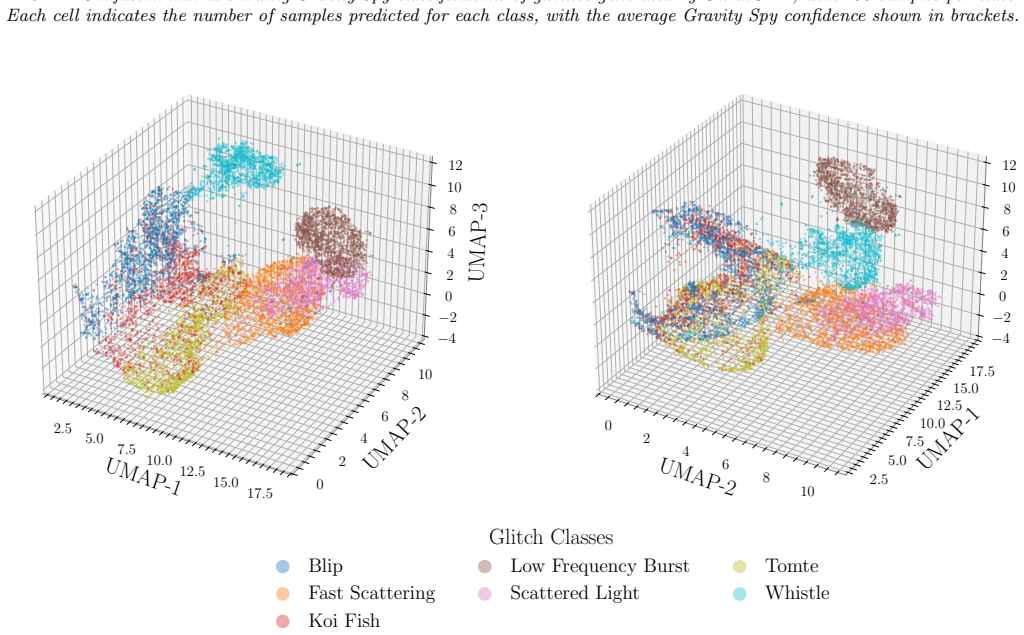
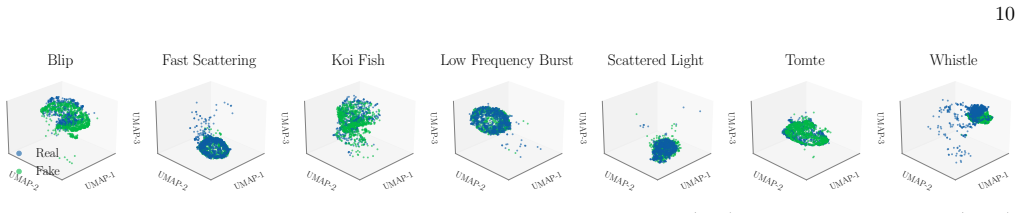
- Synthetic glitches from the model occupy a region in UMAP space that overlaps substantially with real glitches.
Where Pith is reading between the lines
- Direct time-domain output allows the synthetic glitches to be injected into raw detector data streams without reconstruction steps required by spectrogram-based generators.
- Hybrid glitches generated by interpolation could be used to probe classification boundaries or rare transitional noise events that appear infrequently in real data.
- The speed of generation makes it practical to create balanced training sets for machine-learning classifiers that must handle rare glitch classes.
- Extending the conditioning to continuous parameters such as glitch amplitude or duration could map a smoother glitch manifold.
Load-bearing premise
That correct classification by Gravity Spy together with overlap in UMAP embeddings is sufficient to establish that the generated time-domain waveforms are physically realistic rather than only matching the features those tools extract.
What would settle it
A blind test in which experts or a phase-aware analysis cannot distinguish GlitchGAN outputs from real LIGO glitches of the same class, or a mismatch when physical parameters such as instantaneous frequency evolution are extracted from the synthetic waveforms.
Figures

read the original abstract
Gravitational-wave detectors are highly sensitive instruments susceptible to numerous noise sources. Short-duration transient noise events, known as glitches, pose a particular challenge for data analysis pipelines as they can mimic or obscure astrophysical signals. We present GlitchGAN, a class-conditional generative model that is capable of synthesizing realistic glitches directly in the time domain. The model is trained on high-quality reconstructions of seven common glitch types observed during LIGO's third observing run (O3): Blip, Fast Scattering, Koi Fish, Low-Frequency Burst, Scattered Light, Tomte, and Whistle. We show that GlitchGAN generalizes effectively, learning to reproduce a diverse and physically consistent glitch space directly from these reconstructions. Moreover, because the model is conditioned on glitch class, it can generate \textit{hybrid} or transitional glitch morphologies by interpolating across the class-conditioning vector after training. GlitchGAN generates 1000 glitches in under 22 seconds on a CPU, making it suitable for large-scale glitch synthesis for detector simulations, mock data challenges, and pipeline validation. Synthetic glitches are validated against real glitches using the Gravity Spy classifier, widely used in the GW community for glitch classification, and an unsupervised analysis using UMAP embeddings. Gravity Spy classifies the majority of GlitchGAN's synthetic glitches as the correct class while the UMAP analysis shows substantial overlap between real and synthetic samples in the reduced latent space. We further highlight a critical limitation of magnitude-only spectrograms: classifiers operating on magnitude $Q$-transforms can confidently misclassify physically unrealistic glitches from less robust models, underscoring the need for complementary validation methods that preserve phase information.
Editorial analysis
A structured set of objections, weighed in public.
Referee Report
Summary. The manuscript introduces GlitchGAN, a class-conditional derivative GAN trained on high-quality reconstructions of seven glitch classes (Blip, Fast Scattering, Koi Fish, Low-Frequency Burst, Scattered Light, Tomte, Whistle) from LIGO O3. It claims the model synthesizes realistic time-domain glitches, generalizes to a diverse and physically consistent glitch space, generates hybrid morphologies via class-conditioning interpolation, and produces 1000 glitches in <22 s on CPU. Validation consists of Gravity Spy (majority correct class labels) plus substantial UMAP overlap between real and synthetic samples; the authors note that magnitude-only Q-transform classifiers can misclassify unrealistic inputs.
Significance. A validated time-domain glitch synthesizer would be useful for large-scale detector simulations, mock data challenges, and pipeline testing. The class-conditional hybrid generation and reported CPU speed are practical strengths. Significance is limited by the validation approach, which the manuscript itself identifies as potentially insufficient to confirm physical consistency in the time domain.
major comments (2)
- [Abstract / Validation] Abstract and validation section: the central claim of 'physically consistent' time-domain waveforms rests on Gravity Spy (CNN on magnitude Q-transform images) majority-correct classification plus UMAP overlap. The abstract explicitly states that magnitude-only Q-transform classifiers can confidently misclassify physically unrealistic glitches; therefore these metrics do not establish that generated waveforms possess correct phase evolution, frequency content, or morphology that would pass detector-specific consistency tests.
- [Results / Validation] Results / validation: no quantitative time-domain metrics (waveform correlation, phase coherence, matched-filter SNR against real glitches, or direct comparison to strain consistency tests) are reported. Reliance on embedding spaces derived from the same magnitude Q-transforms used by Gravity Spy leaves open the possibility that synthetic outputs match extracted features without matching the underlying time-series structure.
minor comments (1)
- The term 'derivative Generative Adversarial Networks' appears in the title and abstract but is not defined or distinguished from standard conditional GANs in the provided text.
Simulated Author's Rebuttal
We thank the referee for their thoughtful review and for recognizing the practical utility of class-conditional hybrid generation and CPU speed. We address each major comment below and indicate where revisions will be made.
read point-by-point responses
-
Referee: [Abstract / Validation] Abstract and validation section: the central claim of 'physically consistent' time-domain waveforms rests on Gravity Spy (CNN on magnitude Q-transform images) majority-correct classification plus UMAP overlap. The abstract explicitly states that magnitude-only Q-transform classifiers can confidently misclassify physically unrealistic glitches; therefore these metrics do not establish that generated waveforms possess correct phase evolution, frequency content, or morphology that would pass detector-specific consistency tests.
Authors: We agree that Gravity Spy and UMAP, both derived from magnitude Q-transforms, do not by themselves establish full time-domain physical consistency such as phase evolution. The manuscript already flags this exact limitation in the abstract and validation section. Our intent was to show that the generated time-domain outputs are realistic enough to be classified correctly by the community-standard tool and to occupy overlapping regions in the embedding space used by that tool. We will revise the abstract and relevant sections to replace the phrase 'physically consistent glitch space' with language that more precisely reflects the validation performed (e.g., 'realistic as assessed by Gravity Spy classification and UMAP overlap') and will add an explicit statement that complementary time-domain tests remain necessary. revision: yes
-
Referee: [Results / Validation] Results / validation: no quantitative time-domain metrics (waveform correlation, phase coherence, matched-filter SNR against real glitches, or direct comparison to strain consistency tests) are reported. Reliance on embedding spaces derived from the same magnitude Q-transforms used by Gravity Spy leaves open the possibility that synthetic outputs match extracted features without matching the underlying time-series structure.
Authors: The referee correctly notes the absence of direct time-domain quantitative metrics. Because the model is trained end-to-end on time-series reconstructions, the generated outputs are time-domain waveforms by construction; however, we did not report explicit correlation, phase-coherence, or matched-filter statistics. We will add these metrics in the revised manuscript, including class-wise average time-domain correlations with real glitches and comparisons of power spectral density between synthetic and real samples, to provide a more direct assessment of time-series fidelity. revision: yes
Circularity Check
No circularity: empirical ML model with external training data and independent validation
full rationale
The paper describes training a class-conditional GAN on external high-quality glitch reconstructions from LIGO O3 and validates outputs via Gravity Spy (an independent CNN classifier) plus UMAP embeddings. No equations, derivations, fitted parameters renamed as predictions, or self-citation chains appear in the text. The central claims rest on empirical performance against external tools rather than any reduction to the model's own inputs or prior author work.
Axiom & Free-Parameter Ledger
axioms (1)
- domain assumption High-quality reconstructions of observed O3 glitches supply representative training data that capture the relevant physical features of real glitches.
Reference graph
Works this paper leans on
-
[1]
Gravity Spy classification confidenceσ GS ≥0.9, en- suring that the reconstructed glitches are represen- tative of well-characterized classes
-
[2]
Signal-to-noise ratio (SNR)≥15 (sufficient ampli- tude to minimize reconstruction artifacts)
-
[3]
Detectors: LIGO Hanford (H1) and Livingston (L1)
-
[4]
Blipglitches have a characteristic morphology of a symmetric teardrop shape in time-frequency in the range [30,250] Hz with short-durations,∼0.04 s [11]
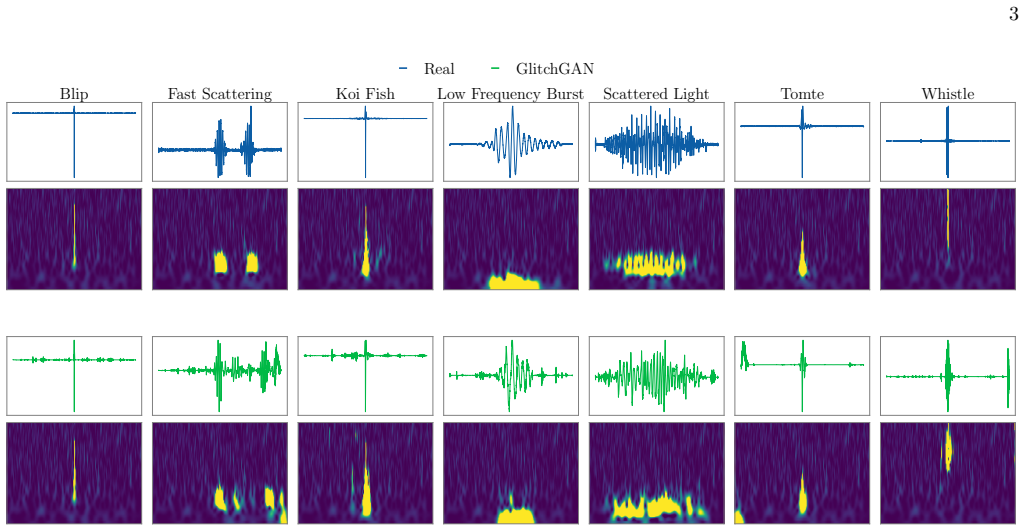
Observing runs: O3a and O3b We include seven glitch classes in the training of Gitch- GAN, namely; Blip, Fast Scattering, Koi Fish, Low- Frequency Burst, Scattered Light, Tomte, and Whistle. Blipglitches have a characteristic morphology of a symmetric teardrop shape in time-frequency in the range [30,250] Hz with short-durations,∼0.04 s [11]. They ap- pea...
-
[5]
The generator is updated to minimize LG =−E ˆx[D(ˆx, c)].(2) In cDVGAN a second discriminatorD∂ operates on the first-order derivative ˙x=dx/dt
Training objective Under the WGAN-GP framework, the loss for discrim- inatorDis LD =E ˆx[D(ˆx, c)]−Ex[D(x, c)]+λE ˜x h (∥∇˜xD(˜x, c)∥2 −1) 2 i , (1) wherexand ˆxare real and generated samples respec- tively, ˜xis a random interpolation between them, and λ= 10 is the gradient-penalty weight. The generator is updated to minimize LG =−E ˆx[D(ˆx, c)].(2) In c...
-
[6]
Generator The generatorGmaps a noise vectorz∼ N(0, I 100) and a one-hot class vectorc∈R 7 to a time series of length 8,192. The class vector is first projected to a 32- dimensional embedding and concatenated withz, then passed through a dense layer and reshaped before five successive upsample-and-convolve blocks with batch nor- malization and ReLU activat...
-
[7]
Discriminators BothDandD ∂ are 1D convolutional networks that map an input sequence and a class vector to a scalar critic value. Class conditioning uses projection [53]: a learned class embedding is dot-producted with the discrimina- tor’s feature vector and added to the scalar output.D operates directly on the 8192-sample waveform;D ∂ op- erates on the 8...
-
[8]
Gravity Spy Classification We reconstruct with DeepExtractor 100 randomly se- lected glitches from the Gravity Spy dataset according to the criteria in Section II, drawing 25 samples per de- tector (H1, L1) per observing run (O3a, O3b). Since Gravity Spy classifies glitches surrounded by detector background noise i.e.g(t) +n(t), each DeepExtractor reconst...
-
[9]
Dimensionality Reduction To visualize and compare the high-dimensional feature space of real and synthetic glitches, we use two comple- mentary nonlinear dimensionality reduction methods:t- distributed Stochastic Neighbor Embedding(t-SNE) [42] andUniform Manifold Approximation and Projection (UMAP) [58]. WhilePrincipal Component Analysis (PCA) captures gl...
-
[10]
Since Gravity Spy supports addi- tional classes beyond our seven training classes, the ma- trix is asymmetric
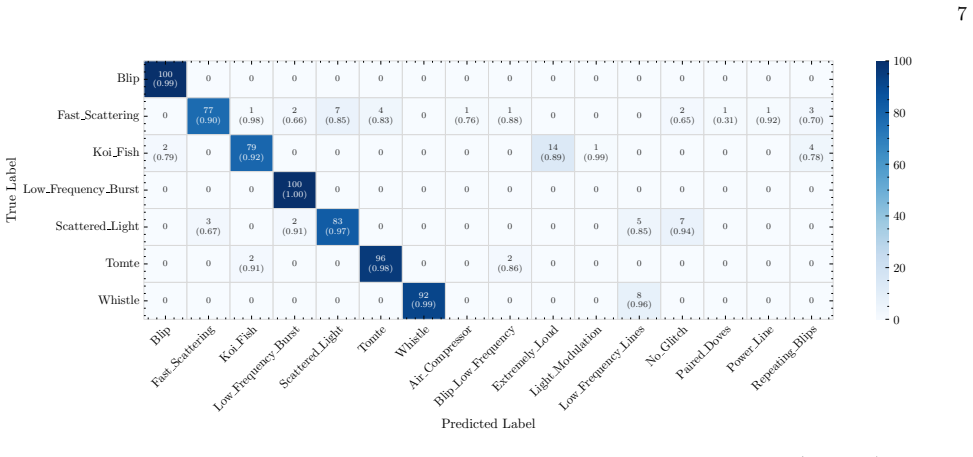
Classification evaluation using Gravity Spy Tables III and IV summarize the results of classify- ing 700 DeepExtractor reconstructions (100 per class) with Gravity Spy. Since Gravity Spy supports addi- tional classes beyond our seven training classes, the ma- trix is asymmetric. Of the 700 reconstructed glitches, 627 are correctly identified by Gravity Sp...
-
[11]
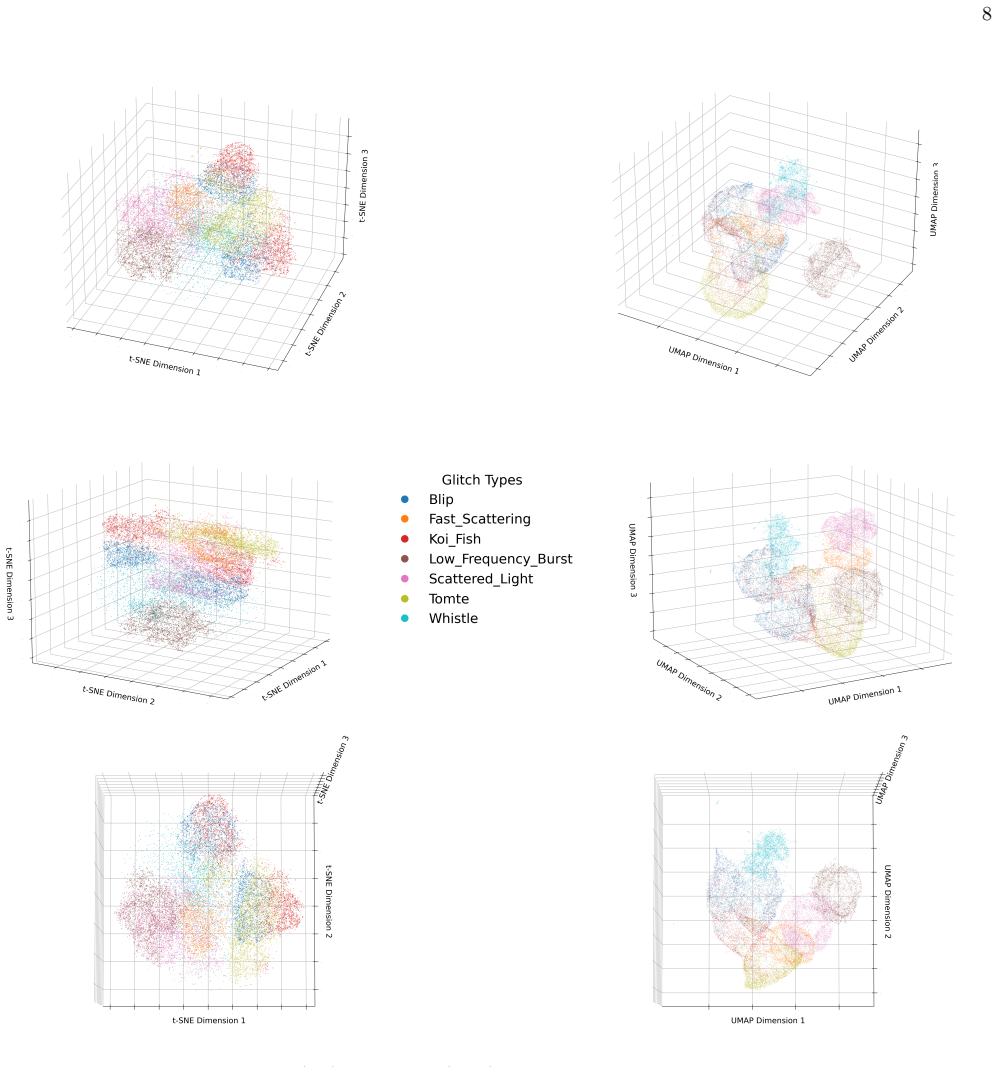
Unsupervised clustering with t-SNE and UMAP Figure 3 shows three-dimensional t-SNE (left) and UMAP (right) embeddings of the DeepExtractor recon- structions, visualized from three complementary view- points. The reconstructions form well-separated clusters that align closely with the Gravity Spy labels, demon- strating that morphologically distinct glitch...
-
[12]
The resulting confusion matrix shown in Figure 4 reflects clas- sifier predictions and confidence scores in brackets
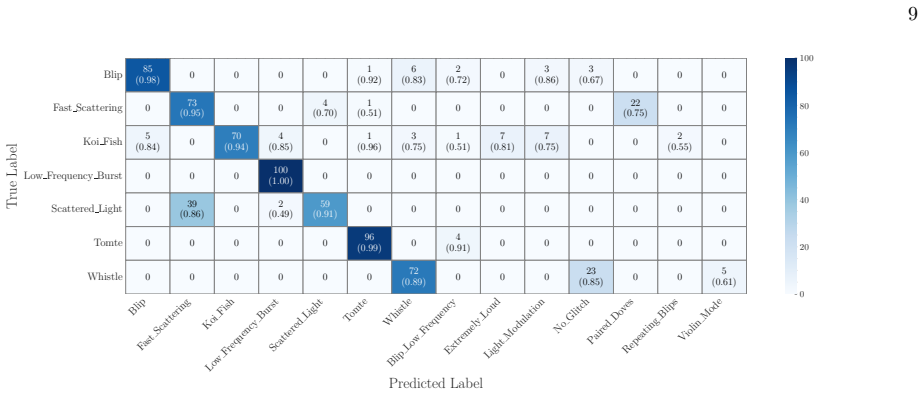
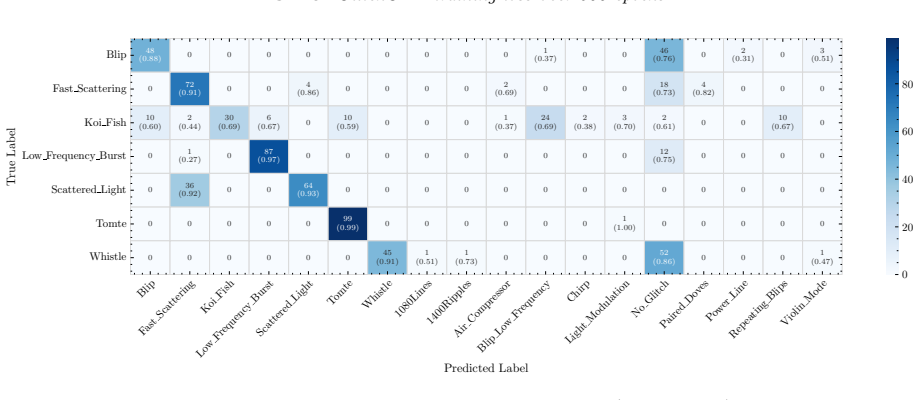
Classification evaluation using Gravity Spy To quantify synthetic glitch realism we follow a similar approach to the DeepExtractor evaluation, injecting 100 generated glitches per class into quiet Hanford O3 back- ground noise and classifying them with Gravity Spy. The resulting confusion matrix shown in Figure 4 reflects clas- sifier predictions and conf...
-
[13]
Figure 5 shows two complementary perspectives of this embedding space, computed from 800 samples per class
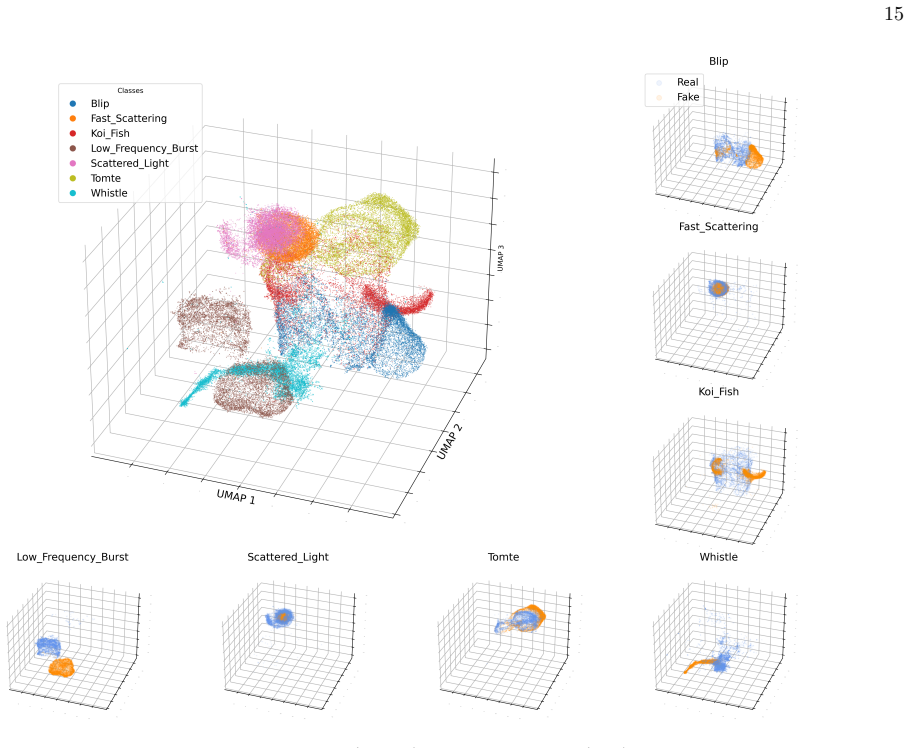
Global morphological similarity via UMAP To assess whether GlitchGAN captures the overall structure of the real glitch distribution, we project both real and synthetic glitch samples into a three-dimensional latent space using UMAP [43]. Figure 5 shows two complementary perspectives of this embedding space, computed from 800 samples per class. Correspondi...
-
[14]
out-of-the-box
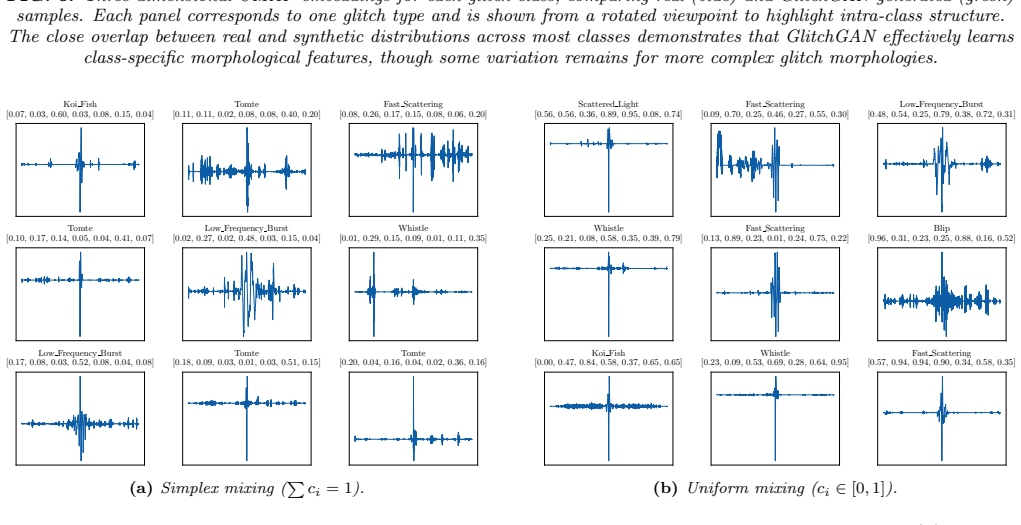
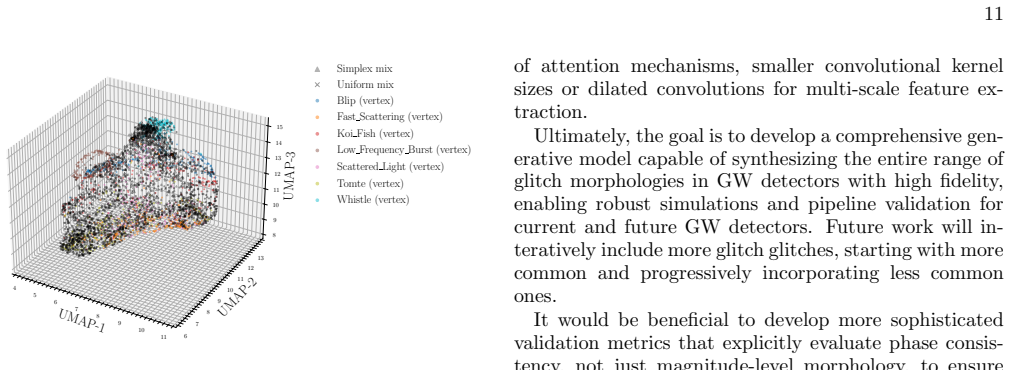
Generating hybrid glitches via class interpolation A key advantage of class-conditional generative mod- els is the ability to produce “hybrid” or transitional mor- phologies by sampling mixed class vectors. We explore two sampling strategies: 1.Simplex mixing:The class vector is normalized such that all coefficients sum to 1, i.e., sampled from ak= 7 simp...
-
[15]
LIGO Scientific Collaboration and others, Advanced LIGO, Class. Quant. Grav.32, 074001 (2015), arXiv:1411.4547 [gr-qc]
work page internal anchor Pith review Pith/arXiv arXiv 2015
-
[16]
Advanced Virgo: a 2nd generation interferometric gravitational wave detector
F. Acerneseet al.(VIRGO), Advanced Virgo: a second- generation interferometric gravitational wave detector, Class. Quant. Grav.32, 024001 (2015), arXiv:1408.3978 [gr-qc]
work page internal anchor Pith review Pith/arXiv arXiv 2015
-
[17]
R. Abbottet al., Gwtc-3: Compact binary coales- cences observed by ligo and virgo during the second part of the third observing run, Physical Review X13, 10.1103/physrevx.13.041039 (2023)
-
[18]
The LIGO Scientific Collaborationet al., Characteriza- tion of the ligo detectors during their third observing run, Classical and Quantum Gravity38, 135003 (2021)
2021
-
[19]
Daviset al., Ligo detector characterization in the sec- ond and third observing runs, Classical and Quantum Gravity38, 135014 (2021)
D. Daviset al., Ligo detector characterization in the sec- ond and third observing runs, Classical and Quantum Gravity38, 135014 (2021)
2021
-
[20]
F. Acerneseet al.(Virgo), Virgo detector characteriza- tion and data quality: results from the O3 run, Class. Quant. Grav.40, 185006 (2023), arXiv:2210.15633 [gr- qc]
-
[21]
T. Akutsuet al., Overview of KAGRA: Calibra- tion, detector characterization, physical environmen- tal monitors, and the geophysics interferometer, Progress of Theoretical and Experimental Physics2021, 05A102 (2021), https://academic.oup.com/ptep/article- pdf/2021/5/05A102/38109702/ptab018.pdf
2021
-
[22]
D. Daviset al., Rapid data quality investigations of gravitational-wave events with the data quality report builder toolkit (2026), arXiv:2605.16183 [astro-ph.IM]
work page internal anchor Pith review Pith/arXiv arXiv 2026
- [23]
-
[24]
The LSC Glitch Group : Monitoring Noise Transients during the fifth LIGO Science Run
L. Blackburnet al., The LSC Glitch Group: Monitor- ing Noise Transients during the fifth LIGO Science Run, Class. Quant. Grav.25, 184004 (2008), arXiv:0804.0800 [gr-qc]
work page internal anchor Pith review Pith/arXiv arXiv 2008
-
[25]
B. P. Abbottet al.(LIGO Scientific, Virgo), Charac- terization of transient noise in Advanced LIGO relevant to gravitational wave signal GW150914, Class. Quant. Grav.33, 134001 (2016), arXiv:1602.03844 [gr-qc]
work page internal anchor Pith review Pith/arXiv arXiv 2016
-
[26]
Pankowet al., Mitigation of the instrumental noise transient in gravitational-wave data surrounding gw170817, Phys
C. Pankowet al., Mitigation of the instrumental noise transient in gravitational-wave data surrounding gw170817, Phys. Rev. D98, 084016 (2018)
2018
-
[27]
Payne, S
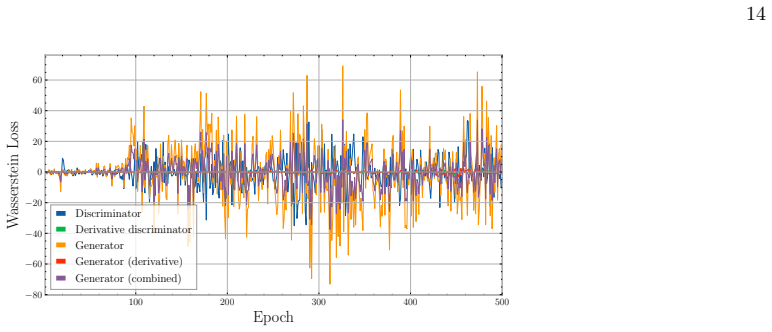
E. Payne, S. Hourihane, J. Golomb, R. Udall, D. Davis, and K. Chatziioannou, Curious case of gw200129: Inter- 14 100 200 300 400 500 Epoch −80 −60 −40 −20 0 20 40 60 Wasserstein Loss Discriminator Derivative discriminator Generator Generator (derivative) Generator (combined) FIG. 10:GlitchGAN training loss over 500 epochs. Blip Fast Scattering Koi Fish Lo...
2022
-
[28]
A. Guptaet al., Possible causes of false general relativ- ity violations in gravitational wave observations (2024), arXiv:2405.02197 [gr-qc]
-
[29]
B. P. Abbottet al.(LIGO Scientific Collaboration and Virgo Collaboration), Gw170817: Observation of gravi- tational waves from a binary neutron star inspiral, Phys. Rev. Lett.119, 161101 (2017)
2017
-
[30]
B. P. Abbottet al., Gw190425: Observation of a com- pact binary coalescence with total mass∼3.4m ⊙, The Astrophysical Journal Letters892, L3 (2020)
2020
-
[31]
Abbottet al., Observation of gravitational waves from two neutron star–black hole coalescences, The Astrophys- ical Journal Letters915, L5 (2021)
R. Abbottet al., Observation of gravitational waves from two neutron star–black hole coalescences, The Astrophys- ical Journal Letters915, L5 (2021)
2021
-
[32]
S. Hild, M. Abernathy, F. Acernese, P. Amaro-Seoane, N. Andersson, K. Arun, F. Barone, B. Barr, M. Barsug- lia, and M. B. e, Sensitivity studies for third-generation gravitational wave observatories, Class. Quant. Grav.28, 094013 (2011)
2011
-
[33]
E. D. Hall , Cosmic explorer: A next-generation ground-based gravitational-wave observatory, Galaxies 10, 10.3390/galaxies10040090 (2022)
-
[34]
Iacovelliet al., Forecasting the detection capabilities of third-generation gravitational-wave detectors using GW- FAST, The Astrophysical Journal941, 208 (2022)
F. Iacovelliet al., Forecasting the detection capabilities of third-generation gravitational-wave detectors using GW- FAST, The Astrophysical Journal941, 208 (2022)
2022
-
[35]
Kalogeraet al., The next generation global gravita- tional wave observatory: The science book (2021)
V. Kalogeraet al., The next generation global gravita- tional wave observatory: The science book (2021)
2021
-
[36]
J. Abadieet al., Search for gravitational waves from com- pact binary coalescence in ligo and virgo data from s5 and vsr1, Physical Review D82, 10.1103/physrevd.82.102001 (2010)
-
[37]
J. Abadieet al., All-sky search for gravitational-wave bursts in the first joint ligo-geo-virgo run, Physical Re- view D81, 10.1103/physrevd.81.102001 (2010)
- [38]
-
[39]
Chatterjee, K
C. Chatterjee, K. McGowan, S. Deshmukh, N. Tyler- Howard, and K. Jani, Machine learning confirms gw231123 is a “lite” intermediate mass black hole merger, The Astrophysical Journal Letters995, L6 (2025)
2025
-
[40]
R. Bondarescu, A. Lundgren, and R. Macas, Quasi- physical model for removing short glitches from LIGO and Virgo data, Phys. Rev. D108, 122004 (2023), arXiv:2309.06594 [gr-qc]
-
[41]
C.-H. Liao and F.-L. Lin, Deep generative models of grav- itational waveforms via conditional autoencoder, Phys. Rev. D103, 124051 (2021), arXiv:2101.06685 [astro- ph.IM]. 15 FIG. 12:Three-dimensional UMAP projection of real (orange) and DiT-generated (blue) glitches across all seven classes. The large panel shows the overall structure, while smaller pane...
-
[42]
Eccleston and M
T. Eccleston and M. C. Edwards, Generative adversar- ial network for stellar core-collapse gravitational waves, Phys. Rev. D110, 104055 (2024)
2024
-
[43]
I. J. Goodfellowet al., Generative Adversarial Networks (2014), arXiv:1406.2661 [stat.ML]
work page internal anchor Pith review Pith/arXiv arXiv 2014
-
[44]
J. Yan, A. P. Leung, and D. C. Y. Hui, On improving the performance of glitch classification for gravitational wave detection by using generative adversarial networks (2022)
2022
-
[45]
Powell, L
J. Powell, L. Sun, K. Gereb, P. D. Lasky, and M. Dollmann, Generating transient noise artefacts in gravitational-wave detector data with generative adver- sarial networks, Classical and Quantum Gravity40, 035006 (2023)
2023
-
[46]
Lopezet al., Simulating transient noise bursts in ligo with generative adversarial networks (2022)
M. Lopezet al., Simulating transient noise bursts in ligo with generative adversarial networks (2022)
2022
-
[47]
Lopez, V
M. Lopez, V. Boudart, S. Schmidt, and S. Caudill, Sim- ulating transient noise bursts in ligo with gengli (2022)
2022
-
[48]
N. J. Cornish and T. B. Littenberg, Bayeswave: Bayesian inference for gravitational wave bursts and instrument glitches, Class. Quant. Grav.32, 135012 (2015)
2015
-
[49]
McGinnet al., Generalised gravitational wave burst generation with generative adversarial networks, Class
J. McGinnet al., Generalised gravitational wave burst generation with generative adversarial networks, Class. Quant. Grav.38, 155005 (2021)
2021
-
[50]
T. Dooneyet al., Time-domain reconstruction of signals and glitches in gravitational wave data with deep learn- ing, Physical Review D 10.1103/s91m-c2jw (2025)
-
[51]
Dooney, R
T. Dooney, R. L. Curier, D. S. Tan, M. Lopez, C. Van Den Broeck, and S. Bromuri, One flexible model for mul- ticlass gravitational wave signal and glitch generation, Phys. Rev. D110, 022004 (2024)
2024
-
[52]
Dooney, S
T. Dooney, S. Bromuri, and L. Curier, Dvgan: Stabi- lize Wasserstein GAN training for time-domain gravita- tional wave physics, in2022 IEEE International Confer- ence on Big Data (Big Data)(Osaka, Japan, 2022) pp. 5468–5477
2022
-
[53]
Zevinet al., Gravity spy: integrating advanced LIGO detector characterization, machine learning, and citizen science, Class
M. Zevinet al., Gravity spy: integrating advanced LIGO detector characterization, machine learning, and citizen science, Class. Quant. Grav.34, 064003 (2017)
2017
-
[54]
Glanzer, S
J. Glanzer, S. Banagiri, S. B. Coughlin, S. Soni, M. Zevin, C. P. L. Berry, O. Patane, S. Bahaadini, N. Rohani, K. Crowston, V. Kalogera, C. Østerlund, L. Trouille, and A. Katsaggelos, Data quality up to the third observing run of advanced ligo: Gravity spy glitch classifications, Classical and Quantum Gravity40, 065004 (2023)
2023
-
[55]
Y. Wu, M. Zevin, C. P. L. Berry, K. Crowston, C. Øster- lund, Z. Doctor, S. Banagiri, C. B. Jackson, V. Kalogera, and A. K. Katsaggelos, Advancing glitch classification in 16 gravity spy: Multi-view fusion with attention-based ma- chine learning for advanced ligo’s fourth observing run (2024), arXiv:2401.12913 [gr-qc]
- [56]
- [58]
-
[59]
T. A. Ferreira and G. Gonz´ alez, Using t-sne for charac- terizing glitches in ligo detectors, Classical and Quantum Gravity42, 105010 (2025)
2025
-
[60]
S. Deshmukh, C. Chatterjee, A. Petulante, T. A. Fer- reira, and K. Jani, The sound of noise: Leveraging the inductive bias of pre-trained audio transformers for glitch identification in ligo (2026), arXiv:2601.20034 [astro- ph.IM]
-
[61]
Sohl-Dickstein, E
J. Sohl-Dickstein, E. A. Weiss, N. Maheswaranathan, and S. Ganguli, Deep unsupervised learning using nonequilib- rium thermodynamics (2015)
2015
-
[62]
Caberoet al., Blip glitches in Advanced LIGO data, Class
M. Caberoet al., Blip glitches in Advanced LIGO data, Class. Quant. Grav.36, 15 (2019), arXiv:1901.05093 [physics.ins-det]
-
[63]
S. Soniet al., Discovering features in gravitational-wave data through detector characterization, citizen science and machine learning, Class. Quant. Grav.38, 195016 (2021), arXiv:2103.12104 [gr-qc]
-
[64]
Improving the Data Quality of Advanced LIGO Based on Early Engineering Run Results
L. Nuttallet al., Improving the Data Quality of Advanced LIGO Based on Early Engineering Run Results, Class. Quant. Grav.32, 245005 (2015), arXiv:1508.07316 [gr- qc]
work page internal anchor Pith review Pith/arXiv arXiv 2015
-
[65]
Arjovsky, S
M. Arjovsky, S. Chintala, and L. Bottou, Wasserstein generative adversarial networks, inProceedings of the 34th International Conference on Machine Learning, Proceedings of Machine Learning Research, Vol. 70, edited by D. Precup and Y. W. Teh (PMLR, 2017) pp. 214–223
2017
-
[66]
Gulrajani, F
I. Gulrajani, F. Ahmed, M. Arjovsky, V. Dumoulin, and A. Courville, Improved training of wasserstein gans (2017)
2017
-
[67]
Conditional Generative Adversarial Nets
M. Mirza and S. Osindero, Conditional generative adver- sarial nets, arXiv preprint (2014), arXiv:1411.1784
work page internal anchor Pith review Pith/arXiv arXiv 2014
-
[68]
Abadiet al., TensorFlow: Large-scale machine learn- ing on heterogeneous systems (2015), software available from tensorflow.org
M. Abadiet al., TensorFlow: Large-scale machine learn- ing on heterogeneous systems (2015), software available from tensorflow.org
2015
-
[69]
J. Ho, A. Jain, and P. Abbeel, Denoising diffusion prob- abilistic models (2020), arXiv:2006.11239 [cs.LG]
work page internal anchor Pith review Pith/arXiv arXiv 2020
-
[70]
Classifier-Free Diffusion Guidance
J. Ho and T. Salimans, Classifier-free diffusion guidance (2022), arXiv:2207.12598 [cs.LG]
work page internal anchor Pith review Pith/arXiv arXiv 2022
-
[71]
D. M. Macleod, J. S. Areeda, S. B. Coughlin, T. J. Massinger, and A. L. Urban, GWpy: A Python pack- age for gravitational-wave astrophysics, SoftwareX13, 100657 (2021)
2021
-
[72]
UMAP: Uniform Manifold Approximation and Projection for Dimension Reduction
L. McInnes, J. Healy, and J. Melville, Umap: Uniform manifold approximation and projection for dimension re- duction (2020), arXiv:1802.03426 [stat.ML]
work page internal anchor Pith review Pith/arXiv arXiv 2020
-
[73]
Areeda, Are blips and koi fish related?, https://blog.gravityspy.org/2017/10/19/ are-blips-and-koi-fish-related/(2017), accessed on 11-06-2025
J. Areeda, Are blips and koi fish related?, https://blog.gravityspy.org/2017/10/19/ are-blips-and-koi-fish-related/(2017), accessed on 11-06-2025
2017
discussion (0)
Sign in with ORCID, Apple, or X to comment. Anyone can read and Pith papers without signing in.