Generative Models on Analog Hardware with Dynamics
Pith reviewed 2026-06-26 01:23 UTC · model grok-4.3
The pith
Analog Interaction Systems enable generative models on analog hardware through time-varying parameters and hidden states that bridge fixed physics with flexible dynamics.
A machine-rendered reading of the paper's core claim, the machinery that carries it, and where it could break.
Core claim
Analog Interaction Systems are dynamical systems that can be realized on analog hardware; when equipped with time-varying piecewise parameters and hidden physical states they become expressive enough for generative modeling, trained via Wasserstein GAN without trajectory constraints, and deliver FID 27.6 on MNIST at 23 µJ per image with 4-bit sparse connectivity.
What carries the argument
Time-varying piecewise parameters and hidden physical states inside oscillator-based Analog Interaction Systems, which expand the limited approximation capacity of fixed differential equations imposed by analog hardware.
If this is right
- Sparse connectivity and low-bit-width quantized parameters are required for practical area and power scaling on analog hardware.
- The energy cost of 23 µJ per generated image is two orders of magnitude below digital baselines.
- The oscillator-based AIS outperforms the best prior hardware-implementable analog generative models by a factor of 3–4 on FID.
- Wasserstein GAN training removes the need for the model to follow any prescribed trajectory during learning.
Where Pith is reading between the lines
- The same mechanisms could be ported to other analog platforms such as Ising machines to widen the set of low-power generative tasks they can support.
- If the fidelity assumption holds, always-on generative sampling becomes feasible in energy-constrained environments without a digital processor.
- Extending the architecture to higher-resolution images will require systematic study of how sparsity and bit-width trade against sample quality.
Load-bearing premise
The time-varying piecewise parameters and hidden physical states can be realized on physical analog hardware with enough fidelity to preserve the claimed expressivity and training behavior.
What would settle it
Fabricate the 4-bit sparse oscillator circuit, load the trained parameters, generate images on the physical hardware, and measure whether the FID on MNIST stays near the simulated value of 27.6.
Figures

read the original abstract
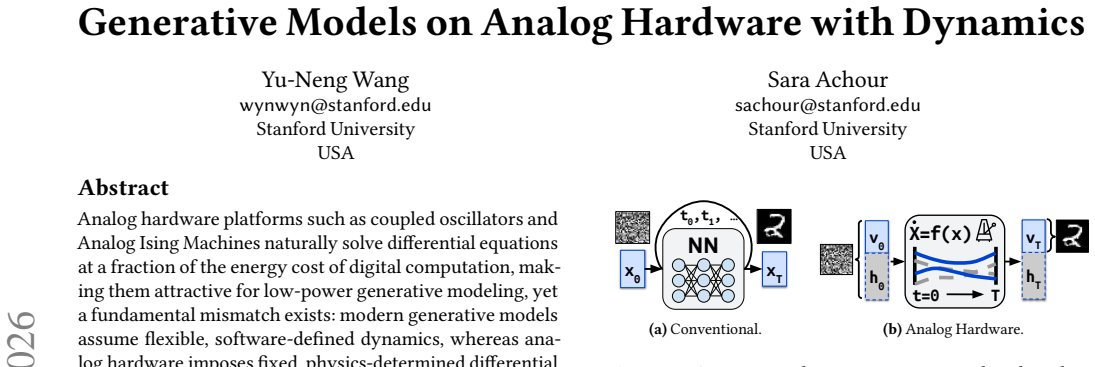
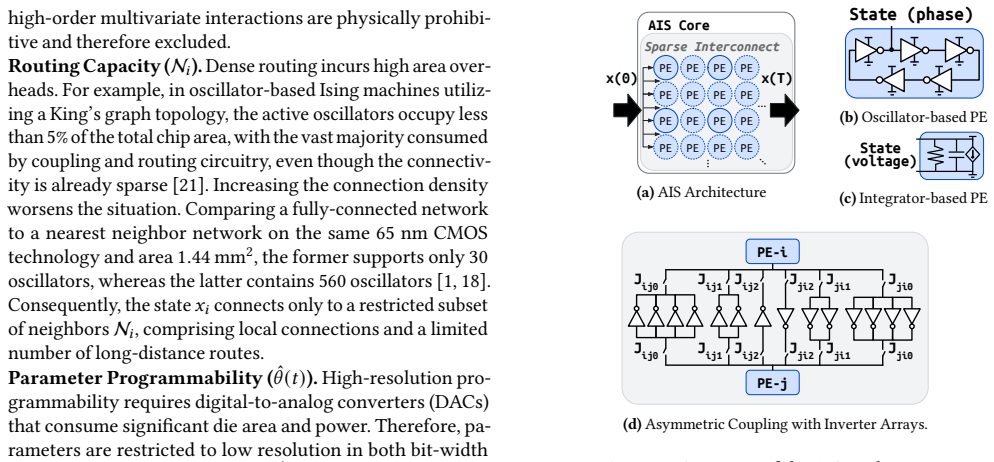
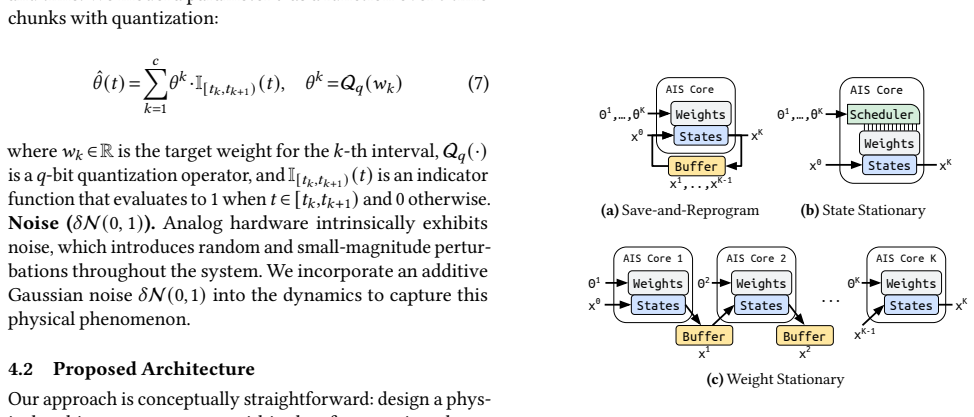
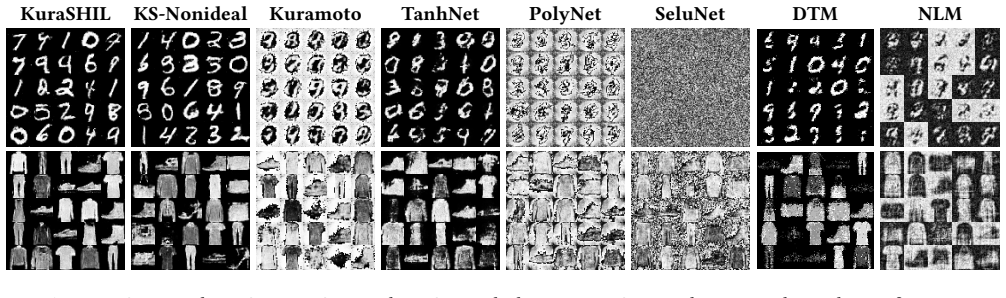
Analog hardware platforms such as coupled oscillators and Analog Ising Machines naturally solve differential equations at a fraction of the energy cost of digital computation, making them attractive for low-power generative modeling, yet a fundamental mismatch exists: modern generative models assume flexible, software-defined dynamics, whereas analog hardware imposes fixed, physics-determined differential equations with limited approximation capacity. This paper introduces Analog Interaction Systems (AIS), a unified framework for hardware-implementable dynamical systems, and empirically characterizes their expressivity gap relative to neural network baselines. Two hardware-compatible mechanisms are proposed to narrow this gap - time-varying piecewise parameters and hidden physical states - and a Wasserstein GAN training procedure is developed to enable training of these models without requiring them to follow a specific trajectory. We characterize how area and power scale with connection density and precision, showing that sparse connectivity and low-bit-width quantized parameters are necessary for practical implementation, and estimate an energy cost of 23uJ per generated image for the chosen architecture, representing a 2-orders-of-magnitude improvement over digital baselines. On MNIST and Fashion-MNIST, our oscillator-based AIS achieves FID scores of 27.6 and 80.8, outperforming the best prior hardware-implementable analog generative models by 3-4x with a 4-bit sparse architecture.
Editorial analysis
A structured set of objections, weighed in public.
Referee Report
Summary. The paper introduces Analog Interaction Systems (AIS) as a unified framework for hardware-implementable dynamical systems on analog platforms such as coupled oscillators. It identifies an expressivity gap with neural networks, proposes time-varying piecewise parameters and hidden physical states to close it, develops a Wasserstein GAN training procedure that does not require exact trajectory matching, characterizes area/power scaling with connection density and precision, estimates 23 μJ per generated image, and reports FID scores of 27.6 (MNIST) and 80.8 (Fashion-MNIST) with a 4-bit sparse architecture, claiming 3-4× improvement over prior hardware-implementable analog generative models and two orders of magnitude energy improvement over digital baselines.
Significance. If the hardware fidelity assumptions hold and the reported FID scores are reproducible under realistic analog constraints, the result would be significant for low-power generative modeling by demonstrating that oscillator-based dynamics can approach neural-network performance while delivering substantial energy savings. Credit is due for the explicit scaling analysis with sparsity and bit-width, the training procedure that decouples from fixed DE trajectories, and the focus on hardware-compatible mechanisms rather than post-hoc approximation.
major comments (2)
- [Abstract] Abstract: the central empirical claim (FID 27.6/80.8 outperforming prior analog models by 3-4×) rests on the realizability of time-varying piecewise parameters and hidden physical states on physical analog hardware, yet no circuit-level analysis, noise model, or fabrication result is supplied to show that external modulation of these parameters can be performed with sufficient fidelity without introducing uncontrolled dynamics that would invalidate the simulated scores or the 23 μJ energy estimate.
- [Abstract] Abstract and scaling discussion: the energy estimate of 23 μJ per image and the necessity of sparse 4-bit connectivity are presented as derived from area/power scaling, but the manuscript supplies no explicit derivation, baseline digital comparison numbers, or sensitivity analysis showing how the estimate changes when time-varying parameters are realized with realistic control overhead.
minor comments (1)
- Notation for the piecewise time-varying parameters and hidden states should be defined with explicit equations in the main text rather than relying on the abstract framing.
Simulated Author's Rebuttal
We thank the referee for the constructive feedback and for acknowledging the significance of the AIS framework, training procedure, and scaling analysis. We address each major comment below, clarifying the simulation-based scope of the work while committing to revisions that strengthen the presentation of assumptions and derivations.
read point-by-point responses
-
Referee: [Abstract] Abstract: the central empirical claim (FID 27.6/80.8 outperforming prior analog models by 3-4×) rests on the realizability of time-varying piecewise parameters and hidden physical states on physical analog hardware, yet no circuit-level analysis, noise model, or fabrication result is supplied to show that external modulation of these parameters can be performed with sufficient fidelity without introducing uncontrolled dynamics that would invalidate the simulated scores or the 23 μJ energy estimate.
Authors: The manuscript presents a simulation study of the AIS framework under idealized hardware assumptions; the reported FID scores reflect numerical integration of the proposed dynamics rather than physical measurements. We will revise the abstract to explicitly state that results are simulation-based and add a new subsection on hardware assumptions, including a literature-based discussion of noise in coupled oscillators and modulation fidelity for piecewise parameters. This addresses the concern without claiming experimental validation, which lies outside the paper's modeling focus. revision: partial
-
Referee: [Abstract] Abstract and scaling discussion: the energy estimate of 23 μJ per image and the necessity of sparse 4-bit connectivity are presented as derived from area/power scaling, but the manuscript supplies no explicit derivation, baseline digital comparison numbers, or sensitivity analysis showing how the estimate changes when time-varying parameters are realized with realistic control overhead.
Authors: We will add an explicit step-by-step derivation of the 23 μJ figure (based on component counts, sparsity, and standard analog power models) to the main text or appendix, along with direct numerical comparisons to digital baselines (e.g., GPU energy per image from cited works). A sensitivity analysis incorporating control overhead for time-varying parameters will also be included, using conservative estimates from analog circuit literature. revision: yes
- Circuit-level analysis, noise model validation, or fabrication results demonstrating realizability of time-varying piecewise parameters and hidden physical states on physical analog hardware.
Circularity Check
No circularity: empirical FID results and scaling estimates are independent of fitted inputs
full rationale
The paper introduces the AIS framework, proposes time-varying piecewise parameters and hidden physical states to address expressivity, develops a Wasserstein GAN training procedure explicitly designed to avoid requiring exact trajectory matching, reports simulated FID scores of 27.6/80.8 on MNIST/Fashion-MNIST, and provides area/power scaling estimates plus a 23uJ energy figure. None of these steps reduce by construction to their own inputs via self-definition, fitted-parameter renaming as prediction, or load-bearing self-citation chains; the performance numbers are presented as simulation outcomes on the proposed model, and the training procedure is described as independent. This is the common case of a self-contained empirical paper with no derivation that collapses to tautology.
Axiom & Free-Parameter Ledger
axioms (1)
- domain assumption Analog hardware platforms such as coupled oscillators naturally solve differential equations at a fraction of the energy cost of digital computation
invented entities (1)
-
Analog Interaction Systems (AIS)
no independent evidence
Reference graph
Works this paper leans on
-
[1]
Ibrahim Ahmed, Po-Wei Chiu, William Moy, and Chris H Kim. 2021. A probabilistic compute fabric based on coupled ring oscillators for solving combinatorial optimization problems.IEEE Journal of Solid-State Circuits56, 9 (2021), 2870–2880
2021
-
[2]
Fabian Böhm, Thomas Van Vaerenbergh, Guy Verschaffelt, and Guy Van der Sande. 2021. Order-of-magnitude differences in computational performance of analog Ising machines induced by the choice of nonlinearity.Communications Physics4, 1 (2021), 149
2021
-
[3]
Wenxiao Cai, Zongru Li, Iris Wang, Yu-Neng Wang, and Thomas H Lee. 2025. OscNet v1. 5: energy efficient hopfield network on CMOS oscillators for image classification. InProceedings of the IEEE/CVF International Conference on Computer Vision. 4733–4741
2025
-
[4]
Shiqi Chen, Yuhang Li, Yuntian Wang, Hanlong Chen, and Aydogan Oz- can. 2025. Optical generative models.Nature644, 8078 (2025), 903–911
2025
-
[5]
Yang Cheng, Qingyuan Shu, Albert Lee, Haoran He, Ivy Zhu, Minzhang Chen, Renhe Chen, Zirui Wang, Hantao Zhang, Chih-Yao Wang, et al
-
[6]
Voltage-controlled magnetoelectric devices for neuromorphic diffusion process.Nature Communications16, 1 (2025), 5022
2025
-
[7]
Jiaqi Chu, Heiner Kremer, Fabian Falck, Grace Brennan, Burcu Canakci, James Clegg, Daniel Cletheroe, Doug Kelly, Christos Gkantsidis, Michael Hansen, et al. 2026. Analog Diffusion Models. (2026)
2026
-
[8]
Tom Conte, Erik DeBenedictis, Natesh Ganesh, Todd Hylton, John Paul Strachan, R Stanley Williams, Alexander Alemi, Lee Altenberg, Gavin Crooks, James Crutchfield, et al. 2019. Thermodynamic computing. arXiv preprint arXiv:1911.01968(2019)
arXiv 2019
-
[9]
Gyorgy Csaba and Wolfgang Porod. 2020. Coupled oscillators for com- puting: A review and perspective.Applied physics reviews7, 1 (2020)
2020
-
[10]
George Cybenko. 1989. Approximation by superpositions of a sigmoidal function.Mathematics of control, signals and systems2, 4 (1989), 303–314
1989
-
[11]
Markus Graber and Klaus Hofmann. 2024. An integrated coupled oscillator network to solve optimization problems.Communications Engineering3, 1 (2024), 116
2024
-
[12]
Ishaan Gulrajani, Faruk Ahmed, Martin Arjovsky, Vincent Dumoulin, and Aaron C Courville. 2017. Improved training of wasserstein gans. Advances in neural information processing systems30 (2017)
2017
-
[13]
Jonathan Ho, Ajay Jain, and Pieter Abbeel. 2020. Denoising diffusion probabilistic models.Advances in neural information processing systems 33 (2020), 6840–6851
2020
-
[14]
Takahiro Inagaki, Kensuke Inaba, Ryan Hamerly, Kyo Inoue, Yoshihisa Yamamoto, and Hiroki Takesue. 2016. Large-scale Ising spin network based on degenerate optical parametric oscillators.Nature Photonics 10, 6 (2016), 415–419
2016
-
[15]
Andraž Jelinčič, Owen Lockwood, Akhil Garlapati, Peter Schillinger, Isaac Chuang, Guillaume Verdon, and Trevor McCourt. 2025. An efficient probabilistic hardware architecture for diffusion-like models. arXiv preprint arXiv:2510.23972(2025)
arXiv 2025
-
[16]
Yann LeCun, Léon Bottou, Yoshua Bengio, and Patrick Haffner. 2002. Gradient-based learning applied to document recognition.Proc. IEEE 86, 11 (2002), 2278–2324
2002
-
[17]
Moshe Leshno, Vladimir Ya Lin, Allan Pinkus, and Shimon Schocken
-
[18]
Multilayer feedforward networks with a nonpolynomial activation function can approximate any function.Neural networks 6, 6 (1993), 861–867
1993
-
[19]
2022.arXiv preprint arXiv:2210.02747(2022)
Yaron Lipman, Ricky TQ Chen, Heli Ben-Hamu, Maximilian Nickel, and Matt Le. 2022.arXiv preprint arXiv:2210.02747(2022). 11
Pith/arXiv arXiv 2022
-
[20]
Antik Mallick, Mohammad Khairul Bashar, Daniel S Truesdell, Benton H Calhoun, Siddharth Joshi, and Nikhil Shukla. 2021. Graph col- oring using coupled oscillator-based dynamical systems. In2021 IEEE International Symposium on Circuits and Systems (ISCAS). IEEE, 1–5
2021
-
[21]
Peter L McMahon, Alireza Marandi, Yoshitaka Haribara, Ryan Hamerly, Carsten Langrock, Shuhei Tamate, Takahiro Inagaki, Hiroki Takesue, Shoko Utsunomiya, Kazuyuki Aihara, et al. 2016. A fully programmable 100-spin coherent Ising machine with all-to-all connections.Science 354, 6312 (2016), 614–617
2016
-
[22]
Takeru Miyato, Sindy Löwe, Andreas Geiger, and Max Welling. 2024. Artificial kuramoto oscillatory neurons.arXiv preprint arXiv:2410.13821 (2024)
arXiv 2024
-
[23]
William Moy, Ibrahim Ahmed, Po-wei Chiu, John Moy, Sachin S Sapatnekar, and Chris H Kim. 2022. A 1,968-node coupled ring oscillator circuit for combinatorial optimization problem solving. Nature Electronics5, 5 (2022), 310–317
2022
-
[24]
Shaila Niazi, Shuvro Chowdhury, Navid Anjum Aadit, Masoud Mohseni, Yao Qin, and Kerem Y Camsari. 2024. Training deep Boltzmann networks with sparse Ising machines.Nature Electronics 7, 7 (2024), 610–619
2024
-
[25]
Ilker Oguz, Niyazi U Dinc, Mustafa Yildirim, Junjie Ke, Innfarn Yoo, Qifei Wang, Feng Yang, Christophe Moser, and Demetri Psaltis. 2024. Optical diffusion models for image generation.Advances in Neural Information Processing Systems37 (2024), 59150–59173
2024
-
[26]
Jooyoung Park and Irwin W Sandberg. 1991. Universal approximation using radial-basis-function networks.Neural computation3, 2 (1991), 246–257
1991
-
[27]
Jumin Qiu, Ganqing Lu, Tingting Liu, Dejian Zhang, Shuyuan Xiao, and Tianbao Yu. 2025. Optoelectronic generative adversarial networks. Communications Physics8, 1 (2025), 162
2025
-
[28]
Alec Radford, Luke Metz, and Soumith Chintala. 2015. Unsupervised representation learning with deep convolutional generative adversarial networks.arXiv preprint arXiv:1511.06434(2015)
Pith/arXiv arXiv 2015
-
[29]
T Konstantin Rusch, Ben Chamberlain, James Rowbottom, Siddhartha Mishra, and Michael Bronstein. 2022. Graph-coupled oscillator networks. InInternational conference on machine learning. PMLR, 18888–18909
2022
-
[30]
Yue Song, T Anderson Keller, Sevan Brodjian, Takeru Miyato, Yisong Yue, Pietro Perona, and Max Welling. 2025. Kuramoto Orientation Diffusion Models.arXiv preprint arXiv:2509.15328(2025)
arXiv 2025
-
[31]
Yang Song, Jascha Sohl-Dickstein, Diederik P Kingma, Abhishek Kumar, Stefano Ermon, and Ben Poole. 2020. Score-based generative modeling through stochastic differential equations.arXiv preprint arXiv:2011.13456(2020)
Pith/arXiv arXiv 2020
-
[32]
Alexander Tong, Kilian Fatras, Nikolay Malkin, Guillaume Huguet, Yanlei Zhang, Jarrid Rector-Brooks, Guy Wolf, and Yoshua Bengio
-
[33]
Improving and generalizing flow-based generative models with minibatch optimal transport.arXiv preprint arXiv:2302.00482(2023)
Pith/arXiv arXiv 2023
-
[34]
Tianshi Wang and Jaijeet Roychowdhury. 2017. Oscillator-based Ising machine.arXiv preprint arXiv:1709.08102(2017)
Pith/arXiv arXiv 2017
-
[35]
Stephen Whitelam. 2026. Generative thermodynamic computing. Physical Review Letters136, 3 (2026), 037101
2026
-
[36]
Han Xiao, Kashif Rasul, and Roland Vollgraf. 2017. Fashion-mnist: a novel image dataset for benchmarking machine learning algorithms. arXiv preprint arXiv:1708.07747(2017)
Pith/arXiv arXiv 2017
-
[37]
Jichang Yang, Hegan Chen, Jia Chen, Songqi Wang, Shaocong Wang, Yifei Yu, Xi Chen, Bo Wang, Xinyuan Zhang, Binbin Cui, et al. 2024. Resistive memory-based neural differential equation solver for score-based diffusion model.arXiv preprint arXiv:2404.05648(2024)
arXiv 2024
-
[38]
Zhendong Yu, Weizhong Huang, and Haiping Huang. 2025. Neural Langevin Machine: a local asymmetric learning rule can be creative. arXiv preprint arXiv:2506.23546(2025)
Pith/arXiv arXiv 2025
-
[39]
Kaicheng Zhang, David N Reynolds, Piero Deidda, and Francesco Tudisco. 2025. Stuart-Landau Oscillatory Graph Neural Network. arXiv preprint arXiv:2511.08094(2025). 12
arXiv 2025
discussion (0)
Sign in with ORCID, Apple, or X to comment. Anyone can read and Pith papers without signing in.