CHIA: An open-source framework for principled, agentic AI-driven hardware/software co-design research
Pith reviewed 2026-06-26 01:47 UTC · model grok-4.3
The pith
CHIA turns hardware and software co-design into agentic AI loops with built-in reliability.
A machine-rendered reading of the paper's core claim, the machinery that carries it, and where it could break.
Core claim
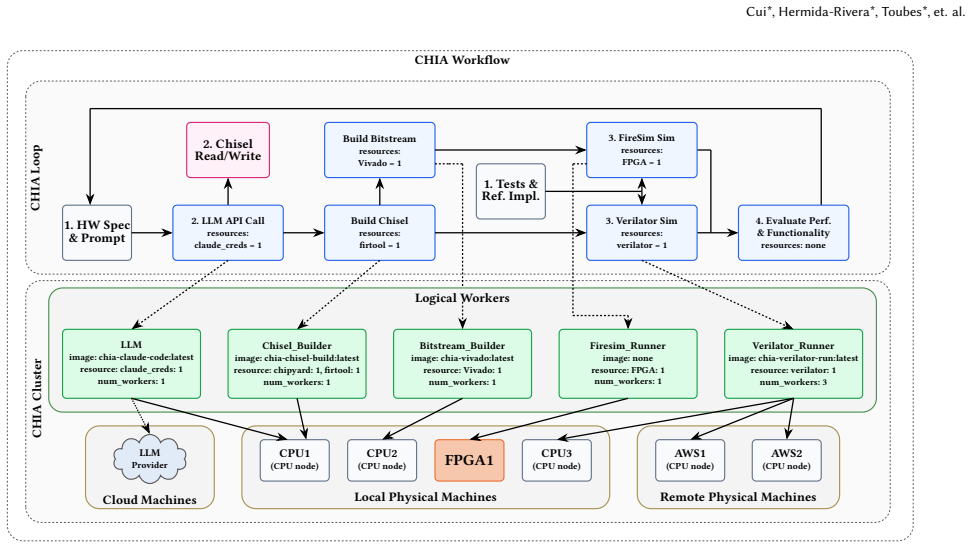
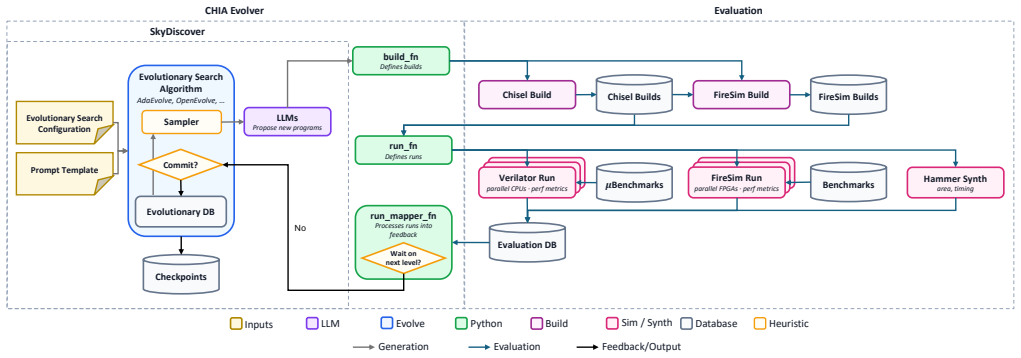
CHIA treats the productive construction and scalable deployment of the co-design flow itself as a first-class objective. In CHIA, agentic AI-driven hardware and software design flows are expressed as CHIA loops: directed cyclic graphs whose nodes execute various system-on-chip design tools, microarchitectural simulators, software build systems, AI models, evolutionary coding agents, and more. The CHIA library provides node implementations for many popular tools, and the system supplies isolation, profiling, fault-tolerant execution, and reliability at scale.
What carries the argument
CHIA loops, directed cyclic graphs whose nodes execute design tools, simulators, AI models and other components, carrying the flow of agentic design.
If this is right
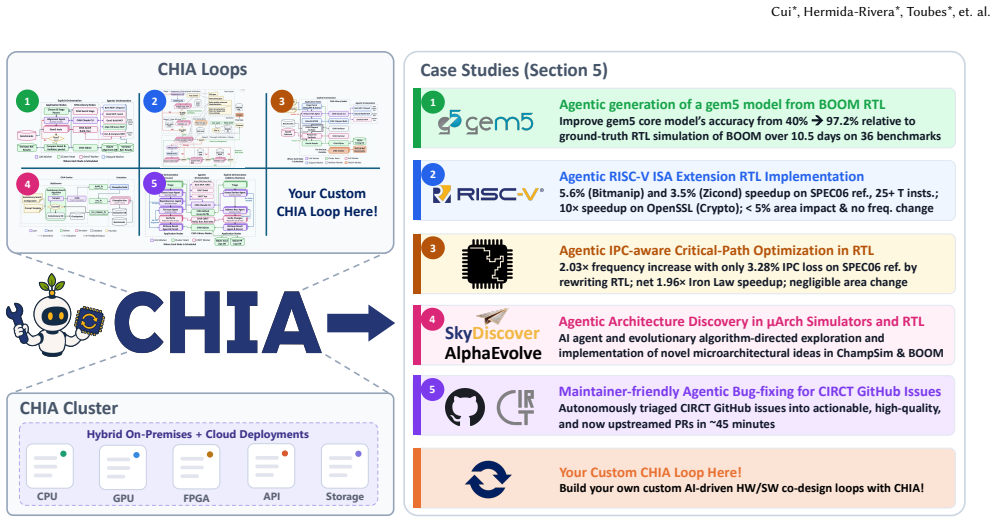
- Five case studies demonstrate loops for RTL-to-simulator alignment, LLM-driven RTL changes, critical path optimization, evolutionary discovery, and GitHub issue resolution.
- Research can move from small isolated demonstrations to workflows that run reliably on hundreds of heterogeneous systems.
- Agentic methods become applicable to real tools like Chipyard, gem5, and commercial CAD flows.
- The same structure supports both evolutionary coding agents and LLM-based agents in one framework.
Where Pith is reading between the lines
- CHIA's isolation mechanisms could reduce risks when AI agents interact with sensitive hardware design tools.
- Extending the node library might allow integration with additional domains such as compiler passes or operating system kernels.
- Researchers could test whether the fault tolerance actually reduces the human effort needed for large co-design experiments.
- The approach might generalize to other agentic AI applications in engineering fields beyond hardware.
Load-bearing premise
The library of nodes and the reliability features will be enough to handle the complexity of actual hardware and software co-design tasks without needing major extra work.
What would settle it
A measurement showing whether a CHIA loop for one of the case studies completes successfully across a large set of heterogeneous systems with minimal human intervention.
Figures
read the original abstract
Agentic artificial intelligence shows great promise for radically improving the pace of innovation in hardware/software co-design research across computer architecture, systems, compilers, and VLSI. Thus far, however, applications of AI in these contexts have generally been demonstrated in isolated settings on small-scale problems, due to the difficulty of designing and deploying complex AI-infused hardware and software development workflows. This paper introduces CHIA, an open-source hardware/software co-design framework for agile and principled research on the application of AI to co-design. CHIA treats the productive construction and scalable deployment of the co-design flow itself as a first-class objective. In CHIA, agentic AI-driven hardware and software design flows are expressed as \textit{CHIA loops}: directed cyclic graphs whose nodes execute various system-on-chip design tools, microarchitectural simulators, software build systems, AI models, evolutionary coding agents, and more. The \textit{CHIA library} provides node implementations for many popular tools, including Chipyard, gem5, ChampSim, FireSim, Hammer (thus several commercial ASIC CAD tools), Vivado, AlphaEvolve, AdaEvolve, and many others. CHIA also provides a broad set of features to conduct principled science around these flows. These include isolation between AI models and hardware tools, profiling mechanisms, fault-tolerant execution, and reliability at scale across hundreds of heterogeneous systems (CPUs, FPGAs, GPUs, etc., across public cloud/on-prem.). To showcase CHIA, we present five CHIA loops as case studies: (1) automatic RTL-to-gem5 simulator alignment, (2) LLM-driven implementation of microarchitectural features in RTL, (3) agentic, IPC-aware critical path optimization, (4) evolutionary architectural discovery, and (5) maintainer-friendly agentic GitHub issue fixing.
Editorial analysis
A structured set of objections, weighed in public.
Referee Report
Summary. The manuscript introduces CHIA, an open-source framework for agentic AI-driven hardware/software co-design. Design flows are expressed as CHIA loops (directed cyclic graphs whose nodes invoke tools such as Chipyard, gem5, ChampSim, FireSim, Hammer, Vivado, and evolutionary agents). The CHIA library supplies node implementations for these tools, while additional mechanisms provide isolation between AI models and hardware tools, profiling, fault-tolerant execution, and claimed reliability across hundreds of heterogeneous systems. Five case studies are presented: automatic RTL-to-gem5 alignment, LLM-driven microarchitectural RTL implementation, agentic IPC-aware critical-path optimization, evolutionary architectural discovery, and maintainer-friendly agentic GitHub issue fixing.
Significance. If the isolation, fault-tolerance, and scalability mechanisms prove effective in practice, CHIA could meaningfully accelerate systematic experimentation in AI-assisted co-design by reducing the engineering overhead of deploying complex, multi-tool workflows. The open-source release together with the broad node library for widely used tools (gem5, FireSim, Hammer, etc.) is a concrete strength that supports reproducibility and adoption.
major comments (2)
- [Abstract] Abstract: the claim that the node library plus isolation/profiling/fault-tolerance mechanisms suffice for 'principled science' and 'reliability at scale across hundreds of heterogeneous systems' is asserted without any reported measurements of isolation effectiveness, fault-recovery rates, execution overhead, or success rates on >10 systems; this is load-bearing for the central sufficiency argument.
- [Case studies] Case studies paragraph: the five CHIA loops are enumerated at a high level but the manuscript supplies no quantitative results, error analysis, or verification data, leaving the reader unable to assess whether the framework actually enables the claimed scalable and principled research.
minor comments (2)
- The terms 'CHIA loops' and 'CHIA library' are introduced without a preceding formal definition or reference to a diagram; a short definitional sentence in the introduction would improve readability.
- [Abstract] The abstract lists many tools (Chipyard, gem5, ChampSim, FireSim, Hammer, Vivado, AlphaEvolve, AdaEvolve) but does not indicate which subset is actually exercised in the five case studies; an explicit mapping would clarify coverage.
Simulated Author's Rebuttal
We thank the referee for the constructive feedback, which identifies key areas where the manuscript's claims require stronger support or qualification. We address each major comment below.
read point-by-point responses
-
Referee: [Abstract] Abstract: the claim that the node library plus isolation/profiling/fault-tolerance mechanisms suffice for 'principled science' and 'reliability at scale across hundreds of heterogeneous systems' is asserted without any reported measurements of isolation effectiveness, fault-recovery rates, execution overhead, or success rates on >10 systems; this is load-bearing for the central sufficiency argument.
Authors: We agree that the abstract asserts sufficiency for principled science and reliability at scale without accompanying quantitative measurements of the mechanisms. The manuscript describes the isolation, profiling, and fault-tolerance features and states their intended purpose, but does not report empirical data such as recovery rates or overheads. We will revise the abstract to remove or qualify these unmeasured claims, limiting assertions to the framework design and the illustrative use in the case studies. revision: yes
-
Referee: [Case studies] Case studies paragraph: the five CHIA loops are enumerated at a high level but the manuscript supplies no quantitative results, error analysis, or verification data, leaving the reader unable to assess whether the framework actually enables the claimed scalable and principled research.
Authors: The case studies section presents the five loops at a high level to demonstrate how CHIA expresses and deploys co-design flows. We acknowledge that the current text provides no quantitative results, error analysis, or verification data, which limits the ability to evaluate effectiveness. We will expand this section in revision to include available quantitative outcomes, error rates, and verification steps from the experiments underlying each case study. revision: yes
Circularity Check
No circularity: framework description with no derivations or fitted predictions
full rationale
The paper introduces an open-source software framework (CHIA) for expressing co-design flows as directed graphs with library nodes and reliability features. It lists five case studies but contains no equations, parameter fits, predictions, or uniqueness theorems. No self-citation chains or ansatzes are invoked to justify core claims; the work is a descriptive systems paper whose assertions rest on implementation and case-study existence rather than any self-referential reduction. This matches the default non-circular outcome for framework papers.
Axiom & Free-Parameter Ledger
invented entities (2)
-
CHIA loops
no independent evidence
-
CHIA library
no independent evidence
Reference graph
Works this paper leans on
-
[1]
SPEC CPU 2006 benchmark
2006. SPEC CPU 2006 benchmark. spec.org. https://www.spec.org/cpu2006/
2006
-
[2]
Martín Abadi, Paul Barham, Jianmin Chen, Zhifeng Chen, Andy Davis, Jeffrey Dean, Matthieu Devin, Sanjay Ghemawat, Geoffrey Irving, Michael Isard, Man- junath Kudlur, Josh Levenberg, Rajat Monga, Sherry Moore, Derek G. Murray, Benoit Steiner, Paul Tucker, Vijay Vasudevan, Pete Warden, Martin Wicke, Yuan Yu, and Xiaoqiang Zheng. 2016. TensorFlow: A system f...
Pith/arXiv arXiv 2016
-
[3]
Stefan Abi-Karam and Cong Hao. 2025. HLS-Eval: A Benchmark and Frame- work for Evaluating LLMs on High-Level Synthesis Design Tasks. In2025 IEEE International Conference on LLM-Aided Design (ICLAD). 219–226. doi:10.1109/ ICLAD65226.2025.00021
arXiv 2025
-
[4]
Dimakis, Ion Stoica, Dan Klein, Matei Zaharia, and Omar Khattab
Lakshya A Agrawal, Shangyin Tan, Dilara Soylu, Noah Ziems, Rishi Khare, Krista Opsahl-Ong, Arnav Singhvi, Herumb Shandilya, Michael J Ryan, Meng Jiang, Christopher Potts, Koushik Sen, Alexandros G. Dimakis, Ion Stoica, Dan Klein, Matei Zaharia, and Omar Khattab. 2026. GEPA: Reflective Prompt Evo- lution Can Outperform Reinforcement Learning. arXiv:2507.19...
Pith/arXiv arXiv 2026
-
[5]
Elisavet Lydia Alvanaki, Kevin Lee, and Luca P. Carloni. 2025. SLDB: An End-To- End Heterogeneous System-on-Chip Benchmark Suite for LLM-Aided Design. arXiv:2507.06376 [cs.AR] https://arxiv.org/abs/2507.06376
arXiv 2025
-
[6]
Alon Amid, David Biancolin, Abraham Gonzalez, Daniel Grubb, Sagar Karandikar, Harrison Liew, Albert Magyar, Howard Mao, Albert Ou, Nathan Pemberton, Paul Rigge, Colin Schmidt, John Wright, Jerry Zhao, Yakun Sophia Shao, Krste Asanović, and Borivoje Nikolić. 2020. Chipyard: Integrated Design, Simulation, and Implementation Framework for Custom SoCs.IEEE Mi...
-
[7]
2025.opencode
anomalyco. 2025.opencode. https://github.com/anomalyco/opencode
2025
-
[8]
Anonymous. 2025. ArchAgent: Agentic AI-driven Computer Architecture Discovery. OpenReview Anonymous Preprint. https://openreview.net/forum ?id=hcxN9l6zqZ Submission Number 714
2025
-
[9]
Anthropic. [n. d.].Claude Code. https://www.anthropic.com/claude-code
-
[10]
2015.airflow
apache. 2015.airflow. https://github.com/apache/airflow
2015
-
[11]
AWS. 2026. Amazon Bedrock. https://aws.amazon.com/bedrock/ Accessed: 2026-06-23
2026
-
[12]
AWS. 2026. S3. https://aws.amazon.com/s/idc-server-side-test/awswt-956-v2- template-s3/variant/ Accessed: 2026-06-23
2026
-
[13]
Yunsheng Bai, Ghaith Bany Hamad, Syed Suhaib, and Haoxing Ren. 2025. Asser- tionForge: Enhancing Formal Verification Assertion Generation with Structured Representation of Specifications and RTL. In2025 IEEE International Conference on LLM-Aided Design (ICLAD). 85–92. doi:10.1109/ICLAD65226.2025.00009
-
[14]
Jonathan Balkind, Michael McKeown, Yaosheng Fu, Tri Nguyen, Yanqi Zhou, Alexey Lavrov, Mohammad Shahrad, Adi Fuchs, Samuel Payne, Xiaohua Liang, Matthew Matl, and David Wentzlaff. 2016. OpenPiton: An Open Source Many- core Research Framework. InProceedings of the Twenty-First International Con- ference on Architectural Support for Programming Languages an...
-
[15]
Abhishek Bhandwaldar, Mihir Choudhury, Ruchir Puri, and Akash Srivastava
-
[16]
Agent Factories for High Level Synthesis: How Far Can General-Purpose Coding Agents Go in Hardware Optimization? arXiv:2603.25719 [cs.AI] https: //arxiv.org/abs/2603.25719
-
[17]
Reinhardt, Ali Saidi, Arkaprava Basu, Joel Hestness, Derek R
Nathan Binkert, Bradford Beckmann, Gabriel Black, Steven K. Reinhardt, Ali Saidi, Arkaprava Basu, Joel Hestness, Derek R. Hower, Tushar Krishna, Somayeh Sardashti, Rathijit Sen, Korey Sewell, Muhammad Shoaib, Nilay Vaish, Mark D. Hill, and David A. Wood. 2011. The gem5 simulator.SIGARCH Comput. Archit. News39, 2 (Aug. 2011), 1–7. doi:10.1145/2024716.2024718
-
[18]
B. Black and J.P. Shen. 1998. Calibration of microprocessor performance models. Computer31, 5 (1998), 59–65. doi:10.1109/2.675637
-
[19]
Alexander Blasberg, Vasilis Kypriotis, and Dimitrios Skarlatos. 2026. Agentic Architect: An Agentic AI Framework for Architecture Design Exploration and Optimization. arXiv:2604.25083 [cs.AI] https://arxiv.org/abs/2604.25083
Pith/arXiv arXiv 2026
-
[20]
Sriyash Caculo, Mahesh Madhav, and Jeff Baxter. 2025. Memory Access Vectors: Improving Sampling Fidelity for CPU Performance Simulations. arXiv:2506.02344 [cs.AR] https://arxiv.org/abs/2506.02344
arXiv 2025
-
[21]
Carlson, Wim Heirman, and Lieven Eeckhout
Trevor E. Carlson, Wim Heirman, and Lieven Eeckhout. 2011. Sniper: Exploring the level of abstraction for scalable and accurate parallel multi-core simulation. InSC ’11: Proceedings of 2011 International Conference for High Performance Computing, Networking, Storage and Analysis. 1–12. doi:10.1145/2063384.2063 454
-
[22]
2018.A Highly Productive Implementation of an Out-of- Order Processor Generator
Christopher Celio. 2018.A Highly Productive Implementation of an Out-of- Order Processor Generator. Ph. D. Dissertation. EECS Department, University of California, Berkeley. http://www2.eecs.berkeley.edu/Pubs/TechRpts/2018/EE CS-2018-151.html
2018
-
[23]
Mert Cemri, Shubham Agrawal, Akshat Gupta, Shu Liu, Audrey Cheng, Qiuyang Mang, Ashwin Naren, Lutfi Eren Erdogan, Koushik Sen, Matei Zaharia, Alex Dimakis, and Ion Stoica. 2026. AdaEvolve: Adaptive LLM Driven Zeroth-Order Optimization. arXiv:2602.20133 [cs.NE] https://arxiv.org/abs/2602.20133
arXiv 2026
-
[24]
Zhengrui Chen, Zixuan Song, Yu Li, Qi Sun, and Cheng Zhuo. 2026. FluxEDA: A Unified Execution Infrastructure for Stateful Agentic EDA. arXiv:2603.25243 [cs.AR] https://arxiv.org/abs/2603.25243
arXiv 2026
-
[25]
Audrey Cheng, Shu Liu, Melissa Pan, Zhifei Li, Bowen Wang, Alex Krentsel, Tian Xia, Mert Cemri, Jongseok Park, Shuo Yang, Jeff Chen, Lakshya Agrawal, Aditya Desai, Jiarong Xing, Koushik Sen, Matei Zaharia, and Ion Stoica. 2025. Barbarians at the Gate: How AI is Upending Systems Research. (2025). arXiv:2510.06189 [cs.AI] https://arxiv.org/abs/2510.06189
arXiv 2025
-
[26]
CHIPS Alliance. 2026. riscv-dv: Random Instruction Generator for RISC-V Processor Verification. https://github.com/chipsalliance/riscv-dv. Accessed: 2026-06-09
2026
-
[27]
Lawrence T. Clark, Vinay Vashishtha, Lucian Shifren, Aditya Gujja, Saurabh Sinha, Brian Cline, Chandarasekaran Ramamurthy, and Greg Yeric. 2016. ASAP7: A 7-nm finFET predictive process design kit.Microelectronics Journal53 (2016), 105–115. doi:10.1016/j.mejo.2016.04.006
-
[28]
Joshua H. Davis, Klaudiusz Rydzy, Srinivasan Ramesh, Aadit Nilay, Daniel Nichols, Swapna Raj, Nikhil Jain, and Abhinav Bhatele. 2026. KEET: Explaining Performance of GPU Kernels Using LLM Agents. arXiv:2605.04467 [cs.PF] https://arxiv.org/abs/2605.04467
Pith/arXiv arXiv 2026
-
[29]
Chenhui Deng, Zhongzhi Yu, Guan-Ting Liu, Nathaniel Pinckney, Brucek Khailany, and Haoxing Ren. 2026. ACE-RTL: When Agentic Context Evo- lution Meets RTL-Specialized LLMs. arXiv:2602.10218 [cs.AR] https://arxiv.or g/abs/2602.10218
arXiv 2026
-
[30]
Schuyler Eldridge, Prithayan Barua, Aliaksei Chapyzhenka, Adam Izraelevitz, Jack Koenig, Chris Lattner, Andrew Lenharth, George Leontiev, Fabian Schuiki, Ram Sunder, Andrew Young, and Richard Xia. 2021. MLIR as hardware compiler infrastructure. InWorkshop on Open-Source EDA Technology (WOSET), Vol. 3
2021
-
[31]
FireworksAI. 2026. FireworksAI. https://fireworks.ai/ Accessed: 2026-06-23
2026
-
[32]
Gaffney, Martin Prammer, Larry Brasfield, D
Kevin P. Gaffney, Martin Prammer, Larry Brasfield, D. Richard Hipp, Dan Kennedy, and Jignesh M. Patel. 2022. SQLite: past, present, and future.Proc. VLDB Endow.15, 12 (Aug. 2022), 3535–3547. doi:10.14778/3554821.3554842
-
[33]
Jiahao Gai, Hao Chen, Zhican Wang, Hongyu Zhou, Wanru Zhao, Nicholas Lane, and Hongxiang Fan. 2025. Exploring Code Language Models for Automated HLS-based Hardware Generation: Benchmark, Infrastructure and Analysis. In Proceedings of the 30th Asia and South Pacific Design Automation Conference (Tokyo, Japan)(ASPDAC ’25). Association for Computing Machiner...
-
[34]
Gansner and Stephen C
Emden R. Gansner and Stephen C. North. 2000. An open graph visualization system and its applications to software engineering.Softw. Pract. Exper.30, 11 (Sept. 2000), 1203–1233
2000
-
[35]
Bogdan Georgiev, Javier Gómez-Serrano, Terence Tao, and Adam Zsolt Wag- ner. 2025. Mathematical exploration and discovery at scale.arXiv preprint arXiv:2511.02864(2025)
Pith/arXiv arXiv 2025
-
[36]
Michael Gerstenhaber and Michael Bachman. 2026. Introducing Gemini Enter- prise Agent Platform, powering the next wave of agents. https://cloud.goog le.com/blog/products/ai-machine-learning/introducing-gemini-enterprise- agent-platform
2026
-
[37]
Github. [n. d.]. GitHub REST API documentation. https://docs.github.com/en/r est Accessed: 2026-06-23
2026
-
[38]
Nathan Gober, Gino Chacon, Lei Wang, Paul V. Gratz, Daniel A. Jimenez, Elvira Teran, Seth Pugsley, and Jinchun Kim. 2022. The Championship Simulator: Ar- chitectural Simulation for Education and Competition. arXiv:2210.14324 [cs.AR] https://arxiv.org/abs/2210.14324
arXiv 2022
-
[39]
Google. 2026. Google Antigravity. https://antigravity.google/ Accessed: 2026-06-23
2026
-
[40]
2014.google-cloud-python
Google googleapis. 2014.google-cloud-python. https://github.com/googleapis/ google-cloud-python
2014
-
[41]
Groq. 2026. Groq. https://groq.com/ Accessed: 2026-06-23
2026
-
[42]
Ce Guo and Tong Zhao. 2025. ResBench: A Resource-Aware Benchmark for LLM- Generated FPGA Designs. InProceedings of the 15th International Symposium on Highly Efficient Accelerators and Reconfigurable Technologies (HEART ’25). Association for Computing Machinery, New York, NY, USA, 25–34. doi:10.114 5/3728179.3728192
arXiv 2025
-
[43]
Raghav Gupta, Akanksha Jain, Abraham Gonzalez, Alexander Novikov, Po-Sen Huang, Matej Balog, Marvin Eisenberger, Sergey Shirobokov, Ngân V˜u, Martin Dixon, Borivoje Nikolić, Parthasarathy Ranganathan, and Sagar Karandikar
-
[44]
arXiv:2602.22425 [cs.AI] https://arxiv.org/abs/2602.22425
ArchAgent: Agentic AI-driven Computer Architecture Discovery. arXiv:2602.22425 [cs.AI] https://arxiv.org/abs/2602.22425
-
[45]
Zhuolun He, Haoyuan Wu, Xinyun Zhang, Xufeng Yao, Su Zheng, Haisheng Zheng, and Bei Yu. 2023. ChatEDA: A Large Language Model Powered Au- tonomous Agent for EDA. In2023 ACM/IEEE 5th Workshop on Machine Learning for CAD (MLCAD). 1–6. doi:10.1109/MLCAD58807.2023.10299852
-
[46]
Charles Hong, Sahil Bhatia, Alvin Cheung, and Yakun Sophia Shao. 2025. Au- tocomp: A Powerful and Portable Code Optimizer for Tensor Accelerators. arXiv:2505.18574 [cs.PL] https://arxiv.org/abs/2505.18574
arXiv 2025
-
[47]
A. Izraelevitz, J. Koenig, P. Li, R. Lin, A. Wang, A. Magyar, D. Kim, C. Schmidt, C. Markley, J. Lawson, and J. Bachrach. 2017. Reusability is FIRRTL ground: Hardware construction languages, compiler frameworks, and transformations. In2017 IEEE/ACM International Conference on Computer-Aided Design (ICCAD). 209–216. doi:10.1109/ICCAD.2017.8203780
-
[48]
Jimenez, John Yang, Alexander Wettig, Shunyu Yao, Kexin Pei, Ofir Press, and Karthik Narasimhan
Carlos E. Jimenez, John Yang, Alexander Wettig, Shunyu Yao, Kexin Pei, Ofir Press, and Karthik Narasimhan. 2024. SWE-bench: Can Language Models Resolve Real-World GitHub Issues? arXiv:2310.06770 [cs.CL] https://arxiv.org/ abs/2310.06770
Pith/arXiv arXiv 2024
-
[49]
Sagar Karandikar, Howard Mao, Donggyu Kim, David Biancolin, Alon Amid, Dayeol Lee, Nathan Pemberton, Emmanuel Amaro, Colin Schmidt, Aditya Chopra, Qijing Huang, Kyle Kovacs, Borivoje Nikolic, Randy Katz, Jonathan Bachrach, and Krste Asanović. 2018. FireSim: FPGA-accelerated Cycle-exact Scale-out System Simulation in the Public Cloud. InProceedings of the ...
-
[50]
Steve Kosier. 2023. SKY’s the Limit with the SKY130 Open-Source PDK. https: //www.skywatertechnology.com/sky130-open-source-pdk/ Accessed: 2026-06-23
2023
-
[51]
Srivatsan Krishnan, Amir Yazdanbakhsh, Shvetank Prakash, Jason Jabbour, Ikechukwu Uchendu, Susobhan Ghosh, Behzad Boroujerdian, Daniel Richins, 17 Cui*, Hermida-Rivera*, Toubes*, et. al. Devashree Tripathy, Aleksandra Faust, and Vijay Janapa Reddi. 2023. ArchGym: An Open-Source Gymnasium for Machine Learning Assisted Architecture De- sign. InProceedings o...
-
[52]
Gonzalez, Hao Zhang, and Ion Stoica
Woosuk Kwon, Zhuohan Li, Siyuan Zhuang, Ying Sheng, Lianmin Zheng, Cody Hao Yu, Joseph E. Gonzalez, Hao Zhang, and Ion Stoica. 2023. Efficient Memory Management for Large Language Model Serving with PagedAttention. arXiv:2309.06180 [cs.LG] https://arxiv.org/abs/2309.06180
Pith/arXiv arXiv 2023
-
[53]
2023.langgraph
langchain ai. 2023.langgraph. https://github.com/langchain-ai/langgraph
2023
-
[54]
2012.riscv-torture
Yunsup Lee and Henry Cook. 2012.riscv-torture. https://github.com/ucb- bar/riscv-torture
2012
-
[55]
Li, Adam M
Patrick S. Li, Adam M. Izraelevitz, and Jonathan Bachrach. 2016.Specification for the FIRRTL Language. Technical Report UCB/EECS-2016-9. EECS Department, University of California, Berkeley. http://www2.eecs.berkeley.edu/Pubs/Tech Rpts/2016/EECS-2016-9.html
2016
-
[56]
Xingquan Li, Simin Tao, Zengrong Huang, Shijian Chen, Zhisheng Zeng, Liwei Ni, Zhipeng Huang, Chunan Zhuang, Hongxi Wu, Weiguo Li1, Xueyan Zhao, He Liu, Shuaiying Long, Wei He, Bojun Liu, Sifeng Gan, Zihao Yu, Tong Liu, Yuchi Miao, Zhiyuan Yan, Hao Wang, Jie Zhao, Yifan Li, Ruizhi Liu, Xiaoze Lin, Bo Yang, Zhen Xue, Fuxing Huang, Zonglin Yang, Zhenggang W...
arXiv 2023
-
[57]
Harrison Liew, Daniel Grubb, John Wright, Colin Schmidt, Nayiri Krzysztofow- icz, Adam Izraelevitz, Edward Wang, Krste Asanović, Jonathan Bachrach, and Borivoje Nikolić. 2022. Hammer: a modular and reusable physical design flow tool: invited. InProceedings of the 59th ACM/IEEE Design Automation Conference (San Francisco, California)(DAC ’22). Association ...
-
[58]
Pan, Alexander Du, Kurt Keutzer, Alvin Cheung, Alexandros G
Shu Liu, Shubham Agarwal, Monishwaran Maheswaran, Mert Cemri, Zhifei Li, Qiuyang Mang, Ashwin Naren, Ethan Boneh, Audrey Cheng, Melissa Z. Pan, Alexander Du, Kurt Keutzer, Alvin Cheung, Alexandros G. Dimakis, Koushik Sen, Matei Zaharia, and Ion Stoica. 2026. EvoX: Meta-Evolution for Automated Discovery. arXiv:2602.23413 [cs.LG] https://arxiv.org/abs/2602.23413
arXiv 2026
-
[59]
Shu Liu, Mert Cemri, Shubham Agarwal, Alexander Krentsel, Ashwin Naren, Qiuyang Mang, Zhifei Li, Akshat Gupta, Monishwaran Maheswaran, Au- drey Cheng, Melissa Pan, Ethan Boneh, Kannan Ramchandran, Koushik Sen, Matei Zaharia, Alexandros G. Dimakis, and Ion Stoica. 2026.SkyDiscover: A Flexible, Adaptive Framework for AI-Driven Scientific and Algorithmic Dis...
-
[60]
Shang Liu, Wenji Fang, Yao Lu, Qijun Zhang, Hongce Zhang, and Zhiyao Xie
-
[61]
In2024 IEEE LLM Aided Design Workshop (LAD)
RTLCoder: Outperforming GPT-3.5 in Design RTL Generation with Our Open-Source Dataset and Lightweight Solution. In2024 IEEE LLM Aided Design Workshop (LAD). IEEE, 1–5. doi:10.1109/lad62341.2024.10691788
-
[62]
LLVM. 2026. LLVM AI Tool Use Policy. llvm.org. https://llvm.org/docs/AITool Policy.html Accessed: 2026-06-19
2026
-
[63]
Jason Lowe-Power, Abdul Mutaal Ahmad, Ayaz Akram, Mohammad Alian, Rico Amslinger, Matteo Andreozzi, Adrià Armejach, Nils Asmussen, Brad Beckmann, Srikant Bharadwaj, Gabe Black, Gedare Bloom, Bobby R. Bruce, Daniel Rodrigues Carvalho, Jeronimo Castrillon, Lizhong Chen, Nicolas Deru- migny, Stephan Diestelhorst, Wendy Elsasser, Carlos Escuin, Marjan Faribor...
arXiv 2020
-
[64]
Yao Lu, Shang Liu, Qijun Zhang, and Zhiyao Xie. 2024. RTLLM: An Open-Source Benchmark for Design RTL Generation with Large Language Model. In2024 29th Asia and South Pacific Design Automation Conference (ASP-DAC). 722–727. doi:10.1109/ASP-DAC58780.2024.10473904
-
[65]
Yi-Chen Lu, Hao-Hsiang Hsiao, and Haoxing Ren. 2025. Invited Paper: LLM- Enhanced GPU-Optimized Physical Design at Scale. In2025 IEEE/ACM Interna- tional Conference On Computer Aided Design (ICCAD). 1–7. doi:10.1109/ICCA D66269.2025.11240986
-
[66]
Cota, Michele Petracca, Christian Pilato, and Luca P
Paolo Mantovani, Davide Giri, Giuseppe Di Guglielmo, Luca Piccolboni, Joseph Zuckerman, Emilio G. Cota, Michele Petracca, Christian Pilato, and Luca P. Carloni. 2020. Agile SoC development with open ESP. InProceedings of the 39th International Conference on Computer-Aided Design(Virtual Event, USA) (ICCAD ’20). Association for Computing Machinery, New Yor...
-
[67]
Dirk Merkel. 2014. Docker: lightweight Linux containers for consistent devel- opment and deployment.Linux J.2014, 239, Article 2 (March 2014)
2014
-
[68]
Kaushal Mhapsekar, Azam Ghanbari, Bita Aslrousta, and Samira Mirbagher- Ajorpaz. 2026. CacheMind: From Miss Rates to Why - Natural-Language, Trace- Grounded Reasoning for Cache Replacement. InProceedings of the 31st ACM International Conference on Architectural Support for Programming Languages and Operating Systems, Volume 2(USA)(ASPLOS ’26). Association...
-
[69]
2025.agent-framework
Microsoft. 2025.agent-framework. https://github.com/microsoft/agent- framework
2025
-
[70]
Jordan, and Ion Stoica
Philipp Moritz, Robert Nishihara, Stephanie Wang, Alexey Tumanov, Richard Liaw, Eric Liang, Melih Elibol, Zongheng Yang, William Paul, Michael I. Jordan, and Ion Stoica. 2018. Ray: a distributed framework for emerging AI applications. InProceedings of the 13th USENIX Conference on Operating Systems Design and Implementation(Carlsbad, CA, USA)(OSDI’18). US...
2018
-
[71]
Alexander Novikov, Ngân V˜u, Marvin Eisenberger, Emilien Dupont, Po-Sen Huang, Adam Zsolt Wagner, Sergey Shirobokov, Borislav Kozlovskii, Francisco J. R. Ruiz, Abbas Mehrabian, M. Pawan Kumar, Abigail See, Swarat Chaud- huri, George Holland, Alex Davies, Sebastian Nowozin, Pushmeet Kohli, and Matej Balog. 2025. AlphaEvolve: A coding agent for scientific a...
Pith/arXiv arXiv 2025
-
[72]
2015.Microbench
Tony Nowatzki. 2015.Microbench. https://github.com/VerticalResearchGroup /microbench
2015
-
[73]
Surim Oh, Mingsheng Xu, Tanvir Ahmed Khan, Baris Kasikci, and Heiner Litz
-
[74]
InProceedings of the 51st International Symposium on Computer Architecture (ISCA) (ISCA 2024)
UDP: Utility-Driven Fetch Directed Instruction Prefetching. InProceedings of the 51st International Symposium on Computer Architecture (ISCA) (ISCA 2024)
2024
-
[75]
2023.ollama
ollama. 2023.ollama. https://github.com/ollama/ollama
2023
-
[76]
OpenAI. 2026. Codex. https://chatgpt.com/codex/ Accessed: 2026-06-23
2026
-
[77]
2026.openclaw
openclaw. 2026.openclaw. https://github.com/openclaw/openclaw
2026
-
[78]
OpenRouter. 2026. OpenRouter. https://openrouter.ai/ Accessed: 2026-06-23
2026
-
[79]
2013.openssl
openssl. 2013.openssl. https://github.com/openssl/openssl
2013
-
[80]
Anne Ouyang, Simon Guo, Simran Arora, Alex L Zhang, William Hu, Christo- pher Re, and Azalia Mirhoseini. 2025. KernelBench: Can LLMs Write Efficient GPU Kernels?. InForty-second International Conference on Machine Learning. https://openreview.net/forum?id=yeoN1iQT1x
2025
discussion (0)
Sign in with ORCID, Apple, or X to comment. Anyone can read and Pith papers without signing in.