REVIEW 3 major objections 4 minor 2 references
Cosmic wallflowers, clusters born in filaments between galaxies, are natural proto-globular cluster candidates.
Reviewed by Pith at T0; open to challenge. T0 means a machine referee read the full paper against a public rubric. the ladder, T0–T4 →
Star clusters forming in cosmic filaments at z≈7.6 are systematically slow rotators, and a gas-rich subset overlaps the kinematic and density locus of Milky Way globular clusters, making them plausible proto-globular clusters.
T0 review reviewed 2026-08-02 challenge →
load-bearing objection A clean kinematic separation between CGM-born and disc-born clusters at z≈7.6, with a suggestive but unproven proto-GC overlap; the low-rotation signal may be a resolution artifact and survival to z=0 is unmodeled, though the authors are honest about both. the 3 major comments →
Too shy to spin? Cosmic wallflowers as proto-globular clusters
The pith
A machine-rendered reading of the paper's core claim, the machinery that carries it, and where it could break.
The reading
Core claim
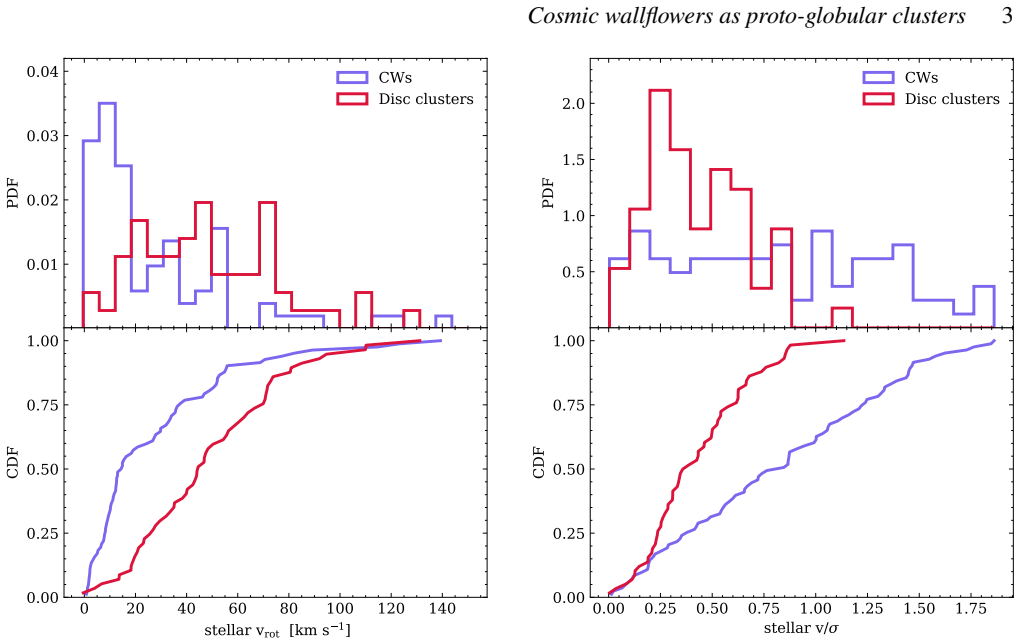
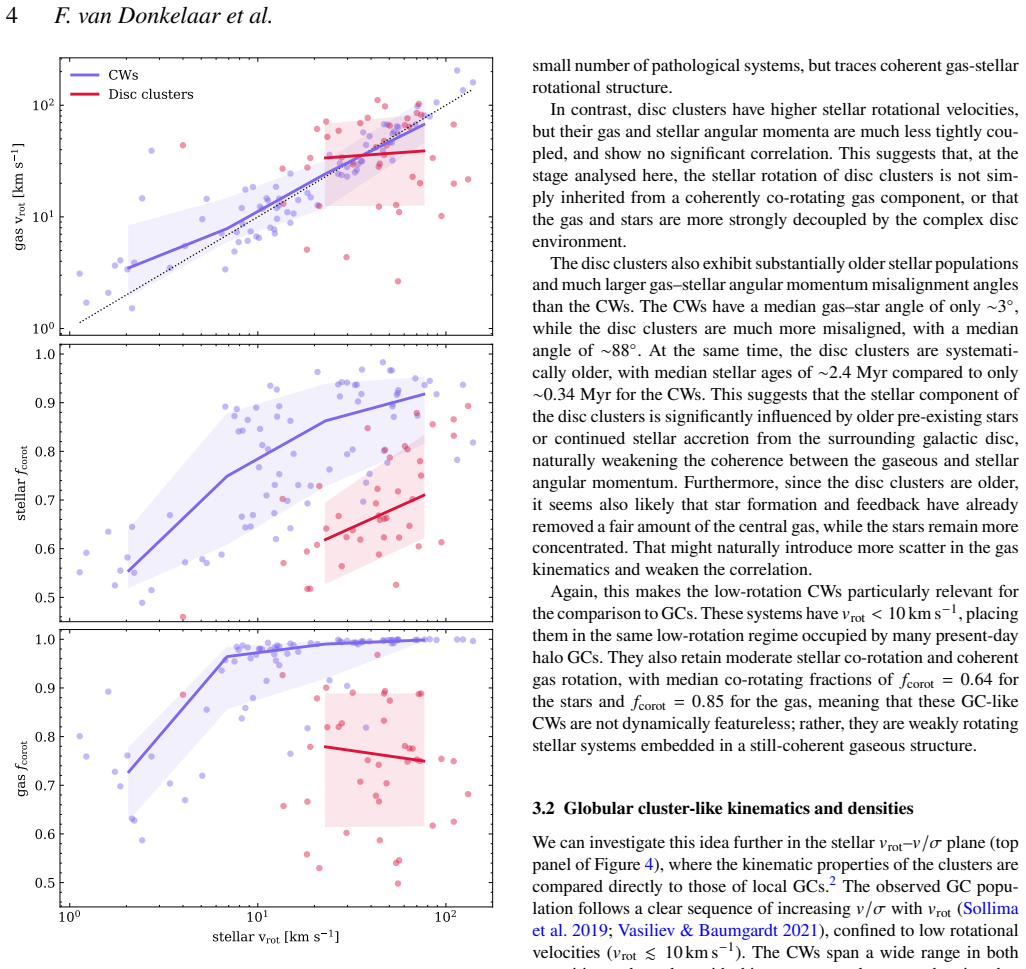
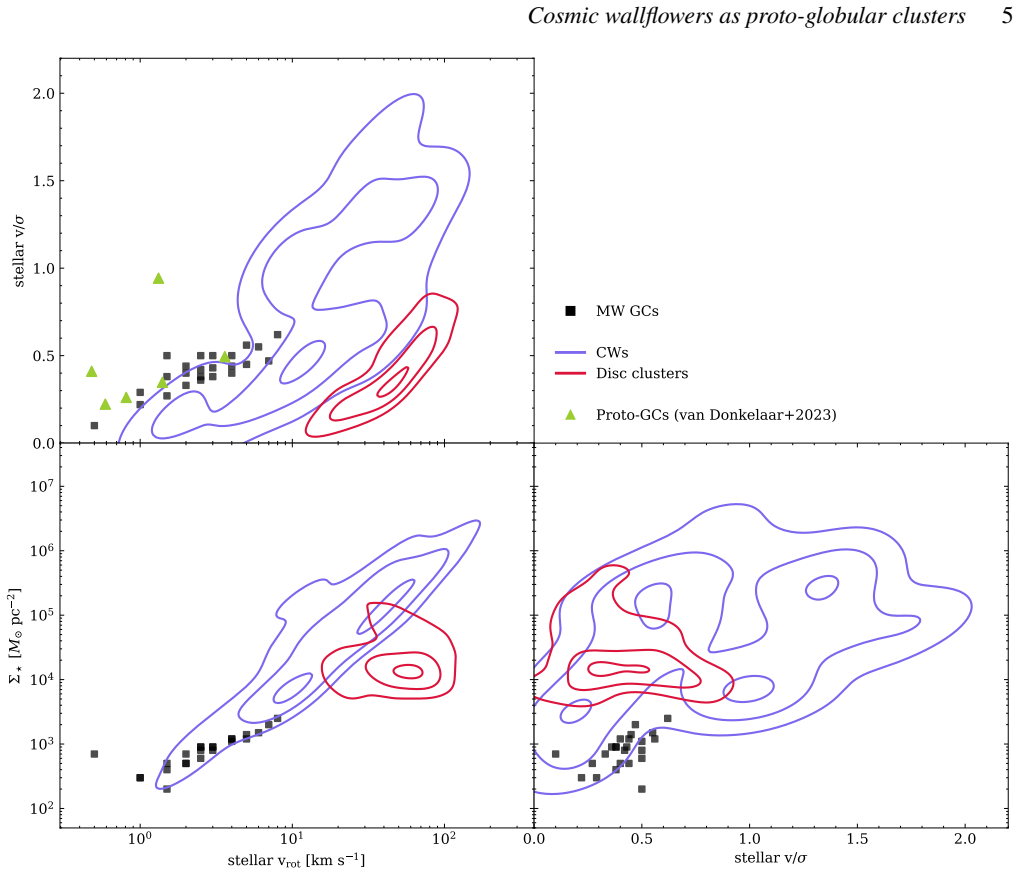
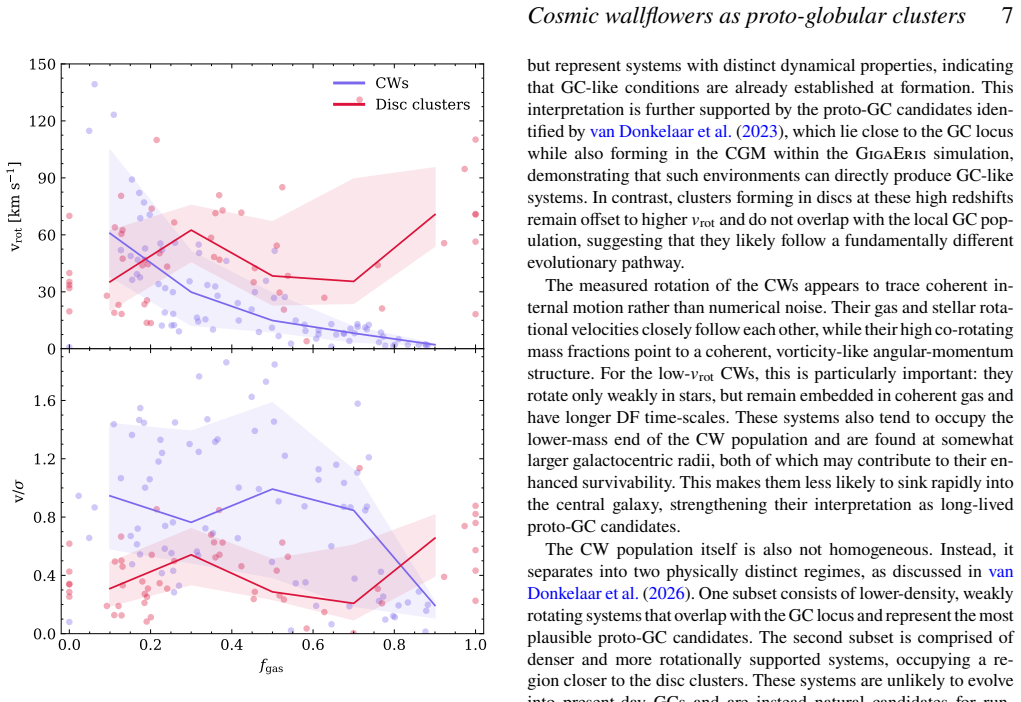
Using stellar kinematics measured within twice the stellar half-mass radius, the paper shows that at z≈7.6 cosmic wallflowers have systematically lower rotational velocities than disc clusters and a wide spread in rotational support v/σ (the ratio of ordered rotation to random motion). Placing the clusters in the v_rot–v/σ plane and comparing stellar surface density, a subset of wallflowers with v_rot below about 10 km/s overlaps the observed Milky Way globular cluster population, whereas disc clusters do not. The rotation is coherent: gas and stars share a common angular-momentum axis, with high co-rotating mass fractions, indicating the low rotation is a real dynamical property rather than
What carries the argument
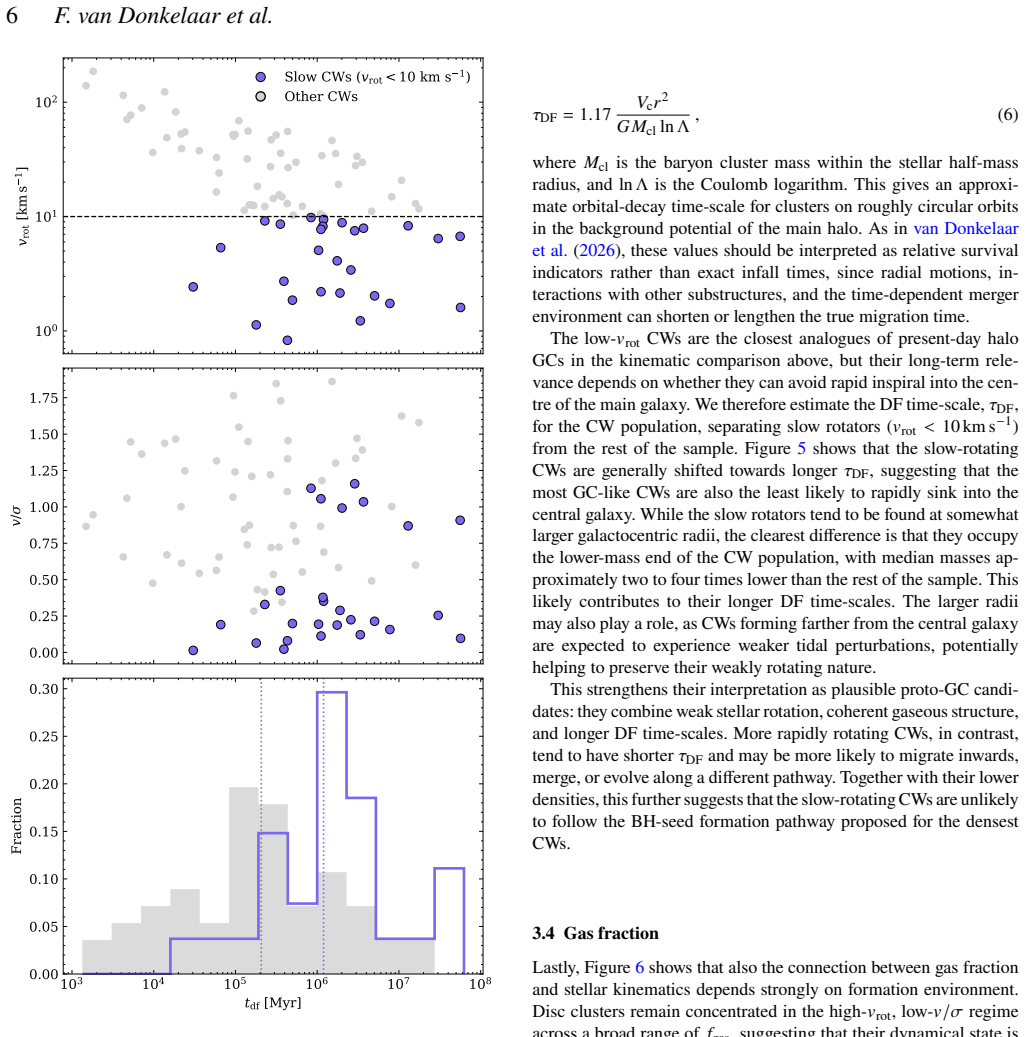
The central objects are 'cosmic wallflowers' (CWs): compact stellar systems whose mass is almost entirely stars and gas, not dark matter, that form in circumgalactic filaments rather than in galactic discs, selected from the high-resolution hydrodynamical simulation. The key diagnostic is the comparison of their stellar rotational velocity v_rot and rotational support v/σ—measured within twice the stellar half-mass radius—against the observed Milky Way globular cluster population, together with stellar surface density and gas fraction. The dynamical-friction timescale, estimated from cluster mass and the host halo potential, serves as a proxy for whether a cluster will survive as an orbiting
Load-bearing premise
The claim rests on treating the z≈7.6 snapshot kinematics as the true initial dynamical state of these clusters, but the authors state that the clusters' internal structure and kinematics are not fully converged at parsec resolution and the simulation does not track their long-term evolution to the present day; if the low rotation is a numerical artifact or the clusters are destroyed before today, the proto-GC interpretation collapses.
What would settle it
A direct check is to re-run the same cluster-formation setup at higher resolution (gas particle mass below about 2.4×10^3 solar masses and softening below 2 pc) and follow the clusters beyond z≈7.6; if the low-rotation, GC-like wallflowers gain significant rotation, disappear, or are disrupted before z=0, the claim fails. Observationally, if JWST measurements of z≈6–10 compact clusters find them to be strongly rotating (v/σ above 1) or gas-poor, the predicted weak-rotation–gas-rich correlation would be contradicted.
If this is right
- If correct, globular cluster progenitors need not form in galactic discs; circumgalactic filaments can produce clusters already in the right kinematic and density regime at z≈7.6.
- The GC-like wallflower subset is both weakly rotating and gas-rich, making gas content a distinguishing mark of proto-GC candidates at high redshift.
- Because the slow rotators have longer dynamical-friction timescales, they are more likely to survive as halo globular clusters rather than migrating into the central galaxy.
- Disc clusters, being strongly rotation-dominated and offset from the GC locus, would need to lose a large amount of angular momentum to become globular clusters, pointing to a different evolutionary pathway.
- The wallflower population splits into two regimes: low-density, slow-spinning systems as proto-GCs, and denser, faster-spinning systems as possible intermediate-mass black hole seed progenitors.
Where Pith is reading between the lines
- A testable extension is observational: if these wallflowers are true proto-GCs, high-redshift compact clusters seen by JWST should preferentially show low rotation and high gas fraction, and future kinematic measurements could be compared directly with the v_rot distribution predicted here.
- The gas-richness of the slow rotators hints that retained gas could feed the multiple stellar populations seen in globular clusters—an implication the paper gestures toward but does not model.
- The longer dynamical-friction timescale for slow rotators implies the surviving halo GC population could be biased toward low-angular-momentum, lower-mass clusters, a prediction that might be checked against the spin distribution of field versus inner Milky Way globular clusters.
Editorial analysis
A structured set of objections, weighed in public.
Referee Report
Summary. This paper analyzes star-forming clusters at z~7.6 in the MassiveBlackPS simulation, comparing the internal stellar kinematics of clusters formed in a galactic disc (Halo 0) with isolated circumgalactic systems called 'cosmic wallflowers' (CWs). The authors measure v_rot, v/σ, and stellar surface density and report that CWs systematically have low v_rot and a wide v/σ range, whereas disc clusters are strongly rotation-dominated. A subset of low-v_rot, gas-rich CWs overlaps the observed Milky Way globular cluster locus in the v_rot–v/σ and surface density planes, and these objects also have longer dynamical-friction timescales. The paper interprets this subset as proto-globular cluster candidates. The authors explicitly caution that the internal structure and kinematics of the CWs are not fully converged and that long-term collisional evolution to z=0 is not followed.
Significance. If the central claim is robust, the paper would establish a formation-environment imprint on the initial kinematics of star clusters and support an in-situ circumgalactic origin for at least some globular clusters. The paper has notable strengths: it uses a high-resolution simulation, provides internal consistency checks via gas–stellar rotational coherence and co-rotating fractions, and compares against external Milky Way GC catalogues, which avoids circularity. The main limitation is that the proto-GC interpretation rests on two unmodelled pillars: numerical convergence of the low-v_rot tail at ~2 pc softening, and survival of the clusters to z=0. The kinematic definitions used for the simulation and the observations are also not directly equivalent. If these issues are addressed, the paper would be an important contribution to the study of globular cluster formation at high redshift.
major comments (3)
- [§2.1; §3.2; Fig. 4] Eq. (3) defines σ as the dispersion of the azimuthal velocity component around v_rot within 2 r_half, whereas the observed GC σ in Fig. 4 is a line-of-sight velocity dispersion at r_half (Sollima et al. 2019; Vasiliev & Baumgardt 2021). The simulated v_rot is also a 3D mean azimuthal velocity around the stellar angular momentum axis, not a projected estimator. These definitions can differ by order-unity factors depending on anisotropy and projection. Since the overlap in Fig. 4 is the central empirical claim, the authors should either compute projected v_rot and σ along multiple sightlines and compare to the GC data in the same space, or at least quantify the systematic offset introduced by the aperture and component choice. Without this, the apparent overlap may be coincidental.
- [§4; Table 1; §2] The central claim relies on the low-v_rot tail of CWs being physical. Yet the median r_half of CWs is 2.52 pc with force softening 2 pc (Table 1), and the authors state in §4 that 'their internal structure and kinematics are not fully converged.' In marginally resolved systems, softening can suppress substructure and rotational coherence, and artificial heating can inflate σ, shifting objects toward the GC locus. A convergence or resolution-robustness test (e.g., comparing a higher-resolution rerun or demonstrating that the low-v_rot tail is insensitive to softening) is needed to show that the low-v_rot and GC-like v/σ values are not numerical artifacts. As it stands, this load-bearing condition is explicitly unmodelled.
- [§3.3; §4] The evolutionary step from a 0.34 Myr-old, gas-rich CW at z≈7.6 to a present-day GC is not simulated. The dynamical-friction estimate in Eq. (6) is a circular-orbit indicator that ignores gas expulsion, tidal shocks, mergers, and collisional evolution; the authors themselves call it a 'relative survival indicator' (§3.3). The paper's final conclusion that these systems are 'likely to evolve into present-day GC analogues' therefore overstates what the simulation supports. I recommend either softening the conclusion to 'initial conditions compatible with GC-like kinematics' or adding a forward-modelling step (e.g., an N-body or analytic evolution model with mass loss and angular momentum loss) to justify survival to z=0.
minor comments (4)
- [§3.3] The v_rot < 10 km/s threshold used to define slow-rotating CWs should be justified as a physical boundary rather than a post-hoc selection; a sensitivity test with, e.g., 5 and 15 km/s would strengthen the dynamical-friction comparison.
- [§2.1] Eq. (3) should explicitly state that σ is an azimuthal dispersion, not the usual 3D or line-of-sight velocity dispersion; the current notation invites confusion.
- [References] The reference to van Donkelaar et al. (2026) gives 'MNRAS, 548, stag792'; 'stag792' appears to be a LaTeX placeholder and must be updated before publication.
- [Fig. 4 caption] Specify how the Sollima et al. (2019) and Vasiliev & Baumgardt (2021) GC samples are combined (e.g., independent points or a cross-match) and clarify the criterion used to exclude the bulge GC population.
Circularity Check
Partial circularity: the GC-like CW subset is selected with the same v_rot cutoff that defines the observed GC locus, though v/sigma, density, and gas-fraction comparisons remain independent.
specific steps
-
self definitional
[Section 3.1 / 3.2, Fig. 4]
"The observed GC population follows a clear sequence of increasing 𝑣/𝜎 with 𝑣rot (Sollima et al. 2019; Vasiliev & Baumgardt 2021), confined to low rotational velocities (𝑣rot ≲10 km s−1). ... These systems have 𝑣rot <10 km s−1, placing them in the same low-rotation regime occupied by many present-day halo GCs."
The subset of CWs singled out as proto-GC candidates is defined by the same v_rot < 10 km/s cutoff that delimits the observed GC locus. Therefore, the statement that these CWs overlap GCs in the v_rot dimension is true by construction. Only the additional comparisons in v/sigma, stellar surface density, and gas fraction are independent; the v_rot overlap alone is a definitional placement rather than a derived prediction.
full rationale
One partially circular step exists: the low-rotation CW subset is isolated using the same v_rot < 10 km/s threshold that defines the observed GC locus, so the overlap on the v_rot axis is guaranteed by construction. However, the paper's central claim is not solely this axis: it additionally checks v/sigma, stellar surface density, gas fraction, and dynamical-friction times, and it benchmarks against external MW GC catalogues (Sollima et al. 2019; Vasiliev & Baumgardt 2021). The self-citations (van Donkelaar et al. 2023, 2026; Mayer et al. 2025) supply the cluster samples and the two-regime interpretation, but they are not the load-bearing evidence for the GC overlap. The unresolved numerical convergence and absence of z=0 collisional evolution admitted in Section 4 are correctness/robustness limitations, not circularity. I therefore assign a moderate score reflecting the partial self-definitional selection rather than full reduction to inputs.
Axiom & Free-Parameter Ledger
free parameters (2)
- Slow-rotator threshold v_rot =
10 km/s
- Coulomb logarithm lnΛ for dynamical friction
axioms (5)
- domain assumption MassiveBlackPS is a representative re-simulation of a massive z≈8 halo, and the z≈7.6 snapshot is a valid formation epoch for the studied clusters.
- domain assumption Gasoline2 subgrid recipes (Stinson et al. 2006 star formation/feedback, Haardt & Madau 2012 UV background, Shen et al. 2010/2013 cooling) produce realistic pc-scale cluster formation.
- domain assumption The AHF-based cluster selection of van Donkelaar et al. (2026), with cuts on size, mass, baryon fraction and visual inspection, cleanly separates bound clusters from dwarf galaxies.
- domain assumption Simulated 3D kinematics measured within 2 r_half are directly comparable to projected observed GC kinematics measured at r_half.
- domain assumption Clusters lose angular momentum through two-body relaxation and tidal interactions over cosmic time, bridging the gap to present-day GCs.
Cite this review
Pith. "Pith review of Too shy to spin? Cosmic wallflowers as proto-globular clusters." pith.science (2026). https://pith.science/paper/YVPVLZOC
@misc{pith2026260627426,
  author       = {Pith},
  title        = {Pith review of: Too shy to spin? Cosmic wallflowers as proto-globular clusters},
  year         = {2026},
  howpublished = {\url{https://pith.science/paper/YVPVLZOC}},
  note         = {Machine review of arXiv:2606.27426}
}
abstract
We investigate the rotational properties of star-forming clusters at $z \sim 7.6$ in the high-resolution simulation MassiveBlackPS, focusing on two formation channels: clusters forming in galactic discs via gravitational instability and isolated circumgalactic systems, referred to as cosmic wallflowers, born out of cosmic filaments. Using stellar kinematics, we compare their rotational velocities, $v_{\rm rot}$, and rotational support, $v/\sigma$, to study whether formation environment leaves a clear dynamical imprint. We find a clear separation, wherein cosmic wallflowers systematically have lower rotational velocities and span a wide range in $v/\sigma$, whereas the identified disc clusters are strongly rotation-dominated and extend to higher $v_{\rm rot}$. When combined with stellar surface densities, a subset of the low-$v_{\rm rot}$ cosmic wallflowers lie surprisingly close to the observed globular cluster population in the Milky Way, whereas disc clusters remain offset. Within the cosmic wallflower population, we identify two regimes: lower-density, weakly rotating systems that overlap with these globular cluster properties, and denser, more rotationally supported systems that likely follow a different evolutionary pathway, possibly linking them to the origin of massive black hole seeds at high redshift. We further find that the gas content correlates with this behaviour, with gas-rich cosmic wallflowers preferentially occupying this low-rotation regime. This all suggests that environment and baryonic content together play a key role in setting the initial dynamical state and possible fate of clusters. In particular, weakly rotating, gas-rich cosmic wallflowers emerge as natural proto-globular cluster candidates, potentially evolving towards present-day systems through angular momentum loss and dynamical heating.
Figures
Reference graph
Works this paper leans on
-
[1]
L., Bertin G., Zocchi A., 2013, ApJ, 772, 67 Bianchini P., van der Marel R
Adamo A., et al., 2024, Nature, 632, 513 Adamo A., et al., 2025, Nature Astronomy, 9, 1134 Bastian N., Lardo C., 2018, ARA&A, 56, 83 Bianchini P., Varri A. L., Bertin G., Zocchi A., 2013, ApJ, 772, 67 Bianchini P., van der Marel R. P., del Pino A., et al. 2018, MNRAS, 481, 2125 BinneyJ.,TremaineS.,2008,GalacticDynamics:SecondEdition.Princeton University P...
Pith/arXiv arXiv 2024
-
[2009]
All systems considered here satisfy these criteria and remain strongly baryon-dominated, with no evidence for associated dark matter subhaloes
identi- fication with strict cuts on size, mass, and baryon fraction, as well as visual inspection, to exclude dwarf galaxies and ensure that only compact, bound stellar systems are selected. All systems considered here satisfy these criteria and remain strongly baryon-dominated, with no evidence for associated dark matter subhaloes. Figure A1 shows that ...
2026
This paper was first reviewed by deepseek-v4-flash on August 2, 2026.
discussion (0)
Sign in with ORCID, Apple, or X to comment. Anyone can read and Pith papers without signing in.