Three-form dark energy: constraints and multi-probe comparison with ΛCDM
Pith reviewed 2026-06-29 01:27 UTC · model grok-4.3
The pith
A minimally coupled three-form field with Gaussian potential describes cosmic expansion as well as or better than LambdaCDM when early and late datasets are combined.
A machine-rendered reading of the paper's core claim, the machinery that carries it, and where it could break.
Core claim
The three-form dark energy model provides a viable and competitive description of the expansion history; it is mildly preferred over LambdaCDM for the combination of early and late-time datasets that are heavily tensioned (CMB+BAO and Pantheon+SH0ES), with the reconstructed dynamics showing a phantom phase at intermediate redshifts that approaches cosmological-constant-like behaviour at early and late times.
What carries the argument
Minimally coupled three-form field with Gaussian potential, whose background evolution is sampled via Markov-chain Monte Carlo and compared to LambdaCDM using information criteria and Bayesian evidence.
If this is right
- The additional degrees of freedom in the three-form field can accommodate early- and late-time observations within a single framework.
- The model permits higher present-day Hubble values yet does not resolve the Hubble tension at a statistically significant level.
- The characteristic phantom excursion at intermediate redshifts constitutes a distinctive observational signature for future probes.
- Information criteria and Bayesian evidence both shift from neutral or LambdaCDM-favouring on single-epoch data to three-form favouring on the most tensioned pairs.
Where Pith is reading between the lines
- If the phantom phase is confirmed, it would motivate checking whether similar three-form constructions appear in other higher-dimensional setups.
- The pattern of preference appearing only on tensioned combinations suggests that model flexibility may systematically help when datasets disagree.
- Precise measurements of the expansion rate around redshift one could directly test whether the equation of state dips below minus one.
Load-bearing premise
The observed mild preference arises from the physical content of the three-form field rather than from the particular choice of Gaussian potential or the specific way the tensioned dataset combinations are assembled.
What would settle it
A future survey measurement that finds the dark-energy equation-of-state parameter remains greater than minus one at all redshifts between 0.5 and 2, or that removes the mild preference when the same data combinations are re-analysed, would falsify the claimed advantage.
Figures
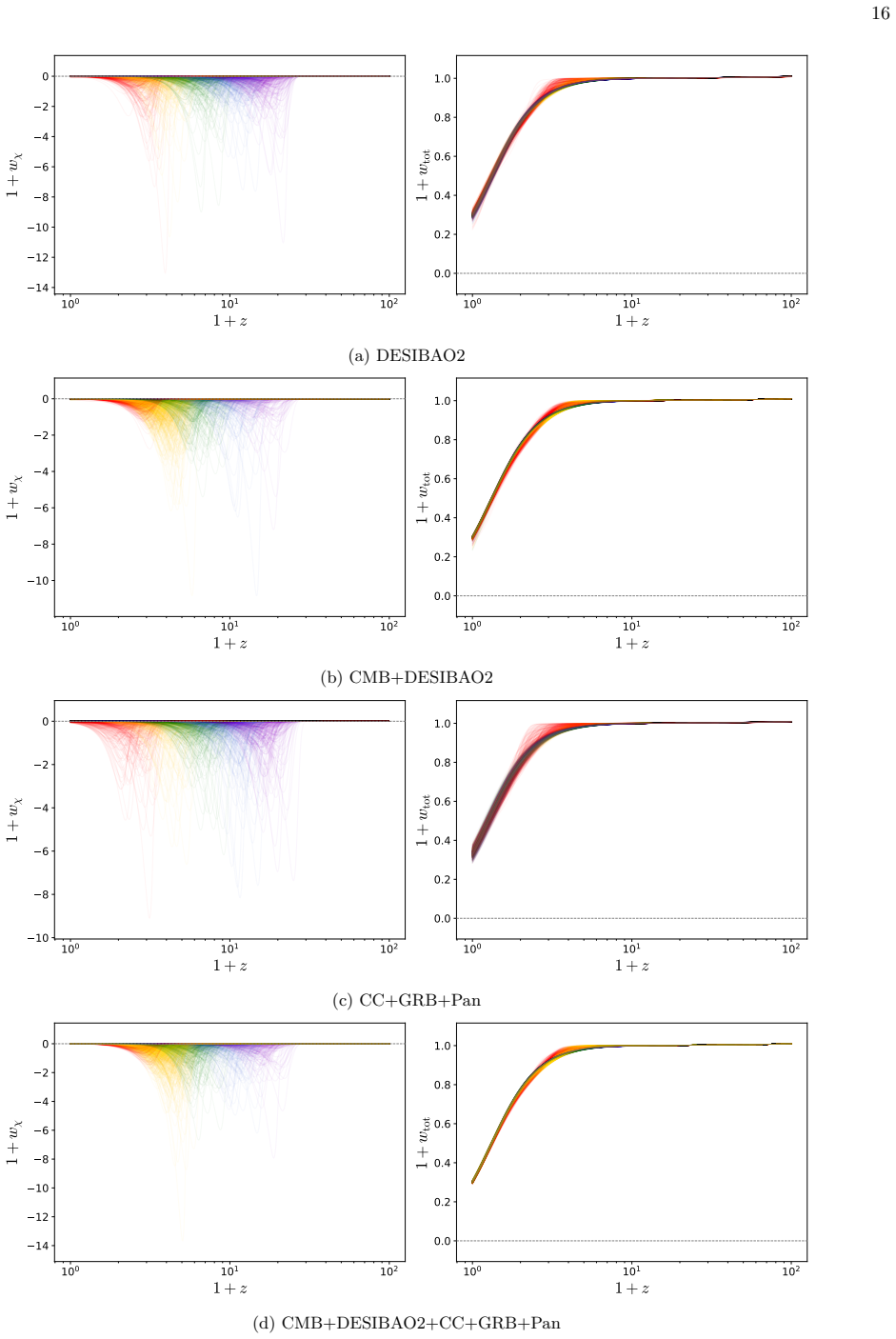
read the original abstract
Three-form fields provide a theoretically well-motivated framework for dark energy, arising in higher-dimensional theories and exhibiting a rich cosmological phenomenology. We investigate a minimally coupled three-form dark energy model with a Gaussian potential and constrain it using current cosmological observations, including CMB shift parameters, DESI DR2 baryon acoustic oscillation measurements, Pantheon+ supernovae with and without SH0ES calibration, cosmic chronometers, and gamma-ray bursts. Parameter estimation is performed within a Bayesian Markov-chain Monte Carlo framework, while model comparison relies on several information criteria and the Bayesian evidence, as well as tension statistics. We find that the three-form model provides a viable and competitive description of the expansion history of the Universe. It is mildly preferred over $\Lambda$CDM for the combination of early and late-time datasets that are heavily tensioned (CMB+BAO and Pantheon+SH0ES). This preference decreases to neutrality for the other, less tensioned combination of early and late-time data, while for individual early-time or late-time datasets analysed separately, the information criteria are neutral or favour $\Lambda$CDM. This suggests that the additional degrees of freedom of the three-form field may help accommodate cosmological observations of different origins within a common framework. The reconstructed dark energy dynamics exhibit a characteristic phantom phase at intermediate redshifts while approaching a cosmological-constant-like behaviour at early and late times, providing a distinctive observational signature. Although the model does not significantly alleviate the Hubble tension despite allowing higher values of $H_0$, it remains consistent with current observations and offers a well-motivated alternative to $\Lambda$CDM whose predictions can be tested by future cosmological surveys.
Editorial analysis
A structured set of objections, weighed in public.
Referee Report
Summary. The paper constrains a minimally coupled three-form dark energy model with Gaussian potential using CMB shift parameters, DESI DR2 BAO, Pantheon+ (with/without SH0ES), cosmic chronometers and GRBs. Bayesian MCMC yields parameter posteriors; model comparison against ΛCDM employs information criteria, Bayesian evidence and tension statistics. The central claim is that the three-form model is viable and mildly preferred over ΛCDM specifically for the CMB+BAO + Pantheon+SH0ES combination (heavily tensioned datasets), neutral for other early+late pairings, and disfavoured or neutral for individual datasets; the dynamics show a phantom phase at intermediate redshifts while approaching Λ-like behaviour at early/late times, without significantly alleviating the H0 tension.
Significance. If the reported mild, combination-dependent preference is robust rather than an artifact of dataset selection, the work supplies a theoretically motivated (higher-dimensional origin) alternative whose distinctive expansion history can be tested by future surveys. The use of standard MCMC plus multiple evidence metrics is a strength, but the incremental nature of the improvement (no H0 resolution, preference vanishes outside selected pairings) limits broader significance to a useful phenomenological exploration rather than a resolution of tensions.
major comments (2)
- [Abstract; model-comparison results] Abstract and results on model comparison: the mild preference is reported only after designating CMB+BAO and Pantheon+SH0ES as the 'heavily tensioned' combination; no pre-specified analysis plan or robustness checks against alternative partitions (e.g., CMB+BAO+CC or Pantheon+ without SH0ES) are described to demonstrate that the evidence ratios are not driven by post-selection of the datasets that already exhibit tension.
- [H0 results and discussion] Discussion of H0 constraints: the paper states that the model 'does not significantly alleviate the Hubble tension' yet still claims preference for the Pantheon+SH0ES-inclusive combination; this internal tension between the H0 posterior and the information-criterion ranking requires explicit quantification (e.g., ΔlnZ or ΔAIC values with and without the SH0ES anchor) to show the preference is not simply the extra parameters absorbing the known H0 residual.
minor comments (2)
- [§2] Notation for the three-form field and potential parameters should be defined once in §2 and used consistently; occasional re-introduction of symbols in later sections reduces readability.
- [Tables reporting AIC/BIC/evidence] Table captions for the information-criteria and evidence comparisons should explicitly state the reference model (ΛCDM) and the sign convention for Δ values.
Simulated Author's Rebuttal
We thank the referee for their thorough review and constructive feedback on our manuscript. We address each major comment point by point below, providing clarifications and committing to revisions where they strengthen the analysis without misrepresenting our results.
read point-by-point responses
-
Referee: [Abstract; model-comparison results] Abstract and results on model comparison: the mild preference is reported only after designating CMB+BAO and Pantheon+SH0ES as the 'heavily tensioned' combination; no pre-specified analysis plan or robustness checks against alternative partitions (e.g., CMB+BAO+CC or Pantheon+ without SH0ES) are described to demonstrate that the evidence ratios are not driven by post-selection of the datasets that already exhibit tension.
Authors: We acknowledge the value of demonstrating robustness against alternative dataset partitions. Our selection of combinations was motivated by the established literature on cosmological tensions (particularly H0 between early- and late-time probes), and we already examined multiple early+late pairings in the manuscript. However, to directly address the concern, we will add explicit results for the suggested alternative partitions (CMB+BAO+CC and Pantheon+ without SH0ES) in a revised Section on model comparison, including the corresponding evidence ratios, AIC/BIC values, and tension statistics. This will clarify that the mild preference is specific to the tensioned combination rather than an artifact of selection. revision: yes
-
Referee: [H0 results and discussion] Discussion of H0 constraints: the paper states that the model 'does not significantly alleviate the Hubble tension' yet still claims preference for the Pantheon+SH0ES-inclusive combination; this internal tension between the H0 posterior and the information-criterion ranking requires explicit quantification (e.g., ΔlnZ or ΔAIC values with and without the SH0ES anchor) to show the preference is not simply the extra parameters absorbing the known H0 residual.
Authors: We agree that explicit quantification is needed to resolve any apparent inconsistency. In the revised manuscript, we will add a dedicated paragraph and supplementary table reporting ΔlnZ, ΔAIC, and ΔBIC values for the relevant combinations both with and without the SH0ES anchor. This will allow direct assessment of whether the preference stems primarily from accommodating the H0 residual or from the model's ability to fit other aspects of the data, while maintaining our statement that the model does not significantly resolve the tension (as the H0 posterior shift remains modest). revision: yes
Circularity Check
No significant circularity; standard model fitting and comparison on external data
full rationale
The paper defines a three-form dark energy model with Gaussian potential and minimal coupling, then performs standard Bayesian MCMC parameter estimation against independent observational datasets (CMB shift parameters, DESI BAO, Pantheon+ supernovae, cosmic chronometers, gamma-ray bursts). Model comparison uses information criteria and Bayesian evidence computed from the likelihood on those data. No equations reduce by construction to inputs, no fitted parameters are relabeled as predictions, and no load-bearing self-citations or uniqueness theorems are invoked. The reported mild preference for specific dataset combinations is an output of the fits rather than an input, making the analysis self-contained against external benchmarks.
Axiom & Free-Parameter Ledger
free parameters (2)
- Gaussian potential amplitude and width
- Three-form field initial conditions
axioms (2)
- domain assumption Minimally coupled three-form field in a flat FLRW metric
- standard math Standard cosmological assumptions for CMB shift parameters, BAO, and supernova luminosity distances
invented entities (1)
-
Three-form field with Gaussian potential
no independent evidence
Reference graph
Works this paper leans on
-
[1]
CMB shift parameters We employ the distance priors derived in [ 71], given by the parameters ωb0 = Ω b0h2, R(z∗) = q Ωm0H 2 0 (1 + z∗)DA(z∗)/c, (25) ℓa(z∗) = (1 + z∗)π DA(r∗) rs(z∗) , (26) and their covariance matrix CCMB. Here, c is the speed of light, DA(z) is the angular diameter distance DA(z) = c (1 + z) Z z 0 dz′ H(z′) (27) and rs(z) is the comoving...
-
[2]
This dataset comprises 13 measurements ex- tending up to z = 2 .33
DESI DR2 BAO data We use the full BAO dataset reported in the latest data release of the DESI collaboration [ 72, 73], as implemented in Cobaya. This dataset comprises 13 measurements ex- tending up to z = 2 .33. The observables are provided as combinations of cosmological distances and the sound horizon rd: DM (z)/rd, DH (z)/rd, and DV (z)/rd, where rd d...
-
[3]
SNe data We use the Pantheon+ Type Ia SNe likelihood as im- plemented in Cobaya. The data are effectively given 3 Here DH (z) is the Hubble distance at redshift z and is related to the radial BAO measurement, while DM (z) is the comoving angular diameter distance corresponding to the transverse mea- surement. The volume-averaged distance DV (z) combines t...
-
[4]
We adopt the compilation of Ref
Cosmic chronometers For the cosmic chronometer data, the expansion rate is inferred from the relation H(z) = − 1 1 + z dz dt , (45) providing direct measurements of H(z). We adopt the compilation of Ref. [ 76], consisting of NCC = 33 measurements spanning approximately 0.07 ≲ z ≲ 2.0. Each data point is given as (zi, Hi, σHi ), where Hi is the observed ex...
-
[5]
Gamma-ray bursts The GRB dataset is provided in terms of the observed distance modulus µobs GRB at a certain redshift and its as- sociated uncertainties. For a given cosmological model, we compute the theoretical prediction µth GRB(z) from the luminosity distance in an analogous way to the one used for SNe, except that there is no need to convert from zhe...
-
[6]
5 To compute the present radiation density Ωr0, we first obtain the redshift of equality matter-radiation through zeq = 2 .5 · 104Ωm0h2 (TCMB T )
We disregard the likelihood of this constraint when calculating the relevant quantities, ef- fectively treating it as a prior on εH0 . 5 To compute the present radiation density Ωr0, we first obtain the redshift of equality matter-radiation through zeq = 2 .5 · 104Ωm0h2 (TCMB T )
-
[7]
The dark energy density is obtained through the constraint of a flat Universe: ΩDE,0 = 1 − Ωm0 − Ωr0 6 The momentum defined here is canonical to ϕ = a3χ
with TCMB = 2.7255 K [ 88] and then fix it with Ωr0 = Ω m0/(1+ zeq). The dark energy density is obtained through the constraint of a flat Universe: ΩDE,0 = 1 − Ωm0 − Ωr0 6 The momentum defined here is canonical to ϕ = a3χ. For more details on the definition of three-form momentum please see [ 68]. C. Model-comparison Criteria We compare the Gaussian three...
-
[8]
For all dataset combinations that are only early (CMB and CMB+DESIBAO2) or late (PPS and CC+GRB+Pan) data, every criterion favours ΛCDM or is inconclusive within uncertainties
Information criteria The differences in information criteria ∆IC ≡ IC3-form − ICΛCDM are presented in Table IV. For all dataset combinations that are only early (CMB and CMB+DESIBAO2) or late (PPS and CC+GRB+Pan) data, every criterion favours ΛCDM or is inconclusive within uncertainties. This is coherent with the previous observations; when fitted to thes...
-
[9]
Dataset consistency and Hubble tension The goodness of fit (GoF) and suspiciousness (S) ten- sion probes defined in subsection IV C are evaluated for two dataset pairs and reported in Table V: early-time CMB+DESIBAO2 against both late-time combinations, PPS and CC+GRB+Pan. For pair 1, both models show a strong tension, driven by the Hubble tension, the ∼ ...
-
[10]
A. G. Riess et al. (Supernova Search Team), Astron. J. 116, 1009 (1998) , arXiv:astro-ph/9805201
Pith/arXiv arXiv 1998
-
[11]
S. Perlmutter et al. (Supernova Cosmology Project), As- trophys. J. 517, 565 (1999) , arXiv:astro-ph/9812133
Pith/arXiv arXiv 1999
-
[12]
Astrophys
Planck Collaboration, Astron. Astrophys. 641, A6 (2020)
2020
-
[13]
A. G. Riess, S. Casertano, W. Yuan, L. M. Macri, and D. Scolnic, Astrophys. J. 876, 85 (2019) , arXiv:1903.07603 [astro-ph.CO]
Pith/arXiv arXiv 2019
-
[14]
L. Verde, T. Treu, and A. G. Riess, Nature Astron. 3, 891 (2019) , arXiv:1907.10625 [astro-ph.CO]
Pith/arXiv arXiv 2019
-
[15]
E. Di Valentino et al. (CosmoVerse Network), Phys. Dark Univ. 49, 101965 (2025) , arXiv:2504.01669 [astro- ph.CO]
Pith/arXiv arXiv 2025
-
[16]
Di Valentino (2026) arXiv:2601.01525 [astro-ph.CO]
E. Di Valentino (2026) arXiv:2601.01525 [astro-ph.CO]
arXiv 2026
-
[17]
Weinberg, Rev
S. Weinberg, Rev. Mod. Phys. 61, 1 (1989)
1989
-
[18]
T. Padmanabhan, Phys. Rept. 380, 235 (2003) , arXiv:hep-th/0212290
Pith/arXiv arXiv 2003
-
[19]
Y. Akrami et al. (CANTATA),Modified Gravity and Cos- mology. An Update by the CANTATA Network , edited by E. N. Saridakis, R. Lazkoz, V. Salzano, P. Vargas Moniz, S. Capozziello, J. Beltrán Jiménez, M. De Laurentis, and G. J. Olmo (Springer, 2021) arXiv:2105.12582 [gr-qc]
arXiv 2021
-
[20]
S. Capozziello and M. De Laurentis, Phys. Rept. 509, 167 (2011) , arXiv:1108.6266 [gr-qc]
Pith/arXiv arXiv 2011
-
[21]
Di Valentino et al
E. Di Valentino et al. , Journal of High Energy Astro- physics 30, 49 (2021)
2021
-
[22]
Ratra and P
B. Ratra and P. J. E. Peebles, Phys. Rev. D 37, 3406 (1988)
1988
-
[23]
R. R. Caldwell, R. Dave, and P. J. Steinhardt, Phys. Rev. Lett. 80, 1582 (1998)
1998
-
[24]
E. J. Copeland, M. Sami, and S. Tsujikawa, Int. J. Mod. Phys. D 15, 1753 (2006) , arXiv:hep-th/0603057
Pith/arXiv arXiv 2006
-
[25]
C. G. Boiza and M. Bouhmadi-López, Eur. Phys. J. C 85, 777 (2025) , arXiv:2409.18184 [astro-ph.CO]
arXiv 2025
- [26]
-
[27]
M. Chevallier and D. Polarski, Int. J. Mod. Phys. D 10, 213 (2001) , arXiv:gr-qc/0009008
Pith/arXiv arXiv 2001
-
[28]
E. V. Linder, Phys. Rev. Lett. 90, 091301 (2003) , arXiv:astro-ph/0208512
Pith/arXiv arXiv 2003
-
[29]
A. Y. Kamenshchik, U. Moschella, and V. Pasquier, Phys. Lett. B 511, 265 (2001) , arXiv:gr-qc/0103004
Pith/arXiv arXiv 2001
-
[30]
M. C. Bento, O. Bertolami, and A. A. Sen, Phys. Rev. D 66, 043507 (2002) , arXiv:gr-qc/0202064
Pith/arXiv arXiv 2002
-
[31]
M. Bouhmadi-López, P. F. González-Díaz, and P. Martín-Moruno, Phys. Lett. B 659, 1 (2008), arXiv:gr- qc/0612135
arXiv 2008
-
[32]
M. Bouhmadi-López, A. Errahmani, P. Martín-Moruno, T. Ouali, and Y. Tavakoli, Int. J. Mod. Phys. D 24, 1550078 (2015) , arXiv:1407.2446 [gr-qc]
Pith/arXiv arXiv 2015
-
[33]
S. Nojiri, S. D. Odintsov, and V. K. Oikonomou, Phys. Rept. 692, 1 (2017) , arXiv:1705.11098 [gr-qc]
Pith/arXiv arXiv 2017
-
[34]
S. Nojiri and S. D. Odintsov, Phys. Rept. 505, 59 (2011) , arXiv:1011.0544 [gr-qc]
Pith/arXiv arXiv 2011
-
[35]
J. Morais, M. Bouhmadi-López, and S. Capozziello, JCAP 09, 041 (2015) , arXiv:1507.02623 [gr-qc]
Pith/arXiv arXiv 2015
-
[36]
G. R. Bengochea and R. Ferraro, Phys. Rev. D 79, 124019 (2009) , arXiv:0812.1205 [astro-ph]
Pith/arXiv arXiv 2009
-
[37]
R. Ferraro and F. Fiorini, Phys. Rev. D 75, 084031 (2007), arXiv:gr-qc/0610067. 18
Pith/arXiv arXiv 2007
-
[38]
Y.-F. Cai, S. Capozziello, M. De Laurentis, and E. N. Saridakis, Rept. Prog. Phys. 79, 106901 (2016) , arXiv:1511.07586 [gr-qc]
Pith/arXiv arXiv 2016
-
[39]
J. Beltrán Jiménez, L. Heisenberg, and T. S. Koivisto, JCAP 08, 039 (2018) , arXiv:1803.10185 [gr-qc]
Pith/arXiv arXiv 2018
-
[40]
J. Beltrán Jiménez, L. Heisenberg, T. S. Koivisto, and S. Pekar, Phys. Rev. D 101, 103507 (2020) , arXiv:1906.10027 [gr-qc]
arXiv 2020
- [41]
-
[42]
C. G. Boiza, M. Petronikolou, M. Bouhmadi-López, and E. N. Saridakis, JCAP 12, 011 (2025) , arXiv:2505.18264 [astro-ph.CO]
arXiv 2025
- [43]
- [44]
- [45]
- [46]
-
[47]
Ö. Akarsu, E. Di Valentino, J. Vyskočil, E. Yılmaz, A. E. Yükselci, and A. Zhuk, (2025), arXiv:2510.18741 [astro- ph.CO]
Pith/arXiv arXiv 2025
-
[48]
M. Bouhmadi-López and B. Ibarra-Uriondo, Phys. Rev. D 112, 063559 (2025) , arXiv:2506.12139 [gr-qc]
arXiv 2025
-
[49]
M. Bouhmadi-López and B. Ibarra-Uriondo, Phys. Dark Univ. 50, 102129 (2025) , arXiv:2506.18992 [gr-qc]
arXiv 2025
-
[50]
B. Ibarra-Uriondo and M. Bouhmadi-López, (2026), arXiv:2602.12347 [astro-ph.CO]
Pith/arXiv arXiv 2026
-
[51]
T. S. Koivisto and N. J. Nunes, Phys. Rev. D 80, 103509 (2009), arXiv:0908.0920 [astro-ph.CO]
Pith/arXiv arXiv 2009
-
[52]
T. S. Koivisto and N. J. Nunes, Physical Review D 88 (2013), 10.1103/physrevd.88.123512
-
[53]
J. Morais, M. Bouhmadi-López, K. Sravan Kumar, J. Marto, and Y. Tavakoli, Phys. Dark Univ. 15, 7 (2017), arXiv:1608.01679 [gr-qc]
Pith/arXiv arXiv 2017
-
[54]
M. Bouhmadi-López, J. Marto, J. Morais, and C. M. Silva, JCAP 03, 042 (2017) , arXiv:1611.03100 [gr-qc]
Pith/arXiv arXiv 2017
-
[55]
Morais, M
J. Morais, M. Bouhmadi-López, and J. Marto, Universe 3, 21 (2017)
2017
-
[56]
Aurilia, H
A. Aurilia, H. Nicolai, and P. K. Townsend, Nucl. Phys. B 176, 509 (1980)
1980
-
[57]
T. S. Koivisto and N. J. Nunes, Phys. Lett. B 685, 105 (2010), arXiv:0907.3883 [astro-ph.CO]
Pith/arXiv arXiv 2010
-
[58]
M. J. Duff and P. van Nieuwenhuizen, Phys. Lett. B 94, 179 (1980)
1980
-
[59]
M. Bouhmadi-López, C.-Y. Chen, X. Y. Chew, Y. C. Ong, and D.-h. Yeom, JCAP 10, 059 (2021) , arXiv:2108.07302 [gr-qc]
arXiv 2021
-
[60]
B. J. Barros and F. S. Lobo, Physical Review D 98 (2018), 10.1103/physrevd.98.044012
-
[61]
M. Bouhmadi-López, C.-Y. Chen, X. Y. Chew, Y. C. Ong, and D.-H. Yeom, Eur. Phys. J. C 81, 278 (2021) , arXiv:2005.13260 [gr-qc]
arXiv 2021
-
[62]
B. J. Barros, B. Dǎnilǎ, T. Harko, and F. S. N. Lobo, Eur. Phys. J. C 80, 617 (2020) , arXiv:2004.06605 [gr-qc]
arXiv 2020
-
[63]
B. J. Barros, Z. Haghani, T. Harko, and F. S. N. Lobo, Eur. Phys. J. C 81, 307 (2021) , arXiv:2101.04445 [gr-qc]
arXiv 2021
-
[64]
C. Germani and A. Kehagias, JCAP 03, 028 (2009) , arXiv:0902.3667 [astro-ph.CO]
Pith/arXiv arXiv 2009
-
[65]
D. J. Mulryne, J. Noller, and N. J. Nunes, Journal of Cosmology and Astroparticle Physics 2012, 016–016 (2012)
2012
-
[66]
F. R. Urban and T. S. Koivisto, JCAP 09, 025 (2012) , arXiv:1207.7328 [astro-ph.CO]
Pith/arXiv arXiv 2012
-
[67]
K. S. Kumar, J. Marto, N. J. Nunes, and P. V. Moniz, JCAP 06, 064 (2014) , arXiv:1404.0211 [gr-qc]
Pith/arXiv arXiv 2014
-
[68]
K. Sravan Kumar, D. J. Mulryne, N. J. Nunes, J. Marto, and P. Vargas Moniz, Phys. Rev. D 94, 103504 (2016) , arXiv:1606.07114 [astro-ph.CO]
Pith/arXiv arXiv 2016
-
[69]
A. De Felice, K. Karwan, and P. Wongjun, Phys. Rev. D 85, 123545 (2012) , arXiv:1202.0896 [hep-ph]
Pith/arXiv arXiv 2012
-
[70]
A. De Felice, K. Karwan, and P. Wongjun, Phys. Rev. D 86, 103526 (2012) , arXiv:1209.5156 [astro-ph.CO]
Pith/arXiv arXiv 2012
-
[71]
B. J. Barros and N. J. Nunes, Phys. Rev. D 93, 043512 (2016), arXiv:1511.07856 [astro-ph.CO]
Pith/arXiv arXiv 2016
-
[72]
B. J. Barros and J. Beltrán Jiménez, JHEP 02, 002 (2024), arXiv:2312.12516 [gr-qc]
arXiv 2024
-
[73]
J. E. B. Gordin, K. MacDevette, and J. Bruton, JHEP 05, 061 (2024) , arXiv:2311.14436 [hep-th]
arXiv 2024
-
[74]
V. da Fonseca, B. J. Barros, T. Barreiro, and N. J. Nunes, Phys. Dark Univ. 47, 101827 (2025) , arXiv:2410.11658 [gr-qc]
arXiv 2025
- [75]
-
[76]
T. Barreiro, U. Bertello, and N. J. Nunes, Phys. Lett. B 773, 417 (2017) , arXiv:1610.00357 [gr-qc]
Pith/arXiv arXiv 2017
-
[77]
M. Bouhmadi-López, D. Brizuela, and I. Garay, JCAP 09, 031 (2018) , arXiv:1802.05164 [gr-qc]
arXiv 2018
-
[78]
M. Bouhmadi-López, H.-W. Chiang, C. G. Boiza, and P. Chen, (2025), arXiv:2512.09991 [astro-ph.CO]
Pith/arXiv arXiv 2025
-
[79]
Wang and P
Y. Wang and P. Mukherjee, The Astrophysical Journal 650, 1–6 (2006)
2006
-
[80]
Zhai and Y
Z. Zhai and Y. Wang, Journal of Cosmology and As- troparticle Physics 2019, 005–005 (2019)
2019
discussion (0)
Sign in with ORCID, Apple, or X to comment. Anyone can read and Pith papers without signing in.