Single- and Double-Λ Hypernuclear Correlations Calibrate ΛΛ Interaction Energies
Pith reviewed 2026-06-29 00:36 UTC · model grok-4.3
The pith
A linear correlation between binding energy deviations in single- and double-Λ hypernuclei transfers empirical constraints to evaluate ΛΛ interaction energies in heavier systems.
A machine-rendered reading of the paper's core claim, the machinery that carries it, and where it could break.
Core claim
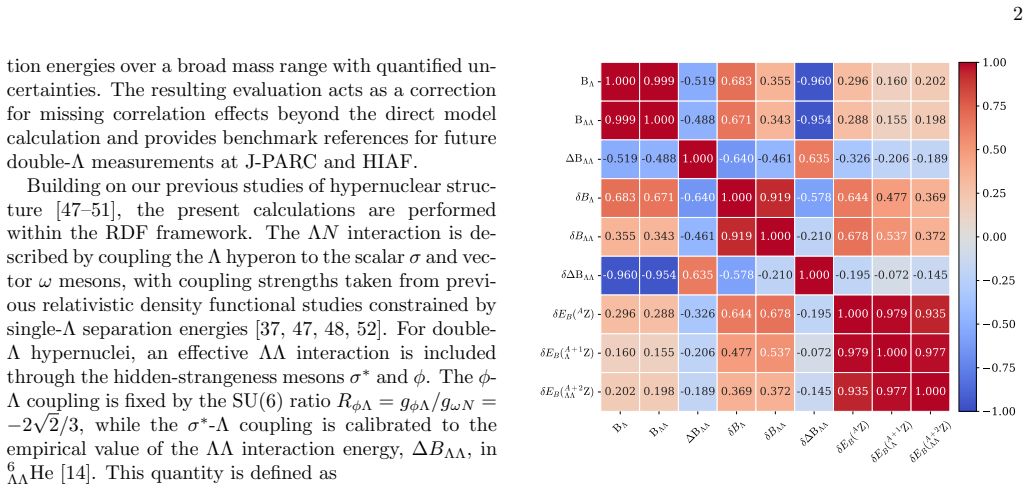
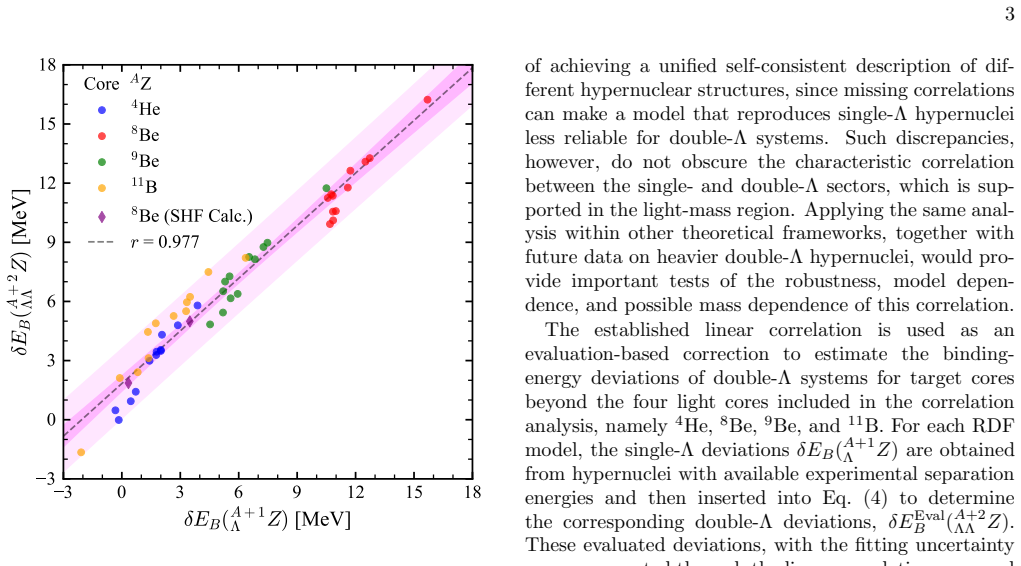
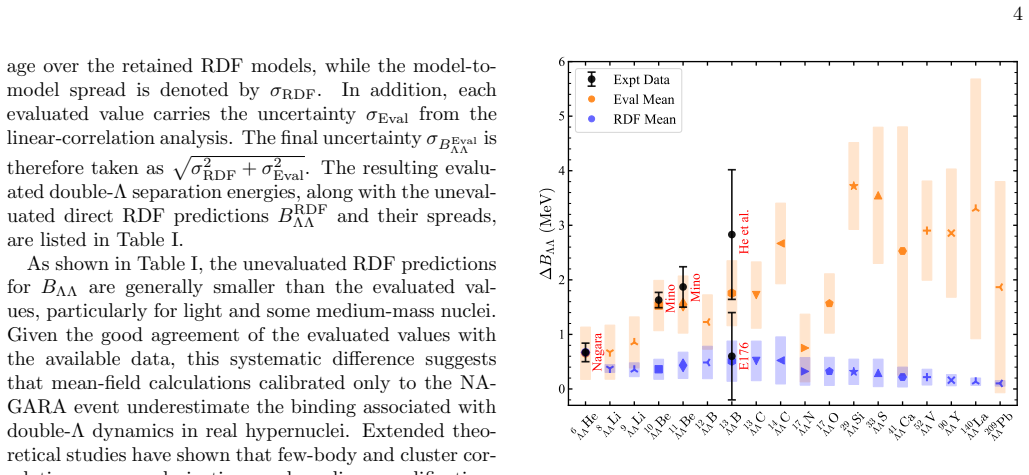
By analyzing theoretical deviations of binding energies in light single- and double-Λ hypernuclei, a robust linear correlation is identified between the two sectors. This enables a statistical evaluation of B_ΛΛ and ΔB_ΛΛ for heavier double-Λ hypernuclei, drawing on empirical data from the single-Λ sector with quantified uncertainties. The evaluated ΔB_ΛΛ values are systematically larger than direct relativistic density functional predictions constrained only by the NAGARA event, suggesting that standard mean-field-based extrapolations may underestimate ΛΛ correlations and other many-body effects.
What carries the argument
The robust linear correlation between theoretical binding energy deviations in the single-Λ (S=-1) and double-Λ (S=-2) sectors.
If this is right
- Evaluated ΔB_ΛΛ values are consistent with existing data but larger than those from mean-field predictions constrained only by the NAGARA event.
- Standard mean-field-based extrapolations may underestimate ΛΛ correlations and other many-body effects.
- The evaluation framework provides quantified uncertainties for predictions of heavier double-Λ hypernuclei.
- The results offer benchmarks for future S=-2 experiments at facilities such as HIAF and J-PARC.
Where Pith is reading between the lines
- If the correlation holds for heavier systems, it could guide targeted improvements in nuclear many-body calculations to include stronger ΛΛ effects.
- The approach might extend to other multi-strangeness hypernuclear systems where empirical data is limited in one sector.
- Refining the linear relation with additional light hypernuclear data could reduce uncertainties in the evaluated interaction energies.
- Discrepancies with direct calculations suggest that empirical corrections derived from single-Λ data could be incorporated into density functional models.
Load-bearing premise
The intrinsic structural similarity between single-Λ and double-Λ systems produces a robust linear correlation in binding energy deviations that can reliably transfer empirical constraints from the S=-1 sector to the S=-2 sector for heavier systems.
What would settle it
A precise experimental measurement of B_ΛΛ or ΔB_ΛΛ in a heavier double-Λ hypernucleus that falls outside the uncertainty range predicted by the linear correlation would challenge the method.
Figures
read the original abstract
Double-$\Lambda$ hypernuclei are essential for probing the $\Lambda\Lambda$ interaction in the double-strangeness $S=-2$ sector, yet the scarcity of experimental data severely limits systematic predictions. We present an evaluation framework based on nuclear many-body theory that exploits the intrinsic structural similarity between single-$\Lambda$ and double-$\Lambda$ systems to transfer empirical constraints from the well-mapped $S = -1$ sector to the $S = -2$ sector. By analyzing theoretical deviations of binding energies in light single- and double-$\Lambda$ hypernuclei, we identify a robust linear correlation between two sectors. This correlation enables a statistical evaluation of double-$\Lambda$ separation energies ($B_{\Lambda\Lambda}$) and $\Lambda\Lambda$ interaction energies ($\Delta B_{\Lambda\Lambda}$) for heavier double-$\Lambda$ hypernuclei, by drawing on a wealth of empirical data from the single-$\Lambda$ sector with quantified uncertainties. Our results show that evaluated $\Delta B_{\Lambda\Lambda}$ values, while consistent with existing data, are systematically larger than direct relativistic density functional predictions constrained only by the NAGARA event. This discrepancy suggests that standard mean-field-based extrapolations may underestimate $\Lambda\Lambda$ correlations and other many-body effects, motivating an evaluation-based correction that offers crucial benchmarks for future $S = -2$ experiments at facilities such as HIAF and J-PARC.
Editorial analysis
A structured set of objections, weighed in public.
Referee Report
Summary. The manuscript identifies a linear correlation between theoretical binding-energy deviations in light single-Λ and double-Λ hypernuclei. This relation is used to transfer empirical constraints and quantified uncertainties from the abundant S=-1 sector to statistically evaluate B_ΛΛ and ΔB_ΛΛ for heavier double-Λ systems, yielding values systematically larger than those obtained from direct relativistic density-functional calculations constrained only by the NAGARA event.
Significance. If the correlation remains stable under extrapolation, the framework supplies a data-driven route to constrain the ΛΛ interaction with realistic uncertainties drawn from single-Λ phenomenology, supplying concrete benchmarks for upcoming S=-2 experiments and indicating that mean-field models may miss important many-body contributions to ΔB_ΛΛ.
major comments (3)
- [§4] §4 (correlation analysis): The linear relation is established exclusively from light systems (A≤12). No hold-out validation, variation of the underlying NN/YN interactions, or explicit test on medium-mass cases is presented to confirm that slope and scatter remain constant when core size and density change, which is required for the central extrapolation to heavier double-Λ hypernuclei.
- [§5.2, Table 3] §5.2 and Table 3: The propagated uncertainties on evaluated ΔB_ΛΛ for A>12 systems treat the fitted slope and intercept as fixed; the manuscript does not propagate the covariance of the linear fit itself, so the quoted error bars are incomplete and the claimed discrepancy with direct predictions rests on an incompletely quantified statistical procedure.
- [§3] §3 (theoretical deviations): Because both the single-Λ and double-Λ deviations are computed within the same family of models, the correlation may inherit model dependence; the text does not demonstrate that the slope is insensitive to the choice of interaction, undermining the claim that empirical single-Λ data can be transferred model-independently.
minor comments (3)
- [Abstract] Abstract: the phrase 'robust linear correlation' should be accompanied by the numerical fit quality (R² or χ²) already in the abstract or immediately in §4.
- [Figure 2] Figure 2: the scatter plots would benefit from explicit 1σ and 2σ confidence bands around the fitted line to allow visual assessment of the extrapolation uncertainty.
- [§2] Notation: the symbol ΔB_ΛΛ is used both for the interaction energy and for its evaluated value; a brief clarifying sentence in §2 would remove ambiguity.
Simulated Author's Rebuttal
We thank the referee for the constructive feedback on our manuscript. The comments highlight important aspects of validation, statistical rigor, and model dependence that we address point by point below. Where revisions are warranted, we indicate them explicitly.
read point-by-point responses
-
Referee: [§4] §4 (correlation analysis): The linear relation is established exclusively from light systems (A≤12). No hold-out validation, variation of the underlying NN/YN interactions, or explicit test on medium-mass cases is presented to confirm that slope and scatter remain constant when core size and density change, which is required for the central extrapolation to heavier double-Λ hypernuclei.
Authors: We agree that the correlation is derived solely from light systems (A≤12), where both single- and double-Λ data exist for direct comparison. The manuscript does not include hold-out validation or explicit medium-mass tests, as the available double-Λ data are limited to very light systems. We will revise §4 to add a robustness check by refitting the correlation on subsets of the light systems and reporting the variation in slope and intercept. However, new calculations for medium-mass double-Λ hypernuclei lie outside the present scope. The revised text will include an explicit statement of the extrapolation assumptions and their limitations. revision: partial
-
Referee: [§5.2, Table 3] §5.2 and Table 3: The propagated uncertainties on evaluated ΔB_ΛΛ for A>12 systems treat the fitted slope and intercept as fixed; the manuscript does not propagate the covariance of the linear fit itself, so the quoted error bars are incomplete and the claimed discrepancy with direct predictions rests on an incompletely quantified statistical procedure.
Authors: The referee correctly identifies that the current uncertainty propagation treats the fit parameters as fixed and omits their covariance. This is an oversight in the statistical procedure. We will revise §5.2 and Table 3 to propagate the full covariance matrix of the linear fit when evaluating B_ΛΛ and ΔB_ΛΛ for A>12. The updated error bars and any consequent changes to the comparison with direct density-functional results will be reported. revision: yes
-
Referee: [§3] §3 (theoretical deviations): Because both the single-Λ and double-Λ deviations are computed within the same family of models, the correlation may inherit model dependence; the text does not demonstrate that the slope is insensitive to the choice of interaction, undermining the claim that empirical single-Λ data can be transferred model-independently.
Authors: Both sets of deviations are obtained within the same relativistic density-functional framework to maintain consistent many-body treatment. Results from several parametrizations are shown, but the manuscript does not vary the underlying NN/YN interactions across qualitatively different model classes. We will revise §3 to clarify that the correlation is demonstrated within this model family and that the transfer of empirical single-Λ constraints therefore carries residual model dependence. A sentence acknowledging this limitation will be added. revision: partial
Circularity Check
No circularity: correlation identified from light systems then extrapolated via empirical single-Λ data
full rationale
The derivation identifies a linear correlation between binding-energy deviations in light single-Λ and double-Λ systems from theoretical calculations, then applies that relation to map empirical single-Λ data onto heavier double-Λ predictions. This is an extrapolation resting on an assumed constancy of the slope, not a self-definitional loop, a fitted parameter renamed as prediction, or any reduction of the output to the input by construction. No load-bearing self-citations or ansatz smuggling appear in the abstract or described chain. The result remains falsifiable against future S=-2 data and is therefore scored as self-contained.
Axiom & Free-Parameter Ledger
free parameters (1)
- slope and intercept of linear correlation
axioms (2)
- domain assumption Nuclear many-body theory accurately captures binding energy deviations in hypernuclei
- ad hoc to paper Structural similarity between single- and double-Λ systems produces a transferable linear correlation
Reference graph
Works this paper leans on
-
[1]
A. Gal, E. V. Hungerford, and D. J. Millener, Rev. Mod. Phys.88, 035004 (2016), URLhttps://link.aps.org/ doi/10.1103/RevModPhys.88.035004
- [2]
-
[3]
title Modern theory of nuclear forces
E. Epelbaum, H. W. Hammer, and U.-G. Meißner, Rev. Mod. Phys.81, 1773 (2009), URLhttps://link.aps. org/doi/10.1103/RevModPhys.81.1773
-
[4]
Hiyama and T
E. Hiyama and T. Yamada, Progress in Particle and Nuclear Physics63, 339 (2009), ISSN 0146- 6410, URLhttps://www.sciencedirect.com/science/ article/pii/S0146641009000350
2009
-
[5]
Lenske, M
H. Lenske, M. Dhar, T. Gaitanos, and X. Cao, Progress in Particle and Nuclear Physics98, 119 (2018), ISSN 0146-6410, URLhttps://www.sciencedirect. com/science/article/pii/S0146641017300728
2018
-
[6]
Burgio, H.-J
G. Burgio, H.-J. Schulze, I. Vida?a, and J.-B. Wei, Progress in Particle and Nuclear Physics 120, 103879 (2021), ISSN 0146-6410, URL https://www.sciencedirect.com/science/article/ pii/S0146641021000338
2021
-
[7]
Haidenbauer, U.-G
J. Haidenbauer, U.-G. Meißner, and A. Nogga, Progress in Particle and Nuclear Physics149, 104242 (2026), ISSN 0146-6410, URLhttps://www.sciencedirect. com/science/article/pii/S0146641026000177
2026
-
[8]
H. R. Fu, J. J. Li, A. Sedrakian, and F. Weber, Physics Letters B834, 137470 (2022), ISSN 0370- 2693, URLhttps://www.sciencedirect.com/science/ article/pii/S0370269322006049
2022
-
[9]
I. Vida˜ na, V. M. Sarti, J. Haidenbauer, D. L. Mihaylov, and L. Fabbietti, The European Physical Journal A 61, 59 (2025), ISSN 1434-601X, URLhttps://link. springer.com/10.1140/epja/s10050-025-01539-z
-
[10]
M. Danysz, K. Garbowska, J. Pniewski, T. Pniewski, J. Zakrzewski, E. Fletcher, J. Lemonne, P. Re- nard, J. Sacton, W. Toner, et al., Nuclear Physics49, 121 (1963), ISSN 0029-5582, URL https://www.sciencedirect.com/science/article/ pii/0029558263900804. 6
-
[11]
D. J. Prowse, Phys. Rev. Lett.17, 782 (1966), URL https://link.aps.org/doi/10.1103/PhysRevLett.17. 782
-
[12]
S. Aoki, S. Y. Bahk, K. S. Chung, S. H. Chung, H. Fu- nahashi, C. H. Hahn, T. Hara, S. Hirata, K. Hoshino, M. Ieiri, et al., Progress of Theoretical Physics85, 1287 (1991), ISSN 0033-068X, URLhttps://doi.org/ 10.1143/PTP.85.1287
-
[13]
S. Aoki, S. Bahk, S. Chung, H. Funahashi, C. Hahn, M. Hanabata, T. Hara, S. Hirata, K. Hoshino, M. Ieiri, et al., Nuclear Physics A828, 191 (2009), ISSN 0375- 9474, URLhttps://www.sciencedirect.com/science/ article/pii/S0375947409005065
2009
-
[14]
J. K. Ahn, H. Akikawa, S. Aoki, K. Arai, S. Y. Bahk, K. M. Baik, B. Bassalleck, J. H. Chung, M. S. Chung, D. H. Davis, et al. (E373 (KEK-PS) Collaboration), Phys. Rev. C88, 014003 (2013), URLhttps://link. aps.org/doi/10.1103/PhysRevC.88.014003
-
[15]
H. Ekawa, K. Agari, J. K. Ahn, T. Akaishi, Y. Akazawa, S. Ashikaga, B. Bassalleck, S. Bleser, Y. Endo, Y. Fujikawa, et al., Progress of Theoretical and Experimental Physics2019, 021D02 (2019), ISSN 2050-3911, https://academic.oup.com/ptep/article- pdf/2019/2/021D02/27970468/pty149.pdf, URL https://doi.org/10.1093/ptep/pty149
-
[16]
K. Miwa, K. Nakazawa, H. Tamura, E. Hiyama, and T. Takahashi, The European Physical Journal A61, 128 (2025), ISSN 1434-601X, URLhttps://link.springer. com/10.1140/epja/s10050-025-01571-z
-
[17]
Takahashi, J
H. Takahashi, J. K. Ahn, H. Akikawa, S. Aoki, K. Arai, S. Y. Bahk, K. M. Baik, B. Bassalleck, J. H. Chung, M. S. Chung, et al., Phys. Rev. Lett.87, 212502 (2001), URLhttps://link.aps.org/doi/10. 1103/PhysRevLett.87.212502
2001
-
[18]
K. Nakazawa, Nuclear Physics A835, 207 (2010), ISSN 0375-9474, proceedings of the 10th Interna- tional Conference on Hypernuclear and Strange Par- ticle Physics, URLhttps://www.sciencedirect.com/ science/article/pii/S0375947410001983
2010
-
[19]
K. Nakazawa and H. Takahashi, Progress of Theo- retical Physics Supplement185, 335 (2010), ISSN 0375-9687, https://academic.oup.com/ptps/article- pdf/doi/10.1143/PTPS.185.335/5337597/185-335.pdf, URLhttps://doi.org/10.1143/PTPS.185.335
-
[20]
Acharya, D
S. Acharya, D. Adamov´ a, S. Adhya, A. Adler, J. Adolfsson, M. Aggarwal, G. Aglieri Rinella, M. Agnello, N. Agrawal, Z. Ahammed, et al., Physics Letters B797, 134822 (2019), ISSN 0370- 2693, URLhttps://www.sciencedirect.com/science/ article/pii/S0370269319305362
2019
-
[21]
T. R. Saito, W. Dou, V. Drozd, H. Ekawa, S. Es- crig, Y. He, N. Kalantar-Nayestanaki, A. Kasagi, M. Kavatsyuk, E. Liu, et al., Nature Reviews Physics3, 803 (2021), URLhttps://doi.org/10.1038/ s42254-021-00371-w
2021
-
[22]
X. Zhou, J. Yang, and the HIAF project team, AAPPS Bulletin32, 35 (2022), URLhttps://doi.org/10.1007/ s43673-022-00064-1
2022
-
[23]
Y. He, V. Drozd, H. Ekawa, S. Escrig, Y. Gao, A. Kasagi, E. Liu, A. Muneem, M. Nakagawa, K. Nakazawa, et al., Nuclear Instruments and Methods in Physics Research Section A: Accelerators, Spectrometers, Detectors and Associated Equipment1073, 170196 (2025), ISSN 0168- 9002, URLhttps://www.sciencedirect.com/science/ article/pii/S0168900224011227
2025
-
[24]
Y. He, T. R. Saito, H. Ekawa, A. Kasagi, Y. Gao, E. Liu, K. Nakazawa, C. Rappold, M. Taki, Y. K. Tanaka, et al., Nature Communications16, 11084 (2025), ISSN 2041-1723, URLhttps://doi.org/10. 1038/s41467-025-66517-x
2025
-
[25]
I. Vida˜ na, A. Ramos, and A. Polls, Phys. Rev. C 70, 024306 (2004), URLhttps://link.aps.org/doi/ 10.1103/PhysRevC.70.024306
-
[26]
T. A. Rijken, M. M. Nagels, and Y. Yamamoto, Progress of Theoretical Physics Supplement185, 14 (2010), ISSN 0375-9687, https://academic.oup.com/ptps/article- pdf/doi/10.1143/PTPS.185.14/5334308/185-14.pdf, URLhttps://doi.org/10.1143/PTPS.185.14
-
[27]
Sasaki, S
K. Sasaki, S. Aoki, T. Doi, S. Gongyo, T. Hatsuda, Y. Ikeda, T. Inoue, T. Iritani, N. Ishii, K. Murano, et al., Nuclear Physics A998, 121737 (2020), ISSN 0375- 9474, URLhttps://www.sciencedirect.com/science/ article/pii/S0375947420300476
2020
-
[28]
Y. Kamiya, K. Sasaki, T. Fukui, T. Hyodo, K. Morita, K. Ogata, A. Ohnishi, and T. Hatsuda, Phys. Rev. C 105, 014915 (2022), URLhttps://link.aps.org/doi/ 10.1103/PhysRevC.105.014915
-
[29]
Gal, Physics Letters B857, 138973 (2024), ISSN 0370- 2693, URLhttps://www.sciencedirect.com/science/ article/pii/S0370269324005318
A. Gal, Physics Letters B857, 138973 (2024), ISSN 0370- 2693, URLhttps://www.sciencedirect.com/science/ article/pii/S0370269324005318
2024
-
[31]
E. Hiyama, M. Kamimura, Y. Yamamoto, and T. Mo- toba, Phys. Rev. Lett.104, 212502 (2010), URL https://link.aps.org/doi/10.1103/PhysRevLett. 104.212502
-
[32]
Garcilazo and A
H. Garcilazo and A. Valcarce, Phys. Rev. Lett.110, 012503 (2013), URLhttps://link.aps.org/doi/10. 1103/PhysRevLett.110.012503
2013
-
[34]
Contessi, M
L. Contessi, M. Sch¨ afer, N. Barnea, A. Gal, and J. Mareˇ s, Physics Letters B797, 134893 (2019), ISSN 0370- 2693, URLhttps://www.sciencedirect.com/science/ article/pii/S0370269319306070
2019
-
[35]
Meher and U
G. Meher and U. Raha, Phys. Rev. C103, 014001 (2021), URLhttps://link.aps.org/doi/10. 1103/PhysRevC.103.014001
2021
-
[36]
D. E. Lanskoy, Phys. Rev. C58, 3351 (1998), URLhttps://link.aps.org/doi/10.1103/PhysRevC. 58.3351
-
[37]
H. Shen, F. Yang, and H. Toki, Progress of The- oretical Physics115, 325 (2006), ISSN 0033- 068X, https://academic.oup.com/ptp/article- pdf/115/2/325/5208734/115-2-325.pdf, URL https://doi.org/10.1143/PTP.115.325
-
[38]
X. R. Zhou, H. J. Schulze, H. Sagawa, C. X. Wu, and E. G. Zhao, Phys. Rev. C76, 034312 (2007), URLhttps: //link.aps.org/doi/10.1103/PhysRevC.76.034312
-
[39]
Minato and K
F. Minato and K. Hagino, Phys. Rev. C85, 024316 (2012), URLhttps://link.aps.org/doi/10. 1103/PhysRevC.85.024316
2012
-
[40]
Schulze and T
H.-J. Schulze and T. Rijken, Phys. Rev. C88, 024322 (2013), URLhttps://link.aps.org/doi/10. 1103/PhysRevC.88.024322. 7
2013
-
[41]
Ghahramani, Nature521, 452 (2015), ISSN 0028-0836, 1476-4687, URLhttps://www.nature.com/ articles/nature14541
Z. Ghahramani, Nature521, 452 (2015), ISSN 0028-0836, 1476-4687, URLhttps://www.nature.com/ articles/nature14541
2015
-
[42]
G. E. Karniadakis, I. G. Kevrekidis, L. Lu, P. Perdikaris, S. Wang, and L. Yang, Nature Reviews Physics3, 422 (2021), ISSN 2522-5820, URLhttps://doi.org/10. 1038/s42254-021-00314-5
2021
-
[43]
Karagiorgi, G
G. Karagiorgi, G. Kasieczka, S. Kravitz, B. Nachman, and D. Shih, Nature Reviews Physics4, 399 (2022), ISSN 2522-5820, URLhttps://www.nature.com/articles/ s42254-022-00455-1
2022
-
[44]
Annala, T
E. Annala, T. Gorda, E. Katerini, A. Kurkela, J. N¨ attil¨ a, V. Paschalidis, and A. Vuorinen, Phys. Rev. X12, 011058 (2022), URLhttps://link.aps.org/doi/10. 1103/PhysRevX.12.011058
2022
-
[45]
Brown, M
D. Brown, M. Chadwick, R. Capote, A. Kahler, A. Trkov, M. Herman, A. Sonzogni, Y. Danon, A. Carlson, M. Dunn, et al., Nuclear Data Sheets148, 1 (2018), ISSN 0090-3752, special Issue on Nuclear Reaction Data, URLhttps://www.sciencedirect.com/science/ article/pii/S0090375218300206
2018
-
[46]
Boehnlein, M
A. Boehnlein, M. Diefenthaler, N. Sato, M. Schram, V. Ziegler, C. Fanelli, M. Hjorth-Jensen, T. Horn, M. P. Kuchera, D. Lee, et al., Rev. Mod. Phys.94, 031003 (2022), URLhttps://link.aps.org/doi/10. 1103/RevModPhys.94.031003
2022
-
[47]
S. Y. Ding, Z. Qian, B. Y. Sun, and W. H. Long, Phys. Rev. C106, 054311 (2022), URLhttps://link.aps. org/doi/10.1103/PhysRevC.106.054311
-
[48]
S.-Y. Ding, W. Yang, and B.-Y. Sun, Chinese Physics C 47, 124103 (2023), URLhttps://dx.doi.org/10.1088/ 1674-1137/acf91e
2023
-
[49]
W. Yang, S. Y. Ding, and B. Y. Sun, Phys. Rev. C 110, 054320 (2024), URLhttps://link.aps.org/doi/ 10.1103/PhysRevC.110.054320
-
[50]
S. Y. Ding, B. Y. Sun, and T.-T. Sun, Phys. Rev. C 111, 014301 (2025), URLhttps://link.aps.org/doi/ 10.1103/PhysRevC.111.014301
-
[51]
S. Y. Ding, X. D. Sun, B. Y. Sun, and A. Li, Phys. Rev. D 112, 103008 (2025), URLhttps://link.aps.org/doi/ 10.1103/k1bx-7nw2
-
[52]
Tu and S.-G
Z.-H. Tu and S.-G. Zhou, The Astrophysical Journal 925, 16 (2022), URLhttps://dx.doi.org/10.3847/ 1538-4357/ac3996
2022
-
[53]
M. Wang, W. Huang, F. Kondev, G. Audi, and S. Naimi, Chinese Physics C45, 030003 (2021), URLhttps:// doi.org/10.1088/1674-1137/abddaf
-
[54]
Hypernuclei Database Collaboration, Hypernuclei database, Website (2022), accessed: 2026- 05-19, URLhttps://hypernuclei.kph.uni-mainz.de
2022
-
[55]
J. Margueron, E. Khan, and F. Gulminelli, Phys. Rev. C96, 054317 (2017), URLhttps://link.aps.org/doi/ 10.1103/PhysRevC.96.054317
-
[56]
Y.-T. Rong, P. Zhao, and S.-G. Zhou, Physics Let- ters B807, 135533 (2020), ISSN 0370-2693, URL https://www.sciencedirect.com/science/article/ pii/S0370269320303373
2020
-
[57]
J. Guo, C. F. Chen, X.-R. Zhou, Q. B. Chen, and H.-J. Schulze, Phys. Rev. C105, 034322 (2022), URLhttps: //link.aps.org/doi/10.1103/PhysRevC.105.034322
-
[58]
C. Schaab, S. Balberg, and J. Schaffner-Bielich, The Astrophysical Journal504, L99 (1998), URLhttps: //doi.org/10.1086/311577
-
[59]
T. Tanigawa, M. Matsuzaki, and S. Chiba, Phys. Rev. C68, 015801 (2003), URLhttps://link.aps.org/doi/ 10.1103/PhysRevC.68.015801
-
[60]
H. G¨ uven, K. Bozkurt, E. Khan, and J. Margueron, Phys. Rev. C98, 014318 (2018), URLhttps://link.aps.org/ doi/10.1103/PhysRevC.98.014318. 8 Appendix A. RELA TIVISTIC DENSITY FUNCTIONALS AND HYPERON COUPLINGS The nucleon interactions are described by well- established nonlinear RMF functionals such as PK1, TM1, and NL-SH, together with six density-depende...
discussion (0)
Sign in with ORCID, Apple, or X to comment. Anyone can read and Pith papers without signing in.