AI-Generated Image Recognition via Fusion of CNNs and Vision Transformers
Pith reviewed 2026-06-29 00:31 UTC · model grok-4.3
The pith
Fusing CNNs with vision transformers detects AI-generated images at 97.32 percent accuracy.
A machine-rendered reading of the paper's core claim, the machinery that carries it, and where it could break.
Core claim
The authors claim that fusion strategies combining multiple detection methods, specifically CNNs and Vision Transformers, yield a robust detector that achieves 97.32 percent accuracy on the CIFAKE dataset for separating AI-generated images from real ones.
What carries the argument
Fusion strategies combining CNNs and Vision Transformers.
If this is right
- The model distinguishes AI-generated images from real images with high accuracy.
- This fusion approach advances data authentication techniques.
- Detection reliability improves for synthetic data proliferation scenarios.
Where Pith is reading between the lines
- The technique could extend to other domains like video or text generation detection.
- Accuracy might drop on images from newer or different AI models not in the training distribution.
- Practical use in platforms could help users identify manipulated content.
Load-bearing premise
The distribution of images in the CIFAKE dataset is representative enough of real-world AI-generated images that the accuracy will hold outside the test set.
What would settle it
Running the model on a fresh dataset of AI-generated images created with different tools or parameters than those in CIFAKE and checking if accuracy remains near 97 percent.
Figures
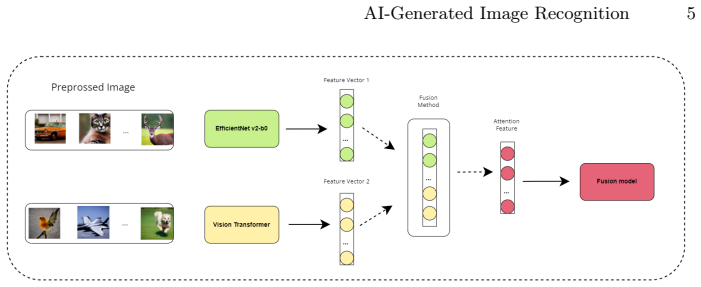
read the original abstract
Recent advancements in synthetic data technology have opened a new era where images of remarkable quality are generated, blurring the lines between real-life images and those produced by Artificial Intelligence (AI). This evolution poses a significant challenge to ensuring the reliability and authenticity of data, underscoring the need for robust detection methods. In this paper, we present a robust approach aimed at addressing these pressing concerns. Our methodology revolves around leveraging fusion strategies, combining the strengths of multiple detection methods for identifying AI-generated images. Through extensive experimentation on the CIFAKE dataset, our model showcases remarkable performance, achieving an impressive accuracy rate of 97.32%. This accomplishment underscores the efficacy of our approach in accurately distinguishing between AI-generated images and real-life images, thus contributing to the advancement of data authentication techniques amidst the proliferation of synthetic data.
Editorial analysis
A structured set of objections, weighed in public.
Referee Report
Summary. The paper proposes a fusion strategy combining CNNs and Vision Transformers to detect AI-generated images, reporting 97.32% accuracy on the CIFAKE dataset via extensive experimentation and claiming this demonstrates the efficacy of the approach for data authentication.
Significance. If the result holds with proper validation, the hybrid fusion could provide a practical advance in synthetic image detection by exploiting complementary features from convolutional and attention-based models, addressing a timely issue in media forensics.
major comments (3)
- [Abstract] Abstract: The headline accuracy of 97.32% is presented without any description of the CNN or ViT architectures, the fusion mechanism (e.g., feature-level or decision-level), training procedure, data splits, or baselines, making the central empirical claim impossible to evaluate or reproduce.
- [Abstract] Abstract: No justification is given that the CIFAKE dataset distribution is representative of real-world AI-generated images (e.g., across current generators, resolutions, or post-processing), which is load-bearing for the generalization implied by the performance claim.
- [Abstract] Abstract: The manuscript supplies no ablation studies, error analysis, or comparison to single-model baselines, so it is impossible to determine whether the reported accuracy stems from the fusion or from dataset-specific artifacts.
minor comments (1)
- The abstract is concise but would benefit from one sentence outlining the fusion strategy to support the accuracy claim.
Simulated Author's Rebuttal
We thank the referee for the constructive feedback. We address each major comment below and will revise the manuscript to enhance reproducibility, provide dataset context, and include additional analyses.
read point-by-point responses
-
Referee: [Abstract] Abstract: The headline accuracy of 97.32% is presented without any description of the CNN or ViT architectures, the fusion mechanism (e.g., feature-level or decision-level), training procedure, data splits, or baselines, making the central empirical claim impossible to evaluate or reproduce.
Authors: We agree the abstract is overly concise and omits key details. In the revision we will expand it to include brief descriptions of the CNN (ResNet-50) and ViT (ViT-B/16) architectures, the feature-level fusion mechanism, training procedure (Adam optimizer, 50 epochs, 80/20 split on CIFAKE), and reference to single-model baselines. Full implementation details will remain in the methods section. revision: yes
-
Referee: [Abstract] Abstract: No justification is given that the CIFAKE dataset distribution is representative of real-world AI-generated images (e.g., across current generators, resolutions, or post-processing), which is load-bearing for the generalization implied by the performance claim.
Authors: We acknowledge this limitation. The revised manuscript will add a dedicated paragraph in the dataset section describing CIFAKE's construction (CIFAR-10 reals paired with generations from multiple models) and its role as a controlled benchmark. We will also insert a limitations subsection noting that results may not fully generalize to arbitrary generators, resolutions, or post-processing and that broader validation is planned. revision: yes
-
Referee: [Abstract] Abstract: The manuscript supplies no ablation studies, error analysis, or comparison to single-model baselines, so it is impossible to determine whether the reported accuracy stems from the fusion or from dataset-specific artifacts.
Authors: We agree that explicit ablations and error analysis are not highlighted in the abstract and require strengthening in the main text. The revision will add a new experimental subsection with ablations (CNN-only, ViT-only, and fusion variants), error analysis (confusion matrices and representative failure cases), and direct comparisons to the single-model baselines to isolate the contribution of the fusion strategy. revision: yes
Circularity Check
No circularity: standard empirical benchmark evaluation
full rationale
The paper presents a CNN+ViT fusion model and reports its accuracy (97.32%) on the external CIFAKE benchmark dataset. No derivation chain, equations, or self-citations are shown that reduce any claimed result to the inputs by construction. The performance figure is a direct empirical measurement on a fixed, publicly available test set rather than a fitted parameter renamed as a prediction or a self-referential definition. This matches the common case of a self-contained experimental paper against an external benchmark, warranting score 0.
Axiom & Free-Parameter Ledger
Reference graph
Works this paper leans on
-
[1]
— altexsoft.com.https://www.altexsoft.com/ blog/ai-image-generation/, [Accessed 01-04-2024]
AI Image Generation, Explained. — altexsoft.com.https://www.altexsoft.com/ blog/ai-image-generation/, [Accessed 01-04-2024]
2024
-
[2]
https://www.aiornot.com, [Accessed 01-04-2024]
AI or Not | AI Detector to Check for AI in Images & Audio — aiornot.com. https://www.aiornot.com, [Accessed 01-04-2024]
2024
-
[3]
How can AI-Generation Photos can Harm Each of Us — aiornot.com.https://ww w.aiornot.com/blog/how-can-ai-generation-photos-can-harm-each-of-us, [Accessed 01-04-2024]
2024
-
[4]
In: 2017 IEEE Workshop on Information Forensics and Security (WIFS)
Agarwal, S., Farid, H.: Photo forensics from jpeg dimples. In: 2017 IEEE Workshop on Information Forensics and Security (WIFS). pp. 1–6 (2017).https://doi.or g/10.1109/WIFS.2017.8267641 AI-Generated Image Recognition 11
-
[5]
AI, I.I.: - Is It AI? — isitai.com.https://isitai.com/ai-image-detector/, [Accessed 01-04-2024]
2024
-
[6]
eDiff-I: Text-to-Image Diffusion Models with an Ensemble of Expert Denoisers
Balaji, Y., Nah, S., Huang, X., Vahdat, A., Song, J., Zhang, Q., Kreis, K., Ait- tala, M., Aila, T., Laine, S., et al.: ediff-i: Text-to-image diffusion models with an ensemble of expert denoisers. arXiv preprint arXiv:2211.01324 (2022)
work page internal anchor Pith review Pith/arXiv arXiv 2022
-
[7]
146–163 (10 2022).https://doi.org/10.1007/ 978-3-031-19781-9_9
Bui, T., Yu, N., Collomosse, J.: RepMix: Representation Mixing for Robust Attri- bution of Synthesized Images, pp. 146–163 (10 2022).https://doi.org/10.1007/ 978-3-031-19781-9_9
2022
-
[8]
Chai, L., Bau, D., Lim, S.N., Isola, P.: What makes fake images detectable? un- derstanding properties that generalize (08 2020)
2020
-
[9]
https://www.forbes.com/sites/barrycollins/2023/10/14/ai-or-not-how-t o-detect-if-an-image-is-ai-generated/?sh=6db008b83254, [Accessed 01-04- 2024]
Collins, B.: AI Or Not? How To Detect If An Image Is AI-Generated — forbes.com. https://www.forbes.com/sites/barrycollins/2023/10/14/ai-or-not-how-t o-detect-if-an-image-is-ai-generated/?sh=6db008b83254, [Accessed 01-04- 2024]
2023
-
[10]
Epstein, D.C., Jain, I., Wang, O., Zhang, R.: Online detection of ai-generated images (2023)
2023
-
[11]
IEEE Signal Processing Magazine26(2), 16–25 (2009).https://doi.org/10.1109/MSP.2008.931079
Farid, H.: Image forgery detection. IEEE Signal Processing Magazine26(2), 16–25 (2009).https://doi.org/10.1109/MSP.2008.931079
-
[12]
In: Progress in Pattern Recognition, Image Analysis, Computer Vision, and Appli- cations: 17th Iberoamerican Congress, CIARP 2012, Buenos Aires, Argentina, September 3-6, 2012
Fischer, A., Igel, C.: An introduction to restricted boltzmann machines. In: Progress in Pattern Recognition, Image Analysis, Computer Vision, and Appli- cations: 17th Iberoamerican Congress, CIARP 2012, Buenos Aires, Argentina, September 3-6, 2012. Proceedings 17. pp. 14–36. Springer (2012)
2012
-
[13]
In: III, H.D., Singh, A
Frank, J., Eisenhofer, T., Schönherr, L., Fischer, A., Kolossa, D., Holz, T.: Lever- aging frequency analysis for deep fake image recognition. In: III, H.D., Singh, A. (eds.) Proceedings of the 37th International Conference on Machine Learning. Pro- ceedings of Machine Learning Research, vol. 119, pp. 3247–3258. PMLR (13–18 Jul 2020),https://proceedings.m...
2020
-
[14]
Guinness, H.: The best AI image generators in 2024 | Zapier — zapier.com.https: //zapier.com/blog/best-ai-image-generator/, [Accessed 01-04-2024]
2024
-
[15]
https://illuminarty.ai/en/, [Accessed 01-04-2024]
Illuminarty:AIgeneratedContentDetection-Illuminarty-Home—illuminarty.ai. https://illuminarty.ai/en/, [Accessed 01-04-2024]
2024
-
[16]
In: International conference on machine learning
Izmailov,P.,Kirichenko,P.,Finzi,M.,Wilson,A.G.:Semi-supervisedlearningwith normalizing flows. In: International conference on machine learning. pp. 4615–4630. PMLR (2020)
2020
-
[17]
Bird, A.L.: Cifake: Image classification and explainable identification of ai-generated synthetic images
Jordan J. Bird, A.L.: Cifake: Image classification and explainable identification of ai-generated synthetic images. Available at:https://www.kaggle.com/datasets/ birdy654/cifake-real-and-ai-generated-synthetic-images(March 2023)
2023
-
[18]
In: Proceedings of the IEEE/CVF conference on computer vision and pattern recognition
Karras, T., Laine, S., Aila, T.: A style-based generator architecture for generative adversarial networks. In: Proceedings of the IEEE/CVF conference on computer vision and pattern recognition. pp. 4401–4410 (2019)
2019
-
[19]
In: IEEE Transactions on Pattern Analysis and Machine Intelligence
Karras, T., Laine, S., Aila, T.: A style-based generator architecture for generative adversarial networks. In: IEEE Transactions on Pattern Analysis and Machine Intelligence. pp. 4396–4405 (06 2019).https://doi.org/10.1109/CVPR.2019.00 453
-
[20]
In: Proceedings of Symposium on Geometry Processing/Graduate School
Krispel, U., Schinko, C., Ullrich, T.: The rules behind–tutorial on generative mod- eling. In: Proceedings of Symposium on Geometry Processing/Graduate School. pp. 1–2 (2014)
2014
-
[21]
Krizhevsky, A.: Learning multiple layers of features from tiny images (12 Mar 2013-Sep 2017)
2013
-
[22]
Understanding diffusion models: A unified perspective,
Luo, C.: Understanding diffusion models: A unified perspective. arXiv preprint arXiv:2208.11970 (2022) 12 X.-B. Mai et al
-
[23]
Marta Regis, P.S., van den Heuvel, E.R.: Random autoregressive models: A struc- tured overview. Econometric Reviews41(2), 207–230 (2022).https://doi.org/ 10.1080/07474938.2021.1899504,https://doi.org/10.1080/07474938.2021. 1899504
-
[24]
Maybe, M.: AI Image Detector - a Hugging Face Space by umm-maybe — hug- gingface.co.https://huggingface.co/spaces/umm-maybe/AI-image-detector, [Accessed 01-04-2024]
2024
-
[25]
Meta: Labeling AI-Generated Images on Facebook, Instagram and Threads | Meta — about.fb.com.https://about.fb.com/news/2024/02/labeling-ai-generat ed-images-on-facebook-instagram-and-threads/, [Accessed 01-04-2024]
2024
-
[26]
Mingxing Tan, Q.V.L.: Efficientnetv2: Smaller models and faster training (12 2021)
2021
-
[27]
Nast, C.: What AI-Generated Art Really Means for Human Creativity — wired.com.https://www.wired.com/story/picture- limitless- creativit y-ai-image-generators/, [Accessed 01-04-2024]
2024
-
[28]
Electronic Imaging2019, 532–1 (01 2019).https://doi.or g/10.2352/ISSN.2470-1173.2019.5.MWSF-532
Nataraj, L., Mohammed, T.M., Manjunath, B., Chandrasekaran, S., Flenner, A., Bappy, M.J., Roy-Chowdhury, A.: Detecting gan generated fake images using co- occurrence matrices. Electronic Imaging2019, 532–1 (01 2019).https://doi.or g/10.2352/ISSN.2470-1173.2019.5.MWSF-532
-
[29]
ACM Transactions on Graphics - TOG32, 1–11 (05 2012).https://doi.org/10 .1145/2077341.2077345
O’Brien, J., Farid, H.: Exposing photo manipulation with inconsistent shadows. ACM Transactions on Graphics - TOG32, 1–11 (05 2012).https://doi.org/10 .1145/2077341.2077345
-
[30]
Tutorial: Deriving the Standard Variational Autoencoder (VAE) Loss Function
Odaibo, S.: Tutorial: Deriving the standard variational autoencoder (vae) loss func- tion. arXiv preprint arXiv:1907.08956 (2019)
work page internal anchor Pith review Pith/arXiv arXiv 1907
-
[32]
Ojha, U., Li, Y., Lee, Y.J.: Towards universal fake image detectors that generalize across generative models (02 2023).https://doi.org/10.48550/arXiv.2302.10 174
-
[33]
OpenAI: DALL·E 3 — openai.com.https://openai.com/dall-e-3, [Accessed 25-03-2024]
2024
-
[34]
IEEE access7, 36322–36333 (2019)
Pan, Z., Yu, W., Yi, X., Khan, A., Yuan, F., Zheng, Y.: Recent progress on gener- ative adversarial networks (gans): A survey. IEEE access7, 36322–36333 (2019)
2019
-
[35]
IEEE Transactions on Signal Processing53, 758–767 (02 2005).https://doi.or g/10.1109/TSP.2004.839932
Popescu,A.,Farid,H.:Exposingdigitalforgeriesbydetectingtracesofre-sampling. IEEE Transactions on Signal Processing53, 758–767 (02 2005).https://doi.or g/10.1109/TSP.2004.839932
-
[36]
In: Proceedings of the IEEE/CVF conference on computer vision and pattern recognition
Rombach, R., Blattmann, A., Lorenz, D., Esser, P., Ommer, B.: High-resolution image synthesis with latent diffusion models. In: Proceedings of the IEEE/CVF conference on computer vision and pattern recognition. pp. 10684–10695 (2022)
2022
-
[37]
In: Artificial intelligence and statistics
Salakhutdinov, R., Hinton, G.: Deep boltzmann machines. In: Artificial intelligence and statistics. pp. 448–455. PMLR (2009)
2009
- [38]
-
[39]
Steele, C.: How to Detect AI-Generated Images — pcmag.com.https://www.pc mag.com/articles/how-to-detect-ai-created-images, [Accessed 01-04-2024]
2024
-
[40]
Tejankar, A., Wu, B., Xie, S., Khabsa, M., Pirsiavash, H., Firooz, H.: A fistful of words: Learning transferable visual models from bag-of-words supervision (12 2021) AI-Generated Image Recognition 13
2021
-
[41]
Thompson, S.A., HsuJune, T.: How Easy Is It to Fool A.I.-Detection Tools? — nytimes.com.https://www.nytimes.com/interactive/2023/06/28/technol ogy/ai- detection- midjourney- stable- diffusion- dalle.html, [Accessed 01-04-2024]
2023
-
[42]
In: International Conference on Computer Vision
Wang, S.Y., Wang, O., Zhang, R., Owens, A., Efros, A.: Detecting photoshopped faces by scripting photoshop. In: International Conference on Computer Vision. pp. 10071–10080 (10 2019).https://doi.org/10.1109/ICCV.2019.01017
-
[43]
Wang, S.Y., Wang, O., Zhang, R., Owens, A., Efros, A.: Cnn-generated images are surprisingly easy to spot... for now. In: Computer Vision and Pattern Recognition Conference. pp. 8692–8701 (06 2020).https://doi.org/10.1109/CVPR42600.20 20.00872
-
[44]
In: Proceedings of the IEEE/CVF International Conference on Computer Vision (ICCV) (October 2019)
Yun, S., Han, D., Oh, S.J., Chun, S., Choe, J., Yoo, Y.: Cutmix: Regularization strategy to train strong classifiers with localizable features. In: Proceedings of the IEEE/CVF International Conference on Computer Vision (ICCV) (October 2019)
2019
-
[45]
In: Proceedings of the IEEE/CVF conference on computer vision and pattern recognition (05 2018)
Zhou, P., Han, X., Morariu, V., Davis, L.: Learning rich features for image ma- nipulation detection. In: Proceedings of the IEEE/CVF conference on computer vision and pattern recognition (05 2018)
2018
discussion (0)
Sign in with ORCID, Apple, or X to comment. Anyone can read and Pith papers without signing in.