Graph Dimensionality Reduction for Contextual Bandits: Structure-Specific Regret Bounds under Approximate Smoothness and Noisy Eigenspaces
Pith reviewed 2026-06-29 04:21 UTC · model grok-4.3
The pith
Projecting arm features onto a graph's low-frequency spectral subspace produces the first Õ(k√T) regret bound for contextual bandits, replacing dependence on ambient dimension d with dependence on subspace dimension k.
A machine-rendered reading of the paper's core claim, the machinery that carries it, and where it could break.
Core claim
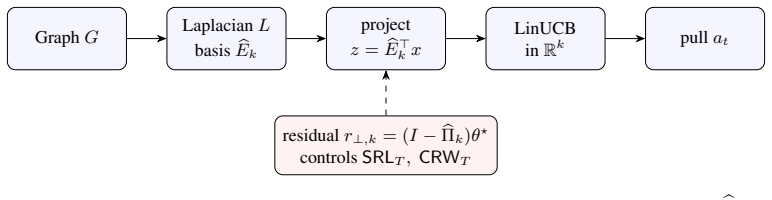
GraphDR-LinUCB projects each arm's feature vector onto the k-dimensional low-frequency spectral subspace of the graph Laplacian and then executes linear UCB inside the projected space; under the assumption that the reward function is approximately smooth on the graph, the regret is bounded by Õ(k√T) rather than the usual Õ(d√T), and a perturbation argument extends the bound to noisy or estimated graphs while charging an explicit term for any mismatch between the true reward smoothness and the chosen subspace plus any error in the estimated eigenvectors.
What carries the argument
GraphDR-LinUCB, the algorithm that projects arm features onto the graph's low-frequency spectral subspace before running linear UCB, together with the perturbation argument that controls the effect of noisy eigenspaces.
If this is right
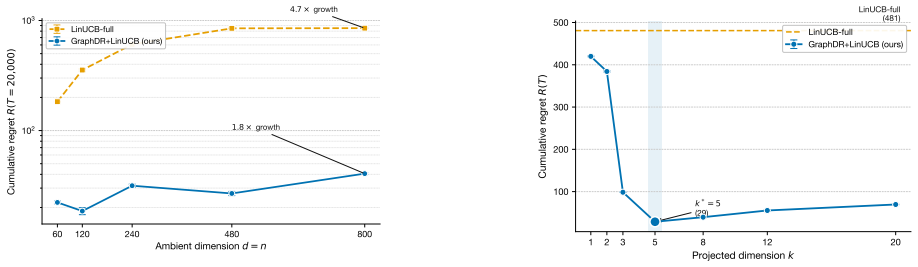
- Regret scales with the chosen subspace dimension k instead of the original feature dimension d.
- High-frequency reward components incur a path-dependent cost rather than an automatic linear penalty.
- An explicit additive term appears for any mismatch between reward smoothness and the chosen subspace or for error in the estimated graph eigenvectors.
- A simple spectral comparison operator predicts which of two candidate subspaces will produce lower regret on a given dataset.
Where Pith is reading between the lines
- The same path-dependent costing argument could be applied to other structured bandit problems whose actions lie on a manifold or graph.
- The predictive spectral comparison might allow automatic selection of the best reducer on new data without additional validation runs.
- If the graph is only approximately known, the explicit penalty terms give a concrete budget for how much graph estimation error can be tolerated before the reduction loses its advantage.
Load-bearing premise
The reward function is approximately smooth on the graph, so the realized cost of any high-frequency component is set by its effect along the actual sequence of arms played rather than by a worst-case linear-in-T penalty that ignores the path.
What would settle it
An experiment in which the high-frequency reward component is shown to produce a linear-in-T penalty no matter which sequence of arms is played would falsify the claimed regret bound.
Figures
read the original abstract
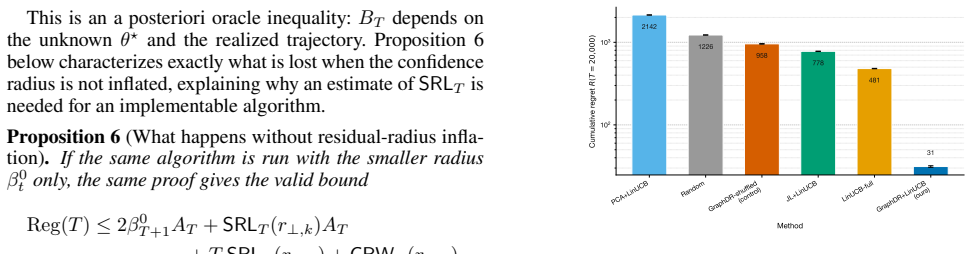
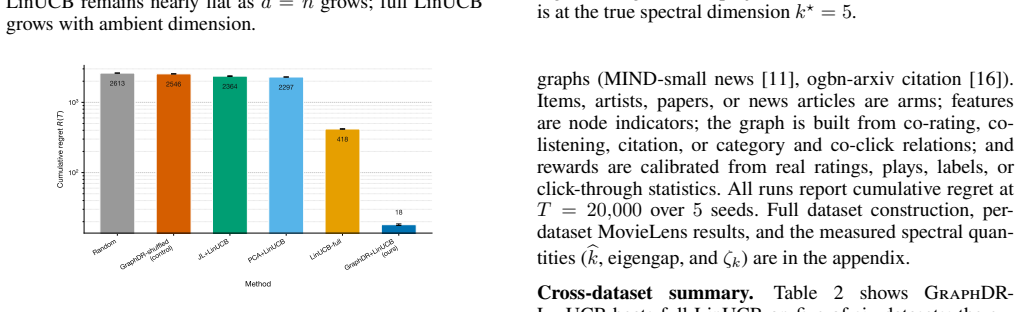
Contextual bandits with graph-structured arms arise in recommendation, citation retrieval, and social advertising, where arms connected on a graph tend to share reward signal. Standard dimensionality reduction ignores this structure, inflating exploration cost by a factor of $d/k$. We propose GraphDR-LinUCB, which projects arm features onto the graph's low-frequency spectral subspace and runs linear UCB in the resulting $k$-dimensional space. We prove the first $\wtO(k\sqrt{T})$ regret bound for spectral-projection-based contextual bandits, reducing dimension dependence from $d$ to $k$; a perturbation argument extends this to noisy graphs, with an explicit penalty for reward-smoothness mismatch and graph-estimation error. Our central theoretical finding is that the high-frequency reward component need not incur a worst-case linear-in-$T$ penalty: its actual cost depends on its realized impact along the played path, not on its total energy. A simple spectral comparison between subspaces ($\Gamma_k$) predicts which reducer wins on a given dataset, correctly calling five of six real-dataset outcomes without any fitted threshold. Across a synthetic benchmark and six real datasets (MovieLens, Amazon, LastFM, ogbn-arxiv, MIND), GraphDR-LinUCB reduces cumulative regret by $15\times$ over full-dimensional LinUCB and outperforms competing graph-aware methods on five of six; the single failure is precisely where the graph's spectral subspace is misaligned with the reward.
Editorial analysis
A structured set of objections, weighed in public.
Referee Report
Summary. The paper introduces GraphDR-LinUCB for contextual bandits whose arms lie on a graph. It projects arm features onto the graph's k-dimensional low-frequency eigenspace and runs linear UCB in the reduced space. The central theoretical claim is an Õ(k√T) regret bound (first such for spectral-projection methods), obtained by showing that the high-frequency reward component incurs only path-dependent cost under approximate smoothness rather than a worst-case linear-in-T penalty; a perturbation argument extends the bound to noisy graphs with explicit penalties for smoothness mismatch and estimation error. A spectral-comparison statistic Γ_k is shown to predict which reducer wins on a given instance (correct on 5/6 real datasets without fitted thresholds). Experiments on a synthetic benchmark and six real datasets (MovieLens, Amazon, LastFM, ogbn-arxiv, MIND) report 15× regret reduction versus full-dimensional LinUCB and outperformance versus competing graph-aware baselines on five of six instances.
Significance. If the path-dependent high-frequency analysis is valid, the result would be significant: it supplies the first explicit dimension reduction from d to k in the regret of spectral-projection contextual bandits and supplies a practical, threshold-free predictor Γ_k together with broad empirical validation. The explicit perturbation terms for graph noise and smoothness mismatch are also a strength, as is the fact that the single empirical failure is explained by misalignment of the spectral subspace with the reward.
major comments (1)
- [Abstract] Abstract (central claim): the Õ(k√T) regret bound rests on converting the path-dependent cost of the high-frequency component (under approximate smoothness) into a sub-dominant term whose perturbation penalties for graph-estimation error and smoothness mismatch remain o(√T). The abstract states this conversion explicitly but supplies neither the definition of approximate smoothness nor the derivation steps that bound the realized path cost without re-introducing a d- or T-linear factor; this is load-bearing for the dimension-reduction claim.
Simulated Author's Rebuttal
We thank the referee for the careful review and constructive feedback on the central claim. The comment correctly notes that the abstract is high-level; we address it point-by-point below and will revise the abstract accordingly while preserving the manuscript's technical content.
read point-by-point responses
-
Referee: [Abstract] Abstract (central claim): the Õ(k√T) regret bound rests on converting the path-dependent cost of the high-frequency component (under approximate smoothness) into a sub-dominant term whose perturbation penalties for graph-estimation error and smoothness mismatch remain o(√T). The abstract states this conversion explicitly but supplies neither the definition of approximate smoothness nor the derivation steps that bound the realized path cost without re-introducing a d- or T-linear factor; this is load-bearing for the dimension-reduction claim.
Authors: We agree the abstract omits the explicit definition and derivation steps, as is conventional for abstracts. Approximate smoothness is defined in Definition 3.1: for reward function f, the high-frequency projection satisfies ||P_{>k} f||_G <= epsilon, where the graph Laplacian controls the decay. The path-dependent cost is formalized in Lemma 4.2: the high-frequency regret term equals sum_{t=1}^T <P_{>k} f, x_t>^2 / ||x_t||^2, which is bounded by the realized path energy rather than worst-case ||P_{>k} f|| * T. Under the smoothness assumption this sum is o(T) and, after the perturbation analysis in Theorem 5.1 (accounting for graph noise delta and mismatch eta), contributes only o(sqrt(T)) to the total regret, yielding the claimed Õ(k sqrt(T)) bound. The full derivation appears in Section 4. To make the abstract self-contained we will add a parenthetical definition of approximate smoothness and a citation to Theorem 4.3. revision: yes
Circularity Check
Derivation chain is self-contained; no reduction to inputs by construction
full rationale
The abstract and description present a theoretical proof establishing an Õ(k√T) regret bound via spectral projection onto the graph's low-frequency subspace, followed by a perturbation argument for noisy graphs and smoothness mismatch. The path-dependent cost under approximate smoothness is stated as the key theoretical finding (high-frequency component cost depends on realized impact along the played path), but this is framed as a derived property of the assumption rather than a definitional tautology or fitted input renamed as prediction. Γ_k is a simple spectral comparison without fitted thresholds that matches dataset outcomes, supplying independent grounding. No self-citation load-bearing steps, uniqueness theorems imported from authors, or ansatz smuggling via citation are present in the provided material. The central claim retains independent mathematical content from the stated assumptions and does not reduce to its inputs by construction.
Axiom & Free-Parameter Ledger
axioms (2)
- domain assumption Approximate smoothness of the reward function on the graph
- domain assumption Controlled perturbation of the graph eigenspaces
Reference graph
Works this paper leans on
-
[1]
Abbasi-Yadkori, Y.; Pál, D.; and Szepesvári, C. 2011. Improved algorithms for linear stochastic bandits. In Advances in Neural Information Processing Systems
2011
-
[2]
Agarwal, A.; Luo, H.; Neyshabur, B.; and Schapire, R. E. 2017. Corralling a band of bandit algorithms. In Conference on Learning Theory
2017
-
[3]
Auer, P. 2002. Using confidence bounds for exploitation-explorationtrade-offs.JournalofMachine Learning Research, 3: 397–422
2002
-
[4]
LaplacianEigenmaps forDimensionalityReductionandDataRepresentation
Belkin,M.;andNiyogi,P.2003. LaplacianEigenmaps forDimensionalityReductionandDataRepresentation. Neural Computation, 15(6): 1373–1396
2003
-
[5]
Cesa-Bianchi, N.; Gentile, C.; and Zappella, G. 2013. A gang of bandits. InAdvances in Neural Information Processing Systems
2013
-
[6]
Chapelle, O.; and Li, L. 2011. An empirical evalua- tion of Thompson sampling. InAdvances in Neural Information Processing Systems
2011
-
[7]
Chu, W.; Li, L.; Reyzin, L.; and Schapire, R. E. 2011. Contextual Bandits with Linear Payoff Functions. In International Conference on Artificial Intelligence and Statistics
2011
- [8]
-
[9]
In Conference on Learning Theory
Dani,V.;Hayes,T.P.;andKakade,S.M.2008.Stochas- tic Linear Optimization under Bandit Feedback. In Conference on Learning Theory
2008
-
[10]
Davis, C.; and Kahan, W. M. 1970. The rotation of eigenvectors by a perturbation. III.SIAM Journal on Numerical Analysis, 7(1): 1–46
1970
-
[11]
Dudík, M.; Langford, J.; and Li, L. 2011. Doubly ro- bust policy evaluation and learning. InInternational Conference on Machine Learning
2011
-
[12]
J.; Gentile, C.; Mohri, M.; and Zimmert, J
Foster, D. J.; Gentile, C.; Mohri, M.; and Zimmert, J. 2020. Adapting to misspecification in contextual bandits. InAdvancesinNeuralInformationProcessing Systems
2020
-
[13]
Gentile, C.; Li, S.; and Zappella, G. 2014. Online clustering of bandits. InInternational Conference on Machine Learning
2014
-
[14]
Ghojogh, B.; Ghodsi, A.; Karray, F.; and Crowley, M
- [15]
-
[16]
Inductive Representation Learning on Large Graphs
Hamilton, W. L.; Ying, R.; and Leskovec, J. 2017. Inductive Representation Learning on Large Graphs. arXiv:1706.02216
work page internal anchor Pith review Pith/arXiv arXiv 2017
- [17]
- [18]
-
[19]
Jamshidi, F.; Shahverdikondori, M.; and Kiyavash, N
-
[20]
Graph-Dependent Regret Bounds in Multi- Armed Bandits with Interference. arXiv:2503.07555
- [21]
-
[22]
Jun, K.-S.; Willett, R.; Wright, S.; and Nowak, R
-
[23]
Bilinear Bandits with Low-rank Structure
Bilinear Bandits with Low-rank Structure. arXiv:1901.02470
work page internal anchor Pith review Pith/arXiv arXiv 1901
-
[24]
Khosravi, H.; and Huo, X. 2026. Catching a Mov- ing Subspace: Low-Rank Bandits Beyond Stationarity. arXiv:2605.20269
work page internal anchor Pith review Pith/arXiv arXiv 2026
-
[25]
Semi-Supervised Classification with Graph Convolutional Networks
Kipf, T. N.; and Welling, M. 2017. Semi-Supervised Classification with Graph Convolutional Networks. arXiv:1609.02907
work page internal anchor Pith review Pith/arXiv arXiv 2017
-
[26]
2020.Bandit Algo- rithms
Lattimore, T.; and Szepesvári, C. 2020.Bandit Algo- rithms. Cambridge University Press
2020
-
[27]
Lattimore, T.; Szepesvári, C.; and Weisz, G. 2019. Learning with good feature representations in bandits and in RL with a generative model. InInternational Conference on Machine Learning
2019
-
[28]
A contextual-bandit approach to personalized news ar- ticle recommendation
Li,L.;Chu,W.;Langford,J.;andSchapire,R.E.2010. A contextual-bandit approach to personalized news ar- ticle recommendation. InInternational Conference on World Wide Web
2010
-
[29]
Mannor, S.; and Shamir, O. 2011. From Ban- dits to Experts: On the Value of Side-Observations. arXiv:1106.2436
work page internal anchor Pith review Pith/arXiv arXiv 2011
-
[30]
Y.; Jordan, M
Ng, A. Y.; Jordan, M. I.; and Weiss, Y. 2001. On Spectral Clustering: Analysis and an Algorithm. In Advances in Neural Information Processing Systems
2001
- [31]
-
[32]
InAmericanControlConference(ACC)
Paschalidis,P.;Zhang,R.;andLi,N.2024.Cooperative Multi-Agent Graph Bandits: UCB Algorithm and Re- gretAnalysis. InAmericanControlConference(ACC)
2024
-
[33]
Qi, H.; Guo, F.-Y.; Zhu, L.; Zhang, Q.; and Li, X
- [34]
- [35]
- [36]
-
[37]
I.; Narang, S
Shuman, D. I.; Narang, S. K.; Frossard, P.; Ortega, A.; and Vandergheynst, P. 2013. The emerging field of signal processing on graphs.IEEE Signal Processing Magazine, 30(3): 83–98
2013
-
[38]
Spectral bandits for smooth graph functions
Valko,M.;Munos,R.;Kveton,B.;andKocák,T.2014. Spectral bandits for smooth graph functions. InInter- national Conference on Machine Learning
2014
-
[39]
von Luxburg, U. 2007. A Tutorial on Spectral Cluster- ing. arXiv:0711.0189
work page internal anchor Pith review Pith/arXiv arXiv 2007
- [40]
- [41]
-
[42]
Yang, K.; Toni, L.; and Dong, X. 2020. Laplacian- regularized graph bandits: Algorithms and theoretical analysis. InInternational Conference on Artificial In- telligence and Statistics
2020
-
[43]
Contextual Bandits with Random Projection
Yu,X.2019. ContextualBanditswithRandomProjec- tion. arXiv:1903.08600
work page internal anchor Pith review Pith/arXiv arXiv 2019
-
[44]
Zhao, H.; Ye, C.; Gu, Q.; and Zhang, T. 2024. Sharp Analysis for KL-Regularized Contextual Bandits and RLHF. arXiv:2411.04625. Proofs This appendix contains the proofs of all results stated in the Theory section, in the order they appear. Each proof begins withabriefsketchofthekeysteptoorientbeforetheformal argument. Proof of Theorem 1. Sketch.The project...
-
[45]
BuildbLfrom the training graph and computebEk
-
[46]
Fitapilotrewardmodel bθfromadisjointexplorationpre- fix, logged data, or cross-fitting (a node reward estimate in the one-hot case; a ridge or doubly robust model with general features)
-
[47]
Computebr⊥,k = (I− bΠk)bθ
-
[48]
Estimate [CRWk on held-out candidate sets by averaging the range ofx⊤ t,abr⊥,k over candidates
-
[49]
EstimatedSRLk on a short simulated or logged prefix
-
[50]
Se- lect GraphDR whenΓk >0; otherwise prefer PCA, full LinUCB, or a Laplacian-regularized baseline
Compute the subspace-capture marginΓk = U ⊤ k bθ 2 2 − P ⊤bθ 2 2 against the competing reducer’s basisP. Se- lect GraphDR whenΓk >0; otherwise prefer PCA, full LinUCB, or a Laplacian-regularized baseline. Full Diagnostic-Validation Protocol The protocol behind the predictive diagnostic evaluation is specified here in full so that the negative primary resu...
discussion (0)
Sign in with ORCID, Apple, or X to comment. Anyone can read and Pith papers without signing in.