Decoys Cannot Go Everywhere: Mapping the Deception Surface in MITRE ATT&CK
Pith reviewed 2026-06-29 04:01 UTC · model grok-4.3
The pith
Only 32% of MITRE ATT&CK techniques allow a reachable defender decoy.
A machine-rendered reading of the paper's core claim, the machinery that carries it, and where it could break.
Core claim
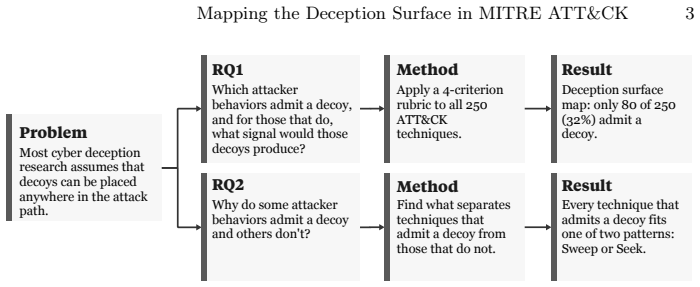
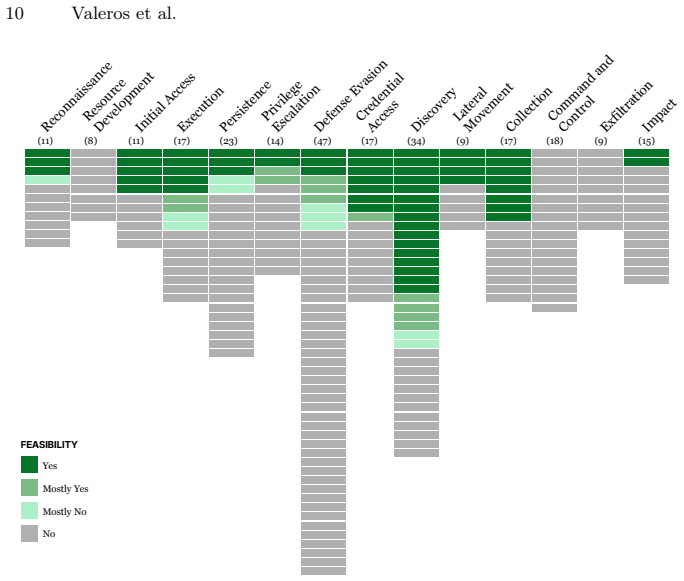
The deception surface is sparse: only 80 techniques (32%) admit a decoy the attacker could plausibly reach. For the remaining 170 techniques, there is no defender-controlled asset in the attacker's path that can be fabricated as a decoy. Decoy placement across those 80 techniques falls into two patterns called Sweep, where the attacker moves broadly through assets, and Seek, where the attacker looks for a specific kind of asset.
What carries the argument
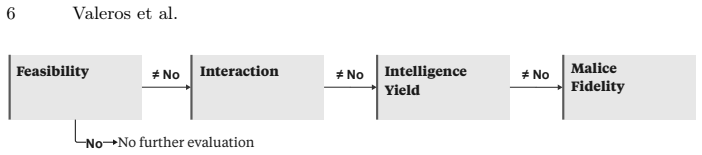
The four-criterion rubric for infrastructure deception that checks placement feasibility, attacker interaction likelihood, intelligence value, and malice indication.
If this is right
- Decoy placement must follow either a sweep path or imitation of a sought asset.
- Infrastructure decoys cannot cover most attacker techniques in ATT&CK.
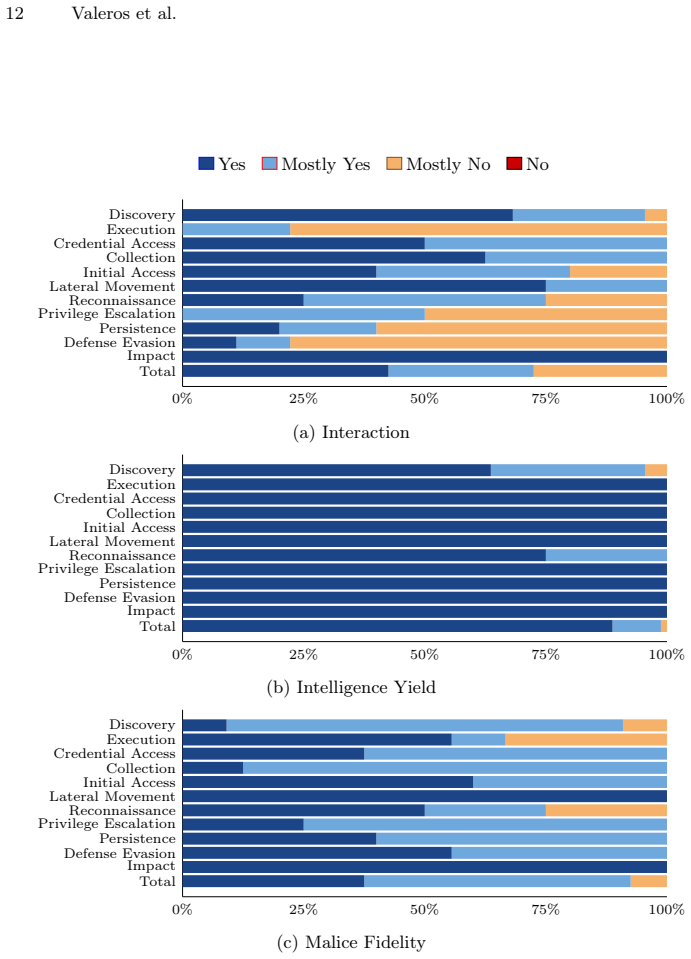
- Intelligence potential from decoys is usually present but interaction likelihood and malice indication vary across techniques.
- The released rubric, decision rules, and per-technique assessments provide a baseline for future deception work.
Where Pith is reading between the lines
- Defenders should concentrate limited resources on the 80 feasible techniques instead of pursuing broad coverage.
- The identified sparsity may account for why deception tools see limited real-world use against diverse attacks.
- Applying the same rubric to other attack frameworks could show whether the 32% limit is specific to ATT&CK or more general.
Load-bearing premise
The four criteria correctly identify when a defender-controlled decoy is feasible and the authors' judgments about attacker behavior and defender capabilities are accurate.
What would settle it
An observed attacker interaction with a fabricated decoy in one of the 170 techniques the rubric classifies as having no reachable defender asset.
Figures
read the original abstract
Cyber deception research often assumes that a decoy can be placed wherever there is attacker behavior. This work tests that assumption across MITRE ATT&CK v18.1. We introduce a four-criterion rubric for infrastructure deception and apply it to all 250 ATT&CK techniques. The rubric evaluates whether a defender-controlled decoy can be placed, whether an attacker is likely to interact with it, what intelligence that interaction can yield, and whether the interaction reliably indicates malice. The resulting deception surface is sparse: only 80 techniques (32%) admit a decoy the attacker could plausibly reach. For the remaining 170 techniques, there is no defender-controlled asset in the attacker's path that can be fabricated as a decoy. Decoy placement across those 80 techniques falls into two patterns we call Sweep and Seek. In Sweep, the attacker moves broadly through assets in range and encounters the decoy as part of that activity. In Seek, the attacker looks for a specific kind of asset and interacts with a fabricated version of it. These patterns give a simple placement rule: a decoy must either sit on a sweep path or imitate a sought asset. We also show that decoys usually have useful intelligence potential, but whether an attacker interacts with them at all, and whether that interaction reliably indicates malice, both vary. We release the rubric, decision rules, and per-technique assessment as an auditable baseline for future deception research and deployment planning, and show that infrastructure decoys cannot be assumed to apply to all attacker behavior.
Editorial analysis
A structured set of objections, weighed in public.
Referee Report
Summary. The manuscript applies a four-criterion rubric (defender-controlled asset, plausible attacker interaction, intelligence yield, reliable malice indication) to all 250 MITRE ATT&CK v18.1 techniques. It concludes that only 80 techniques (32%) admit a reachable decoy, with the remaining 170 having no defender-controlled asset in the attacker's path. The feasible cases fall into two placement patterns (Sweep: decoy encountered during broad asset traversal; Seek: decoy imitates a specifically sought asset), and the full rubric, decision rules, and per-technique assessments are released as an auditable artifact.
Significance. If the rubric judgments hold, the work supplies an empirical baseline showing that infrastructure deception is not universally applicable across ATT&CK, directly challenging a common assumption in cyber-deception research. The public release of the complete decision rules and assessments is a clear strength, enabling external verification and reuse as a reference for deployment planning and future studies.
major comments (1)
- [Rubric definition and results section] The 80/170 split and the two placement patterns rest entirely on the authors' application of the four rubric criteria to each technique. The manuscript should explicitly describe the assessment process (single author, multiple raters, resolution of edge cases) in the section presenting the rubric and results, as subjective elements in criteria such as 'likely to interact' and 'reliably indicates malice' directly affect the central claim.
minor comments (2)
- [Placement patterns discussion] Provide counts or a breakdown of how many of the 80 techniques fall into Sweep versus Seek to make the pattern claim more quantitative.
- [Abstract] Ensure the abstract states that the per-technique assessments are released, to match the body text and improve standalone readability.
Simulated Author's Rebuttal
We thank the referee for the constructive comment and the recommendation of minor revision. We address the point below.
read point-by-point responses
-
Referee: [Rubric definition and results section] The 80/170 split and the two placement patterns rest entirely on the authors' application of the four rubric criteria to each technique. The manuscript should explicitly describe the assessment process (single author, multiple raters, resolution of edge cases) in the section presenting the rubric and results, as subjective elements in criteria such as 'likely to interact' and 'reliably indicates malice' directly affect the central claim.
Authors: We agree that the assessment process must be described explicitly because the central claims depend on the application of criteria that contain subjective elements. The rubric was applied by the lead author through systematic review of each of the 250 techniques against the four criteria and the ATT&CK documentation; edge cases and borderline judgments (particularly on 'likely to interact' and 'reliably indicates malice') were then discussed by the full author team until consensus was reached, with final decisions recorded in the released artifact. We will insert a new paragraph in the Rubric Definition and Results section that states this process, notes the absence of formal inter-rater reliability statistics, and explains how the released per-technique assessments allow external verification. revision: yes
Circularity Check
No significant circularity
full rationale
The paper defines an explicit four-criterion rubric for infrastructure deception and applies it exhaustively to all 250 ATT&CK techniques, releasing the full decision rules and per-technique assessments as an auditable artifact. The resulting 80/170 split follows directly from this classification process using an external framework (MITRE ATT&CK v18.1) and newly stated criteria; no step reduces by construction to a fitted parameter, self-referential definition, or self-citation chain. The two placement patterns (Sweep/Seek) are derived as an observational summary of the rubric outcomes rather than an input. The derivation is self-contained against external benchmarks with no load-bearing internal reductions.
Axiom & Free-Parameter Ledger
axioms (2)
- domain assumption MITRE ATT&CK v18.1 provides a complete enumeration of relevant attacker techniques.
- ad hoc to paper The four criteria of the rubric are sufficient and appropriate for determining decoy feasibility.
Reference graph
Works this paper leans on
-
[1]
In: 2022 Winter Simulation Conference (WSC)
Al Amin, M.A.R., Shetty, S., Kamhoua, C.: Cyber Deception Metrics For Inter- connected Complex Systems. In: 2022 Winter Simulation Conference (WSC). pp. 473–483 (2022).https://doi.org/10.1109/WSC57314.2022.10015347
-
[2]
Al-Sada, B., Sadighian, A., Oligeri, G.: MITRE ATT&CK: State of the Art and Way Forward. ACM Comput. Surv.57(1), 12:1–12:37 (2024).https://doi.org/ 10.1145/3687300
-
[3]
Anwar, A.H., Kamhoua, C.A., Leslie, N.O., Kiekintveld, C.: Honeypot Alloca- tion for Cyber Deception Under Uncertainty. IEEE Transactions on Network and Service Management19(3), 3438–3452 (2022).https://doi.org/10.1109/TNSM. 2022.3179965
-
[4]
IEEE Communications Sur- veys & Tutorials pp
Beltrán-López, P., Pérez, M.G., Nespoli, P.: Cyber Deception: Taxonomy, State of the Art, Frameworks, Trends, and Open Challenges. IEEE Communications Sur- veys & Tutorials pp. 1–1 (2025).https://doi.org/10.1109/COMST.2025.3594788
-
[5]
USENIX Conference p
Bill Cheswick: An Evening with Berferd In Which a Cracker is Lured, Endured, and Studied. USENIX Conference p. 11 (1992) Mapping the Deception Surface in MITRE ATT&CK 17
1992
-
[6]
Bridges, R.A., Mitchell, T.R., Muñoz, M., Henriksson, T.: SoK: Honeypots & LLMs, More Than the Sum of Their Parts? (2025).https://doi.org/10.48550/ arXiv.2510.25939
Pith/arXiv arXiv 2025
-
[7]
Chouhan, P., Aujla, G.: Deception Technology for Active Defence: Background and Opportunities (2024).https://doi.org/10.1109/ICCWorkshops59551.2024. 10615759
-
[8]
In: 2025 5th Intel- ligent Cybersecurity Conference (ICSC)
Chouhan, P.K., Colombo, M., Asal, R., Cui, Z.: CATCH: A Tool to Automatic Deploy Decoys and Breadcrumbs Based on Network Analysis. In: 2025 5th Intel- ligent Cybersecurity Conference (ICSC). pp. 147–154 (2025).https://doi.org/ 10.1109/ICSC65596.2025.11140200
-
[9]
Clifford Stoll: Stalking the wily hacker. Commun. ACM31(5), 484–497 (1988). https://doi.org/10.1145/42411.42412
-
[10]
IEEE Communications Surveys & Tutorials23(4), 2351–2383 (2021)
Franco, J., Aris, A., Canberk, B., Uluagac, A.S.: A Survey of Honeypots and Hon- eynets for Internet of Things, Industrial Internet of Things, and Cyber-Physical Systems. IEEE Communications Surveys & Tutorials23(4), 2351–2383 (2021). https://doi.org/10.1109/COMST.2021.3106669
-
[11]
Han, X., Kheir, N., Balzarotti, D.: Deception Techniques in Computer Security: A Research Perspective. ACM Comput. Surv.51(4), 80:1–80:36 (2018).https: //doi.org/10.1145/3214305
-
[12]
Communication Methods and Measures1(1), 77–89 (Apr 2007).https://doi.org/10.1080/19312450709336664
Hayes, A.F., Krippendorff, K.: Answering the Call for a Standard Reliability Mea- sure for Coding Data. Communication Methods and Measures1(1), 77–89 (Apr 2007).https://doi.org/10.1080/19312450709336664
-
[13]
dtic.mil/sti/html/tr/ADA002169/
Hollingworth, D.: Enhancing Computer System Security (1973),https://apps. dtic.mil/sti/html/tr/ADA002169/
1973
-
[14]
Kahlhofer, M., Rass, S.: Application Layer Cyber Deception without Developer Interaction (2024),http://arxiv.org/abs/2405.12852
arXiv 2024
-
[15]
Kohnfelder, L., Garg, P.: The threats to our products. Tech. rep., Mi- crosoft Corporation (1999),https://shostack.org/files/microsoft/ The-Threats-To-Our-Products.docx
1999
-
[16]
IEEE Security & Privacy4(6), 85–89 (2006)
Mell, P., Scarfone, K., Romanosky, S.: Common vulnerability scoring system. IEEE Security & Privacy4(6), 85–89 (2006)
2006
-
[17]
MITRE Corporation: MITRE ATT&CK.https://attack.mitre.org/(2024)
2024
-
[18]
MITRE Corporation: MITRE D3FEND.https://d3fend.mitre.org/(2024)
2024
-
[19]
MITRE Corporation: MITRE Engage.https://engage.mitre.org/(2024)
2024
-
[20]
Mongardini, A.M., Cordeiro, A., Elzer, K., Giacometti, I., Maddaloni, D., Safar- galieva, A., Yaben, R., Vasilomanolakis, E.: A Systematic Meta-Survey of Cyber Deception: Unified Taxonomy and Research Directions (2026).https://doi.org/ 10.36227/techrxiv.176800929.95140503/v1
-
[21]
Pittman, J.M., Hoffpauir, K., Markle, N., Meadows, C.: A Taxonomy for Dynamic Honeypot Measures of Effectiveness (2020).https://doi.org/10.48550/arXiv. 2005.12969
work page internal anchor Pith review doi:10.48550/arxiv 2020
-
[22]
In: Annual Computer Security Applications Conference
Sajid, M.S.I., Wei, J., Abdeen, B., Al-Shaer, E., Islam, M.M., Diong, W., Khan, L.: SODA: A System for Cyber Deception Orchestration and Automation. In: Annual Computer Security Applications Conference. pp. 675–689. ACM, Virtual Event USA (2021).https://doi.org/10.1145/3485832.3485918
-
[23]
In: Fu, J., Kroupa, T., Hayel, Y
Sayed, M.A., Anwar, A.H., Kiekintveld, C., Kamhoua, C.: Honeypot Allocation for Cyber Deception in Dynamic Tactical Networks: A Game Theoretic Approach. In: Fu, J., Kroupa, T., Hayel, Y. (eds.) Decision and Game Theory for Security. pp. 195–214. Springer Nature Switzerland, Cham (2023).https://doi.org/10. 1007/978-3-031-50670-3_10 18 Valeros et al
2023
-
[24]
In: 2025 IEEE European Symposium on Security and Privacy Workshops (EuroS&PW)
Sladić, M., Valeros, V., Catania, C., Garcia, S.: VelLMes: A high-interaction AI- based deception framework. In: 2025 IEEE European Symposium on Security and Privacy Workshops (EuroS&PW). pp. 671–679 (2025).https://doi.org/10. 1109/EuroSPW67616.2025.00082
arXiv 2025
-
[25]
In: Proceedings of the 8th International Conference on Security of Information and Networks
Vasilomanolakis, E., Karuppayah, S., Kikiras, P., Mühlhäuser, M.: A honeypot- driven cyber incident monitor: lessons learned and steps ahead. In: Proceedings of the 8th International Conference on Security of Information and Networks. pp. 158–164. SIN ’15, Association for Computing Machinery, New York, NY, USA (2015).https://doi.org/10.1145/2799979.2799999
-
[26]
Computers & Security148, 104144 (2025).https://doi.org/10.1016/j.cose.2024.104144
Zambianco, M., Facchinetti, C., Siracusa, D.: A Proactive Decoy Selection Scheme for Cyber Deception using MITRE ATT&CK. Computers & Security148, 104144 (2025).https://doi.org/10.1016/j.cose.2024.104144
-
[27]
Zhang, L., Thing, V.: Three decades of deception techniques in active cyber defense - Retrospect and outlook. Computers & Security106, 102288 (2021).https:// doi.org/10.1016/j.cose.2021.102288 A Asset Inventory and Decoy-Targetable Assets Thisappendixlistsexampleclientassettypesidentifiedduringtechniquescoring, along with example decoys and example attack...
discussion (0)
Sign in with ORCID, Apple, or X to comment. Anyone can read and Pith papers without signing in.