Competing spin-1 and spin-2 regimes in a frustrated four-leg spin-1/2 ladder
Pith reviewed 2026-06-29 02:40 UTC · model grok-4.3
The pith
A frustrated four-leg spin-1/2 ladder realizes three regimes including an effective spin-2 Heisenberg chain confirmed by string order and edge excitations.
A machine-rendered reading of the paper's core claim, the machinery that carries it, and where it could break.
Core claim
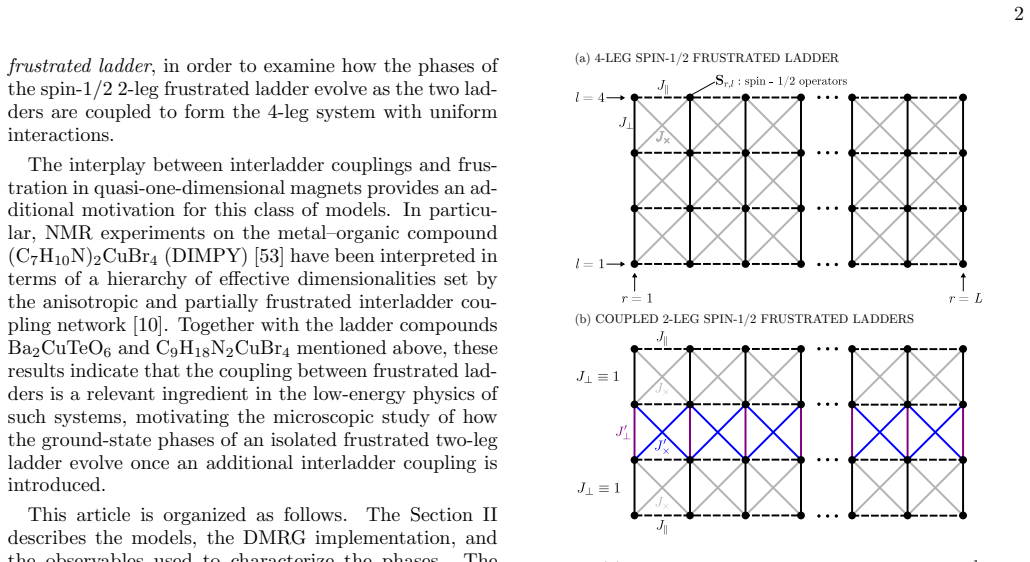
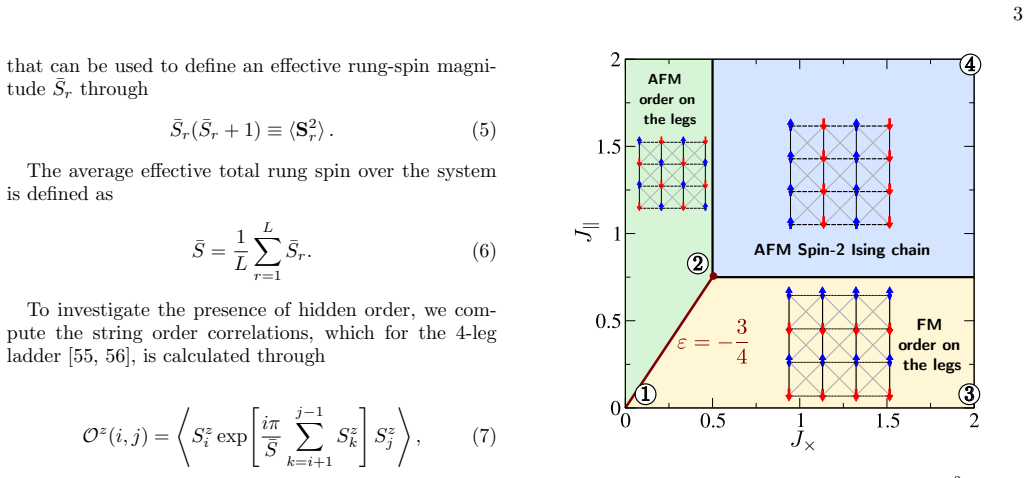
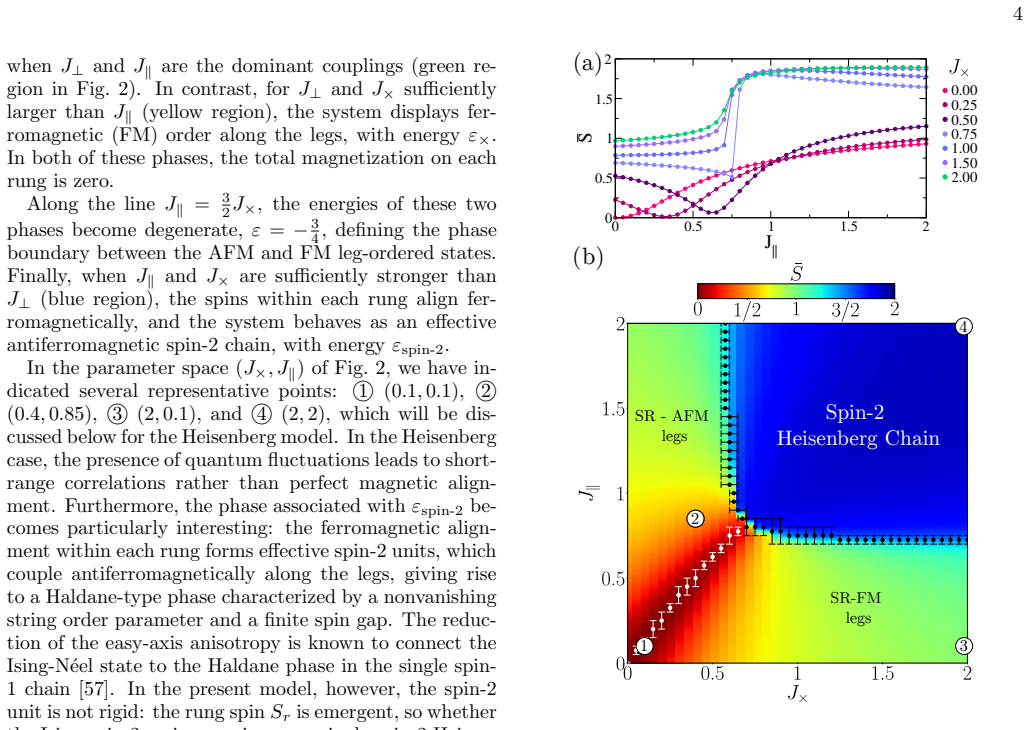
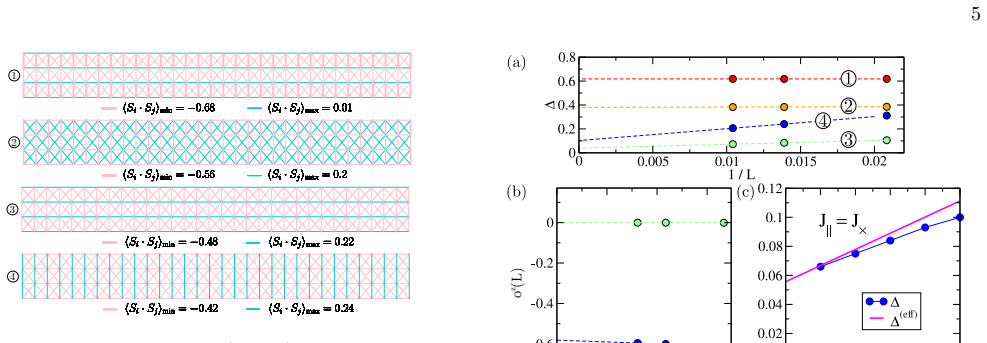
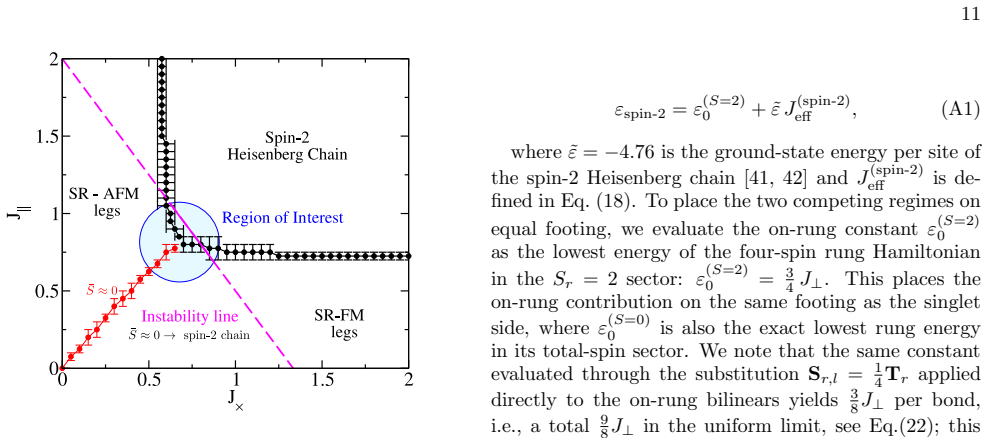
The uniform system displays three regimes: short-range antiferromagnetic legs, short-range ferromagnetic legs, and an effective spin-2 Heisenberg chain, separated by a crossover and a first-order transition. The spin-2 regime is confirmed through its finite string order parameter, edge-localized excitations, and excellent agreement with a projected S_r=2 effective Hamiltonian. Recasting the model as two frustrated two-leg ladders coupled by rung and diagonal interactions, the phase diagrams show how the trivial and Haldane phases evolve as interladder couplings are introduced, clarifying the emergence of effective spin-1 versus spin-2 behavior.
What carries the argument
Projection of the four-leg ladder onto an effective S_r=2 Heisenberg Hamiltonian in the spin-2 regime.
If this is right
- The spin-2 regime is marked by a finite string order parameter.
- Edge-localized excitations characterize the spin-2 regime.
- The crossover and first-order transition lines are predicted by the spin-2 projection.
- Merger of two two-leg ladders reorganizes singlet- and triplet-dominated regimes into spin-1 and spin-2 effective behaviors.
Where Pith is reading between the lines
- Effective spin-2 behavior may appear in other multi-leg ladder geometries with suitable frustration.
- Experimental signatures of the first-order transition could be sought in quasi-one-dimensional magnetic materials.
- The method of projecting to effective higher-spin chains could be applied to identify spin-3 regimes in six-leg ladders.
Load-bearing premise
The DMRG calculations and the projection to the effective spin-2 model remain free of significant higher-spin contamination or finite-size effects throughout the parameter space.
What would settle it
Direct computation of the string order parameter yielding zero in the parameter window identified as the spin-2 regime, or mismatch between the full ladder spectrum and the projected model, would falsify the existence of that regime.
Figures

read the original abstract
We investigate a frustrated four-leg spin-$1/2$ ladder using density matrix renormalization group calculations. The uniform system displays three regimes: short-range antiferromagnetic legs, short-range ferromagnetic legs, and an effective spin-2 Heisenberg chain, separated by a crossover and a first-order transition. The spin-2 regime is confirmed through its finite string order parameter, edge-localized excitations, and excellent agreement with a projected $S_r=2$ effective Hamiltonian. Recasting the model as two frustrated two-leg ladders coupled by rung and diagonal interactions, we track how the trivial and Haldane phases of an isolated ladder evolve as interladder couplings are introduced. The resulting phase diagrams reveal crossover and first-order lines whose locations are captured by the spin-2 projection and show how singlet- and triplet-dominated regimes reorganize when two ladders merge into a four-leg structure, clarifying the emergence of effective spin-1 versus spin-2 behavior.
Editorial analysis
A structured set of objections, weighed in public.
Referee Report
Summary. The paper investigates a frustrated four-leg spin-1/2 ladder using DMRG calculations. It identifies three regimes in the uniform system—short-range antiferromagnetic legs, short-range ferromagnetic legs, and an effective spin-2 Heisenberg chain—separated by a crossover and a first-order transition. The spin-2 regime is confirmed via a finite string order parameter, edge-localized excitations, and quantitative agreement with a projected S_r=2 effective Hamiltonian. The model is recast as two coupled frustrated two-leg ladders to track the evolution of trivial and Haldane phases under interladder couplings, with phase diagrams showing how singlet- and triplet-dominated regimes reorganize into effective spin-1 versus spin-2 behavior.
Significance. If the DMRG results hold with adequate convergence, the work clarifies the emergence of effective higher-spin descriptions in frustrated ladder geometries and the reorganization of phases when merging two-leg ladders, providing a concrete example of competing spin-1 and spin-2 regimes with falsifiable signatures such as string order and edge excitations.
major comments (1)
- [Numerical methods / Results on spin-2 regime] Numerical methods and results sections: The central identification of the spin-2 regime rests on a finite string order parameter, edge excitations, and match to the projected S_r=2 Hamiltonian, yet the manuscript provides no explicit tables or figures reporting bond-dimension convergence, truncation error estimates, or finite-size scaling of the string order in that regime. Without these, it remains possible that higher-spin admixtures or boundary effects contaminate the diagnostic, undermining the distinction from the short-range ferromagnetic regime.
minor comments (1)
- [Abstract] Abstract and introduction: The separation into 'crossover and first-order transition' is stated clearly, but the precise location of the first-order line in parameter space (leg, rung, diagonal couplings) should be cross-referenced to a specific figure or table for immediate readability.
Simulated Author's Rebuttal
We thank the referee for their careful reading of the manuscript and for highlighting the need for explicit numerical convergence data. We address the single major comment below.
read point-by-point responses
-
Referee: [Numerical methods / Results on spin-2 regime] Numerical methods and results sections: The central identification of the spin-2 regime rests on a finite string order parameter, edge excitations, and match to the projected S_r=2 Hamiltonian, yet the manuscript provides no explicit tables or figures reporting bond-dimension convergence, truncation error estimates, or finite-size scaling of the string order in that regime. Without these, it remains possible that higher-spin admixtures or boundary effects contaminate the diagnostic, undermining the distinction from the short-range ferromagnetic regime.
Authors: We agree that explicit convergence diagnostics are essential to substantiate the spin-2 regime. Although the methods section states the bond dimensions and truncation thresholds employed, we did not include dedicated figures or tables isolating the spin-2 regime. In the revised manuscript we will add (i) a supplementary figure showing the string order parameter versus bond dimension (D = 400–2000) at representative points inside the spin-2 regime, (ii) tabulated truncation errors for the same points, and (iii) finite-size scaling of the string order for L = 16–64. These additions will directly address the possibility of higher-spin admixtures or boundary contamination and will strengthen the distinction from the short-range ferromagnetic regime. revision: yes
Circularity Check
Numerical DMRG exploration with independently derived effective projection
full rationale
The manuscript performs DMRG on a microscopic frustrated four-leg ladder Hamiltonian and identifies regimes including an effective spin-2 chain via string order, edge states, and quantitative match to a projected S_r=2 Hamiltonian. The projection is constructed from the microscopic model parameters rather than fitted to the target observables, and the abstract and description contain no self-definitional equations, fitted-input predictions, or load-bearing self-citations. The derivation chain is therefore self-contained against external numerical benchmarks.
Axiom & Free-Parameter Ledger
free parameters (1)
- leg, rung, and diagonal coupling strengths
axioms (1)
- domain assumption DMRG with finite bond dimension and open boundaries accurately captures the ground-state properties and string order in the four-leg ladder for the system sizes considered.
Reference graph
Works this paper leans on
-
[1]
Haldane, Continuum dynamics of the 1-D Heisenberg antiferromagnet: Identification with the O(3) nonlinear sigma model, Physics Letters A93, 464 (1983)
F. Haldane, Continuum dynamics of the 1-D Heisenberg antiferromagnet: Identification with the O(3) nonlinear sigma model, Physics Letters A93, 464 (1983)
1983
-
[2]
Kennedy and H
T. Kennedy and H. Tasaki, Hidden z2 x z2 symmetry breaking in haldane-gap antiferromagnets, Physical Re- view B45, 304 (1992)
1992
-
[3]
Wen, Choreographed entanglement dances: Topo- logical states of quantum matter, Science363, eaal3099 (2019)
X.-G. Wen, Choreographed entanglement dances: Topo- logical states of quantum matter, Science363, eaal3099 (2019)
2019
-
[4]
Dagotto and T
E. Dagotto and T. M. Rice, Surprises on the way from one- to two-dimensional quantum magnets: The ladder materials, Science271, 618 (1996)
1996
-
[5]
H. G. Evertz, Coupled Quantum Chains: A Bumpy Path from 1 to 2 Dimensions, inComputer Simulation Studies in Condensed-Matter Physics IX, edited by D. P. Lan- dau, K. K. Mon, and H.-B. Sch¨ uttler (Springer, Berlin, Heidelberg, 1997) pp. 59–73
1997
-
[6]
R. A. L. Silva and M. Almeida, Spin-ladder behaviour in molecular materials, Journal of Materials Chemistry C 9, 10573 (2021)
2021
-
[7]
Ramos, M
L. Ramos, M. Schmidt, and F. Zimmer, Spin–singlet dimer phase in a frustrated square lattice under a mag- netic field, Journal of Magnetism and Magnetic Materials 637, 173687 (2026)
2026
-
[8]
Q. Li, L. Hu, P. Zhang, C. Miao, Y. Xu, Z. Liu, and X. Kong, Effects of alternating interactions and bound- ary conditions on quantum entanglement of a three-leg Heisenberg ladder, Chinese Journal of Physics94, 582 (2025)
2025
- [9]
-
[10]
S. C. Furuya, M. Dupont, S. Capponi, N. Laflorencie, and T. Giamarchi, Dimensional modulation of sponta- neous magnetic order in quasi-two-dimensional quantum antiferromagnets, Phys. Rev. B94, 144403 (2016)
2016
-
[11]
Sompet, S
P. Sompet, S. Hirthe, D. Bourgund, T. Chalopin, J. Bibo, J. Koepsell, P. Bojovi´ c, R. Verresen, F. Pollmann, G. Sa- lomon, C. Gross, T. A. Hilker, and I. Bloch, Realizing the symmetry-protected Haldane phase in Fermi–Hubbard ladders, Nature606, 484 (2022)
2022
-
[12]
Reigrotzki, H
M. Reigrotzki, H. Tsunetsugu, and T. M. Rice, Strong- coupling expansions for antiferromagnetic heisenberg spin-one-half ladders, Journal of Physics: Condensed Matter6, 9235 (1994)
1994
-
[13]
S. R. White, R. M. Noack, and D. J. Scalapino, Resonat- ing Valence Bond Theory of Coupled Heisenberg Chains, Physical Review Letters73, 886 (1994). 12
1994
-
[14]
Sierra, The nonlinear sigma model and spin ladders, Journal of Physics A: Mathematical and General29, 3299 (1996)
G. Sierra, The nonlinear sigma model and spin ladders, Journal of Physics A: Mathematical and General29, 3299 (1996)
1996
-
[15]
F. B. Ramos and J. C. Xavier,n-leg spin-sheisenberg ladders: A density-matrix renormalization group study, Phys. Rev. B89, 094424 (2014)
2014
-
[16]
Gopalan, T
S. Gopalan, T. M. Rice, and M. Sigrist, Spin ladders with spin gaps: A description of a class of cuprates, Physical Review B49, 8901 (1994)
1994
-
[17]
Nomura, Y
K. Nomura, Y. H. Matsuda, A. Ikeda, Y. Kohama, H. Tsuda, N. Amaya, T. Ono, and Y. Hosokoshi, Metastable magnetization plateaus in the$S$=1 organic spin ladder BIP-TENO induced by a microsecond-pulsed megagauss field, Physical Review B105, 214430 (2022)
2022
-
[18]
Kohshiro, R
H. Kohshiro, R. Kaneko, S. Morita, H. Katsura, and N. Kawashima, Multiple magnetization plateaus induced by farther neighbor interactions in an$S=1$two-leg Heisenberg spin ladder, Physical Review B104, 214409 (2021)
2021
-
[19]
Sakai, N
T. Sakai, N. Okazaki, K. Okamoto, K. Kindo, Y. Narumi, Y. Hosokoshi, K. Kato, K. Inoue, and T. Goto, Magne- tization plateau inS=1 organic spin ladder BIP-TENO, Physica B: Condensed Matter Proceedings of the 23rd International Conference on Low Temperature Physics, 329–333, 1203 (2003)
2003
-
[20]
Katoh, Y
K. Katoh, Y. Hosokoshi, K. Inoue, M. I. Bartashevich, H. Nakano, and T. Goto, Magnetic properties of organic two-leg spin–ladder systems withS=1/2 andS=1, Jour- nal of Physics and Chemistry of Solids Proceedings of the 8th ISSP International Symposium,63, 1277 (2002)
2002
-
[21]
Katoh, Y
K. Katoh, Y. Hosokoshi, K. Inoue, and T. Goto, Singlet Ground States in an Organic S=1/2Spin Ladder and a Novel Double Spin Chain of Ferromagnetic Dimers Formed by an Organic Tetraradical, Journal of the Phys- ical Society of Japan69, 1008 (2000)
2000
-
[22]
A. S. Gibbs, A. Yamamoto, A. N. Yaresko, K. S. Knight, H. Yasuoka, M. Majumder, M. Baenitz, P. J. Saines, J. R. Hester, D. Hashizume, A. Kondo, K. Kindo, and H. Tak- agi,s= 1 2 quantum critical spin ladders produced by orbital ordering in ba 2cuteo6, Phys. Rev. B95, 104428 (2017)
2017
-
[23]
Macdougal, A
D. Macdougal, A. S. Gibbs, T. Ying, S. Wessel, H. C. Walker, D. Voneshen, F. Mila, H. Takagi, and R. Coldea, Spin dynamics of coupled spin ladders near quantum crit- icality in ba2cuteo6, Phys. Rev. B98, 174410 (2018)
2018
-
[24]
Pughe, O
C. Pughe, O. H. J. Mustonen, A. S. Gibbs, S. Lee, R. Stewart, B. Gade, C. Wang, H. Luetkens, A. Foster, F. C. Coomer, H. Takagi, and E. J. Cussen, Partition- ing the two-leg spin ladder in ba 2cu1−xznxteo6: From magnetic order through spin-freezing to paramagnetism, Chemistry of Materials35, 2752 (2023)
2023
-
[25]
T. Hong, K. P. Schmidt, K. Coester, F. F. Awwadi, M. M. Turnbull, Y. Qiu, J. A. Rodriguez-Rivera, M. Zhu, X. Ke, C. P. Aoyama, Y. Takano, H. Cao, W. Tian, J. Ma, R. Custelcean, H. D. Zhou, and M. Matsuda, Magnetic ordering induced by interladder coupling in the spin- 1 2 heisenberg two-leg ladder antiferromagnet c9h18n2cubr4, Phys. Rev. B89, 174432 (2014)
2014
-
[26]
T. Ying, K. P. Schmidt, and S. Wessel, Higgs mode of planar coupled spin ladders and its observation in c9h18n2cubr4, Phys. Rev. Lett.122, 127201 (2019)
2019
-
[27]
T. Hong, M. Matsumoto, Y. Qiu, W. Chen, T. R. Gen- tile, S. Watson, F. F. Awwadi, M. M. Turnbull, S. E. Dissanayake, H. Agrawal, R. Toft-Petersen, B. Klemke, K. Coester, K. P. Schmidt, and D. A. Tennant, Higgs amplitude mode in a two-dimensional quantum antiferro- magnet near the quantum critical point, Nature Physics 13, 638 (2017)
2017
-
[28]
Capriotti and F
L. Capriotti and F. Becca, Quantum phase transition in coupled spin ladders, Phys. Rev. B65, 092406 (2002)
2002
-
[29]
Philippe, F
J. Philippe, F. Elson, N. P. M. Casati, S. Sanz, M. Met- zelaars, O. Shliakhtun, O. K. Forslund, J. Lass, T. Shi- roka, A. Linden, D. G. Mazzone, J. Ollivier, S. Shin, M. Medarde, B. Lake, M. M˚ ansson, M. Bartkowiak, B. Normand, P. K¨ ogerler, Y. Sassa, M. Janoschek, and G. Simutis, (C 5H9NH3)2cubr4: A metal-organic two- ladder quantum magnet, Phys. Rev....
2024
-
[30]
J. a. P. G. D’Elia and T. Paiva, Topological phase tran- sition in the two-leg hubbard model: Emergence of the haldane phase via diagonal hopping and strong interac- tions, Phys. Rev. B112, 035169 (2025)
2025
-
[31]
D. S. Almeida and R. R. Montenegro-Filho, Quantum bi- critical point and phase separation in a frustrated Heisen- berg ladder, Physical Review B108, 224433 (2023)
2023
-
[32]
Wessel, B
S. Wessel, B. Normand, F. Mila, and A. Honecker, Effi- cient Quantum Monte Carlo simulations of highly frus- trated magnets: The frustrated spin-1/2 ladder, SciPost Physics3, 005 (2017)
2017
-
[33]
Michaud, T
F. Michaud, T. Coletta, S. R. Manmana, J.-d. Picon, and F. Mila, Frustration-Induced Plateaus inS≥ 1 2 Heisen- berg Spin Ladders, Physical Review B81, 014407 (2010)
2010
-
[34]
Hikihara and O
T. Hikihara and O. A. Starykh, Phase diagram of the frustrated spin ladder, Physical Review B81, 064432 (2010)
2010
-
[35]
Fouet, F
J.-B. Fouet, F. Mila, D. Clarke, H. Youk, O. Tch- ernyshyov, P. Fendley, and R. M. Noack, Condensation of magnons and spinons in a frustrated ladder, Physical Review B73, 214405 (2006)
2006
-
[36]
Honecker, F
A. Honecker, F. Mila, and M. Troyer, Magnetization plateaux and jumps in a class of frustrated ladders: A simple route to a complex behaviour, The European Physical Journal B15, 227 (2000)
2000
-
[37]
Wang, Low Energy Properties of a Frustrated Anti- ferromagnetic Spin-1/2 Ladder, Modern Physics Letters B14, 327 (2000)
X. Wang, Low Energy Properties of a Frustrated Anti- ferromagnetic Spin-1/2 Ladder, Modern Physics Letters B14, 327 (2000)
2000
-
[38]
Weihong, V
Z. Weihong, V. Kotov, and J. Oitmaa, Two-Chain Spin Ladder with Frustrating Second-Neighbor Interactions, Physical Review B57, 11439 (1998)
1998
-
[39]
Mila, Ladders in a magnetic field: A strong cou- pling approach, The European Physical Journal B6, 201 (1998)
F. Mila, Ladders in a magnetic field: A strong cou- pling approach, The European Physical Journal B6, 201 (1998)
1998
-
[40]
M. P. Gelfand, Linked-tetrahedra spin chain: Exact ground state and excitations, Physical Review B43, 8644 (1991)
1991
-
[41]
Schollw¨ ock and T
U. Schollw¨ ock and T. Jolicoeur, Haldane gap and hidden order in the s = 2 antiferromagnetic quantum spin chain, Europhysics Letters30, 493 (1995)
1995
-
[42]
Schollw¨ ock, O
U. Schollw¨ ock, O. Golinelli, and T. Jolicœur,S=2 an- tiferromagnetic quantum spin chain, Physical Review B 54, 4038 (1996)
1996
-
[43]
Todo and K
S. Todo and K. Kato, Cluster algorithms for general- Squantum spin systems, Phys. Rev. Lett.87, 047203 (2001)
2001
-
[44]
X. Wang, S. Qin, and L. Yu, Haldane gap for thes= 2 antiferromagnetic heisenberg chain revisited, Phys. Rev. B60, 14529 (1999)
1999
-
[45]
Nakano and T
H. Nakano and T. Sakai, Precise estimation of the s = 2 13 haldane gap by numerical diagonalization, Journal of the Physical Society of Japan87, 105002 (2018)
2018
-
[46]
H. J. Schulz, Phase diagrams and correlation exponents for quantum spin chains of arbitrary spin quantum num- ber, Phys. Rev. B34, 6372 (1986)
1986
-
[47]
Jiang, Coupled cluster study of the coupled spin ladders with frustration, Physica A: Statistical Mechanics and its Applications540, 123131 (2020)
J.-J. Jiang, Coupled cluster study of the coupled spin ladders with frustration, Physica A: Statistical Mechanics and its Applications540, 123131 (2020)
2020
-
[48]
Schollw¨ ock, The density-matrix renormalization group in the age of matrix product states, Annals of Physics 326, 96 (2011)
U. Schollw¨ ock, The density-matrix renormalization group in the age of matrix product states, Annals of Physics 326, 96 (2011)
2011
-
[49]
Schollw¨ ock, The density-matrix renormalization group, Reviews of Modern Physics77, 259 (2005)
U. Schollw¨ ock, The density-matrix renormalization group, Reviews of Modern Physics77, 259 (2005)
2005
-
[50]
Schollw¨ ock, Progress in density matrix renormaliza- tion: What quantum information is teaching us, Journal of Magnetism and Magnetic Materials310, 1394 (2007)
U. Schollw¨ ock, Progress in density matrix renormaliza- tion: What quantum information is teaching us, Journal of Magnetism and Magnetic Materials310, 1394 (2007)
2007
-
[51]
S. R. White, Density matrix formulation for quantum renormalization groups, Physical Review Letters69, 2863 (1992)
1992
-
[52]
S. R. White, Density-matrix algorithms for quantum renormalization groups, Physical Review B48, 10345 (1993)
1993
-
[53]
Jeong, H
M. Jeong, H. Mayaffre, C. Berthier, D. Schmidiger, A. Zheludev, and M. Horvati´ c, Magnetic-order crossover in coupled spin ladders, Phys. Rev. Lett.118, 167206 (2017)
2017
-
[54]
Fishman, S
M. Fishman, S. R. White, and E. M. Stoudenmire, The ITensor Software Library for Tensor Network Calcula- tions, SciPost Phys. Codebases , 4 (2022)
2022
-
[55]
Nishiyama, N
Y. Nishiyama, N. Hatano, and M. Suzuki, Hidden or- ders and rvb formation of the four-leg heisenberg ladder model, Journal of the Physical Society of Japan65, 560 (1996)
1996
-
[56]
H. Ueda, H. Nakano, and K. Kusakabe, Finite-size scal- ing of string order parameters characterizing the Haldane phase, Physical Review B78, 224402 (2008)
2008
-
[57]
Botet, R
R. Botet, R. Jullien, and M. Kolb, Finite-size-scaling study of the spin-1 Heisenberg-Ising chain with uniax- ial anisotropy, Phys. Rev. B28, 3914 (1983)
1983
discussion (0)
Sign in with ORCID, Apple, or X to comment. Anyone can read and Pith papers without signing in.