Physics-constrained neural networks for surrogate modeling of lossless periodic structures
Pith reviewed 2026-06-29 02:37 UTC · model grok-4.3
The pith
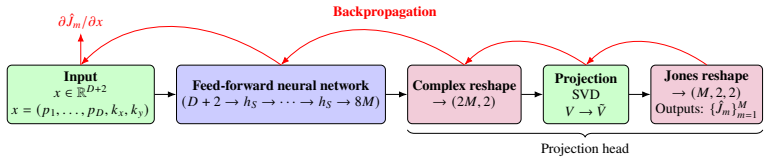
A neural network predicts Jones matrices for lossless periodic structures by projecting outputs onto the Stiefel manifold to enforce energy conservation by construction.
A machine-rendered reading of the paper's core claim, the machinery that carries it, and where it could break.
Core claim
By projecting neural-network predictions onto the Stiefel manifold with differentiable symmetric orthogonalization, the surrogate model for RCWA outputs in lossless periodic structures satisfies energy conservation exactly at every forward pass while remaining end-to-end differentiable for gradient-based inverse design.
What carries the argument
Differentiable symmetric orthogonalization that projects network outputs onto the Stiefel manifold, turning the physical energy-conservation requirement into a hard architectural constraint.
If this is right
- The surrogate can be dropped directly into gradient-based inverse-design loops without any auxiliary loss or repair step to restore energy conservation.
- Training data no longer needs to teach the network the energy constraint; the manifold projection supplies it at every step.
- The same projection layer applies to any lossless periodic structure whose Jones matrix must be unitary.
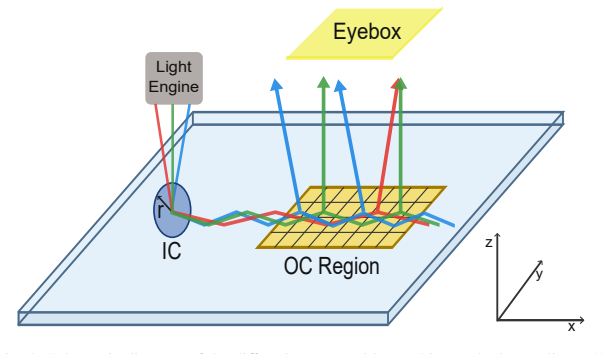
- The method was shown to support the inverse design of a diffractive waveguide combiner for augmented-reality glasses.
Where Pith is reading between the lines
- The projection technique could be reused for other optics problems whose physical constraints correspond to known matrix manifolds.
- Because the constraint is enforced exactly rather than approximately, the approach may allow smaller training sets than purely data-driven surrogates.
- The same idea could be tested on structures that are only approximately lossless to see how gracefully the hard constraint degrades.
Load-bearing premise
RCWA outputs for lossless layered periodic structures lie exactly on the Stiefel manifold, so the projection step recovers the true physical mapping without distortion.
What would settle it
Running the trained network on a set of lossless test structures and finding that the projected Jones matrices deviate from independent RCWA calculations by more than floating-point error.
Figures



read the original abstract
We introduce a physics-constrained neural network (PCNN) for the rapid prediction of rigorous coupled-wave analysis (RCWA) outputs in the form of Jones matrices. Starting from energy conservation in lossless layered periodic structures, we use the fact that RCWA outputs lie on a Stiefel manifold. This energy constraint is enforced as a hard condition by projecting onto the manifold using differentiable symmetric orthogonalization. The resulting surrogate enforces energy conservation by construction while preserving differentiability for gradient-based inverse design. The performance and generality of the proposed approach are demonstrated through the inverse design of a diffractive waveguide combiner for augmented reality glasses.
Editorial analysis
A structured set of objections, weighed in public.
Referee Report
Summary. The manuscript introduces a physics-constrained neural network (PCNN) surrogate for predicting Jones matrices from rigorous coupled-wave analysis (RCWA) of lossless layered periodic structures. It starts from the observation that energy conservation implies RCWA outputs lie on the Stiefel manifold and enforces this via differentiable symmetric orthogonalization as a hard projection step. The resulting model is claimed to satisfy energy conservation exactly by construction while remaining differentiable for gradient-based inverse design; performance is illustrated on the inverse design of a diffractive waveguide combiner for augmented-reality glasses.
Significance. If the central construction holds, the work supplies a concrete, differentiable mechanism for embedding a global physical constraint (energy conservation) into optical surrogates without post-hoc penalties or soft regularization. This is potentially useful for inverse-design loops that rely on gradient flow through the surrogate. The explicit use of manifold projection rather than an auxiliary loss term is a clear methodological choice that could be adopted more broadly if the numerical fidelity of the projection step is established.
major comments (2)
- [Abstract] Abstract: The statement that 'RCWA outputs lie on a Stiefel manifold' is presented as a fact enabling exact enforcement by construction, yet the text supplies no quantitative check (e.g., measured deviation of J^H J from I on the training or test RCWA data) nor any bound on how floating-point, truncation, or discretization errors in RCWA affect manifold membership. This assumption is load-bearing for the 'by construction' claim.
- [Abstract] Abstract: No numerical error metrics, ablation against unconstrained baselines, or comparison of projection-induced distortion versus unconstrained prediction error are reported. Without these, it is impossible to assess whether the projection step improves or degrades surrogate accuracy relative to the underlying RCWA data.
Simulated Author's Rebuttal
We thank the referee for the thoughtful and constructive report. The two major comments both concern the strength of the central claim that RCWA Jones matrices lie on the Stiefel manifold and the lack of supporting numerical evidence. We address each point below and commit to revisions that directly respond to the concerns raised.
read point-by-point responses
-
Referee: [Abstract] Abstract: The statement that 'RCWA outputs lie on a Stiefel manifold' is presented as a fact enabling exact enforcement by construction, yet the text supplies no quantitative check (e.g., measured deviation of J^H J from I on the training or test RCWA data) nor any bound on how floating-point, truncation, or discretization errors in RCWA affect manifold membership. This assumption is load-bearing for the 'by construction' claim.
Authors: We agree that an explicit quantitative verification strengthens the manuscript. Although the Stiefel-manifold property follows rigorously from energy conservation for lossless structures (as derived from the unitarity of the scattering matrix in the absence of absorption), RCWA implementations are subject to finite discretization and floating-point effects. In the revised version we will add a dedicated subsection that reports the measured Frobenius norm ||J^H J - I||_F for all RCWA-generated training and test matrices, together with a brief discussion of how mesh density and solver tolerances influence the observed deviation. This addition will make the load-bearing assumption empirically transparent without altering the theoretical justification. revision: yes
-
Referee: [Abstract] Abstract: No numerical error metrics, ablation against unconstrained baselines, or comparison of projection-induced distortion versus unconstrained prediction error are reported. Without these, it is impossible to assess whether the projection step improves or degrades surrogate accuracy relative to the underlying RCWA data.
Authors: We acknowledge that the current manuscript emphasizes the methodological construction and the inverse-design demonstration rather than exhaustive benchmarking. To allow readers to evaluate the effect of the hard projection, the revised manuscript will include: (i) standard surrogate error metrics (MSE, MAE) on held-out RCWA data, (ii) a direct ablation comparing the physics-constrained network against an otherwise identical unconstrained network, and (iii) a side-by-side comparison of prediction error before versus after the differentiable symmetric orthogonalization step. These additions will quantify any accuracy trade-off introduced by the manifold projection. revision: yes
Circularity Check
No significant circularity; physics constraint applied from first principles
full rationale
The derivation begins from energy conservation for lossless structures, invokes the mathematical consequence that Jones matrices lie on the Stiefel manifold, and applies differentiable symmetric orthogonalization as a hard projection. No step reduces the output to a fitted parameter renamed as prediction, a self-citation chain, or a self-definitional loop; the projection is a standard operation on a domain-derived property. The central claim of enforcement by construction therefore retains independent content from the physical assumption and is not equivalent to the inputs by construction.
Axiom & Free-Parameter Ledger
axioms (1)
- domain assumption RCWA outputs for lossless layered periodic structures lie on the Stiefel manifold due to energy conservation.
Reference graph
Works this paper leans on
-
[1]
Phase relief gratings with conic section profile used in the production of multiple beams,
P. Langois and R. Beaulieu, “Phase relief gratings with conic section profile used in the production of multiple beams,” Appl. Opt.29, 3434–3439 (1990)
1990
-
[2]
Freeform metagratings based on complex light scattering dynamics for extreme, high efficiency beam steering,
J. Yang, D. Sell, and J. A. Fan, “Freeform metagratings based on complex light scattering dynamics for extreme, high efficiency beam steering,” Ann. der Physik530, 1700302 (2018)
2018
-
[3]
Ultra-thin high-efficiency mid-infrared transmissive huygens meta-optics,
L. Zhang, J. Ding, H. Zheng,et al., “Ultra-thin high-efficiency mid-infrared transmissive huygens meta-optics,” Nat. Commun.9, 1481 (2018)
2018
-
[4]
Theoryandapplicationsofguided-moderesonancefilters,
S.S.WangandR.Magnusson,“Theoryandapplicationsofguided-moderesonancefilters,”Appl.Opt.32,2606–2613 (1993)
1993
-
[5]
Grating couplers for coupling between optical fibers and nanophotonic waveguides,
D. Taillaert, F. V. Laere, M. Ayre,et al., “Grating couplers for coupling between optical fibers and nanophotonic waveguides,” Jpn. J. Appl. Phys.45, 6071 (2006)
2006
-
[6]
Highefficiencygratingcouplerbetweensilicon-on-insulatorwaveguides and perfectly vertical optical fibers,
G.Roelkens,D.V.Thourhout,andR.Baets,“Highefficiencygratingcouplerbetweensilicon-on-insulatorwaveguides and perfectly vertical optical fibers,” Opt. Lett.32, 1495–1497 (2007)
2007
-
[7]
Imaging with blazed-binary diffractive elements,
M. S. L. Lee, P. Lalanne, J. C. Rodier,et al., “Imaging with blazed-binary diffractive elements,” J. Opt. A: Pure Appl. Opt.4, S119 (2002)
2002
-
[8]
Waveguidecombinersformixedrealityheadsets: ananophotonicsdesignperspective,
B.C.KressandI.Chatterjee,“Waveguidecombinersformixedrealityheadsets: ananophotonicsdesignperspective,” Nanophotonics10, 41–74 (2020)
2020
-
[9]
Rigorous coupled-wave analysis of planar-grating diffraction,
M. G. Moharam and T. K. Gaylord, “Rigorous coupled-wave analysis of planar-grating diffraction,” J. Opt. Soc. Am. 71, 811–818 (1981)
1981
-
[10]
Formulation for stable and efficient implementation of the rigorous coupled-wave analysis of binary gratings,
M. G. Moharam, E. B. Grann, D. A. Pommet,et al., “Formulation for stable and efficient implementation of the rigorous coupled-wave analysis of binary gratings,” J. Opt. Soc. Am. A12, 1068–1076 (1995)
1995
-
[11]
Stable implementation of the rigorous coupled-wave analysis for surface-relief gratings: enhanced transmittance matrix approach,
M. G. Moharam, D. A. Pommet, E. B. Grann,et al., “Stable implementation of the rigorous coupled-wave analysis for surface-relief gratings: enhanced transmittance matrix approach,” J. Opt. Soc. Am. A12, 1077–1086 (1995)
1995
-
[12]
Deep learning for accelerated all-dielectric metasurface design,
C. C. Nadell, B. Huang, J. M. Malof,et al., “Deep learning for accelerated all-dielectric metasurface design,” Opt. Express27, 27523–27535 (2019)
2019
-
[13]
Training deep neural networks for the inverse design of nanophotonic structures,
D. Liu, Y. Tan, E. Khoram,et al., “Training deep neural networks for the inverse design of nanophotonic structures,” ACS Photonics5, 1365–1369 (2018)
2018
-
[14]
Deep neural network inverse design of integrated photonic power splitters,
M. H. Tahersima, K. Kojima, T. Koike-Akino,et al., “Deep neural network inverse design of integrated photonic power splitters,” Sci. Reports9, 1368 (2019)
2019
-
[15]
Nanophotonic particle simulation and inverse design using artificial neural networks,
J. Peurifoy, Y. Shen, L. Jing,et al., “Nanophotonic particle simulation and inverse design using artificial neural networks,” Sci. Adv.4, eaar4206 (2018)
2018
-
[16]
Physics-informed neural networks for inverse problems in nano-optics and metamaterials,
Y. Chen, L. Lu, G. E. Karniadakis,et al., “Physics-informed neural networks for inverse problems in nano-optics and metamaterials,” Opt. Express28, 11618 (2020)
2020
-
[17]
MaxwellNet: Physics-driven deep neural network training based on Maxwell’s equations,
J. Lim and D. Psaltis, “MaxwellNet: Physics-driven deep neural network training based on Maxwell’s equations,” APL Photonics7, 011301 (2022)
2022
-
[18]
Physics-informed neural networks: A deep learning framework for solving forward and inverse problems involving nonlinear partial differential equations,
M. Raissi, P. Perdikaris, and G. E. Karniadakis, “Physics-informed neural networks: A deep learning framework for solving forward and inverse problems involving nonlinear partial differential equations,” J. Comput. Phys.378, 686–707 (2019)
2019
-
[19]
High speed simulation and freeform optimization of nanophotonic devices with physics-augmented deep learning,
M. Chen, R. Lupoiu, C. Mao,et al., “High speed simulation and freeform optimization of nanophotonic devices with physics-augmented deep learning,” ACS Photonics9, 3110–3123 (2022)
2022
-
[20]
The geometry of algorithms with orthogonality constraints,
A. Edelman, T. A. Arias, and S. T. Smith, “The geometry of algorithms with orthogonality constraints,” SIAM J. on Matrix Anal. Appl.20, 303–353 (1998)
1998
-
[21]
Reticolo software for grating analysis,
J. P. Hugonin and P. Lalanne, “Reticolo software for grating analysis,” arXiv:2101.00901 (2021)
-
[22]
Löwdin,On the Nonorthogonality Problem(Academic Press, 1970), vol
P.-O. Löwdin,On the Nonorthogonality Problem(Academic Press, 1970), vol. 5, pp. 185–199
1970
-
[23]
On löwdin orthogonalization,
J. G. Aiken, J. A. Erdos, and J. A. Goldstein, “On löwdin orthogonalization,” Int. J. Quantum Chem.18, 1101–1108 (1980)
1980
-
[24]
Courant and D
R. Courant and D. Hilbert,Methods of Mathematical Physics(Wiley, 1989)
1989
-
[25]
Deep Learning using Rectified Linear Units (ReLU)
A. F. Agarap, “Deep learning using rectified linear units (ReLU),” arXiv:1803.08375 (2019)
work page internal anchor Pith review Pith/arXiv arXiv 2019
-
[26]
Visible light metasurfaces based on single-crystal silicon,
D. Sell, J. Yang, S. Doshay,et al., “Visible light metasurfaces based on single-crystal silicon,” ACS Photonics3, 1919–1925 (2016)
1919
-
[27]
Refractive index determination of SiO2 layer in the UV/Vis/NIR range: spectrophotometric reverse engineering on single and bi-layer designs,
L. Gao, F. Lemarchand, and M. Lequime, “Refractive index determination of SiO2 layer in the UV/Vis/NIR range: spectrophotometric reverse engineering on single and bi-layer designs,” J. Eur. Opt. Soc.-Rapid Publ.8, 13010 (2013)
2013
-
[28]
Accelerating and enabling the design of complex diffractive gratings using physics-informed neural networks to evaluate scattering matrices,
E. Prehn and P. Jung, “Accelerating and enabling the design of complex diffractive gratings using physics-informed neural networks to evaluate scattering matrices,” inProc. SPIE,vol. 13595 (2025), p. 135950M
2025
-
[29]
Waveguide-based augmented reality displays: perspectives and challenges,
Y. Ding, Q. Yang, Y. Li,et al., “Waveguide-based augmented reality displays: perspectives and challenges,” eLight3, 24 (2023)
2023
-
[30]
Inverse design of large-area metasurfaces,
R. Pestourie, C. Pérez-Arancibia, Z. Lin,et al., “Inverse design of large-area metasurfaces,” Opt. Express26, 33732–33747 (2018)
2018
-
[31]
Simple analytic approximations to the CIE XYZ color matching functions,
C. Wyman, P.-P. Sloan, and P. Shirley, “Simple analytic approximations to the CIE XYZ color matching functions,” J. Comput. Graph. Tech. (JCGT)2, 1–11 (2013)
2013
-
[32]
JAX: composable transformations of Python+NumPy programs,
J. Bradbury, R. Frostig, P. Hawkins,et al., “JAX: composable transformations of Python+NumPy programs,” https://github.com/jax-ml/jax (2018)
2018
discussion (0)
Sign in with ORCID, Apple, or X to comment. Anyone can read and Pith papers without signing in.