An Algebraic Framework for Quantitative Semantics of Spatio-Temporal Logic with Graph Operators
Pith reviewed 2026-06-30 00:28 UTC · model grok-4.3
The pith
Quantitative semantics for Spatio-Temporal Logic with Graph Operators follow from monotonicity on an abstract accumulator that separates temporal and graph layers.
A machine-rendered reading of the paper's core claim, the machinery that carries it, and where it could break.
Core claim
We develop quantitative semantics for STL-GO as a layered algebraic construction that separates temporal aggregation from graph-operator aggregation (governed by an abstract accumulator with a monotone fold and readout). We prove that soundness and completeness reduce to monotonicity conditions on these components.
What carries the argument
Abstract accumulator whose fold and readout functions satisfy monotonicity, governing graph-operator aggregation separately from the temporal layer.
If this is right
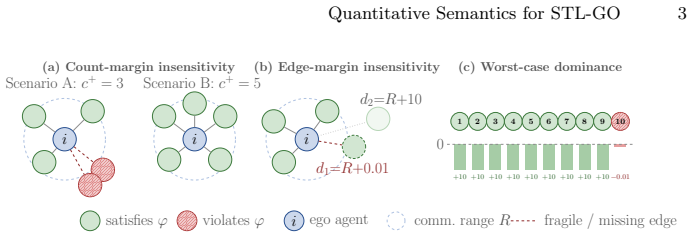
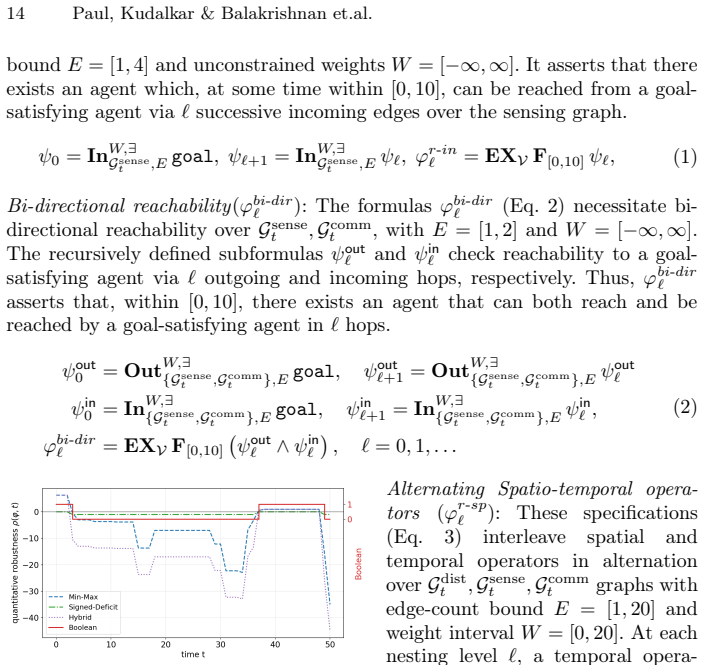
- The framework supports four semantic instantiations (Boolean, min-max, signed-deficit, hybrid) whose quantitative values differ while preserving soundness under monotonicity.
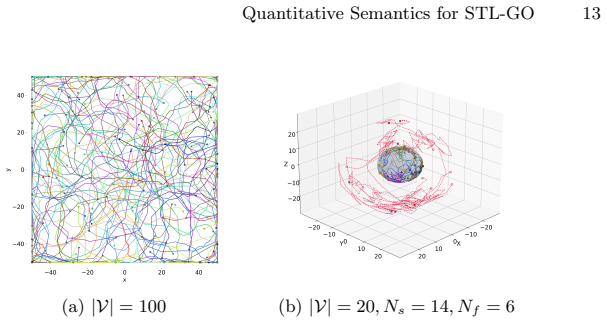
- Evaluation on a 2D bounded region with stochastic Dubins-car dynamics and a 3D Earth-satellite system demonstrates scalability with the number of agents and time horizon.
- Accumulator choice controls the numerical interpretation of counting constraints without altering the underlying Boolean semantics when monotonicity holds.
- The separation of layers allows independent replacement of the temporal or graph aggregation components.
Where Pith is reading between the lines
- The monotonicity template could be reused to define quantitative semantics for other temporal logics that incorporate counting or aggregation operators.
- Automated checks for monotonicity on custom fold and readout functions would make the framework easier to extend to new accumulators.
- The same layered construction might accommodate additional spatial or probabilistic operators while retaining the soundness proof structure.
Load-bearing premise
The graph-operator aggregation can be captured by an abstract accumulator whose fold and readout functions satisfy monotonicity, and that this separation from the temporal layer preserves the intended counting semantics for STL-GO formulas.
What would settle it
An STL-GO formula together with a non-monotone accumulator for which the quantitative semantics nevertheless satisfies soundness or completeness on all input traces.
Figures
read the original abstract
Spatio-Temporal Logic with Graph Operators (STL-GO) extends Signal Temporal Logic (STL) to multi-agent systems via graph operators that count neighboring agents satisfying a property, together with multi-agent quantifiers. While Boolean semantics for STL-GO are well-defined, quantitative semantics have not yet been developed and existing quantitative semantics for spatio-temporal logics such as STREL cannot capture the counting constraints in STL-GO's graph operators. We develop quantitative semantics for STL-GO as a layered algebraic construction that separates temporal aggregation from graph-operator aggregation (governed by an abstract accumulator with a monotone fold and readout). We prove that soundness and completeness reduce to monotonicity conditions on these components. We implement the framework and evaluate it on two multi-agent environments: a 2D bounded region with stochastic Dubins-car dynamics and a 3D Earth-satellite system, under four semantic instantiations (Boolean, min-max, signed-deficit, and a hybrid), demonstrating the tradeoffs between accumulator choices and reporting scalability in the number of agents and time horizon.
Editorial analysis
A structured set of objections, weighed in public.
Referee Report
Summary. The paper develops quantitative semantics for Spatio-Temporal Logic with Graph Operators (STL-GO) via a layered algebraic construction that separates temporal aggregation from graph-operator aggregation, the latter governed by an abstract accumulator equipped with a monotone fold and readout. It claims that soundness and completeness of the resulting quantitative semantics reduce to monotonicity conditions on these accumulator components, and reports an implementation evaluated on a 2D Dubins-car system and a 3D Earth-satellite system under four semantic instantiations (Boolean, min-max, signed-deficit, hybrid).
Significance. If the reduction to monotonicity holds with the stated assumptions, the framework supplies a modular, reusable way to lift Boolean STL-GO semantics to quantitative ones while preserving counting constraints on graph neighborhoods; the explicit separation of layers and the four concrete instantiations provide a clear basis for comparing trade-offs in multi-agent verification.
major comments (2)
- [reduction theorem (Section 4)] The central claim (abstract and the reduction theorem) that soundness and completeness reduce to monotonicity of the fold and readout is load-bearing yet appears incomplete: monotonicity alone permits saturating or constant-on-positive folds that map every count meeting a threshold to the same non-positive value, violating completeness for the intended counting semantics of STL-GO graph operators. The manuscript must either add an explicit extra axiom (e.g., strict increase past the threshold or unbounded range) or demonstrate why the existing monotone-fold definition already guarantees positive outputs for satisfying counts.
- [§3.2] §3.2 (accumulator definition): the weakest assumption—that an arbitrary monotone accumulator can faithfully encode the exact counting thresholds of STL-GO graph operators—is not discharged by the monotonicity conditions alone; an edge case where the fold saturates below the required positive readout would falsify completeness while still satisfying the stated hypotheses.
minor comments (2)
- [Abstract] The abstract states that soundness and completeness proofs 'reduce to monotonicity conditions' but does not list the precise monotonicity axioms; a one-sentence enumeration would improve readability.
- [experimental evaluation] Table 1 (or the corresponding experimental table) reports scalability in number of agents and time horizon; adding a column for the concrete accumulator parameters used in each of the four instantiations would make the trade-off discussion easier to reproduce.
Simulated Author's Rebuttal
We thank the referee for the careful and constructive review. The two major comments both concern the sufficiency of the stated monotonicity conditions for the reduction theorem. We address them point by point below and will revise the manuscript accordingly.
read point-by-point responses
-
Referee: [reduction theorem (Section 4)] The central claim (abstract and the reduction theorem) that soundness and completeness reduce to monotonicity of the fold and readout is load-bearing yet appears incomplete: monotonicity alone permits saturating or constant-on-positive folds that map every count meeting a threshold to the same non-positive value, violating completeness for the intended counting semantics of STL-GO graph operators. The manuscript must either add an explicit extra axiom (e.g., strict increase past the threshold or unbounded range) or demonstrate why the existing monotone-fold definition already guarantees positive outputs for satisfying counts.
Authors: We agree that the current formulation of monotonicity alone does not rule out saturating folds that could map all satisfying counts to a non-positive value, thereby breaking completeness. The manuscript will be revised by adding an explicit axiom to the accumulator definition (Section 3.2) requiring that the readout is strictly positive whenever the fold value meets or exceeds the counting threshold of the graph operator. The reduction theorem in Section 4 will be restated to include this axiom, and the proof will be updated to invoke it explicitly. This change preserves the layered algebraic structure while closing the identified gap. revision: yes
-
Referee: [§3.2] §3.2 (accumulator definition): the weakest assumption—that an arbitrary monotone accumulator can faithfully encode the exact counting thresholds of STL-GO graph operators—is not discharged by the monotonicity conditions alone; an edge case where the fold saturates below the required positive readout would falsify completeness while still satisfying the stated hypotheses.
Authors: We concur that the existing monotonicity hypotheses do not by themselves discharge the requirement that every monotone accumulator faithfully encodes the counting thresholds. We will strengthen the accumulator definition in §3.2 with an additional axiom ensuring that the fold is unbounded above the threshold (or at minimum produces a readout strictly above zero for satisfying counts). The four concrete instantiations will be checked against the new axiom, and the completeness direction of the reduction theorem will be adjusted to rely on it. This revision directly addresses the edge-case concern. revision: yes
Circularity Check
No significant circularity; derivation is self-contained
full rationale
The paper defines quantitative semantics for STL-GO via a layered algebraic construction that takes an abstract accumulator (with monotonicity assumptions on its fold and readout) as an independent input. Soundness and completeness are then shown to follow from those stated assumptions. No equations reduce the central result to a self-definition, a fitted parameter renamed as prediction, or a load-bearing self-citation chain. The monotonicity conditions are explicit premises, not derived from the target semantics, so the framework does not collapse by construction.
Axiom & Free-Parameter Ledger
axioms (1)
- domain assumption The accumulator component admits a monotone fold and a monotone readout
invented entities (1)
-
Abstract accumulator with monotone fold and readout
no independent evidence
Reference graph
Works this paper leans on
-
[1]
Akazaki, T., Hasuo, I.: Time robustness in mtl and expressivity in hybrid system falsification.In:InternationalConferenceonComputerAidedVerification.pp.356–
-
[2]
In: 2021 60th IEEE Conference on Decision and Control (CDC)
Alsalehi, S., Mehdipour, N., Bartocci, E., Belta, C.: Neural network-based control for multi-agent systems from spatio-temporal specifications. In: 2021 60th IEEE Conference on Decision and Control (CDC). pp. 5110–5115. IEEE (2021)
2021
-
[3]
Balakrishnan, A., Deshmukh, J.V.: Structured reward shaping using signal tem- poral logic specifications. In: 2019 IEEE/RSJ International Conference on Intelli- gent Robots and Systems (IROS). pp. 3481–3486 (2019). https://doi.org/10.1109/ IROS40897.2019.8968254
-
[4]
In: Proceedings of the 25th ACM International Conference on Hybrid Systems: Computation and Control
Balakrishnan, A., Jaksic, S., Aguilar, E., Nickovic, D., Deshmukh, J.: Poster abstract: Model-free reinforcement learning for symbolic automata-encoded ob- jectives. In: Proceedings of the 25th ACM International Conference on Hybrid Systems: Computation and Control. HSCC ’22, Association for Computing Ma- chinery, New York, NY, USA (2022). https://doi.org...
-
[5]
Balakrishnan, A., Paul, S., Silvetti, S., Nenzi, L., Deshmukh, J.V.: Monitoring spa- tially distributed cyber-physical systems with alternating finite automata. In: Pro- ceedings of the 28th ACM International Conference on Hybrid Systems: Computa- tionandControl.HSCC’25,AssociationforComputingMachinery,NewYork,NY, USA (2025). https://doi.org/10.1145/37168...
-
[6]
Bartocci, E., Bortolussi, L., Loreti, M., Nenzi, L.: Monitoring mobile and spa- tially distributed cyber-physical systems. In: Proceedings of the 15th ACM-IEEE International Conference on Formal Methods and Models for System Design. pp. 146–155. MEMOCODE ’17, Association for Computing Machinery, New York, NY, USA (Sep 2017). https://doi.org/10.1145/312704...
-
[7]
On the Robustness of Temporal Properties for Stochastic Models
Bartocci, E., Bortolussi, L., Nenzi, L., Sanguinetti, G.: On the robustness of tem- poral properties for stochastic models. arXiv preprint arXiv:1309.0866 (2013)
work page internal anchor Pith review Pith/arXiv arXiv 2013
-
[8]
In: International Conference on Formal Modeling and Analysis of Timed Systems
Chen, H., Lin, S., Smolka, S.A., Paoletti, N.: An stl-based formulation of resilience in cyber-physical systems. In: International Conference on Formal Modeling and Analysis of Timed Systems. pp. 117–135. Springer (2022)
2022
-
[9]
Journal of the Australian Mathematical Society34(3), 377–393 (Jun 1983)
Cignoli, R., Gallego, M.S.D.: Dualities for some de morgan algebras with operators and lukasiewicz algebras. Journal of the Australian Mathematical Society34(3), 377–393 (Jun 1983). https://doi.org/10.1017/S1446788700023806
-
[10]
In: Chatterjee, K., Henzinger, T.A
Donzé, A., Maler, O.: Robust satisfaction of temporal logic over real-valued sig- nals. In: Chatterjee, K., Henzinger, T.A. (eds.) Formal Modeling and Analysis of Timed Systems. pp. 92–106. Lecture Notes in Computer Science, Springer, Berlin, Heidelberg (2010). https://doi.org/10.1007/978-3-642-15297-9_9
-
[11]
Theoretical Computer Science410(42), 4262–4291 (Sep 2009)
Fainekos, G.E., Pappas, G.J.: Robustness of temporal logic specifications for continuous-time signals. Theoretical Computer Science410(42), 4262–4291 (Sep 2009). https://doi.org/10.1016/j.tcs.2009.06.021
-
[12]
The First-Order Logic of Hyperproperties
Finkbeiner, B., Zimmermann, M.: The first-order logic of hyperproperties. arXiv preprint arXiv:1610.04388 (2016)
work page internal anchor Pith review Pith/arXiv arXiv 2016
-
[13]
Springer Netherlands, Dordrecht (1999)
Golan, J.S.: Semirings and Their Applications. Springer Netherlands, Dordrecht (1999). https://doi.org/10.1007/978-94-015-9333-5
-
[14]
In: Proceedings of 18 Paul, Kudalkar & Balakrishnan et.al
Haghighi, I., Jones, A., Kong, Z., Bartocci, E., Gros, R., Belta, C.: Spatel: a novel spatial-temporal logic and its applications to networked systems. In: Proceedings of 18 Paul, Kudalkar & Balakrishnan et.al. the 18th International Conference on Hybrid Systems: Computation and Control. pp. 189–198 (2015)
2015
-
[15]
In: 2019 IEEE 58th Conference on Decision and Control (CDC)
Haghighi, I., Mehdipour, N., Bartocci, E., Belta, C.: Control from signal temporal logic specifications with smooth cumulative quantitative semantics. In: 2019 IEEE 58th Conference on Decision and Control (CDC). pp. 4361–4366. IEEE (2019)
2019
-
[16]
Formal Methods in System Design53(1), 83–112 (Aug 2018)
Jakšić, S., Bartocci, E., Grosu, R., Nguyen, T., Ničković, D.: Quantitative moni- toring of stl with edit distance. Formal Methods in System Design53(1), 83–112 (Aug 2018). https://doi.org/10.1007/s10703-018-0319-x
-
[17]
arXiv preprint arXiv:2511.08502 (2025)
Karagulle, R., Vasile, C.I., Ozay, N.: Safe and optimal learning from preferences via weighted temporal logic with applications in robotics and formula 1. arXiv preprint arXiv:2511.08502 (2025)
-
[18]
In: International Conference on Runtime Verification
Kudalkar, V., Hashemi, N., Mukhopadhyay, S., Mallick, S., Budnik, C., Nagaraja, P., Deshmukh, J.V.: Sampling-based and gradient-based efficient scenario gener- ation. In: International Conference on Runtime Verification. pp. 70–88. Springer (2024)
2024
-
[19]
In: Proceedings of the International Conference on Automated Planning and Schedul- ing
Kudalkar, V., Ponguluri, S., Balakrishnan, A., Deshmukh, J.V.: Sampling-based multi-agent path planning guided by spatio-temporal logic mission objectives. In: Proceedings of the International Conference on Automated Planning and Schedul- ing. vol. 36, pp. 133–141 (2026)
2026
-
[20]
Springer Berlin Heidel- berg, Berlin, Heidelberg (1986)
Kuich, W., Salomaa, A.: Semirings, Automata, Languages. Springer Berlin Heidel- berg, Berlin, Heidelberg (1986)
1986
-
[21]
In: 2017 IEEE/RSJ International Conference on Intelligent Robots and Systems (IROS)
Li, X., Vasile, C.I., Belta, C.: Reinforcement learning with temporal logic rewards. In: 2017 IEEE/RSJ International Conference on Intelligent Robots and Systems (IROS). pp. 3834–3839. IEEE (2017)
2017
-
[22]
In: 2020 ACM/IEEE 11th International Conference on Cyber-Physical Systems (ICCPS)
Ma, M., Bartocci, E., Lifland, E., Stankovic, J., Feng, L.: Sastl: Spatial aggregation signal temporal logic for runtime monitoring in smart cities. In: 2020 ACM/IEEE 11th International Conference on Cyber-Physical Systems (ICCPS). pp. 51–62. IEEE (2020)
2020
-
[23]
In: Lakhnech, Y., Yovine, S
Maler, O., Nickovic, D.: Monitoring temporal properties of continuous signals. In: Lakhnech, Y., Yovine, S. (eds.) Formal Techniques, Modelling and Analysis of Timed and Fault-Tolerant Systems. pp. 152–166. Springer Berlin Heidelberg, Berlin, Heidelberg (2004)
2004
-
[24]
In: 2019 American Control Con- ference (ACC)
Mehdipour, N., Vasile, C.I., Belta, C.: Arithmetic-geometric mean robustness for control from signal temporal logic specifications. In: 2019 American Control Con- ference (ACC). pp. 1690–1695. IEEE (2019)
2019
-
[25]
Logical Methods in Computer ScienceVolume 18, Issue 1(Jan 2022)
Nenzi, L., Bartocci, E., Bortolussi, L., Loreti, M.: A logic for monitoring dy- namic networks of spatially-distributed cyber-physical systems. Logical Methods in Computer ScienceVolume 18, Issue 1(Jan 2022). https://doi.org/10.46298/ lmcs-18(1:4)2022
2022
-
[26]
Logical Methods in Computer ScienceVolume 14, Issue 4(Oct 2018)
Nenzi, L., Bortolussi, L., Ciancia, V., Loreti, M., Massink, M.: Qualitative and quantitative monitoring of spatio-temporal properties with sstl. Logical Methods in Computer ScienceVolume 14, Issue 4(Oct 2018). https://doi.org/10.23638/ LMCS-14(4:2)2018, https://lmcs.episciences.org/4913
2018
-
[27]
In: 2017 IEEE Conference on Control Tech- nology and Applications (CCTA)
Pant, Y.V., Abbas, H., Mangharam, R.: Smooth operator: Control using the smooth robustness of temporal logic. In: 2017 IEEE Conference on Control Tech- nology and Applications (CCTA). pp. 1235–1240. IEEE (2017)
2017
-
[28]
In: Hillston, J., Soudjani, S., Waga, M
Paul, S., Balakrishnan, A., Qin, X., Deshmukh, J.V.: Multi-agent path finding for timed tasks using evolutionary games. In: Hillston, J., Soudjani, S., Waga, M. (eds.) Quantitative Evaluation of Systems and Formal Modeling and Analysis of Timed Systems. pp. 302–321. Springer Nature Switzerland, Cham (2024) Quantitative Semantics for STL-GO 19
2024
-
[29]
Paul, S., Deshmukh, J.V.: Survival of the Fittest: Evolutionary Adaptation of Policies for Environmental Shifts. IOS Press (Oct 2024). https://doi.org/10.3233/ faia240874, http://dx.doi.org/10.3233/FAIA240874
-
[30]
In: 53rd IEEE Conference on Decision and Control
Raman, V., Donzé, A., Maasoumy, M., Murray, R.M., Sangiovanni-Vincentelli, A., Seshia, S.A.: Model predictive control with signal temporal logic specifications. In: 53rd IEEE Conference on Decision and Control. pp. 81–87. IEEE (2014)
2014
-
[31]
In: Proceedings of the 19th International Conference on Hybrid Systems: Computation and Control
Rodionova, A., Bartocci, E., Nickovic, D., Grosu, R.: Temporal logic as filtering. In: Proceedings of the 19th International Conference on Hybrid Systems: Computation and Control. pp. 11–20 (2016)
2016
-
[32]
Silano, G., Afifi, A., Saska, M., Franchi, A.: Stl-based motion planning and uncertainty-aware risk analysis for human-robot collaboration with a multi-rotor aerial vehicle. arXiv preprint arXiv:2509.10692 (2025)
work page internal anchor Pith review Pith/arXiv arXiv 2025
-
[33]
In: Proceedings of the 23rd International Conference on Hybrid Systems: Computation and Control
Waga, M.: Falsification of cyber-physical systems with robustness-guided black-box checking. In: Proceedings of the 23rd International Conference on Hybrid Systems: Computation and Control. pp. 1–13 (2020)
2020
-
[34]
In: Robotics: Science and Systems (2017)
Yoo, C., Belta, C.: Rich time series classification using temporal logic. In: Robotics: Science and Systems (2017)
2017
-
[35]
ACM Transactions on Embedded Computing Systems24(5s), 1–23 (2025) 20 Paul, Kudalkar & Balakrishnan et.al
Zhao, Y., Yu, X., Hoxha, B., Fainekos, G., Deshmukh, J., Lindemann, L.: Stl-go: Spatio-temporal logic with graph operators for distributed systems with multiple network topologies. ACM Transactions on Embedded Computing Systems24(5s), 1–23 (2025) 20 Paul, Kudalkar & Balakrishnan et.al. Appendix A Compositional Behavior of Algebraic Semantics Table 3: Alge...
2025
-
[36]
For every atomic predicateµ,ρ(σ, µ, t)∈K + ⇐ ⇒σ, t|=µ
-
[37]
at least 5 neighbors satisfyψ
for every semantic operatorF:K n →K, there exists a Boolean operator f:{0,1} n → {0,1}such that for all inputsx 1, . . . , xn ∈K, F(x 1, . . . , xn)∈K + ⇐ ⇒f(1 x1∈K + , . . . ,1xn∈K + ) = 1. Then for every formulaϕ,ρ(σ, ϕ, t)∈K + ⇐ ⇒σ, t|=ϕ.That is, the quan- titative semantics are sound and complete with respect to the Boolean semantics. Proof.The proof ...
discussion (0)
Sign in with ORCID, Apple, or X to comment. Anyone can read and Pith papers without signing in.