Reheating matters: Starobinsky inflation in light of joint CMB+BAO results and gravitational-wave forecasts
Pith reviewed 2026-06-30 01:13 UTC · model grok-4.3
The pith
Stiff reheating to fit Starobinsky inflation to recent CMB+BAO data is already ruled out at 1σ by BBN radiation limits.
A machine-rendered reading of the paper's core claim, the machinery that carries it, and where it could break.
Core claim
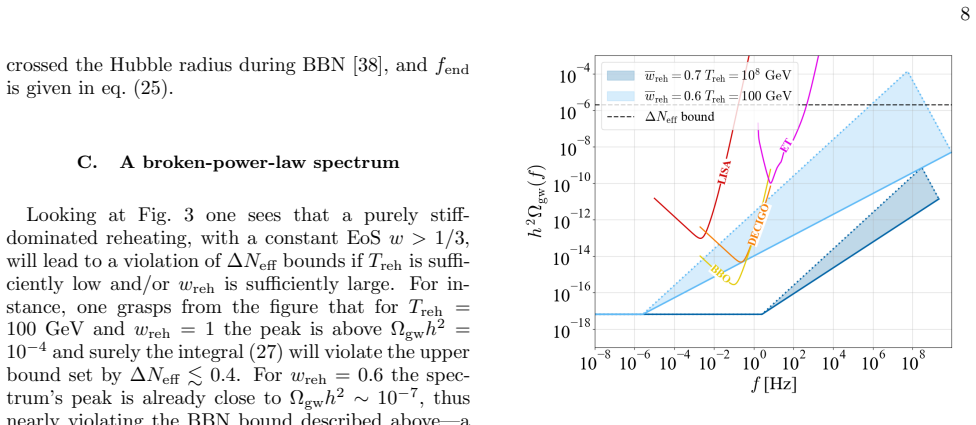
In all three reheating scenarios considered, the 1σ region of parameter space allowed by recent CMB+BAO data is excluded by BBN bounds on radiation density; in a considerable fraction of the remaining 2σ region the blue tilt of the tensor spectrum becomes large enough for detection by future experiments such as Einstein Telescope, LISA, DECIGO and BBO.
What carries the argument
The blue-tilting of the primordial gravitational-wave spectrum caused by a stiff equation-of-state epoch (p > ρ/3) during reheating, which simultaneously changes the post-inflationary expansion history and thereby shifts the scalar spectral index.
If this is right
- The 1σ CMB+BAO region for Starobinsky inflation with stiff reheating is incompatible with BBN radiation limits in every modeled scenario.
- A sizable portion of the 2σ region produces a blue-tilted tensor spectrum that would be detectable by Einstein Telescope, LISA, DECIGO or BBO.
- Stiff-dominated reheating cannot reconcile Starobinsky inflation with current scalar data without violating early-universe radiation constraints.
Where Pith is reading between the lines
- Tighter future BBN determinations of the radiation density would exclude still more of the two-sigma parameter space.
- The same reheating modeling could be applied to other plateau potentials to check consistency between scalar and tensor observables.
- Absence of the predicted gravitational-wave signal in the coming decade would further limit the allowed duration of any stiff epoch.
Load-bearing premise
The piecewise-constant equation-of-state epochs used to model reheating do not inject or remove entropy at the transitions in any way that would change the radiation density at BBN beyond the simple effect of the altered expansion rate.
What would settle it
A BBN measurement that permits the higher radiation density required by the stiff-reheating CMB+BAO fits at 1σ, or a non-detection of the predicted blue-tilted gravitational-wave background at the frequencies and amplitudes corresponding to the remaining 2σ parameter space.
Figures
read the original abstract
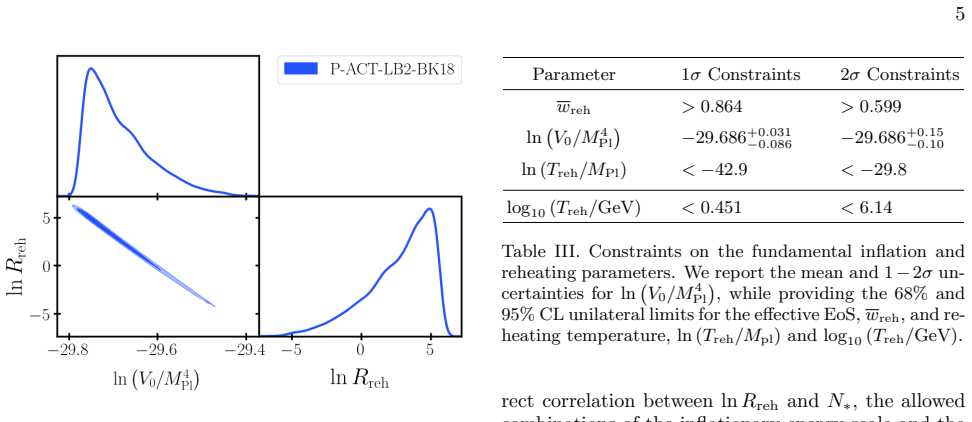
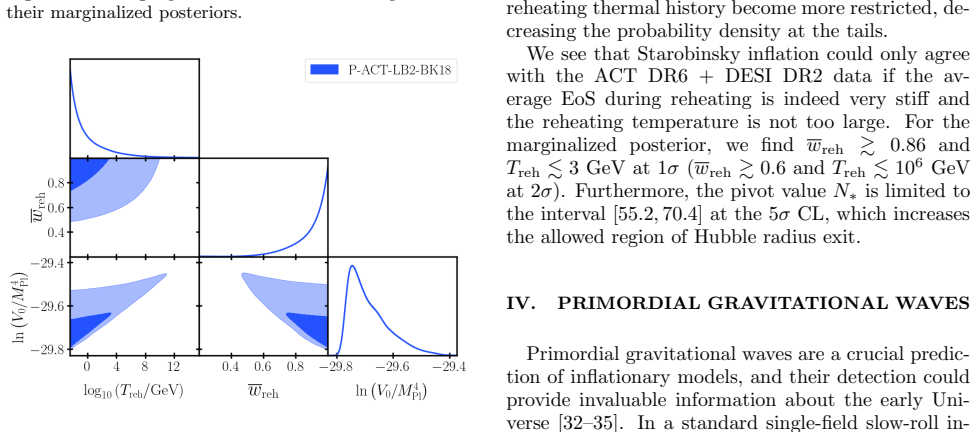
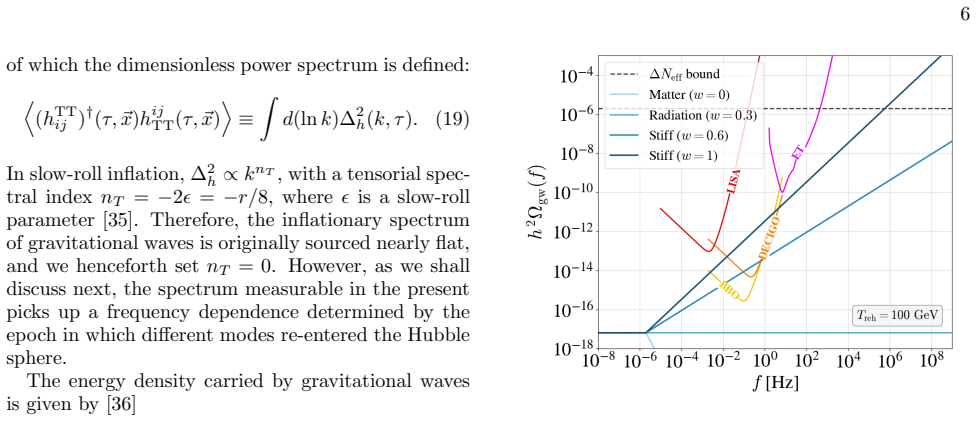
It has been noted in the literature that, if post-inflationary reheating is dominated by a stiff fluid with equation of state (EoS) $p>\rho/3$, then the predictions of Starobinsky inflation for the scalar spectral index could be made to agree with measurements from the combined CMB+BAO datasets performed by the Atacama Cosmology Telescope (ACT) and the South Pole Telescope (SPT) collaborations. However, a side-effect of such a stiff epoch is the blue-tilting of the primordial gravitational-wave (GW) spectrum. In this work, we explore the observational consequences of this blue-tilting in three scenarios: (i) a purely stiff-dominated reheating, (ii) a more realistic case where reheating is first dominated by a matter-like fluid (corresponding to inflaton oscillations around the bottom of a quadratic potential well) later followed by a stiff epoch, and (iii) a case analogous to the previous one, but with an earlier radiation-dominated instead of matter-dominated epoch. We show that in all cases the $1\sigma$ region allowed by recent CMB+BAO data is already excluded by constraints on the amount of radiation present during Big Bang Nucleosynthesis (BBN). Moreover, in a considerable fraction of the remaining $2\sigma$ region we find that the blue-tilting would be severe enough to make the primordial spectrum detectable in future interferometers such as Einstein Telescope, LISA, DECIGO, and BBO, thus rendering these scenarios testable by these experiments.
Editorial analysis
A structured set of objections, weighed in public.
Referee Report
Summary. The paper examines how post-inflationary reheating dominated by a stiff fluid (w>1/3) can reconcile Starobinsky inflation predictions for the scalar spectral index with recent CMB+BAO constraints from ACT and SPT. It analyzes three piecewise-constant EoS scenarios—pure stiff reheating, matter-then-stiff, and radiation-then-stiff—and concludes that the 1σ CMB+BAO region is excluded by BBN radiation-density bounds while a substantial fraction of the 2σ region yields a blue-tilted primordial GW spectrum detectable by ET, LISA, DECIGO, and BBO.
Significance. If the modeling assumptions hold, the work supplies concrete, observationally testable links between reheating dynamics, BBN, and future GW interferometers, tightening the viable parameter space for Starobinsky inflation beyond what CMB+BAO alone provide.
major comments (2)
- [Abstract] Abstract (scenarios (i)–(iii)): the central claim that the entire 1σ CMB+BAO region is excluded by BBN rests on the assumption that EoS transitions inject or remove no entropy and therefore affect only the integrated expansion history when fixing ρ_rad at T∼1 MeV. No explicit check or microphysical justification is supplied for this modeling choice, which directly determines the exclusion and the subsequent GW-forecast region.
- [Abstract] Abstract and paragraph describing scenarios (i)–(iii): the radiation-density constraint at BBN is presented as a hard exclusion without reported error propagation, full Monte-Carlo scans over transition times, or comparison against a baseline entropy-conserving evolution; the robustness of the 1σ exclusion therefore cannot be assessed from the given information.
minor comments (2)
- [Abstract] Notation for the three scenarios is introduced only in the abstract; a dedicated subsection with explicit definitions of the piecewise w(t) functions and matching conditions would improve readability.
- The GW detectability statements cite specific experiments but do not tabulate the corresponding Ω_GW(f) thresholds or frequency bands used for the forecasts.
Simulated Author's Rebuttal
We thank the referee for the careful reading and constructive comments on our manuscript. The points raised concern the entropy-conservation assumption at EoS transitions and the robustness of the BBN exclusion. We address each below and will revise the manuscript accordingly.
read point-by-point responses
-
Referee: [Abstract] Abstract (scenarios (i)–(iii)): the central claim that the entire 1σ CMB+BAO region is excluded by BBN rests on the assumption that EoS transitions inject or remove no entropy and therefore affect only the integrated expansion history when fixing ρ_rad at T∼1 MeV. No explicit check or microphysical justification is supplied for this modeling choice, which directly determines the exclusion and the subsequent GW-forecast region.
Authors: We acknowledge that the exclusion relies on the standard phenomenological assumption of entropy conservation across instantaneous EoS transitions in our piecewise-constant models. This is a common modeling choice in the literature on stiff-fluid reheating (e.g., works treating the stiff component as an effective background without additional entropy sources at transitions). The radiation density at BBN is then set solely by the integrated expansion. While the original text did not supply an explicit microphysical justification or check, this assumption is justified within the effective description adopted; any entropy injection at transitions would only increase ρ_rad and strengthen the exclusion. In the revision we will add a dedicated paragraph justifying the choice, citing analogous treatments in the stiff-reheating literature, and explicitly state its impact on the results. revision: yes
-
Referee: [Abstract] Abstract and paragraph describing scenarios (i)–(iii): the radiation-density constraint at BBN is presented as a hard exclusion without reported error propagation, full Monte-Carlo scans over transition times, or comparison against a baseline entropy-conserving evolution; the robustness of the 1σ exclusion therefore cannot be assessed from the given information.
Authors: The referee correctly notes the absence of error propagation, Monte-Carlo variation of transition times, and explicit baseline comparison. Our original analysis used representative fixed transition scales motivated by typical reheating temperatures and applied the standard BBN bound on extra radiation. To improve robustness, the revised manuscript will include (i) a sensitivity study varying transition times over physically allowed ranges, (ii) propagation of uncertainties from the CMB+BAO posteriors into the BBN constraint, and (iii) a direct comparison to the constant-w=1/3 baseline. These additions will quantify how the 1σ exclusion holds under reasonable variations. revision: yes
Circularity Check
No circularity: standard derivations from reheating EoS to n_s, GW tilt, and BBN radiation density
full rationale
The paper computes the scalar spectral index n_s and the GW spectral index from the piecewise-constant equation-of-state parameters during the three reheating scenarios using the standard slow-roll and post-inflationary expansion relations. The BBN radiation-density bound is obtained by integrating the Hubble evolution under the stated assumption of no net entropy injection at transitions. These relations are independent of the CMB+BAO likelihood fit; the 1σ exclusion and 2σ GW-forecast statements are direct consequences of the model equations rather than redefinitions or self-citations. No load-bearing step reduces to a fitted parameter renamed as a prediction or to a self-citation chain.
Axiom & Free-Parameter Ledger
free parameters (1)
- duration and onset of stiff epoch
axioms (1)
- domain assumption Standard radiation-dominated expansion after reheating with no additional entropy production or non-standard interactions affecting BBN radiation density
Reference graph
Works this paper leans on
-
[1]
A. A. Starobinsky,A New Type of Isotropic Cosmological Models Without Singularity,Phys. Lett. B91(1980) 99
1980
-
[2]
A. A. Starobinsky,The Perturbation Spectrum Evolving from a Nonsingular Initially De-Sitter Cosmology and the Microwave Background Anisotropy,Sov. Astron. Lett.9(1983) 302
1983
-
[3]
’t Hooft and M
G. ’t Hooft and M. J. G. Veltman,One-loop 13 divergencies in the theory of gravitation,Ann. Inst. H. Poincare Phys. Theor. A20(1974) 69
1974
-
[4]
J. F. Donoghue,General relativity as an effective field theory: The leading quantum corrections,Phys. Rev. D50(1994) 3874 [gr-qc/9405057]
Pith/arXiv arXiv 1994
-
[5]
G. C. Dorsch, L. Miranda and N. Yokomizo, Gravitational reheating in Starobinsky inflation, JCAP11(2024) 050 [2406.04161]
arXiv 2024
-
[6]
G. C. Dorsch, L. C. Miranda and N. Yokomizo, Reheating after Starobinsky Inflation in the Jordan Frame,2603.04497
-
[7]
A. De Felice and S. Tsujikawa,f(R) theories,Living Rev. Rel.13(2010) 3 [1002.4928]
Pith/arXiv arXiv 2010
-
[8]
A. R. Liddle and S. M. Leach,How long before the end of inflation were observable perturbations produced?,Phys. Rev. D68(2003) 103503 [astro-ph/0305263]
Pith/arXiv arXiv 2003
-
[9]
S. Dodelson and L. Hui,A Horizon Ratio Bound for Inflationary Fluctuations,Phys. Rev. Lett.91(2003) 131301 [astro-ph/0305113]. [12]Atacama Cosmology Telescopecollaboration, The Atacama Cosmology Telescope: DR6 power spectra, likelihoods andΛCDM parameters,JCAP 11(2025) 062 [2503.14452]. [13]DESIcollaboration,DESI DR2 results. II. Measurements of baryon ac...
Pith/arXiv arXiv 2003
-
[10]
E. G. M. Ferreira, E. McDonough, L. Balkenhol, R. Kallosh, L. Knox and A. Linde,BAO-CMB tension and implications for inflation,Phys. Rev. D 113(2026) 043524 [2507.12459]
arXiv 2026
-
[11]
M. Drees and Y. Xu,Refined predictions for Starobinsky inflation and post-inflationary constraints in light of ACT,Phys. Lett. B867 (2025) 139612 [2504.20757]
arXiv 2025
-
[12]
D. S. Zharov, O. O. Sobol and S. I. Vilchinskii,ACT observations, reheating, and Starobinsky and Higgs inflation,Phys. Rev. D112(2025) 023544 [2505.01129]
arXiv 2025
-
[13]
M. R. Haque, S. Pal and D. Paul,Improved predictions on Higgs-Starobinsky inflation and reheating with ACT DR6 and primordial gravitational waves,Phys. Lett. B869(2025) 139852 [2505.04615]
arXiv 2025
-
[14]
Martin and C
J. Martin and C. Ringeval,Inflation after wmap3: confronting the slow-roll and exact power spectra with cmb data,Journal of Cosmology and Astroparticle Physics2006(2006) 009
2006
-
[15]
Martin, C
J. Martin, C. Ringeval, R. Trotta and V. Vennin, The best inflationary models after planck,Journal of Cosmology and Astroparticle Physics2014(2014) 039
2014
-
[16]
D. J. Fixsen,The temperature of the cosmic microwave background,The Astrophysical Journal 707(2009) 916
2009
-
[17]
Torrado and A
J. Torrado and A. Lewis,Cobaya: code for bayesian analysis of hierarchical physical models,Journal of Cosmology and Astroparticle Physics2021(2021) 057
2021
-
[18]
Cobaya: Bayesian analysis in cosmology
J. Torrado and A. Lewis, “Cobaya: Bayesian analysis in cosmology.” Astrophysics Source Code Library, record ascl:1910.019, Oct., 2019
1910
-
[19]
D. Blas, J. Lesgourgues and T. Tram,The cosmic linear anisotropy solving system (class). part ii: Approximation schemes,Journal of Cosmology and Astroparticle Physics2011(2011) 034
2011
-
[20]
Gelman and D
A. Gelman and D. B. Rubin,Inference from iterative simulation using multiple sequences,Statistical Science7(1992) 457
1992
-
[21]
D. S. Zharov, O. O. Sobol and S. I. Vilchinskii,Act observations, reheating, and starobinsky and higgs inflation,Phys. Rev. D112(2025) 023544
2025
-
[22]
Hannestad,What is the lowest possible reheating temperature?,Phys
S. Hannestad,What is the lowest possible reheating temperature?,Phys. Rev. D70(2004) 043506
2004
-
[23]
Cartis, J
C. Cartis, J. Fiala, B. Marteau and L. Roberts, Improving the flexibility and robustness of model-based derivative-free optimization solvers,
-
[24]
Lewis,Getdist: a python package for analysing monte carlo samples,Journal of Cosmology and Astroparticle Physics2025(2025) 025
A. Lewis,Getdist: a python package for analysing monte carlo samples,Journal of Cosmology and Astroparticle Physics2025(2025) 025
2025
-
[25]
Foreman-Mackey, D
D. Foreman-Mackey, D. W. Hogg, D. Lang and J. Goodman,emcee: The mcmc hammer, Publications of the Astronomical Society of the Pacific125(2013) 306
2013
-
[26]
Maggiore,Gravitational Waves
M. Maggiore,Gravitational Waves. Vol. 2: Astrophysics and Cosmology. Oxford University Press, 2018
2018
-
[27]
Maggiore,Gravitational wave experiments and early universe cosmology,Phys
M. Maggiore,Gravitational wave experiments and early universe cosmology,Phys. Rept.331(2000) 283 [gr-qc/9909001]
Pith/arXiv arXiv 2000
-
[28]
M. C. Guzzetti, N. Bartolo, M. Liguori and S. Matarrese,Gravitational waves from inflation, Riv. Nuovo Cim.39(2016) 399 [1605.01615]
Pith/arXiv arXiv 2016
-
[29]
L. M. B. Alves,Gravitational waves from the big bang, 2026
2026
-
[30]
C. W. Misner, K. S. Thorne and J. A. Wheeler, Gravitation. W. H. Freeman, San Francisco, 1973
1973
-
[31]
Duval, S
H. Duval, S. Kuroyanagi, A. Mariotti, A. Romero-Rodr´ ıguez and M. Sakellariadou, Investigating cosmic histories with a stiff era through gravitational waves, 2024
2024
-
[32]
L. A. Boyle and A. Buonanno,Relating gravitational wave constraints from primordial nucleosynthesis, pulsar timing, laser interferometers, and the CMB: Implications for the early Universe,Phys. Rev. D78 (2008) 043531 [0708.2279]
Pith/arXiv arXiv 2008
-
[33]
M. R. Haque, D. Maity, T. Paul and L. Sriramkumar,Decoding the phases of early and late time reheating through imprints on primordial gravitational waves,Phys. Rev. D104(2021) 063513 [2105.09242]
arXiv 2021
-
[34]
K. Nakayama, S. Saito, Y. Suwa and J. Yokoyama, Probing reheating temperature of the universe with gravitational wave background,JCAP06(2008) 020 [0804.1827]
Pith/arXiv arXiv 2008
-
[35]
GWplotter
C. J. Moore, R. H. Cole and C. P. L. Berry, “GWplotter.”https://gwplotter.com/, 2015
2015
-
[36]
C. J. Moore, R. H. Cole and C. P. L. Berry, Gravitational-wave sensitivity curves,Classical and Quantum Gravity32(2014) 015014
2014
-
[37]
E. Thrane and J. D. Romano,Sensitivity curves for searches for gravitational-wave backgrounds,Phys. Rev. D88(2013) 124032 [1310.5300]
Pith/arXiv arXiv 2013
-
[38]
Mossa et al.,The baryon density of the Universe from an improved rate of deuterium burning,Nature 587(2020) 210
V. Mossa et al.,The baryon density of the Universe from an improved rate of deuterium burning,Nature 587(2020) 210
2020
-
[39]
T. Hsyu, R. J. Cooke, J. X. Prochaska and M. Bolte, The PHLEK Survey: A New Determination of the 14 Primordial Helium Abundance,Astrophys. J.896 (2020) 77 [2005.12290]
arXiv 2020
-
[40]
R. J. Cooke, M. Pettini and C. C. Steidel,One Percent Determination of the Primordial Deuterium Abundance,Astrophys. J.855(2018) 102 [1710.11129]
Pith/arXiv arXiv 2018
-
[41]
R. H. Cyburt, B. D. Fields, K. A. Olive and T.-H. Yeh,Big Bang Nucleosynthesis: 2015,Rev. Mod. Phys.88(2016) 015004 [1505.01076]
Pith/arXiv arXiv 2015
-
[42]
E. W. Kolb,The Early Universe, vol. 69. Taylor and Francis, 5, 2019, 10.1201/9780429492860
discussion (0)
Sign in with ORCID, Apple, or X to comment. Anyone can read and Pith papers without signing in.