Microscopic and macroscopic characterization: MBE-grown versus sputter-deposited Au/Co/Au thin films for CISS and MIPAC effect studies
Pith reviewed 2026-06-30 00:35 UTC · model grok-4.3
The pith
Microscopic CISS signatures are similar on MBE and sputter-deposited Au/Co/Au films while macroscopic MIPAC magnetic responses appear only in sputtered samples
A machine-rendered reading of the paper's core claim, the machinery that carries it, and where it could break.
Core claim
These results suggest that microscopic CISS signatures are robust for both sample types, whereas macroscopic MIPAC-type magnetic responses are more sensitive to the substrate microstructure.
What carries the argument
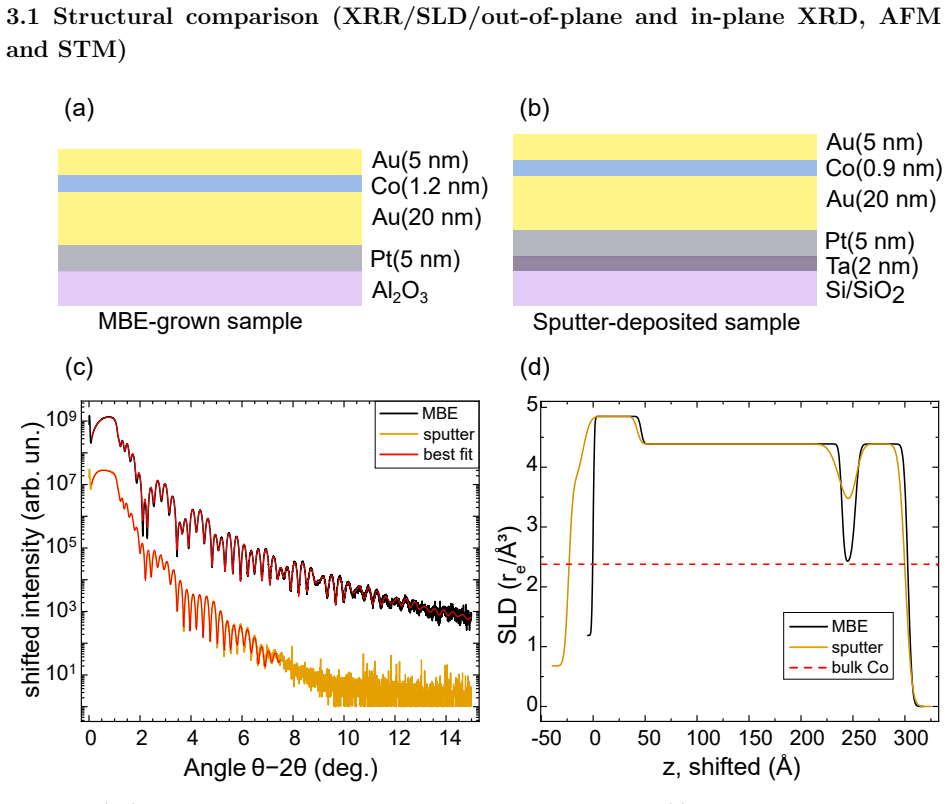
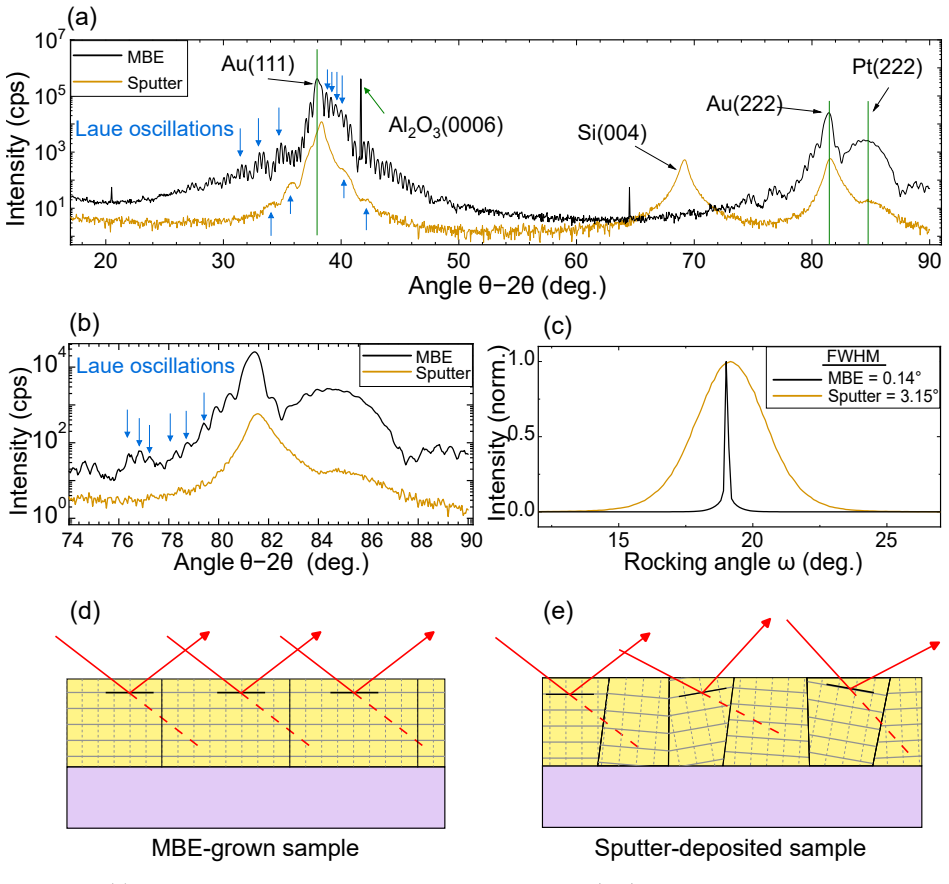
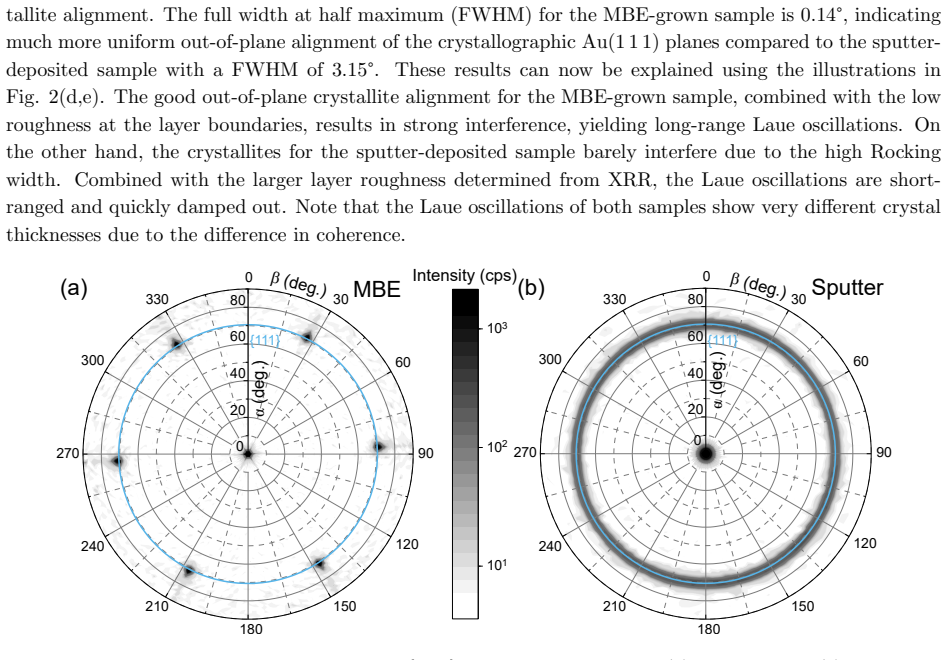
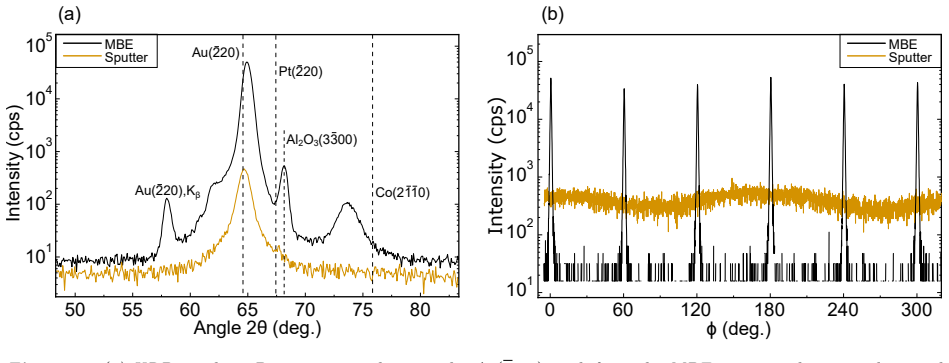
Side-by-side microscopic (scanning tunneling spectroscopy) and macroscopic (magneto-optical Kerr effect) measurements on peptide-exposed MBE-grown versus sputter-deposited Au/Co/Au films, with supporting X-ray reflectivity, diffraction, and surface imaging to characterize microstructure differences.
If this is right
- Local CISS effects remain accessible with either deposition technique provided locally smooth Au(111) regions exist.
- Macroscopic MIPAC-type magnetic modifications require the grain or interface features typical of sputter deposition.
- Sharper interfaces produced by MBE do not enhance or suppress the local CISS magnitude.
- Device concepts relying on MIPAC must account for deposition-method dependence at the macroscopic scale.
Where Pith is reading between the lines
- Grain boundaries or roughness present in sputtered films may enable the collective magnetic response underlying MIPAC while being absent in MBE films.
- Spintronic devices that need only microscopic CISS can tolerate a wider range of fabrication methods than those that also require MIPAC.
- Systematic variation of grain size or defect density in future films could map the threshold microstructure needed for observable MIPAC.
Load-bearing premise
Peptide adsorption conditions, surface cleanliness, and measurement setups are equivalent between the two film types so that observed differences can be attributed only to deposition-induced microstructure variations.
What would settle it
Detection of clearly different CISS magnitudes in scanning tunneling spectroscopy between the two sample types, or detection of comparable macroscopic coercivity and domain-wall changes in the MBE sample, would undermine the claimed separation of microscopic robustness from macroscopic microstructure sensitivity.
Figures

read the original abstract
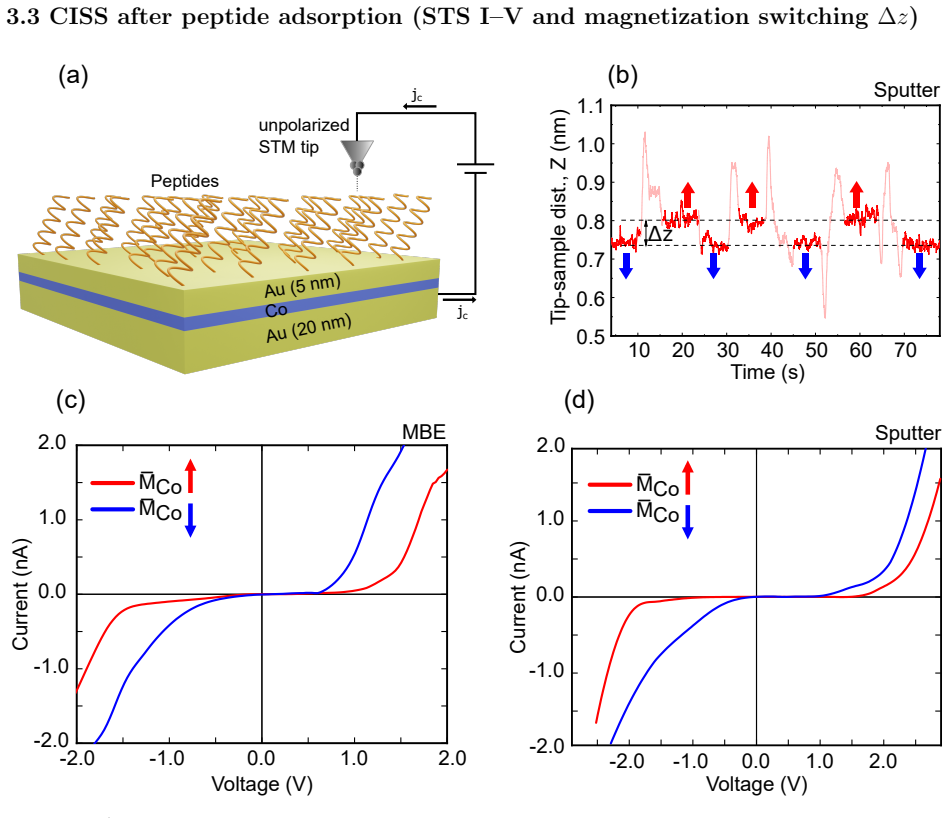
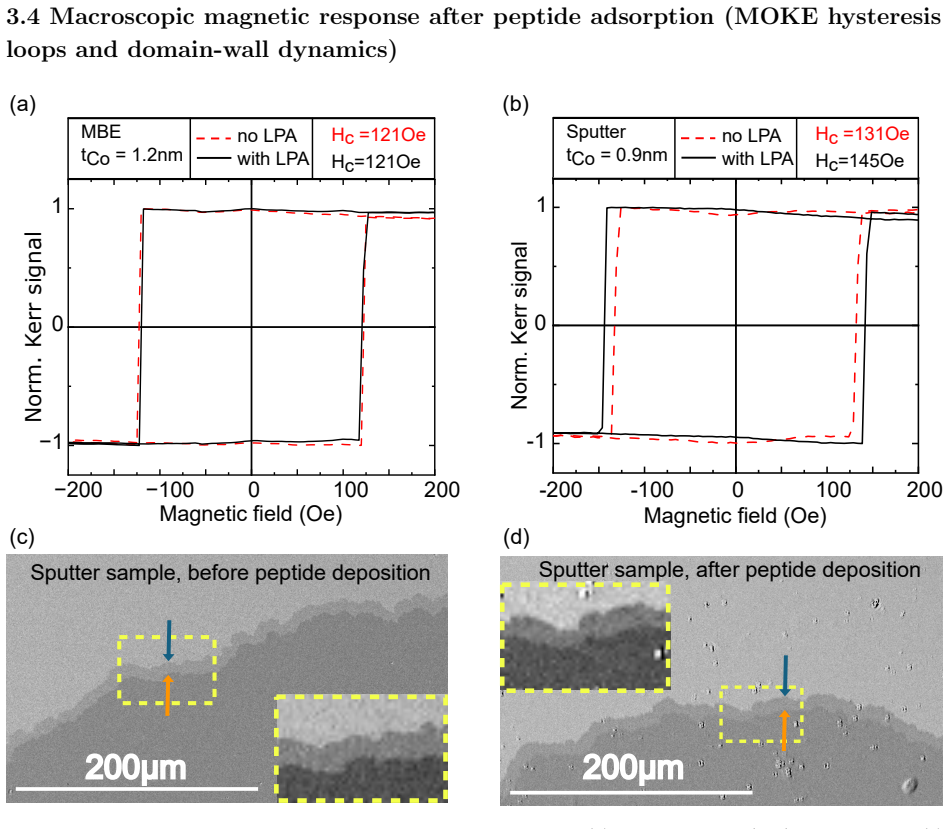
Chirality-induced spin selectivity (CISS) enables spin-dependent transport at chiral molecule/Au(111) interfaces and is used in spintronics when combined with ferromagnetic thin films in spin-valve-type hybrids. However, the influence of substrate microstructure on CISS and the related magnetization induced by the proximity of adsorbed chiral molecules (MIPAC) effect is still not well understood. In this study, we compare the effects of the adsorption of L-chiral alpha-helical alanine-rich peptides on Au/Co/Au ferromagnetic thin films fabricated by molecular beam epitaxy (MBE) and magnetron sputtering. X-ray reflectivity and X-ray diffraction show sharper interfaces and a narrower Au(111) rocking-curve width for the MBE-grown sample. However, atomic force microscopy and scanning tunneling microscopy images reveal that both sample types have locally smooth Au(111) surface regions suitable for peptide adsorption, despite clear differences in larger-scale morphology. Microscopic scanning tunneling spectroscopy after peptide exposure yields similar magnetization-direction-dependent tunneling currents in both sample types, confirming a similar magnitude CISS effect on the molecular scale. In contrast, macroscopic magneto-optical Kerr effect hysteresis loops and effect microscopy reveals that only sputter-deposited samples show slight coercivity enhancements and a consistent reduction in domain wall velocity after peptide exposure. These results suggest that microscopic CISS signatures are robust for both sample types, whereas macroscopic MIPAC-type magnetic responses are more sensitive to the substrate microstructure.
Editorial analysis
A structured set of objections, weighed in public.
Referee Report
Summary. The manuscript compares MBE-grown versus sputter-deposited Au/Co/Au thin films using XRR, XRD, AFM, STM/STS, and MOKE before and after L-chiral peptide adsorption. It reports similar local Au(111) smoothness and magnetization-dependent tunneling currents (CISS) in both film types via STS, but observes coercivity enhancement and reduced domain-wall velocity only in the sputtered films via MOKE, concluding that microscopic CISS is robust while macroscopic MIPAC responses are microstructure-sensitive.
Significance. If the attribution of MIPAC differences to microstructure holds after controls, the distinction between scale-dependent responses would be useful for CISS-based spintronics fabrication. The multi-technique characterization (XRR/XRD for interfaces, AFM/STM for local morphology, STS for local CISS, MOKE for macro magnetism) is a positive aspect of the experimental design.
major comments (2)
- [Abstract] Abstract: The central claim that 'macroscopic MIPAC-type magnetic responses are more sensitive to the substrate microstructure' requires that peptide adsorption conditions, coverage, and interface quality are equivalent between MBE and sputtered films. No quantitative cross-checks (XPS coverage, ellipsometry thickness, or identical MOKE sweep protocols) are described, so the observed MOKE contrast cannot be cleanly attributed to microstructure rather than adsorption variables.
- [Abstract] Abstract and Results (MOKE and STS sections): The reported differences in coercivity and domain-wall velocity are described qualitatively without error bars, standard deviations, number of samples measured, or statistical tests. This makes it impossible to assess whether the 'slight' enhancements and velocity reductions are significant or reproducible, directly weakening the differential-sensitivity conclusion.
minor comments (1)
- [Abstract] The abstract and figure captions would benefit from explicit statement of the number of independent samples and measurement repetitions for each technique.
Simulated Author's Rebuttal
We thank the referee for the careful reading and constructive comments on our manuscript. We address each major point below, indicating where revisions will be made to improve clarity and rigor while preserving the core findings.
read point-by-point responses
-
Referee: [Abstract] Abstract: The central claim that 'macroscopic MIPAC-type magnetic responses are more sensitive to the substrate microstructure' requires that peptide adsorption conditions, coverage, and interface quality are equivalent between MBE and sputtered films. No quantitative cross-checks (XPS coverage, ellipsometry thickness, or identical MOKE sweep protocols) are described, so the observed MOKE contrast cannot be cleanly attributed to microstructure rather than adsorption variables.
Authors: We agree that explicit confirmation of equivalent adsorption conditions strengthens the attribution to microstructure. XRR data already quantify sharper interfaces in MBE films, while AFM/STM and STS confirm locally comparable Au(111) smoothness and identical CISS signatures in both film types. MOKE measurements were performed with identical sweep protocols, field ranges, and sample mounting for both sets. Although XPS and ellipsometry coverage data are not available, the local-probe equivalence at the molecular scale supports that differences in macroscopic response arise from microstructure rather than adsorption variability. We will revise the abstract and methods to explicitly state the identical MOKE protocols and add a brief discussion of this limitation. revision: partial
-
Referee: [Abstract] Abstract and Results (MOKE and STS sections): The reported differences in coercivity and domain-wall velocity are described qualitatively without error bars, standard deviations, number of samples measured, or statistical tests. This makes it impossible to assess whether the 'slight' enhancements and velocity reductions are significant or reproducible, directly weakening the differential-sensitivity conclusion.
Authors: We concur that quantitative presentation of the MOKE results is needed. In the revised manuscript we will add error bars to coercivity values, report the number of samples and independent measurements, include standard deviations, and note the reproducibility across runs. Domain-wall velocity data from magneto-optical microscopy will likewise be accompanied by measurement statistics and a short discussion of variability. These additions will allow direct evaluation of significance without changing the reported trends. revision: yes
Circularity Check
No circularity: purely experimental comparison with no derivations or self-referential predictions
full rationale
The paper is a side-by-side experimental characterization of MBE-grown versus sputter-deposited Au/Co/Au films. All reported contrasts (sharper interfaces via XRR/XRD for MBE, locally smooth Au(111) regions via AFM/STM for both, similar CISS via STS tunneling currents, and MIPAC-type MOKE differences only in sputtered samples) rest on direct measurements without equations, fitted parameters renamed as predictions, or load-bearing self-citations. No derivation chain exists that could reduce to the authors' own inputs by construction. The central claim that microscopic CISS is robust while macroscopic MIPAC responses are microstructure-sensitive follows from the presented data sets rather than from any definitional or self-referential step.
Axiom & Free-Parameter Ledger
axioms (1)
- domain assumption Standard thin-film deposition and characterization techniques (MBE, sputtering, XRR, XRD, AFM, STM, MOKE) produce reliable, comparable data when applied to Au/Co/Au systems.
Reference graph
Works this paper leans on
-
[1]
K. Ray, S. P. Ananthavel, D. H. Waldeck, and R. Naaman. Asymmetric Scattering of Polarized Electrons by Organized Organic Films of Chiral Molecules.Science, 283(5403):814–816, February 1999. doi: 10.1126/science.283.5403.814
-
[2]
R. Naaman and David H. Waldeck. Chiral-Induced Spin Selectivity Effect.The Journal of Physical Chemistry Letters, 3(16):2178–2187, August 2012. doi: 10.1021/jz300793y
-
[3]
Brian P. Bloom, Yossi Paltiel, Ron Naaman, and David H. Waldeck. Chiral Induced Spin Selectivity. Chemical Reviews, 124(4):1950–1991, February 2024. ISSN 0009-2665, 1520-6890. doi: 10.1021/acs. chemrev.3c00661
work page doi:10.1021/acs 1950
-
[4]
Markus, Sidney R
Zouti Xie, Tal Z. Markus, Sidney R. Cohen, Zeev Vager, Rafael Gutierrez, and Ron Naaman. Spin Specific Electron Conduction through DNA Oligomers.Nano Letters, 11(11):4652–4655, November
- [5]
-
[6]
J. J. Wei, C. Schafmeister, G. Bird, A. Paul, R. Naaman, and D. H. Waldeck. Molecular Chirality and Charge Transfer through Self-Assembled Scaffold Monolayers.The Journal of Physical Chemistry B, 110(3):1301–1308, January 2006. ISSN 1520-6106. doi: 10.1021/jp055145c
-
[7]
S. G. Ray, S. S. Daube, G. Leitus, Z. Vager, and R. Naaman. Chirality-Induced Spin-Selective Properties of Self-Assembled Monolayers of DNA on Gold.Physical Review Letters, 96(3):036101, January 2006. ISSN 0031-9007, 1079-7114. doi: 10.1103/PhysRevLett.96.036101
-
[8]
Aragon` es, Ernesto Medina, Miriam Ferrer-Huerta, Nuria Gimeno, Meritxell Teixid´ o, Julio L
Albert C. Aragon` es, Ernesto Medina, Miriam Ferrer-Huerta, Nuria Gimeno, Meritxell Teixid´ o, Julio L. Palma, Nongjian Tao, Jesus M. Ugalde, Ernest Giralt, Ismael D´ ıez-P´ erez, and Vladimiro Mujica. Mea- suring the Spin-Polarization Power of a Single Chiral Molecule.Small, 13(2):1602519, 2017. ISSN 1613-6829. doi: 10.1002/smll.201602519
-
[9]
Mohammad Reza Safari, Frank Matthes, Karl-Heinz Ernst, Daniel E. B¨ urgler, and Claus M. Schnei- der. Deposition of Chiral Heptahelicene Molecules on Ferromagnetic Co and Fe Thin-Film Substrates. Nanomaterials, 12(19):3281, September 2022. ISSN 2079-4991. doi: 10.3390/nano12193281
-
[10]
Matthias Kettner, Volodymyr V. Maslyuk, Daniel N¨ urenberg, Johannes Seibel, Rafael Gutierrez, Gi- anaurelio Cuniberti, Karl-Heinz Ernst, and Helmut Zacharias. Chirality-Dependent Electron Spin Filter- ing by Molecular Monolayers of Helicenes.The Journal of Physical Chemistry Letters, 9(8):2025–2030, April 2018. doi: 10.1021/acs.jpclett.8b00208
-
[11]
Schneider, Karl-Heinz Ernst, and Daniel E
Mohammad Reza Safari, Frank Matthes, Claus M. Schneider, Karl-Heinz Ernst, and Daniel E. B¨ urgler. Spin-Selective Electron Transport Through Single Chiral Molecules.Small, 20(22):2308233, 2024. ISSN 1613-6829. doi: 10.1002/smll.202308233
-
[12]
Baczewski, and Christoph Tegenkamp
Thi Ngoc Ha Nguyen, Lokesh Rasabathina, Olav Hellwig, Apoorva Sharma, Georgeta Salvan, Shira Yochelis, Yossi Paltiel, Lech T. Baczewski, and Christoph Tegenkamp. Cooperative Effect of Electron Spin Polarization in Chiral Molecules Studied with Non-Spin-Polarized Scanning Tunneling Microscopy. ACS Applied Materials & Interfaces, 14(33):38013–38020, August ...
-
[13]
Thi Ngoc Ha Nguyen, Georgeta Salvan, Olav Hellwig, Yossi Paltiel, Lech Thomasz Baczewski, and Christoph Tegenkamp. The mechanism of the molecular CISS effect in chiral nano-junctions.Chemical Science, 15(36):14905–14912, 2024. ISSN 2041-6520, 2041-6539. doi: 10.1039/D4SC04435E. 18
-
[14]
Apoorva Sharma, Patrick Matthes, Ivan Soldatov, Sri Sai Phani Kanth Arekapudi, Benny B¨ ohm, Ma- rina Lindner, Oleksandr Selyshchev, Nguyen Thi Ngoc Ha, Michael Mehring, Christoph Tegenkamp, Stefan E. Schulz, Dietrich R. T. Zahn, Yossi Paltiel, Olav Hellwig, and Georgeta Salvan. Control of magneto-optical properties of cobalt-layers by adsorption ofα-heli...
-
[15]
Oren Ben Dor, Shira Yochelis, Anna Radko, Kiran Vankayala, Eyal Capua, Amir Capua, See-Hun Yang, Lech Tomasz Baczewski, Stuart Stephen Papworth Parkin, Ron Naaman, and Yossi Paltiel. Magnetiza- tion switching in ferromagnets by adsorbed chiral molecules without current or external magnetic field. Nature Communications, 8:14567, February 2017. ISSN 2041-17...
-
[16]
Exchange Bias Effect of Ferro-/Antiferromagnetic Heterostructures
Florin Radu and Hartmut Zabel. Exchange Bias Effect of Ferro-/Antiferromagnetic Heterostructures. In Hartmut Zabel and Samuel D. Bader, editors,Magnetic Heterostructures: Advances and Perspectives in Spinstructures and Spintransport, pages 97–184. Springer, Berlin, Heidelberg, 2008. ISBN 978-3-540- 73462-8. doi: 10.1007/978-3-540-73462-8 3
-
[17]
Exchange bias.Journal of Magnetism and Magnetic Materials, 192(2): 203–232, February 1999
J Nogu´ es and Ivan K Schuller. Exchange bias.Journal of Magnetism and Magnetic Materials, 192(2): 203–232, February 1999. ISSN 0304-8853. doi: 10.1016/S0304-8853(98)00266-2
-
[18]
S. Maat, K. Takano, S. S. P. Parkin, and Eric E. Fullerton. Perpendicular Exchange Bias of $\mathrm{Co}/\mathrm{Pt}$Multilayers.Physical Review Letters, 87(8):087202, August 2001. doi: 10.1103/PhysRevLett.87.087202
-
[19]
Magnetoresistance effect based on spin-selective transport in nanodevices using chiral molecules.Nanoscale, 17(32):18866–18875, August
Mizuki Matsuzaka, Kotaro Kashima, Koki Terai, Takumi Ueda, Ryunosuke Miyamoto, Takashi Ya- mamoto, Kohei Sambe, Tomoyuki Akutagawa, and Hideo Kaiju. Magnetoresistance effect based on spin-selective transport in nanodevices using chiral molecules.Nanoscale, 17(32):18866–18875, August
-
[20]
ISSN 2040-3372. doi: 10.1039/D5NR01259G
-
[21]
Mathew, Prakash Chandra Mondal, Hagay Moshe, Yitzhak Mastai, and Ron Naaman
Shinto P. Mathew, Prakash Chandra Mondal, Hagay Moshe, Yitzhak Mastai, and Ron Naaman. Non- magnetic organic/inorganic spin injector at room temperature.Applied Physics Letters, 105(24):242408, December 2014. ISSN 0003-6951. doi: 10.1063/1.4904941
-
[22]
Seyedamin Firouzeh, Md Anik Hossain, Juan Manuel Cuerva, Luis ´Alvarez de Cienfuegos, and Sandipan Pramanik. Chirality-Induced Spin Selectivity in Composite Materials: A Device Perspective.Accounts of Chemical Research, 57(10):1478–1487, May 2024. ISSN 0001-4842. doi: 10.1021/acs.accounts.4c00077
-
[23]
Koyel Banerjee-Ghosh, Oren Ben Dor, Francesco Tassinari, Eyal Capua, Shira Yochelis, Amir Capua, See-Hun Yang, Stuart S. P. Parkin, Soumyajit Sarkar, Leeor Kronik, Lech Tomasz Baczewski, Ron Naaman, and Yossi Paltiel. Separation of enantiomers by their enantiospecific interaction with achiral magnetic substrates.Science, 360(6395):1331–1334, June 2018. do...
-
[24]
Amir Ziv, Abhijit Saha, Hen Alpern, Nir Sukenik, Lech Tomasz Baczewski, Shira Yochelis, Meital Reches, and Yossi Paltiel. AFM-Based Spin-Exchange Microscopy Using Chiral Molecules.Advanced Materials, 31(40):1904206, 2019. ISSN 1521-4095. doi: 10.1002/adma.201904206
-
[25]
Shammi Rana, Massimiliano Remigio, Lekshmi Aravindan Geetha, Karol Struty´ nski, Martina Volpi, Sanjay John, Lech Tomasz Baczewski, Yossi Paltiel, Roland Resel, Manuel Melle-Franco, Kunal S. Mali, Yves H. Geerts, and Steven De Feyter. Chirality-Induced Spin Selectivity in Two-Dimensional Self-Assembled Molecular Networks.Journal of the American Chemical S...
-
[26]
Y. H. G. Lin, C. K. Cheng, L. B. Young, L. S. Chiang, W. S. Chen, K. H. Lai, S. P. Chiu, C. T. Wu, C. T. Liang, J. J. Lin, C. H. Hsu, Y. H. Lin, J. Kwo, and M. Hong. Nanometer-thick molecular beam epitaxy Al films capped with in situ deposited Al2O3—High-crystallinity, morphology, and superconductivity. Journal of Applied Physics, 136(7):074401, August 20...
-
[27]
Shammi Rana, Maurizio Mastropasqua Talamo, Navathej Preetha Genesh, David Cornil, Flavia Pop, J´ erˆ ome Cornil, Lech Tomasz Baczewski, Yossi Paltiel, Yves H. Geerts, Kunal S. Mali, Narcis Avarvari, and Steven De Feyter. Enantiospecific Magnetoconductance Asymmetry in a Racemic Conglomerate Driven by Surface-Assisted Symmetry Breaking.Journal of the Ameri...
-
[28]
Thin Film Growth Through Sputtering Technique and Its Applications
Edgar Alfonso, Jairo Olaya, and Gloria Cubillos. Thin Film Growth Through Sputtering Technique and Its Applications. InCrystallization - Science and Technology. IntechOpen, September 2012. ISBN 978-953-51-0757-6 978-953-51-5009-1. doi: 10.5772/35844
-
[29]
Yohaselly Santiago-Rodr´ ıguez, Jeffrey A. Herron, Mar´ ıa C. Curet-Arana, and Manos Mavrikakis. Atomic and molecular adsorption on Au(111).Surface Science, 627:57–69, September 2014. ISSN 0039-6028. doi: 10.1016/j.susc.2014.04.012
-
[30]
Niccol` o Giaconi, Lorenzo Poggini, Michela Lupi, Matteo Briganti, Anil Kumar, Tapan K. Das, An- drea L. Sorrentino, Caterina Viglianisi, Stefano Menichetti, Ron Naaman, Roberta Sessoli, and Matteo Mannini. Efficient Spin-Selective Electron Transport at Low Voltages of Thia-Bridged Triarylamine Het- ero[4]helicenes Chemisorbed Monolayer.ACS Nano, 17(15):1...
-
[31]
S Jomni, N Mliki, R Belhi, K Abdelmoula, M Ayadi, and G Nihoul. Face centred cubic cobalt ultrathin- layers in Au/Co(111) multilayers: A study by electron diffraction and by HREM.Thin Solid Films, 370 (1):186–191, July 2000. ISSN 0040-6090. doi: 10.1016/S0040-6090(00)00916-0
-
[32]
R. F. C. Farrow, G. R. Harp, R. F. Marks, T. A. Rabedeau, M. F. Toney, D. Weller, and S. S. P. Parkin. Epitaxial growth of Pt on basal-plane sapphire: A seed film for artificially layered magnetic metal structures.Journal of Crystal Growth, 133(1):47–58, October 1993. ISSN 0022-0248. doi: 10. 1016/0022-0248(93)90102-3
1993
-
[33]
Rico Ehrler. Manifold role of a Ta adhesion layer in pressure-tuned Co/Pt multilayers.Physical Review B, 112(9), 2025. doi: 10.1103/5g32-ykxx
-
[34]
Yael Kapon, Dror Merhav, Gal Finkelstein-Zuta, Omer Blumen, Naomi Melamed-Book, Yael Levi- Kalisman, Ilya Torchinsky, Shira Yochelis, Daniel Sharon, Lech Tomasz Baczewski, Ehud Gazit, and Yossi Paltiel. Controlling Amyloid Assembly Dynamics Using Spin Interfaces.ACS Nano, 19(31): 28326–28334, August 2025. ISSN 1936-0851. doi: 10.1021/acsnano.5c06285
-
[35]
Th¨ ummler, Jitul Deka, Pranava K
Matthias Rohmer, Yishen Xie, Sandipan Roy, Christian Hildebrand, Justus F. Th¨ ummler, Jitul Deka, Pranava K. Sivakumar, Stuart S. P. Parkin, Thi Ngoc Ha Nguyen, Lech Tomasz Baczewski, Christoph Tegenkamp, and Wolfgang H. Binder. Chiral induced spin selectivity in achiral poly(amino acid)s acting as transducers of centrochiral information via the sergeant...
-
[36]
J. Christopher Love, Lara A. Estroff, Jennah K. Kriebel, Ralph G. Nuzzo, and George M. Whitesides. Self-Assembled Monolayers of Thiolates on Metals as a Form of Nanotechnology.Chemical Reviews, 105(4):1103–1170, April 2005. ISSN 0009-2665. doi: 10.1021/cr0300789. 20
-
[37]
S. Marqusee and R. L. Baldwin. Helix stabilization by Glu-...Lys+ salt bridges in short peptides of de novo design.Proceedings of the National Academy of Sciences of the United States of America, 84(24): 8898–8902, December 1987. ISSN 0027-8424. doi: 10.1073/pnas.84.24.8898
-
[38]
Alanine-Rich Peptide for Spin-Dependent Transport: Synthesis of a 36-mer via Pentamer Assembly
Aleksandr Kazimir, Lokesh Rasabathina, Jannik Knoche, Linda Sch¨ utz, Thi Ngoc Ha Nguyen, Olav Hellwig, Christoph Tegenkamp, Georgeta Salvan, Irene Coin, and Christina Lamers. Alanine-Rich Peptide for Spin-Dependent Transport: Synthesis of a 36-mer via Pentamer Assembly. June 2026. doi: 10.26434/chemrxiv.15004758/v1
-
[39]
Miller, Mellie Lemon, Marisa A
Aaron M. Miller, Mellie Lemon, Marisa A. Choffel, Sarah R. Rich, Fischer Harvel, and David C. Johnson. Extracting information from X-ray diffraction patterns containing Laue oscillations.Zeitschrift f¨ ur Naturforschung B, 77(4-5):313–322, May 2022. ISSN 1865-7117. doi: 10.1515/znb-2022-0020
-
[40]
Castner, Kenneth Hinds, and David W
David G. Castner, Kenneth Hinds, and David W. Grainger. X-ray Photoelectron Spectroscopy Sulfur 2p Study of Organic Thiol and Disulfide Binding Interactions with Gold Surfaces.Langmuir, 12(21): 5083–5086, January 1996. ISSN 0743-7463. doi: 10.1021/la960465w
-
[41]
O. Cavalleri, G. Gonella, S. Terreni, M. Vignolo, L. Floreano, A. Morgante, M. Canepa, and R. Rolandi. High resolution X-ray photoelectron spectroscopy of L-cysteine self-assembled films.Physical Chemistry Chemical Physics, 6(15):4042–4046, July 2004. ISSN 1463-9084. doi: 10.1039/B405516K
-
[42]
O Cavalleri, L Oliveri, A Dacc` a, R Parodi, and R Rolandi. XPS measurements on l-cysteine and 1- octadecanethiol self-assembled films: A comparative study.Applied Surface Science, 175–176:357–362, May 2001. ISSN 0169-4332. doi: 10.1016/S0169-4332(01)00067-8
-
[43]
A Artemenko, A Shchukarev, P ˇStenclov´ a, T W˚ agberg, J Segervald, X Jia, and A Kromka. Reference XPS spectra of amino acids.IOP Conference Series: Materials Science and Engineering, 1050(1): 012001, January 2021. ISSN 1757-899X. doi: 10.1088/1757-899X/1050/1/012001
-
[44]
Luca Gnoli, Mattia Benini, Corrado Del Conte, Alberto Riminucci, Rajib K. Rakshit, Manju Singh, Samuele Sanna, Roshni Yadav, Ko-Wei Lin, Alessio Mezzi, Simona Achilli, Elena Molteni, Marco Marino, Guido Fratesi, Valentin Dediu, and Ilaria Bergenti. Enhancement of Magnetic Stability in Antiferromagnetic CoO Films by Adsorption of Organic Molecules.ACS Appl...
-
[45]
Yao-Jane Hsu, Yu-Ling Lai, Chih-Han Chen, Ying-Chang Lin, Hsiu-Yun Chien, Jeng-Han Wang, Tu- Ngoc Lam, Yuet-Loy Chan, D. H. Wei, Hong-Ji Lin, and Chien-Te Chen. Enhanced Magnetic Anisotropy via Quasi-Molecular Magnet at Organic-Ferromagnetic Contact.The Journal of Physical Chemistry Letters, 4(2):310–316, January 2013. doi: 10.1021/jz301757x
-
[46]
Mattia Benini, Andrei Shumilin, Viktor Kabanov, Rajib Kumar Rakshit, Antarjami Sahoo, Anita Halder, Andrea Droghetti, Francesco Cugini, Massimo Solzi, Diego Bisero, Patrizio Graziosi, Alberto Riminucci, Ilaria Bergenti, Manju Singh, Luca Gnoli, Samuele Sanna, Mirko Cinchetti, Tomaz Mertelj, Stefano Sanvito, and Valentin Alek Dediu. Collapse of the standar...
discussion (0)
Sign in with ORCID, Apple, or X to comment. Anyone can read and Pith papers without signing in.