The NANOGrav 15 yr Data Set: Customized Chromatic Noise Models
Pith reviewed 2026-06-30 01:17 UTC · model grok-4.3
The pith
Customized chromatic noise models reclassify some achromatic noise as interstellar in 19 of 67 NANOGrav pulsars.
A machine-rendered reading of the paper's core claim, the machinery that carries it, and where it could break.
Core claim
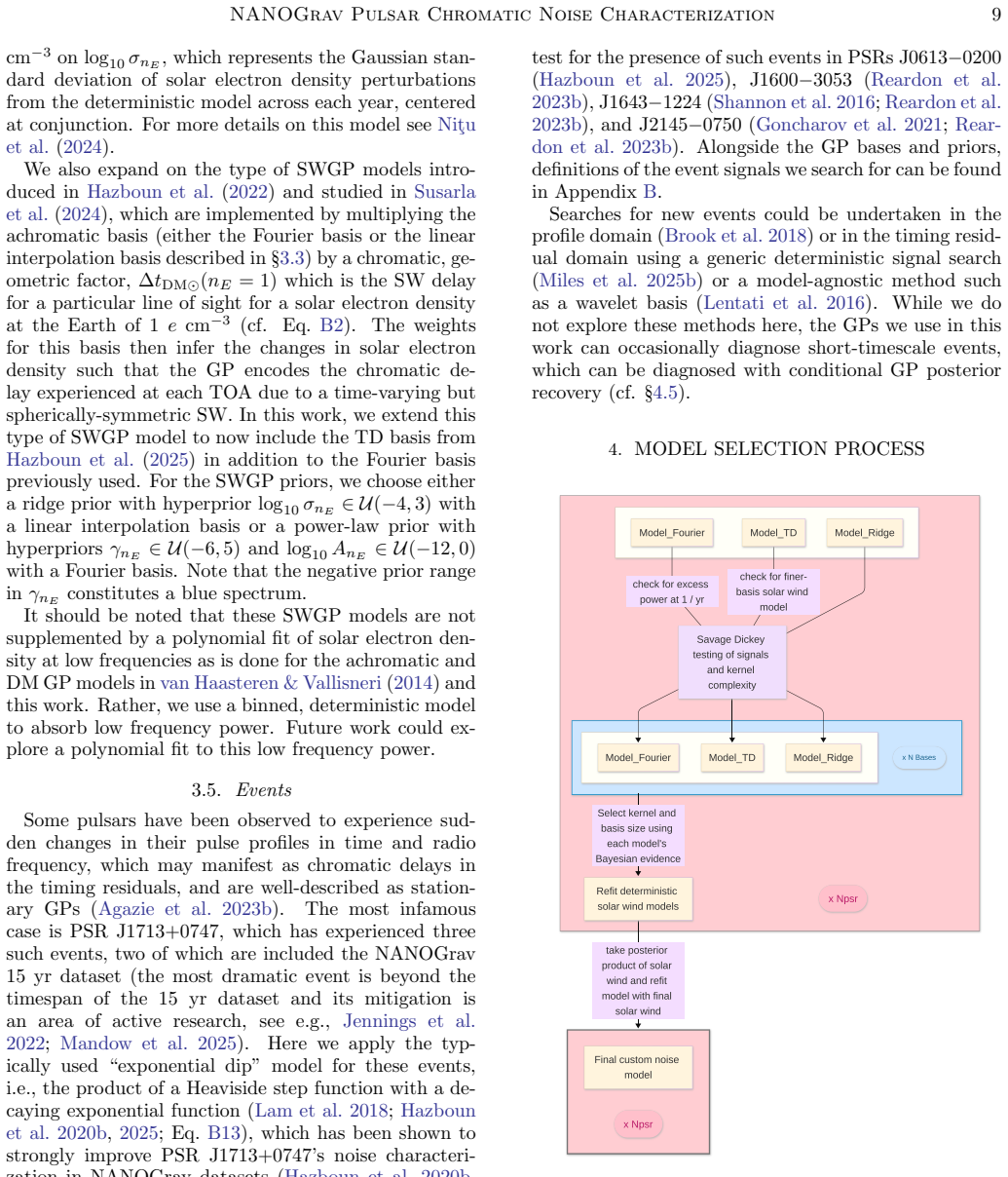
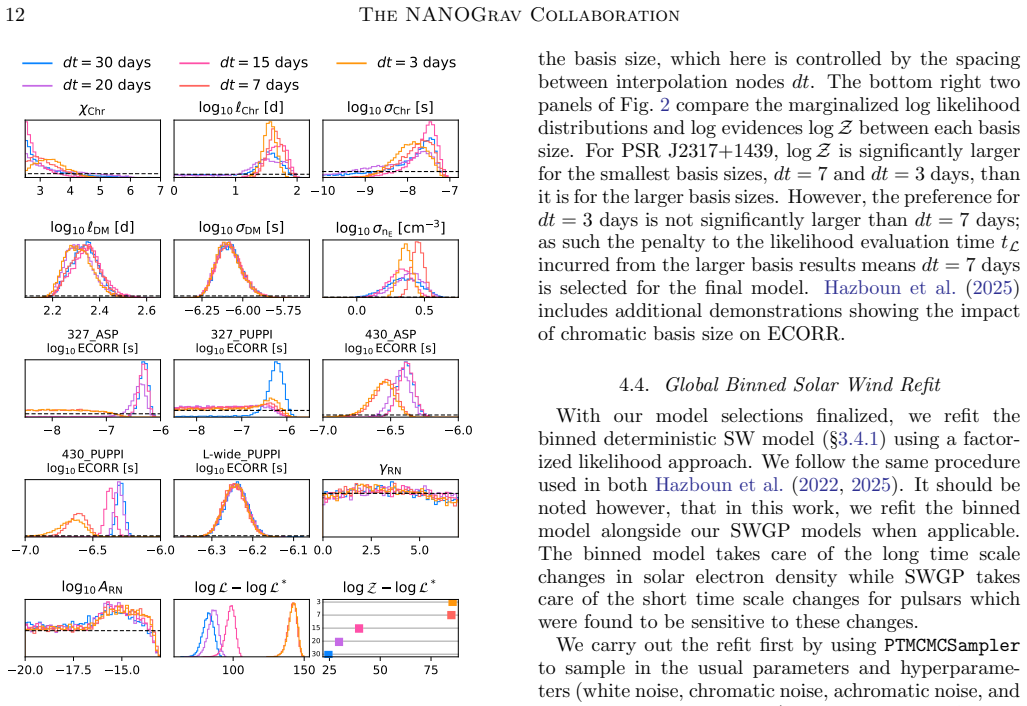
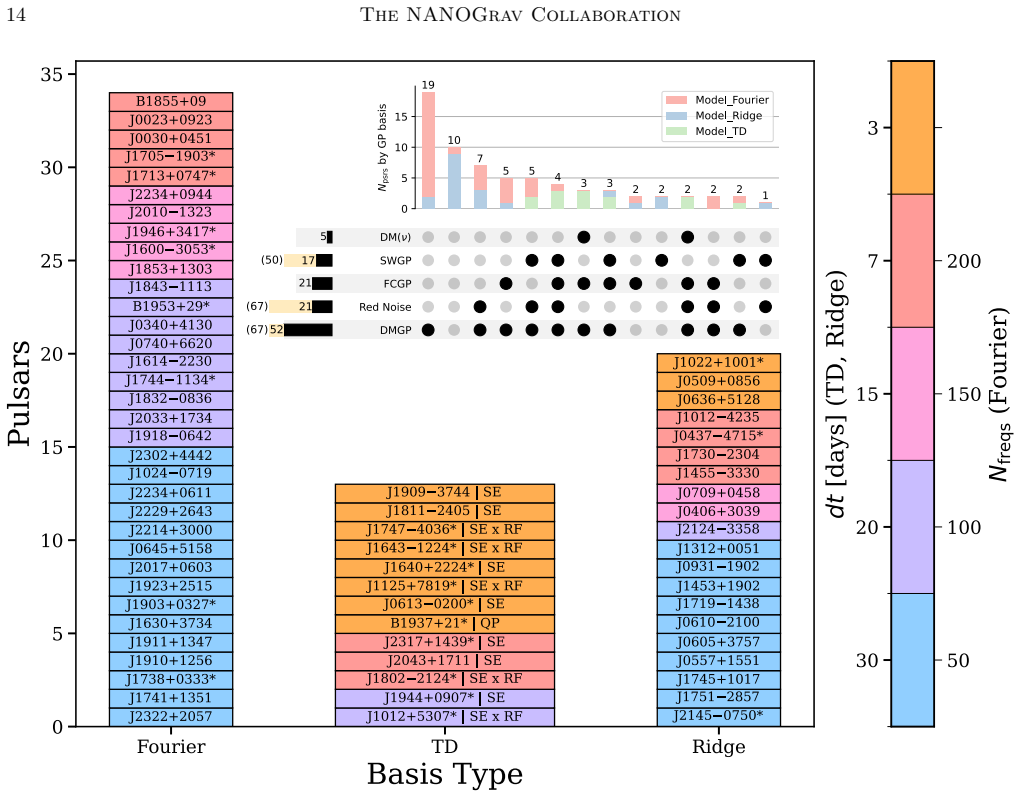
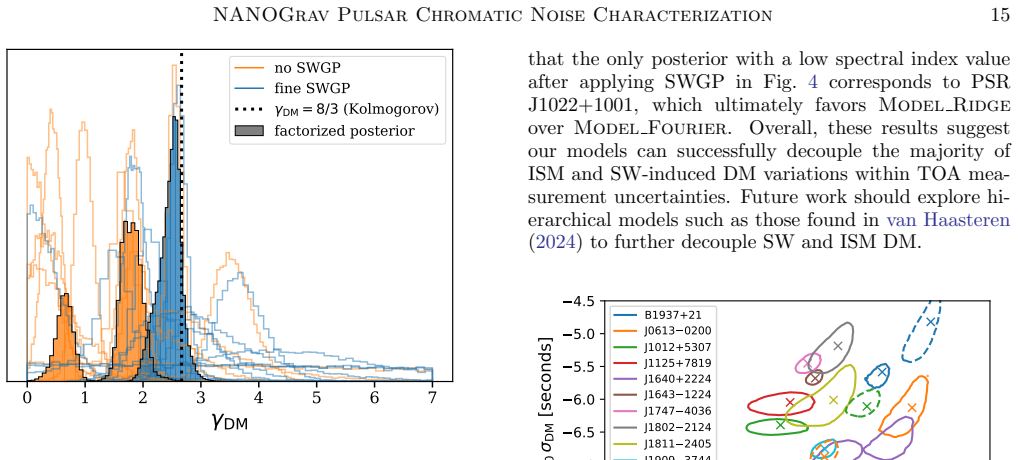
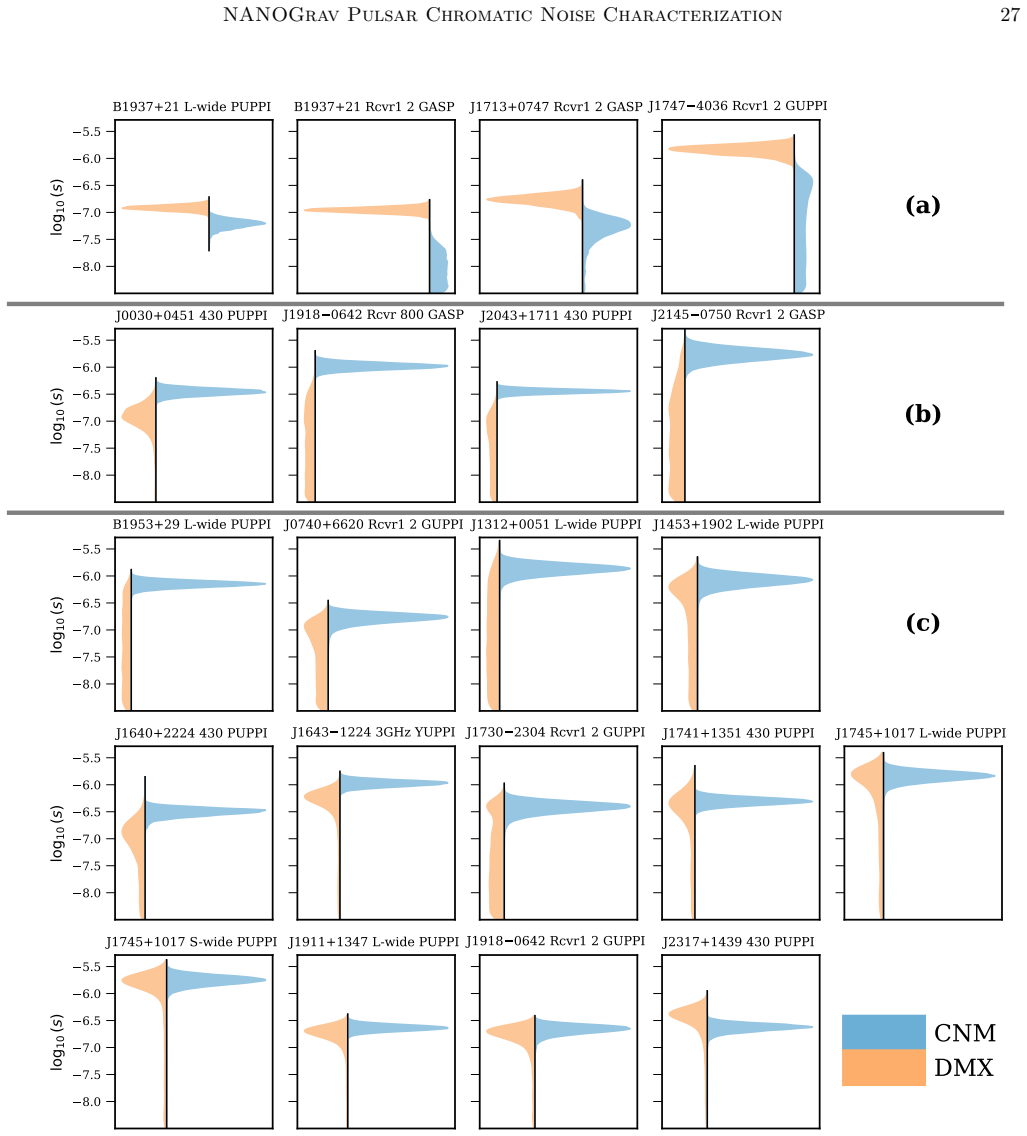
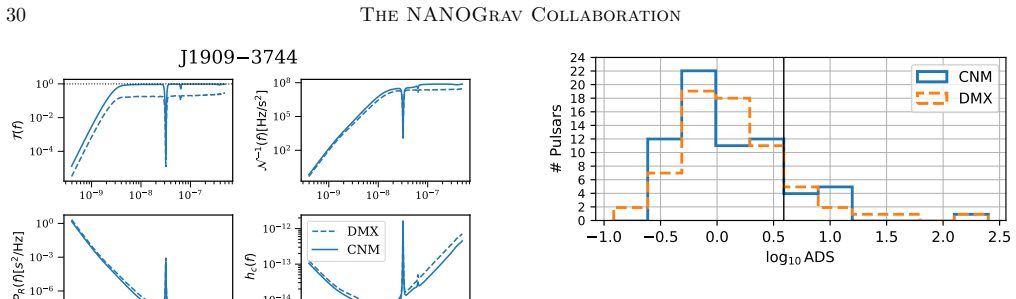
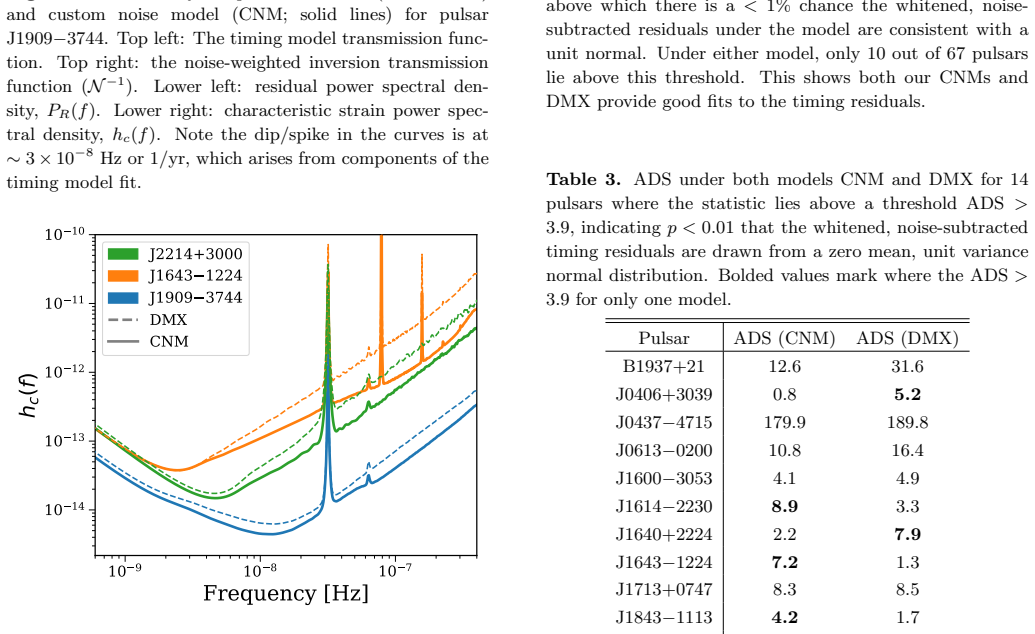
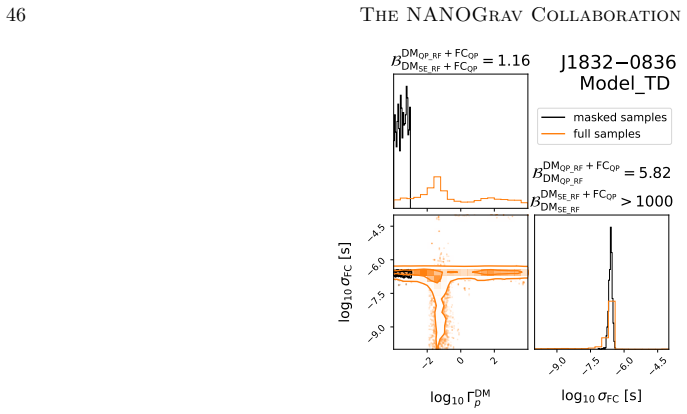
We present customized chromatic noise models for 67 pulsars in the NANOGrav 15 yr dataset. These models are selected from an expanded suite of Gaussian processes to simultaneously characterize multiple types of chromatic delays and are tailored to each pulsar's dataset. After applying our chromatic models, we observe significant impacts on the inference of achromatic noise in 19 out of 67 pulsars, finding in several cases that a previously significant achromatic noise process can be partially or entirely described as chromatic.
What carries the argument
Per-pulsar selection from an expanded suite of Gaussian processes that jointly model multiple chromatic delay processes.
If this is right
- Refined per-pulsar chromatic modeling is required to avoid biasing gravitational-wave searches in pulsar timing arrays.
- Some noise previously treated as intrinsic or achromatic can be reattributed to interstellar propagation.
- Solar-wind electron density can be tracked over multiple solar cycles using the same timing data.
- Non-dispersive chromatic delays appear in roughly one-third of the observed pulsars.
Where Pith is reading between the lines
- Future PTA analyses that adopt similar per-pulsar chromatic suites may recover weaker gravitational-wave backgrounds than current achromatic-only models allow.
- The same modeling strategy could be applied to other PTA datasets to test whether the fraction of reclassified noise is consistent across instruments.
- Independent multi-frequency observations of the same pulsars could confirm whether the newly identified non-dispersive chromatic delays persist.
Load-bearing premise
The selected Gaussian processes capture the true chromatic delays without substantial overfitting or unmodeled residuals that would change the inferred achromatic noise.
What would settle it
Repeating the full noise analysis on the identical 15-year timing residuals but with the chromatic models turned off, and finding that the achromatic noise parameters for the 19 affected pulsars remain unchanged within their reported uncertainties.
Figures
read the original abstract
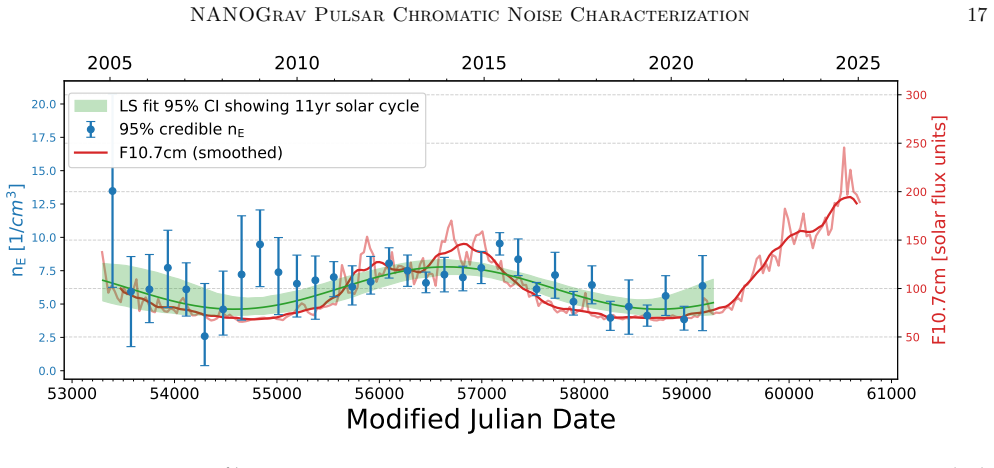
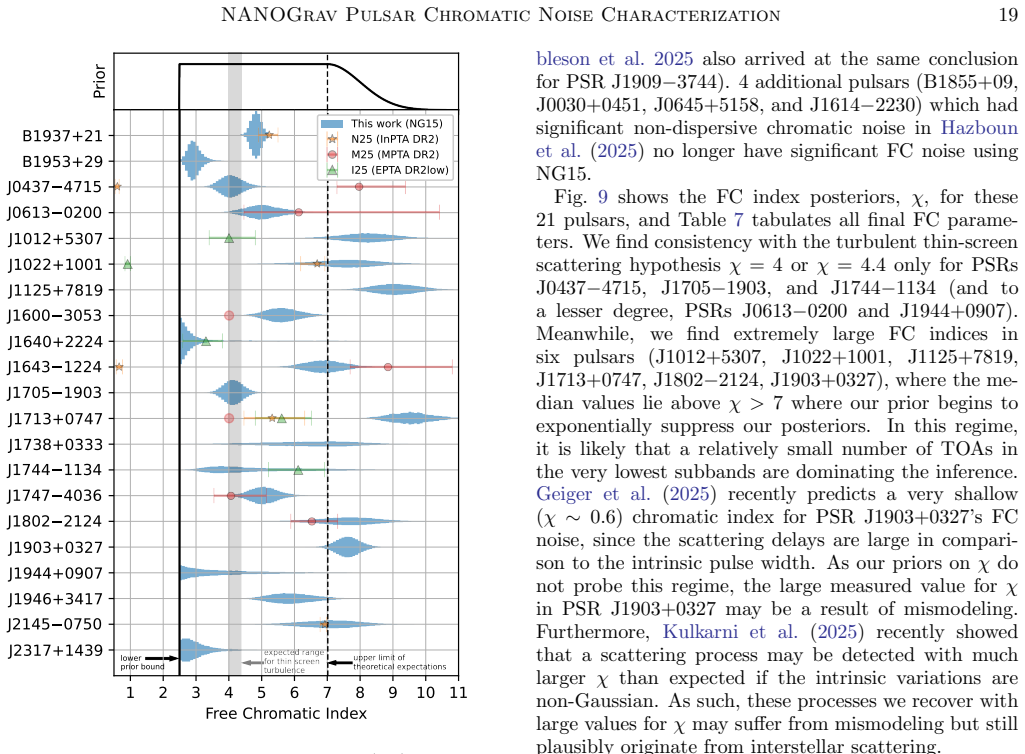
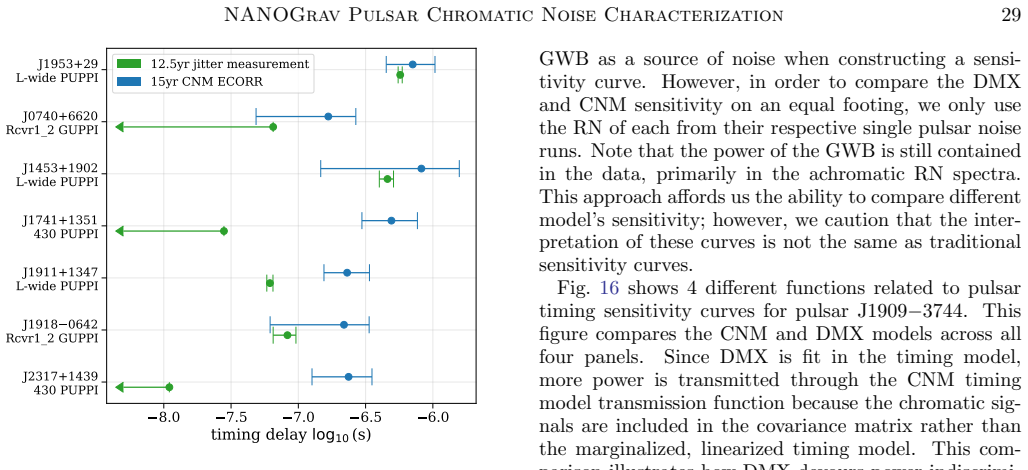
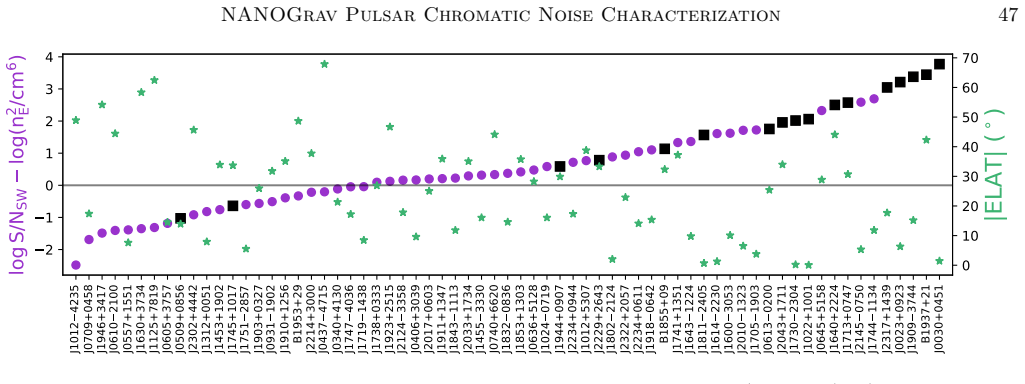
Pulsar timing arrays conduct low-frequency gravitational wave searches, which require comprehensive accounting of various noise sources to achieve robust results. Interstellar propagation effects (e.g., dispersion and scattering) are especially complex noise sources, introducing chromatic delays that can reduce sensitivity to gravitational waves and bias their inference if left unmodeled. These delays also strongly depend on the line of sight properties to each individual pulsar. To address this, we present customized chromatic noise models for 67 pulsars in the NANOGrav 15 yr dataset. These models are selected from an expanded suite of Gaussian processes to simultaneously characterize multiple types of chromatic delays and are tailored to each pulsar's dataset. Alongside probing the interstellar medium, we use these models to infer the solar wind electron density over the course of $\sim 1.5$ solar cycles. We also find evidence for non-dispersive chromatic delays in 21 out of 67 NANOGrav pulsars. After applying our chromatic models, we observe significant impacts on the inference of achromatic noise in 19 out of 67 pulsars, finding in several cases that a previously significant achromatic noise process can be partially or entirely described as chromatic. These results demonstrate that refined noise modeling is essential to enhance the sensitivity and accuracy of low-frequency gravitational wave searches with pulsar timing arrays.
Editorial analysis
A structured set of objections, weighed in public.
Referee Report
Summary. The paper develops per-pulsar customized chromatic noise models drawn from an expanded suite of Gaussian processes for the 67 pulsars in the NANOGrav 15 yr data set. These models are used to characterize multiple chromatic delays (including non-dispersive components), to estimate solar-wind electron density over ~1.5 solar cycles, and to reassess achromatic red-noise parameters; the central empirical result is that the new models produce statistically significant changes to achromatic-noise inferences in 19 pulsars and allow previously significant achromatic processes to be re-described as chromatic in several cases.
Significance. If the separation between chromatic and achromatic components is robust, the work supplies a practical, pulsar-specific noise-modeling framework that directly improves the fidelity of low-frequency gravitational-wave searches. The solar-wind time series and the detection of non-dispersive chromatic delays in 21 pulsars are additional concrete deliverables that can be tested against independent ISM observations.
major comments (3)
- [Abstract, §4] Abstract and §4 (model-selection procedure): the headline claim that achromatic noise is significantly impacted in 19/67 pulsars rests on per-pulsar GP model selection from an expanded suite, yet the manuscript supplies no quantitative guardrails (e.g., posterior-predictive checks, injection-recovery statistics, or cross-validation across frequency bands) that would rule out the possibility that a flexible chromatic kernel is absorbing achromatic power. This is load-bearing for the central claim.
- [§5.2] §5.2 (achromatic-noise re-assessment): the statement that “a previously significant achromatic noise process can be partially or entirely described as chromatic” is presented without reporting the change in Bayes factor or the fractional reduction in achromatic amplitude for the affected pulsars; without these numbers it is impossible to judge whether the re-attribution is driven by genuine chromatic structure or by the increased flexibility of the new model set.
- [§3.3] §3.3 (solar-wind modeling): the inference of solar-wind electron density is obtained by fitting the same per-pulsar GP suite; the manuscript does not demonstrate that the solar-wind component remains identifiable when the chromatic GP hyperparameters are allowed to vary freely, raising the possibility that part of the reported solar-wind signal is an artifact of the joint fit.
minor comments (3)
- [§2] Notation for the chromatic GP kernels is introduced without a compact table summarizing the functional forms and hyperparameter priors; a single reference table would improve readability.
- [Fig. 7] Figure captions for the solar-wind time series do not state the exact frequency bands or the number of frequency channels used in each pulsar’s fit.
- [Introduction] The manuscript cites earlier NANOGrav noise-model papers but does not explicitly compare the new per-pulsar chromatic models against the fixed chromatic models used in the 15 yr GW search paper; a short quantitative comparison would strengthen the narrative.
Simulated Author's Rebuttal
We thank the referee for their careful reading and constructive comments, which have helped us identify areas where the manuscript can be strengthened. We address each major comment below and indicate the revisions we will make.
read point-by-point responses
-
Referee: [Abstract, §4] Abstract and §4 (model-selection procedure): the headline claim that achromatic noise is significantly impacted in 19/67 pulsars rests on per-pulsar GP model selection from an expanded suite, yet the manuscript supplies no quantitative guardrails (e.g., posterior-predictive checks, injection-recovery statistics, or cross-validation across frequency bands) that would rule out the possibility that a flexible chromatic kernel is absorbing achromatic power. This is load-bearing for the central claim.
Authors: We agree that additional validation metrics would strengthen confidence in the separation of chromatic and achromatic components. Model selection in the current analysis relies on Bayesian evidence ratios obtained via nested sampling, which already supplies a quantitative preference for the inclusion of specific chromatic kernels. To directly address the concern about possible absorption of achromatic power, we will add posterior-predictive checks and a brief injection-recovery test for a subset of pulsars in the revised manuscript. revision: yes
-
Referee: [§5.2] §5.2 (achromatic-noise re-assessment): the statement that “a previously significant achromatic noise process can be partially or entirely described as chromatic” is presented without reporting the change in Bayes factor or the fractional reduction in achromatic amplitude for the affected pulsars; without these numbers it is impossible to judge whether the re-attribution is driven by genuine chromatic structure or by the increased flexibility of the new model set.
Authors: We acknowledge that explicit quantification of the changes would improve interpretability. The revised manuscript will include a table (or supplementary material) reporting, for each of the 19 affected pulsars, the change in log-evidence when the additional chromatic terms are included and the fractional reduction in the achromatic red-noise amplitude (or its upper limit) relative to the original model. revision: yes
-
Referee: [§3.3] §3.3 (solar-wind modeling): the inference of solar-wind electron density is obtained by fitting the same per-pulsar GP suite; the manuscript does not demonstrate that the solar-wind component remains identifiable when the chromatic GP hyperparameters are allowed to vary freely, raising the possibility that part of the reported solar-wind signal is an artifact of the joint fit.
Authors: The solar-wind contribution is implemented as a deterministic, geometry-dependent function whose amplitude is allowed to vary with time, while the Gaussian-process kernels capture stochastic chromatic processes. We will add a dedicated subsection showing that the recovered solar-wind densities remain stable when the GP hyperparameters are marginalized or fixed to alternative values, together with a short discussion of any residual degeneracies. revision: yes
Circularity Check
No significant circularity; empirical per-pulsar GP fitting to timing data
full rationale
The paper describes selection and fitting of Gaussian-process chromatic noise models from an expanded suite to NANOGrav timing residuals for 67 pulsars. Reported outcomes (impacts on achromatic noise in 19/67 pulsars, solar-wind density inference, non-dispersive delays in 21/67) are direct results of these data-driven fits. No equations, self-citations, or ansatzes reduce any claimed quantity to a definition or prior fit by construction. The analysis is self-contained against external timing data benchmarks and does not invoke load-bearing self-citations or uniqueness theorems. This is the expected non-finding for a statistical modeling study.
Axiom & Free-Parameter Ledger
free parameters (1)
- Gaussian process hyperparameters per pulsar
axioms (1)
- domain assumption Gaussian processes with chosen kernels can adequately represent the combination of dispersion, scattering, and other chromatic delays in pulsar timing residuals
Reference graph
Works this paper leans on
-
[1]
Pulsar Timing Arrays Require Hierarchical Models. , keywords =. doi:10.3847/1538-4365/ad530f , archivePrefix =. 2406.05081 , primaryClass =
-
[2]
A periodically active pulsar giving insight into magnetospheric physics
A Periodically Active Pulsar Giving Insight into Magnetospheric Physics. Science , keywords =. doi:10.1126/science.1124060 , archivePrefix =. astro-ph/0604605 , primaryClass =
work page internal anchor Pith review Pith/arXiv arXiv doi:10.1126/science.1124060
-
[3]
An Asteroid Belt Interpretation for the Timing Variations of the Millisecond Pulsar B1937+21
An Asteroid Belt Interpretation for the Timing Variations of the Millisecond Pulsar B1937+21. , keywords =. doi:10.1088/0004-637X/766/1/5 , archivePrefix =. 1301.6429 , primaryClass =
work page internal anchor Pith review Pith/arXiv arXiv doi:10.1088/0004-637x/766/1/5
-
[4]
Limitations in timing precision due to single-pulse shape variability in millisecond pulsars
Limitations in timing precision due to single-pulse shape variability in millisecond pulsars. , keywords =. doi:10.1093/mnras/stu1213 , archivePrefix =. 1406.4716 , primaryClass =
work page internal anchor Pith review Pith/arXiv arXiv doi:10.1093/mnras/stu1213
-
[5]
Evaluating the prevalence of spurious correlations in pulsar timing array data sets. , keywords =. doi:10.1093/mnras/stac2100 , archivePrefix =. 2207.12237 , primaryClass =
-
[6]
The NANOGrav 12.5 yr Data Set: The Frequency Dependence of Pulse Jitter in Precision Millisecond Pulsars. , keywords =. doi:10.3847/1538-4357/ab01cd , archivePrefix =. 1809.03058 , primaryClass =
work page internal anchor Pith review Pith/arXiv arXiv doi:10.3847/1538-4357/ab01cd
-
[7]
Cordes and Stella Koch Ocker and Shami Chatterjee and Timothy Dolch and Ross J
James M. Cordes and Stella Koch Ocker and Shami Chatterjee and Timothy Dolch and Ross J. Jennings and Michael T. Lam and Jacob E. Turner , title =. , year =
-
[8]
The NANOGrav 12.5-Year Data Set: Dispersion Measure Misestimations with Varying Bandwidths. , keywords =. doi:10.3847/1538-4357/ad2858 , archivePrefix =. 2307.13248 , primaryClass =
-
[9]
Where are the supermassive black holes measured by PTAs?. , keywords =. doi:10.1103/PhysRevD.110.063020 , adsurl =
-
[10]
A Cyclic Spectroscopy Scintillation Study of PSR B1937+21. I. Demonstration of Improved Scintillometry. , keywords =. doi:10.3847/1538-4357/ad5af9 , archivePrefix =. 2404.13796 , primaryClass =
-
[11]
Customised Single-Pulsar Noise Analysis and Noise Budget
The Indian Pulsar Timing Array Data Release 2: II. Customised Single-Pulsar Noise Analysis and Noise Budget. arXiv e-prints , keywords =. doi:10.48550/arXiv.2512.20455 , archivePrefix =. 2512.20455 , primaryClass =
-
[12]
Optimising the MeerKAT Pulsar Timing Array and towards precision pulsar timing with SKA-mid. arXiv e-prints , keywords =. doi:10.48550/arXiv.2510.03139 , archivePrefix =. 2510.03139 , primaryClass =
-
[13]
Pulsar timing methods for evaluating dispersion measure time series. , keywords =. doi:10.1051/0004-6361/202450740 , archivePrefix =. 2410.22170 , primaryClass =
-
[14]
An improved solar wind electron-density model for pulsar timing
An Improved Solar Wind Electron Density Model for Pulsar Timing. , keywords =. doi:10.1086/522227 , archivePrefix =. 0709.0135 , primaryClass =
work page internal anchor Pith review Pith/arXiv arXiv doi:10.1086/522227
-
[15]
Ultra-Wideband Polarimetry of the April 2021 Profile Change Event in PSR J1713+0747 , journal =
2021
-
[16]
Taylor , title =
Stephen R. Taylor , title =. 2021 , note =
2021
-
[17]
F10.7 cm Solar Radio Flux Data , howpublished =
-
[18]
The 10.7 cm solar radio flux (F _ 10.7 ). Space Weather , keywords =. doi:10.1002/swe.20064 , adsurl =
-
[19]
Recursive Pathways to Marginal Likelihood Estimation with Prior-Sensitivity Analysis
Recursive Pathways to Marginal Likelihood Estimation with Prior-Sensitivity Analysis. arXiv e-prints , keywords =. doi:10.48550/arXiv.1301.6450 , archivePrefix =. 1301.6450 , primaryClass =
work page internal anchor Pith review Pith/arXiv arXiv doi:10.48550/arxiv.1301.6450
-
[20]
Simulating Normalizing Constants: From Importance Sampling to Bridge Sampling to Path Sampling , urldate =
Andrew Gelman and Xiao-Li Meng , journal =. Simulating Normalizing Constants: From Importance Sampling to Bridge Sampling to Path Sampling , urldate =
-
[21]
A comprehensive Bayesian approach to gravitational wave astronomy
-
[22]
The stepping-stone sampling algorithm for calculating the evidence of gravitational wave models
Stepping-stone sampling algorithm for calculating the evidence of gravitational wave models. , keywords =. doi:10.1103/PhysRevD.99.084006 , archivePrefix =. 1810.04488 , primaryClass =
work page internal anchor Pith review Pith/arXiv arXiv doi:10.1103/physrevd.99.084006
-
[23]
Nature Reviews Methods Primers , keywords =
Nested sampling for physical scientists. Nature Reviews Methods Primers , keywords =. doi:10.1038/s43586-022-00121-x , archivePrefix =. 2205.15570 , primaryClass =
-
[24]
Nested Sampling. Bayesian Inference and Maximum Entropy Methods in Science and Engineering: 24th International Workshop on Bayesian Inference and Maximum Entropy Methods in Science and Engineering , year = 2004, editor =. doi:10.1063/1.1835238 , adsurl =
-
[25]
The weighted likelihood ratio, linear hypotheses on normal location parameters , year =
Dickey, James M , journal =. The weighted likelihood ratio, linear hypotheses on normal location parameters , year =
-
[26]
The Solar Cycle. Living Reviews in Solar Physics , keywords =. doi:10.1007/lrsp-2015-4 , archivePrefix =. 1502.07020 , primaryClass =
work page internal anchor Pith review Pith/arXiv arXiv doi:10.1007/lrsp-2015-4 2015
-
[27]
TEMPO2, a new pulsar timing package - II. The timing model and precision estimates. , keywords =. doi:10.1111/j.1365-2966.2006.10870.x , archivePrefix =. astro-ph/0607664 , primaryClass =
-
[28]
arXiv e-prints , keywords =
The NANOGrav 12.5-year Data Set: Chromatic Noise Characterization & Mitigation with Time-Domain Kernels. arXiv e-prints , keywords =
-
[29]
Exploring the time variability of the solar wind using LOFAR pulsar data. , keywords =. doi:10.1051/0004-6361/202450680 , archivePrefix =. 2409.09838 , primaryClass =
-
[30]
New advances in the Gaussian-process approach to pulsar-timing data analysis
doi:10.1103/PhysRevD.90.104012 , eid =. arXiv , author =:1407.1838 , journal =
work page internal anchor Pith review Pith/arXiv arXiv doi:10.1103/physrevd.90.104012
-
[31]
The NANOGrav Nine-Year Data Set: Measurement and Interpretation of Variations in Dispersion Measures
doi:10.3847/1538-4357/aa73df , eid =. arXiv , author =:1612.03187 , journal =
work page internal anchor Pith review Pith/arXiv arXiv doi:10.3847/1538-4357/aa73df
-
[32]
A Second Chromatic Timing Event of Interstellar Origin toward PSR J1713+0747
doi:10.3847/1538-4357/aac770 , eid =. arXiv , author =:1712.03651 , journal =
work page internal anchor Pith review Pith/arXiv arXiv doi:10.3847/1538-4357/aac770
-
[33]
Frequency-Dependent Dispersion Measures and Implications for Pulsar Timing
doi:10.3847/0004-637X/817/1/16 , eid =. arXiv , author =:1503.08491 , journal =
work page internal anchor Pith review Pith/arXiv arXiv doi:10.3847/0004-637x/817/1/16
-
[34]
arXiv , author =:2202.08293 , journal =
doi:10.1103/PhysRevD.105.084049 , eid =. arXiv , author =:2202.08293 , journal =
-
[35]
Monthly Notices of the Royal Astronomical Society , volume =
Tiburzi, C and Verbiest, J P W and Shaifullah, G M and Janssen, G H and Anderson, J M and Horneffer, A and Künsemöller, J and Oslowski, S and Donner, J Y and Kramer, M and Kumari, A and Porayko, N K and Zucca, P and Ciardi, B and Dettmar, R-J and Grießmeier, J-M and Hoeft, M and Serylak, M , title =. Monthly Notices of the Royal Astronomical Society , vol...
-
[36]
arXiv , author =:2012.11726 , journal =
doi:10.1051/0004-6361/202039846 , eid =. arXiv , author =:2012.11726 , journal =
-
[37]
doi:10.1093/mnras/stv2143 , eprint =
, keywords =. doi:10.1093/mnras/stv2143 , eprint =
-
[38]
arXiv , author =:1912.08807 , journal =
doi:10.1088/1361-6382/ab8bbd , eid =. arXiv , author =:1912.08807 , journal =
-
[39]
doi:10.1038/s41550-017-0299-6 , eprint =
Nature Astronomy , keywords =. doi:10.1038/s41550-017-0299-6 , eprint =
-
[40]
doi:10.3847/2041-8205/819/1/L6 , eid =. arXiv , author =:1511.05564 , journal =
work page internal anchor Pith review Pith/arXiv arXiv doi:10.3847/2041-8205/819/1/l6 2041
-
[41]
arXiv , author =:2010.11950 , journal =
doi:10.3847/2041-8213/abf2c9 , eid =. arXiv , author =:2010.11950 , journal =
-
[42]
Optimal Frequency Ranges for Sub-Microsecond Precision Pulsar Timing
doi:10.3847/1538-4357/aac48d , eid =. arXiv , author =:1710.02272 , journal =
work page internal anchor Pith review Pith/arXiv arXiv doi:10.3847/1538-4357/aac48d
-
[43]
doi:10.1088/0264-9381/30/22/224009 , eid =
Classical and Quantum Gravity , month = nov, number =. doi:10.1088/0264-9381/30/22/224009 , eid =
-
[44]
The Parkes Pulsar Timing Array Project
doi:10.1017/pasa.2012.017 , eid =. arXiv , author =:1210.6130 , journal =
work page internal anchor Pith review Pith/arXiv arXiv doi:10.1017/pasa.2012.017 2012
-
[45]
Luke Zoltan Kelley and Emiko C Gardiner and David Wright and Magdalena Siwek and Cayenne Matt and Jeff Hazboun and A. Cingoranelli and J. Andrew Casey-Clyde and Tingting Liu and Kayhan G. holodeck , url =. 2023 , bdsk-url-1 =. doi:10.5281/zenodo.10966412 , eid =
-
[46]
arXiv , author =:2305.01116 , journal =
doi:10.1103/PhysRevD.108.104050 , eid =. arXiv , author =:2305.01116 , journal =
-
[47]
Practical Methods for Continuous Gravitational Wave Detection using Pulsar Timing Data
doi:10.1088/0004-637X/753/2/96 , eid =. arXiv , author =:1202.0808 , journal =
work page internal anchor Pith review Pith/arXiv arXiv doi:10.1088/0004-637x/753/2/96
-
[48]
doi:10.1103/PhysRevD.90.104028 , eid =. arXiv , author =:1406.5224 , journal =
work page internal anchor Pith review Pith/arXiv arXiv doi:10.1103/physrevd.90.104028
-
[49]
Targeted search for continuous gravitational waves: Bayesian versus maximum-likelihood statistics
doi:10.1088/0264-9381/26/20/204013 , eid =. arXiv , author =:0907.2569 , journal =
work page internal anchor Pith review Pith/arXiv arXiv doi:10.1088/0264-9381/26/20/204013
-
[50]
The generalized F-statistic: multiple detectors and multiple GW pulsars
doi:10.1103/PhysRevD.72.063006 , eid =. arXiv , author =:gr-qc/0504011 , journal =
work page internal anchor Pith review Pith/arXiv arXiv doi:10.1103/physrevd.72.063006
-
[51]
doi:10.1103/PhysRevD.58.063001 , eid =. arXiv , author =:gr-qc/9804014 , journal =
work page internal anchor Pith review Pith/arXiv arXiv doi:10.1103/physrevd.58.063001
-
[52]
Optimization of NANOGrav's Time Allocation for Maximum Sensitivity to Single Sources
doi:10.1088/0004-637X/794/2/163 , eid =. arXiv , author =:1409.7722 , journal =
work page internal anchor Pith review Pith/arXiv arXiv doi:10.1088/0004-637x/794/2/163
-
[53]
The stochastic background: scaling laws and time to detection for pulsar timing arrays
doi:10.1088/0264-9381/30/22/224015 , eid =. arXiv , author =:1305.3196 , journal =
work page internal anchor Pith review Pith/arXiv arXiv doi:10.1088/0264-9381/30/22/224015
-
[54]
arXiv , author =:2309.07227 , journal =
doi:10.3847/1538-4357/ad2be8 , eid =. arXiv , author =:2309.07227 , journal =
-
[55]
doi:10.1093/mnras/stv1098 , eprint =
, keywords =. doi:10.1093/mnras/stv1098 , eprint =
-
[56]
Searching For Anisotropic Gravitational-wave Backgrounds Using Pulsar Timing Arrays
doi:10.1103/PhysRevD.88.084001 , eid =. arXiv , author =:1306.5395 , journal =
work page internal anchor Pith review Pith/arXiv arXiv doi:10.1103/physrevd.88.084001
-
[57]
Characterising gravitational wave stochastic background anisotropy with Pulsar Timing Arrays
doi:10.1103/PhysRevD.88.062005 , eid =. arXiv , author =:1306.5394 , journal =
work page internal anchor Pith review Pith/arXiv arXiv doi:10.1103/physrevd.88.062005
-
[58]
doi:10.1093/mnras/stac3237 , eprint =
, keywords =. doi:10.1093/mnras/stac3237 , eprint =
-
[59]
arXiv , author =:2404.02864 , journal =
doi:10.48550/arXiv.2404.02864 , eid =. arXiv , author =:2404.02864 , journal =
-
[60]
doi:10.1103/PhysRevD.91.044048 , eid =. arXiv , author =:1410.8256 , journal =
work page internal anchor Pith review Pith/arXiv arXiv doi:10.1103/physrevd.91.044048
-
[61]
Optimal strategies for gravitational wave stochastic background searches in pulsar timing data
doi:10.1103/PhysRevD.79.084030 , eid =. arXiv , author =:0809.0701 , journal =
work page internal anchor Pith review Pith/arXiv arXiv doi:10.1103/physrevd.79.084030
-
[62]
doi:10.1088/0004-637X/718/2/1400 , eprint =
, keywords =. doi:10.1088/0004-637X/718/2/1400 , eprint =
-
[63]
Assessing Pulsar Timing Array Sensitivity to Gravitational Wave Bursts with Memory
doi:10.1088/0004-637X/788/2/141 , eid =. arXiv , author =:1404.5682 , journal =
work page internal anchor Pith review Pith/arXiv arXiv doi:10.1088/0004-637x/788/2/141
-
[64]
Sensitivity curves for searches for gravitational-wave backgrounds
doi:10.1103/PhysRevD.88.124032 , eid =. arXiv , author =:1310.5300 , journal =
work page internal anchor Pith review Pith/arXiv arXiv doi:10.1103/physrevd.88.124032
-
[65]
Comparing Recent Pulsar Timing Array Results on the Nanohertz Stochastic Gravitational-wave Background. , keywords =. doi:10.3847/1538-4357/ad36be , archivePrefix =. 2309.00693 , primaryClass =
-
[66]
arXiv , author =:2301.07135 , journal =
doi:10.3847/1538-4357/acb492 , eid =. arXiv , author =:2301.07135 , journal =
-
[67]
arXiv , author =:2303.12105 , journal =
doi:10.1103/PhysRevD.108.023008 , eid =. arXiv , author =:2303.12105 , journal =
-
[68]
doi:10.1086/191076 , journal =
-
[69]
arXiv , author =:1010.3785 , journal =
-
[70]
Effects of the ISM on Detection of Low-frequency Gravitational Waves
doi:10.1088/0264-9381/30/22/224006 , eid =. arXiv , author =:1310.8316 , journal =
work page internal anchor Pith review Pith/arXiv arXiv doi:10.1088/0264-9381/30/22/224006
-
[71]
in preparation , title =
-
[72]
doi:10.1119/1.1374248 , journal =
-
[73]
doi:10.48550/arXiv.1706.09975 , eid =. arXiv , author =:1706.09975 , journal =
work page internal anchor Pith review Pith/arXiv arXiv doi:10.48550/arxiv.1706.09975
-
[74]
arXiv , author =:2306.16223 , journal =
doi:10.48550/arXiv.2306.16223 , eid =. arXiv , author =:2306.16223 , journal =
-
[75]
arXiv , author =:2303.15442 , journal =
doi:10.48550/arXiv.2303.15442 , eid =. arXiv , author =:2303.15442 , journal =
-
[76]
doi:10.1088/1674-4527/acdfa5 , eid =. arXiv , author =:2306.16216 , journal =
work page internal anchor Pith review Pith/arXiv arXiv doi:10.1088/1674-4527/acdfa5
-
[77]
arXiv , author =:2306.16228 , journal =
doi:10.48550/arXiv.2306.16228 , eid =. arXiv , author =:2306.16228 , journal =
-
[78]
arXiv , author =:2306.16227 , journal =
doi:10.48550/arXiv.2306.16227 , eid =. arXiv , author =:2306.16227 , journal =
-
[79]
arXiv , author =:2306.16226 , journal =
doi:10.48550/arXiv.2306.16226 , eid =. arXiv , author =:2306.16226 , journal =
-
[80]
doi:10.48550/arXiv.2306.16214 , eid =. arXiv , author =:2306.16214 , journal =
work page internal anchor Pith review Pith/arXiv arXiv doi:10.48550/arxiv.2306.16214
discussion (0)
Sign in with ORCID, Apple, or X to comment. Anyone can read and Pith papers without signing in.