Surrogate-Gated Generation and Foundation-Model Embeddings for Bayesian Materials Design
Pith reviewed 2026-06-30 00:30 UTC · model grok-4.3
The pith
A Gaussian process surrogate on foundation embeddings gates generative proposals to match full-oracle results at one-fifth the cost.
A machine-rendered reading of the paper's core claim, the machinery that carries it, and where it could break.
Core claim
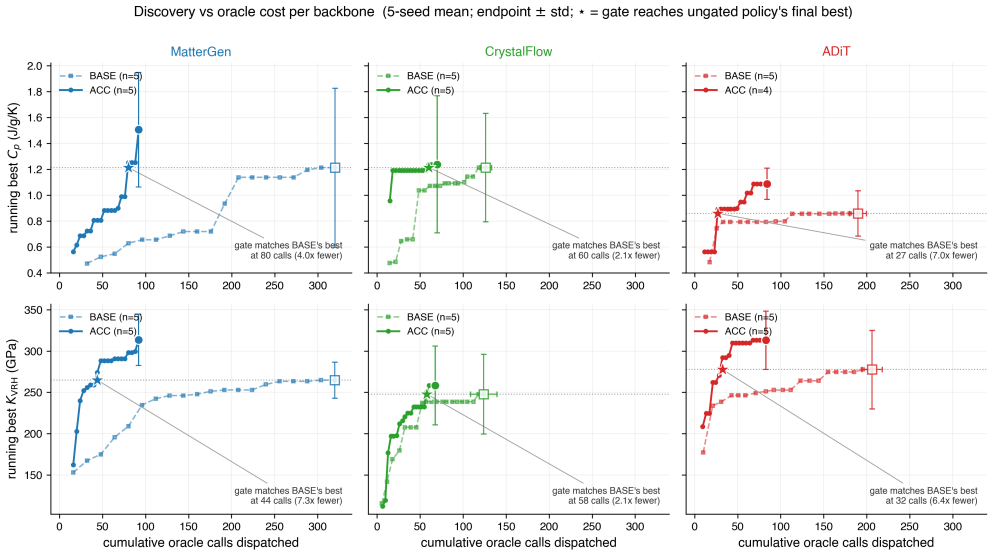
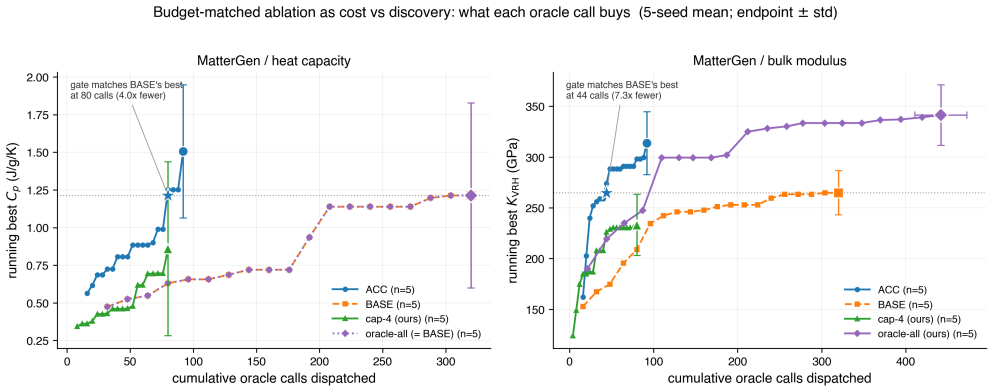
A Gaussian process acquisition gate placed between structure generation and the oracle in an RL-steered workflow matches or exceeds ungated fine-tuning while limiting oracle calls to a fixed budget per cycle. At a four-call budget the gate reaches within approximately 9 percent of exhaustive oracle performance using roughly one-fifth the calls, with the surrogate's ranking choice driving the gain over arbitrary selection.
What carries the argument
Gaussian process surrogate trained on ORB embeddings that performs ranking-based selection to decide which generated structures to evaluate with the oracle.
If this is right
- Ranking-based selection from the surrogate outperforms arbitrary selection at the same budget.
- The gate performs close to exhaustive oracle use at much lower cost across three distinct diffusion priors.
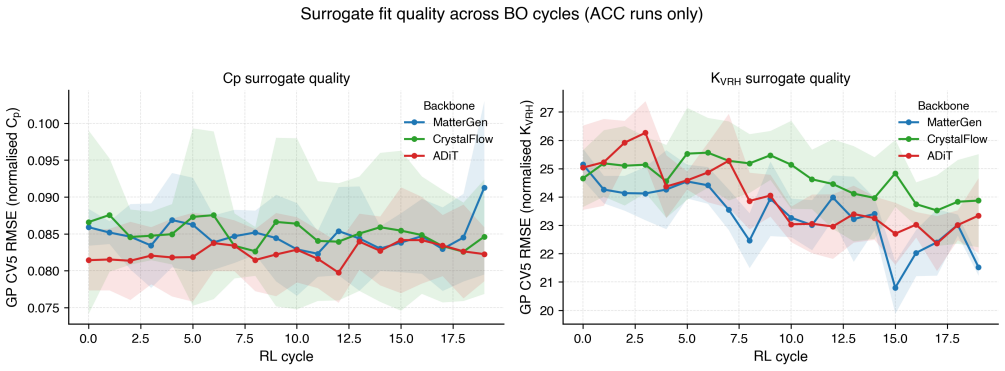
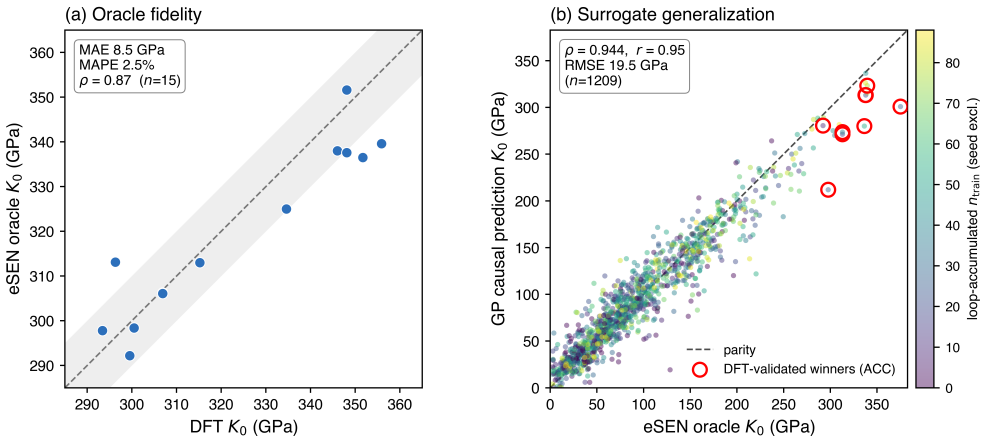
- DFT validation confirms the learned oracle to within 2.5% and the surrogate ranking at Spearman rho of 0.94.
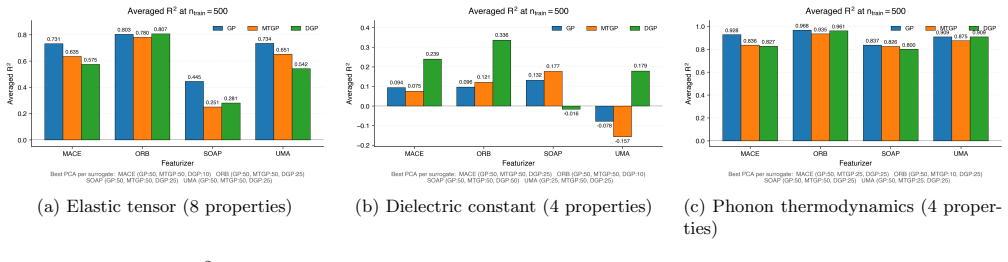
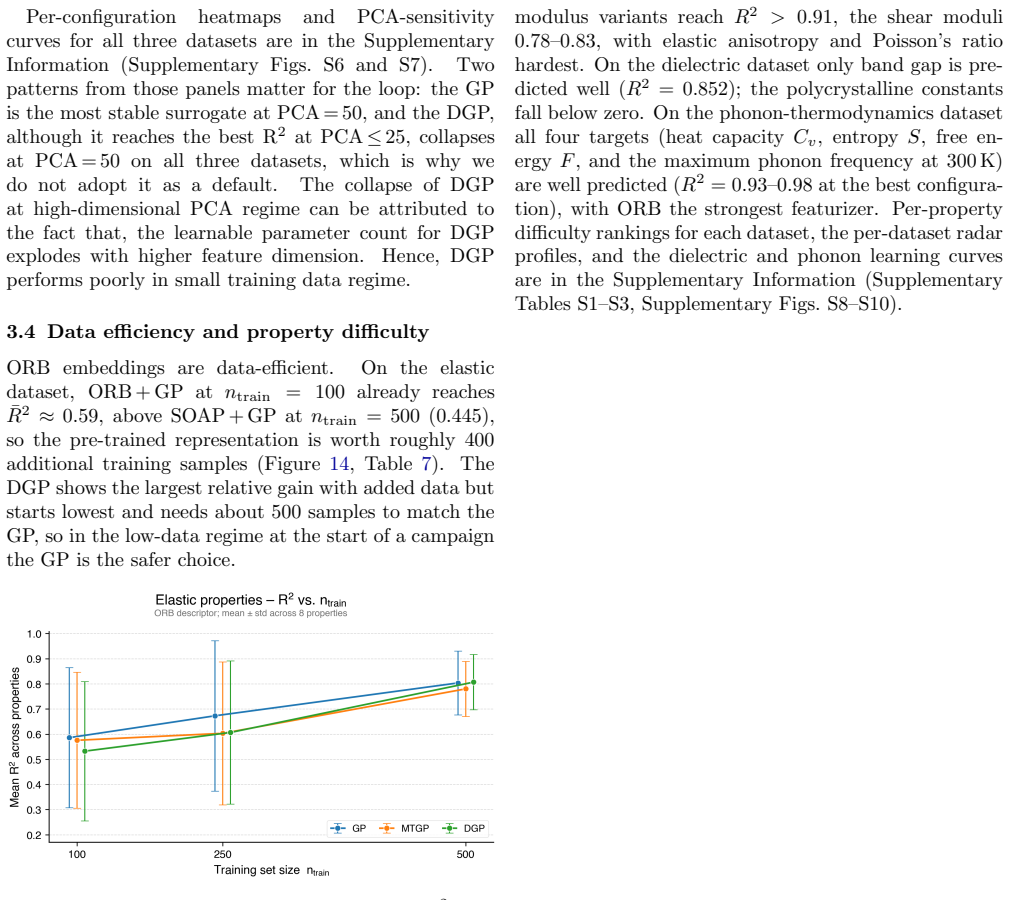
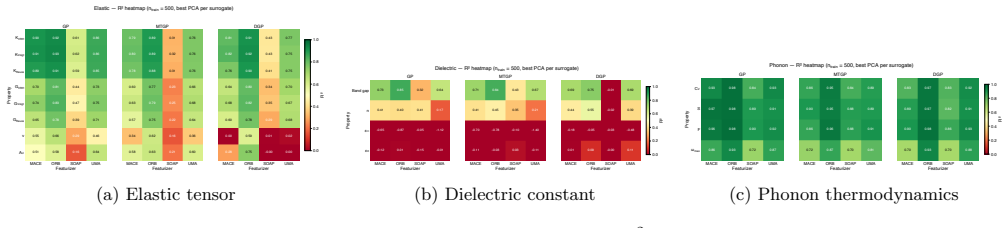
- ORB embeddings with Gaussian process form the most reliable surrogate combination across mechanical, electronic, and vibrational properties.
Where Pith is reading between the lines
- If the surrogate ranking holds under larger distribution shifts, the method could support longer RL-steered campaigns without retraining.
- The open pipeline could be tested directly on additional generators or property oracles to measure generalization.
- Extending the gate to multi-property oracles might allow simultaneous optimization of several targets at fixed budget.
Load-bearing premise
The Gaussian process surrogate maintains reliable ranking of structures sampled from the generative priors even when distribution shift occurs in the RL workflow.
What would settle it
Running the workflow with the surrogate gate and finding that the top structures selected do not achieve property values within 9% of those found by exhaustive oracle evaluation at the same total budget.
Figures
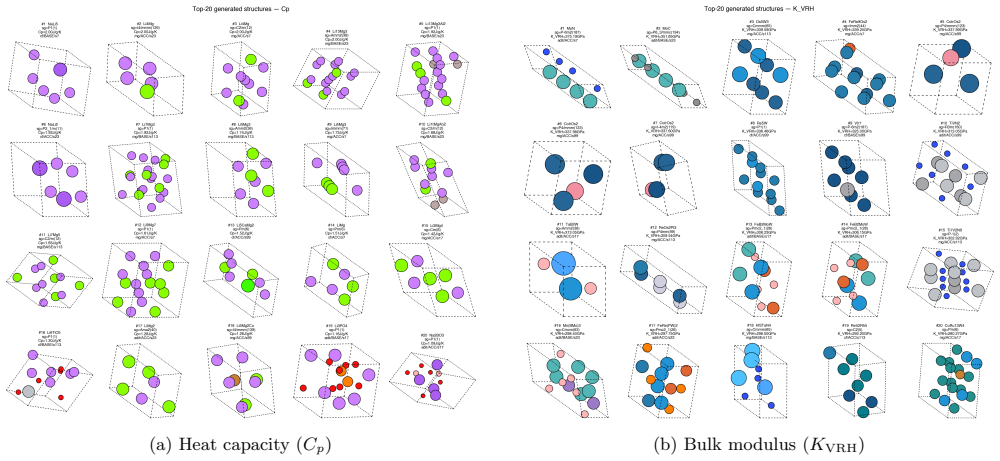
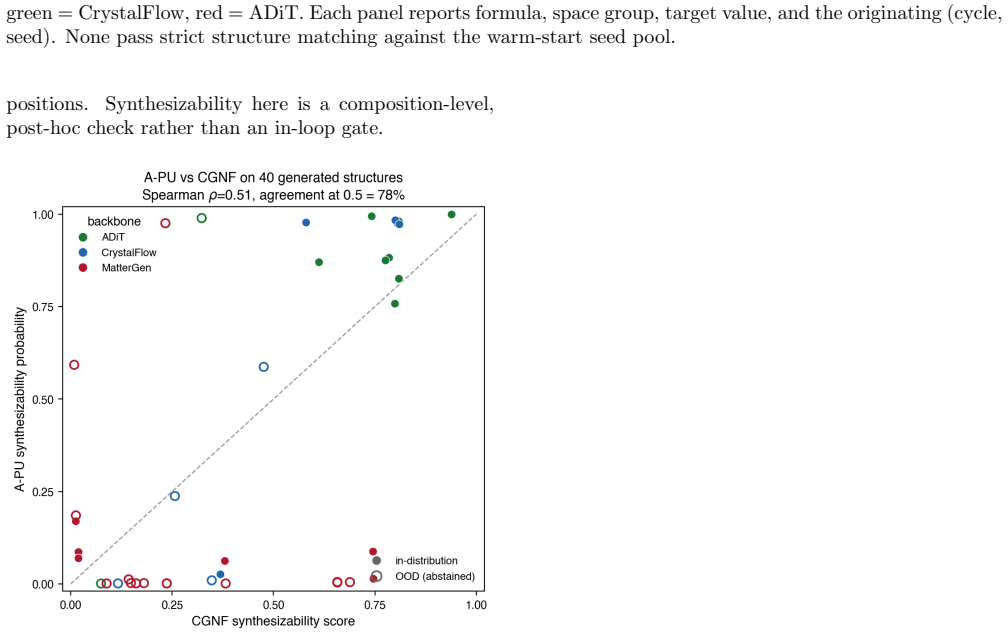
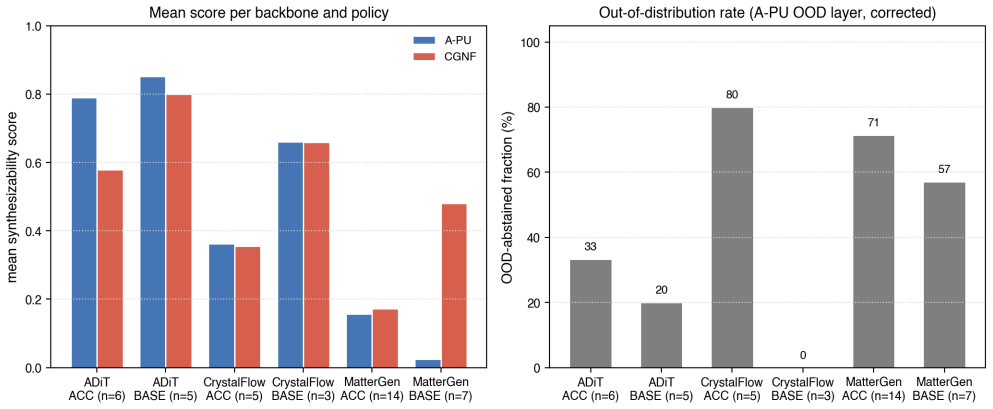
read the original abstract
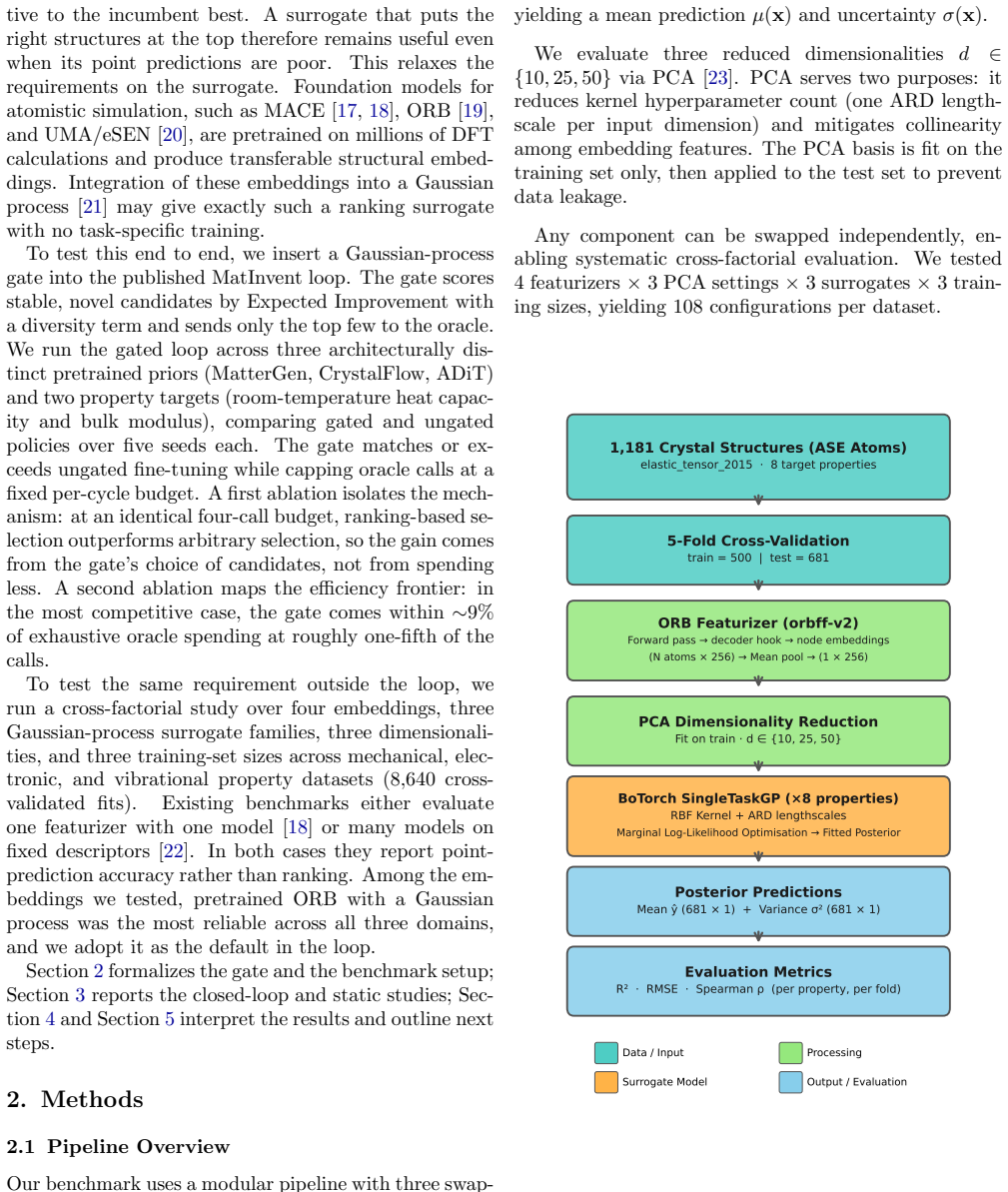
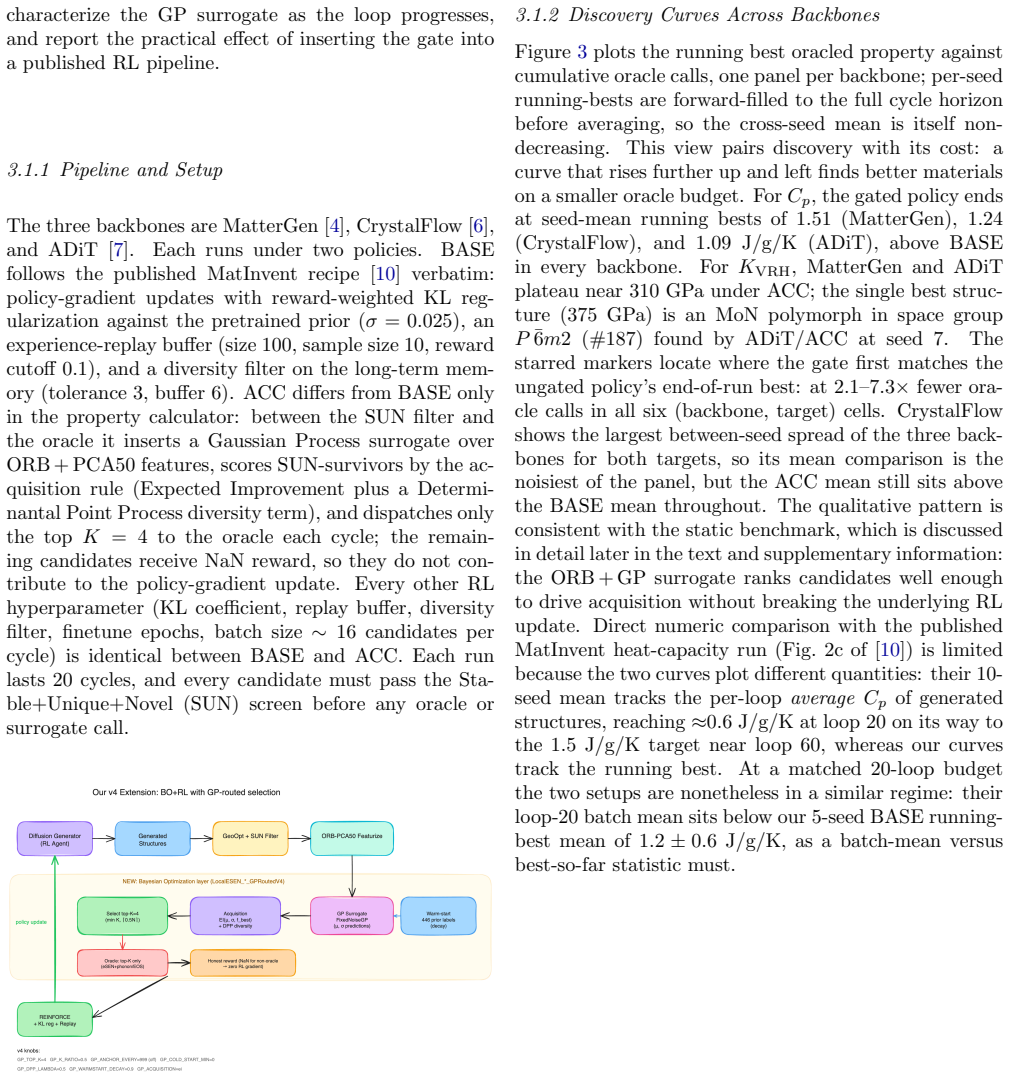
Closed-loop materials discovery iterates between proposing candidate structures and evaluating their properties, and property evaluation dominates the cost. In the generative variant, a learned prior proposes candidate crystals and a property oracle scores them; we ask whether a cheap probabilistic surrogate can triage the generator's output, and what such a surrogate must do well. Across three architecturally distinct pretrained diffusion priors (MatterGen, CrystalFlow, ADiT) and two targets (room-temperature heat capacity and bulk modulus), we insert a Gaussian process acquisition gate between structure generation and the oracle in an RL-steered generative workflow. The gate matches or exceeds ungated fine-tuning of the generative model while capping oracle calls at a fixed per-cycle budget. Budget-matched ablations isolate the mechanism. At an identical four-call budget, ranking-based selection outperforms arbitrary selection, confirming that the gain comes from the surrogate's choice; the gate comes within $\sim$9\% of exhaustive oracle spending at roughly one-fifth of the calls. A density-functional-theory check of the bulk-modulus discoveries confirms the learned oracle to within 2.5\% on average and the surrogate's ranking of the generated structures at Spearman $\rho = 0.94$. A cross-factorial benchmark of surrogate performance spanning mechanical, electronic, and vibrational properties identifies pretrained ORB embeddings with a Gaussian process as the most reliable combination, which we adopt as the building blocks of the proposed workflow. The complete pipeline is released as open-source software.
Editorial analysis
A structured set of objections, weighed in public.
Referee Report
Summary. The manuscript introduces a surrogate-gated workflow for closed-loop generative materials discovery. A Gaussian process surrogate operating on pretrained ORB embeddings is inserted as an acquisition gate between diffusion-based structure generators (MatterGen, CrystalFlow, ADiT) and an expensive property oracle within an RL-steered loop. The approach is tested on room-temperature heat capacity and bulk modulus, with budget-matched ablations, a cross-factorial surrogate benchmark, and DFT validation of discovered structures (2.5% average error, Spearman ρ=0.94). The gate is reported to match or exceed ungated fine-tuning while limiting oracle calls to a fixed per-cycle budget, and the full pipeline is released as open-source software.
Significance. If the empirical results hold, the work demonstrates a practical, budget-controlled mechanism for integrating cheap probabilistic surrogates into generative priors, reducing the dominant cost of oracle evaluations without sacrificing ranking quality. The open-source release, DFT cross-check, and identification of ORB+GP as the strongest embedding-surrogate pair across mechanical/electronic/vibrational properties provide concrete, reproducible building blocks for the field.
minor comments (2)
- [Abstract] Abstract: the phrase 'RL-steered generative workflow' is used without specifying the reinforcement-learning algorithm, reward formulation, or exact integration point of the gate; a brief clause would improve clarity for readers unfamiliar with the prior literature.
- [Abstract] The cross-factorial benchmark is described as selecting ORB+GP, but the abstract does not report the number of property classes, number of embedding models, or statistical significance of the ranking; adding these details would strengthen the claim.
Simulated Author's Rebuttal
We thank the referee for their positive assessment of the work and the recommendation to accept.
Circularity Check
No significant circularity detected
full rationale
The paper's central claims rest on empirical DFT validations (2.5% oracle error, Spearman ρ=0.94 on generated structures), budget-matched ablations isolating ranking vs. arbitrary selection, and a cross-factorial benchmark identifying ORB+GP as optimal before adoption. These elements are externally falsifiable and do not reduce any prediction or gate performance to a fitted parameter or self-citation by construction. No self-definitional steps, fitted-input predictions, or load-bearing self-citations appear in the reported workflow; the derivation chain remains self-contained against the stated external checks and open-source release.
Axiom & Free-Parameter Ledger
free parameters (2)
- GP kernel hyperparameters
- acquisition function threshold or budget parameters
axioms (1)
- domain assumption Pretrained ORB embeddings capture transferable structural features relevant to mechanical, electronic, and vibrational properties
Reference graph
Works this paper leans on
-
[1]
Generative AI for crystal structures: a review.npj Computational Materials, 2025
Pierre-Paul De Breuck, Hai-Chen Wang, Gian- Marco Rignanese, Silvana Botti, and Miguel A L Marques. Generative AI for crystal structures: a review.npj Computational Materials, 2025. doi: 10.1038/s41524-025-01881-2
-
[2]
Crystal diffusion variational autoencoder for periodic material gen- eration
Tian Xie, Xiang Fu, Octavian-Eugen Ganea, Regina Barzilay, and Tommi Jaakkola. Crystal diffusion variational autoencoder for periodic material gen- eration. InInternational Conference on Learning Representations, 2022. arXiv:2110.06197. 20
-
[3]
Crystal struc- ture prediction by joint equivariant diffusion
Rui Jiao, Wenbing Huang, Peijia Lin, Jiaqi Han, Pin Chen, Yutong Lu, and Yang Liu. Crystal struc- ture prediction by joint equivariant diffusion. InAd- vances in Neural Information Processing Systems,
-
[4]
A generative model for inor- ganic materials design.Nature, 639(8055):624–632,
Claudio Zeni, Robert Pinsler, Daniel Z¨ ugner, An- drew Fowler, Matthew Horton, Xiang Fu, Zilong Wang, Aliaksandra Shysheya, Jonathan Crabb´ e, Shoko Ueda, et al. A generative model for inor- ganic materials design.Nature, 639(8055):624–632,
- [5]
-
[6]
CrystalFlow: a flow-based gen- erative model for crystalline materials.Nature Communications, 16(1):9267, 2025
Xiaoshan Luo, Zhenyu Wang, Qingchang Wang, Xuechen Shao, Jian Lv, Lei Wang, Yanchao Wang, and Yanming Ma. CrystalFlow: a flow-based gen- erative model for crystalline materials.Nature Communications, 16(1):9267, 2025. doi: 10.1038/ s41467-025-64364-4
2025
-
[7]
Chaitanya K Joshi, Xiang Fu, Yi-Lun Liao, Vahe Gharakhanyan, Benjamin Kurt Miller, Anuroop Sriram, and Zachary W Ulissi. All-atom diffu- sion transformers: Unified generative modelling of molecules and materials.arXiv preprint arXiv:2503.03965, 2025
-
[8]
Training Diffusion Models with Reinforcement Learning
Kevin Black, Michael Janner, Yilun Du, Ilya Kostrikov, and Sergey Levine. Training dif- fusion models with reinforcement learning. In International Conference on Learning Represen- tations, volume 2024, pages 4965–4987, 2024. arXiv:2305.13301
work page internal anchor Pith review Pith/arXiv arXiv 2024
-
[9]
DPOK: Reinforcement learn- ing for fine-tuning text-to-image diffusion mod- els
Ying Fan, Olivia Watkins, Yuqing Du, Hao Liu, Moonkyung Ryu, Craig Boutilier, Pieter Abbeel, Mohammad Ghavamzadeh, Kangwook Lee, and Kimin Lee. DPOK: Reinforcement learn- ing for fine-tuning text-to-image diffusion mod- els. InAdvances in Neural Information Process- ing Systems, volume 36, pages 79858–79885, 2023. arXiv:2305.16381
-
[10]
Junwu Chen, Jeff Guo, Edvin Fako, and Philippe Schwaller. Accelerating inverse materials design us- ing generative diffusion models with reinforcement learning.arXiv preprint arXiv:2511.03112, 2025
-
[11]
CrystalFormer- RL: Reinforcement fine-tuning for materials design
Zhendong Cao and Lei Wang. CrystalFormer- RL: Reinforcement fine-tuning for materials design. arXiv preprint arXiv:2504.02367, 2025
- [12]
-
[13]
Han Qi, Xinyang Geng, Stefano Rando, Iku Ohama, Aviral Kumar, and Sergey Levine. Latent conserva- tive objective models for data-driven crystal struc- ture prediction.arXiv preprint arXiv:2310.10056, 2023
-
[14]
A mobile robotic chemist.Nature, 583(7815):237–241, 2020
Benjamin Burger, Phillip M Maffettone, Vladimir V Gusev, Catherine M Aitchison, Yang Bai, Xiaoyan Wang, Xiaobo Li, Ben M Alston, Buyi Li, Rob Clowes, Nicola Rankin, Brandon Harris, Reiner Se- bastian Sprick, and Andrew I Cooper. A mobile robotic chemist.Nature, 583(7815):237–241, 2020. doi: 10.1038/s41586-020-2442-2
-
[15]
A tutorial on Bayesian optimization
Peter I Frazier. A tutorial on Bayesian optimization. Recent Advances in Optimization and Modeling of Contemporary Problems, pages 255–278, 2018. doi: 10.1287/educ.2018.0188. arXiv:1807.02811
-
[16]
Spectral Deferred Correction Methods for Ordinary Differential Equations
Donald R Jones, Matthias Schonlau, and William J Welch. Efficient global optimization of expen- sive black-box functions.Journal of Global Op- timization, 13(4):455–492, 1998. doi: 10.1023/A: 1008306431147
work page doi:10.1023/a: 1998
-
[17]
MACE: Higher order equivariant message passing neural networks for fast and accurate force fields
Ilyes Batatia, D´ avid P´ eter Kov´ acs, Gregor N C Simm, Christoph Ortner, and G´ abor Cs´ anyi. MACE: Higher order equivariant message passing neural networks for fast and accurate force fields. InAdvances in Neural Information Processing Sys- tems, volume 35, pages 11423–11436, 2022. doi: 10.52202/068431-0830
-
[18]
Ilyes Batatia, Philipp Benner, Yuan Chiang, Alin M Elena, D´ avid P Kov´ acs, Janosh Riebesell, Xavier R Advincula, Mark Asta, Matthew Avaylon, William J Baldwin, et al. A foundation model for atomistic materials chemistry.The Journal of chem- ical physics, 163(18), 2025. doi: 10.1063/5.0297006
-
[19]
Orb: A fast, scalable neural network potential.arXiv preprint arXiv:2410.22570, 2024
Mark Neumann, James Gin, Benjamin Rhodes, Steven Bennett, Zhiyi Li, Hitarth Choubisa, Arthur Hussey, and Jonathan Godwin. Orb: A fast, scalable neural network potential.arXiv preprint arXiv:2410.22570, 2024
-
[20]
Xiang Fu, Brandon M Wood, Luis Barroso-Luque, Daniel S Levine, Meng Gao, Misko Dzamba, and C Lawrence Zitnick. Learning smooth and expres- sive interatomic potentials for physical property pre- diction.arXiv preprint arXiv:2502.12147, 2025
-
[21]
MIT Press, Cambridge, MA, 2006
Carl Edward Rasmussen and Christopher K I Williams.Gaussian Processes for Machine Learn- ing. MIT Press, Cambridge, MA, 2006. doi: 10.7551/mitpress/3206.001.0001. 21
-
[22]
Benchmarking materials property prediction methods: the Matbench test set and Automatminer reference algorithm.npj Com- putational Materials, 6(1):138, 2020
Alexander Dunn, Qi Wang, Alex Ganose, Daniel Dopp, and Anubhav Jain. Benchmarking materials property prediction methods: the Matbench test set and Automatminer reference algorithm.npj Com- putational Materials, 6(1):138, 2020. doi: 10.1038/ s41524-020-00406-3
2020
-
[23]
Springer, New York, 2nd edition, 2002
Ian T Jolliffe.Principal Component Analysis. Springer, New York, 2nd edition, 2002
2002
-
[24]
Logan Ward, Alexander Dunn, Alireza Faghaninia, Nils E R Zimmermann, Saurabh Bajaj, Qi Wang, Joseph H Montoya, Jiming Chen, Kyle Bystrom, Mark Dylla, Kyle Chard, Mark Asta, Kristin A Persson, G Jeffrey Snyder, Ian Foster, and Anubhav Jain. Matminer: An open source toolkit for materi- als data mining.Computational Materials Science, 152:60–69, 2018. doi: 1...
-
[25]
Guido Petretto, Shyam Dwaraknath, Henrique P. C. Miranda, Donald Winston, Matteo Giantomassi, Michiel J. van Setten, Xavier Gonze, Kristin A. Persson, Geoffroy Hautier, and Gian-Marco Rig- nanese. High-throughput density-functional pertur- bation theory phonons for inorganic materials.Sci- entific Data, 5:180065, 2018. doi: 10.1038/sdata. 2018.65
-
[26]
Anubhav Jain, Shyue Ping Ong, Geoffroy Hautier, Wei Chen, William Davidson Richards, Stephen Dacek, Shreyas Cholia, Dan Gunter, David Skin- ner, Gerbrand Ceder, and Kristin A Persson. Com- mentary: The Materials Project: A materials genome approach to accelerating materials inno- vation.APL Materials, 1(1):011002, 2013. doi: 10.1063/1.4812323
-
[27]
Maarten de Jong, Wei Chen, Thomas Angsten, Anubhav Jain, Randy Notestine, Anthony Gamst, Marcel Sluiter, Chaitanya Krishna Ande, Sybrand van der Zwaag, Jose J Plata, Cormac Toher, Stefano Curtarolo, Gerbrand Ceder, Kristin A Persson, and Mark Asta. Charting the complete elastic properties of inorganic crystalline compounds.Scientific Data, 2(1):150009, 20...
-
[28]
Ioannis Petousis, David Mrdjenovich, Eric Ballouz, Miao Liu, Donald Winston, Wei Chen, Tanja Graf, Thomas D Schladt, Kristin A Persson, and Fritz B Prinz. High-throughput screening of inorganic com- pounds for the discovery of novel dielectric and op- tical materials.Scientific Data, 4(1):160134, 2017. doi: 10.1038/sdata.2016.134
-
[29]
On representing chemical environments.Phys- ical Review B—Condensed Matter and Materi- als Physics, 87(18):184115, 2013
Albert P Bart´ ok, Risi Kondor, and G´ abor Cs´ anyi. On representing chemical environments.Phys- ical Review B—Condensed Matter and Materi- als Physics, 87(18):184115, 2013. doi: 10.1103/ PhysRevB.87.184115
2013
-
[30]
Lauri Himanen, Marc O J J¨ ager, Eiaki V Morooka, Filippo Federici Canova, Yashasvi S Ranawat, David Z Gao, Patrick Rinke, and Adam S Foster. DScribe: Library of descriptors for machine learning in materials science.Computer Physics Communi- cations, 247:106949, 2020. doi: 10.1016/j.cpc.2019. 106949
-
[31]
Bowen Deng, Peichen Zhong, KyuJung Jun, Janosh Riebesell, Kevin Han, Christopher J Bartel, and Gerbrand Ceder. CHGNet as a pretrained uni- versal neural network potential for charge-informed atomistic modelling.Nature Machine Intelligence, 5: 1031–1041, 2023. doi: 10.1038/s42256-023-00716-3
-
[32]
BoTorch: A frame- work for efficient monte-carlo Bayesian optimiza- tion
Maximilian Balandat, Brian Karrer, Daniel R Jiang, Samuel Daulton, Benjamin Letham, Andrew Gor- don Wilson, and Eytan Bakshy. BoTorch: A frame- work for efficient monte-carlo Bayesian optimiza- tion. InAdvances in Neural Information Processing Systems, volume 33, pages 21524–21538, 2020
2020
-
[33]
GPyTorch: Blackbox matrix-matrix Gaussian process inference with GPU acceleration
Jacob R Gardner, Geoff Pleiss, Kilian Q Wein- berger, David Bindel, and Andrew Gordon Wil- son. GPyTorch: Blackbox matrix-matrix Gaussian process inference with GPU acceleration. InAd- vances in Neural Information Processing Systems, volume 31, 2018
2018
-
[34]
Multi-task Gaussian pro- cess prediction
Edwin V Bonilla, Kian Ming Adam Chai, and Christopher K I Williams. Multi-task Gaussian pro- cess prediction. InAdvances in Neural Information Processing Systems, volume 20, 2007
2007
-
[35]
Deep Gaussian processes
Andreas Damianou and Neil D Lawrence. Deep Gaussian processes. InProceedings of the Sixteenth International Conference on Artificial Intelligence and Statistics, pages 207–215, 2013
2013
-
[36]
Deep neural networks as point es- timates for deep Gaussian processes
Vincent Dutordoir, James Hensman, Mark van der Wilk, Carl Henrik Ek, Zoubin Ghahramani, and Nicolas Durrande. Deep neural networks as point es- timates for deep Gaussian processes. InAdvances in Neural Information Processing Systems, volume 34, 2021
2021
-
[37]
First principles phonon calculations in materials science.Scripta Materialia, 108:1–5, 2015
Atsushi Togo and Isao Tanaka. First principles phonon calculations in materials science.Scripta Materialia, 108:1–5, 2015
2015
-
[38]
Finite elastic strain of cubic crystals
Francis Birch. Finite elastic strain of cubic crystals. Physical Review, 71(11):809–824, 1947
1947
-
[39]
MADE: Benchmark environments for closed-loop materials discovery
Shreshth A Malik, Tiarnan Doherty, Panagiotis Tigas, Muhammed Razzak, Stephen J Roberts, Aron Walsh, and Yarin Gal. MADE: Benchmark environments for closed-loop materials discovery. arXiv preprint arXiv:2601.20996, 2026. 22
-
[40]
Siddharth Betala, Samuel P Gleason, Ali Ram- laoui, Andy Xu, Georgia Channing, Daniel Levy, Cl´ ementine Fourrier, Nikita Kazeev, Chaitanya K Joshi, S´ ekou-Oumar Kaba, F´ elix Therrien, Alex Hernandez-Garcia, Roc´ ıo Mercado, N M Anoop Kr- ishnan, and Alexandre Duval. LeMat-GenBench: A unified evaluation framework for crystal generative models.arXiv prep...
-
[41]
Spglib: a software library for crystal symmetry search.arXiv preprint arXiv:1808.01590, 2018
Atsushi Togo and Isao Tanaka. Spglib: a software library for crystal symmetry search.arXiv preprint arXiv:1808.01590, 2018
-
[42]
Efficient iter- ative schemes for ab initio total-energy calculations using a plane-wave basis set.Physical Review B, 54 (16):11169–11186, 1996
Georg Kresse and J¨ urgen Furthm¨ uller. Efficient iter- ative schemes for ab initio total-energy calculations using a plane-wave basis set.Physical Review B, 54 (16):11169–11186, 1996
1996
-
[43]
Python materials genomics (pymatgen): A robust, open- source python library for materials analysis.Com- putational Materials Science, 68:314–319, 2013
Shyue Ping Ong, William Davidson Richards, Anubhav Jain, Geoffroy Hautier, Michael Kocher, Shreyas Cholia, Dan Gunter, Vincent L Chevrier, Kristin A Persson, and Gerbrand Ceder. Python materials genomics (pymatgen): A robust, open- source python library for materials analysis.Com- putational Materials Science, 68:314–319, 2013
2013
-
[44]
Perdew, Kieron Burke, and Matthias Ernz- erhof
John P. Perdew, Kieron Burke, and Matthias Ernz- erhof. Generalized gradient approximation made simple.Physical Review Letters, 77(18):3865–3868, 1996
1996
-
[45]
Bl¨ ochl
Peter E. Bl¨ ochl. Projector augmented-wave method. Physical Review B, 50(24):17953–17979, 1994
1994
-
[46]
From ultrasoft pseudopotentials to the projector augmented-wave method.Physical Review B, 59(3):1758–1775, 1999
Georg Kresse and Daniel Joubert. From ultrasoft pseudopotentials to the projector augmented-wave method.Physical Review B, 59(3):1758–1775, 1999
1999
-
[47]
Jidon Jang, Juhwan Noh, Lan Zhou, Geun Ho Gu, John M. Gregoire, and Yousung Jung. Syn- thesizability of materials stoichiometry using semi- supervised learning.Matter, 7(6):2294–2312, 2024. doi: 10.1016/j.matt.2024.05.002
-
[48]
A general-purpose machine learning framework for predicting properties of inorganic materials
Logan Ward, Ankit Agrawal, Alok Choudhary, and Christopher Wolverton. A general-purpose machine learning framework for predicting properties of inor- ganic materials.npj Computational Materials, 2(1): 16028, 2016. doi: 10.1038/npjcompumats.2016.28
-
[49]
Fantine Mordelet and Jean-Philippe Vert. A bag- ging svm to learn from positive and unlabeled exam- ples.Pattern Recognition Letters, 37:201–209, 2014. doi: 10.1016/j.patrec.2013.06.010
-
[50]
Takuya Akiba, Shotaro Sano, Toshihiko Yanase, Takeru Ohta, and Masanori Koyama. Optuna: A next-generation hyperparameter optimization framework. InProceedings of the 25th ACM SIGKDD International Conference on Knowledge Discovery and Data Mining, pages 2623–2631, 2019. doi: 10.1145/3292500.3330701
-
[51]
Predicting materi- als properties with little data using shotgun trans- fer learning.ACS Central Science, 5(10):1717–1730,
Hironao Yamada, Chang Liu, Stephen Wu, Yukinori Koyama, Shenghong Ju, Junichiro Shiomi, Junko Morikawa, and Ryo Yoshida. Predicting materi- als properties with little data using shotgun trans- fer learning.ACS Central Science, 5(10):1717–1730,
-
[52]
doi: 10.1021/acscentsci.9b00804. 23 Supporting Information for Surrogate-Gated Diffusion and Foundation-Model Embeddings for Bayesian Materials Design Sk Md Ahnaf Akif Alvi, Jan Janssen, Danny Perez, Douglas Allaire, Raymundo Arr´ oyave This Supplementary Information collects the closed-loop per-cycle views and the static- benchmark deep-dive figures and ...
-
[53]
upper bound
Each bar shows the best R 2 (a) or Spearmanρ(b) across all surrogate–PCA combinations, with the winning surrogate name overlaid. ORB achieves the highest R 2 on all three datasets, and its Spearman correlations stay above 0.7 across datasets. 7 Figure S13: Best averaged R 2 per surrogate across the three datasets (ORB descriptor,n train = 500, best PCA pe...
2000
discussion (0)
Sign in with ORCID, Apple, or X to comment. Anyone can read and Pith papers without signing in.