Meshtryoshka: Differentiable Rendering of Real-World Scenes via Mesh Rasterization
Pith reviewed 2026-06-30 00:41 UTC · model grok-4.3
The pith
Nested mesh shells extracted from a signed distance function enable differentiable rendering with standard mesh rasterizers on large-scale scenes.
A machine-rendered reading of the paper's core claim, the machinery that carries it, and where it could break.
Core claim
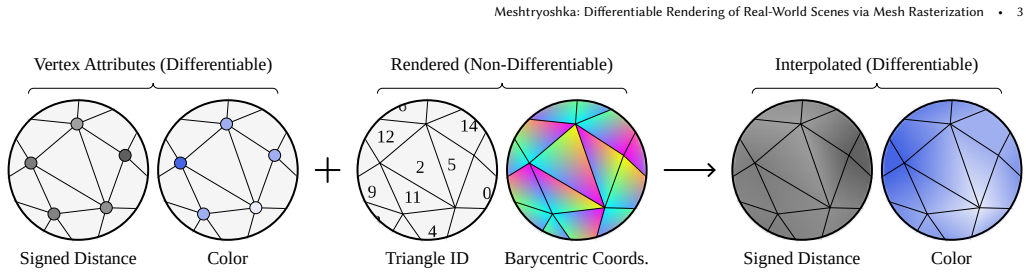
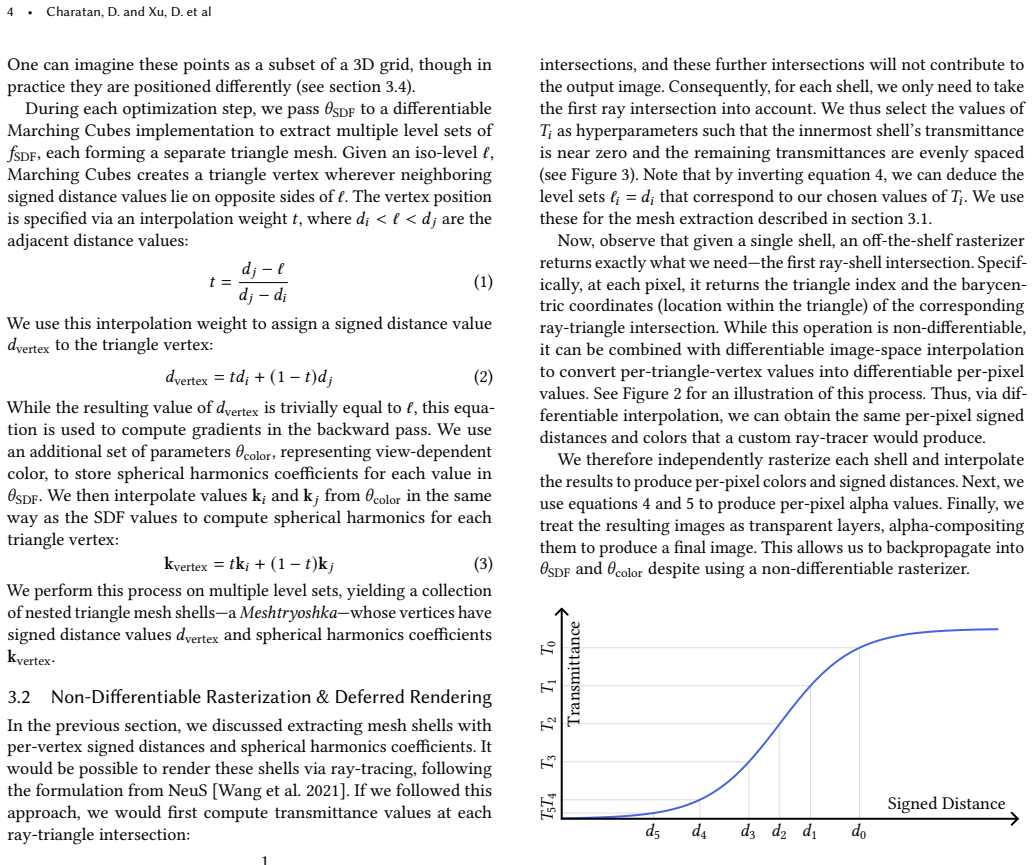
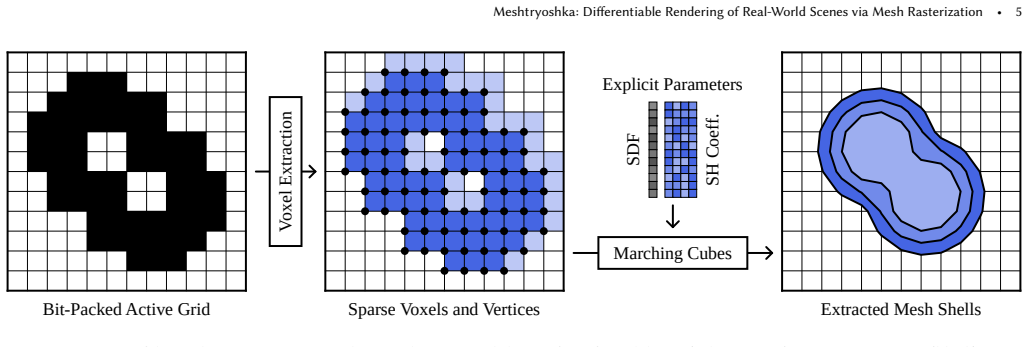
By extracting nested mesh shells anew each forward pass from a 3D signed distance function via iso-surface extraction, assigning opacities as a function of signed distance, rasterizing each shell independently with a standard mesh rasterizer, and forming the final image via alpha compositing, the framework performs differentiable rendering. Vertex positions update only indirectly through gradients that flow through the opacity values into the signed distance function, making the method compatible with off-the-shelf rasterizers that need not differentiate with respect to vertex positions. On object-centric scenes the results are competitive with surface-based differentiable rendering techniqu
What carries the argument
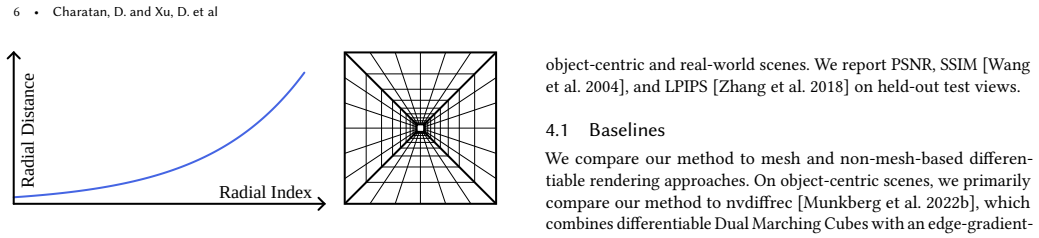
Nested mesh shells (matryoshka-like) extracted via iso-surface from a signed distance function, with opacities computed as a function of signed distance; indirect vertex optimization occurs via gradients through those opacities.
If this is right
- The method performs competitively with surface-based differentiable rendering on object-centric scenes.
- It scales to unbounded real-world 3D scenes while producing high-quality novel view synthesis.
- Results approach those of state-of-the-art non-mesh differentiable rendering methods.
- Differentiable rendering becomes possible using only conventional tools from the computer graphics toolbox.
Where Pith is reading between the lines
- Existing graphics pipelines that already rely on meshes could incorporate learned 3D reconstruction without switching to custom renderers.
- Training speed might increase by leveraging hardware-accelerated standard rasterizers instead of custom differentiable ones.
- The indirect gradient path could be tested on scenes with sharp edges to see whether the signed distance function alone supplies enough signal for precise vertex placement.
Load-bearing premise
Gradients flowing through the opacity values into the signed distance function are sufficient to optimize the mesh vertex positions indirectly.
What would settle it
A large unbounded scene where the method produces visible artifacts or lower quality than a direct vertex-differentiable mesh renderer, while the signed distance function itself converges.
Figures
read the original abstract
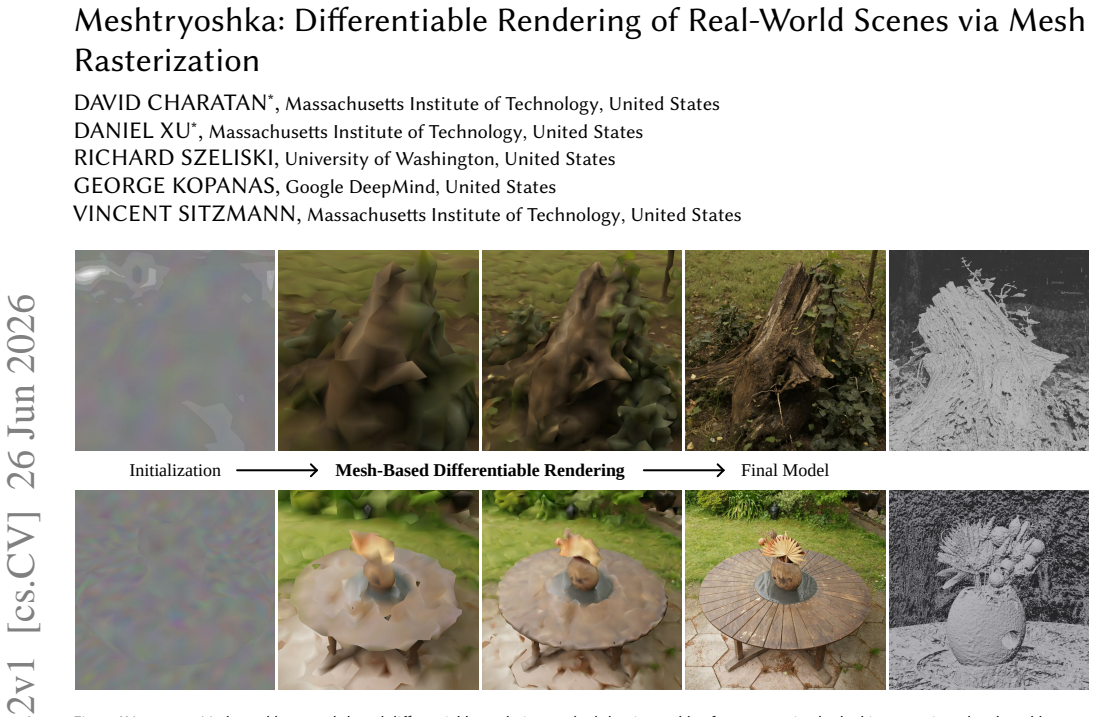
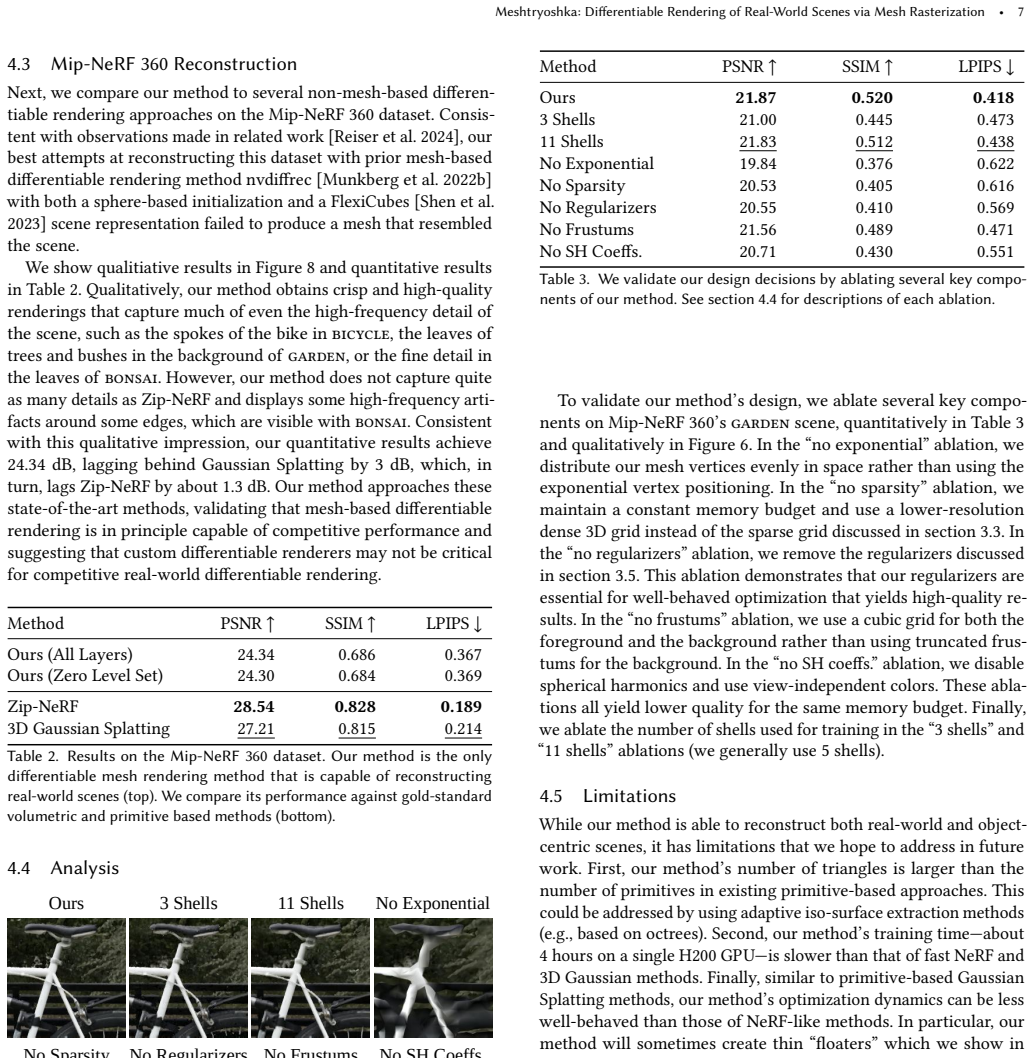
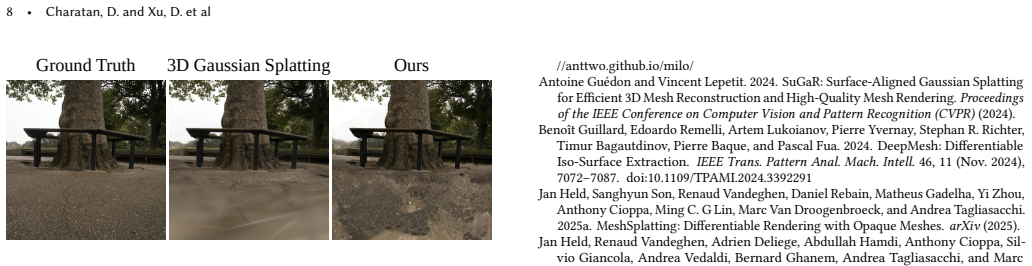
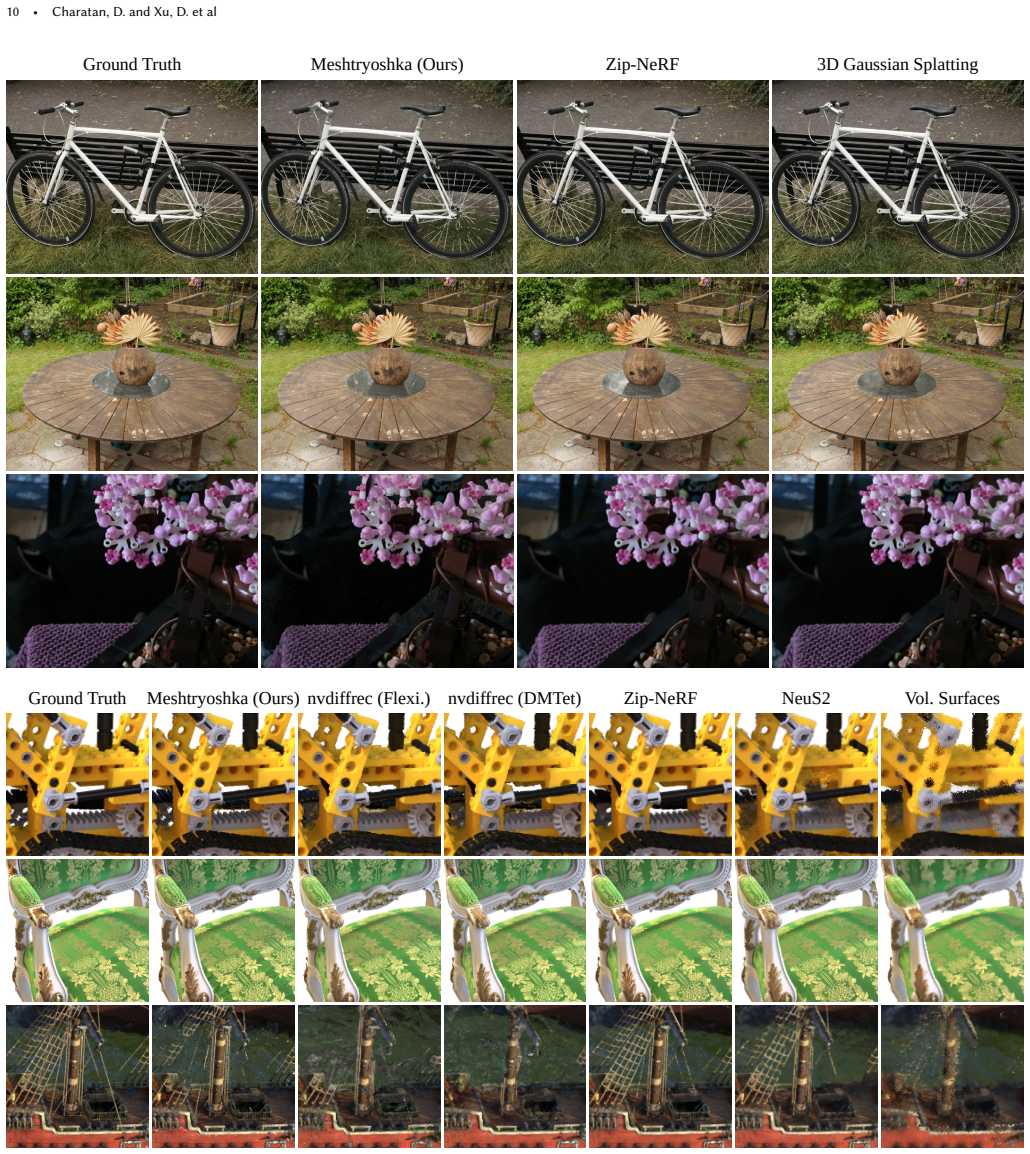
Differentiable rendering has emerged as a powerful approach for 3D reconstruction and novel view synthesis. State-of-the-art differentiable rendering methods combine a variety of custom representations of 3D geometry and appearance with specialized renderers. However, most downstream tasks in computer graphics rely on 3D meshes. While prior work has attempted differentiable rendering with mesh representations, these approaches are limited to object-centric scenes and fail to reconstruct large-scale, unbounded scenes. In this work, we introduce Meshtryoshka, a novel mesh differentiable rendering framework that combines an off-the-shelf triangle rasterizer with a 3D representation that consists of nested mesh shells which resemble a matryoshka doll. In every forward pass, the mesh shells are extracted anew from a 3D signed distance function via iso-surface extraction, and the opacities for each vertex are computed as a function of signed distance. Each mesh shell is then rasterized independently, and the final image is created via alpha compositing. Crucially, mesh vertex positions are updated only indirectly via gradients that flow through the opacity values into the signed distance function, and hence, our method is compatible with off-the-shelf mesh renderers that need not be differentiable with respect to vertex positions. On object-centric scenes, our method performs competitively with surface-based differentiable rendering techniques. Our differentiable mesh rendering method scales to unbounded, real-world 3D scenes, where it yields high-quality novel view synthesis results approaching those of state-of-the-art, non-mesh methods. Our method suggests that it may be possible to solve the differentiable rendering problem without relying on specialized renderers, only using conventional tools from the computer graphics toolbox.
Editorial analysis
A structured set of objections, weighed in public.
Referee Report
Summary. The manuscript introduces Meshtryoshka, a differentiable rendering framework for real-world 3D scenes. It represents geometry as nested mesh shells (resembling matryoshka dolls) extracted via iso-surface extraction from a signed distance function (SDF) at each forward pass. Vertex opacities are computed as a function of signed distance; each shell is rasterized independently with an off-the-shelf non-differentiable triangle rasterizer, and the image is formed by alpha compositing. Vertex positions are updated only indirectly through gradients flowing from the rendered image through the opacity values back into the SDF. The paper claims competitive performance with prior surface-based differentiable rendering methods on object-centric scenes and high-quality novel view synthesis on unbounded real-world scenes that approaches state-of-the-art non-mesh methods.
Significance. If the central claim holds, the work is significant for enabling differentiable rendering of large-scale scenes using only standard mesh representations and conventional graphics renderers, without custom differentiable rasterizers. This could simplify integration with existing computer graphics pipelines and downstream tasks that rely on meshes. The nested-shell construction for handling unbounded scenes is a concrete technical idea that, if validated, addresses a known limitation of prior mesh-based differentiable renderers.
major comments (2)
- [Method description (abstract and §3)] The optimization mechanism (described in the abstract and method section) supplies gradients to the SDF exclusively through the opacity term; the dependence of vertex coordinates on the SDF via iso-surface extraction contributes no gradient because the rasterizer is non-differentiable w.r.t. positions. For the headline claim—that the method scales to unbounded real-world scenes with high-quality geometry—to hold, this partial gradient must still drive the SDF to surfaces whose projected locations minimize rendering error. The manuscript should provide a targeted analysis or ablation (e.g., comparison against a version with direct positional gradients or visualization of optimized surfaces) showing that the omitted d(image)/d(position) term is not required for accurate geometry optimization.
- [Abstract / Experiments] The abstract asserts that the method 'yields high-quality novel view synthesis results approaching those of state-of-the-art, non-mesh methods' on unbounded scenes, yet the provided text contains no quantitative metrics, error bars, scene-scale details, or direct comparisons. Without these, the support for the scaling claim cannot be assessed and the central empirical contribution remains unsubstantiated.
Simulated Author's Rebuttal
We thank the referee for the constructive feedback on the gradient mechanism and empirical support. We address the two major comments below and will revise the manuscript accordingly to strengthen the presentation.
read point-by-point responses
-
Referee: [Method description (abstract and §3)] The optimization mechanism (described in the abstract and method section) supplies gradients to the SDF exclusively through the opacity term; the dependence of vertex coordinates on the SDF via iso-surface extraction contributes no gradient because the rasterizer is non-differentiable w.r.t. positions. For the headline claim—that the method scales to unbounded real-world scenes with high-quality geometry—to hold, this partial gradient must still drive the SDF to surfaces whose projected locations minimize rendering error. The manuscript should provide a targeted analysis or ablation (e.g., comparison against a version with direct positional gradients or visualization of optimized surfaces) showing that the omitted d(image)/d(position) term is not required for accurate geometry optimization.
Authors: We agree that gradients reach the SDF only through the opacity term, as the non-differentiable rasterizer and iso-surface extraction block direct position gradients. Because vertex opacities are computed directly from SDF values at the extracted locations, updates to the SDF simultaneously refine both the implicit surface and the per-vertex rendering weights. Our competitive results on object-centric scenes indicate that this indirect pathway is sufficient in practice. To address the request, we will add (i) visualizations of the evolving SDF isosurfaces across optimization and (ii) a short analysis section discussing why the omitted positional term is not required for convergence in the nested-shell formulation. These additions will be included in the revised manuscript. revision: yes
-
Referee: [Abstract / Experiments] The abstract asserts that the method 'yields high-quality novel view synthesis results approaching those of state-of-the-art, non-mesh methods' on unbounded scenes, yet the provided text contains no quantitative metrics, error bars, scene-scale details, or direct comparisons. Without these, the support for the scaling claim cannot be assessed and the central empirical contribution remains unsubstantiated.
Authors: We acknowledge that the current version does not present quantitative metrics, error bars, or direct numerical comparisons in the abstract or main text. The experiments section contains results on unbounded scenes, but these were not sufficiently highlighted. We will revise the abstract to include concrete metrics (e.g., PSNR/SSIM values with error bars) and add a dedicated table in the experiments section that reports scene scales, direct comparisons against both mesh-based and non-mesh SOTA methods, and statistical details. This will make the scaling claim fully substantiated. revision: yes
Circularity Check
No significant circularity detected
full rationale
The paper defines a new rendering pipeline (nested iso-surface extraction from SDF, opacity assignment, off-the-shelf rasterization, indirect gradients via opacity) and reports empirical novel-view results. No equation or claim reduces a derived quantity to a fitted parameter by construction, no load-bearing premise rests solely on self-citation, and no uniqueness theorem or ansatz is imported from prior author work. The derivation chain is the explicit method specification itself, which remains independent of the target reconstruction metrics.
Axiom & Free-Parameter Ledger
axioms (2)
- domain assumption Iso-surface extraction from SDF produces valid mesh shells
- standard math Alpha compositing of independently rasterized shells produces correct image
invented entities (1)
-
Nested mesh shells (Meshtryoshka)
no independent evidence
Reference graph
Works this paper leans on
-
[1]
2021 , booktitle =
Deep Marching Tetrahedra: a Hybrid Representation for High-Resolution 3D Shape Synthesis , author =. 2021 , booktitle =
2021
-
[2]
An Efficient Method of Triangulating Equi-Valued Surfaces by Using Tetrahedral Cells , year=
Akio Doi and Akio Koide , journal=. An Efficient Method of Triangulating Equi-Valued Surfaces by Using Tetrahedral Cells , year=. doi:, ISSN=
-
[3]
, booktitle=
Nielson, G.M. , booktitle=. Dual marching cubes , year=
-
[4]
ACM Transactions on Graphics (Special Issue of SIGGRAPH) , volume =
Neural Dual Contouring , author=. ACM Transactions on Graphics (Special Issue of SIGGRAPH) , volume =
-
[5]
ACM Transactions on Graphics (Special Issue of SIGGRAPH Asia) , volume =
Neural Marching Cubes , author=. ACM Transactions on Graphics (Special Issue of SIGGRAPH Asia) , volume =
-
[6]
IEEE Transactions on Visualization and Computer Graphics , month = jan, pages =
Lopes, Adriano and Brodlie, Ken , title =. IEEE Transactions on Visualization and Computer Graphics , month = jan, pages =. 2003 , issue_date =. doi:10.1109/TVCG.2003.1175094 , abstract =
-
[7]
1995 , url=
Marching Cubes 33: Construction of Topologically Correct Isosurfaces , author=. 1995 , url=
1995
-
[8]
Deep Marching Cubes: Learning Explicit Surface Representations , booktitle =
Yiyi Liao and Simon Donn\'. Deep Marching Cubes: Learning Explicit Surface Representations , booktitle =
-
[9]
Lorensen, William E. and Cline, Harvey E. , title =. Proceedings of the 14th Annual Conference on Computer Graphics and Interactive Techniques , pages =. 1987 , isbn =. doi:10.1145/37401.37422 , abstract =
-
[10]
Ju, Tao and Losasso, Frank and Schaefer, Scott and Warren, Joe , title =. ACM Trans. Graph. , month = jul, pages =. 2002 , issue_date =. doi:10.1145/566654.566586 , abstract =
-
[11]
2025 IEEE/CVF Winter Conference on Applications of Computer Vision (WACV) , pages=
Neumanifold: Neural watertight manifold reconstruction with efficient and high-quality rendering support , author=. 2025 IEEE/CVF Winter Conference on Applications of Computer Vision (WACV) , pages=. 2025 , organization=
2025
-
[12]
MeshSDF: Differentiable Iso-Surface Extraction , url =
Remelli, Edoardo and Lukoianov, Artem and Richter, Stephan and Guillard, Benoit and Bagautdinov, Timur and Baque, Pierre and Fua, Pascal , booktitle =. MeshSDF: Differentiable Iso-Surface Extraction , url =
-
[13]
Advances In Neural Information Processing Systems , year=
Learning Deformable Tetrahedral Meshes for 3D Reconstruction , author=. Advances In Neural Information Processing Systems , year=
-
[14]
DeepMesh: Differentiable Iso-Surface Extraction , year =
Guillard, Beno\^. DeepMesh: Differentiable Iso-Surface Extraction , year =. IEEE Trans. Pattern Anal. Mach. Intell. , month = nov, pages =. doi:10.1109/TPAMI.2024.3392291 , abstract =
-
[15]
Kai Zhang and Gernot Riegler and Noah Snavely and Vladlen Koltun , title =. arXiv:2010.07492 , year =
arXiv 2010
-
[16]
2026 , eprint=
Mesh Splatting for End-to-end Multiview Surface Reconstruction , author=. 2026 , eprint=
2026
-
[17]
3D Gaussian Splatting for Real-Time Radiance Field Rendering , journal = tog, number =
Kerbl, Bernhard and Kopanas, Georgios and Leimk. 3D Gaussian Splatting for Real-Time Radiance Field Rendering , journal = tog, number =. 2023 , url =
2023
-
[18]
ACM Transactions on Graphics , year =
Modular Primitives for High-Performance Differentiable Rendering , author =. ACM Transactions on Graphics , year =
-
[19]
uller, Thomas and Fidler, Sanja , title =
Munkberg, Jacob and Hasselgren, Jon and Shen, Tianchang and Gao, Jun and Chen, Wenzheng and Evans, Alex and M\"uller, Thomas and Fidler, Sanja , title = ". Proceedings of the IEEE/CVF Conference on Computer Vision and Pattern Recognition (CVPR) , month =. 2022 , pages =
2022
-
[20]
ACM Transactions on Graphics (Proceedings of SIGGRAPH Asia) , volume =
Baptiste Nicolet and Alec Jacobson and Wenzel Jakob , title =. ACM Transactions on Graphics (Proceedings of SIGGRAPH Asia) , volume =. 2021 , month = dec, doi =
2021
-
[21]
Soft Rasterizer: A Differentiable Renderer for Image-based 3D Reasoning , author=
-
[22]
Goel, Purvi and Cohen, Loudon and Guesman, James and Thamizharasan, Vikas and Tompkin, James and Ritchie, Daniel , booktitle =. 2020 , volume =. doi:10.1109/3DV50981.2020.00129 , url =
-
[23]
arXiv preprint arXiv:2106.10689 , year=
NeuS: Learning Neural Implicit Surfaces by Volume Rendering for Multi-view Reconstruction , author=. arXiv preprint arXiv:2106.10689 , year=
-
[24]
d: Fast, modular and differentiable shader programming , author=
Slang. d: Fast, modular and differentiable shader programming , author=. ACM Transactions on Graphics (TOG) , volume=. 2023 , publisher=
2023
-
[25]
2019 , eprint=
PyTorch: An Imperative Style, High-Performance Deep Learning Library , author=. 2019 , eprint=
2019
-
[26]
CVPR , year=
Mip-NeRF 360: Unbounded Anti-Aliased Neural Radiance Fields , author=. CVPR , year=
-
[27]
Neff, Thomas and Stadlbauer, Pascal and Parger, Mathias and Kurz, Andreas and Mueller, Joerg H. and Chaitanya, Chakravarty R. Alla and Kaplanyan, Anton S. and Steinberger, Markus , year =. Computer Graphics Forum , title =. doi:10.1111/cgf.14340 , url =
-
[28]
and Sheikh, H.R
Zhou Wang and Bovik, A.C. and Sheikh, H.R. and Simoncelli, E.P. , journal=. Image quality assessment: from error visibility to structural similarity , year=
-
[29]
and Shechtman, Eli and Wang, Oliver , booktitle=
Zhang, Richard and Isola, Phillip and Efros, Alexei A. and Shechtman, Eli and Wang, Oliver , booktitle=. The Unreasonable Effectiveness of Deep Features as a Perceptual Metric , year=
-
[30]
Munkberg, Jacob and Hasselgren, Jon and Shen, Tianchang and Gao, Jun and Chen, Wenzheng and Evans, Alex and M\"uller, Thomas and Fidler, Sanja , title =
-
[31]
Modular Primitives for High-Performance Differentiable Rendering , author =
-
[32]
Shen, Tianchang and Munkberg, Jacob and Hasselgren, Jon and Yin, Kangxue and Wang, Zian and Chen, Wenzheng and Gojcic, Zan and Fidler, Sanja and Sharp, Nicholas and Gao, Jun , title =. 2023 , issue_date =. doi:10.1145/3592430 , journal = tog, month =
-
[33]
TetWeave: Isosurface Extraction using On-The-Fly Delaunay Tetrahedral Grids for Gradient-Based Mesh Optimization , author =
-
[34]
SuGaR: Surface-Aligned Gaussian Splatting for Efficient 3D Mesh Reconstruction and High-Quality Mesh Rendering , author=
-
[35]
SIGGRAPH 2024 Conference Papers , year =
2D Gaussian Splatting for Geometrically Accurate Radiance Fields , author=. SIGGRAPH 2024 Conference Papers , year =
2024
-
[36]
2020 , slug =
Differentiable Volumetric Rendering: Learning Implicit 3D Representations without 3D Supervision , booktitle = cvpr, pages =. 2020 , slug =
2020
-
[37]
Scene Representation Networks: Continuous 3D-Structure-Aware Neural Scene Representations , booktitle = neurips, year=
Sitzmann, Vincent and Zollh. Scene Representation Networks: Continuous 3D-Structure-Aware Neural Scene Representations , booktitle = neurips, year=
-
[38]
NeuS2: Fast Learning of Neural Implicit Surfaces for Multi-view Reconstruction , author=
-
[39]
NeRF: Representing Scenes as Neural Radiance Fields for View Synthesis , author=
-
[40]
LTM: Lightweight Textured Mesh Extraction and Refinement of Large Unbounded Scenes for Efficient Storage and Real-time Rendering , author =
-
[41]
MAtCha Gaussians: Atlas of Charts for High-Quality Geometry and Photorealism From Sparse Views , author=
-
[42]
Binary Opacity Grids: Capturing Fine Geometric Detail for Mesh-Based View Synthesis , author=
-
[43]
BakedSDF: Meshing Neural SDFs for Real-Time View Synthesis , author=
-
[44]
2021 , doi =
Baptiste Nicolet and Alec Jacobson and Wenzel Jakob , title =. 2021 , doi =
2021
-
[45]
Thomas M\"uller and Alex Evans and Christoph Schied and Alexander Keller , title =. 2022 , pages =. doi:10.1145/3528223.3530127 , publisher =
-
[46]
2022 , booktitle=
Plenoxels: Radiance Fields without Neural Networks , author=. 2022 , booktitle=
2022
-
[47]
arXiv preprint arXiv:2404.09758 , year=
Transforming a Non-Differentiable Rasterizer into a Differentiable One with Stochastic Gradient Estimation , author=. arXiv preprint arXiv:2404.09758 , year=
-
[48]
Direct Voxel Grid Optimization: Super-fast Convergence for Radiance Fields Reconstruction , booktitle = cvpr, year =
Cheng Sun and Min Sun and Hwann. Direct Voxel Grid Optimization: Super-fast Convergence for Radiance Fields Reconstruction , booktitle = cvpr, year =
-
[49]
Alex Yu and Ruilong Li and Matthew Tancik and Hao Li and Ren Ng and Angjoo Kanazawa , year=
-
[50]
Volume rendering of neural implicit surfaces , author=
-
[51]
Reiser, Christian and Szeliski, Rick and Verbin, Dor and Srinivasan, Pratul and Mildenhall, Ben and Geiger, Andreas and Barron, Jon and Hedman, Peter , title =. ACM Trans. Graph. , month = jul, articleno =. 2023 , issue_date =. doi:10.1145/3592426 , abstract =
-
[52]
MobileNeRF: Exploiting the Polygon Rasterization Pipeline for Efficient Neural Field Rendering on Mobile Architectures , author=
-
[53]
2024 , organization=
Volumetric rendering with baked quadrature fields , author=. 2024 , organization=
2024
-
[54]
Learning neural duplex radiance fields for real-time view synthesis , author=
-
[55]
2024 , publisher=
Gaussian opacity fields: Efficient adaptive surface reconstruction in unbounded scenes , author=. 2024 , publisher=
2024
-
[56]
arXiv , year =
Triangle Splatting+: Differentiable Rendering with Opaque Triangles , author =. arXiv , year =
-
[57]
MILo: Mesh-In-the-Loop Gaussian Splatting for Detailed and Efficient Surface Reconstruction , journal =
Gu. MILo: Mesh-In-the-Loop Gaussian Splatting for Detailed and Efficient Surface Reconstruction , journal =. 2025 , url =
2025
-
[58]
arXiv , year =
Triangle Splatting for Real-Time Radiance Field Rendering , author =. arXiv , year =
-
[59]
2025 , eprint=
Radiant Triangle Soup with Soft Connectivity Forces for 3D Reconstruction and Novel View Synthesis , author=. 2025 , eprint=
2025
-
[60]
2025 , eprint=
2D Triangle Splatting for Direct Differentiable Mesh Training , author=. 2025 , eprint=
2025
-
[61]
Held, Jan and Vandeghen, Renaud and Hamdi, Abdullah and Deliege, Adrien and Cioppa, Anthony and Giancola, Silvio and Vedaldi, Andrea and Ghanem, Bernard and Van Droogenbroeck, Marc , booktitle =
-
[62]
arXiv , year =
MeshSplatting: Differentiable Rendering with Opaque Meshes , author =. arXiv , year =
-
[63]
2025 , organization=
Neumanifold: Neural watertight manifold reconstruction with efficient and high-quality rendering support , author=. 2025 , organization=
2025
-
[64]
Adaptive shells for efficient neural radiance field rendering , author=
-
[65]
arXiv preprint arXiv:2409.02482 , year=
Volumetric Surfaces: Representing Fuzzy Geometries with Layered Meshes , author=. arXiv preprint arXiv:2409.02482 , year=
-
[66]
Computer Graphics Forum , volume=
Advances in neural rendering , author=. Computer Graphics Forum , volume=. 2022 , organization=
2022
-
[67]
Computer Graphics Forum , volume=
Neural fields in visual computing and beyond , author=. Computer Graphics Forum , volume=. 2022 , organization=
2022
discussion (0)
Sign in with ORCID, Apple, or X to comment. Anyone can read and Pith papers without signing in.