Survival of the metallic state in a single-hole multiband p-orbital molecular system
Reviewed by Pith T0 review T1 audit T2 compute T3 formal T4 kernel 2026-06-30 08:56 UTCgrok-4.3pith:HYHHSNKYrecord.jsonopen to challenge →
The pith
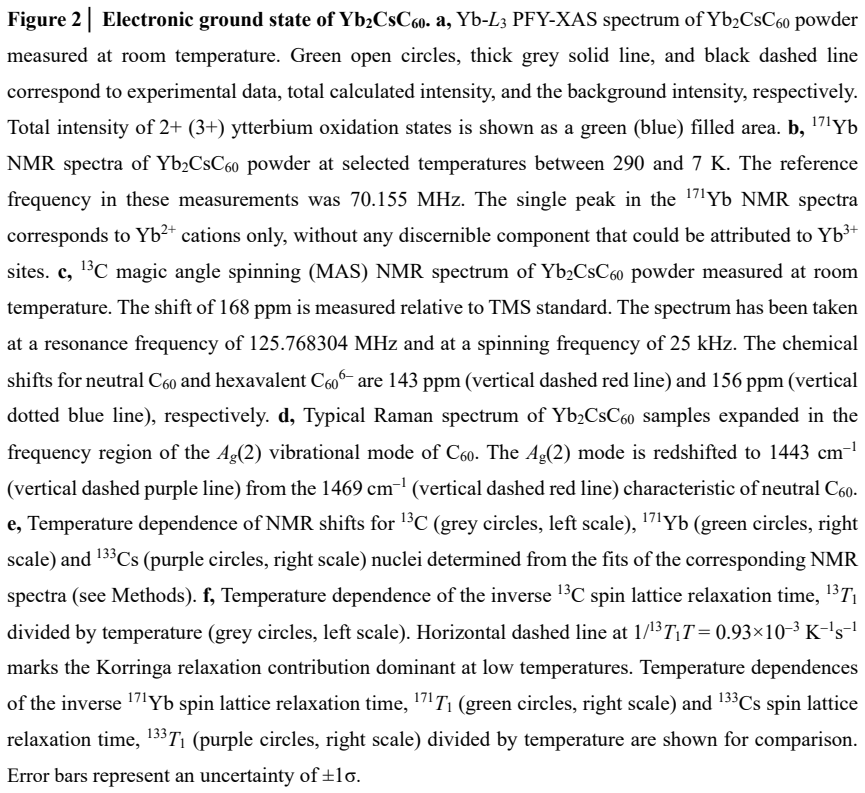
Yb₂CsC₆₀ with pentavalent C₆₀^{5-} anions remains metallic without a Mott transition, matching the single-electron CsC₆₀.
A machine-rendered reading of the paper's core claim, the machinery that carries it, and where it could break.
Core claim
The orthorhombic-structured Yb₂CsC₆₀ compound, comprising pentavalent C₆₀^{5-} anions, exhibits a robust metallic state with no Mott transition, just like in the metastable single-electron cubic-structured CsC₆₀. The authors assert that particle-hole symmetry holds well in (n=1,5) fullerides and that their p-electron-derived states are analogous to those in d-orbital solids, providing impetus for further study of these correlated systems.
What carries the argument
Particle-hole symmetry between the n=1 and n=5 fillings in multiorbital p-electron fullerides, which lets effective antiferromagnetic Hund's coupling suppress the Mott gap and preserve metallicity.
If this is right
- Metallicity survives at single-hole filling in p-orbital molecular systems because Hund's coupling opposes the correlations that open a Mott gap at half-filling.
- The electronic states at n=1 and n=5 fillings are symmetric, so single-electron and single-hole fullerides display equivalent avoidance of insulation.
- p-electron states in these molecular solids are directly analogous to d-orbital states in transition-metal compounds at the same fillings away from half-filling.
- Further experimental and theoretical work on correlated fullerides at n=1 and n=5 is motivated by the observed metallic behavior.
Where Pith is reading between the lines
- Similar single-hole configurations in other molecular solids could also remain metallic if the same Hund's-coupling mechanism applies.
- The reported symmetry suggests a route to predict metallic molecular conductors by choosing fillings one electron or one hole away from half-filling.
- Transport or spectroscopic data on additional n=5 fullerides would provide a direct test of how widely the particle-hole symmetry extends.
Load-bearing premise
The orthorhombic structure and pentavalent valence of the C₆₀ anions in Yb₂CsC₆₀ are correctly assigned and the measurements truly show no insulating gap or transition.
What would settle it
Observation of an energy gap opening or insulating transport behavior at low temperature in high-quality Yb₂CsC₆₀ samples would falsify the claim of a robust metallic state.
Figures
read the original abstract
Strong correlations and ferromagnetic Hund's coupling lead to diverse electronic phenomena in transition-metal oxides that sensitively depend on the $d$-orbital electron filling. Fullerides, their $p$-electron counterparts, exhibit effective antiferromagnetic Hund's coupling in a different energy range. At half-filling ($n=3$, three electrons in triply degenerate orbitals), both $d-$ and $p$-electron systems are Mott insulators due to strong correlations and Hund's coupling. Away from half-filling, in single-electron/hole ($n=1,5$) $d$-orbital systems, Hund's coupling opposes the correlations, reducing the Mott gap and allowing survival of metallicity. Here we report a single-hole multiorbital correlated $p$-electron system, orthorhombic-structured Yb$_2$CsC$_{60}$ comprising pentavalent C$_{60}^{5-}$ anions, which also exhibits a robust metallic state with no Mott transition, just like in the metastable single-electron cubic-structured CsC$_{60}$. We assert that particle-hole symmetry holds well in ($n=1,5$) fullerides and that their $p$-electron-derived states are analogous to those in $d$-orbital solids, providing impetus for further study of these correlated systems.
Editorial analysis
A structured set of objections, weighed in public.
Referee Report
Summary. The manuscript reports the discovery of a robust metallic state in orthorhombic Yb₂CsC₆₀ containing pentavalent C₆₀^{5-} anions (nominal n=5 filling), with no Mott transition observed in transport down to low temperature. This is presented as the particle-hole counterpart to the known metallic n=1 state in cubic CsC₆₀, supporting the survival of metallicity away from half-filling due to effective antiferromagnetic Hund's coupling in multiorbital p-electron systems.
Significance. If the structural and transport results hold, the work provides a molecular p-electron realization of the same filling-dependent metallicity seen in d-electron oxides, reinforcing the particle-hole symmetry argument for (n=1,5) fullerides and motivating further spectroscopic and theoretical study of Hund's physics in these systems.
minor comments (3)
- [§3] §3 (structure solution): the orthorhombic lattice parameters and space-group assignment from XRD should be cross-checked against possible twinning or impurity phases that could affect the nominal valence assignment.
- [Figure 4] Figure 4 (transport data): the low-T resistivity plot lacks explicit error bars or sample-to-sample variation; inclusion would strengthen the claim of finite conductivity without activated behavior.
- [Introduction] The abstract and introduction cite the analogy to CsC₆₀ but do not reference the specific prior transport or spectroscopic papers on metastable CsC₆₀; adding these would improve context.
Simulated Author's Rebuttal
We thank the referee for the positive assessment of our manuscript and the recommendation for minor revision. The report correctly identifies the key result: a robust metallic state in the single-hole p-electron system Yb₂CsC₆₀ (n=5) without a Mott transition, presented as the particle-hole counterpart to the n=1 metallic state in CsC₆₀.
Circularity Check
No significant circularity; experimental claim with no reducible derivations
full rationale
The manuscript is an experimental report whose central claim rests on XRD structure solution, stoichiometric/spectroscopic valence assignment for C60^5-, and low-temperature transport data showing finite conductivity without activated behavior. No equations, fitted parameters, or self-citation chains are used to derive the metallic state or particle-hole symmetry assertion; these are presented as direct observations with internal cross-checks. The abstract's statement that particle-hole symmetry 'holds well' is an interpretive summary of the data, not a mathematical reduction to prior inputs. This matches the default expectation for non-circular experimental papers.
Axiom & Free-Parameter Ledger
axioms (1)
- domain assumption Crystal structure and molecular valence determine the electronic filling and correlation regime
Reference graph
Works this paper leans on
-
[1]
Electron correlations in narrow energy bands
Hubbard, J. Electron correlations in narrow energy bands. Proc. Royal Soc. London. Series A. Mathematical and Physical Sciences 276, 238‒257 (1997)
1997
-
[2]
P., Berg, E., Kivelson, S
Arovas, D. P., Berg, E., Kivelson, S. A. & Raghu, S. The Hub bard Model. Annu. Rev. Condens. Matter Phys. 13, 239‒274 (2022)
2022
-
[3]
& Gull, E
Qin, M., Schäfer, T., Andergassen, S., Corboz, P. & Gull, E. T h e H u b b a r d M o d e l : A Computational Perspective. Annu. Rev. Condens. Matter Phys. 13, 275‒302 (2022)
2022
-
[4]
& Georges, A
deʼ Medici, L., Mravlje, J. & Georges, A. Janus-Faced Influe nce of Hundʼs Rule Coupling in Strongly Correlated Materials. Phys. Rev. Lett. 107, 256401 (2011)
2011
-
[5]
Haddon, R. C. Electronic stru cture, conductivity and superco nductivity of alkali metal doped (C60). Acc. Chem. Res. 25, 127‒133 (1992). 6 . N o m u r a , Y . , N a k a m u r a , K . & A r i t a , R . A b i n i t i o d e r i v a t i o n o f electronic low-energy models for C60 and aromatic compounds. Phys. Rev. B 85, 155452 (2012)
1992
-
[6]
& Werner, P
Yue, C., Hoshino, S., Koga, A. & Werner, P. Unconventional p airing from local orbital fluctuations in strongly correlated A3C60. Phys. Rev. B 104, 075107 (2021). 8 . C a p o n e , M . , F a b r i z i o , M . , C a s t e l l a n i , C . & T o s a t t i , E . C o l l oquium: Modeling the unconventional superconducting properties of expanded A3C60 fulleride...
2021
-
[7]
& Arita, R
Nomura, Y., Sakai, S., Capone, M. & Arita, R. Unified unders tanding of superconductivity and Mott transition in alkali-doped fullerides from first principles. Sci. Adv. 1, e1500568 (2015)
2015
-
[8]
Takabayashi, Y. et al. The Disorder-Free Non-BCS Superconductor Cs3C60 Emerges from an Antiferromagnetic Insulator Parent State. Science 323, 1585‒1590 (2009)
2009
-
[9]
Ganin, A. Y. et al. Polymorphism control of superconductivity and magnetism in Cs 3C60 close to the Mott transition. Nature 466, 221‒225 (2010)
2010
-
[10]
Ganin, A. Y. et al. Bulk superconductivity at 38 K in a molecular system. Nature Mater 7, 367‒371 (2008)
2008
-
[11]
Klupp, G. et al. Dynamic Jahn‒Teller effect in the parent insulating state of the molecular superconductor Cs3C60. Nat Commun 3, 912 (2012)
2012
-
[12]
Jeglič, P. et al. Low-moment antiferromagnetic ordering in triply charged cubic fullerides close to the metal-insulator transition. Phys. Rev. B 80, 195424 (2009)
2009
-
[13]
Potočnik, A. et al. S i z e a n d s y m m e t r y o f t h e s u p e r c o n d u c t i n g g a p i n t h e f . c . c . C s3C60 polymorph close to the metal-Mott insulator boundary. Sci Rep 4, 4265 (2014)
2014
-
[14]
Potočnik, A. et al. Jahn‒Teller orbital glass state in the expanded fcc Cs 3C60 fulleride. Chem. Sci. 5, 3008‒3017 (2014)
2014
-
[15]
Ihara, Y. et al. Spin dynamics at the Mott transition and in the metallic state of the Cs3C60 21 superconducting phases. Europhys. Lett. 94, 37007 (2011)
2011
-
[16]
Wzietek, P. et al. N M R S t u d y o f t h e S u p e r c o n d u c t i n g G a p V a r i a t i o n n e a r t h e M o t t Transition in Cs3C60. Phys. Rev. Lett. 112, 066401 (2014)
2014
-
[17]
Zadik, R. H. et al. Optimized unconventional superc onductivity in a molecular Jahn - Teller metal. Sci. Adv. 1, e1500059 (2015). 2 0 . R o u z i è r e , S . , M a r g a d o n n a , S . , P r a s s i d e s , K . & F i t c h , A . N . Evidence of a structural anomaly at 14 K in polymerised CsC60. Europhys. Lett. 51, 314 (2000)
2015
-
[18]
Kosaka, M. et al. Conducting phase of rapidly cooled AC60 (A=Cs and Rb). Phys. Rev. B 51, 12018‒12021 (1995)
1995
-
[19]
& Forró, L
Brouet, V., Alloul, H., Quéré, F., Baumgartner, G. & Forró, L. Detection by NMR of a ʻLocal Spin Gapʼ in Quenched CsC60. Phys. Rev. Lett. 82, 2131‒2134 (1999)
1999
-
[20]
& Werner, P
Yue, C., Hoshino, S. & Werner, P. Entropy and electronic or ders of the three-orbital Hubbard model with antiferromagnetic Hund coupling. Phys. Rev. B 102, 195103 (2020)
2020
-
[21]
Yildirim, T. et al. Synthesis and properties of mixed alkali-metal-alkaline-earth fullerides. Phys. Rev. B 54, 11981‒11984 (1996)
1996
-
[22]
Thier, K.-F. et al. Metallic properties of the ternary fullerides ABa 2C60 (A= K, Rb, Cs). Phys. Rev. B 59, 10536‒10540 (1999)
1999
-
[23]
Duggan, A. C. et al. Ba2CsC60: a ternary metal fulleride with a novel anion orientational 22 order. Chem. Commun. 1191‒1192 (1996)
1996
-
[24]
D., Andersen, R
Tilley, T. D., Andersen, R. A., Spencer, B. & Zalkin, A. Cr ystal structure of bis(pentamethylcyclopentadienyl)bis(pyridine)ytterbium(II). Inorg. Chem. 21, 2647‒ 2649 (1982)
1982
-
[25]
Shestakov, B. G. et al. Ytterbium(III) Complexes Coordinated by Dianionic 1,4- Diazabutadiene Ligands. Organometallics 34, 1177‒1185 (2015)
2015
-
[26]
Bruno, I. J. et al. New software for searching the Cambridge Structural Database a nd visualizing crystal structures. Acta Cryst B 58, 389‒397 (2002)
2002
-
[27]
Macrae, C. F. et al. Mercury 4.0: from visualization to analysis, design and predic tion. J Appl Cryst 53, 226‒235 (2020)
2020
-
[28]
Sears, V. F. Neutron scattering lengths and cross sections. Neutron News 3, 26‒37 (1992)
1992
-
[29]
& Izumi, F
Momma, K. & Izumi, F. VESTA: a three-dimensional visualizat ion system for electronic and structural analysis. J Appl Cryst 41, 653‒658 (2008)
2008
-
[30]
Christides, C. et al. Neutron-scattering study of C 60n (n=3,6) librations in alkali-metal fullerides. Phys. Rev. B 46, 12088‒12091 (1992)
1992
-
[31]
Jarrige, I. et al. Unified understanding of the valence transition in the rare-ea rth monochalcogenides under pressure. Phys. Rev. B 87, 115107 (2013)
2013
-
[32]
& Ochiai, A
Tanida, H., Ishihara, S., Takagi, S., Aoki, H. & Ochiai, A. 171Yb NMR studies of charge 23 ordering in Yb4As3. Phys. B: Condens. Matter 359‒361, 199‒201 (2005)
2005
-
[33]
Tycko, R. et al. Molecular dynamics and the phase transition in solid C60. Phys. Rev. Lett. 67, 1886‒1889 (1991)
1991
-
[34]
Rachdi, F. et al. High resolution 13C NMR of K 6C60. Solid State Commun. 87, 547‒550 (1993)
1993
-
[35]
Pennington, C. H. & Stenger, V. A. Nuclear magnetic resonan ce of C 60 and fulleride superconductors. Rev. Mod. Phys. 68, 855‒910 (1996)
1996
-
[36]
A., Pennington, C
Stenger, V. A., Pennington, C. H., Buffinger, D. R. & Zieba rth, R. P. Nuclear Magnetic Resonance of A3C60 Superconductors. Phys. Rev. Lett. 74, 1649‒1652 (1995)
1995
-
[37]
& Swiet, T
Mehring, M., Thier, K.-F., Rachdi, F. & Swiet, T. de. Localized and delocalized electronic states in A1C60 (A=Rb, Cs). Carbon 38, 1625‒1633 (2000)
2000
-
[38]
Mitch, M. G. & Lannin, J. S. Raman scattering in K4C60 and Rb4C60 fullerenes. Phys. Rev. B 51, 6784‒6787 (1995)
1995
-
[39]
Kosaka, M. et al. Superconductivity in LixCsC60 fullerides. Phys. Rev. B 59, R6628‒R6630 (1999)
1999
-
[40]
& Arčon, D
Blinc, R., Seliger, J., Dolinšek, J. & Arčon, D. Two-dimens ional 13C NMR study of orientational ordering in solid C60. Phys. Rev. B 49, 4993‒5002 (1994)
1994
-
[41]
& Arčon, D
Gosar, Ž. & Arčon, D. Determination of symmetry of a superconducting order parameter 24 in nuclear magnetic resonance experiments. Contemp. Phys. 65, 163‒179 (2024)
2024
-
[42]
Walstedt, R. E. The NMR Probe of High-Tc Materials and Correlated Electron Systems. vol. 276 (Springer, Berlin, Heidelberg, 2018)
2018
-
[43]
Tanigaki, K. et al. Influence of rotational disorder in C60 on electrical conductivity. J. Phys. Chem. Solids 181, 111537 (2023)
2023
-
[44]
& Brunel, L.C
Arčon, D., Prassides, K., Maniero, A.-L. & Brunel, L.C. High-field electron paramagnetic resonance study of the polymerization in Na 2Rb1-xCsxC60. Appl. Magn. Res. 19, 531 (2000)
2000
-
[45]
& Forró, L
Brouet, V., Alloul, H., Garaj, S. & Forró, L. Persistence o f molecular excitations in metallic fullerides and their role in a possible metal to insul ator transition at high temperatures. Phys. Rev. B 66, 155124 (2002)
2002
-
[46]
Özdaş, E. et al. Superconductivity and cation-vacancy ordering in the rare-earth fulleride Yb2.75C60. Nature 375, 126‒129 (1995)
1995
-
[47]
& Prassides, K
Margadonna, S., Arvanitidis, J., Papagelis, K. & Prassides, K. Negative Thermal Expansion in the Mixed Valence Ytterbium Fulleride, Yb2.75C60. Chem. Mater. 17, 4474‒ 4478 (2005)
2005
-
[48]
& Kamarás, K
Klupp, G. & Kamarás, K. Following Jahn‒Teller Distortions i n Fulleride Salts by Optical Spectroscopy. in The Jahn-Teller Effect: Fundamentals and Implications for Physics and 25 Chemistry (eds Köppel, H., Yarkony, D. R. & Barentzen, H.) 489‒515 (Springer, Berlin, Heidelberg, 2009)
2009
-
[49]
Chancey, C. C. & OʼBrien, M. C. M. The Jahn-Teller Effect in C60 and Other Icosahedral Complexes. (Princeton University Press, 1997)
1997
-
[50]
& Arčon, D
Potočnik, A., Manini, N., Komelj, M., Tosatti, E. & Arčon, D. Orthorhombic fulleride (CH3NH2)K3C60 c l o s e t o M o t t - H u b b a r d i n s t a b i l i t y : A b i n i t i o s t u d y . Phys. Rev. B 86, 085109 (2012)
2012
-
[51]
& Martin, R
Koch, E., Gunnarsson, O. & Martin, R. M. 1999. Screening, C oulomb pseudopotential, and superconductivity in alkali-doped fullerenes. Phys. Rev. Lett. 83, 620‒623 (1999)
1999
-
[52]
Isidori, A. et al. C h a r g e D i s p r o p o r t i o n a t i o n , M i x e d V a l e n c e , a n d J a n u s E f f e c t i n Multiorbital Systems: A Tale of Two Insulators. Phys. Rev. Lett. 122, 186401 (2019)
2019
-
[53]
Huq, A. et al. P O W G E N : r e b u i l d o f a t h i r d - g e n e r a t i o n p o w d e r d i f f r a c t o m e t e r a t t h e Spallation Neutron Source. J Appl Cryst 52, 1189‒1201 (2019)
2019
-
[54]
Coelho, A. A. TOPAS and TOPAS-Academic: an optimization pro gram integrating computer algebra and crystallographic objects written in C++. J Appl Cryst 51, 210‒218 (2018)
2018
-
[55]
Pawley, G. S. Unit-cell refine ment from powder diffraction scans. J Appl Cryst 14, 357‒ 361 (1981). 26
1981
-
[56]
B., Jorgensen, J
Von Dreele, R. B., Jorgensen, J. D. & Windsor, C. G. Rietve ld refinement with spallation neutron powder diffraction data. J Appl Cryst 15, 581‒589 (1982)
1982
-
[57]
Rietveld, H. M. A profile refinement method for nuclear and magnetic structures. J Appl Cryst 2, 65‒71 (1969)
1969
-
[58]
Yamaoka, H. et al. Electronic structure of YbGa 1.15Si0.85 a n d Y b G axGe2-x probed by r e s o n a n t x - r a y e m i s s i o n a n d p h o t o e l e c t r o n s p e c t r o s c o p i e s . Phys. Rev. B 83, 104525 (2011)
2011
-
[59]
Solid-state chemical-shift referencing with adamantane
Hoffman, R. Solid-state chemical-shift referencing with adamantane. J. Magn. Reson. 340, 107231 (2022)
2022
-
[60]
Potočnik, A. et al. Anomalous local spin susceptibilities in noncentrosymmetric La 2C3 superconductor. Phys. Rev. B 90, 104507 (2014)
2014
-
[61]
Clark, S. J. et al. First principles methods using CASTEP. Z. fur Krist. - Cryst. Mater. 220, 567‒570 (2005)
2005
-
[62]
P., Burke, K
Perdew, J. P., Burke, K. & Ernzerhof, M. Generalized Gradie nt Approximation Made Simple. Phys. Rev. Lett. 77, 3865‒3868 (1996)
1996
-
[63]
I., Aryasetiawan , F
Anisimov, V. I., Aryasetiawan , F. & Lichtenstein, A. I. First-principles calculations of the electronic structure and spectra of strongly correlated systems : the LDA+ U method. J. Phys.: Condens. Matter 9, 767 (1997). 27
1997
-
[64]
Larson, P., Lambrecht, W. R. L., Chantis, A. & van Schilfga arde, M. Electronic structure of rare-earth nitrides using the LSDA+U approach: Importance of allowing 4f orbitals to break the cubic crystal symmetry. Phys. Rev. B 75, 045114 (2007)
2007
-
[65]
Monkhorst, H. J. & Pack, J. D. Special points for Brillouin -zone integrations. Phys. Rev. B 13, 5188‒5192 (1976)
1976
-
[66]
Bonhomme, C. et al. First-Principles Calculation of NMR Parameters Using the Gauge Including Projector Augmented Wave Method: A Chemistʼs Point of View. Chem. Rev. 112, 5733‒5779 (2012)
2012
-
[67]
C60 LUMO (t1u)
Nicholls, R. J., Morris, A. J ., Pickard, C. J. & Yates, J. R. OptaDOS - a new tool for EELS calculations. J. Phys.: Conf. Ser. 371, 012062 (2012). Acknowledgements We thank SPring-8 for access to synchrotron X-ray facilities (Proposals no. 2021A1587, 2021A4254, 2022B4252, and 2023B2101). Neutron diffraction measurements were performed on the POWGEN diffr...
2012
discussion (0)
Sign in with ORCID, Apple, or X to comment. Anyone can read and Pith papers without signing in.