A Comprehensive Design Framework for Vertical Power Delivery in High-Performance Computing
Pith reviewed 2026-06-30 09:00 UTC · model grok-4.3
The pith
A distributed vertical power delivery framework reaches 84% efficiency for 48V-to-1V conversion in HPC systems using only 54% of the area under the load.
A machine-rendered reading of the paper's core claim, the machinery that carries it, and where it could break.
Core claim
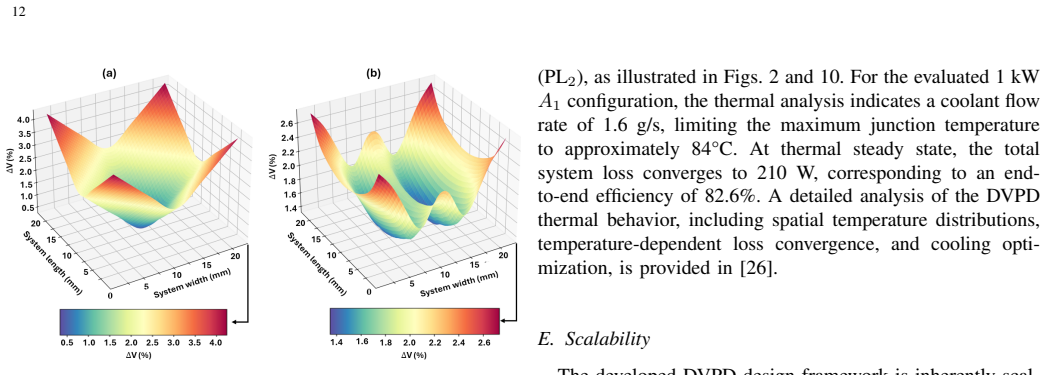
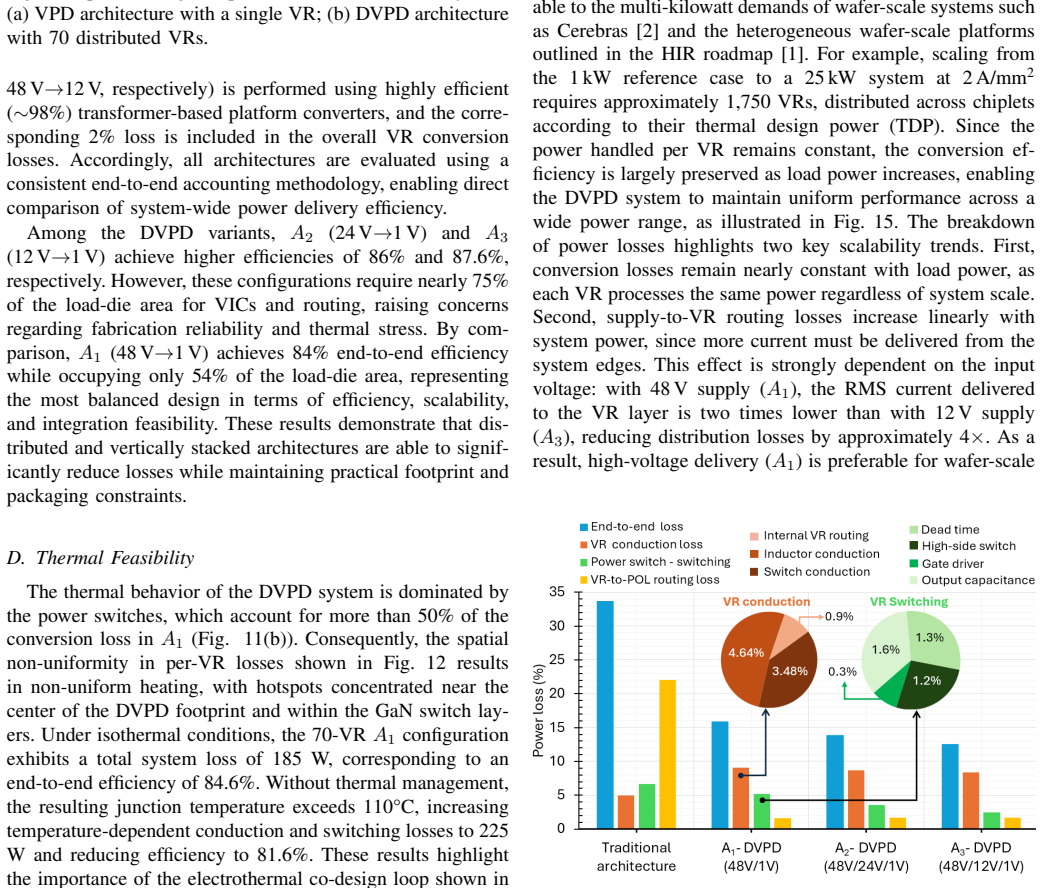
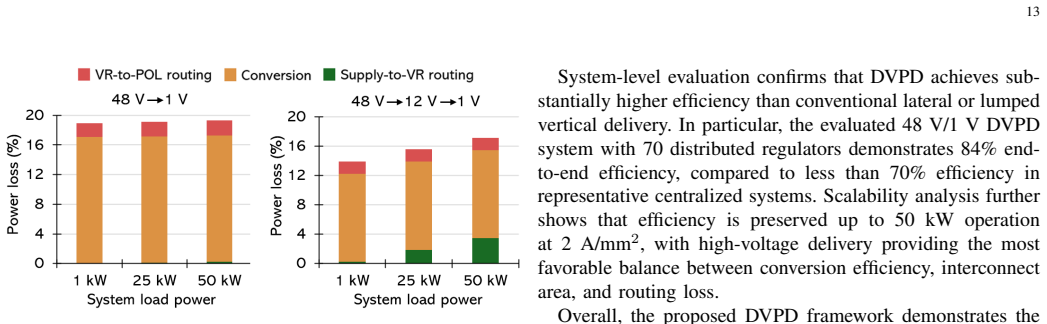
The central discovery is that the distributed vertical power delivery (DVPD) approach, leveraging substrate-embedded GaN power switches along with tailored inductor and capacitor arrays, combined with multi-stage conversion schemes and analytical modeling of losses and drops, enables system-wide efficiencies of 84% for direct 48V-to-1V delivery at 54% area occupation, scaling up to 87.6% at higher area use, with peak steady-state drops of 2.7% and transient drops of 9% without decoupling capacitors, making it suitable for 1-50 kW loads in wafer-scale HPC.
What carries the argument
The DVPD architecture consisting of distributed power stages with embedded GaN switches and unit inductor-capacitor arrays, supported by analytical models for steady-state voltage drops and power losses.
Load-bearing premise
The analytical models used to calculate voltage drops and power losses accurately represent the behavior of real devices and interconnects without needing calibration for manufacturing variations.
What would settle it
Fabricating a DVPD prototype for the 48V-to-1V case and measuring end-to-end efficiency below 80% or steady-state voltage drops above 3% would disprove the performance claims.
Figures
read the original abstract
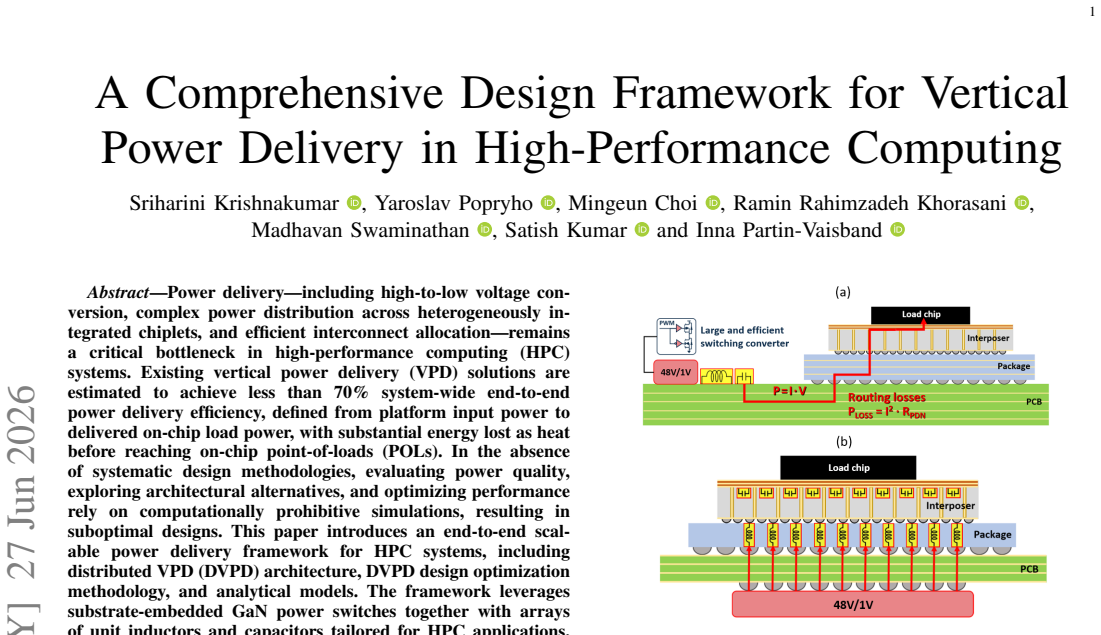
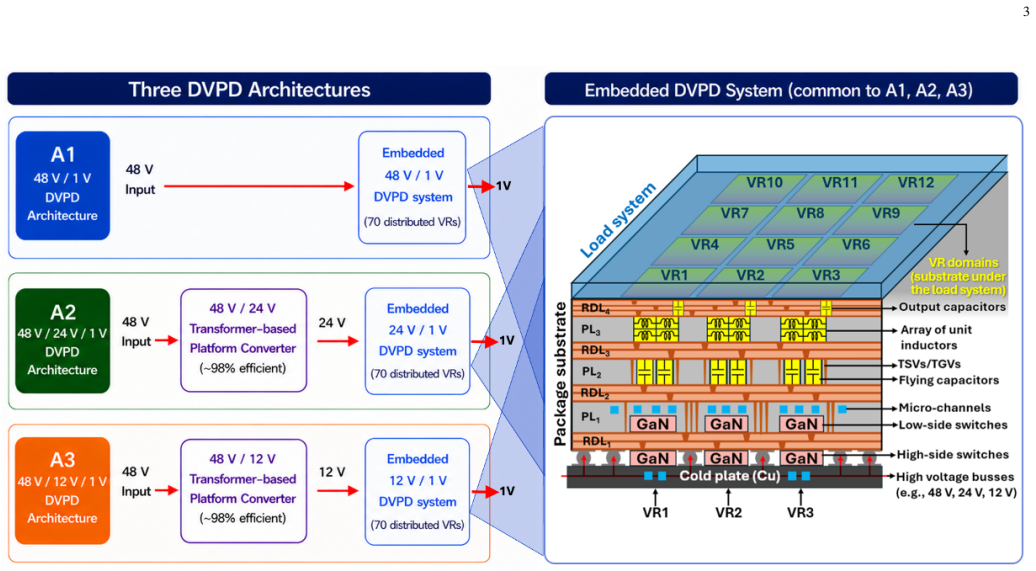
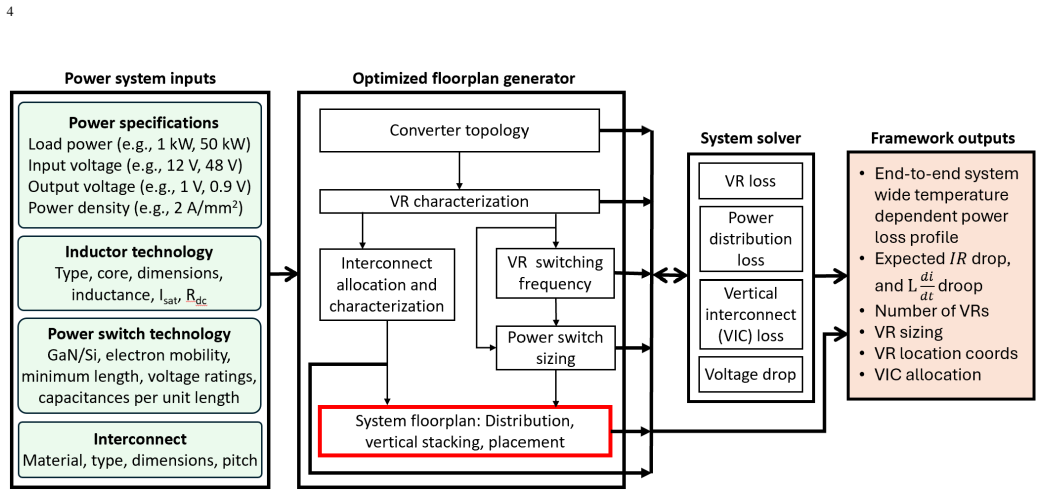
Power delivery -- including high-to-low voltage conversion, complex power distribution across heterogeneously integrated chiplets, and efficient interconnect allocation -- remains a critical bottleneck in high-performance computing (HPC) systems. Existing vertical power delivery (VPD) solutions are estimated to achieve less than 70\% system-wide end-to-end power delivery efficiency, defined from platform input power to delivered on-chip load power, with substantial energy lost as heat before reaching on-chip point-of-loads (POLs). In the absence of systematic design methodologies, evaluating power quality, exploring architectural alternatives, and optimizing performance rely on computationally prohibitive simulations, resulting in suboptimal designs. This paper introduces an end-to-end scalable power delivery framework for HPC systems, including distributed VPD (DVPD) architecture, DVPD design optimization methodology, and analytical models. The framework leverages substrate-embedded GaN power switches together with arrays of unit inductors and capacitors tailored for HPC applications. Multi-stage power conversion schemes (48V-to-1V, 48V-to-24V-to-1V, and 48V-to-12V-to-1V) are explored, with system-wide voltage drops and power losses evaluated under steady-state conditions. Design specifications for passive and active devices are formulated to meet next-generation efficiency targets. For the 48V-to-1V case, the proposed DVPD approach achieves 84\% system-wide efficiency while occupying 54\% of the area beneath the load system, with efficiency increasing to 87.6\% at 75\% area utilization across a 1--50~kW load range. Furthermore, steady-state voltage drops peak at 2.7\% and transient drops at 9\% (without decoupling capacitors), demonstrating the viability of DVPD for future wafer-scale HPC platforms.
Editorial analysis
A structured set of objections, weighed in public.
Referee Report
Summary. The paper introduces an end-to-end scalable framework for vertical power delivery in HPC systems consisting of a distributed VPD (DVPD) architecture using substrate-embedded GaN switches and arrays of unit inductors/capacitors, a design optimization methodology, and analytical models for multi-stage conversion (48V-to-1V, 48V-to-24V-to-1V, 48V-to-12V-to-1V). It evaluates system-wide voltage drops and power losses under steady-state conditions and reports that the 48V-to-1V DVPD case achieves 84% efficiency at 54% area utilization beneath the load (rising to 87.6% at 75% utilization) over 1-50 kW, with peak steady-state drops of 2.7% and transient drops of 9% (no decoupling caps).
Significance. If the analytical models prove accurate, the framework would supply a systematic, simulation-light methodology for exploring and optimizing VPD architectures that currently rely on computationally expensive full-system simulations, potentially enabling efficiencies above the <70% baseline cited for existing solutions.
major comments (2)
- [Abstract / Analytical Models] Abstract and analytical-models description: the headline results (84% system efficiency, 2.7% steady-state drop, 9% transient drop) are generated exclusively by the paper's analytical models of losses and voltage drops, yet no derivation steps, explicit equations, parameter-calibration procedure, or tolerance analysis are supplied, preventing assessment of whether the models correctly embed interconnect parasitics, GaN non-idealities, and inductor/capacitor losses across the full 1-50 kW range.
- [Analytical Models / Results] Validation of models: the manuscript reports no cross-check of the analytical predictions against SPICE-level netlists, electromagnetic extraction, or measured prototypes; any systematic omission in the models (e.g., unmodeled parasitic inductance or switch R_on variation) would directly scale into the claimed efficiency and area numbers, making the central performance claims unverifiable from the given material.
minor comments (2)
- [Abstract] The abstract states that 'design specifications for passive and active devices are formulated' but provides no concrete criteria or optimization constraints used to arrive at those specifications.
- [Results] The transient-drop figure of 9% is given without decoupling capacitors; the manuscript should clarify whether this is a worst-case bound or an operating-point value and how it was obtained from the steady-state models.
Simulated Author's Rebuttal
We thank the referee for the constructive feedback. We address the two major comments on the analytical models below, agreeing that additional detail is warranted for verifiability.
read point-by-point responses
-
Referee: [Abstract / Analytical Models] Abstract and analytical-models description: the headline results (84% system efficiency, 2.7% steady-state drop, 9% transient drop) are generated exclusively by the paper's analytical models of losses and voltage drops, yet no derivation steps, explicit equations, parameter-calibration procedure, or tolerance analysis are supplied, preventing assessment of whether the models correctly embed interconnect parasitics, GaN non-idealities, and inductor/capacitor losses across the full 1-50 kW range.
Authors: We agree the models require more explicit documentation. The revised manuscript will add a dedicated subsection with derivation steps and explicit equations for multi-stage loss and voltage-drop calculations (including GaN R_on, switching losses, inductor ESR, capacitor ESR, and interconnect parasitics). We will also include the parameter-calibration procedure from datasheets and a tolerance/sensitivity analysis over the 1-50 kW range. revision: yes
-
Referee: [Analytical Models / Results] Validation of models: the manuscript reports no cross-check of the analytical predictions against SPICE-level netlists, electromagnetic extraction, or measured prototypes; any systematic omission in the models (e.g., unmodeled parasitic inductance or switch R_on variation) would directly scale into the claimed efficiency and area numbers, making the central performance claims unverifiable from the given material.
Authors: The manuscript currently presents results from the analytical models without direct SPICE cross-validation. We will add a new results subsection comparing analytical predictions to SPICE netlist simulations for representative operating points (e.g., 10 kW and 50 kW) to verify embedding of parasitics and device non-idealities. Full electromagnetic extraction and hardware prototypes lie outside the scope of this framework paper but will be noted as future work. revision: partial
Circularity Check
No circularity: efficiencies and drops are model outputs, not inputs by construction
full rationale
The paper presents an analytical modeling framework whose outputs (84% efficiency, 2.7% steady-state drop, etc.) are computed from device and interconnect parameters for the DVPD architecture. No equations, fitted parameters, or self-citations are shown that would make these quantities equivalent to their own inputs by definition. The derivation chain therefore remains self-contained against external benchmarks and does not reduce to any of the enumerated circular patterns.
Axiom & Free-Parameter Ledger
Reference graph
Works this paper leans on
-
[1]
(2024) Chapter 22: 2D/3D power delivery for heterogeneous integration
Heterogeneous Integration Roadmap. (2024) Chapter 22: 2D/3D power delivery for heterogeneous integration. Available online: https://eps.ieee. org/wp-content/uploads/2025/11/HIR 2024 ch22 2D-3D.pdf
2024
-
[2]
TPU vs GPU vs Cerebras vs Graphcore: A fair comparison between ML hardware,
M. Khairy, “TPU vs GPU vs Cerebras vs Graphcore: A fair comparison between ML hardware,”Medium, 2020
2020
-
[3]
Vertical power delivery for emerging packaging and integration platforms-power conversion and dis- tribution,
S. Krishnakumar and I. Partin-Vaisband, “Vertical power delivery for emerging packaging and integration platforms-power conversion and dis- tribution,” inIEEE International System-on-Chip Conference (SOCC), 2023, pp. 1–6
2023
-
[4]
Power delivery for high-performance microprocessors—challenges, solutions, and future trends,
K. Radhakrishnan, M. Swaminathan, and B. K. Bhattacharyya, “Power delivery for high-performance microprocessors—challenges, solutions, and future trends,”IEEE Transactions on Components, Packaging and Manufacturing Technology, vol. 11, no. 4, pp. 655–671, 2021
2021
-
[5]
Recent advances in IVR solutions for high power microprocessors,
K. Radhakrishnan, “Recent advances in IVR solutions for high power microprocessors,” February 2024, Invited talk
2024
-
[6]
NVIDIA Hopper H100 GPU: Scaling performance,
J. Choquette, “NVIDIA Hopper H100 GPU: Scaling performance,”IEEE Micro, vol. 43, no. 3, pp. 9–17, 2023
2023
-
[7]
Vertically stacked dual- bus DC-DC converter for data center high-current power delivery,
J. Geng, R. Mandrioli, C. Jiang, and M. Ricco, “Vertically stacked dual- bus DC-DC converter for data center high-current power delivery,”IEEE Transactions on Power Electronics, 2025, Early access
2025
-
[8]
A vertical power delivery architecture for high performance computing,
C. Kong, W. Huan, J. Wang, D. Li, H. Sun, X. Zhang, F. Ye, and K. Lin, “A vertical power delivery architecture for high performance computing,”IEEE Transactions on Power Electronics, vol. 40, no. 5, pp. 6663–74, 2025
2025
-
[9]
A monolithic 5.7 A/mm2 91% peak efficiency scalable multistage modular switched capacitor voltage regulator for base die vertical power delivery in 3D-ICs,
X. Liu, J. Yu, M. Gong, N. Butzen, S. Weng, H. K. Krishnamurthy, K. Ravichandran, R. H. Ahangharnejhad, W. James, P. Christopher et al., “A monolithic 5.7 A/mm2 91% peak efficiency scalable multistage modular switched capacitor voltage regulator for base die vertical power delivery in 3D-ICs,”IEEE Journal of Solid-State Circuits, 2025
2025
-
[10]
A Robust Integrated Power Delivery Methodology for 3-D ICs,
Y . Safari and B. Vaisband, “A Robust Integrated Power Delivery Methodology for 3-D ICs,”IEEE Transactions on V ery Large Scale Integration (VLSI) Systems, vol. 31, no. 3, pp. 287–295, 2023
2023
-
[11]
Power delivery for silicon interconnect fabric,
——, “Power delivery for silicon interconnect fabric,” inIEEE Interna- tional Symposium on Circuits and Systems (ISCAS), 2021, pp. 1–5
2021
-
[12]
Design considerations for DC-DC voltage regulators in distributed vertical power delivery sys- tems,
S. Krishnakumar, M. Choi, R. R. Khorasani, R. Sharma, M. Swami- nathan, S. Kumar, and I. Partin-Vaisband, “Design considerations for DC-DC voltage regulators in distributed vertical power delivery sys- tems,” inIEEE International Symposium on Circuits and Systems (ISCAS), 2024, pp. 1–5
2024
-
[13]
Power-Integrity Modeling of VR Faults in High-Performance Applications
S. Krishnakumar and I. Partin-Vaisband, “Power-integrity model- ing of vr faults in high-performance applications,”arXiv preprint arXiv:2605.24877, 2026
work page internal anchor Pith review Pith/arXiv arXiv 2026
-
[14]
——, “Dynamic power management methodology for distributed ver- tical power delivery in high-performance computing systems,”arXiv preprint arXiv:2605.24874, 2026
work page internal anchor Pith review Pith/arXiv arXiv 2026
-
[15]
Substrate-embedded microfluidic cooling of distributed vertical power delivery architectures for high-performance computing processors,
M. Choi, S. Krishnakumar, R. R. Khorasani, M. Swaminathan, I. Partin- Vaisband, and S. Kumar, “Substrate-embedded microfluidic cooling of distributed vertical power delivery architectures for high-performance computing processors,”IEEE Transactions on Components, Packaging and Manufacturing Technology, 2025
2025
-
[16]
Thermal analysis of high current vertical power delivery network with embedded microchannel cooling,
M. Choi, S. Krishnakumar, R. R. Khorasani, I. Partin-Vaisband, R. Sharma, M. Swaminathan, and S. Kumar, “Thermal analysis of high current vertical power delivery network with embedded microchannel cooling,” inIEEE Intersociety Conference on Thermal and Thermome- chanical Phenomena in Electronic Systems (ITherm), 2024, pp. 1–8. 14
2024
-
[17]
High-efficiency nonisolated con- verter with very high step-down conversion ratio,
O. Kirshenboim and M. M. Peretz, “High-efficiency nonisolated con- verter with very high step-down conversion ratio,”IEEE Transactions on Power Electronics, vol. 32, no. 5, pp. 3683–3690, 2017
2017
-
[18]
A Regulated 48V/1V/100A 90.9%-Efficient Hy- brid Converter for POL Applications in Data Centers and Telecommuni- cation Systems,
R. Das and H.-P. Le, “A Regulated 48V/1V/100A 90.9%-Efficient Hy- brid Converter for POL Applications in Data Centers and Telecommuni- cation Systems,” inIEEE Annual Applied Power Electronics Conference and Exposition (APEC), March 2019, pp. 1997––2001
2019
-
[19]
A 90.4% peak efficiency 48V/1V three-level hybrid dickson converter with gradient descent run- time optimizer and GaN/Si hybrid conversion,
M. Gong, X. Zhang, and A. Raychowdhury, “A 90.4% peak efficiency 48V/1V three-level hybrid dickson converter with gradient descent run- time optimizer and GaN/Si hybrid conversion,” inIEEE Symposium on VLSI Technology and Circuits (VLSI Symposium), 2022, pp. 176–177
2022
-
[20]
Vertical stacked LEGO-PoL CPU voltage regulator,
J. Baek, Y . Elasser, K. Radhakrishnan, H. Gan, J. P. Douglas, H. K. Krishnamurthy, X. Li, S. Jiang, C. R. Sullivan, and M. Chen, “Vertical stacked LEGO-PoL CPU voltage regulator,”IEEE Transactions on Power Electronics, vol. 37, no. 6, pp. 6305–6322, 2021
2021
-
[21]
Analytical benchmarking of direct hybrid switched-capacitor DC-DC converters,
G. Pillonnet and P. Mercier, “Analytical benchmarking of direct hybrid switched-capacitor DC-DC converters,”IEEE Open Journal of Power Electronics, 2024
2024
-
[22]
A multi-phase cascaded series-parallel (CaSP) hybrid converter for direct 48 V to point-of-load applications,
Y . Zhu, Z. Ye, T. Ge, R. Abramson, and R. C. Pilawa-Podgurski, “A multi-phase cascaded series-parallel (CaSP) hybrid converter for direct 48 V to point-of-load applications,” inIEEE Energy Conversion Congress and Exposition (ECCE), 2021, pp. 1973–1980
2021
-
[23]
Multiphase buck design from start to finish (part 1),
C. Parisi, “Multiphase buck design from start to finish (part 1),”Texas Instruments, Application Report SLVA882, vol. 55, 2017
2017
-
[24]
Interleaved resonant fcml converter architecture for scal- able vertical power delivery in high-performance computing systems,
A. Lotfi, S. Krishnakumar, A. G. Nazari, M. B. Shadmand, and I. Partin- Vaisband, “Interleaved resonant fcml converter architecture for scal- able vertical power delivery in high-performance computing systems,” in2026 IEEE Applied Power Electronics Conference and Exposition (APEC). IEEE, 2026, pp. 2495–2500
2026
-
[25]
Automated electro-thermal modeling framework of distributed vertical power delivery architectures with substrate-embedded microfluidic cooling,
M. Choi, S. Krishnakumar, Y . Popryho, R. R. Khorasani, M. Swami- nathan, I. Partin-Vaisband, and S. Kumar, “Automated electro-thermal modeling framework of distributed vertical power delivery architectures with substrate-embedded microfluidic cooling,” inIEEE Intersociety Conference on Thermal and Thermomechanical Phenomena in Elec- tronic Systems (ITher...
2025
-
[26]
Self-consistent electrothermal modeling of distributed vertical power delivery architecture with substrate-embedded microfluidic cool- ing,
——, “Self-consistent electrothermal modeling of distributed vertical power delivery architecture with substrate-embedded microfluidic cool- ing,”IEEE Transactions on Components, Packaging and Manufacturing Technology, 2025
2025
-
[27]
A review of 5G front-end systems package integration,
A. O. Watanabe, M. Ali, S. Y . B. Sayeed, R. R. Tummala, and M. R. Pulugurtha, “A review of 5G front-end systems package integration,” IEEE Transactions on Components, Packaging and Manufacturing Tech- nology, vol. 11, no. 1, pp. 118–133, 2020
2020
-
[28]
Embedded silicon chip capacitors in glass package for vertical power delivery,
R. R. Khorasani, X. Li, M. Al-Juwhari, W. Murti, J. Cha, and M. Swami- nathan, “Embedded silicon chip capacitors in glass package for vertical power delivery,” inIEEE Electronic Components and Technology Con- ference (ECTC), 2025, pp. 416–423
2025
-
[29]
Saras embedded stile tm ipd technology for high per- formance power delivery networks,
B. DEPROSPO, “Saras embedded stile tm ipd technology for high per- formance power delivery networks,”IMAPSOURCE PROCEEDINGS: IMAPS-International Microelectronics Assembly and Packaging Society, 2024
2024
-
[30]
Glass interposer with multiple embedded dies for mmWave applications,
X. Li, X. Jia, J. W. Kim, S. Erdogan, K.-S. Moon, M. B. Jordan, and M. Swaminathan, “Glass interposer with multiple embedded dies for mmWave applications,”IEEE Transactions on Components, Packaging and Manufacturing Technology, 2024
2024
-
[31]
Hybrid voltage regulators for high performance computing: Analytical models and design methodology,
S. Abdelzaher, M. Gharib, and I. Partin-Vaisband, “Hybrid voltage regulators for high performance computing: Analytical models and design methodology,” inIEEE Electronic Components and Technology Conference (ECTC), 2025, pp. 2286–2292
2025
-
[32]
Heterogeneous method for energy efficient distribution of on-chip power supplies and power network on-chip system for scalable power delivery,
I. Vaisband and E. G. Friedman, “Heterogeneous method for energy efficient distribution of on-chip power supplies and power network on-chip system for scalable power delivery,” 2017, uS patent 9,785,161. [Online]. Available: https://patents.google.com/patent/US9785161B2/en
2017
-
[33]
Vertical power delivery for high performance computing systems with buck-derived regulators,
S. Krishnakumar, M. Choi, R. R. Khorasani, R. Sharma, M. Swami- nathan, S. Kumar, and I. Partin-Vaisband, “Vertical power delivery for high performance computing systems with buck-derived regulators,” in IEEE Electronic Components and Technology Conference (ECTC), 2024, pp. 2136–2142
2024
-
[34]
Silicon-interconnect fabric for fine-pitch (≤10 µm) heterogeneous integration,
S. Jangam and S. S. Iyer, “Silicon-interconnect fabric for fine-pitch (≤10 µm) heterogeneous integration,”IEEE Transactions on Compo- nents, Packaging and Manufacturing Technology, vol. 11, no. 5, pp. 727–738, 2021
2021
-
[35]
A bunch-of-wires (bow) interface for interchiplet communication,
R. Farjadrad, M. Kuemerle, and B. Vinnakota, “A bunch-of-wires (bow) interface for interchiplet communication,”IEEE Micro, vol. 40, no. 1, pp. 15–24, 2019
2019
-
[36]
FIVR–fully integrated voltage regulators on 4th generation Intel® CoreTM SoCs,
E. A. Burton, G. Schrom, F. Paillet, J. Douglas, W. J. Lambert, K. Rad- hakrishnan, and M. J. Hill, “FIVR–fully integrated voltage regulators on 4th generation Intel® CoreTM SoCs,” inIEEE Applied Power Electronics Conference and Exposition (APEC), 2014, pp. 432–439
2014
-
[37]
Integrated voltage regulator efficiency improvement using coaxial magnetic com- posite core inductors,
K. Bharath, K. Radhakrishnan, M. J. Hill, P. Chatterjee, H. Hariri, S. Venkataraman, H. T. Do, L. Wojewoda, and S. Srinivasan, “Integrated voltage regulator efficiency improvement using coaxial magnetic com- posite core inductors,” inIEEE Electronic Components and Technology Conference (ECTC), 2021, pp. 1286–1292
2021
-
[38]
Fabrication and characterization of package embedded inductors for integrated voltage regulators,
P. Murali, V . Avula, M. Ahmed, M. D. Losego, M. Swaminathan, C. Alvarez, Y . Oishi, T. Uemura, R. Nagatsuka, and N. Watanabe, “Fabrication and characterization of package embedded inductors for integrated voltage regulators,” inIEEE Electronic Components and Technology Conference (ECTC), 2022, pp. 301–305
2022
-
[39]
High aspect ratio spiral inductor with progressive turn widths for embedded power converters,
R. Rasheedi and I. Partin-Vaisband, “High aspect ratio spiral inductor with progressive turn widths for embedded power converters,” inIEEE Electronic Components and Technology Conference (ECTC), 2025, pp. 2271–2277
2025
-
[40]
High-performance 3-d silicon-embedded coupled solenoid inductors with inserted magnetic core,
P. Pan, C. Chen, J. Gu, M. Liu, and X. Li, “High-performance 3-d silicon-embedded coupled solenoid inductors with inserted magnetic core,”IEEE Transactions on Electron Devices, vol. 71, no. 5, pp. 3169– 3174, 2024
2024
-
[41]
On-chip coupled solenoid inductors for integrated power conversion,
Y . He, R. Wu, Z. Zhong, H. Zhang, and F. Bai, “On-chip coupled solenoid inductors for integrated power conversion,”IEEE Transactions on Electron Devices, vol. 68, no. 12, pp. 6292–6295, 2021
2021
-
[42]
Through- silicon via coupled inductors for vertical power delivery,
Y . Ding, X. Wang, Y . Zhu, M. Chen, S. Li, and M. G. Allen, “Through- silicon via coupled inductors for vertical power delivery,”IEEE Trans- actions on Power Electronics, 2026
2026
-
[43]
Design and demonstration of dual-core spiral package-embedded inductors for 48V-to-1V and 12V- to-1V integrated voltage regulators,
V . Avula, P. Murali, and M. Swaminathan, “Design and demonstration of dual-core spiral package-embedded inductors for 48V-to-1V and 12V- to-1V integrated voltage regulators,”Authorea Preprints, 2024
2024
-
[44]
Embedded inductors using composite magnetic materials for 12–1-V integrated voltage regulators,
C. A. Barros, P. Murali, M. Swaminathan, O. Yusuke, T. Junichi, N. Ryo, and N. Watanabe, “Embedded inductors using composite magnetic materials for 12–1-V integrated voltage regulators,”IEEE Transactions on Components, Packaging and Manufacturing Technology, vol. 11, no. 12, pp. 2183–2192, 2021
2021
-
[45]
(2023, October) Gallium nitride (GaN) power devices
Efficient Power Conversion Corporation (EPC). (2023, October) Gallium nitride (GaN) power devices. [Online]. Available: https: //epc-co.com/epc/products/gan-fets-and-ics
2023
-
[46]
Power loss calculation with com- mon source inductance consideration for synchronous buck converters,
D. Jauregui, B. Wang, and R. Chen, “Power loss calculation with com- mon source inductance consideration for synchronous buck converters,” Application Report (SLPA009A), Texas Instruments, 2011
2011
-
[47]
System archi- tecture optimization for vertical power delivery,
S. Krishnakumar, Y . Popryho, and I. Partin-Vaisband, “System archi- tecture optimization for vertical power delivery,” inProceedings of the Great Lakes Symposium on VLSI, 2024, pp. 351–352
2024
-
[48]
Fast algorithms for power grid analysis based on effective resistance,
S. K ¨ose and E. G. Friedman, “Fast algorithms for power grid analysis based on effective resistance,” inProceedings of the IEEE International Symposium on Circuits and Systems, 2010, pp. 3661–3664
2010
-
[49]
Deep trench capacitors in silicon interconnect fabric,
K. Kannan and S. S. Iyer, “Deep trench capacitors in silicon interconnect fabric,” in2020 IEEE 70th Electronic Components and Technology Conference (ECTC). IEEE, 2020, pp. 2295–2301
2020
discussion (0)
Sign in with ORCID, Apple, or X to comment. Anyone can read and Pith papers without signing in.