Unusual upper critical field in UTe2 revealed by magnetotransport measurements up to 42 T
Pith reviewed 2026-06-30 08:35 UTC · model grok-4.3
The pith
In UTe2 the SC3 phase reaches zero resistivity only above the metamagnetic transition Hm across the angular range studied.
A machine-rendered reading of the paper's core claim, the machinery that carries it, and where it could break.
Core claim
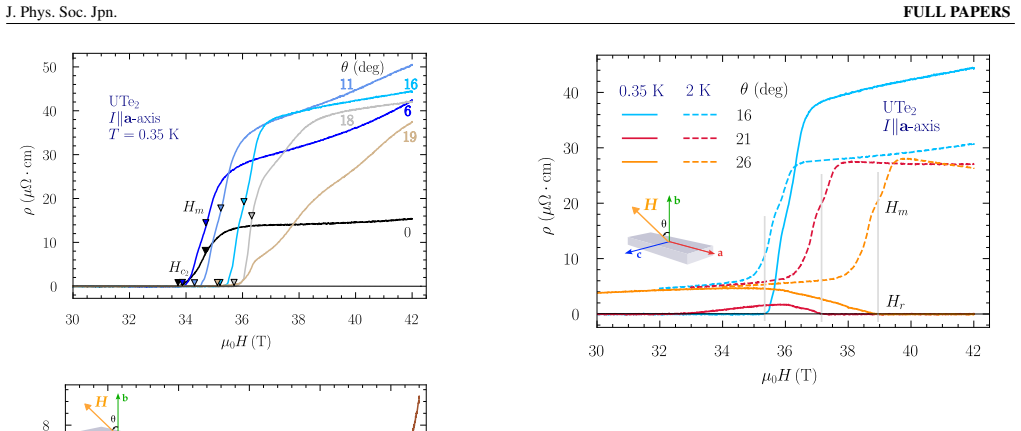
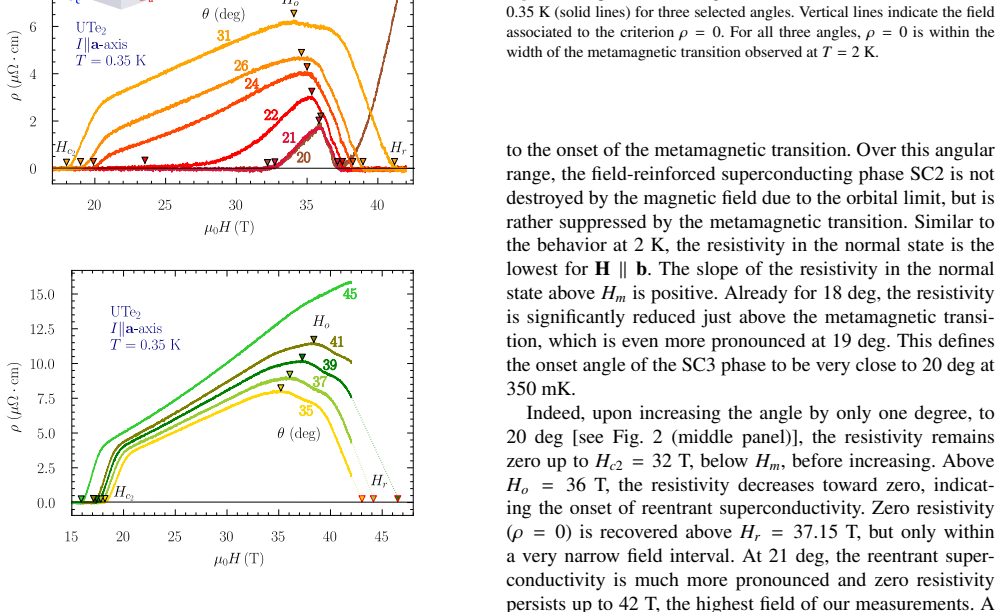
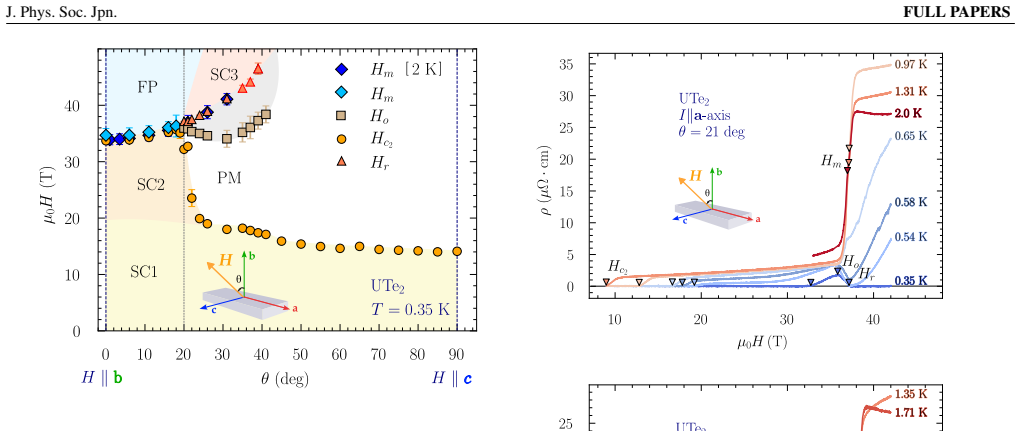
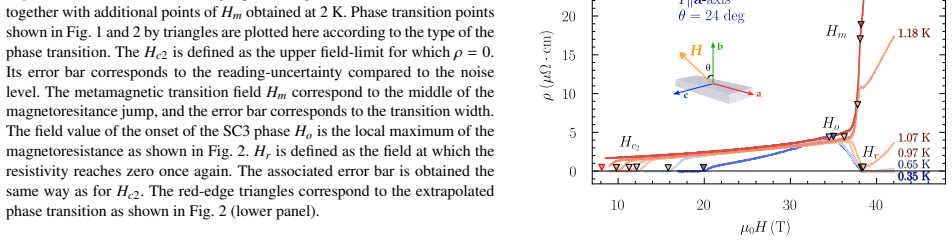
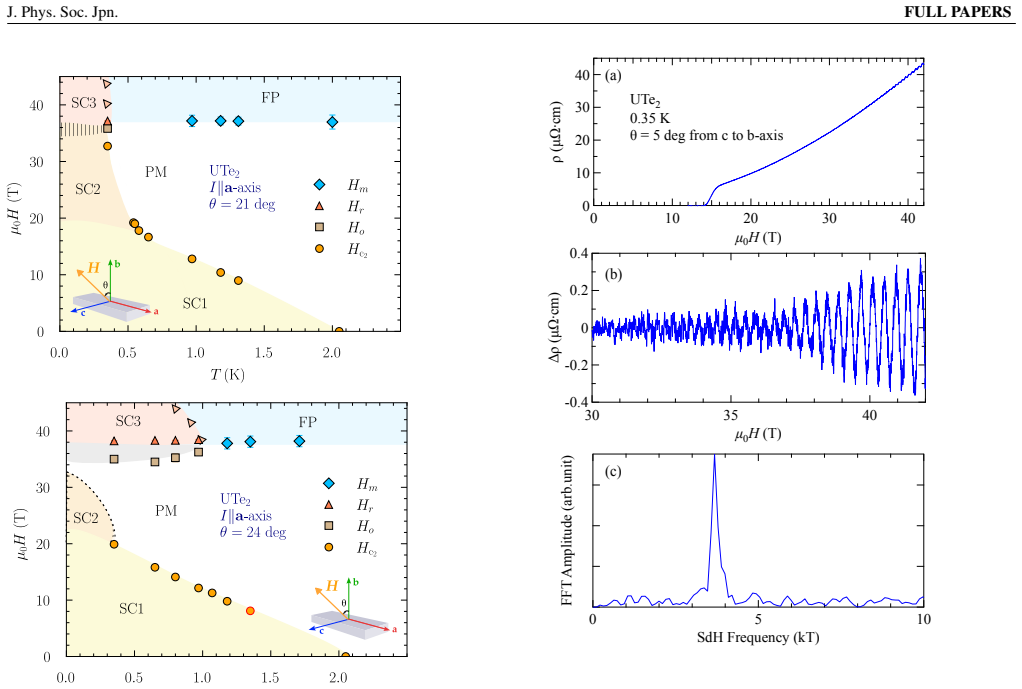
The SC3 phase first appears at an angle of 20 deg from the b axis. At larger angles the resistivity maximum that signals its onset lies below Hm, but zero resistivity occurs only above Hm throughout the angular range. At 21 deg the phase is rapidly suppressed with rising temperature, while at 24 deg it persists up to about 1 K.
What carries the argument
Magnetoresistance traces that locate the field where resistivity reaches zero and where a maximum appears, used to trace the SC3 boundary relative to the metamagnetic transition Hm.
If this is right
- SC3 superconductivity develops inside the spin-polarized state above Hm.
- The angular window for SC3 begins at 20 deg from the b axis at low temperature.
- SC3 temperature stability increases between 21 deg and 24 deg from the b axis.
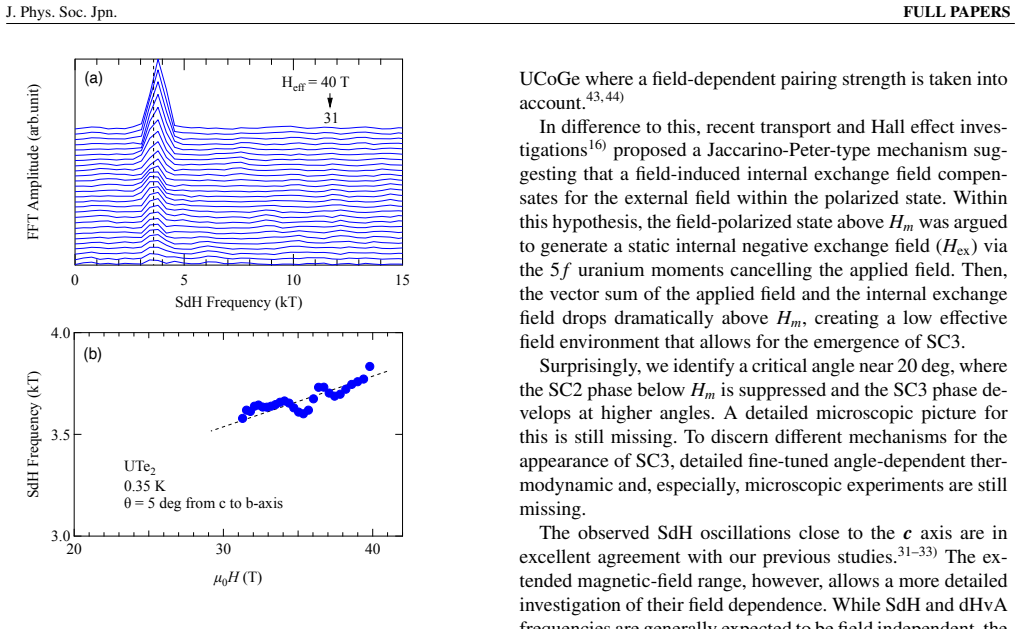
- SdH frequencies near the c axis remain consistent with earlier Fermi-surface data.
Where Pith is reading between the lines
- The metamagnetic transition may directly stabilize the SC3 pairing.
- Angle-dependent temperature robustness could reflect orientation-specific changes in the electronic structure above Hm.
- Similar high-field transport studies on other heavy-fermion compounds might reveal whether zero-resistance states commonly require a metamagnetic boundary.
Load-bearing premise
A maximum in resistivity marks the true onset of the SC3 superconducting phase and is not produced by sample inhomogeneity or contact effects.
What would settle it
Observation of zero resistivity at any angle below Hm at 0.35 K would show that the SC3 zero-resistance state is not confined above Hm.
Figures

read the original abstract
The heavy-fermion superconductor UTe2 is unique in that, at ambient pressure, it exhibits three distinct superconducting phases, two of which are induced by magnetic field. When the field is applied along the crystallographic b axis in the orthorhombic structure, the field-induced phase SC2 develops above approximately 20 T and persists up to the metamagnetic transition at Hm about 34 T. When the magnetic field is tilted towards the c axis, another superconducting phase, SC3, emerges at very high fields above about 40 T over a certain angular range. The origin of this exotic phase remains under debate. One of the key open questions regarding the origin of SC3 is whether it is confined to the spin-polarized state above Hm, or whether it already develops at lower fields. Here, we report magnetoresistance measurements performed on a high-quality single crystal of UTe2 in static magnetic fields up to 42 T applied in the (bc) plane at temperatures down to 0.35 K. At this temperature, we find that the SC3 phase first appears at an angle of 20 deg from the b axis. At larger angles, the onset of the SC3 phase, defined by a maximum in resistivity, occurs below Hm. However, zero resistivity is reached only above Hm throughout the entire angular range investigated. These results are summarized in the resulting field-angle phase diagram. Furthermore, we find that at 21 deg the SC3 phase is rapidly suppressed with increasing temperature, whereas at 24 deg it becomes considerably more robust and persists up to about 1 K. Finally, we observe Shubnikov de Haas (SdH) oscillations in the vicinity of the c axis. The observed oscillation frequencies are in good agreement with our previous results. The field dependence of the strongest SdH frequency and of the effective mass is discussed.
Editorial analysis
A structured set of objections, weighed in public.
Referee Report
Summary. The manuscript reports magnetotransport measurements up to 42 T on a UTe2 single crystal with field in the (bc) plane. It claims that the SC3 phase first appears at 20° from the b axis; for larger angles the onset (defined by a resistivity maximum) lies below Hm while zero resistance occurs only above Hm, yielding a field-angle phase diagram. Additional results include stronger temperature robustness of SC3 at 24° than at 21° and SdH oscillations near the c axis whose frequencies agree with prior work.
Significance. If the resistivity maxima reliably mark bulk SC3 onsets, the angular and temperature dependence would constrain whether SC3 requires the spin-polarized state above Hm, informing models of multiple field-induced superconducting phases in UTe2. The reported consistency of SdH frequencies with earlier measurements provides useful sample characterization.
major comments (2)
- [Abstract] Abstract and results paragraph describing resistivity features: the central claim that SC3 onset occurs below Hm rests on identifying the resistivity maximum as the superconducting boundary, yet no independent confirmation (thermodynamic signature, Hall resistivity vanishing, or similar) is provided to rule out influence from the nearby metamagnetic transition or inhomogeneity; this interpretation is load-bearing for the phase diagram.
- [Results paragraph on angular dependence] Results paragraph on angular dependence: the statement that zero resistivity is reached only above Hm throughout the investigated angular range is presented without quantitative detail on the zero-resistance criterion, its field/temperature resolution, or checks against contact resistance, which directly supports the conclusion that SC3 is confined above Hm.
minor comments (2)
- The differing temperature robustness at 21° versus 24° would be strengthened by explicit error bars on the reported upper-temperature limits and by stating the number of samples or field sweeps used.
- Notation for the angles (e.g., “20 deg from the b axis”) should be made consistent with any figure labels or table entries for clarity.
Simulated Author's Rebuttal
We thank the referee for their thorough review and valuable feedback on our manuscript. We address each major comment below, providing clarifications and indicating revisions where appropriate to enhance the clarity and robustness of our claims.
read point-by-point responses
-
Referee: [Abstract] Abstract and results paragraph describing resistivity features: the central claim that SC3 onset occurs below Hm rests on identifying the resistivity maximum as the superconducting boundary, yet no independent confirmation (thermodynamic signature, Hall resistivity vanishing, or similar) is provided to rule out influence from the nearby metamagnetic transition or inhomogeneity; this interpretation is load-bearing for the phase diagram.
Authors: We recognize that the identification of the SC3 onset via the resistivity maximum is central to our phase diagram and that independent thermodynamic or Hall effect confirmation would strengthen the claim. In high magnetic fields, such measurements are experimentally challenging, and transport data has been the primary probe for these phases in previous studies on UTe2. The resistivity maximum is distinct from the metamagnetic transition signature, and our data show consistent angular dependence. In the revised version, we will add a sentence in the abstract and results section acknowledging that this is a transport-based identification and discussing potential influences from the metamagnetic transition, while maintaining that the observed features align with SC3. revision: partial
-
Referee: [Results paragraph on angular dependence] Results paragraph on angular dependence: the statement that zero resistivity is reached only above Hm throughout the investigated angular range is presented without quantitative detail on the zero-resistance criterion, its field/temperature resolution, or checks against contact resistance, which directly supports the conclusion that SC3 is confined above Hm.
Authors: We agree that providing quantitative details on the zero-resistance criterion will improve the manuscript. We will revise the relevant paragraph to specify the criterion (resistivity below 1% of the normal-state value, for example), the field and temperature resolution achieved, and note that contact resistances were verified to be negligible through multiple contact configurations and current-reversal checks. This will better support our conclusion regarding the confinement of SC3 above Hm. revision: yes
Circularity Check
No circularity: experimental phase boundaries defined directly by measured resistivity features
full rationale
The manuscript is a pure experimental report of magnetoresistance data in static fields up to 42 T. Phase boundaries for SC3 (onset via resistivity maximum, zero resistance above Hm) are read off the raw traces at fixed angles and temperatures; no equations, ansatzes, fitted parameters, or derivations are invoked. The sole self-reference ('in good agreement with our previous results' for SdH frequencies) is peripheral and does not support the central SC3 claims. All load-bearing statements reduce to direct observation rather than to any prior input or self-citation chain.
Axiom & Free-Parameter Ledger
Reference graph
Works this paper leans on
-
[1]
Unusual upper critical field in UTe2 revealed by magnetotransport measurements up to 42 T
Introduction Since the discovery of unusual, presumably spin-triplet, superconductivity in the heavy-fermion compound UTe 2 slightly more than seven years ago, 1, 2) this material has at- tracted intense experimental and theoretical interest. UTe 2 crystallizes in a body-centered orthorhombic structure (space group: No. 71,Immm,D 25 2h) in which the urani...
work page internal anchor Pith review Pith/arXiv arXiv 2026
-
[2]
5) The high quality of the sample is demonstrated by its large residual resistivity ratio (RRR) of 576, corresponding to a residual resistivity ofρ 0 =0.57µΩ· cm
Experimental details The single crystal of UTe2 studied in this work was grown using the molten-salt flux liquid-transport technique, as de- scribed in detail elsewhere. 5) The high quality of the sample is demonstrated by its large residual resistivity ratio (RRR) of 576, corresponding to a residual resistivity ofρ 0 =0.57µΩ· cm. The zero-field supercond...
-
[3]
At this temperature, the sample is in the normal state above 30 T for all the field angles up to at least 31 deg
Experimental results 3.1 Angular dependence of the magnetoresistance In order to consistently determineH m at different angles, we performed up- and down-field sweeps between 30 and 42 T atT=2 K. At this temperature, the sample is in the normal state above 30 T for all the field angles up to at least 31 deg. The result for angles from -4 deg to 31 deg in ...
-
[4]
Discussion The main result of this study is the detailed determina- tion of theH−θphase diagram shown in Fig. 4, and the temperature dependence of different superconducting phases at angles close to the critical angleθ≈20 deg, where the field-enhanced SC2 superconducting phase vanishes and the field-induced phase SC3 occurs. Our results are very similar t...
-
[5]
We confirm that the field-induced SC3 phase emerges above a critical angle of 6 J
Conclusions and Outlook In summary, we performed transport measurements on a high-quality single crystal of UTe2 in static magnetic fields up to 42 T and at temperatures down to 0.35 K. We confirm that the field-induced SC3 phase emerges above a critical angle of 6 J. Phys. Soc. Jpn. FULL PAPERS about 20 deg, corresponding to the maximum angle at which th...
-
[6]
S. Ran, C. Eckberg, Q.-P. Ding, Y . Furukawa, T. Metz, S. R. Saha, I.-L. Liu, M. Zic, H. Kim, J. Paglione, and N. P. Butch: Science365(2019) 684
2019
-
[7]
D. Aoki, A. Nakamura, F. Honda, D. Li, Y . Homma, Y . Shimizu, Y . J. Sato, G. Knebel, J.-P. Brison, A. Pourret, D. Braithwaite, G. Lapertot, Q. Niu, M. Valiˇska, H. Harima, and J. Flouquet: J. Phys. Soc. Jpn.88 (2019) 043702
2019
-
[8]
Sakai, P
H. Sakai, P. Opletal, Y . Tokiwa, E. Yamamoto, Y . Tokunaga, S. Kambe, and Y . Haga: Physical Review Materials6(2022) 1
2022
-
[9]
P. F. S. Rosa, A. Weiland, S. S. Fender, B. L. Scott, F. Ronning, J. D. Thompson, E. D. Bauer, and S. M. Thomas: Commun. Mater.3(2022) 33
2022
-
[10]
D. Aoki: J. Phys. Soc. Jpn.93(2024) 043703
2024
-
[11]
Z. Wu, T. I. Weinberger, J. Chen, A. Cabala, D. V . Chichinadze, D. Shaf- fer, J. Posp´ıˇsil, J. Prokle ˇska, T. Haidamak, G. Bastien, V . Sechovsk´y, A. J. Hickey, M. J. Mancera-Ugarte, S. Benjamin, D. E. Graf, Y . Sk- ourski, G. G. Lonzarich, M. Vali ˇska, F. M. Grosche, and A. G. Eaton: Proceedings of the National Academy of Sciences of the United Stat...
2024
-
[12]
I. M. Hayes, T. E. Metz, C. E. Frank, S. R. Saha, N. P. Butch, V . Mishra, P. Hirschfeld, and J. Paglione: Phys. Rev. X15(2025) 021029
2025
-
[13]
Braithwaite, M
D. Braithwaite, M. Vali ˇska, G. Knebel, G. Lapertot, J.-P. Brison, A. Pourret, M. E. Zhitomirsky, J. Flouquet, F. Honda, and D. Aoki: Commun. Phys.2(2019) 147
2019
-
[14]
D. Aoki, F. Honda, G. Knebel, D. Braithwaite, A. Nakamura, D. Li, Y . Homma, Y . Shimizu, Y . J. Sato, J.-P. Brison, and J. Flouquet: J. Phys. Soc. Jpn.89(2020) 053705
2020
-
[15]
S. M. Thomas, F. B. Santos, M. H. Christensen, T. Asaba, F. Ronning, J. D. Thompson, E. D. Bauer, R. M. Fernandes, G. Fabbris, and P. F. Rosa: Sci. Adv.6(2020)
2020
-
[16]
Kinjo, H
K. Kinjo, H. Fujibayashi, H. Matsumura, F. Hori, S. Kitagawa, K. Ishida, Y . Tokunaga, H. Sakai, S. Kambe, A. Nakamura, Y . Shimizu, Y . Homma, D. Li, F. Honda, and D. Aoki: Sci. Adv.9(2023) eadg2736
2023
-
[17]
Z. Wu, J. Chen, T. I. Weinberger, A. Cabala, V . Sechovsk´y, M. Valiˇska, P. L. Alireza, A. G. Eaton, and F. M. Grosche: Phys. Rev. Lett.134 (2025) 236501
2025
-
[18]
Ran, I.-L
S. Ran, I.-L. Liu, Y . S. Eo, D. J. Campbell, P. M. Neves, W. T. Fuhrman, S. R. Saha, C. Eckberg, H. Kim, D. Graf, F. Balakirev, J. Singleton, J. Paglione, and N. P. Butch: Nat. Phys.15(2019) 1250
2019
-
[19]
Rosuel, C
A. Rosuel, C. Marcenat, G. Knebel, T. Klein, A. Pourret, N. Marquardt, Q. Niu, S. Rousseau, A. Demuer, G. Seyfarth, G. Lapertot, D. Aoki, D. Braithwaite, J. Flouquet, and J. P. Brison: Phys. Rev. X13(2023) 011022
2023
-
[20]
S. K. Lewin, C. E. Frank, S. Ran, J. Paglione, and N. P. Butch: Rep. Prog. Phys.86(2023) 114501
2023
-
[21]
T. Helm, M. Kimata, K. Sudo, A. Miyata, J. Stirnat, T. F ¨orster, J. Hornung, M. K ¨onig, I. Sheikin, A. Pourret, G. Lapertot, D. Aoki, G. Knebel, J. Wosnitza, and J.-P. Brison: Nat. Commun.15(2024) 37
2024
-
[22]
Z. Wu, T. I. Weinberger, A. J. Hickey, D. V . Chichinadze, D. Shaffer, A. Cabala, H. Chen, M. Long, T. J. Brumm, W. Xie, Y . Ling, Z. Zhu, Y . Skourski, D. E. Graf, V . Sechovsk´y, M. Valiˇska, G. G. Lonzarich, F. M. Grosche, and A. G. Eaton: Phys. Rev. X15(2025) 021019
2025
-
[23]
Knebel, W
G. Knebel, W. Knafo, A. Pourret, Q. Niu, M. Vali ˇska, D. Braithwaite, G. Lapertot, M. Nardone, A. Zitouni, S. Mishra, I. Sheikin, G. Sey- farth, J.-P. Brison, D. Aoki, and J. Flouquet: J. Phys. Soc. Jpn.88(2019) 063707
2019
-
[24]
Kinjo, H
K. Kinjo, H. Fujibayashi, S. Kitagawa, K. Ishida, Y . Tokunaga, H. Sakai, S. Kambe, A. Nakamura, Y . Shimizu, Y . Homma, D. X. Li, F. Honda, D. Aoki, K. Hiraki, M. Kimata, and T. Sasaki: Phys. Rev. B 107(2023) L060502
2023
-
[25]
Zhang, C
L. Zhang, C. Guo, D. Graf, C. Putzke, M. M. Bordelon, E. D. Bauer, S. M. Thomas, F. Ronning, P. F. S. Rosa, and P. J. W. Moll: Nat. Com- mun.16(2025) 10308
2025
-
[26]
Sakai, Y
H. Sakai, Y . Tokiwa, P. Opletal, M. Kimata, S. Awaji, T. Sasaki, D. Aoki, S. Kambe, Y . Tokunaga, and Y . Haga: Phys. Rev. Lett.130 (2023) 196002
2023
-
[27]
Tokiwa, H
Y . Tokiwa, H. Sakai, S. Kambe, P. Opletal, E. Yamamoto, M. Kimata, S. Awaji, T. Sasaki, Y . Yanase, Y . Haga, and Y . Tokunaga: Phys. Rev. B 108(2023) 144502
2023
-
[28]
M. Vali ˇska, T. Haidamak, A. Cabala, P. Proschek, A. Hausprug, S. Zher- litsyn, and V . Sechovsk´y: arXiv 2604.25896 (2026)
work page internal anchor Pith review Pith/arXiv arXiv 2026
-
[29]
Knafo, M
W. Knafo, M. Nardone, M. Vali ˇska, A. Zitouni, G. Lapertot, D. Aoki, G. Knebel, and D. Braithwaite: Commun. Phys.4(2020) 40
2020
-
[30]
Thebault, K
T. Thebault, K. Somesh, G. Lapertot, M. Nardone, A. Zitouni, M. Bar- ragan, J. B´eard, J. Billette, F. Lecouturier-Dupouy, S. Tardieu, D. Aoki, G. Knebel, D. Braithwaite, and W. Knafo: Phys. Rev. B113(2026) L220503
2026
-
[31]
Sch ¨onemann, P
R. Sch ¨onemann, P. F. Rosa, S. M. Thomas, Y . Lai, D. N. Nguyen, J. Singleton, E. L. Brosha, R. D. McDonald, V . Zapf, B. Maiorov, and M. Jaime: PNAS Nexus3(2024) 1
2024
-
[32]
N. Marquardt, C. Duffy, C. Proust, S. Badoux, M. A. Patino, G. Laper- tot, D. Aoki, J. P. Brison, G. Knebel, and D. LeBoeuf: arXiv 2512.17691 (2025)
-
[33]
C. E. Frank, S. K. Lewin, G. Saucedo Salas, P. Czajka, I. M. Hayes, H. Yoon, T. Metz, J. Paglione, J. Singleton, and N. P. Butch: Nat. Com- mun.15(2024) 3378
2024
-
[34]
S. K. Lewin, P. Czajka, C. E. Frank, G. Saucedo Salas, G. T. Noe II, H. Yoon, Y . S. Eo, J. Paglione, A. H. Nevidomskyy, J. Singleton, and N. P. Butch: Science389(2025) 512
2025
- [35]
-
[36]
D. Aoki, H. Sakai, P. Opletal, Y . Tokiwa, J. Ishizuka, Y . Yanase, H. Harima, A. Nakamura, D. Li, Y . Homma, Y . Shimizu, G. Knebel, J. Flouquet, and Y . Haga: J. Phys. Soc. Jpn.91(2022) 083704
2022
-
[37]
D. Aoki, I. Sheikin, A. McCollam, J. Ishizuka, Y . Yanase, G. Lapertot, J. Flouquet, and G. Knebel: J. Phys. Soc. Jpn.92(2023) 065002
2023
-
[38]
D. Aoki, I. Sheikin, N. Marquardt, G. Lapertot, J. Flouquet, and 7 J. Phys. Soc. Jpn. FULL PAPERS G. Knebel: J. Phys. Soc. Jpn93(2024) 123702
2024
-
[39]
Pugnat, R
P. Pugnat, R. Barbier, F. Debray, C. Grandcl ´ement, S. Kr ¨amer, F. Molini´e, R. Pfister, L. Ronayette, B. Vincent, and C. Simon: IEEE Trans. Appl. Supercond.36(2026) 4300407
2026
-
[40]
Pugnat, H
P. Pugnat, H. Abir, R. Barbier, C. Berriaud, J. Chastagnier, F. De- bray, C. Grandcl´ement, B. Hervieu, F. P. Juster, S. Kr¨amer, Y . Krupko, F. Molini´e, K. Paillot, R. Pfister, and L. Ronayette: IEEE Trans. Appl. Supercond.36(2026) 4300604
2026
- [41]
- [42]
-
[43]
A. G. Eaton, T. I. Weinberger, N. J. M. Popiel, Z. Wu, A. J. Hickey, A. Cabala, J. Posp´ıˇsil, J. Prokleˇska, T. Haidamak, G. Bastien, P. Opletal, H. Sakai, Y . Haga, R. Nowell, S. M. Benjamin, V . Sechovsk ´y, G. G. Lonzarich, F. M. Grosche, and M. Vali ˇska: Nat. Commun.15(2024) 223
2024
-
[44]
Tokunaga, H
Y . Tokunaga, H. Sakai, S. Kambe, Y . Haga, Y . Tokiwa, P. Ople- tal, H. Fujibayashi, K. Kinjo, S. Kitagawa, K. Ishida, A. Nakamura, Y . Shimizu, Y . Homma, D. Li, F. Honda, and D. Aoki: J. Phys. Soc. Jpn.91(2022) 1
2022
-
[45]
Knafo, M
W. Knafo, M. Valiˇska, D. Braithwaite, G. Lapertot, G. Knebel, A. Pour- ret, J.-P. Brison, J. Flouquet, and D. Aoki: J. Phys. Soc. Jpn.88(2019) 063705
2019
-
[46]
Imajo, Y
S. Imajo, Y . Kohama, A. Miyake, C. Dong, M. Tokunaga, J. Flouquet, K. Kindo, D. Aoki, M. Tokunaga, J. Flouquet, K. Kindo, and D. Aoki: J. Phys. Soc. Jpn.88(2019) 083705
2019
-
[47]
Miyake, Y
A. Miyake, Y . Shimizu, Y . J. Sato, D. Li, A. Nakamura, Y . Homma, F. Honda, J. Flouquet, M. Tokunaga, and D. Aoki: J. Phys. Soc. Jpn.90 (2021) 103702
2021
-
[48]
Miyake, D
A. Miyake, D. Aoki, and J. Flouquet: J. Phys. Soc. Jpn.77(2008) 094709
2008
-
[49]
B. Wu, G. Bastien, M. Taupin, C. Paulsen, L. Howald, D. Aoki, and J.-P. Brison: Nat. Commun.8(2017) 14480
2017
-
[50]
H. Aoki, N. Kimura, and T. Terashima: J. Phys. Soc. Jpn.83(2014) 072001
2014
-
[51]
McCollam, M
A. McCollam, M. Fu, and S. R. Julian: Journal of Physics: Condensed Matter33(2021) 075804
2021
-
[52]
Terashima, C
T. Terashima, C. Haworth, M. Takashita, and H. Aoki: Phys. Rev. B55 (1997) 369
1997
-
[53]
Q. Niu, G. Knebel, D. Braithwaite, D. Aoki, G. Lapertot, M. Vali ˇska, G. Seyfarth, W. Knafo, T. Helm, J.-P. Brison, J. Flouquet, and A. Pour- ret: Phys. Rev. Res.2(2020) 033179. 8
2020
discussion (0)
Sign in with ORCID, Apple, or X to comment. Anyone can read and Pith papers without signing in.