Estimating Available Traction Power in Multi-Train AC Railway Networks from a Distance-Dependent Power Envelope
Pith reviewed 2026-06-30 08:44 UTC · model grok-4.3
The pith
A shared-path voltage model estimates available traction power for any number of trains on an AC railway feeder after two offline calibrations.
A machine-rendered reading of the paper's core claim, the machinery that carries it, and where it could break.
Core claim
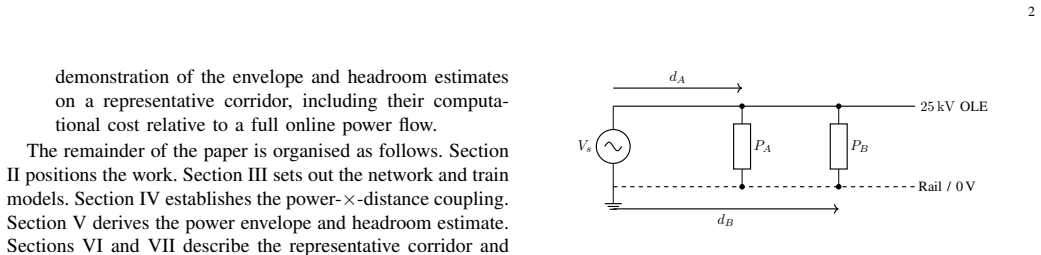
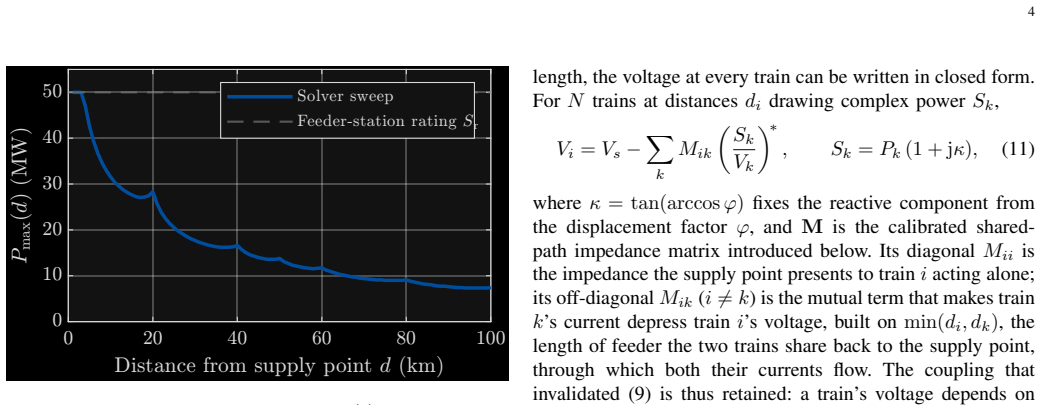
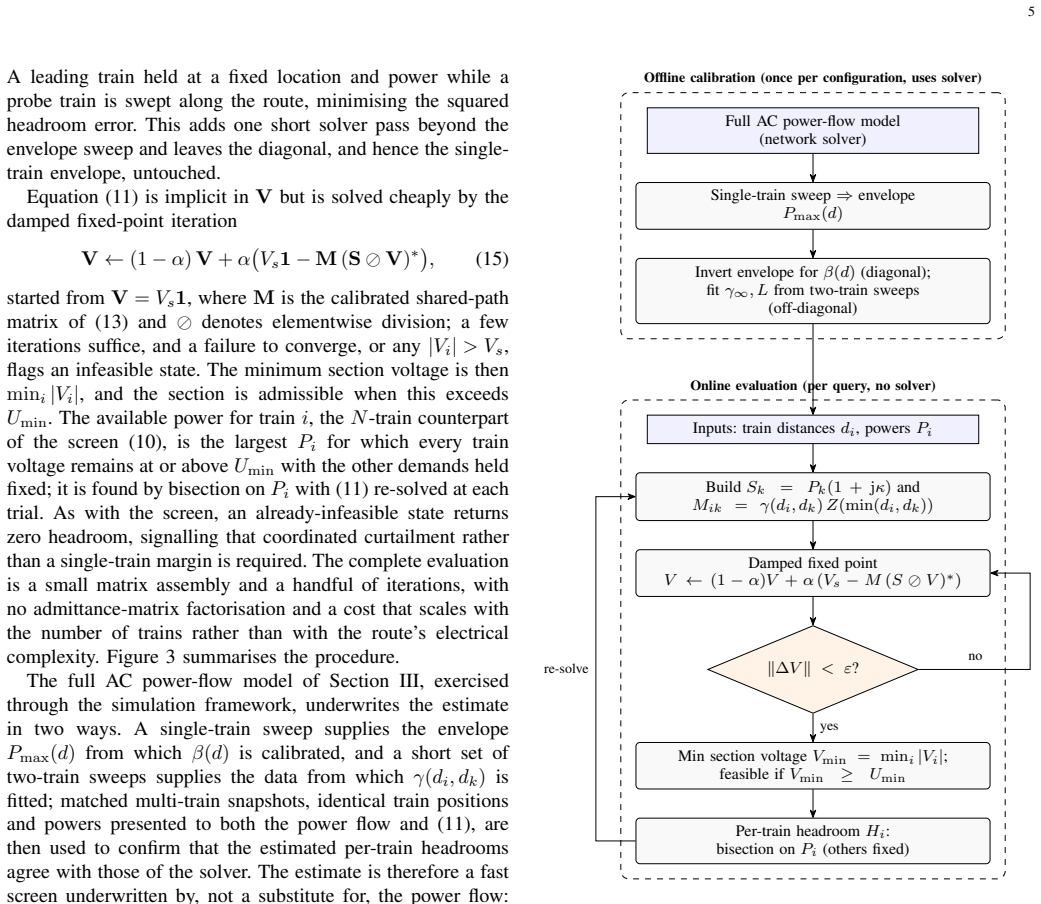
The minimum network voltage is governed by the product of power and distance rather than by power alone, yielding a distance-dependent single-train power envelope. This envelope does not add when several trains share a feeder, so a conservative pairwise screen is generalised to a solver-free multi-train estimate: a calibrated shared-path voltage model returning the minimum section voltage and the per-train available power for any number of trains. Calibration uses two short offline solver runs, one fixing the self-impedance and one the inter-train coupling through a separation-dependent factor.
What carries the argument
shared-path voltage model: a calibrated voltage model that returns minimum section voltage and per-train available power using fixed self-impedance and a separation-dependent inter-train coupling factor obtained from two offline solver runs.
If this is right
- The estimate tracks full power flow within nine percent on average for two-, three- and four-train cases and improves as more trains share the feeder.
- Online computation scales with the number of trains rather than the size of the network.
- The model reproduces EN 50388-1 current-limitation behaviour.
- Real-time per-train available-power values become available without solving the full network equations each time step.
Where Pith is reading between the lines
- The same two-run calibration approach could be tested on DC or mixed electrification systems where distance-dependent voltage drop is also present.
- Embedding the model in an online train scheduler might allow proactive power limiting before voltage violations occur.
- If the coupling factor proves stable across seasons or maintenance states, the offline runs could be performed once per feeder rather than repeatedly.
Load-bearing premise
Two short offline solver runs that fix self-impedance and a separation-dependent coupling factor are enough to produce a model whose accuracy holds across operating conditions and network topologies without further tuning.
What would settle it
Apply the calibrated model to a new feeder topology or a different set of train positions and powers; if the error against a full power-flow solution exceeds nine percent on average for matched multi-train cases, the claim fails.
Figures
read the original abstract
Decarbonisation is raising the electrical load on mainline alternating-current railway feeders that were not designed for sustained, simultaneous high-power demand. When several trains accelerate together on a shared feeder, the contact-line voltage can fall far enough to trigger rolling-stock current limitation or feeder protection, eroding capacity and reliability. Preventing this in real time requires a quantity conventional operation does not expose: a localised, continuously updated estimate of the traction power available to each train given the live network state. A railway power-flow model, with trains represented under a voltage-dependent automatic current-limitation characteristic, shows that the minimum network voltage is governed by the product of power and distance rather than by power alone, yielding a distance-dependent single-train power envelope. This envelope does not add up when several trains share a feeder, so a conservative pairwise screen is generalised to a solver-free multi-train estimate: a calibrated shared-path voltage model returning the minimum section voltage and the per-train available power for any number of trains. Calibration uses two short offline solver runs, one fixing the self-impedance and one the inter-train coupling through a separation-dependent factor. Its current-limitation behaviour follows EN 50388-1, and on matched multi-train cases the estimate tracks the full power flow to within about nine per cent on average across two-, three-, and four-train cases, improving as more trains share the feeder, while its online cost scales with the number of trains rather than the network size.
Editorial analysis
A structured set of objections, weighed in public.
Referee Report
Summary. The manuscript proposes a solver-free estimator for available traction power in multi-train AC railway networks. Starting from a voltage-dependent power-flow model, it derives a distance-dependent single-train power envelope governed by the product of power and distance. This is extended to multiple trains via a shared-path voltage model whose self-impedance and separation-dependent inter-train coupling factor are fixed by two short offline solver runs. The method respects EN 50388-1 current limitation and is reported to track full power-flow solutions to within ~9 % average error on matched 2-, 3- and 4-train cases, with online cost scaling with the number of trains rather than network size.
Significance. If the two-run calibration generalizes, the approach would supply a lightweight, real-time alternative to full network solvers for estimating per-train available power under simultaneous high-load conditions. This could support capacity management and protection coordination on legacy AC feeders. The explicit use of only two calibration runs and the scaling property are practical strengths; however, the evaluation is performed exclusively against the reference solver on matched cases, so the assessed significance remains conditional on further external validation.
major comments (3)
- [Abstract] Abstract: the 9 % average tracking error is stated without error bars, without the number or diversity of test cases, without network-topology details, and without any comparison to measured field data, so the quantitative accuracy claim cannot be assessed for robustness.
- [Abstract] Abstract: the shared-path voltage model is calibrated by exactly two solver runs (self-impedance and one separation-dependent coupling factor); no sensitivity study or derivation is supplied showing that a single scalar factor remains valid when the underlying admittance matrix changes (different substation spacing, additional parallel feeders, or non-uniform mutual coupling).
- [Abstract] Abstract: because the multi-train estimate is calibrated directly against the full solver it is intended to replace, the reported 9 % figure measures agreement with the reference model on matched cases rather than predictive performance on unseen operating conditions or topologies.
minor comments (1)
- The abstract would be clearer if it briefly indicated the range of feeder lengths and substation spacings used in the matched-case tests.
Simulated Author's Rebuttal
We thank the referee for the constructive comments. We respond point-by-point to the major comments on the abstract and indicate the revisions we will incorporate.
read point-by-point responses
-
Referee: [Abstract] Abstract: the 9 % average tracking error is stated without error bars, without the number or diversity of test cases, without network-topology details, and without any comparison to measured field data, so the quantitative accuracy claim cannot be assessed for robustness.
Authors: We agree the abstract would benefit from additional qualifiers. The current text already states the 9% average is taken across two-, three- and four-train cases on matched scenarios. In revision we will insert the number of test cases, a brief topology description, and either error bars or standard deviation. Because the study is simulation-based against the reference solver, we will also add an explicit statement that no field measurements are used. revision: yes
-
Referee: [Abstract] Abstract: the shared-path voltage model is calibrated by exactly two solver runs (self-impedance and one separation-dependent coupling factor); no sensitivity study or derivation is supplied showing that a single scalar factor remains valid when the underlying admittance matrix changes (different substation spacing, additional parallel feeders, or non-uniform mutual coupling).
Authors: The two-run calibration is presented as a practical, network-specific procedure. No sensitivity study across altered admittance matrices is contained in the manuscript. We will revise the abstract to state that the coupling factor is fixed for the calibrated topology and that re-calibration is required for materially different substation spacing or feeder configurations. revision: yes
-
Referee: [Abstract] Abstract: because the multi-train estimate is calibrated directly against the full solver it is intended to replace, the reported 9 % figure measures agreement with the reference model on matched cases rather than predictive performance on unseen operating conditions or topologies.
Authors: We accept the distinction. The 9% figure quantifies agreement with the reference solver on the tested matched cases. We will rephrase the abstract to read that the estimator approximates the full power-flow solutions to within 9% on the evaluated matched cases, thereby clarifying that the metric is not a claim of generalization to unseen conditions. revision: yes
Circularity Check
No significant circularity in derivation chain.
full rationale
The abstract describes an explicitly calibrated approximation: two offline solver runs fix self-impedance and a separation-dependent coupling factor, after which the shared-path voltage model is used to produce a solver-free estimate whose accuracy is then measured against the same reference solver on matched multi-train cases. This constitutes standard empirical validation of a fast surrogate model rather than any first-principles derivation or prediction that reduces to its inputs by construction. No equations, self-citations, uniqueness theorems, or ansatzes are quoted that would trigger any of the enumerated circularity patterns. The reported 9 % tracking figure is therefore an agreement metric with the intended reference, not a circular self-measurement.
Axiom & Free-Parameter Ledger
free parameters (2)
- separation-dependent inter-train coupling factor
- self-impedance calibration constant
axioms (1)
- domain assumption Minimum network voltage is governed by the product of power and distance rather than power alone under voltage-dependent current limitation
Reference graph
Works this paper leans on
-
[1]
Marton Laszlo Ambrus, Stuart Hillmansen, and Zhong- bei Tian.Algorithmic Energy Management in Con- strained Railway Traction Networks: A Systematic Re- view. 2026. arXiv: 2604 . 06369[eess.SY].URL: https://arxiv.org/abs/2604.06369
work page internal anchor Pith review Pith/arXiv arXiv 2026
-
[2]
EN 50388-1:2022
CENELEC.Railway Applications — Fixed Installations and Rolling Stock — Technical Criteria for the Coordi- nation Between Electric Traction Power Supply Systems and Rolling Stock to Achieve Interoperability — Part 1: General. EN 50388-1:2022. European Committee for Electrotechnical Standardization. Brussels, Belgium, 2022
2022
-
[3]
Single-Train Trajectory Optimiza- tion
Shaofeng Lu et al. “Single-Train Trajectory Optimiza- tion”. In:IEEE Transactions on Intelligent Transporta- tion Systems14.2 (2013), pp. 743–750.DOI: 10.1109/ TITS.2012.2234118
-
[4]
Gerben M. Scheepmaker, Rob M.P. Goverde, and Leo G. Kroon. “Review of energy-efficient train control and timetabling”. In:European Journal of Operational Research257.2 (2017), pp. 355–376.DOI: 10.1016/j. ejor.2016.09.044
work page doi:10.1016/j 2017
-
[5]
A Multiple Train Trajectory Opti- mization to Minimize Energy Consumption and Delay
Ning Zhao et al. “A Multiple Train Trajectory Opti- mization to Minimize Energy Consumption and Delay”. In:IEEE Transactions on Intelligent Transportation Systems16.5 (2015), pp. 2363–2372.DOI: 10 . 1109 / TITS.2014.2388356
-
[6]
A Cooperative Train Control Model for Energy Saving
Shuai Su, Tao Tang, and Clive Roberts. “A Cooperative Train Control Model for Energy Saving”. In:IEEE Transactions on Intelligent Transportation Systems16.2 (2015), pp. 622–631.DOI: 10 . 1109 / TITS . 2014 . 2334061
2015
-
[7]
Energy-efficient approach combin- ing train speed profile and timetable optimisations for metro operations
Xin-Chen Ran et al. “Energy-efficient approach combin- ing train speed profile and timetable optimisations for metro operations”. In:IET Intelligent Transport Systems 14.14 (2020), pp. 1967–1977
2020
-
[8]
Integrated Timetable Optimization for Minimum Total Energy Consumption of an AC Railway System
Ziqiang Pan et al. “Integrated Timetable Optimization for Minimum Total Energy Consumption of an AC Railway System”. In:IEEE Transactions on Vehicular Technology69.4 (2020), pp. 3641–3653.DOI: 10.1109/ TVT.2020.2975603
-
[9]
SmartDrive: Traction Energy Op- timization and Applications in Rail Systems
Zhongbei Tian et al. “SmartDrive: Traction Energy Op- timization and Applications in Rail Systems”. In:IEEE Transactions on Intelligent Transportation Systems20.7 (2019), pp. 2764–2773.DOI: 10 . 1109 / TITS . 2019 . 2897279
2019
-
[10]
Energy-saving train operation synergy based on multi-agent deep reinforcement learn- ing on spark cloud
Mengying Shang et al. “Energy-saving train operation synergy based on multi-agent deep reinforcement learn- ing on spark cloud”. In:IEEE Transactions on Vehicular Technology72.1 (2022), pp. 214–226
2022
-
[11]
Energy-efficient train control incor- porating inherent reduced-power and hybrid braking characteristics of railway vehicles
Yang Peng et al. “Energy-efficient train control incor- porating inherent reduced-power and hybrid braking characteristics of railway vehicles”. In:Transportation Research Part C: Emerging Technologies163 (2024), p. 104626
2024
-
[12]
Comparative performance analysis of speed trajectory optimization algorithms for metro and high-speed railways
Xiao Liu et al. “Comparative performance analysis of speed trajectory optimization algorithms for metro and high-speed railways”. In:IEEE Transactions on Transportation Electrification(2025)
2025
-
[13]
An assessment of available measures to reduce traction energy use in railway net- works
Heather Douglas et al. “An assessment of available measures to reduce traction energy use in railway net- works”. In:Energy Conversion and Management106 (2015), pp. 1149–1165.DOI: 10.1016/j.enconman.2015. 10.053
-
[14]
Recent developments and applications of en- ergy storage devices in electrified railways
Tosaphol Ratniyomchai, Stuart Hillmansen, and Pietro Tricoli. “Recent developments and applications of en- ergy storage devices in electrified railways”. In:IET Electrical Systems in Transportation4.1 (2014), pp. 9– 20.DOI: 10.1049/iet-est.2013.0031
-
[15]
Electric railway traction systems and techniques for energy saving
S. Hillmansen and R. Ellis. “Electric railway traction systems and techniques for energy saving”. In:IET 13th Professional Development Course on Electric Traction Systems. 2014, pp. 1–6.DOI: 10.1049/cp.2014.1432
-
[16]
Railway Driver Advice Systems: Evaluation of Methods, Tools and Systems
Konstantinos Panou, Panos Tzieropoulos, and Daniel Emery. “Railway Driver Advice Systems: Evaluation of Methods, Tools and Systems”. In:Journal of Rail Trans- port Planning & Management3.4 (2013), pp. 150–162. DOI: 10.1016/j.jrtpm.2013.10.005
-
[17]
Simulator for studying operational and power-supply conditions in 10 rapid-transit railways
B Mellitt, CJ Goodman, and RIM Arthurton. “Simulator for studying operational and power-supply conditions in 10 rapid-transit railways”. In:Proceedings of the Institution of Electrical Engineers. V ol. 125. 4. IET. 1978, pp. 298– 303
1978
-
[18]
Overview of electric railway systems and the calculation of train performance
Colin Goodman. “Overview of electric railway systems and the calculation of train performance”. In:2008 IET Professional Development Course on Electric Traction Systems. IET. 2008, pp. 1–24
2008
-
[19]
System Energy Optimisation Strategies for Metros with Regeneration
Zhongbei Tian et al. “System Energy Optimisation Strategies for Metros with Regeneration”. In:Trans- portation Research Part C: Emerging Technologies75 (2017), pp. 120–135.DOI: 10.1016/j.trc.2016.12.004
-
[20]
Railway Traffic Flow Optimisation with Differing Control Systems
Ning Zhao. “Railway Traffic Flow Optimisation with Differing Control Systems”. PhD thesis. Birmingham, UK: University of Birmingham, 2013
2013
-
[21]
Zhongbei Tian et al. “Traction Power Substation Load Analysis with Various Train Operating Styles and Substation Fault Modes”. In:Energies13.11 (2020), p. 2788.DOI: 10.3390/en13112788
-
[22]
A literature review on train motion model calibration
Alex Cunillera et al. “A literature review on train motion model calibration”. In:IEEE Transactions on Intelligent Transportation Systems24.4 (2023), pp. 3660–3677
2023
-
[23]
A multi-state train-following model for the analysis of virtual coupling railway operations
Egidio Quaglietta, Meng Wang, and Rob MP Goverde. “A multi-state train-following model for the analysis of virtual coupling railway operations”. In:Journal of Rail Transport Planning & Management15 (2020), p. 100195
2020
-
[24]
Railway electrification systems and configurations
Bharat Bhargava. “Railway electrification systems and configurations”. In:1999 IEEE Power Engineering So- ciety Summer Meeting. V ol. 1. IEEE. 1999, pp. 445– 450
1999
-
[25]
AC 25 kV 50 Hz electrification supply design
Roger D White. “AC 25 kV 50 Hz electrification supply design”. In:7th IET Professional Development Course on Railway Electrification Infrastructure and Systems (REIS 2015). IET, 2015
2015
-
[26]
Railway electric power feeding systems
Yasu Oura, Yoshifumi Mochinaga, and Hiroki Naga- sawa. “Railway electric power feeding systems”. In: Japan Railway & Transport Review16 (1998), pp. 48– 58
1998
-
[27]
Traction power systems for electrified railways: evolution, state of the art, and future trends
Haitao Hu et al. “Traction power systems for electrified railways: evolution, state of the art, and future trends”. In:Railway Engineering Science32.1 (2024), pp. 1–19
2024
-
[28]
AC railway electrification systems—An EMC perspec- tive
Zhouxiang Fei, Tadeusz Konefal, and Rob Armstrong. “AC railway electrification systems—An EMC perspec- tive”. In:IEEE Electromagnetic Compatibility Maga- zine8.4 (2020), pp. 62–69
2020
-
[29]
A Comprehensive Design Framework for AT-Fed Railway Traction Power Systems
Archita Vijayvargia and Abhijit R. Abhyankar. “A Comprehensive Design Framework for AT-Fed Railway Traction Power Systems”. In:2025 11th International Conference on Power Systems (ICPS). 2025, pp. 1–6. DOI: 10.1109/ICPS67276.2025.11364793
-
[30]
W. Mingli, C. Roberts, and S. Hillmansen. “Modelling of AC Feeding Systems of Electric Railways Based on a Uniform Multi-Conductor Chain Circuit Topology”. In:IET Conference on Railway Traction Systems (RTS 2010). Birmingham, UK, 2010.DOI: 10.1049/ic.2010. 0018
-
[31]
Modified current injection method for power flow analysis in heavy-meshed DC railway networks with nonreversible substations
Bassam Mohamed, Pablo Arboleya, and Cristina Gonzalez-Moran. “Modified current injection method for power flow analysis in heavy-meshed DC railway networks with nonreversible substations”. In:IEEE Transactions on Vehicular Technology66.9 (2017), pp. 7688–7696
2017
-
[32]
EN 50163:2004+A1:2007+A2:2020
CENELEC.Railway Applications — Supply Voltages of Traction Systems. EN 50163:2004+A1:2007+A2:2020. European Committee for Electrotechnical Standardiza- tion. Brussels, Belgium, 2004
2004
-
[33]
RSSB.Review of AC Electric Rolling Stock Power Limitations. Tech. rep. T1331. Research project, 2024–
2024
-
[34]
London, UK: Rail Safety and Standards Board, 2025
2025
-
[35]
Iterative linear AC power flow solution for fast approximate outage studies
Norris M Peterson, William F Tinney, and Donald W Bree. “Iterative linear AC power flow solution for fast approximate outage studies”. In:IEEE Transactions on Power Apparatus and Systems5 (1972), pp. 2048–2056
1972
-
[36]
Optimal power flow solutions
Hermann W Dommel and William F Tinney. “Optimal power flow solutions”. In:IEEE Transactions on Power Apparatus and Systems10 (1968), pp. 1866–1876
1968
-
[37]
Local solutions of the optimal power flow problem
Waqquas A Bukhsh et al. “Local solutions of the optimal power flow problem”. In:IEEE Transactions on Power Systems28.4 (2013), pp. 4780–4788
2013
-
[38]
Learning optimal solutions for extremely fast AC optimal power flow
Ahmed S Zamzam and Kyri Baker. “Learning optimal solutions for extremely fast AC optimal power flow”. In:2020 IEEE SmartGridComm. IEEE. 2020, pp. 1–6
2020
-
[39]
A data-driven method for fast AC optimal power flow solutions via deep reinforcement learning
Yuhao Zhou et al. “A data-driven method for fast AC optimal power flow solutions via deep reinforcement learning”. In:Journal of Modern Power Systems and Clean Energy8.6 (2020), pp. 1128–1139
2020
discussion (0)
Sign in with ORCID, Apple, or X to comment. Anyone can read and Pith papers without signing in.