Pure Nash Equilibria under the Affine Mechanism: A Potential Game of Exaggeration
Pith reviewed 2026-06-30 08:21 UTC · model grok-4.3
The pith
The affine mechanism induces pure Nash equilibria where all players exaggerate to extremes.
A machine-rendered reading of the paper's core claim, the machinery that carries it, and where it could break.
Core claim
The game induced by the affine mechanism is a potential game whose pure Nash equilibria are the strategy profiles in which every player reports either the minimal or the maximal feasible value, producing extreme exaggeration. The same boundary equilibria arise in the Bayesian version of the game.
What carries the argument
The affine mechanism that maps a vector of reports to an affine function of their average, together with the potential function that establishes the game is potential and thereby has pure equilibria at the extremes.
If this is right
- Extreme exaggeration occurs in every pure Nash equilibrium of the complete-information game.
- Extreme exaggeration occurs in every pure Nash equilibrium of the Bayesian game.
- The mean mechanism inherits these extreme-exaggeration equilibria as a special case.
- Players have no incentive to report intermediate values in equilibrium.
Where Pith is reading between the lines
- Applications that use mean or affine aggregation may observe polarized reports in strategic environments.
- Alternative aggregation rules could be tested to see if they reduce boundary reporting while preserving other properties.
- Laboratory experiments with human subjects could verify whether reported values cluster at the extremes as predicted.
Load-bearing premise
Players maximize their expected utility by playing pure-strategy Nash equilibria in the game induced by the mechanism.
What would settle it
A single observed pure Nash equilibrium in which any player reports a value strictly inside the interval between the lowest and highest feasible reports would contradict the characterization.
Figures
read the original abstract
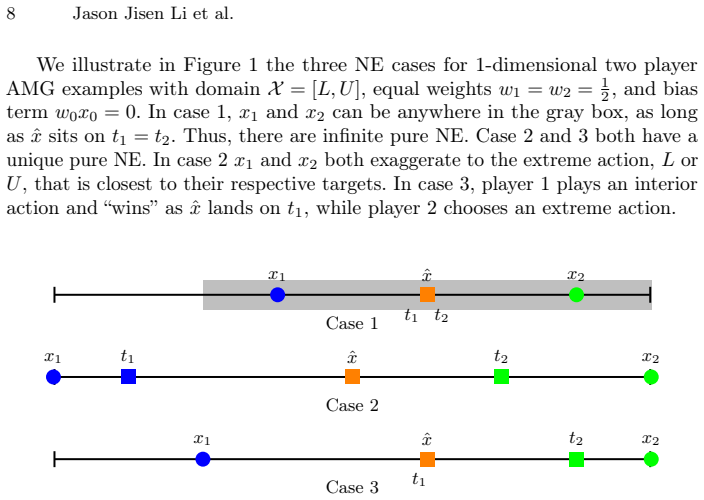
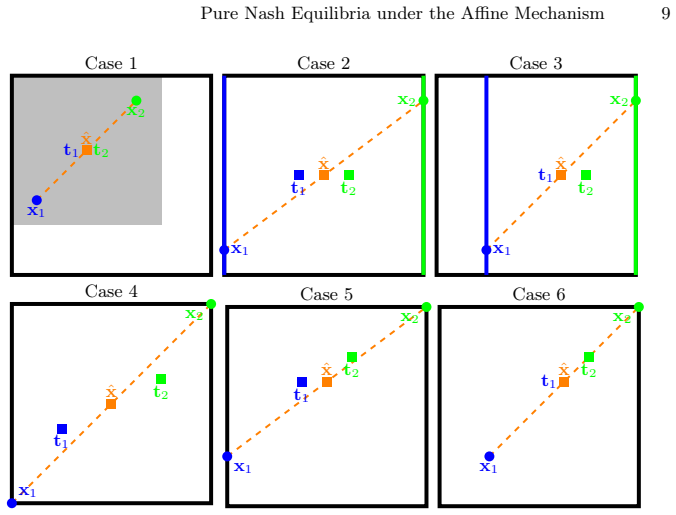
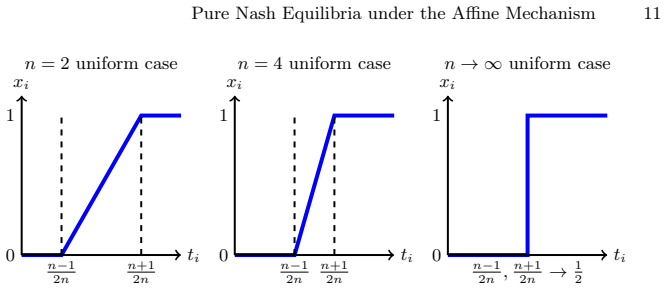
The mean mechanism is known to be non-incentive-compatible, namely, rational players are incentivized to misreport their values. Despite this game-theoretic issue, the mean mechanism is prevalent in practice due to its other desirable properties. We give a full characterization of pure Nash equilibria--how the players will misreport--for the affine mechanism, of which the mean is a special case. Furthermore, we characterize both complete-information and Bayesian games under the affine mechanism. Our results highlight the inevitability of extreme exaggeration in such games.
Editorial analysis
A structured set of objections, weighed in public.
Referee Report
Summary. The manuscript claims to deliver a full characterization of pure Nash equilibria (including the specific misreporting strategies) for the affine mechanism in both complete-information and Bayesian settings, with the mean mechanism as a special case; it models the setting as a potential game and concludes that extreme exaggeration is inevitable under rational play.
Significance. If the claimed characterization is correct and complete, the result would be significant for mechanism design: it would give an exact, closed-form description of equilibrium behavior in a widely deployed but non-strategyproof aggregation rule, thereby explaining observed misreporting and providing a concrete basis for predicting outcomes in both full-information and incomplete-information environments.
minor comments (1)
- The abstract asserts the existence of a 'full characterization' without any proof sketch, key assumptions, or verification approach; this makes it impossible to assess whether the central claim is supported by the subsequent sections.
Simulated Author's Rebuttal
We thank the referee for their review of our manuscript. The referee's summary accurately reflects our claimed contributions regarding the characterization of pure Nash equilibria under the affine mechanism in both complete-information and Bayesian settings. No specific major comments were enumerated in the report, so there are no individual points requiring point-by-point responses at this time. We stand by the results as presented and remain available to address any additional questions or concerns.
Circularity Check
No significant circularity detected
full rationale
The paper claims a full characterization of pure Nash equilibria for the affine mechanism (including the mean as special case) in both complete-information and Bayesian settings. This is a standard game-theoretic derivation based on the definition of Nash equilibrium and the mechanism's payment rule; no equations reduce a prediction to a fitted input by construction, no load-bearing self-citation chain is invoked to justify uniqueness or an ansatz, and the rationality premise is the conventional one for such analyses rather than a self-referential definition. The provided abstract and description contain no self-definitional steps or renaming of known results as novel derivations. The result is therefore self-contained against external benchmarks in mechanism design.
Axiom & Free-Parameter Ledger
Reference graph
Works this paper leans on
-
[1]
2025 , booktitle=
Equitable Mechanism Design for Facility Location , author=. 2025 , booktitle=
2025
-
[2]
American Economic Review , volume=
Mechanism design: How to implement social goals , author=. American Economic Review , volume=. 2008 , publisher=
2008
-
[3]
The Review of Economic Studies , volume=
Optimal voting rules , author=. The Review of Economic Studies , volume=. 2017 , publisher=
2017
-
[4]
1991 , publisher=
Experts in uncertainty: opinion and subjective probability in science , author=. 1991 , publisher=
1991
-
[5]
American Political Science Review , volume=
Congressional decision making and the separation of powers , author=. American Political Science Review , volume=. 2001 , publisher=
2001
-
[6]
The 30th International Joint Conference on Artificial Intelligence (IJCAI 2021) , pages=
Mechanism Design for Facility Location Problem: A Survey , author=. The 30th International Joint Conference on Artificial Intelligence (IJCAI 2021) , pages=
2021
-
[7]
The method of paired comparisons , author =
Rank analysis of incomplete block designs: I. The method of paired comparisons , author =. Biometrika , publisher =
-
[8]
Advances in Neural Information Processing Systems , volume = 33, pages =
Simultaneous preference and metric learning from paired comparisons , author =. Advances in Neural Information Processing Systems , volume = 33, pages =
-
[9]
International Conference on Machine Learning , pages =
Actively learning hemimetrics with applications to eliciting user preferences , author =. International Conference on Machine Learning , pages =
-
[10]
Active ranking using pairwise comparisons , author =
-
[11]
Psychological scaling without a unit of measurement , author =
-
[12]
Advances in Neural Information Processing Systems , volume = 35, pages =
Fine-tuning language models to find agreement among humans with diverse preferences , author =. Advances in Neural Information Processing Systems , volume = 35, pages =
-
[13]
International Conference on Machine Learning , pages =
Whose opinions do language models reflect? , author =. International Conference on Machine Learning , pages =
-
[14]
PAL: Pluralistic Alignment Framework for Learning from Heterogeneous Preferences , author =
-
[15]
Convex Optimization , author =
-
[16]
Advances in neural information processing systems , volume = 35, pages =
Training language models to follow instructions with human feedback , author =. Advances in neural information processing systems , volume = 35, pages =
-
[17]
Direct preference optimization: Your language model is secretly a reward model , author =
-
[18]
Ai alignment: A comprehensive survey , author =
-
[19]
Open problems and fundamental limitations of reinforcement learning from human feedback , author =
-
[20]
Text embeddings reveal (almost) as much as text , author =
-
[21]
International Journal of Game Theory , publisher =
Correlated equilibrium and potential games , author =. International Journal of Game Theory , publisher =
-
[22]
Proceedings of the 17th International Conference on Machine Learning (ICML 2000) , publisher =
Crafting Papers on Machine Learning , author =. Proceedings of the 17th International Conference on Machine Learning (ICML 2000) , publisher =
2000
-
[23]
The Need for Biases in Learning Generalizations , author =
-
[24]
Computational Complexity of Machine Learning , author =
-
[25]
I , year = 1983, publisher =
Machine Learning: An Artificial Intelligence Approach, Vol. I , year = 1983, publisher =
1983
-
[26]
Pattern Classification , author =
-
[27]
Suppressed for Anonymity , author =
-
[28]
Cognitive Skills and Their Acquisition , publisher =
Mechanisms of Skill Acquisition and the Law of Practice , author =. Cognitive Skills and Their Acquisition , publisher =
-
[29]
IBM Journal of Research and Development , volume = 3, number = 3, pages =
Some Studies in Machine Learning Using the Game of Checkers , author =. IBM Journal of Research and Development , volume = 3, number = 3, pages =
-
[30]
IEEE Transactions on Automatic Control , publisher =
Self-triggered best-response dynamics for continuous games , author =. IEEE Transactions on Automatic Control , publisher =
-
[31]
Optimization for data analysis , author =
-
[32]
Communications of the ACM , publisher =
Algorithmic game theory , author =. Communications of the ACM , publisher =
-
[33]
A course in game theory , author =
-
[34]
Game Theory: An Introduction , author =
-
[35]
Rlhf from heterogeneous feedback via personalization and preference aggregation , author =
-
[36]
Online Learning from Strategic Human Feedback in LLM Fine-Tuning , author =
-
[37]
Mechanism Design for LLM Fine-tuning with Multiple Reward Models , author =
-
[38]
Truthful Aggregation of LLMs with an Application to Online Advertising , author =
-
[39]
Social Choice Should Guide AI Alignment in Dealing with Diverse Human Feedback , author =
-
[40]
Online prediction with selfish experts , author =
-
[41]
Direct nash optimization: Teaching language models to self-improve with general preferences , author =
-
[42]
Nash learning from human feedback , author =
-
[43]
A minimaximalist approach to reinforcement learning from human feedback , author =
-
[44]
Journal of the ACM (JACM) , publisher =
Settling the complexity of computing two-player Nash equilibria , author =. Journal of the ACM (JACM) , publisher =
-
[45]
Games and economic behavior , publisher =
Potential games , author =. Games and economic behavior , publisher =
-
[46]
Econometrica: journal of the Econometric Society , publisher =
Manipulation of voting schemes: a general result , author =. Econometrica: journal of the Econometric Society , publisher =
-
[47]
American Economic Journal: Microeconomics , publisher =
On the foundations of ex post incentive-compatible mechanisms , author =. American Economic Journal: Microeconomics , publisher =
-
[48]
Econometrica: Journal of the Econometric Society , publisher =
Straightforwardness of game forms with lotteries as outcomes , author =. Econometrica: Journal of the Econometric Society , publisher =
-
[49]
American Economic Review , publisher =
Bayesian persuasion , author =. American Economic Review , publisher =
-
[50]
Games and Economic Behavior , publisher =
Bayesian persuasion with multiple senders and rich signal spaces , author =. Games and Economic Behavior , publisher =
-
[51]
National Bias of international gymnastics judges during the 2013-2016 Olympic cycle , author =
2013
-
[52]
Measuring Herding and Exaggeration by Equity Analysts and Other Opinion Sellers , author =
-
[53]
DotCom mania: a survey of market efficiency in the internet sector , author =
-
[54]
, author =
Review bombing: ideology-driven polarisation in online ratings: The case study of The Last of Us (part II) GG Cantone et al. , author =. Quality & Quantity , publisher =
-
[55]
Public Choice , publisher =
On strategy-proofness and single peakedness , author =. Public Choice , publisher =
-
[56]
ACM Transactions on Economics and Computation (TEAC) , publisher =
Approximate mechanism design without money , author =. ACM Transactions on Economics and Computation (TEAC) , publisher =
-
[57]
Social Choice and Welfare , publisher =
Single-peakedness and strategy-proofness of generalized median voter schemes , author =. Social Choice and Welfare , publisher =
-
[58]
Journal of Economic Theory , publisher =
Strategy-proof location on a network , author =. Journal of Economic Theory , publisher =
-
[59]
Autonomous Agents and Multi-Agent Systems , publisher =
Strategyproof facility location mechanisms on discrete trees , author =. Autonomous Agents and Multi-Agent Systems , publisher =
-
[60]
Optimality of the coordinate-wise median mechanism for strategyproof facility location in two dimensions , author =
-
[61]
International Conference on Artificial Intelligence and Statistics , pages =
Bayesian strategy-proof facility location via robust estimation , author =. International Conference on Artificial Intelligence and Statistics , pages =
-
[62]
Advances in Neural Information Processing Systems , volume = 37, pages =
MAC advice for facility location mechanism design , author =. Advances in Neural Information Processing Systems , volume = 37, pages =
-
[63]
Management Science , publisher =
Optimal linear opinion pools , author =. Management Science , publisher =
-
[64]
Episteme , publisher =
An interpretation of weights in linear opinion pooling , author =. Episteme , publisher =
-
[65]
International journal of forecasting , publisher =
Combining forecasts: A review and annotated bibliography , author =. International journal of forecasting , publisher =
-
[66]
International Journal of Forecasting , publisher =
Forecast combinations: An over 50-year review , author =. International Journal of Forecasting , publisher =
-
[67]
Nature reviews psychology , publisher =
Cognitive--motivational mechanisms of political polarization in social-communicative contexts , author =. Nature reviews psychology , publisher =
-
[68]
Annals of the International Communication Association , publisher =
The role of (social) media in political polarization: a systematic review , author =. Annals of the International Communication Association , publisher =
-
[69]
Trends in cognitive sciences , publisher =
How social media shapes polarization , author =. Trends in cognitive sciences , publisher =
-
[70]
Intelligent Computing-Proceedings of the Computing Conference , pages =
Sycophancy in large language models: Causes and mitigations , author =. Intelligent Computing-Proceedings of the Computing Conference , pages =
-
[71]
ACM Transactions on Information and System Security (TISSEC) , publisher =
False data injection attacks against state estimation in electric power grids , author =. ACM Transactions on Information and System Security (TISSEC) , publisher =
-
[72]
IEEE transactions on industrial informatics , publisher =
False data injection on state estimation in power systems—Attacks, impacts, and defense: A survey , author =. IEEE transactions on industrial informatics , publisher =
-
[73]
False data injection attacks in smart grids: State of the art and way forward , author =
-
[74]
Journal of optimization theory and applications , volume=
Convergence of a block coordinate descent method for nondifferentiable minimization , author=. Journal of optimization theory and applications , volume=. 2001 , publisher=
2001
discussion (0)
Sign in with ORCID, Apple, or X to comment. Anyone can read and Pith papers without signing in.