Citizen Science Research with the Square Kilometre Array Observatory (SKAO)
Pith reviewed 2026-06-30 02:44 UTC · model grok-4.3
The pith
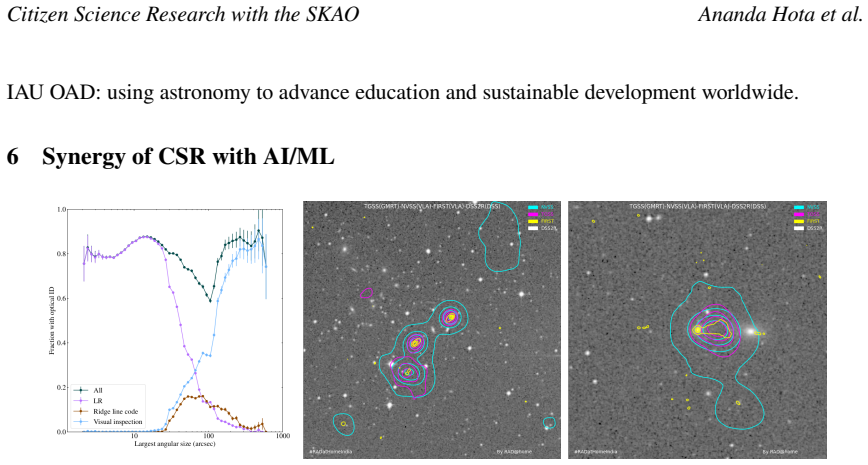
Citizen science can complement and at times surpass AI/ML pipelines in identifying rare radio features for the SKA.
A machine-rendered reading of the paper's core claim, the machinery that carries it, and where it could break.
Core claim
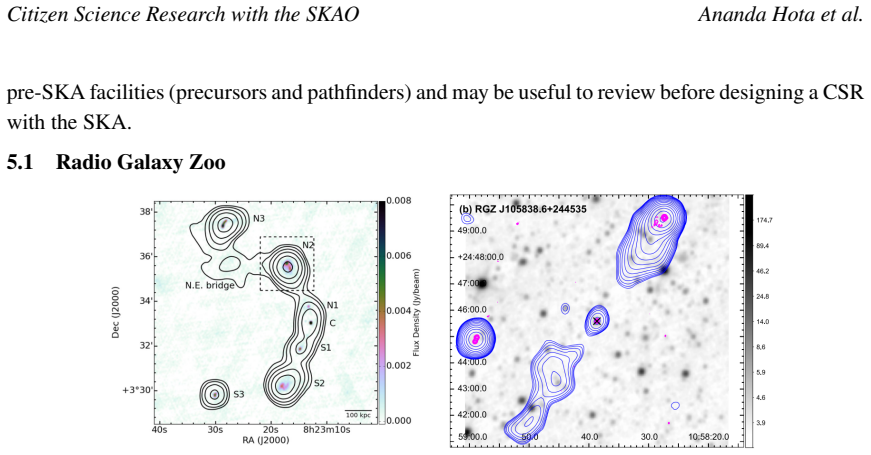
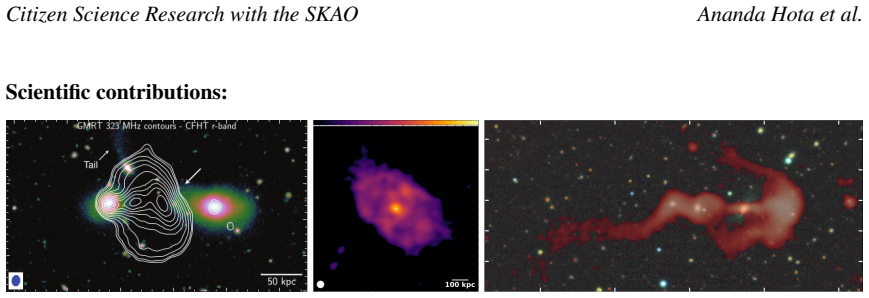
The paper establishes that citizen science research, through platforms like Radio Galaxy Zoo and RAD@home, has produced discoveries of episodic wide-angle-tailed radio galaxies, jet-galaxy interactions, collimated synchrotron threads, twin-ring odd radio circles, and large-scale shocks. It proposes SKA@home to extend these methods to SKA data, arguing that citizen science can complement and at times surpass automated AI/ML pipelines, particularly in identifying rare, intricate, or unexpected features, while also building public engagement.
What carries the argument
SKA@home, the proposed citizen science framework with a purely web-based mode and a collaboratory mode using national training programmes, extending Radio Galaxy Zoo and RAD@home to enable hybrid human-machine analysis of SKA data.
If this is right
- CSR will become increasingly relevant across radio astronomy in the SKA era.
- Hybrid human-machine frameworks will be suited to big-data challenges.
- Early discovery potential of SKA data will be enhanced.
- A deeper connection with society at large will be initiated.
- SKA construction and outreach plans will support public participation in science.
Where Pith is reading between the lines
- Citizen science models developed for SKA could be adapted for other large astronomical surveys facing similar data volumes.
- Volunteer training in the collaboratory mode might generate new methods for teaching complex pattern recognition in science.
- Rare features first spotted by citizens could supply targeted examples to refine AI training datasets.
- Global volunteer access to SKA data would require practical solutions for data distribution and quality control.
Load-bearing premise
Citizen science platforms can be effectively scaled and integrated with SKA data volumes through the proposed SKA@home modes.
What would settle it
A study of SKA pilot data showing that all rare, intricate, or unexpected features identified by citizen scientists are also detected by AI/ML pipelines without any human assistance.
Figures
read the original abstract
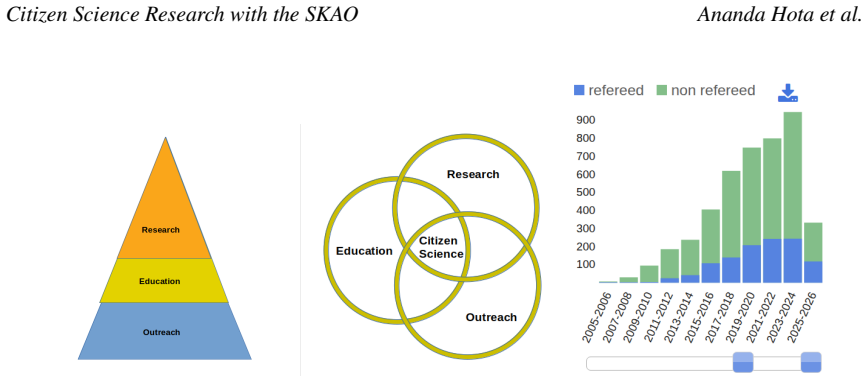
Over the past two decades, internet-enabled citizen science research (CSR) has contributed to significant discoveries while involving millions of people in the research process. Our review highlights CSR in extragalactic radio astronomy and emphasises that such approaches will become increasingly relevant across radio astronomy in the era of the Square Kilometre Array (SKA). As astronomical data volumes grow, CSR is converging with Artificial Intelligence and Machine Learning (AI/ML), creating hybrid human-machine frameworks suited to big-data challenges. Two CSR platforms, Radio Galaxy Zoo and RAD@home, demonstrate success: the former excels in large-scale, web-based catalogue creation, while the latter combines structured training with collaborative discovery. Following this, we propose CSR with the SKA, namely SKA@home, with two modes: one purely web-based and the other in collaboratory mode with national training programmes. We argue that CSR can complement, and at times surpass, automated AI/ML pipelines, particularly in identifying rare, intricate, or unexpected features. Illustrative CSR discoveries include an episodic wide-angle-tailed radio galaxy, a jet-galaxy interaction, a collimated synchrotron thread, a twin-ring odd radio circle, and a large-scale shock ahead of a cluster-infalling galaxy. Consistent with the IAU's recognition of CSR as a driver of Astronomy for Development and the United Nations' affirmation of participation in science as a universal human right, both the SKA construction proposal and outreach strategies show commitment to enabling CSR with SKA. The proposed SKA@home would not only enhance the early discovery potential of SKA data but also initiate a deeper and more meaningful connection with society at large.
Editorial analysis
A structured set of objections, weighed in public.
Referee Report
Summary. The manuscript is a review of citizen science research (CSR) in extragalactic radio astronomy, focusing on the successes of Radio Galaxy Zoo and RAD@home. It proposes the SKA@home initiative in two modes (web-based and collaboratory with national training) to integrate CSR with Square Kilometre Array (SKA) data. The central argument is that CSR can complement and at times surpass AI/ML pipelines for identifying rare, intricate, or unexpected features, supported by five illustrative discoveries, while aligning with IAU and UN principles on public participation in science.
Significance. If the conceptual proposal for hybrid human-machine frameworks is realized, the work could help shape data-analysis strategies for the SKA era by highlighting the complementary role of citizen scientists in big-data astronomy, potentially accelerating discovery of rare objects and advancing Astronomy for Development goals.
major comments (2)
- [Illustrative CSR discoveries section] The section presenting illustrative CSR discoveries (episodic wide-angle-tailed radio galaxy, jet-galaxy interaction, collimated synchrotron thread, twin-ring odd radio circle, and large-scale shock): these five examples are offered in support of the claim that CSR can 'at times surpass' automated AI/ML pipelines, yet the text provides no systematic comparison, false-negative rates, or metrics showing that the features were missed by existing ML methods; this evidence gap is load-bearing for the central claim in the abstract and final paragraphs.
- [SKA@home proposal] The SKA@home proposal (final section): the two modes are described at a high level without any discussion of data-volume scaling, volunteer training throughput, or concrete integration protocols with AI/ML pipelines, leaving the feasibility of the advocated hybrid frameworks unaddressed despite being central to the paper's forward-looking argument.
minor comments (2)
- [Title and abstract] The title uses SKAO while the body text consistently uses SKA; a single consistent abbreviation would improve readability.
- [Throughout] The manuscript would benefit from explicit cross-references between the cited past discoveries and the proposed SKA@home modes to clarify how lessons from Radio Galaxy Zoo and RAD@home translate to the new framework.
Simulated Author's Rebuttal
We thank the referee for their constructive and detailed report. The comments identify important areas where the manuscript's central claims and forward-looking proposal can be strengthened with greater precision and context. We respond to each major comment below.
read point-by-point responses
-
Referee: [Illustrative CSR discoveries section] The section presenting illustrative CSR discoveries (episodic wide-angle-tailed radio galaxy, jet-galaxy interaction, collimated synchrotron thread, twin-ring odd radio circle, and large-scale shock): these five examples are offered in support of the claim that CSR can 'at times surpass' automated AI/ML pipelines, yet the text provides no systematic comparison, false-negative rates, or metrics showing that the features were missed by existing ML methods; this evidence gap is load-bearing for the central claim in the abstract and final paragraphs.
Authors: We accept the validity of this observation. The five cases are presented as concrete illustrations of complex or rare morphological features identified through citizen science that were not previously highlighted in automated catalogues or surveys. We do not possess, and the cited literature does not provide, quantitative false-negative rates or head-to-head benchmarks for these specific objects. In the revised manuscript we will (i) rephrase the relevant sentences in the abstract, the discoveries section, and the conclusions to stress complementarity rather than outright surpassing, (ii) add explicit language acknowledging the absence of systematic comparative metrics, and (iii) note that rigorous benchmarking of this kind remains an open research question. These changes constitute a partial revision. revision: partial
-
Referee: [SKA@home proposal] The SKA@home proposal (final section): the two modes are described at a high level without any discussion of data-volume scaling, volunteer training throughput, or concrete integration protocols with AI/ML pipelines, leaving the feasibility of the advocated hybrid frameworks unaddressed despite being central to the paper's forward-looking argument.
Authors: We agree that the current description is conceptual and would benefit from additional grounding. In revision we will expand the SKA@home section with (i) order-of-magnitude estimates of data volume per SKA field and how web-based platforms such as Zooniverse have scaled to similar volumes in existing projects, (ii) reference to training throughput achieved by RAD@home-style collaboratories, and (iii) a high-level outline of integration protocols (e.g., AI pre-filtering followed by citizen validation of low-confidence or anomalous sources). Detailed numerical simulations of volunteer capacity or end-to-end pipeline specifications lie beyond the scope of this review and will be flagged as topics for dedicated follow-up studies. This will be a partial revision. revision: partial
Circularity Check
No significant circularity identified
full rationale
The manuscript is a review and proposal paper with no equations, derivations, quantitative predictions, or fitted parameters. Its central qualitative claim—that CSR can complement or surpass AI/ML for rare features—is supported by citations to independent prior discoveries from Radio Galaxy Zoo and RAD@home rather than any self-referential reduction or self-citation chain. The SKA@home proposal is presented as a forward suggestion without internal validation loops. No load-bearing step reduces to the paper's own inputs by construction.
Axiom & Free-Parameter Ledger
axioms (1)
- domain assumption Citizen science approaches have contributed to significant discoveries in extragalactic radio astronomy over the past two decades.
Reference graph
Works this paper leans on
-
[1]
The application of ridgelines in extended radio source cross-identification. , keywords =. doi:10.1093/mnras/stab2952 , archivePrefix =. 2110.05254 , primaryClass =
-
[2]
Discovery of a spiral-host episodic radio galaxy. , keywords =. doi:10.1111/j.1745-3933.2011.01115.x , archivePrefix =. 1107.4742 , primaryClass =
-
[3]
doi:10.1111/j.1745-3933.2012.01303.x
NGC 3801 caught in the act: a post-merger star-forming early-type galaxy with AGN-jet feedback. , keywords =. doi:10.1111/j.1745-3933.2012.01231.x , archivePrefix =. 1111.5325 , primaryClass =
-
[4]
Nielsen, Michael , title =
-
[5]
Galaxy Zoo: Morphological classification of galaxy images from the Illustris simulation
Galaxy Zoo: Morphological Classification of Galaxy Images from the Illustris Simulation. , keywords =. doi:10.3847/1538-4357/aaa250 , archivePrefix =. 1801.08541 , primaryClass =
work page internal anchor Pith review Pith/arXiv arXiv doi:10.3847/1538-4357/aaa250
-
[6]
Precovery of near-Earth asteroids by a citizen-science project of the Spanish Virtual Observatory
Precovery of near-Earth asteroids by a citizen-science project of the Spanish Virtual Observatory. Astronomische Nachrichten , keywords =. doi:10.1002/asna.201311888 , archivePrefix =. 1302.5375 , primaryClass =
work page internal anchor Pith review Pith/arXiv arXiv doi:10.1002/asna.201311888
-
[7]
Complex morphology and precession indicators of active galactic nuclei jets in LoTSS DR2. , keywords =. doi:10.1051/0004-6361/202453559 , archivePrefix =. 2504.18518 , primaryClass =
-
[8]
Identification of multicomponent LOFAR sources with multimodal deep learning. , keywords =. doi:10.1093/mnras/stae1454 , archivePrefix =. 2405.18584 , primaryClass =
-
[9]
2019 , eprint=
Anticipated Performance of the Square Kilometre Array -- Phase 1 (SKA1) , author=. 2019 , eprint=
2019
-
[10]
2015 , publisher=
Advancing Astrophysics with the Square Kilometre Array (AASKA14) , author=. 2015 , publisher=
2015
-
[11]
Search and analysis of giant radio galaxies with associated nuclei (SAGAN). IV. Interplay with the Supercluster environment. , keywords =. doi:10.1051/0004-6361/202450011 , archivePrefix =. 2405.19154 , primaryClass =
-
[12]
The spectral index-flux density relation for extragalactic radio sources selected at metre and decametre wavelengths. , keywords =. doi:10.1051/0004-6361/202346593 , archivePrefix =. 2306.11205 , primaryClass =
-
[13]
RAD@home discovery of extragalactic radio rings and odd radio circles: clues to their origins. , keywords =. doi:10.1093/mnras/staf1531 , archivePrefix =. 2510.01999 , primaryClass =
-
[14]
RAD@home discovery of a bow-and-arrow radio galaxy tracing a 560 kpc bow-shock structure in a multi-halo environment. , keywords =. doi:10.1093/mnras/stag1033 , archivePrefix =. 2606.23106 , primaryClass =
work page internal anchor Pith review Pith/arXiv arXiv doi:10.1093/mnras/stag1033
-
[15]
Unexpected circular radio objects at high Galactic latitude. , keywords =. doi:10.1017/pasa.2020.52 , archivePrefix =. 2006.14805 , primaryClass =
-
[16]
MeerKAT uncovers the physics of an odd radio circle. , keywords =. doi:10.1093/mnras/stac701 , archivePrefix =. 2203.10669 , primaryClass =
-
[17]
Single- and double-headed odd radio circles in the LOFAR surveys
Single- and double-headed odd radio circles in the LOFAR surveys. , keywords =. doi:10.1051/0004-6361/202658988 , archivePrefix =. 2602.18294 , primaryClass =
work page internal anchor Pith review Pith/arXiv arXiv doi:10.1051/0004-6361/202658988
-
[18]
Identifying anomalous radio sources in the Evolutionary Map of the Universe Pilot Survey using a complexity-based approach. , keywords =. doi:10.1093/mnras/stad537 , archivePrefix =. 2206.14677 , primaryClass =
-
[19]
RAD@home citizen science discovery of an active galactic nucleus spewing a large unipolar radio bubble on to its merging companion galaxy. , keywords =. doi:10.1093/mnrasl/slac116 , archivePrefix =. 2210.06100 , primaryClass =
-
[20]
New results on the exotic galaxy `Speca' and discovering many more Specas with RAD@home network
New results on the exotic galaxy `Speca' and discovering many more Specas with RAD@home network. Astronomical Society of India Conference Series , year = 2014, series =. doi:10.48550/arXiv.1402.3674 , archivePrefix =. 1402.3674 , primaryClass =
work page internal anchor Pith review Pith/arXiv arXiv doi:10.48550/arxiv.1402.3674 2014
-
[21]
The Multimessenger Chakra of Blazar Jets , year = 2023, editor =
RAD@home RGB-maker web-tool for citizen science research in multi-wavelength study of AGNs with radio jets. The Multimessenger Chakra of Blazar Jets , year = 2023, editor =. doi:10.1017/S1743921323000674 , adsurl =
-
[22]
Tracking Galaxy Evolution Through Low-Frequency Radio Continuum Observations using SKA and Citizen-Science Research using Multi-Wavelength Data. Journal of Astrophysics and Astronomy , keywords =. doi:10.1007/s12036-016-9415-8 , archivePrefix =. 1610.09798 , primaryClass =
work page internal anchor Pith review Pith/arXiv arXiv doi:10.1007/s12036-016-9415-8
-
[23]
Ten years of searching for relics of AGN jet feedback through RAD@home citizen science. arXiv e-prints , keywords =. doi:10.48550/arXiv.2410.10294 , archivePrefix =. 2410.10294 , primaryClass =
-
[24]
RAD@home Citizen Science Discovery of Two Spiral Galaxies Where the 30-220 kpc Radio Lobes Are Possibly Shaped by Ram Pressure Stripping. Galaxies , keywords =. doi:10.3390/galaxies13050098 , archivePrefix =. 2508.09518 , primaryClass =
-
[25]
Journal of Astrophysics and Astronomy , keywords =
Galaxies, clusters, and intergalactic medium: A vision document for the Indian Astronomical Community. Journal of Astrophysics and Astronomy , keywords =. doi:10.1007/s12036-025-10056-w , adsurl =
-
[26]
Journal of Astrophysics and Astronomy , keywords =
Supermassive black holes and active galactic nuclei. Journal of Astrophysics and Astronomy , keywords =. doi:10.1007/s12036-025-10075-7 , adsurl =
-
[27]
Journal of Astrophysics and Astronomy , keywords =
Human resource development in astronomy: An Indian perspective. Journal of Astrophysics and Astronomy , keywords =. doi:10.1007/s12036-025-10041-3 , adsurl =
-
[28]
Journal of Astrophysics and Astronomy , keywords =
Square Kilometre Array India Consortium: Education and Public Outreach. Journal of Astrophysics and Astronomy , keywords =. doi:10.1007/s12036-023-09984-2 , adsurl =
-
[29]
Journal of Astrophysics and Astronomy , keywords =
India and the SKA: An overview. Journal of Astrophysics and Astronomy , keywords =. doi:10.1007/s12036-023-09909-z , adsurl =
-
[30]
Journal of Astrophysics and Astronomy , keywords =
Plans for building a prototype SKA regional centre in India. Journal of Astrophysics and Astronomy , keywords =. doi:10.1007/s12036-022-09897-6 , archivePrefix =. 2209.10277 , primaryClass =
-
[31]
Ideas for Citizen Science in Astronomy
Ideas for Citizen Science in Astronomy. , keywords =. doi:10.1146/annurev-astro-081913-035959 , archivePrefix =. 1409.4291 , primaryClass =
work page internal anchor Pith review Pith/arXiv arXiv doi:10.1146/annurev-astro-081913-035959
-
[32]
Astronomers Engaging with the Education Ecosystem: A Best-Evidence Synthesis. , keywords =. doi:10.1146/annurev-astro-032620-021943 , archivePrefix =. 2011.11350 , primaryClass =
-
[33]
Gems of the Galaxy Zoos-A Wide-ranging Hubble Space Telescope Gap-filler Program. , keywords =. doi:10.3847/1538-3881/ac517d , archivePrefix =. 2202.01098 , primaryClass =
-
[34]
Radio Galaxy Zoo: host galaxies and radio morphologies derived from visual inspection
Radio Galaxy Zoo: host galaxies and radio morphologies derived from visual inspection. , keywords =. doi:10.1093/mnras/stv1688 , archivePrefix =. 1507.07272 , primaryClass =
work page internal anchor Pith review Pith/arXiv arXiv doi:10.1093/mnras/stv1688
-
[35]
Radio Galaxy Zoo: discovery of a poor cluster through a giant wide-angle tail radio galaxy
Radio Galaxy Zoo: discovery of a poor cluster through a giant wide-angle tail radio galaxy. , keywords =. doi:10.1093/mnras/stw1067 , archivePrefix =. 1606.05016 , primaryClass =
work page internal anchor Pith review Pith/arXiv arXiv doi:10.1093/mnras/stw1067
-
[36]
The LOFAR Two-Metre Sky Survey. VI. Optical identifications for the second data release. , keywords =. doi:10.1051/0004-6361/202347333 , archivePrefix =. 2309.00102 , primaryClass =
-
[37]
Radio Galaxy Zoo: A Search for Hybrid Morphology Radio Galaxies
Radio Galaxy Zoo: A Search for Hybrid Morphology Radio Galaxies. , keywords =. doi:10.3847/1538-3881/aa90b7 , archivePrefix =. 1711.09611 , primaryClass =
work page internal anchor Pith review Pith/arXiv arXiv doi:10.3847/1538-3881/aa90b7
-
[38]
Radio Galaxy Zoo: new giant radio galaxies in the RGZ DR1 catalogue. , keywords =. doi:10.1093/mnras/staa2805 , archivePrefix =. 2009.03583 , primaryClass =
-
[39]
Galaxy Zoo: morphologies derived from visual inspection of galaxies from the Sloan Digital Sky Survey. , keywords =. doi:10.1111/j.1365-2966.2008.13689.x , archivePrefix =. 0804.4483 , primaryClass =
-
[40]
Galaxy Zoo: reproducing galaxy morphologies via machine learning. , keywords =. doi:10.1111/j.1365-2966.2010.16713.x , archivePrefix =. 0908.2033 , primaryClass =
-
[41]
Computer-generated visual morphology catalog of ~3,000,000 SDSS galaxies
A Computer-generated Visual Morphology Catalog of -0.5ex 3,000,000 SDSS Galaxies. , keywords =. doi:10.3847/0067-0049/223/2/20 , archivePrefix =. 1602.06854 , primaryClass =
work page internal anchor Pith review Pith/arXiv arXiv doi:10.3847/0067-0049/223/2/20
-
[42]
Constraining the giant radio galaxy population with machine learning and Bayesian inference. , keywords =. doi:10.1051/0004-6361/202348897 , archivePrefix =. 2405.00232 , primaryClass =
-
[43]
& Zhang, B.\ 2009, , 398, 4, 1936
Galaxy Zoo: `Hanny's Voorwerp', a quasar light echo?. , keywords =. doi:10.1111/j.1365-2966.2009.15299.x , archivePrefix =. 0906.5304 , primaryClass =
-
[44]
& Zhang, B.\ 2009, , 398, 4, 1936
Galaxy Zoo Green Peas: discovery of a class of compact extremely star-forming galaxies. , keywords =. doi:10.1111/j.1365-2966.2009.15383.x , archivePrefix =. 0907.4155 , primaryClass =
-
[45]
Galaxy Zoo: passive red spirals. , keywords =. doi:10.1111/j.1365-2966.2010.16503.x , archivePrefix =. 0910.4113 , primaryClass =
-
[46]
Galaxy Zoo: Bulgeless Galaxies With Growing Black Holes
Galaxy Zoo: bulgeless galaxies with growing black holes. , keywords =. doi:10.1093/mnras/sts491 , archivePrefix =. 1207.4190 , primaryClass =
work page internal anchor Pith review Pith/arXiv arXiv doi:10.1093/mnras/sts491
-
[47]
Tracing the Ancestry of Galaxies , year = 2011, editor =
Building on IYA2009: IAU Strategic Plan ``Astronomy for the Developing World''. Tracing the Ancestry of Galaxies , year = 2011, editor =. doi:10.1017/S1743921311022782 , adsurl =
-
[48]
Next Steps for Citizen Science. Science , keywords =. doi:10.1126/science.1251554 , adsurl =
-
[49]
Nature Sustainability , year = 2019, month = oct, volume =
Citizen science and the United Nations Sustainable Development Goals. Nature Sustainability , year = 2019, month = oct, volume =. doi:10.1038/s41893-019-0390-3 , adsurl =
-
[50]
The contribution of the modern amateur astronomer to the science of astronomy. arXiv e-prints , keywords =. doi:10.48550/arXiv.2212.12543 , archivePrefix =. 2212.12543 , primaryClass =
-
[51]
Pathways to Discovery in Astronomy and Astrophysics for the 2020s , year =. doi:10.17226/26141 , adsurl =
-
[52]
European Physical Journal Plus , keywords =
Citizen science in European research infrastructures. European Physical Journal Plus , keywords =. doi:10.1140/epjp/s13360-024-05223-x , archivePrefix =. 2404.18635 , primaryClass =
-
[53]
Scientific Data Mining in Astronomy
Scientific Data Mining in Astronomy. arXiv e-prints , keywords =. doi:10.48550/arXiv.0911.0505 , archivePrefix =. 0911.0505 , primaryClass =
work page internal anchor Pith review Pith/arXiv arXiv doi:10.48550/arxiv.0911.0505
-
[54]
astro2010: The Astronomy and Astrophysics Decadal Survey , year = 2009, volume =
The High Impact of Astronomical Data Archives. astro2010: The Astronomy and Astrophysics Decadal Survey , year = 2009, volume =
2009
-
[55]
Science , volume =
Beyond the Data Deluge , author=. Science , volume =. 2009 , doi =
2009
-
[56]
A reference tool for identification of astronomical sources
The ALADIN interactive sky atlas. A reference tool for identification of astronomical sources. , keywords =. doi:10.1051/aas:2000331 , adsurl =
-
[57]
Learning Through Citizen Science: Enhancing Opportunities by Design , isbn =. 2018 , publisher =. doi:10.17226/25183 , url =
-
[58]
The science of citizen science , volume=
What is citizen science? The challenges of definition , author=. The science of citizen science , volume=. 2021 , publisher=
2021
-
[59]
Citizen science: Innovation in open science, society and policy , pages=
Ten principles of citizen science , author=. Citizen science: Innovation in open science, society and policy , pages=. 2018 , publisher=
2018
-
[60]
Crowd science: The organization of scientific research in open collaborative projects , journal =
Chiara Franzoni and Henry Sauermann , keywords =. Crowd science: The organization of scientific research in open collaborative projects , journal =. 2014 , issn =. doi:https://doi.org/10.1016/j.respol.2013.07.005 , url =
-
[61]
Rasmussen and Caren Cooper , title =
Lisa M. Rasmussen and Caren Cooper , title =. Citizen Science: Theory and Practice , year =. doi:10.5334/cstp.235 , url =
-
[62]
Citizen Science: Theory and Practice , year =
Lucy Fortson and Kevin Crowston and Laure Kloetzer and Marisa Ponti , title =. Citizen Science: Theory and Practice , year =. doi:10.5334/cstp.812 , url =
-
[63]
Wisconsin Law Review , year =
Lea Shaver , title =. Wisconsin Law Review , year =
-
[64]
European Journal of Human Rights , volume=
The right to science: Ensuring that everyone benefits from scientific and technological progress , author=. European Journal of Human Rights , volume=
-
[65]
Philosophy & Technology , year =
Effy Vayena and John Tasioulas , title =. Philosophy & Technology , year =. doi:10.1007/s13347-015-0204-0 , url =
-
[66]
The PULSE@Parkes project: A new observing technique for long-term pulsar monitoring
The PULSE@Parkes Project: a New Observing Technique for Long-Term Pulsar Monitoring. , keywords =. doi:10.1071/AS09021 , archivePrefix =. 0907.4847 , primaryClass =
work page internal anchor Pith review Pith/arXiv arXiv doi:10.1071/as09021
-
[67]
Planetary Radio Emissions VI , year = 2006, editor =
The Radio JOVE Project: Amateurs Working with Professionals. Planetary Radio Emissions VI , year = 2006, editor =
2006
-
[68]
Radio galaxy zoo EMU: towards a semantic radio galaxy morphology taxonomy. , keywords =. doi:10.1093/mnras/stad1021 , archivePrefix =. 2304.07171 , primaryClass =
-
[69]
Radio Galaxy Zoo: EMU -- paving the way for EMU cataloging using AI and citizen science. arXiv e-prints , keywords =. doi:10.48550/arXiv.2506.16138 , archivePrefix =. 2506.16138 , primaryClass =
-
[70]
EMU and the DRAGNs I: A catalogue of DRAGNs. , keywords =. doi:10.1017/pasa.2025.10076 , archivePrefix =. 2507.23337 , primaryClass =
-
[71]
Bursts from Space: MeerKAT - the first citizen science project dedicated to commensal radio transients. , keywords =. doi:10.1093/mnras/stad1298 , archivePrefix =. 2304.14157 , primaryClass =
-
[72]
The Pulsar Search Collaboratory: Discovery and Timing of Five New Pulsars
The Pulsar Search Collaboratory: Discovery and Timing of Five New Pulsars. , keywords =. doi:10.1088/0004-637X/768/1/85 , archivePrefix =. 1209.4108 , primaryClass =
work page internal anchor Pith review Pith/arXiv arXiv doi:10.1088/0004-637x/768/1/85
-
[73]
The Evolutionary Map of the Universe pilot survey. , keywords =. doi:10.1017/pasa.2021.42 , archivePrefix =. 2108.00569 , primaryClass =
-
[74]
The Evolutionary Map of the Universe: A new radio atlas for the southern hemisphere sky. , keywords =. doi:10.1017/pasa.2025.10042 , archivePrefix =. 2505.08271 , primaryClass =
-
[75]
Radio Galaxy Zoo EMU: Harnessing Citizen Science and AI to Advance Open Science Catalogues. arXiv e-prints , keywords =. doi:10.48550/arXiv.2509.19787 , archivePrefix =. 2509.19787 , primaryClass =
-
[76]
PLoS One , volume=
Benefits and challenges of incorporating citizen science into university education , author=. PLoS One , volume=. 2017 , publisher=
2017
-
[77]
Editorial: The Science of Citizen Science Evolves
Vohland, Katrin and Land-Zandstra, Anne and Ceccaroni, Luigi and Lemmens, Rob and Perell \'o , Josep and Ponti, Marisa and Samson, Roeland and Wagenknecht, Katherin. Editorial: The Science of Citizen Science Evolves. The Science of Citizen Science. 2021. doi:10.1007/978-3-030-58278-4_1
-
[78]
Online Learning , year=
Why Do Institutions Offer MOOCs? , author=. Online Learning , year=
-
[79]
Laurillard Diana , year=. The educational problem that MOOCs could solve: professional development for teachers of disadvantaged students , volume=. doi:10.3402/rlt.v24.29369 , journal=
-
[80]
CBE—Life Sciences Education , volume =
Lopatto, David , title =. CBE—Life Sciences Education , volume =. 2007 , doi =
2007
discussion (0)
Sign in with ORCID, Apple, or X to comment. Anyone can read and Pith papers without signing in.