Rodeo Filtering for Direct Steady-State Estimation in Open Quantum Systems
Pith reviewed 2026-06-30 07:48 UTC · model grok-4.3
The pith
Rodeo filtering isolates the steady state of open quantum systems by projecting onto the known zero mode of the Liouvillian with logarithmic resource scaling.
A machine-rendered reading of the paper's core claim, the machinery that carries it, and where it could break.
Core claim
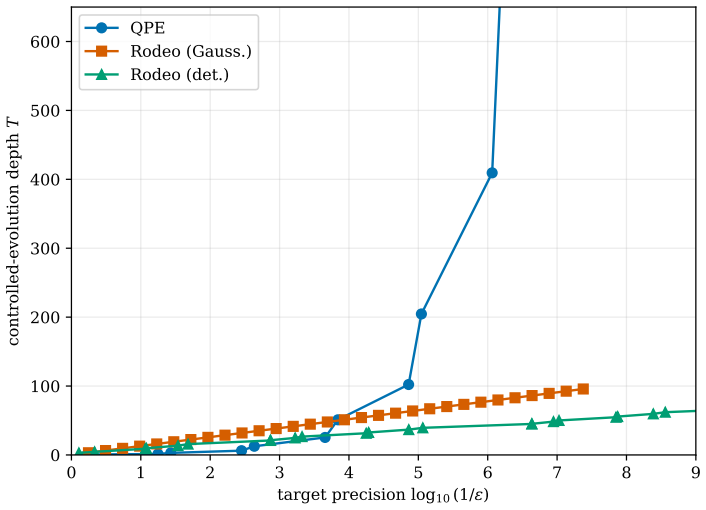
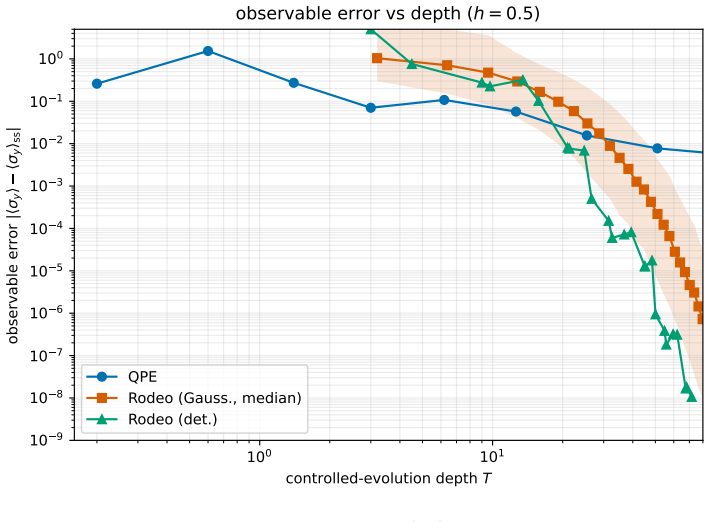
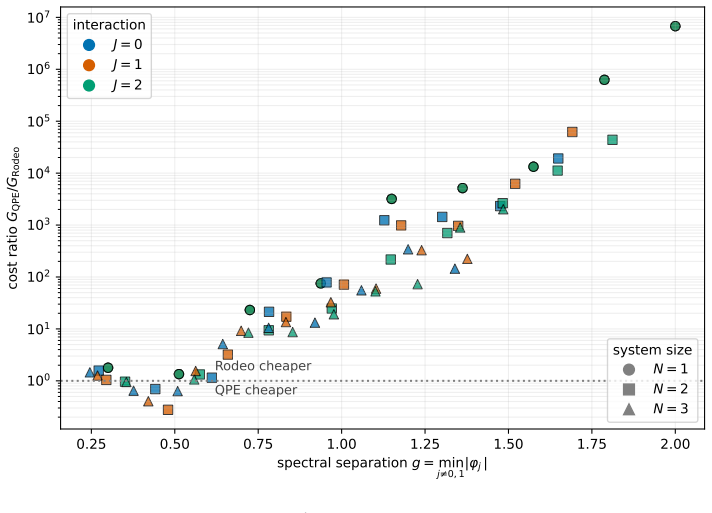
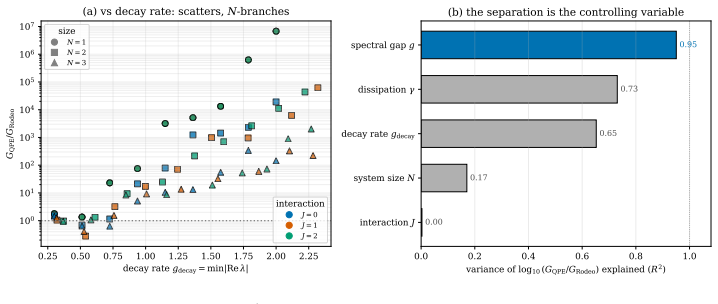
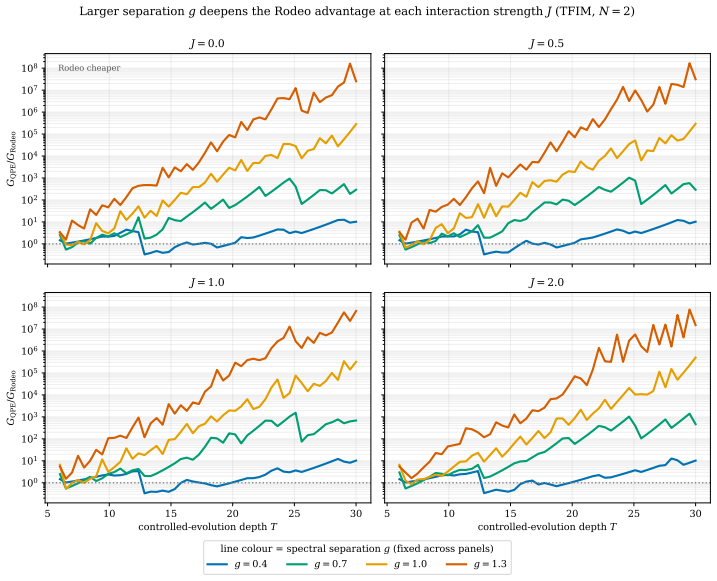
The Rodeo algorithm, applied to the known-zero-sector projection problem for the Hermitian Liouvillian, enables restart on failure and reduces the target-error dependence of the filtering cost and controlled-evolution depth from power-law to logarithmic; the advantage over phase-estimation filtering of the same projection increases with the spectral separation of the embedding, so that Rodeo already outperforms at modest controlled-evolution depths.
What carries the argument
Rodeo algorithm performing stochastic spectral filtering via repeated controlled evolutions and measurement-conditioned filtering steps, centered directly at the known zero eigenvalue of the Hermitian Liouvillian embedding.
If this is right
- Restart on measurement failure becomes possible, avoiding the full restart cost of phase estimation.
- Both total filtering cost and maximum controlled-evolution depth scale logarithmically rather than polynomially with target error.
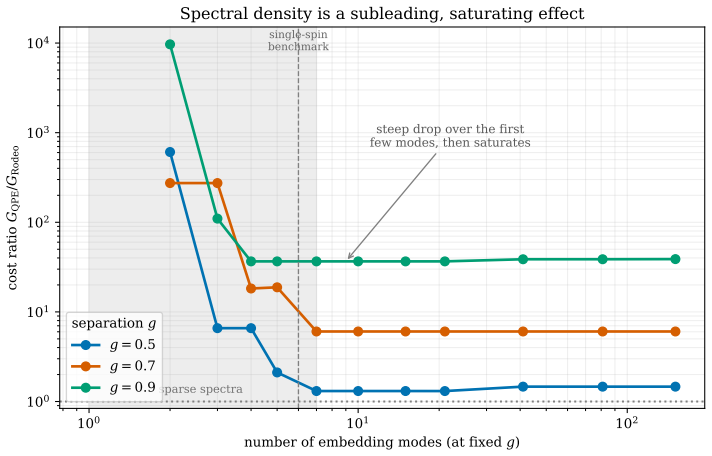
- The performance gap versus phase-estimation filtering widens as the spectral separation around zero increases.
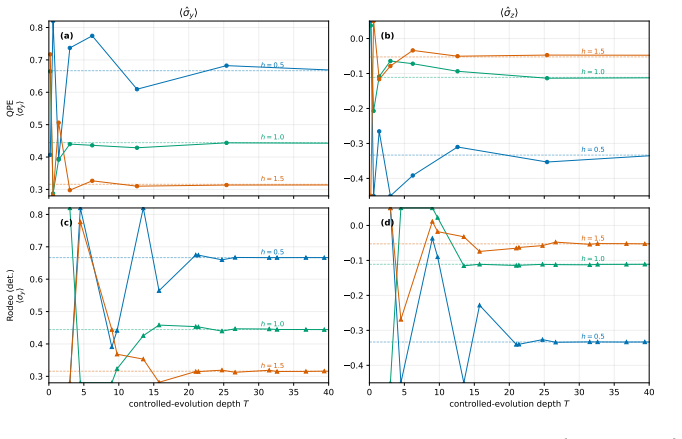
- Steady-state observables can be estimated at modest circuit depths once the gap condition holds.
- The approach supplies a direct, search-free primitive for open-system steady states.
Where Pith is reading between the lines
- The same restart-and-log-scaling structure could apply to other quantum problems where an eigenvalue is known in advance, such as certain symmetry-protected sectors.
- Hardware demonstrations on small damped spin chains or bosonic modes would directly test whether the predicted logarithmic advantage appears at accessible gate depths.
- Combining Rodeo filtering with existing open-system simulators might reduce the total number of shots needed for expectation values of local observables.
- If the gap shrinks with system size, the method would still require an initial gap-certification step whose cost is left open by the present analysis.
Load-bearing premise
The Hermitian embedding of the Liouvillian must keep a sufficient spectral gap around the zero mode so the Rodeo filter can isolate the steady state without extra search or large overlap penalties.
What would settle it
A numerical or hardware experiment on a small open system showing that the number of controlled evolutions required to reach a fixed target error grows as a power of the error rather than its logarithm when the spectral gap is held constant.
Figures
read the original abstract
Computing non-equilibrium steady states of open quantum systems is a challenging task on conventional computers, motivating quantum algorithms for direct steady-state estimation. A natural route is to regard the steady state as the zero mode of the Liouvillian and to isolate this sector spectrally. We formulate this task as a known-zero-sector projection problem and implement the corresponding filter using the Rodeo algorithm, which performs stochastic spectral filtering through repeated controlled evolutions and measurement-conditioned filtering steps. In the steady-state setting, the filter can be centered directly at the known zero eigenvalue, avoiding the spectral search required in generic eigenstate preparation. Compared with a phase-estimation-based implementation of the same projection, the Rodeo approach enables restart on failure and reduces the target-error dependence of the filtering cost and controlled-evolution depth from power-law to logarithmic. This advantage becomes more pronounced as the spectral separation of the Hermitian Liouvillian embedding increases, allowing Rodeo filtering to outperform phase-estimation filtering already at modest controlled-evolution depths. Our results identify Rodeo filtering as a resource-efficient primitive for estimating steady-state observables in open quantum systems.
Editorial analysis
A structured set of objections, weighed in public.
Referee Report
Summary. The manuscript formulates steady-state estimation for open quantum systems as projection onto the known zero mode of a Hermitian embedding of the Liouvillian superoperator and implements the projection via the Rodeo algorithm. It claims that Rodeo filtering permits restart on failure and converts the target-error dependence of filtering cost and controlled-evolution depth from power-law to logarithmic scaling relative to a phase-estimation implementation of the same projection, with the advantage increasing as the spectral separation of the embedding grows.
Significance. If the scaling claims and the required spectral-gap properties of the embedding hold, the work supplies a concrete, restart-capable primitive that could lower the quantum resources needed for direct steady-state estimation in open systems, especially when the embedding spectrum is well separated.
major comments (2)
- [abstract (Rodeo implementation paragraph)] The central performance claims (logarithmic vs. power-law scaling, outperformance already at modest depths) rest on the assumption that the Hermitian Liouvillian embedding produces a usable gap around the zero mode sufficient for the Rodeo filter (centered at zero) to succeed with high probability from a generic initial state. The manuscript supplies neither an explicit construction of the embedding nor a bound on this gap in terms of the original Liouvillian spectrum (abstract, paragraph beginning “In the steady-state setting…”).
- [abstract] No derivations, error analysis, or numerical benchmarks are presented to substantiate the claimed reduction in controlled-evolution depth or the restart-on-failure benefit (abstract, sentences comparing Rodeo to phase estimation). Without these, the load-bearing scaling statements cannot be verified.
minor comments (1)
- [abstract] The abstract states that the advantage “becomes more pronounced as the spectral separation … increases” but does not define the quantitative measure of separation or the filter width used in the comparison.
Simulated Author's Rebuttal
We thank the referee for their careful reading and constructive feedback. We address the major comments point by point below, indicating where revisions will be made to strengthen the manuscript.
read point-by-point responses
-
Referee: [abstract (Rodeo implementation paragraph)] The central performance claims (logarithmic vs. power-law scaling, outperformance already at modest depths) rest on the assumption that the Hermitian Liouvillian embedding produces a usable gap around the zero mode sufficient for the Rodeo filter (centered at zero) to succeed with high probability from a generic initial state. The manuscript supplies neither an explicit construction of the embedding nor a bound on this gap in terms of the original Liouvillian spectrum (abstract, paragraph beginning “In the steady-state setting…”).
Authors: We agree that an explicit construction of the Hermitian embedding and a bound on the induced gap (in terms of the original Liouvillian spectrum) are necessary to substantiate the performance claims. The current manuscript describes the embedding at a high level but does not supply the requested construction or gap bound. In the revised version we will add both: an explicit block-matrix construction of the Hermitian embedding together with a rigorous lower bound on the gap around the zero mode, expressed in terms of the spectral properties of the original Liouvillian. This addition will be placed in the main text and referenced from the abstract. revision: yes
-
Referee: [abstract] No derivations, error analysis, or numerical benchmarks are presented to substantiate the claimed reduction in controlled-evolution depth or the restart-on-failure benefit (abstract, sentences comparing Rodeo to phase estimation). Without these, the load-bearing scaling statements cannot be verified.
Authors: We acknowledge that the abstract alone does not contain the supporting derivations, error analysis, or benchmarks. The main text does contain the scaling derivations, cost analysis, and restart analysis, but these are not cross-referenced from the abstract and the numerical evidence is limited. In revision we will (i) expand the abstract to include explicit pointers to the relevant sections, (ii) add a concise error-propagation derivation for the logarithmic depth scaling, and (iii) include additional numerical benchmarks that directly compare controlled-evolution depth and restart success probability against phase estimation. These changes will make the scaling claims verifiable from the abstract onward. revision: yes
Circularity Check
No circularity: proposal applies external Rodeo primitive to known-zero projection without self-referential reduction
full rationale
The paper formulates steady-state estimation as zero-mode projection on a Hermitian Liouvillian embedding and implements it via the Rodeo algorithm. All performance claims (restart-on-failure, logarithmic vs power-law scaling, outperformance at modest depths) are stated as consequences of the algorithm's known properties when the filter is centered at a known eigenvalue and when a spectral gap exists; none of these claims are derived by fitting parameters to the target data or by redefining the embedding in terms of the desired gap. The embedding itself is introduced as an external construction whose gap is an input assumption, not an output of the present derivation. No self-citation is load-bearing for the central claim, and no equation reduces the stated advantage to a tautology.
Axiom & Free-Parameter Ledger
Reference graph
Works this paper leans on
-
[1]
On the generators of quantum dynamical semigroups
Goran Lindblad. On the generators of quantum dynamical semigroups. Communications in mathematical physics, 48(2):119–130, 1976. 18
1976
-
[2]
Completely positive dynamical semigroups of n-level sys- tems.Journal of Mathematical Physics, 17(5):821–825, 1976
Vittorio Gorini, Andrzej Kossakowski, and Ennackal Chandy George Sudarshan. Completely positive dynamical semigroups of n-level sys- tems.Journal of Mathematical Physics, 17(5):821–825, 1976
1976
-
[3]
Anal- ysis of quantum semigroups with gks–lindblad generators: I
Bernhard Baumgartner, Heide Narnhofer, and Walter Thirring. Anal- ysis of quantum semigroups with gks–lindblad generators: I. sim- ple generators.Journal of Physics A: Mathematical and Theoretical, 41(6):065201, 2008
2008
-
[4]
On the uniqueness of the steady-state solution of the lindblad–gorini–kossakowski–sudarshan equation.Journal of Statistical Mechanics: Theory and Experiment, 2019(4):043202, 2019
Davide Nigro. On the uniqueness of the steady-state solution of the lindblad–gorini–kossakowski–sudarshan equation.Journal of Statistical Mechanics: Theory and Experiment, 2019(4):043202, 2019
2019
-
[5]
Quantum states and phases in driven open quantum systems with cold atoms.Nature Physics, 4(11):878–883, 2008
Sebastian Diehl, Andrea Micheli, Adrian Kantian, B Kraus, Hans Peter Büchler, and Peter Zoller. Quantum states and phases in driven open quantum systems with cold atoms.Nature Physics, 4(11):878–883, 2008
2008
-
[6]
Quantum com- putation and quantum-state engineering driven by dissipation.Nature physics, 5(9):633–636, 2009
Frank Verstraete, Michael M Wolf, and J Ignacio Cirac. Quantum com- putation and quantum-state engineering driven by dissipation.Nature physics, 5(9):633–636, 2009
2009
-
[7]
Keldysh field theory for driven open quantum systems.Reports on Progress in Physics, 79(9):096001, 2016
Lukas M Sieberer, Michael Buchhold, and Sebastian Diehl. Keldysh field theory for driven open quantum systems.Reports on Progress in Physics, 79(9):096001, 2016
2016
-
[8]
Problem of equilibration and the computation of correlation functions on a quantum computer
Barbara M Terhal and David P DiVincenzo. Problem of equilibration and the computation of correlation functions on a quantum computer. Physical Review A, 61(2):022301, 2000
2000
-
[9]
Variational quantum algorithm for nonequilibrium steady states
Nobuyuki Yoshioka, Yuya O Nakagawa, Kosuke Mitarai, and Keisuke Fujii. Variational quantum algorithm for nonequilibrium steady states. Physical Review Research, 2(4):043289, 2020
2020
-
[10]
A quantum algorithm for the direct estimation of the steady state of open quantum systems.Quan- tum, 5:399, 2021
Nathan Ramusat and Vincenzo Savona. A quantum algorithm for the direct estimation of the steady state of open quantum systems.Quan- tum, 5:399, 2021
2021
-
[11]
Quantum algorithm for ground state energy estimation using circuit depth with exponentially improved dependence on precision.Quantum, 7:1167, 2023
Guoming Wang, Daniel Stilck França, Ruizhe Zhang, Shuchen Zhu, and Peter D Johnson. Quantum algorithm for ground state energy estimation using circuit depth with exponentially improved dependence on precision.Quantum, 7:1167, 2023
2023
-
[12]
Quantum multiple eigenvalue gaussian filtered search: an efficient and versatile quantum phase estimation method.Quantum, 8:1487, 2024
Zhiyan Ding, Haoya Li, Lin Lin, HongKang Ni, Lexing Ying, and Ruizhe Zhang. Quantum multiple eigenvalue gaussian filtered search: an efficient and versatile quantum phase estimation method.Quantum, 8:1487, 2024. 19
2024
-
[13]
Filtered Quantum Phase Estimation
Gwonhak Lee, Minhyeok Kang, Jungsoo Hong, Stepan Fomichev, and Joonsuk Huh. Filtered quantum phase estimation.arXiv preprint arXiv:2510.04294, 2025
work page internal anchor Pith review arXiv 2025
-
[14]
Rodeo algorithm for quantum computing.Physical Review Letters, 127(4):040505, 2021
Kenneth Choi, Dean Lee, Joey Bonitati, Zhengrong Qian, and Jacob Watkins. Rodeo algorithm for quantum computing.Physical Review Letters, 127(4):040505, 2021
2021
-
[15]
Demonstration of the rodeo algorithm on a quantum computer.The European Physical Journal A, 60(7):151, 2024
Zhengrong Qian, Jacob Watkins, Gabriel Given, Joey Bonitati, Ken- neth Choi, and Dean Lee. Demonstration of the rodeo algorithm on a quantum computer.The European Physical Journal A, 60(7):151, 2024
2024
-
[16]
Cohen and Hyunwoo Oh
Thomas D. Cohen and Hyunwoo Oh. Optimizing the rodeo projection algorithm.Phys. Rev. A, 108:032422, Sep 2023
2023
-
[17]
Matthew Patkowski, Onat Ayyildiz, Katherine Hunt, Nathan Jansen, and Dean Lee. Improved rodeo algorithm performance for spectral func- tions and state preparation.arXiv preprint arXiv:2602.05978, 2026
-
[18]
Griffiths and Chi-Sheng Niu
Robert B. Griffiths and Chi-Sheng Niu. Semiclassical fourier transform for quantum computation.Phys. Rev. Lett., 76:3228–3231, Apr 1996
1996
-
[19]
A. D. Córcoles, Maika Takita, Ken Inoue, Scott Lekuch, Zlatko K. Minev, Jerry M. Chow, and Jay M. Gambetta. Exploiting dynamic quantum circuits in a quantum algorithm with superconducting qubits. Phys. Rev. Lett., 127:100501, Aug 2021
2021
-
[20]
Elisa Bäumer, Vinay Tripathi, Alireza Seif, Daniel Lidar, and Derek S. Wang. Quantum fourier transform using dynamic circuits.Phys. Rev. Lett., 133:150602, Oct 2024
2024
-
[21]
Arbitrary accuracy iterative quantum phase estimation al- gorithm using a single ancillary qubit: A two-qubit benchmark.Phys
Miroslav Dobšíček, Göran Johansson, Vitaly Shumeiko, and Göran Wendin. Arbitrary accuracy iterative quantum phase estimation al- gorithm using a single ancillary qubit: A two-qubit benchmark.Phys. Rev. A, 76:030306(R), Sep 2007
2007
-
[22]
Measuring error rates of mid- circuit measurements.Nature Communications, 16(1):5761, 2025
Daniel Hothem, Jordan Hines, Charles Baldwin, Dan Gresh, Robin Blume-Kohout, and Timothy Proctor. Measuring error rates of mid- circuit measurements.Nature Communications, 16(1):5761, 2025
2025
-
[23]
Preserving a qubit during state- destroying operations on an adjacent qubit at a few micrometers dis- tance.Nature Communications, 15(1):6575, 2024
Sainath Motlakunta, Nikhil Kotibhaskar, Chung-You Shih, Anthony Vogliano, Darian McLaren, Lewis Hahn, Jingwen Zhu, Roland Hablützel, and Rajibul Islam. Preserving a qubit during state- destroying operations on an adjacent qubit at a few micrometers dis- tance.Nature Communications, 15(1):6575, 2024
2024
-
[24]
rodeo_ness: Numerical codeforreproducingtherodeo–nesssimulations.https://github.com/ HaEumKim/rodeo_ness, 2026
SoyoungShin, HaEumKim, andHyeonjunYeo. rodeo_ness: Numerical codeforreproducingtherodeo–nesssimulations.https://github.com/ HaEumKim/rodeo_ness, 2026. GitHubrepository, accessed24June2026. 20
2026
-
[25]
Childs, Yuan Su, Minh C
Andrew M. Childs, Yuan Su, Minh C. Tran, Nathan Wiebe, and Shuchen Zhu. Theory of trotter error with commutator scaling.Phys. Rev. X, 11:011020, Feb 2021. 21 A Filtering and gate-cost estimates This appendix collects the estimates underlying the resource comparison in Table 1. We first derive the residual-weight suppression for Rodeo and phase- estimation...
2021
discussion (0)
Sign in with ORCID, Apple, or X to comment. Anyone can read and Pith papers without signing in.