Breathing mode of quantum droplets in dipolar quantum gases: A sum-rule analysis
Pith reviewed 2026-06-30 02:14 UTC · model grok-4.3
The pith
Quantum fluctuations raise breathing-mode frequencies in dipolar quantum droplets by enhancing incompressibility compared to standard Bose gases.
A machine-rendered reading of the paper's core claim, the machinery that carries it, and where it could break.
Core claim
By applying a Gaussian variational ansatz to the extended Gross-Pitaevskii equation and using a sum-rule analysis, explicit analytical formulas are obtained for the breathing-mode frequencies in both axial and radial directions. These formulas predict that quantum fluctuations enhance the incompressibility, leading to elevated frequencies in the droplet phase relative to the weakly interacting regime. The predictions agree well with existing experimental measurements on 166Er and 162Dy gases, and comprehensive phase diagrams illustrate the transitions between the dilute BEC and dense droplet phases.
What carries the argument
Gaussian variational ansatz combined with non-perturbative sum-rule analysis applied to the extended Gross-Pitaevskii equation that includes the Lee-Huang-Yang quantum-fluctuation correction.
If this is right
- Breathing frequencies become markedly higher once the system enters the quantum droplet regime.
- First-order phase transitions produce discontinuous jumps in peak density and cloud size when the scattering length is varied.
- Quasi-two-dimensional and quasi-one-dimensional confinements exhibit either jumps or continuous crossovers in the same observables.
- The analytical frequency formulas hold across a range of atom numbers and trap aspect ratios in lanthanide gases.
Where Pith is reading between the lines
- The same sum-rule technique could be extended to other low-lying collective modes such as quadrupole oscillations in the same systems.
- The closed-form expressions offer a quick way to estimate mode frequencies without solving the full time-dependent equation for each parameter set.
- Tests with polar molecules rather than lanthanide atoms would check whether the incompressibility enhancement remains universal.
- The quasi-low-dimensional crossover behavior points to possible experimental control of droplet stability through trap geometry alone.
Load-bearing premise
The Gaussian variational ansatz combined with the sum-rule approach accurately captures both the ground-state density profile and the collective excitation spectrum of the extended Gross-Pitaevskii equation across the BEC-to-droplet crossover.
What would settle it
A measurement of radial and axial breathing frequencies in a trapped 166Er or 162Dy gas while tuning the s-wave scattering length across the droplet transition point, testing whether the observed values follow the derived analytical expressions within experimental uncertainty.
Figures




read the original abstract
We theoretically investigate the ground-state properties and breathing-mode collective excitations of three-dimensional dipolar Bose gases in anisotropic harmonic traps incorporating quantum fluctuations. Combining a Gaussian variational ansatz with a non-perturbative sum-rule analysis, we derive explicit analytical expressions for both axial and radial breathing-mode frequencies, which are validated by numerical solutions of the time-dependent extended Gross-Pitaevskii equation. Our theoretical predictions show excellent agreement with existing experimental data for $^{166}$Er and $^{162}$Dy gases. By constructing comprehensive phase diagrams across the parameter space of the $s$-wave scattering length, atom number, and trap aspect ratio, we reveal both discontinuous first-order phase transitions and smooth crossovers between the dilute Bose-Einstein condensate and dense quantum droplet phases. We confirm that the enhanced incompressibility induced by quantum fluctuations significantly elevates the breathing-mode frequencies in the droplet phase compared to conventional weakly interacting Bose gases. Furthermore, the system undergoes a phase transition and a crossover over the scattering length under the quasi-two-dimensional and quasi-one-dimensional confinements, characterized by discontinuous jumps and continuous crossovers in peak density and atomic cloud sizes, respectively. Our work offers a rigorous and highly accurate framework to characterize collective excitations in dipolar quantum gases, providing quantitative insights for forthcoming ultracold atom experiments in lanthanide atoms and polar molecules.
Editorial analysis
A structured set of objections, weighed in public.
Referee Report
Summary. The paper investigates ground-state properties and breathing-mode collective excitations of three-dimensional dipolar Bose gases in anisotropic harmonic traps with quantum fluctuations (LHY term). It combines a Gaussian variational ansatz with non-perturbative sum-rule analysis to derive closed-form analytical expressions for axial and radial breathing frequencies, validates these against direct numerical solutions of the time-dependent extended Gross-Pitaevskii equation, reports quantitative agreement with published data on ^{166}Er and ^{162}Dy, and maps phase diagrams showing first-order transitions and crossovers between BEC and quantum-droplet regimes as functions of scattering length, atom number, and trap aspect ratio. The central claim is that quantum fluctuations enhance incompressibility and thereby elevate breathing frequencies in the droplet phase relative to weakly interacting BECs.
Significance. If the central results hold, the work supplies a practical analytical toolkit for collective modes in dipolar droplets together with explicit phase diagrams; the explicit validation against time-dependent eGPE numerics and the reported agreement with existing Er/Dy experiments constitute concrete strengths that increase the utility of the framework for planning future lanthanide and polar-molecule experiments.
major comments (2)
- [§3 and §4] §3 (sum-rule derivation) and §4 (numerical validation): the breathing frequencies are obtained by evaluating the sum-rule moments with the same Gaussian trial density used for the variational ground state; while the manuscript states that these frequencies agree quantitatively with time-dependent eGPE simulations, no direct comparison of the variational density profile (or its second moments) against the numerically obtained ground-state density is presented in the droplet regime, where the LHY term is expected to produce flatter, non-Gaussian profiles. This leaves open whether the reported elevation of frequencies is robust or partly an artifact of the ansatz.
- [Fig. 5] Fig. 5 and associated text (phase diagrams): the claim of discontinuous first-order transitions versus smooth crossovers is based on jumps in peak density and cloud size obtained within the Gaussian ansatz; because the ansatz is known to be less accurate precisely at the BEC-droplet boundary, an independent check (e.g., full numerical minimization of the eGPE energy functional) would be required to confirm that the transition order is not altered by the variational restriction.
minor comments (2)
- [Abstract and §4.2] The abstract and §4.2 state 'excellent agreement' with Er and Dy data but supply neither quantitative error metrics (RMS deviation, etc.) nor a sensitivity analysis with respect to the variational width parameters; adding these would strengthen the experimental comparison.
- Notation for the dipolar interaction strength and the LHY coefficient is introduced without an explicit table of symbols; a short nomenclature table would improve readability.
Simulated Author's Rebuttal
We thank the referee for their thorough review and valuable comments. Below we provide point-by-point responses to the major comments.
read point-by-point responses
-
Referee: [§3 and §4] §3 (sum-rule derivation) and §4 (numerical validation): the breathing frequencies are obtained by evaluating the sum-rule moments with the same Gaussian trial density used for the variational ground state; while the manuscript states that these frequencies agree quantitatively with time-dependent eGPE simulations, no direct comparison of the variational density profile (or its second moments) against the numerically obtained ground-state density is presented in the droplet regime, where the LHY term is expected to produce flatter, non-Gaussian profiles. This leaves open whether the reported elevation of frequencies is robust or partly an artifact of the ansatz.
Authors: We agree that a direct comparison of the variational and numerical density profiles is not included in the manuscript. The quantitative agreement between the sum-rule frequencies and the time-dependent eGPE results provides indirect validation that the second moments are accurately reproduced by the Gaussian ansatz. To further address this point, we will add a supplementary comparison of the density profiles for selected parameters in the droplet regime in the revised manuscript. revision: yes
-
Referee: [Fig. 5] Fig. 5 and associated text (phase diagrams): the claim of discontinuous first-order transitions versus smooth crossovers is based on jumps in peak density and cloud size obtained within the Gaussian ansatz; because the ansatz is known to be less accurate precisely at the BEC-droplet boundary, an independent check (e.g., full numerical minimization of the eGPE energy functional) would be required to confirm that the transition order is not altered by the variational restriction.
Authors: The phase diagrams are constructed within the Gaussian variational framework, which allows for analytical expressions and comprehensive mapping of the parameter space. We recognize that the ansatz may affect the precise location and order of transitions near the boundary. While our frequency validations use full numerical methods, a complete numerical phase diagram was not computed. We will modify the discussion to clarify that the reported first-order transitions and crossovers are obtained within the variational ansatz and may require further numerical confirmation. revision: partial
Circularity Check
No circularity: Gaussian ansatz + sum-rule yields approximate analytical expressions validated by independent TD-eGPE numerics and experiment
full rationale
The derivation applies a Gaussian variational ansatz to obtain the ground-state density, computes moments from that density, and inserts them into standard sum-rule expressions for breathing frequencies. These closed-form results are then compared to separate numerical solutions of the full time-dependent extended GPE (without the ansatz) and to experimental data on Er and Dy. No step reduces a claimed prediction to its own fitted input by construction, no self-citation chain is load-bearing, and the method is externally benchmarked. This is a standard variational approximation procedure with independent checks, hence self-contained against external benchmarks.
Axiom & Free-Parameter Ledger
axioms (2)
- domain assumption The ground state and low-lying excitations of the dipolar gas are accurately described by the extended Gross-Pitaevskii equation including quantum fluctuation corrections.
- domain assumption A Gaussian ansatz suffices to capture the essential density profile for both ground-state energy minimization and moment calculations in the sum-rule approach.
Reference graph
Works this paper leans on
-
[1]
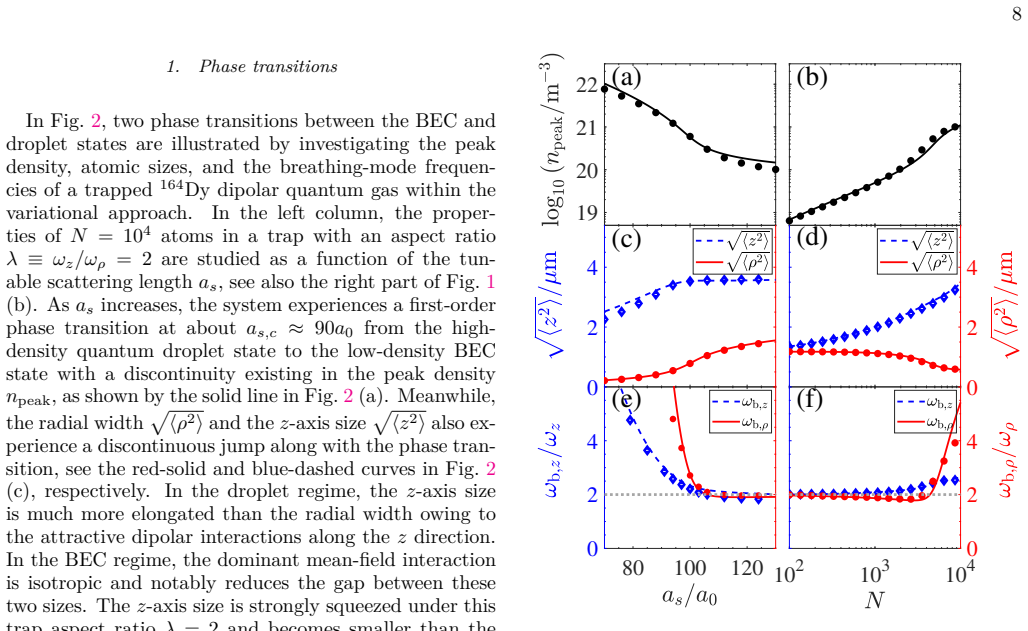
Phase transitions In Fig. 2, two phase transitions between the BEC and droplet states are illustrated by investigating the peak density, atomic sizes, and the breathing-mode frequen- cies of a trapped 164Dy dipolar quantum gas within the variational approach. In the left column, the proper- ties of N = 10 4 atoms in a trap with an aspect ratio λ ≡ ωz/ωρ =...
-
[2]
3, by illustrating the peak density, atomic sizes, and breathing-mode frequencies within the variational ap- proach
Crossovers We now present the crossovers between the BEC and droplet states of a trapped 164Dy dipolar quantum gas in Fig. 3, by illustrating the peak density, atomic sizes, and breathing-mode frequencies within the variational ap- proach. We take a nearly elongated confinement with an aspect ratio λ ≡ ωz/ωρ = 0 .5 and consider a fixed atom number N = 10 ...
-
[3]
Breathing-mode frequency comparison: experiments in 166Er and 162Dy atoms To validate the reliability of our theoretical approaches and results, we make a quantitative comparison of the breathing-mode frequency with two recent experiments on dipolar quantum gases in 166Er [ 17] and 162Dy [18] atoms. In Fig. 4, three values of the axial breathing- mode fre...
-
[4]
Quasi-one-dimensional confinement By taking a typical quasi-1D confinement, i.e., at a relatively small aspect ratio λ = 0 .1, the peak density, atomic sizes, and breathing-mode frequencies of a 164Dy dipolar quantum gas are presented as a function of the scattering length as in the top panel of Fig. 6. Under this quasi-1D geometric confinement, the syste...
-
[5]
Quasi-two-dimensional confinement Furthermore, by taking a typical quasi-2D confine- ment, i.e., at a relatively large aspect ratio λ = 10 , the peak density, atomic sizes, and breathing-mode frequen- cies of a 164Dy dipolar quantum gas are presented as a function of the scattering length as in the bottom panel of Fig. 6. In stark contrast to the case in ...
2025
-
[6]
Griesmaier, J
A. Griesmaier, J. Werner, S. Hensler, J. Stuhler, and T. Pfau, Bose-einstein condensation of chromium, Phys. Rev. Lett. 94, 160401 (2005)
2005
-
[7]
M. Lu, N. Q. Burdick, S. H. Youn, and B. L. Lev, Strongly dipolar bose-einstein condensate of dysprosium, Phys. Rev. Lett. 107, 190401 (2011)
2011
-
[8]
Aikawa, A
K. Aikawa, A. Frisch, M. Mark, S. Baier, A. Rietzler, R. Grimm, and F. Ferlaino, Bose-einstein condensation of erbium, Phys. Rev. Lett. 108, 210401 (2012)
2012
-
[9]
Lahaye, C
T. Lahaye, C. Menotti, L. Santos, M. Lewenstein, and T. Pfau, The physics of dipolar bosonic quantum gases, Rep. Prog. Phys. 72, 126401 (2009)
2009
-
[10]
M. A. Baranov, M. Dalmonte, G. Pupillo, and P. Zoller, Condensed matter theory of dipolar quantum gases, Chemical Reviews 112, 5012 (2012)
2012
-
[11]
Böttcher, J.-N
F. Böttcher, J.-N. Schmidt, J. Hertkorn, K. S. Ng, S. D. Graham, M. Guo, T. Langen, and T. Pfau, New states of matter with fine-tuned interactions: quantum droplets and dipolar supersolids, Rep. Prog. Phys. 84, 012403 (2021)
2021
-
[12]
Z.-H. Luo, W. Pang, B. Liu, Y.-Y. Li, and B. A. Mal- omed, A new form of liquid matter: Quantum droplets, Frontiers of Physics 16, 32201 (2021)
2021
-
[13]
Guo and T
M. Guo and T. Pfau, A new state of matter of quantum 14 60 80 100 120 0 50 100 150 200 250 80 100 120 0 0.04 0.08 0.12 0.16(a) (b) FIG. 7: Comparison of breathing-mode frequencies cal- culated by the numerical time-dependent extended GPE together with specific slight perturbations adopted in this work (i.e., solid dots and diamonds), with the ex- isting r...
2021
-
[14]
M. A. Norcia and F. Ferlaino, Developments in atomic control using ultracold magnetic lanthanides, Nature Physics 17, 1349 (2021)
2021
-
[15]
Chomaz, I
L. Chomaz, I. Ferrier-Barbut, F. Ferlaino, B. Laburthe- Tolra, B. L. Lev, and T. Pfau, Dipolar physics: a review of experiments with magnetic quantum gases, Rep. Prog. Phys. 86, 026401 (2023)
2023
-
[16]
A. R. P. Lima and A. Pelster, Quantum fluctuations in dipolar bose gases, Phys. Rev. A 84, 041604(R) (2011)
2011
-
[17]
A. R. P. Lima and A. Pelster, Beyond mean-field low- lying excitations of dipolar bose gases, Phys. Rev. A 86, 063609 (2012)
2012
-
[18]
D. S. Petrov, Quantum mechanical stabilization of a col- lapsing bose-bose mixture, Phys. Rev. Lett. 115, 155302 (2015)
2015
-
[19]
Kadau, M
H. Kadau, M. Schmitt, M. Wenzel, C. Wink, T. Maier, I. Ferrier-Barbut, and T. Pfau, Observing the rosensweig instability of a quantum ferrofluid, Nature 530, 194 (2016)
2016
-
[20]
Ferrier-Barbut, H
I. Ferrier-Barbut, H. Kadau, M. Schmitt, M. Wenzel, and T. Pfau, Observation of quantum droplets in a strongly dipolar bose gas, Phys. Rev. Lett. 116, 215301 (2016)
2016
-
[21]
Schmitt, M
M. Schmitt, M. Wenzel, F. Böttcher, I. Ferrier-Barbut, and T. Pfau, Self-bound droplets of a dilute magnetic quantum liquid, Nature 539, 259 (2016)
2016
-
[22]
Chomaz, S
L. Chomaz, S. Baier, D. Petter, M. Mark, F. Wächtler, L. Santos, and F. Ferlaino, Quantum-fluctuation-driven crossover from a dilute bose-einstein condensate to a macrodroplet in a dipolar quantum fluid, Phys. Rev. X 6, 041039 (2016)
2016
-
[23]
Tanzi, S
L. Tanzi, S. M. Roccuzzo, E. Lucioni, F. Famà, A. Fioretti, C. Gabbanini, G. Modugno, A. Recati, and S. Stringari, Supersolid symmetry breaking from com- pressional oscillations in a dipolar quantum gas, Nature 574, 382 (2019)
2019
-
[24]
Böttcher, M
F. Böttcher, M. Wenzel, J.-N. Schmidt, M. Guo, T. Lan- gen, I. Ferrier-Barbut, T. Pfau, R. Bombín, J. Sánchez- Baena, J. Boronat, and F. Mazzanti, Dilute dipolar quan- tum droplets beyond the extended gross-pitaevskii equa- tion, Phys. Rev. Res. 1, 033088 (2019)
2019
-
[25]
Tanzi, E
L. Tanzi, E. Lucioni, F. Famà, J. Catani, A. Fioretti, C. Gabbanini, R. N. Bisset, L. Santos, and G. Modugno, Observation of a dipolar quantum gas with metastable supersolid properties, Phys. Rev. Lett. 122, 130405 (2019)
2019
-
[26]
C. R. Cabrera, L. Tanzi, J. Sanz, B. Naylor, P. Thomas, P. Cheiney, and L. Tarruell, Quantum liquid droplets in a mixture of bose-einstein condensates, Science 359, 301 (2018)
2018
-
[27]
Semeghini, G
G. Semeghini, G. Ferioli, L. Masi, C. Mazzinghi, L. Wol- swijk, F. Minardi, M. Modugno, G. Modugno, M. In- guscio, and M. Fattori, Self-bound quantum droplets of atomic mixtures in free space, Phys. Rev. Lett. 120, 235301 (2018)
2018
-
[28]
Cheiney, C
P. Cheiney, C. R. Cabrera, J. Sanz, B. Naylor, L. Tanzi, and L. Tarruell, Bright soliton to quantum droplet tran- sition in a mixture of bose-einstein condensates, Phys. Rev. Lett. 120, 135301 (2018)
2018
-
[29]
Ferioli, G
G. Ferioli, G. Semeghini, L. Masi, G. Giusti, G. Mod- ugno, M. Inguscio, A. Gallemí, A. Recati, and M. Fattori, Collisions of self-bound quantum droplets, Phys. Rev. Lett. 122, 090401 (2019)
2019
-
[30]
T. G. Skov, M. G. Skou, N. B. Jørgensen, and J. J. Arlt, Observation of a Lee-Huang-Yang fluid, Phys. Rev. Lett. 126, 230404 (2021)
2021
-
[31]
D’Errico, A
C. D’Errico, A. Burchianti, M. Prevedelli, L. Salasnich, F. Ancilotto, M. Modugno, F. Minardi, and C. Fort, Ob- servation of quantum droplets in a heteronuclear bosonic mixture, Phys. Rev. Res. 1, 033155 (2019)
2019
-
[32]
Burchianti, C
A. Burchianti, C. D’Errico, M. Prevedelli, L. Salasnich, F. Ancilotto, M. Modugno, F. Minardi, and C. Fort, A dual-species bose-einstein condensate with attractive in- terspecies interactions, Condensed Matter 5, 21 (2020)
2020
-
[33]
Cavicchioli, C
L. Cavicchioli, C. Fort, F. Ancilotto, M. Modugno, F. Mi- nardi, and A. Burchianti, Dynamical formation of multi- ple quantum droplets in a bose-bose mixture, Phys. Rev. Lett. 134, 093401 (2025)
2025
-
[34]
Z. Guo, F. Jia, L. Li, Y. Ma, J. M. Hutson, X. Cui, and D. Wang, Lee-Huang-Yang effects in the ultracold mixture of 23Na and 87Rb with attractive interspecies interactions, Phys. Rev. Res. 3, 033247 (2021)
2021
-
[35]
Bigagli, W
N. Bigagli, W. Yuan, S. Zhang, B. Bulatovic, T. Kar- man, I. Stevenson, and S. Will, Observation of bose– einstein condensation of dipolar molecules, Nature 631, 289 (2024)
2024
-
[36]
Zhang, W
S. Zhang, W. Yuan, N. Bigagli, H. Kwak, T. Karman, I. Stevenson, and S. Will, Observation of self-bound droplets of ultracold dipolar molecules, Nature 651, 601 (2026)
2026
-
[37]
Ferrier-Barbut, M
I. Ferrier-Barbut, M. Schmitt, M. Wenzel, H. Kadau, and T. Pfau, Liquid quantum droplets of ultracold magnetic atoms, Journal of Physics B: Atomic, Molecular and Op- tical Physics 49, 214004 (2016)
2016
-
[38]
Ferrier-Barbut, M
I. Ferrier-Barbut, M. Wenzel, F. Böttcher, T. Langen, M. Isoard, S. Stringari, and T. Pfau, Scissors mode of dipolar quantum droplets of dysprosium atoms, Phys. Rev. Lett. 120, 160402 (2018)
2018
-
[39]
Wenzel, F
M. Wenzel, F. Böttcher, T. Langen, I. Ferrier-Barbut, and T. Pfau, Striped states in a many-body system of 15 tilted dipoles, Phys. Rev. A 96, 053630 (2017)
2017
-
[40]
Böttcher, J.-N
F. Böttcher, J.-N. Schmidt, M. Wenzel, J. Hertkorn, M. Guo, T. Langen, and T. Pfau, Transient supersolid properties in an array of dipolar quantum droplets, Phys. Rev. X 9, 011051 (2019)
2019
-
[41]
Chomaz, D
L. Chomaz, D. Petter, P. Ilzhöfer, G. Natale, A. Traut- mann, C. Politi, G. Durastante, R. M. W. van Bijnen, A. Patscheider, M. Sohmen, M. J. Mark, and F. Ferlaino, Long-lived and transient supersolid behaviors in dipolar quantum gases, Phys. Rev. X 9, 021012 (2019)
2019
-
[42]
M. A. Norcia, C. Politi, L. Klaus, E. Poli, M. Sohmen, M. J. Mark, R. N. Bisset, L. Santos, and F. Ferlaino, Two-dimensional supersolidity in a dipolar quantum gas, Nature 596, 357 (2021)
2021
- [43]
-
[44]
Klaus, T
L. Klaus, T. Bland, E. Poli, C. Politi, G. Lamporesi, E. Casotti, R. N. Bisset, M. J. Mark, and F. Ferlaino, Observation of vortices and vortex stripes in a dipolar condensate, Nature Physics 18, 1453 (2022)
2022
-
[45]
Casotti, E
E. Casotti, E. Poli, L. Klaus, A. Litvinov, C. Ulm, C. Politi, M. J. Mark, T. Bland, and F. Ferlaino, Ob- servation of vortices in a dipolar supersolid, Nature 635, 327 (2024)
2024
-
[46]
Trautmann, P
A. Trautmann, P. Ilzhöfer, G. Durastante, C. Politi, M. Sohmen, M. J. Mark, and F. Ferlaino, Dipolar quan- tum mixtures of erbium and dysprosium atoms, Phys. Rev. Lett. 121, 213601 (2018)
2018
-
[47]
Durastante, C
G. Durastante, C. Politi, M. Sohmen, P. Ilzhöfer, M. J. Mark, M. A. Norcia, and F. Ferlaino, Feshbach reso- nances in an erbium-dysprosium dipolar mixture, Phys. Rev. A 102, 033330 (2020)
2020
-
[48]
Politi, A
C. Politi, A. Trautmann, P. Ilzhöfer, G. Durastante, M. J. Mark, M. Modugno, and F. Ferlaino, Interspecies interactions in an ultracold dipolar mixture, Phys. Rev. A 105, 023304 (2022)
2022
-
[49]
Saito, Path-integral monte carlo study on a droplet of a dipolar bose–einstein condensate stabilized by quantum fluctuation, J
H. Saito, Path-integral monte carlo study on a droplet of a dipolar bose–einstein condensate stabilized by quantum fluctuation, J. Phys. Soc. Japan 85, 053001 (2016)
2016
-
[50]
Cinti, A
F. Cinti, A. Cappellaro, L. Salasnich, and T. Macrì, Su- perfluid filaments of dipolar bosons in free space, Phys. Rev. Lett. 119, 215302 (2017)
2017
-
[51]
Cinti and M
F. Cinti and M. Boninsegni, Classical and quantum fila- ments in the ground state of trapped dipolar bose gases, Phys. Rev. A 96, 013627 (2017)
2017
-
[52]
Bombin, J
R. Bombin, J. Boronat, and F. Mazzanti, Dipolar bose supersolid stripes, Phys. Rev. Lett. 119, 250402 (2017)
2017
-
[53]
Ronen, D
S. Ronen, D. C. E. Bortolotti, and J. L. Bohn, Radial and angular rotons in trapped dipolar gases, Phys. Rev. Lett. 98, 030406 (2007)
2007
-
[54]
R. M. Wilson, S. Ronen, and J. L. Bohn, Critical super- fluid velocity in a trapped dipolar gas, Phys. Rev. Lett. 104, 094501 (2010)
2010
-
[55]
Baillie, R
D. Baillie, R. M. Wilson, and P. B. Blakie, Collective excitations of self-bound droplets of a dipolar quantum fluid, Phys. Rev. Lett. 119, 255302 (2017)
2017
-
[56]
S. M. Roccuzzo and F. Ancilotto, Supersolid behavior of a dipolar bose-einstein condensate confined in a tube, Phys. Rev. A 99, 041601(R) (2019)
2019
-
[57]
Hertkorn, F
J. Hertkorn, F. Böttcher, M. Guo, J. N. Schmidt, T. Lan- gen, H. P. Büchler, and T. Pfau, Fate of the amplitude mode in a trapped dipolar supersolid, Phys. Rev. Lett. 123, 193002 (2019)
2019
-
[58]
S. Pal, D. Baillie, and P. B. Blakie, Infinite dipolar droplet: A simple theory for the macrodroplet regime, Phys. Rev. A 105, 023308 (2022)
2022
-
[59]
P. B. Blakie, Axial collective mode of a dipolar quantum droplet, Photonics 10, 393 (2023)
2023
-
[60]
Schubert, T
M. Schubert, T. Bland, M. J. Mark, F. Ferlaino, and S. M. Reimann, Soliton-to-droplet crossover in a dipolar bose gas in one and two dimensions, Phys. Rev. Res. 8, 023090 (2026)
2026
-
[61]
Boudjemâa, Fluctuations and quantum self-bound droplets in a dipolar bose-bose mixture, Phys
A. Boudjemâa, Fluctuations and quantum self-bound droplets in a dipolar bose-bose mixture, Phys. Rev. A 98, 033612 (2018)
2018
-
[62]
Aybar and M
E. Aybar and M. O. Oktel, Temperature-dependent den- sity profiles of dipolar droplets, Phys. Rev. A 99, 013620 (2019)
2019
-
[63]
Boudjemâa and N
A. Boudjemâa and N. Guebli, Quantum correlations in dipolar droplets: Time-dependent hartree-fock- bogoliubov theory, Phys. Rev. A 102, 023302 (2020)
2020
-
[64]
Baillie, R
D. Baillie, R. M. Wilson, R. N. Bisset, and P. B. Blakie, Self-bound dipolar droplet: A localized matter wave in free space, Phys. Rev. A 94, 021602 (2016)
2016
-
[65]
R. N. Bisset, R. M. Wilson, D. Baillie, and P. B. Blakie, Ground-state phase diagram of a dipolar condensate with quantum fluctuations, Phys. Rev. A 94, 033619 (2016)
2016
-
[66]
Wächtler and L
F. Wächtler and L. Santos, Ground-state properties and elementary excitations of quantum droplets in dipo- lar bose-einstein condensates, Phys. Rev. A 94, 043618 (2016)
2016
-
[67]
Wächtler and L
F. Wächtler and L. Santos, Quantum filaments in dipo- lar bose-einstein condensates, Phys. Rev. A 93, 061603 (2016)
2016
-
[68]
R. N. Bisset, L. A. P. n. Ardila, and L. Santos, Quan- tum droplets of dipolar mixtures, Phys. Rev. Lett. 126, 025301 (2021)
2021
-
[69]
J. C. Smith, D. Baillie, and P. B. Blakie, Quantum droplet states of a binary magnetic gas, Phys. Rev. Lett. 126, 025302 (2021)
2021
-
[70]
Santos, G
L. Santos, G. V. Shlyapnikov, P. Zoller, and M. Lewen- stein, Bose-einstein condensation in trapped dipolar gases, Phys. Rev. Lett. 85, 1791 (2000)
2000
-
[71]
Yi and L
S. Yi and L. You, Trapped condensates of atoms with dipole interactions, Phys. Rev. A 63, 053607 (2001)
2001
-
[72]
Cidrim, F
A. Cidrim, F. E. dos Santos, E. A. Henn, and T. Macrì, Vortices in self-bound dipolar droplets, Phys. Rev. A 98, 023618 (2018)
2018
-
[73]
Pitaevskii and S
L. Pitaevskii and S. Stringari, Bose-Einstein condensa- tion and superfluidity , Vol. 164 (Oxford University Press, 2016)
2016
-
[74]
Menotti and S
C. Menotti and S. Stringari, Collective oscillations of a one-dimensional trapped bose-einstein gas, Phys. Rev. A 66, 043610 (2002)
2002
-
[75]
De Palo, E
S. De Palo, E. Orignac, M. L. Chiofalo, and R. Citro, Polarization angle dependence of the breathing mode in confined one-dimensional dipolar bosons, Phys. Rev. B 103, 115109 (2021)
2021
-
[76]
Orignac, S
E. Orignac, S. De Palo, L. Salasnich, and R. Citro, Breathing mode of a quantum droplet in a quasi-one- dimensional dipolar bose gas, Phys. Rev. A 109, 043316 (2024)
2024
-
[77]
Y. Fei, X. Du, X.-L. Chen, and Y. Zhang, Collective ex- citations in two-dimensional harmonically trapped quan- tum droplets, Phys. Rev. A 109, 053309 (2024)
2024
-
[78]
Zheng, Z
H. Zheng, Z. Yuan, X. Qu, W. Xu, and X.-L. Chen, 16 Collective excitation dynamics in spin-orbit coupled bose gases, Acta Physica Sinica 74, 147101 (2025)
2025
-
[79]
H. Xiao, X. Zhang, J. Liu, X. Du, X.-L. Chen, and Y. Zhang, One-dimensional asymmetrically interacting quantum droplets in bose-bose mixtures, Phys. Rev. A 113, 063301 (2026)
2026
-
[80]
Ho and M
T.-L. Ho and M. Ma, Quasi 1 and 2d dilute bose gas in magnetic traps: Existence of off-diagonal order and anomalous quantum fluctuations, J. Low Temp. Phys. 115, 61 (1999)
1999
discussion (0)
Sign in with ORCID, Apple, or X to comment. Anyone can read and Pith papers without signing in.