Gravitational lensing by extremal rotating black holes in the strong deflection limit
Pith reviewed 2026-06-30 02:27 UTC · model grok-4.3
The pith
Light near extremal rotating black holes shows a power-law divergence in deflection angle in addition to the usual logarithm.
A machine-rendered reading of the paper's core claim, the machinery that carries it, and where it could break.
Core claim
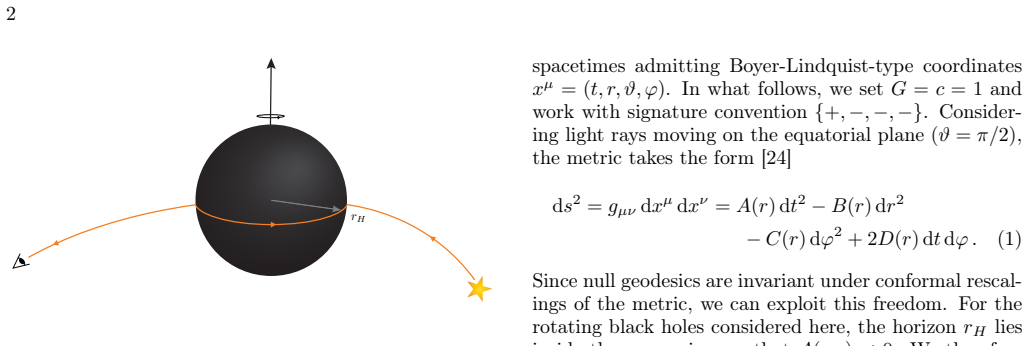
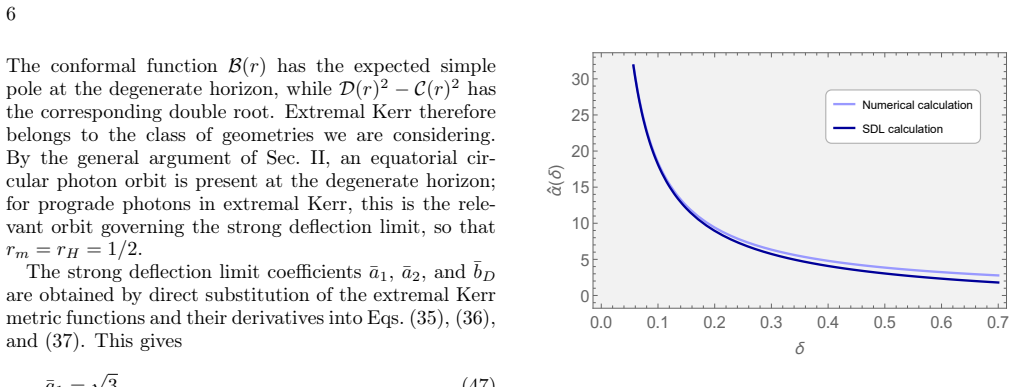
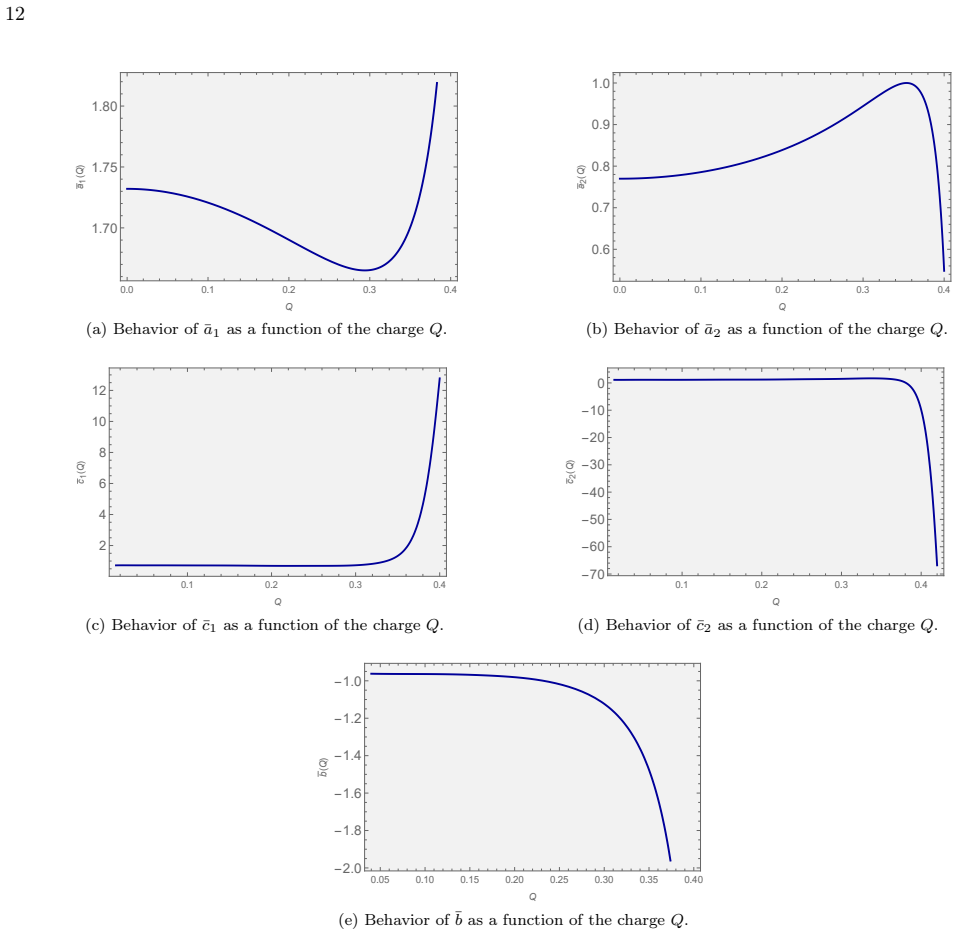
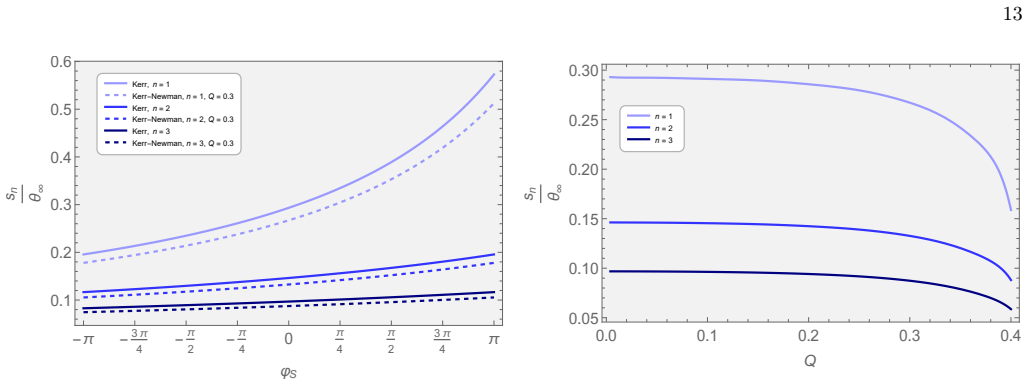
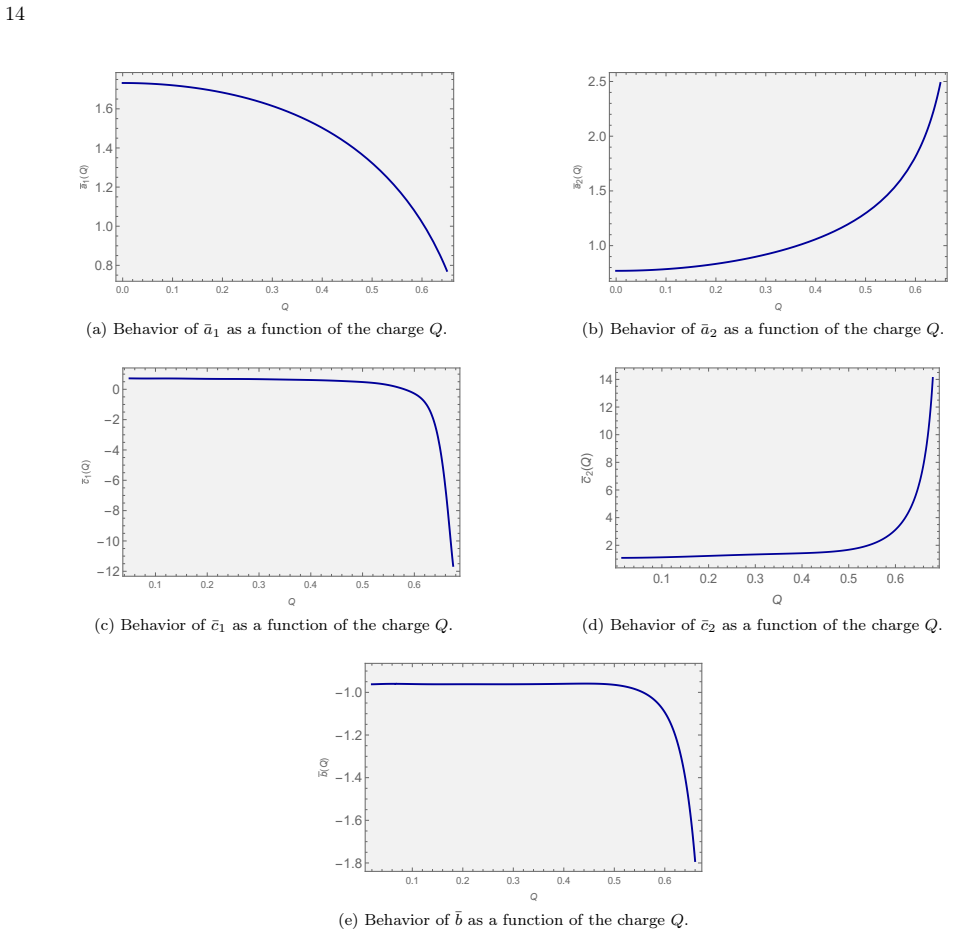
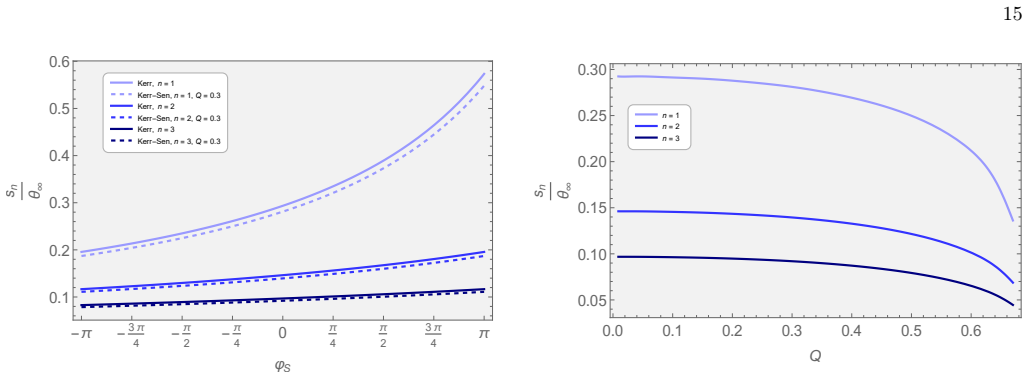
When the prograde critical photon orbit coincides with the degenerate horizon of an extremal rotating black hole, the deflection angle in the strong deflection limit diverges as a combination of a power law and a logarithm rather than logarithm alone, requiring a modified expansion that keeps additional higher-order terms to capture the behavior of higher-order images. The construction is first performed for equatorial prograde motion and then extended to quasi-equatorial trajectories to obtain magnifications and caustic positions. The resulting framework applies to a general class of extremal rotating metrics and is illustrated with the Kerr, Kerr-Newman and Kerr-Sen solutions.
What carries the argument
A new strong deflection limit expansion tailored to the horizon critical orbit, which retains extra terms beyond the standard logarithmic approximation.
If this is right
- The deflection angle for prograde equatorial rays near the horizon critical orbit follows a combined power-law and logarithmic divergence.
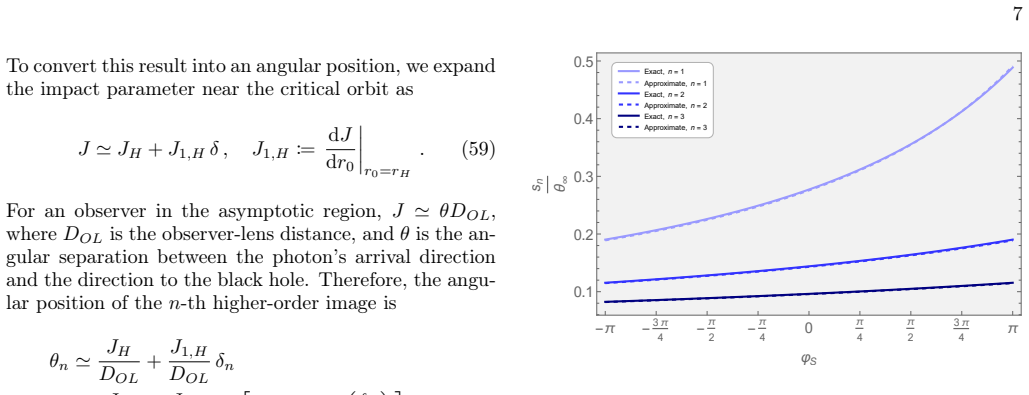
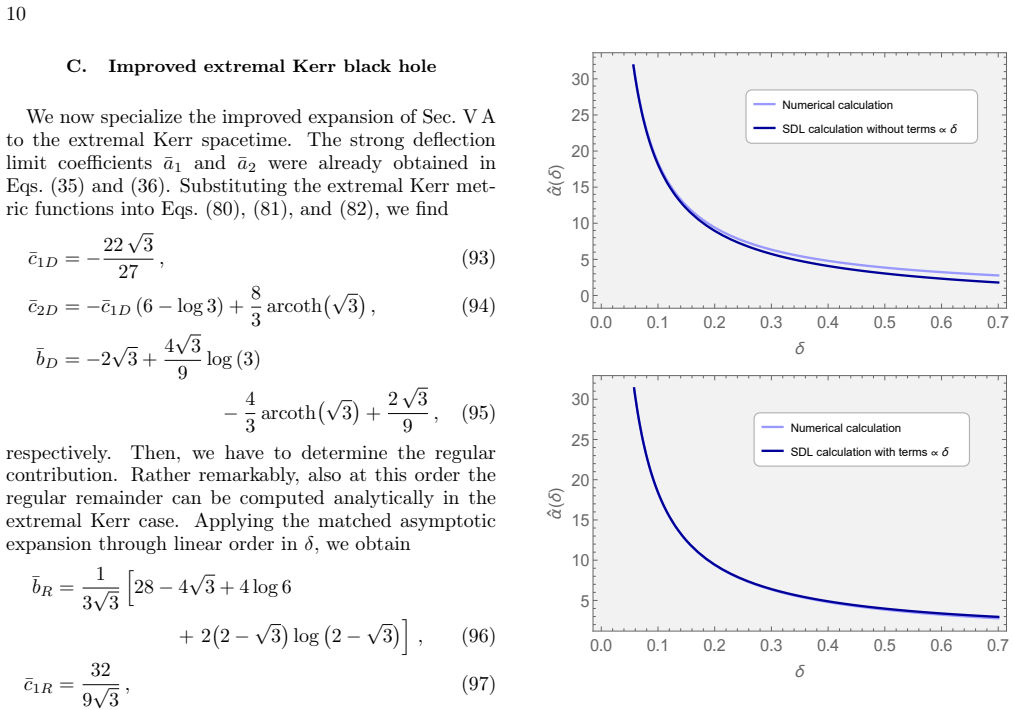
- Additional terms in the expansion are required for accurate positions of higher-order images.
- Quasi-equatorial analysis yields the magnification of higher-order images and the locations of caustic points.
- The method applies to any extremal rotating black hole metric in the specified class.
- Explicit results are obtained for the Kerr, Kerr-Newman, and Kerr-Sen black holes.
Where Pith is reading between the lines
- Observers could use the new expansion to predict image locations for nearly extremal black holes more reliably than with the standard limit.
- Numerical geodesic integration could verify the presence of the power-law term for specific parameters.
- The technique might extend to other strong-field phenomena involving near-horizon orbits in extremal spacetimes.
- Comparisons with observations of black hole shadows or lensing events around Sgr A* or M87* could test the predictions if spin is close to extremal.
Load-bearing premise
The traditional logarithmic strong-deflection expansion fails precisely when the critical photon orbit merges with the horizon, so a revised series that captures the altered scaling is required.
What would settle it
Numerical integration of null geodesics for an extremal Kerr black hole with impact parameter approaching the critical value, checking whether the deflection angle grows as a power law plus logarithm rather than pure logarithm.
Figures
read the original abstract
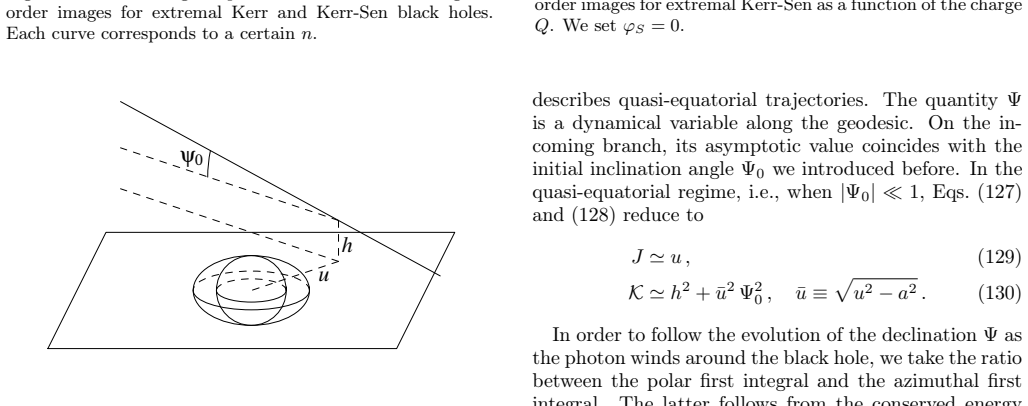
In the strong deflection regime, light rays passing close to an astrophysical black hole may remain trapped near unstable photon orbits for a long time before escaping to infinity. The traditional strong-deflection limit, which accurately describes the logarithmic divergence of the deflection angle for spherically symmetric and slowly rotating black holes, breaks down when the relevant prograde critical photon orbit coincides with the degenerate horizon of an extremal rotating black hole. We present a new strong deflection limit expansion for this horizon critical orbit, covering a general class of extremal rotating black holes. We show that the deflection angle exhibits a stronger power-law divergence in addition to the logarithmic divergence. For an adequate description of higher-order images, additional terms in the expansion must be retained. We first study prograde gravitational lensing in the equatorial plane and then extend the analysis to quasi-equatorial motion, which allows us to calculate the magnification of the higher-order images and the position of the caustic points. We finally apply the general framework to explicit examples, including the Kerr, Kerr-Newman, and Kerr-Sen metrics.
Editorial analysis
A structured set of objections, weighed in public.
Referee Report
Summary. The manuscript develops a new strong-deflection-limit expansion for prograde gravitational lensing by extremal rotating black holes when the critical photon orbit coincides with the degenerate horizon. It shows that the deflection angle then contains both a power-law divergence and the usual logarithmic term, so that additional terms must be retained to describe higher-order images. The analysis begins in the equatorial plane, is extended to quasi-equatorial rays to obtain magnifications and caustic locations, and is applied to the Kerr, Kerr-Newman and Kerr-Sen metrics.
Significance. If the derivation is correct, the result supplies a controlled analytic description of a previously singular regime in strong lensing by near-extremal Kerr-like black holes. The explicit treatment of quasi-equatorial motion and the three concrete examples make the framework directly usable for modeling higher-order images, which is a concrete advance over the standard logarithmic expansion.
minor comments (2)
- The definition of the general class of extremal metrics (presumably in §2) should be stated explicitly as a set of metric functions or curvature conditions rather than left implicit from the examples.
- In the quasi-equatorial extension, the ordering of the retained terms in the deflection-angle expansion should be justified by a clear power-counting argument with respect to the small parameter measuring proximity to the horizon.
Simulated Author's Rebuttal
We thank the referee for the positive evaluation of the manuscript and the recommendation to accept. No major comments were raised in the report.
Circularity Check
No significant circularity; derivation is self-contained
full rationale
The paper derives a new strong-deflection expansion for the deflection angle when the prograde photon orbit merges with the degenerate horizon in extremal rotating black holes. This follows directly from analyzing the integral for the deflection angle using the metric's near-horizon scaling properties, yielding a combined power-law and logarithmic divergence without reducing to fitted parameters, self-citations, or ansatzes imported from prior work. The extension to quasi-equatorial motion and applications to Kerr, Kerr-Newman, and Kerr-Sen metrics are presented as explicit calculations from the general framework. No load-bearing step equates a prediction to its input by construction.
Axiom & Free-Parameter Ledger
axioms (1)
- domain assumption The spacetime is described by a stationary axisymmetric metric satisfying the Einstein equations or modified gravity as in the examples.
Reference graph
Works this paper leans on
-
[1]
Akiyama, A
Event Horizon Telescope Collaboration, K. Akiyama, A. Alberdi, W. Alef, K. Asada, R. Azulay, A.-K. Baczko, D. Ball, et al., The Astrophysical Journal Letters875, L1 (2019)
2019
-
[2]
Akiyama, A
Event Horizon Telescope Collaboration, K. Akiyama, A. Alberdi, W. Alef, K. Asada, R. Azulay, A.-K. Baczko, D. Ball, et al., The Astrophysical Journal Letters875, L2 (2019)
2019
-
[3]
Akiyama, A
Event Horizon Telescope Collaboration, K. Akiyama, A. Alberdi, W. Alef, K. Asada, R. Azulay, A.-K. Baczko, D. Ball, et al., The Astrophysical Journal Letters875, L3 (2019)
2019
-
[4]
Akiyama, A
Event Horizon Telescope Collaboration, K. Akiyama, A. Alberdi, W. Alef, K. Asada, R. Azulay, A.-K. Baczko, 25 D. Ball, et al., The Astrophysical Journal Letters875, L4 (2019)
2019
-
[5]
Akiyama, A
Event Horizon Telescope Collaboration, K. Akiyama, A. Alberdi, W. Alef, K. Asada, R. Azulay, A.-K. Baczko, D. Ball, et al., The Astrophysical Journal Letters875, L5 (2019)
2019
-
[6]
Akiyama, A
Event Horizon Telescope Collaboration, K. Akiyama, A. Alberdi, W. Alef, K. Asada, R. Azulay, A.-K. Baczko, D. Ball, et al., The Astrophysical Journal Letters875, L6 (2019)
2019
-
[7]
Kocherlakota, L
P. Kocherlakota, L. Rezzolla, H. Falcke, C. M. Fromm, M. Kramer, Y. Mizuno, A. Nathanail, et al. (Event Hori- zon Telescope Collaboration), Physical Review D103, 104047 (2021)
2021
-
[8]
Akiyama, A.Alberdi, W.Alef, J.C.Algaba, R.Anantua, K.Asada, R
Event Horizon Telescope Collaboration, K. Akiyama, A.Alberdi, W.Alef, J.C.Algaba, R.Anantua, K.Asada, R. Azulay, U. Bach, A.-K. Baczko, D. Ball, et al., The Astrophysical Journal Letters930, L12 (2022)
2022
-
[9]
Akiyama, A.Alberdi, W.Alef, J.C.Algaba, R.Anantua, K.Asada, R
Event Horizon Telescope Collaboration, K. Akiyama, A.Alberdi, W.Alef, J.C.Algaba, R.Anantua, K.Asada, R. Azulay, U. Bach, A.-K. Baczko, D. Ball, et al., The Astrophysical Journal Letters930, L13 (2022)
2022
-
[10]
Akiyama, A.Alberdi, W.Alef, J.C.Algaba, R.Anantua, K.Asada, R
Event Horizon Telescope Collaboration, K. Akiyama, A.Alberdi, W.Alef, J.C.Algaba, R.Anantua, K.Asada, R. Azulay, U. Bach, A.-K. Baczko, D. Ball, et al., The Astrophysical Journal Letters930, L14 (2022)
2022
-
[11]
Akiyama, A.Alberdi, W.Alef, J.C.Algaba, R.Anantua, K.Asada, R
Event Horizon Telescope Collaboration, K. Akiyama, A.Alberdi, W.Alef, J.C.Algaba, R.Anantua, K.Asada, R. Azulay, U. Bach, A.-K. Baczko, D. Ball, et al., The Astrophysical Journal Letters930, L15 (2022)
2022
-
[12]
Akiyama, A.Alberdi, W.Alef, J.C.Algaba, R.Anantua, K.Asada, R
Event Horizon Telescope Collaboration, K. Akiyama, A.Alberdi, W.Alef, J.C.Algaba, R.Anantua, K.Asada, R. Azulay, U. Bach, A.-K. Baczko, D. Ball, et al., The Astrophysical Journal Letters930, L16 (2022)
2022
-
[13]
Akiyama, A.Alberdi, W.Alef, J.C.Algaba, R.Anantua, K.Asada, R
Event Horizon Telescope Collaboration, K. Akiyama, A.Alberdi, W.Alef, J.C.Algaba, R.Anantua, K.Asada, R. Azulay, U. Bach, A.-K. Baczko, D. Ball, et al., The Astrophysical Journal Letters930, L17 (2022)
2022
-
[14]
Darwin, Proceedings of the Royal Society of London, Series A, Mathematical and Physical Sciences249, 180 (1959)
C. Darwin, Proceedings of the Royal Society of London, Series A, Mathematical and Physical Sciences249, 180 (1959)
1959
-
[15]
R. d’E. Atkinson, Astronomical Journal70, 517 (1965)
1965
-
[16]
C. W. Misner, K. S. Thorne, and J. A. Wheeler,Gravi- tation(W. H. Freeman, San Francisco, 1973)
1973
-
[17]
Luminet, Astronomy and Astrophysics75, 228–235 (1979)
J.-P. Luminet, Astronomy and Astrophysics75, 228–235 (1979)
1979
-
[18]
H. C. Ohanian, American Journal of Physics55, 428–432 (1987)
1987
-
[19]
K. S. Virbhadra and G. F. R. Ellis, Physical Review D 62, 084003 (2000)
2000
-
[20]
Frittelli, T
S. Frittelli, T. P. Kling, and E. T. Newman, Physical Review D61, 064021 (2000)
2000
-
[21]
Perlick, Physical Review D69, 064017 (2004)
V. Perlick, Physical Review D69, 064017 (2004)
2004
-
[22]
Bozza, S
V. Bozza, S. Capozziello, G. Iovane, and G. Scar- petta, General Relativity and Gravitation33, 1535–1548 (2001)
2001
-
[23]
Bozza, Physical Review D66, 103001 (2002)
V. Bozza, Physical Review D66, 103001 (2002)
2002
-
[24]
Bozza, Physical Review D67, 103006 (2003)
V. Bozza, Physical Review D67, 103006 (2003)
2003
-
[25]
Bozza, F
V. Bozza, F. De Luca, G. Scarpetta, and M. Sereno, Physical Review D72, 083003 (2005)
2005
-
[26]
Feleppa, O
F. Feleppa, O. Yu. Tsupko, and V. Bozza, Physical Re- view D110, 064031 (2024)
2024
-
[27]
Feleppa, O
F. Feleppa, O. Yu. Tsupko, and V. Bozza, Physical Re- view D111, 044018 (2025)
2025
-
[28]
Claudel, K
C.-M. Claudel, K. S. Virbhadra, and G. F. R. Ellis, Jour- nal of Mathematical Physics42, 818–838 (2001)
2001
-
[29]
Hasse and V
W. Hasse and V. Perlick, General Relativity and Gravi- tation34, 415–433 (2002)
2002
-
[30]
Perlick, Living Reviews in Relativity7, 9 (2004)
V. Perlick, Living Reviews in Relativity7, 9 (2004)
2004
-
[31]
S. V. Iyer and A. O. Petters, General Relativity and Gravitation39, 1563–1582 (2007)
2007
-
[32]
K. S. Virbhadra and C. R. Keeton, Physical Review D 77, 124014 (2008)
2008
-
[33]
G. S. Bisnovatyi-Kogan and O. Yu. Tsupko, Astrophysics 51, 99–111 (2008)
2008
-
[34]
Mukherjee and A
N. Mukherjee and A. S. Majumdar, Gravitation and Cos- mology15, 263–272 (2009)
2009
-
[35]
Tarasenko, Physical Review D81, 123005 (2010)
A. Tarasenko, Physical Review D81, 123005 (2010)
2010
-
[36]
E. F. Eiroa and C. M. Sendra, Classical and Quantum Gravity28, 085008 (2011)
2011
-
[37]
Wei, Yu.-X
S.-W. Wei, Yu.-X. Liu, C.-E. Fu and K. Yang, Journal of Cosmology and Astroparticle Physics, 10 (2012) 053
2012
-
[38]
G. Li, Y. Zhang, L. Zhang, Z. Feng, et al., International Journal of Theoretical Physics54, 1245–1252 (2015)
2015
-
[39]
Alhamzawiand R
A. Alhamzawiand R. Alhamzawi, General Relativity and Gravitation48, 167 (2016)
2016
-
[40]
Tsukamoto, Physical Review D94, 124001 (2016)
N. Tsukamoto, Physical Review D94, 124001 (2016)
2016
-
[41]
G. F. Aldi and V. Bozza, Journal of Cosmology and As- troparticle Physics 02 (2017) 033
2017
-
[42]
D.-C. Dai, D. Stojkovic, and G. D. Starkman, Physical Review D98, 124027 (2018)
2018
-
[43]
Aratore and V
F. Aratore and V. Bozza, Journal of Cosmology and As- troparticle Physics 10 (2021) 054
2021
-
[44]
Kuang, Z.-Y
X.-M. Kuang, Z.-Y. Tang, B. Wang, and A. Wang, Phys- ical Review D106, 064012 (2022)
2022
-
[45]
Abbas, A
G. Abbas, A. Övgün, A. Mahmood, M. Zubair, Universe 9, 3 (2023)
2023
-
[46]
Y. Duan, S. Lin and J. Jia, Journal of Cosmology and Astroparticle Physics 07 (2023) 036
2023
-
[47]
Aratore and V
F. Aratore and V. Bozza, Journal of Cosmology and As- troparticle Physics 07 (2024) 033
2024
-
[48]
Vachher, S
A. Vachher, S. G. Ghosh, Journal of High Energy Astro- physics45, 75–86 (2025)
2025
-
[49]
Feleppa, F
F. Feleppa, F. Aratore, and V. Bozza, Physical Review D112, 044007 (2025)
2025
-
[50]
Tsukamoto, Physical Review D113, 104016 (2026)
N. Tsukamoto, Physical Review D113, 104016 (2026)
2026
-
[51]
Igata, Physical Review D113, 044042 (2026)
T. Igata, Physical Review D113, 044042 (2026)
2026
-
[52]
Igata, Physical Review D113, 024036 (2026)
T. Igata, Physical Review D113, 024036 (2026)
2026
-
[53]
Igata, T
T. Igata, T. Sasaki, N. Tsukamoto, Physical Review D 113, 104022 (2026)
2026
-
[54]
S. E. Gralla, D. E. Holz, and R. M. Wald, Physical Re- view D100, 024018 (2019)
2019
-
[55]
M. D. Johnson, A. Lupsasca, A. Strominger, G. N. Wong, S. Hadar, D. Kapec, R. Narayan, A. Chael, C. F. Gam- mie, P. Galison, et al., Science Advances6, eaaz1310 (2020)
2020
-
[56]
S. E. Gralla and A. Lupsasca, Physical Review D102, 124003 (2020)
2020
-
[57]
S. E. Gralla, A. Lupsasca, D. P. Marrone, Physical Re- view D102, 124004 (2020)
2020
-
[58]
S. E. Gralla and A. Lupsasca, Physical Review D101, 044031 (2020)
2020
-
[59]
Wielgus, Physical Review D104, 124058 (2021)
M. Wielgus, Physical Review D104, 124058 (2021)
2021
-
[60]
A. E. Broderick, P. Tiede, D. W. Pesce, and R. Gold, The Astrophysical Journal927, 6 (2022)
2022
-
[61]
Ayzenberg, Class
D. Ayzenberg, Class. Quantum Grav.39, 105009 (2022)
2022
-
[62]
Guerrero, G
M. Guerrero, G. J. Olmo, D. Rubiera-Garcia, and D. S.- C. Gómez, Physical Review D106, 044070 (2022). 26
2022
-
[63]
G. S. Bisnovatyi-Kogan and O. Yu. Tsupko, Physical Re- view D105, 064040 (2022)
2022
-
[64]
O. Yu. Tsupko, Physical Review D106, 064033 (2022)
2022
-
[65]
Eichhorn, A
A. Eichhorn, A. Held and P.-V. Johannsen, Journal of Cosmology and Astroparticle Physics 01 (2023) 043
2023
-
[66]
A. E. Broderick, K. Salehi, and B. Georgiev, The Astro- physical Journal958, 114 (2023)
2023
-
[67]
Kocherlakota, L
P. Kocherlakota, L. Rezzolla, R. Roy, and M. Wielgus, Physical Review D109, 064064 (2024)
2024
-
[68]
Kocherlakota, L
P. Kocherlakota, L. Rezzolla, R. Roy, and M. Wielgus, Monthly Notices of the Royal Astronomical Society531, 3, 3606–3641 (2024)
2024
-
[69]
Aratore, O
F. Aratore, O. Yu. Tsupko, and V. Perlick, Physical Re- view D109, 124057 (2024)
2024
-
[70]
O. Yu. Tsupko, F. Aratore, and V. Perlick, Physical Re- view D113, 024017 (2026)
2026
-
[71]
S. E. Gralla, A. Lupsasca, A. Strominger, Monthly No- tices of the Royal Astronomical Society475(3), 3829– 3853 (2018)
2018
-
[72]
B.-R. Chen, T. Hsieh, and D.-S. Lee, Physical Review D 111, 024058 (2025)
2025
-
[73]
Tamburini, B
F. Tamburini, B. Thidé, and M. Della Valle, Monthly Notices of the Royal Astronomical Society: Letters492, 1, L22–L27 (2020)
2020
-
[74]
Tamburini, F
F. Tamburini, F. Feleppa, and B. Thidé, International Journal of Modern Physics D30, 14, 2142017 (2021)
2021
-
[75]
Tamburini, F
F. Tamburini, F. Feleppa, B. Thidé, and I. Licata, Phys- ical Review D104, 013718 (2021)
2021
-
[76]
G. N. Gyulchev and S. S. Yazadjiev, Physical Review D 75, 023006 (2007)
2007
-
[77]
Bozza and G
V. Bozza and G. Scarpetta, Physical Review D76, 083008 (2007)
2007
-
[78]
E. T. Newman and A. Janis, Journal of Mathematical Physics6, 915 (1965)
1965
-
[79]
E. T. Newman and A. Janis, Journal of Mathematical Physics6, 902 (1965)
1965
-
[80]
E. T. Newman, E. Couch, K. Chinnapared, A. Ex- ton, A. Prakash, R. Torrence, Journal of Mathematical Physics6, 918–919 (1965)
1965
discussion (0)
Sign in with ORCID, Apple, or X to comment. Anyone can read and Pith papers without signing in.