What Does the Single-Particle Spectrum Imply on the Pairing Nature and Pairing Mechanism in La₃Ni₂O₇?
Pith reviewed 2026-06-30 02:11 UTC · model grok-4.3
The pith
The nodeless pairing gap in La3Ni2O7 selects Hund's rule coupling with d_x2-y2 orbital dominance over orbital-hybridization mechanisms.
A machine-rendered reading of the paper's core claim, the machinery that carries it, and where it could break.
Core claim
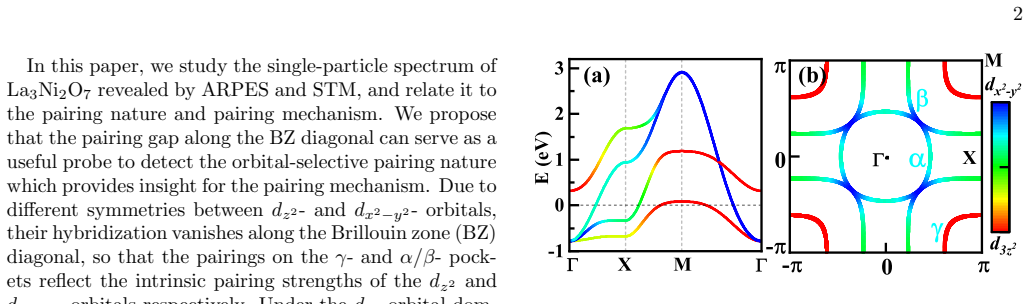
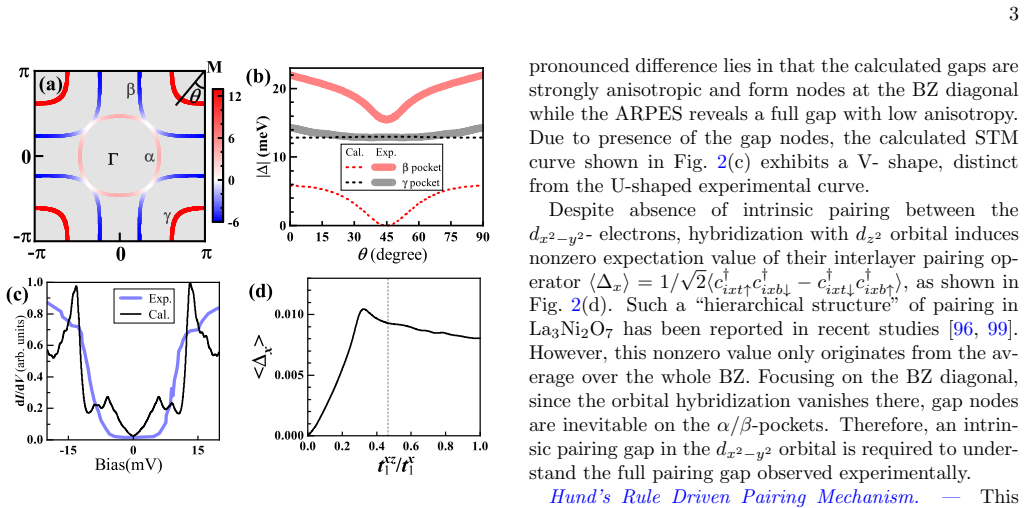
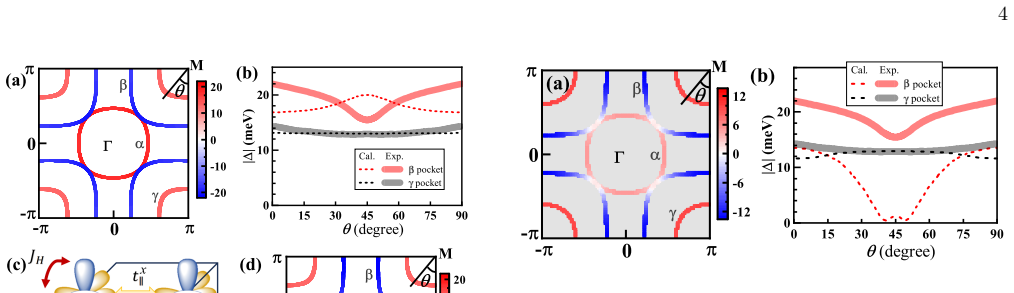
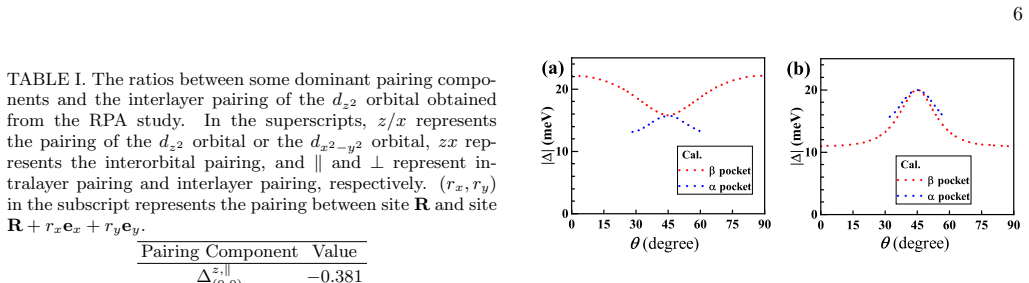
Symmetry analysis shows orbital hybridization vanishes along the BZ diagonal, so the pairing gaps on the gamma pocket and on the alpha/beta pockets separately measure d_z2 and d_x2-y2 orbital pairing strengths. Under d_z2-dominated pairing driven by orbital hybridization, nodes appear on the alpha and beta pockets, conflicting with the full gap from ARPES and STM. The Hund's rule mechanism instead yields a full gap consistent with experiment, establishing d_x2-y2 dominance and Hund's rule as the operative pairing mechanism in La3Ni2O7.
What carries the argument
The symmetry-enforced vanishing of orbital hybridization along the Brillouin zone diagonal, which isolates the d_x2-y2 pairing contribution on the alpha and beta pockets.
If this is right
- d_z2-orbital-dominated pairing driven by orbital hybridization is incompatible with the observed full gap.
- Weak-coupling theories that produce d_z2-dominated pairing are also ruled out by the same nodal conflict.
- The d_x2-y2 orbital supplies the dominant pairing strength under the Hund's rule mechanism.
- The Hund's rule picture produces a full gap with low anisotropy that matches both ARPES and STM spectra.
Where Pith is reading between the lines
- The same diagonal-gap diagnostic could be applied to other bilayer or multilayer nickelates to test whether Hund's rule remains dominant.
- Precise mapping of gap anisotropy exactly on the BZ diagonal in future experiments would provide a sharp test of the symmetry argument.
- Theoretical work on strong-coupling models should prioritize Hund's coupling over hybridization channels when modeling bilayer nickelate superconductivity.
Load-bearing premise
Orbital hybridization vanishes along the Brillouin zone diagonal so that gaps on the gamma pocket and on the alpha/beta pockets independently reflect d_z2 and d_x2-y2 pairing strengths.
What would settle it
Observation of nodes or near-nodes on the alpha and beta pockets along the BZ diagonal in higher-resolution ARPES or STM would falsify the conclusion that Hund's rule drives the pairing.
Figures
read the original abstract
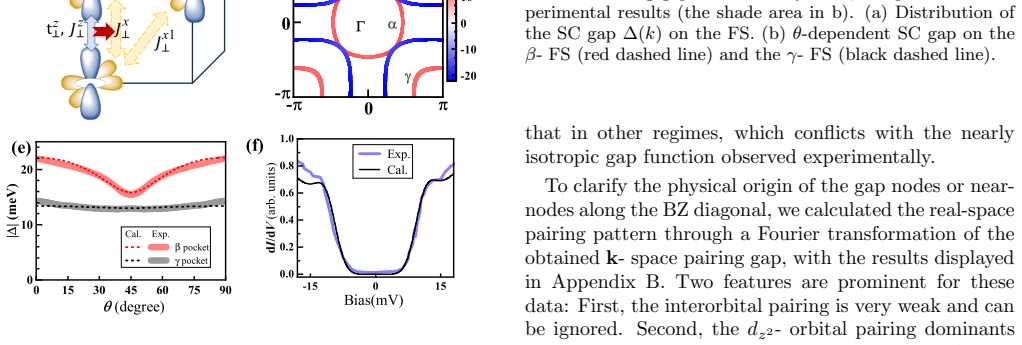
The pairing mechanism of the bilayer nickelates La$_3$Ni$_2$O$_7$ remains a hotly-debated open question. Existing strong-coupling theories are divided into class favoring intralayer d-wave pairing and that favoring interlayer s-wave pairing, with the latter further divided into $d_{z^2}$ orbital dominated mechanism driven by orbital hybridization and $d_{x^2-y^2}$ orbital dominated mechanism driven by Hund's rule. Recent angle-resolved-photoemission-spectrum (ARPES) and scanning-tunneling-microscope (STM) combinedly reveal a nodeless full pairing gap with low anisotropy, supporting the s-wave pairing. Here we propose that the pairing gap along the Brillouin zone (BZ) diagonal can serve as a useful probe of pairing mechanism. Symmetry analysis suggests that orbital hybridization vanishes along the BZ diagonal, rendering that the pairing gaps on the $\gamma$- and $\alpha/\beta$- pockets reflect the $d_{z^2}$- and $d_{x^2-y^2}$- orbital pairing strength respectively. Under the $d_{z^2}$ orbital dominated pairing mechanism driven by orbital hybridization, gap nodes are inevitable on the $\alpha$- and $\beta$- pockets along the BZ diagonal, which conflicts with the full gap revealed by ARPES and the U-shaped dI/dV curve observed by STM. The Hund's rule driven pairing mechanism instead leads to a full pairing gap, which well fits the ARPES and STM results. Furthermore, through a random-phase-approximation based calculation, we show that the weak-coupling theory, which tends to yield a $d_{z^2}$-orbital dominated pairing, also leads to nodes or near-nodes on the $\alpha$- and $\beta$- pockets along the BZ diagonal, conflicting with experiments. This analysis clarifies the dominant role of $d_{x^2-y^2}$ orbital in the pairing and establishes the Hund's rule driven pairing mechanism as the most relevant one in La$_3$Ni$_2$O$_7$.
Editorial analysis
A structured set of objections, weighed in public.
Referee Report
Summary. The manuscript claims that the nodeless full gap observed by ARPES and STM in La3Ni2O7 can distinguish pairing mechanisms. Symmetry analysis is used to argue that orbital hybridization vanishes exactly along the BZ diagonal, so the γ-pocket gap reflects only d_z² pairing strength while α/β-pocket gaps reflect only d_x²-y² strength. This implies that hybridization-driven d_z²-dominated pairing must produce nodes on α/β pockets (conflicting with experiment), whereas Hund's-rule-driven d_x²-y² pairing produces a full gap. An RPA calculation is invoked to show that weak-coupling theories (which favor d_z²) also yield nodes or near-nodes on those pockets.
Significance. If the orbital-mapping argument is rigorous, the work supplies a symmetry-based diagnostic that favors the Hund's-rule mechanism and the dominant role of the d_x²-y² orbital, helping to adjudicate between competing strong-coupling scenarios for bilayer nickelates and linking directly to recent spectroscopic data.
major comments (2)
- [symmetry analysis section / abstract] The symmetry argument that orbital hybridization vanishes along the BZ diagonal (abstract and the section presenting the symmetry analysis) is load-bearing for the central claim that γ-pocket gap maps exclusively to d_z² strength and α/β gaps map exclusively to d_x²-y² strength. The manuscript must supply the explicit hybridization matrix element (or the symmetry operation that forces it to zero) and confirm that no other terms in the bilayer Hamiltonian introduce mixing along that line; otherwise the node-inevitability distinction between mechanisms does not hold.
- [RPA calculation section] RPA calculation section: the claim that weak-coupling theory produces nodes or near-nodes on the α- and β-pockets along the BZ diagonal depends on the specific interaction parameters, band structure, and gap-function solution. These details (including the form of the pairing interaction and the numerical method used to extract the gap) must be stated explicitly so that the node finding can be reproduced and its robustness assessed.
minor comments (2)
- The abstract states that the Hund's-rule mechanism 'well fits' the ARPES and STM results; the manuscript should quantify the anisotropy or provide a direct comparison plot of the predicted gap function versus the experimental data points.
- Notation for the Fermi pockets (γ, α, β) and orbitals should be defined at first use with a reference to the band-structure figure or table.
Simulated Author's Rebuttal
We are grateful to the referee for the thorough review and insightful comments. The suggestions for greater explicitness in the symmetry analysis and RPA sections are constructive, and we will revise the manuscript to incorporate the requested details while preserving the central claims.
read point-by-point responses
-
Referee: [symmetry analysis section / abstract] The symmetry argument that orbital hybridization vanishes along the BZ diagonal (abstract and the section presenting the symmetry analysis) is load-bearing for the central claim that γ-pocket gap maps exclusively to d_z^{2} strength and α/β gaps map exclusively to d_x^{2}-y^{2} strength. The manuscript must supply the explicit hybridization matrix element (or the symmetry operation that forces it to zero) and confirm that no other terms in the bilayer Hamiltonian introduce mixing along that line; otherwise the node-inevitability distinction between mechanisms does not hold.
Authors: We agree that the symmetry argument benefits from greater explicitness. In the revised manuscript we will present the explicit hybridization matrix element between the d_{z^{2}} and d_{x^{2}-y^{2}} orbitals in the bilayer Hamiltonian and demonstrate, via the relevant symmetry operation (mirror symmetry across the diagonal or C_{4} rotation combined with layer exchange), that this element is identically zero along the BZ diagonal. We will further confirm that no additional terms in the Hamiltonian produce mixing along this line. revision: yes
-
Referee: [RPA calculation section] RPA calculation section: the claim that weak-coupling theory produces nodes or near-nodes on the α- and β-pockets along the BZ diagonal depends on the specific interaction parameters, band structure, and gap-function solution. These details (including the form of the pairing interaction and the numerical method used to extract the gap) must be stated explicitly so that the node finding can be reproduced and its robustness assessed.
Authors: We appreciate the request for reproducibility. The revised manuscript will explicitly tabulate the interaction parameters (U, J_H, and inter-orbital V) of the multi-orbital Hubbard-Hund model, the tight-binding parameters defining the band structure, the momentum-space form of the RPA pairing interaction, and the numerical procedure (linearized gap equation solved as an eigenvalue problem on a discretized Brillouin-zone grid). We will also note the robustness of the nodal structure under modest parameter variations. revision: yes
Circularity Check
No significant circularity; derivation relies on independent symmetry analysis and external experiments
full rationale
The paper's key step is a symmetry analysis asserting that orbital hybridization vanishes along the BZ diagonal, allowing gaps on γ and α/β pockets to map to d_z² and d_x²-y² pairing strengths respectively. This is presented as a standalone symmetry fact, not derived from or equivalent to the target pairing mechanism conclusion. The Hund's-rule mechanism is then shown to produce a full gap consistent with independent ARPES and STM data, while the hybridization mechanism and RPA weak-coupling calculation are shown to produce nodes. No self-citations, self-definitional mappings, fitted inputs renamed as predictions, or ansatz smuggling appear in the text. The derivation chain is self-contained against external benchmarks.
Axiom & Free-Parameter Ledger
axioms (1)
- domain assumption Orbital hybridization vanishes along the Brillouin zone diagonal due to symmetry
Reference graph
Works this paper leans on
-
[1]
H. Sun, M. Huo, X. Hu, J. Li, Z. Liu, Y. Han, L. Tang, Z. Mao, P. Yang, B. Wang, J. Cheng, D.-X. Yao, G.-M. Zhang, and M. Wang, Nature621, 493 (2023)
2023
-
[2]
Zhang, D
Y. Zhang, D. Su, Y. Huang, Z. Shan, H. Sun, M. Huo, K. Ye, J. Zhang, Z. Yang, Y. Xu, Y. Su, R. Li, M. Smid- man, M. Wang, L. Jiao, and H. Yuan, Nat. Phys.20, 1269 (2024)
2024
-
[3]
Hou, P.-T
J. Hou, P.-T. Yang, Z.-Y. Liu, J.-Y. Li, P.-F. Shan, L. Ma, G. Wang, N.-N. Wang, H.-Z. Guo, J.-P. Sun, Y. Uwatoko, M. Wang, G.-M. Zhang, B.-S. Wang, and J.-G. Cheng, Chin. Phys. Lett.40, 117302 (2023)
2023
-
[4]
G. Wang, N. N. Wang, X. L. Shen, J. Hou, L. Ma, L. F. Shi, Z. A. Ren, Y. D. Gu, H. M. Ma, P. T. Yang, Z. Y. Liu, H. Z. Guo, J. P. Sun, G. M. Zhang, S. Calder, J.-Q. Yan, B. S. Wang, Y. Uwatoko, and J.-G. Cheng, Phys. Rev. X14, 011040 (2024)
2024
-
[5]
Y. Zhou, J. Guo, S. Cai, H. Sun, C. Li, J. Zhao, P. Wang, J. Han, X. Chen, Y. Chen, Q. Wu, Y. Ding, T. Xiang, H.-k. Mao, and L. Sun, Matter and Radiation at Extremes10(2025)
2025
- [6]
- [7]
-
[8]
N. Wang, G. Wang, X. Shen, J. Hou, J. Luo, X. Ma, H. Yang, L. Shi, J. Dou, J. Feng, J. Yang, Y. Shi, Z. Ren, H. Ma, P. Yang, Z. Liu, Y. Liu, H. Zhang, X. Dong, Y. Wang, K. Jiang, J. Hu, S. Calder, J. Yan, J. Sun, B. Wang, R. Zhou, Y. Uwatoko, and J. Cheng, Nature 7 634, 579 (2024)
2024
-
[9]
Z. Dong, G. Wang, N. Wang, W.-H. Dong, L. Gu, Y. Xu, J. Cheng, Z. Chen, and Y. Wang, Nature Materials24, 1927 (2025)
1927
-
[10]
L. Liu, J. Guo, D. Hu, G. Yan, Y. Chen, L. Yu, M. Wang, X.-D. Liu, and X. Huang, Phys. Rev. Lett. 135, 096001 (2025)
2025
- [11]
-
[12]
F. Li, Z. Xing, D. Peng, J. Dou, N. Guo, L. Ma, Y. Zhang, L. Wang, J. Luo, J. Yang, J. Zhang, T. Chang, Y.-S. Chen, W. Cai, J. Cheng, Y. Wang, Z. Zeng, Q. Zeng, R. Zhou, Q. Zeng, X. Tao, and J. Zhang, Nature649, 871 (2026)
2026
- [13]
-
[14]
Puphal, P
P. Puphal, P. Reiss, N. Enderlein, Y.-M. Wu, G. Khal- iullin, V. Sundaramurthy, T. Priessnitz, M. Knauft, A. Suthar, L. Richter, M. Isobe, P. A. van Aken, H. Tak- agi, B. Keimer, Y. E. Suyolcu, B. Wehinger, P. Hans- mann, and M. Hepting, Phys. Rev. Lett.133, 146002 (2024)
2024
-
[15]
X. Chen, J. Zhang, A. S. Thind, S. Sharma, H. LaBol- lita, G. Peterson, H. Zheng, D. P. Phelan, A. S. Botana, R. F. Klie, and J. F. Mitchell, J. Am. Chem. Soc.146, 3640 (2024)
2024
- [16]
-
[17]
N. Yuan, A. Elghandour, J. Arneth, K. Dey, and R. Klingeler, J. Cryst. Growth627, 127511 (2024)
2024
-
[18]
Li, C.-Q
J. Li, C.-Q. Chen, C. Huang, Y. Han, M. Huo, X. Huang, P. Ma, Z. Qiu, J. Chen, X. Hu, L. Chen, T. Xie, B. Shen, H. Sun, D. Yao, and M. Wang, Sci. China Phys. Mech. Astron.67, 117403 (2024)
2024
-
[19]
F. Li, N. Guo, Q. Zheng, Y. Shen, S. Wang, Q. Cui, C. Liu, S. Wang, X. Tao, G.-M. Zhang, and J. Zhang, Phys. Rev. Mater.8, 053401 (2024)
2024
-
[20]
E. K. Ko, Y. Yu, Y. Liu, L. Bhatt, J. Li, V. Thampy, C.-T. Kuo, B. Y. Wang, Y. Lee, K. Lee, J.-S. Lee, B. H. Goodge, D. A. Muller, and H. Y. Hwang, Nature638, 935 (2025)
2025
-
[21]
G. Zhou, W. Lv, H. Wang, Z. Nie, Y. Chen, Y. Li, H. Huang, W. Chen, Y. Sun, Q.-K. Xue,et al., Nature 640, 641 (2025)
2025
-
[22]
Y. Liu, E. K. Ko, Y. Tarn, L. Bhatt, J. Li, V. Thampy, B. H. Goodge, D. A. Muller, S. Raghu, Y. Yu, and H. Y. Hwang, Nature Materials , 1 (2025)
2025
-
[23]
G. Wang, N. Wang, T. Lu, S. Calder, J. Yan, L. Shi, J. Hou, L. Ma, L. Zhang, J. Sun, B. Wang, S. Meng, M. Liu, and J. Cheng, npj Quantum Materials10, 1 (2025)
2025
- [24]
-
[25]
L. Wang, Y. Li, S. Xie, F. Liu, H. Sun, C. Huang, Y. Gao, T. Nakagawa, B. Fu, B. Dong, Z. Cao, R. Yu, S. I. Kawaguchi, H. Kadobayashi, M. Wang, C. Jin, H. kwang Mao, and H. Liu, Journal of the American Chemical Society146, 7506 (2024)
2024
-
[26]
Z. Huo, Z. Luo, P. Zhang, A. Yang, Z. Liu, X. Tao, Z. Zhang, S. Guo, Q. Jiang, W. Chen, D.-X. Yao, D. Duan, and T. Cui, Science China Physics, Mechanics & Astronomy68, 237411 (2025)
2025
-
[27]
Geisler, J
B. Geisler, J. J. Hamlin, G. R. Stewart, R. G. Hennig, and P. Hirschfeld, npj Quantum Materials9, 38 (2024)
2024
- [28]
-
[29]
X.-W. Yi, W. Li, J.-Y. You, B. Gu, and G. Su, Phys. Rev. B112, L140504 (2025)
2025
-
[30]
Y. Li, X. Du, Y. Cao, C. Pei, M. Zhang, W. Zhao, K. Zhai, R. Xu, Z. Liu, Z. Li, J. Zhao, G. Li, Y. Qi, H. Guo, Y. Chen, and L. Yang, Chin. Phys. Lett.41, 087402 (2024)
2024
-
[31]
J. Yang, H. Sun, X. Hu, Y. Xie, T. Miao, H. Luo, H. Chen, B. Liang, W. Zhu, G. Qu, C.-Q. Chen, M. Huo, Y. Huang, S. Zhang, F. Zhang, F. Yang, Z. Wang, Q. Peng, H. Mao, G. Liu, Z. Xu, T. Qian, D.-X. Yao, M. Wang, L. Zhao, and X. J. Zhou, Nat. Commun.15, 4373 (2024)
2024
- [32]
-
[33]
S. Fan, Z. Luo, M. Huo, Z. Wang, H. Li, H. Yang, M. Wang, D.-X. Yao, and H.-H. Wen, Phys. Rev. B 110, 134520 (2024)
2024
-
[34]
X. Chen, J. Choi, Z. Jiang, J. Mei, K. Jiang, J. Li, S. Agrestini, M. Garcia-Fernandez, X. Huang, H. Sun, D. Shen, M. Wang, J. Hu, Y. Lu, K.-J. Zhou, and D. Feng, Nature Communications15, 9597 (2024)
2024
-
[35]
Kakoi, T
M. Kakoi, T. Oi, Y. Ohshita, M. Yashima, K. Kuroki, T. Kato, H. Takahashi, S. Ishiwata, Y. Adachi, N. Hatada, T. Uda, and H. Mukuda, J. Phys. Soc. Jpn.93, 053702 (2024)
2024
-
[36]
Y. Li, Y. Cao, L. Liu, P. Peng, H. Lin, C. Pei, M. Zhang, H. Wu, X. Du, W. Zhao, K. Zhai, X. Zhang, J. Zhao, M. Lin, P. Tan, Y. Qi, G. Li, H. Guo, L. Yang, and L. Yang, Sci. Bull.70, 180 (2025)
2025
-
[37]
Z. Liu, M. Huo, J. Li, Q. Li, Y. Liu, Y. Dai, X. Zhou, J. Hao, Y. Lu, M. Wang, and H.-H. Wen, Nat. Com- mun.15, 7570 (2024)
2024
-
[38]
Z. Luo, X. Hu, M. Wang, W. W´ u, and D.-X. Yao, Phys. Rev. Lett.131, 126001 (2023)
2023
-
[39]
Ouyang, J.-M
Z. Ouyang, J.-M. Wang, J.-X. Wang, R.-Q. He, L. Huang, and Z.-Y. Lu, Phys. Rev. B109, 115114 (2024)
2024
-
[40]
Zhang, L.-F
Y. Zhang, L.-F. Lin, A. Moreo, and E. Dagotto, Phys. Rev. B108, L180510 (2023)
2023
-
[41]
X. Sui, X. Han, H. Jin, X. Chen, L. Qiao, X. Shao, and B. Huang, Phys. Rev. B109, 205156 (2024)
2024
-
[42]
Geisler, L
B. Geisler, L. Fanfarillo, J. J. Hamlin, G. R. Stewart, R. G. Hennig, and P. J. Hirschfeld, npj Quantum Ma- terials9, 89 (2024)
2024
-
[43]
Ouyang, M
Z. Ouyang, M. Gao, and Z.-Y. Lu, npj Quantum Ma- terials9, 80 (2024)
2024
-
[44]
X. Chen, P. Jiang, J. Li, Z. Zhong, and Y. Lu, Phys. Rev. B111, 014515 (2025)
2025
- [45]
-
[46]
L. C. Rhodes and P. Wahl, Phys. Rev. Mater.8, 044801 (2024)
2024
- [47]
- [48]
-
[49]
P. Li, G. Zhou, W. Lv, Y. Li, C. Yue, H. Huang, L. Xu, J. Shen, Y. Miao, W. Song, Z. Nie, Y. Chen, H. Wang, W. Chen, Y. Huang, Z.-H. Chen, T. Qian, J. Lin, J. He, Y.-J. Sun, Z. Chen, and Q.-K. Xue, National Science Review12, nwaf205 (2025)
2025
- [50]
- [51]
-
[52]
Yue, J.-J
C. Yue, J.-J. Miao, H. Huang, Y. Hua, P. Li, Y. Li, G. Zhou, W. Lv, Q. Yang, F. Yang, H. Sun, Y.-J. Sun, J. Lin, Q.-K. Xue, Z. Chen, and W.-Q. Chen, National Science Review12, nwaf253 (2025)
2025
-
[53]
Shao, Y.-B
Z.-Y. Shao, Y.-B. Liu, M. Liu, and F. Yang, Phys. Rev. B112, 024506 (2025)
2025
-
[54]
X. Hu, W. Qiu, C.-Q. Chen, Z. Luo, and D.-X. Yao, Communications Physics8, 506 (2025)
2025
-
[55]
K. Ushio, S. Kamiyama, Y. Hoshi, R. Mizuno, M. Ochi, K. Kuroki, and H. Sakakibara, arXiv:2506.20497 (2025)
work page internal anchor Pith review Pith/arXiv arXiv 2025
-
[56]
Strain-Engineered Electronic Structure and Superconductivity in La$_3$Ni$_2$O$_7$ Thin Films
Y.-H. Cao, K.-Y. Jiang, H.-Y. Lu, D. Wang, and Q.-H. Wang, arxiv:2507.13694 (2025)
work page internal anchor Pith review Pith/arXiv arXiv 2025
- [57]
-
[58]
Zhang, L.-F
Y. Zhang, L.-F. Lin, A. Moreo, S. Okamoto, T. A. Maier, and E. Dagotto, Phys. Rev. B113, L140505 (2026)
2026
-
[59]
B. Geisler, J. J. Hamlin, G. R. Stewart, R. G. Hennig, and P. Hirschfeld, arXiv:2503.10902 (2025)
- [60]
- [61]
- [62]
- [63]
-
[64]
Y. Wang, Y. Zhang, and K. Jiang, Chinese Physics B 34, 047105 (2025)
2025
-
[65]
K. Chen, X. Liu, Y. Wang, J. Han, Z. Zhu, J. Jiao, C. Jiang, Y. Guo, C. Zheng, and L. Shu, Phys. Rev. Res.7, L032014 (2025)
2025
- [66]
-
[67]
H.-X. Wang, H. Oh, T. Helbig, B. Y. Wang, J. Li, Y. Yu, H. Y. Hwang, H.-C. Jiang, Y.-M. Wu, and S. Raghu, arXiv:2509.25344 (2025)
work page internal anchor Pith review Pith/arXiv arXiv 2025
- [68]
-
[69]
J. Shen, G. Zhou, Y. Miao, P. Li, Y. Zhipeng Ou, Chen, Z. Wang, R. Luan, H. Sun, Z. Feng, X. Yong, Y. Li, L. Xu, W. Lv, Z. Nie, H. Wang, H. Huang, Y.-J. Sun, Q.-K. Xue, J. He, and Z. Chen, Science , 10.1126/sci- ence.adw8329 (2026)
-
[70]
S. Fan, M. Ou, M. Scholten, Q. Li, Z. Shang, Y. Wang, J. Xu, H. Yang, I. M. Eremin, and H.-H. Wen, arXiv:2506.01788 (2025)
work page internal anchor Pith review Pith/arXiv arXiv 2025
-
[71]
X. Wang, Y. Chen, C. Ding, L. Xu, J.-J. Miao, G. Zhou, Z. Chen, Y.-J. Sun, J.-F. Jia, and Q.-K. Xue, arXiv:2605.14806 (2026)
work page internal anchor Pith review Pith/arXiv arXiv 2026
-
[72]
Observation of flat-bottom U-shaped energy gap in high-Tc nickelate (La,Pr)3Ni2O7 thin films
Z. Liang, T. Wei, W. Ren, H. Ji, Z. Xie, Y. Liu, Z. Wang, and J. Wang, arXiv:2605.15703 (2026)
work page internal anchor Pith review Pith/arXiv arXiv 2026
-
[73]
Q. Li, J. Sun, S. Boetzel, M. Ou, Z.-N. Xiang, F. Lecher- mann, B. Wang, Y. Wang, Y.-J. Zhang, J. Cheng, I. M. Eremin, and H.-H. Wen, arxiv:2507.10399 (2025)
work page internal anchor Pith review Pith/arXiv arXiv 2025
- [74]
-
[75]
G. Zhou, H. Wang, H. Huang, Y. Chen, F. Peng, W. Lv, Z. Nie, W. Wang, J.-F. Jia, Q.-K. Xue, and Z. Chen, National Science Review13, nwag151 (2026)
2026
- [76]
- [77]
-
[78]
Liu, J.-W
Y.-B. Liu, J.-W. Mei, F. Ye, W.-Q. Chen, and F. Yang, Phys. Rev. Lett.131, 236002 (2023)
2023
-
[79]
Zhang, L.-F
Y. Zhang, L.-F. Lin, A. Moreo, T. A. Maier, and E. Dagotto, Nat. Commun.15, 2470 (2024)
2024
-
[80]
Zhang, L.-F
Y. Zhang, L.-F. Lin, A. Moreo, T. A. Maier, and E. Dagotto, Phys. Rev. B108, 165141 (2023)
2023
discussion (0)
Sign in with ORCID, Apple, or X to comment. Anyone can read and Pith papers without signing in.