REVIEW 4 major objections 5 minor 6 references
Cognitive World Model for Progressive BDI/E Trajectory Evaluation of Conversational Agents
T0 review · 4 major / 5 minor · reviewed 2026-08-03 · deepseek-v4-flash
Pith's one-line read Conversational agents should be judged by the cognitive trajectories they produce in users, not by final replies.
desk verdict Solid new integration of BDI/E state tracking with user simulation; the process-level evaluation machinery is real, but the headline agent-ranking and fidelity claims outrun the evidence because the simulator is judging itself. read the letter →
The pith
A machine-rendered reading of the paper's core claim, the machinery that carries it, and where it could break.
The reading
What carries the argument
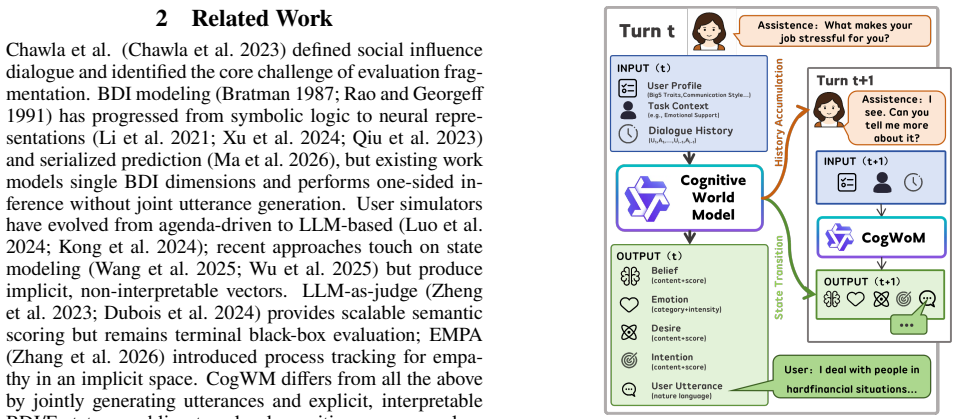
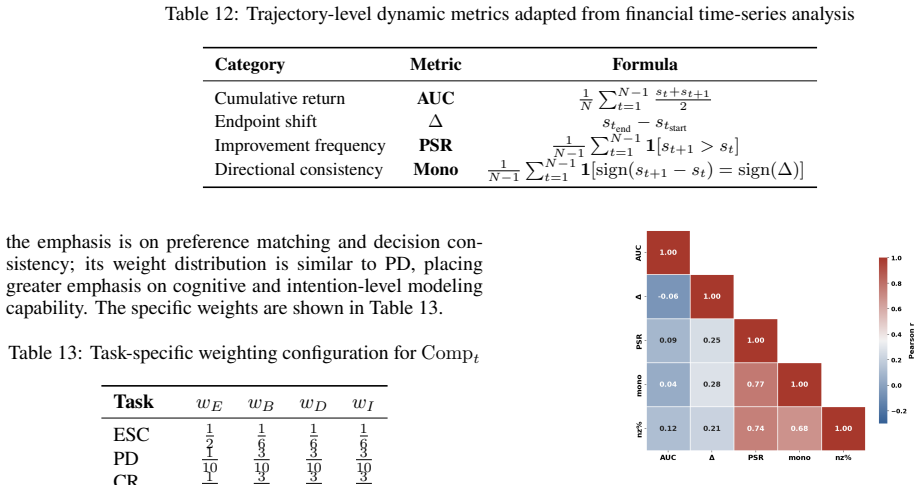
The load-bearing mechanism is the joint conditional model p(St, Ut | profile, context, history, St−1), which forces the model to generate the user's BDI/E state and utterance from shared representations; the ablations attribute cognitive tracking to this coupling rather than to model scale. Training is supported by the Summarize-and-Allocate (SaA) annotation pipeline, which first extracts global BDI/E items from a whole dialogue and then allocates them to individual turns with evidence links, producing 150,454 turn-level samples. Evaluation rests on the task-weighted per-turn composite score Compt and the Composite Trajectory Score CTS = 0.40·AUC + 0.30·PSR + 0.30·Δ, three weakly correlated
What would settle it
Run CogWM alongside real users in the same four tasks, collect per-turn self-reports of belief, desire, intention, and emotion, and compare the predicted trajectories to those self-reports; if the correlation is weak, or if agents ranked highest by CTS are not the ones users judge as most influential, the central claim fails.
Extended reading notes
Core claim
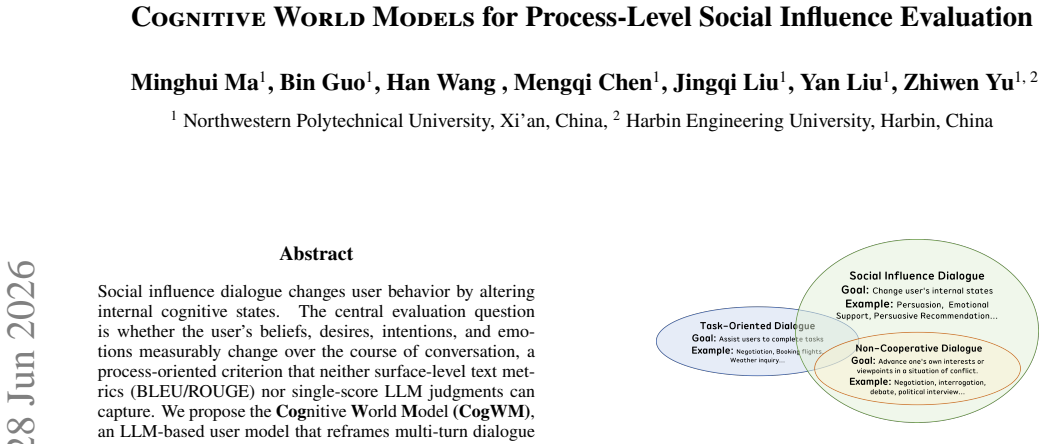
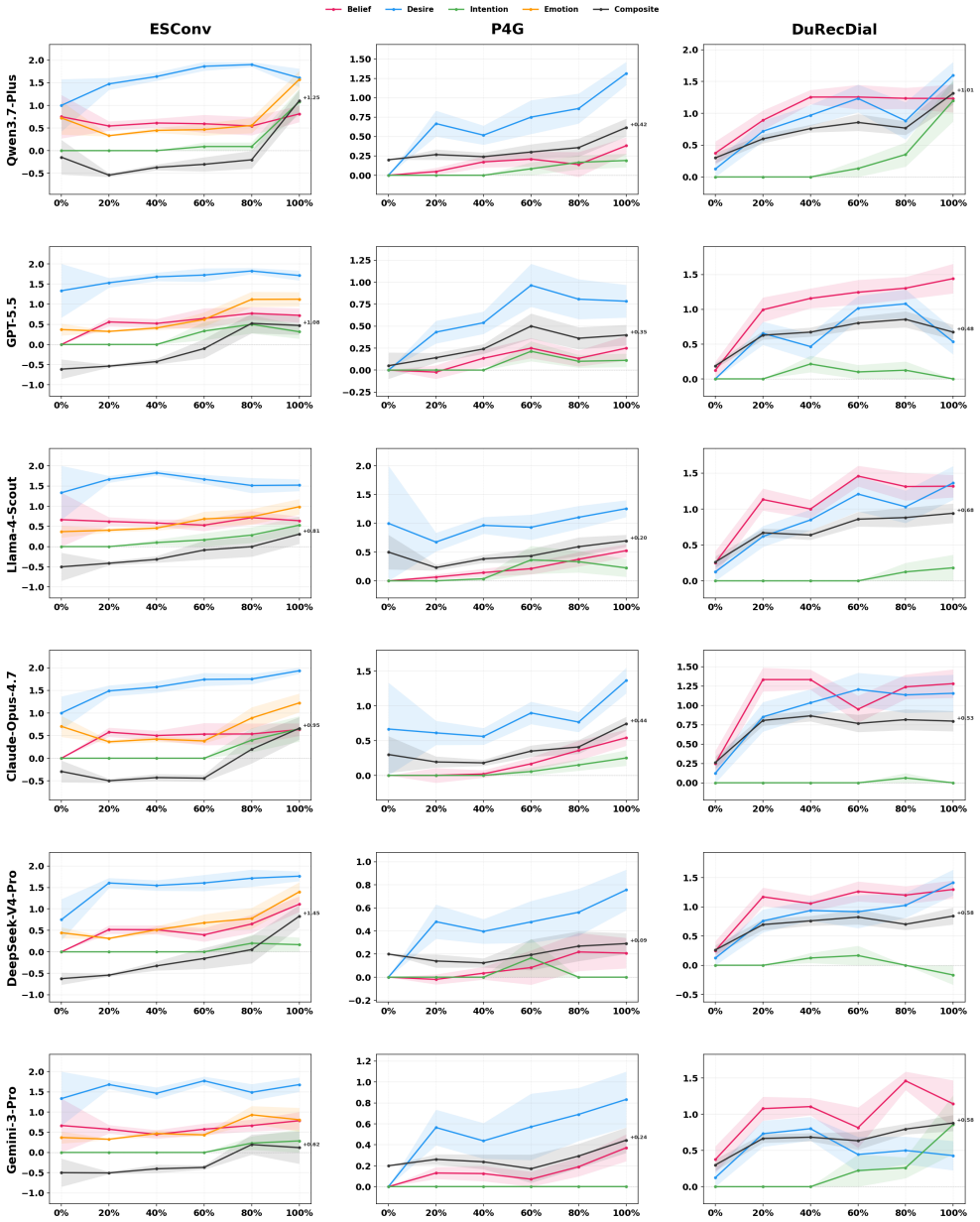
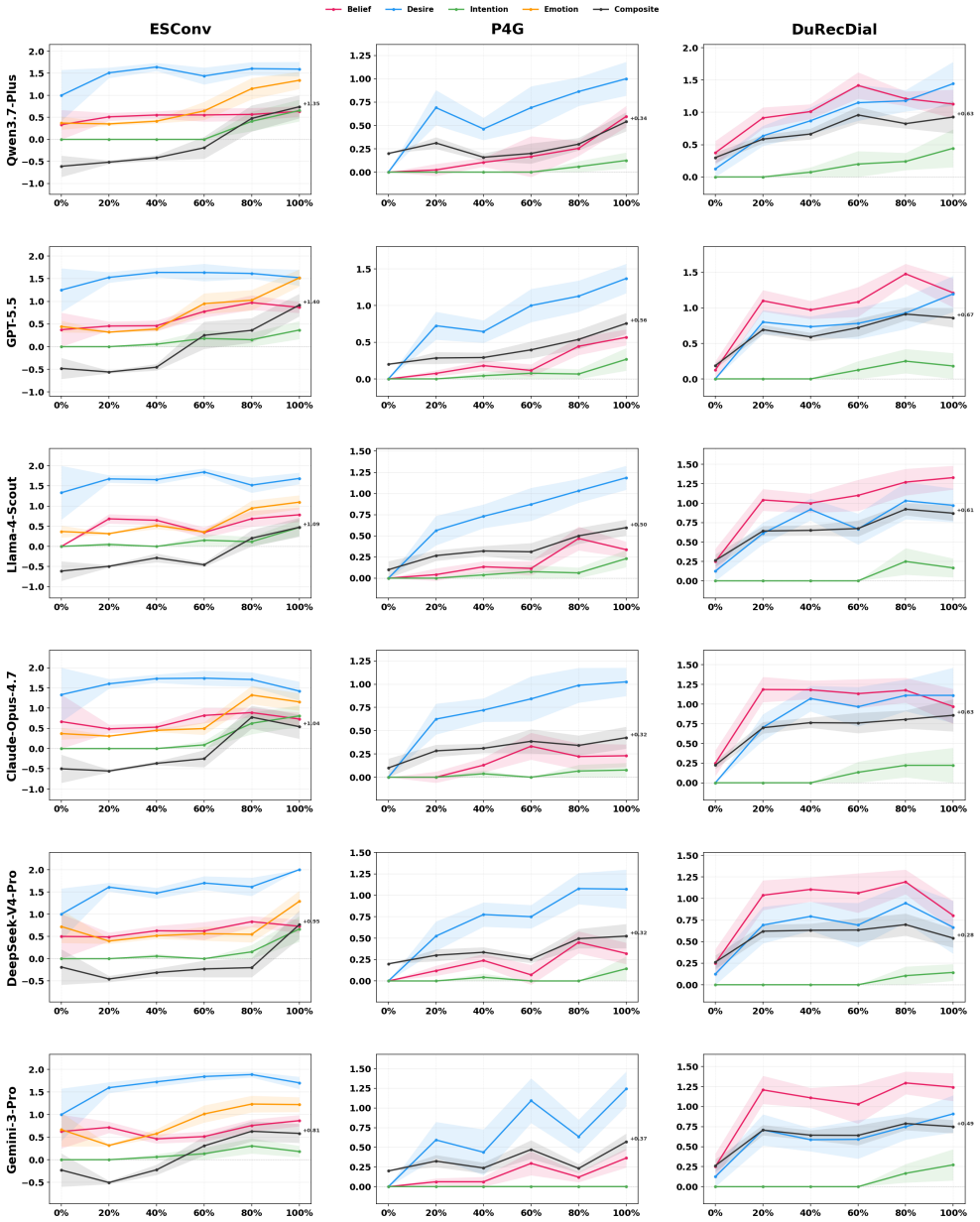
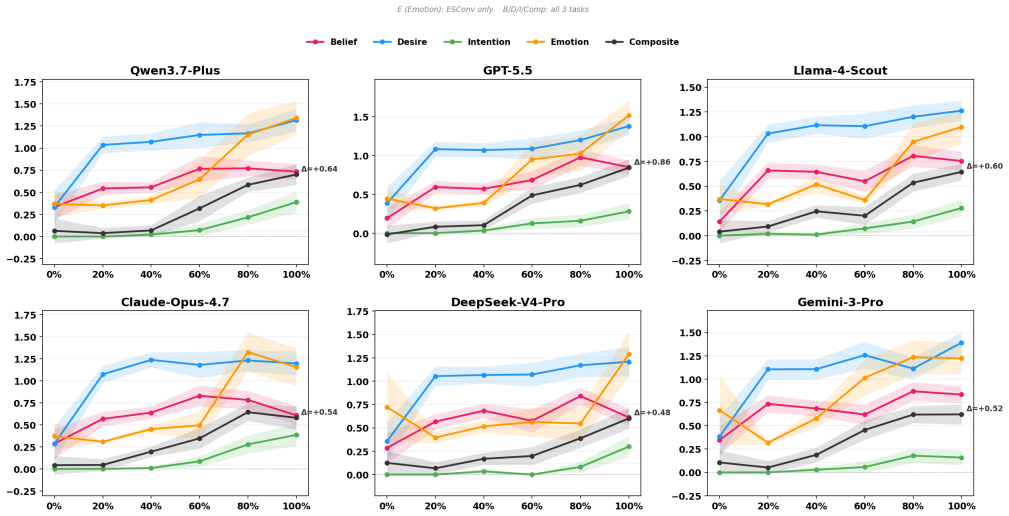
CogWM's central claim is that a user's internal state can be made explicit and used as the unit of dialogue evaluation. At each turn the model outputs an emotion label with intensity, plus beliefs, desires, and intentions scored against task-specific criteria, together with the user's natural-language response. The paper argues that the coupling of state prediction and utterance generation is what makes the model work: an utterance-only baseline fails to recover cognitive states, while joint training reaches high accuracy without needing a larger backbone. In 3,600 agent-interaction trials, the Composite Trajectory Score—combining AUC, positive-step ratio, and net change over a task-weighted
Load-bearing premise
The load-bearing premise is that the LLM-generated BDI/E states, validated only against human annotators, faithfully represent real users' internal cognitive states—otherwise the fidelity numbers and the agent rankings produced by CogWM measure the annotation model, not user psychology.
Editorial extensions
If this is right
- If CogWM is right, dialogue evaluation should report the shape of the user's cognitive trajectory, not just a final score; a single response can look good while leaving the user unchanged.
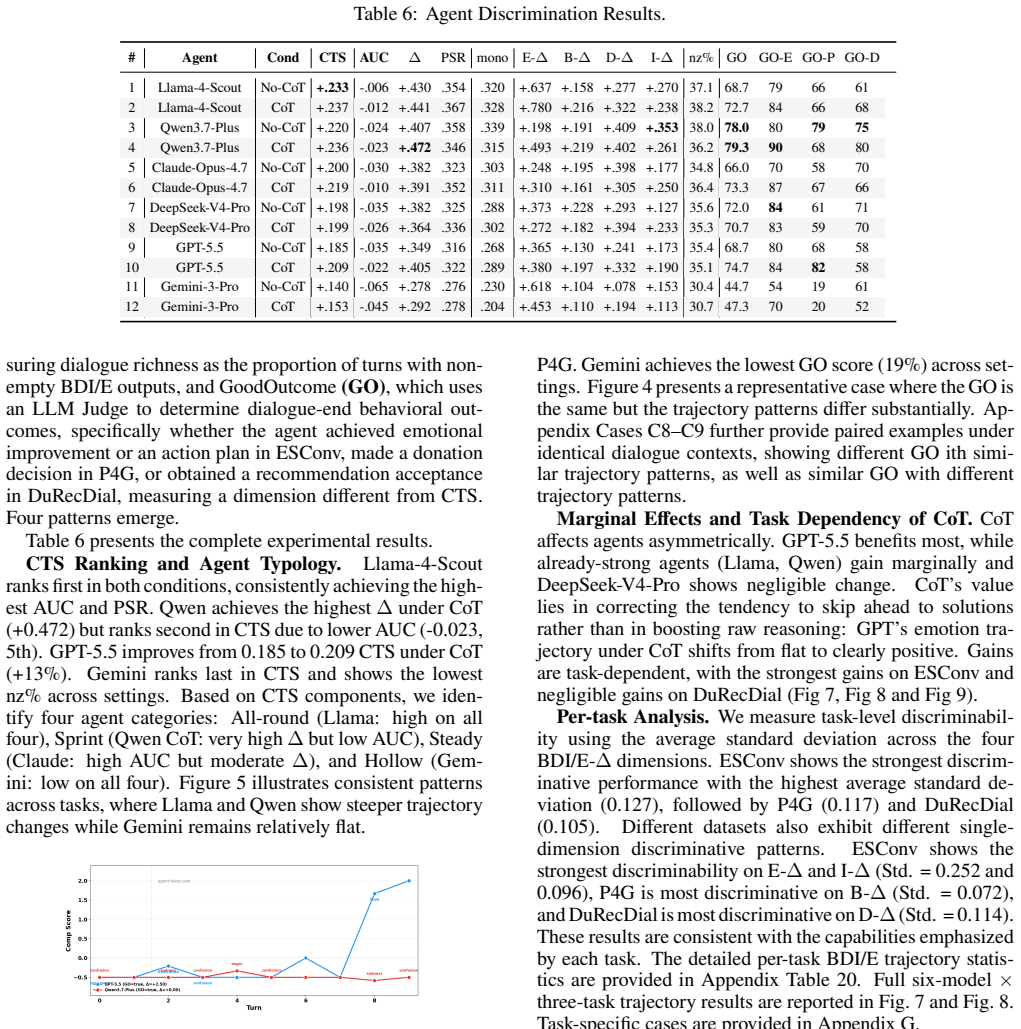
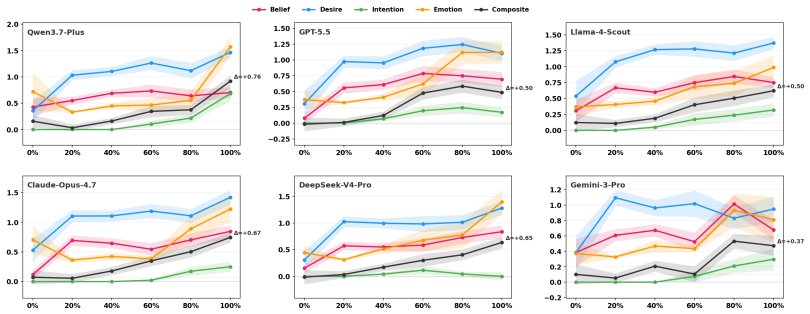
- Agents can be typed by their trajectory profile (all-round, sprint, steady, hollow), so diagnosis and improvement can target specific weaknesses in how the agent changes user states.
- Cognitive improvement and behavioral outcome are complementary: an agent can shift beliefs without producing a donation or commitment, and a polite closing phrase can produce a false-positive terminal outcome.
- Because joint training rather than scale drives cognitive tracking, the same approach can be transferred to smaller models and run as a low-cost automatic evaluation.
- Evaluation suites for social-influence dialogue should report both process-level (CTS) and outcome-level (GO) metrics, since they diverge in ways either alone misses.
Reading between the lines
- Beyond the paper: the same trajectory machinery could be used as a training signal—for instance, rewarding agents for monotone BDI/E improvement—so the evaluator becomes part of an RL loop, a direction the paper mentions as future work.
- Beyond the paper: the explicit BDI/E representation could transfer to other influence settings such as medical consultations, tutoring, or negotiation, but the task-specific scoring rules would need to be re-derived per domain; a testable extension is whether trajectory rankings remain stable across domains.
- Beyond the paper: the agent rankings stand or fall with the fidelity of the LLM-generated BDI/E labels; a direct human validation comparing CogWM's predicted trajectories with real users' self-reported states would settle whether the rankings measure the annotation model or genuine user cognition.
- Beyond the paper: the CTS–GO divergence predicts that agents optimized purely for observable outcomes (donations, acceptances) may incur unmeasured emotional costs; a concrete test would compare agents trained on CTS versus GO in the same scenarios.
Editorial analysis
A structured set of objections, weighed in public.
Referee Report
Summary. The paper proposes CogWM, an LLM-based user simulator that jointly predicts turn-level BDI/E (belief, desire, intention, emotion) states and user utterances. It introduces a Summarize-and-Allocate (SaA) annotation pipeline that produces 150,454 turn-level samples over four datasets, a three-tier evaluation framework (turn-level fidelity, trajectory-level dynamics, task-level composite scores with CTS and GoodOutcome), and a fine-tuned Qwen3-14B model. The reported experiments show large gains over zero-shot API baselines in BDI/E prediction and response fidelity, and a 3,600-trial agent discrimination study that ranks six commercial LLM-based agents by their influence on CogWM-simulated users' cognitive trajectories. The central claim is that CogWM's explicit cognitive trajectories provide a valid, interpretable, process-level alternative to terminal dialogue evaluation.
Significance. The paper targets a real gap: social influence dialogue evaluation currently relies on terminal scores, and a turn-level cognitive-state trajectory would be a genuinely useful diagnostic tool. Strengths include the released code and models, the scale of the dataset (150K turn-level samples), the controlled ablation showing that joint state-utterance training provides a large improvement over utterance-only training, and the human validation of a sample of SaA annotations, which goes beyond purely LLM-generated labels. The proposed three-tier metric stack is well structured and decomposable. However, the central validity claim is not yet established: fidelity numbers are computed against labels produced by the same LLM-based annotation pipeline, and the agent ranking in §6.2 is generated by measuring changes in CogWM's own predicted states. The paper's own §8 acknowledges the LLM-only annotation limitation, but the evaluation circularity is load-bearing and requires additional external validation before the framework can be accepted as a valid measurement instrument.
major comments (4)
- [§6.2, Table 6] The agent discrimination experiment is circular with respect to the paper's central claim. CogWM is used both as the user simulator that generates every user utterance and as the measurement instrument that produces every BDI/E state in the trajectories; the resulting CTS ranking is then presented as evidence that CogWM 'enables progressive comparison of agents.' No human user interacts with the agents, no independently annotated cognitive states are collected, and the auxiliary outcome metric GO is an LLM judgment on the same simulated dialogues. The ranking (e.g., Llama-4-Scout first, Gemini-3-Pro last) could therefore reflect CogWM's inductive biases rather than real differences in social influence. This is not a fatal flaw in the modeling idea, but the claimed validity of the evaluation platform requires an external check. I would expect at least one of the following: (a) a human stu
- [§4.2, §F.1, Table 4] The fidelity results in Table 4 are computed against SaA-generated BDI/E labels, not against human ground truth. Human validation in §F.1 covers only 300 dialogues and reports global BDI recall 0.79, precision 0.77, and emotion Cohen's κ = 0.69; these are moderate and, more importantly, they validate global item extraction and single-turn emotion allocation, not multi-turn trajectory-level states. Therefore the headline numbers (E-Acc 77.6%, B-Sim 0.773, etc.) quantify agreement with the annotation pipeline, not with human cognition. The '2.1x over GPT-5.5' comparison is also not apples-to-apples: CogWM is fine-tuned in-domain on 150K samples, while GPT-5.5/DeepSeek-V4-Pro are evaluated zero-shot. A stronger baseline would be an LLM fine-tuned on the same data with the same output schema, or at least a few-shot setup. I recommend adding an independently human-annotated test set and repor
- [§5, Eq. (1); §D.2, Table 13] The primary composite score CTS is built on hand-set weights (0.40, 0.30, 0.30) and the task weights in Table 13 (w_E, w_B, w_D, w_I) are also manually chosen. The reported low redundancy of CTS components is based on correlations computed on CogWM's own 3,600 trajectories, not on any external or human-validated trajectories. Because the agent ranking in §6.2 is the main practical output, the sensitivity of the ranking to these weights is a load-bearing question. For example, the distinction between the 'Sprint' and 'All-round' categories depends on the relative weight of Δ versus AUC. I request a sensitivity analysis over reasonable weight ranges, or a principled derivation of the weights, to show that the qualitative agent ranking is robust.
- [§D.3, Appendix C9] The GoodOutcome metric is described as a dialogue-level behavioral outcome, but the paper's own case C9 demonstrates a structural false positive: a user's polite closing phrase 'It feels good. Thank you for your help' triggers the relaxed emotion-improved criterion and yields GO=true, even though the trajectory shows Δ = 0.00 and no action commitment. This is not merely an illustration of CTS–GO complementarity; it shows that the current GO criterion does not reliably measure behavioral outcome. Since GO is used to support the 'complementary perspectives' claim in §6.2, the operational definition of GO should be tightened and re-validated, or the result should be reframed as a known limitation of terminal LLM-judged outcomes rather than as an independent validation signal.
minor comments (5)
- [§4] The text says 'four public dialogue datasets' and then 'three social influence scenarios plus DailyDialog.' DailyDialog is not a social influence scenario; the phrasing should be adjusted to avoid overclaiming coverage.
- [Table 18, §F.6] CogWM-32B appears as a row with all dashes and the text says 'Results for 32B are pending.' In a final submission, either report the results or omit the row; as written it looks like incomplete data.
- [§F.4] There is a broken cross-reference: 'The complete breakdown by task is presented in §?? (Fig 7: 18 subplot trajectories...).' Please fix the reference.
- [Eq. (2), §C.1] Eq. (2) uses E_val_t as 'pure emotion valence (without intensity scaling),' while §C.1 defines a quantified emotion score e_t = v_e · s_e. Please clarify which quantity is used in the Comp_t definition, and whether intensity is dropped or folded into the weights.
- [Abstract] The abstract states 'trained on 150K user-turn samples with Qwen3-14B' but the contribution list also mentions an 8B/14B/32B comparison. Minor wording: specify that 14B is the primary model.
Circularity Check
CogWM's agent rankings are generated by the same model being validated; fidelity numbers are agreement with its own LLM annotation pipeline.
-
self definitional
[§1 (Introduction) and §6.2 (Agent Discrimination Experiment)]
"This dual output makes CogWM a unified evaluation platform: an SID agent under test is connected to CogWM, which simulates the user, and the resulting BDI/E trajectory quantifies the agent’s influence in SID. ... CogWM-14B (tp=0.3) serves as the user simulator. ... We evaluate agents using the three-tier framework defined in §D. The primary metric is CTS (§5)."
The agent ranking in §6.2 is computed entirely from CogWM's own turn-by-turn BDI/E predictions: the six agents interact with CogWM, and their cognitive influence is measured by CTS over CogWM-generated trajectories. No human user, independently annotated cognitive state, or externally observed behavioral outcome enters this evaluation. The conclusion that CogWM 'distinguishes six agents by cognitive influence' therefore reduces to properties of CogWM's simulator; the claim that these trajectories are valid measurements of social influence is defined as true by the framework rather than verified against external ground truth.
-
fitted input called prediction
[§4.2, §6.1, and §8 (SaA annotation, fidelity experiments, limitations)]
"From the SaA annotations we construct 150,454 turn-level training samples. ... CogWM achieves 77.6% emotion accuracy (2.1×over GPT-5.5). ... Current annotations are LLM-generated. Human validation shows BDI recall 0.79, precision 0.77, and emotion κ= 0.69, but subtle states such as implicit beliefs and unexpressed desires may be missed (§4.2)."
The headline BDI/E fidelity scores in Table 4 are computed against test labels produced by the same Summarize-and-Allocate LLM annotation pipeline that generated the training labels. The model is therefore optimized and evaluated against the same machine-generated target, and the reported 77.6% E-Acc and related metrics quantify fit to SaA, not independent verification of user cognition. The small human validation set (300 dialogues) has only moderate agreement and does not cover the multi-turn trajectory claims, so calling this 'cognitive state understanding' presents reproduction of the annotation model as prediction of real user cognition.
full rationale
The paper contains a genuine trained model and a train/test split, so it is not a closed-form tautology: CogWM can fail to reproduce SaA labels, and its utterance generation results are internally meaningful. However, the central validity claims are partially self-referential. First, the evaluation platform's core evidence is that CogWM ranks agents using CogWM's own predicted cognitive trajectories, with no external human or behavioral validation of those trajectories. Second, the fidelity numbers that establish 'cognitive state understanding' are measured against machine-generated annotations from the same pipeline used for training. The paper's §8 explicitly concedes that all annotations are LLM-generated and that extensive human validation remains future work. The self-citation to Ma et al. (2026) is present but not load-bearing for these conclusions. Overall, the score reflects partial circularity: the model's internal consistency is real, but its status as an externally valid measure of user cognition and agent social influence is supported mainly by the model's own outputs.
Assumptions & free parameters
free parameters (4)
- CTS weights =
0.40·AUC + 0.30·PSR + 0.30·Δ
- Task weights w_E, w_B, w_D, w_I =
ESC (1/2, 1/6, 1/6, 1/6); PD/CR (1/10, 3/10, 3/10, 3/10)
- Emotion valence and intensity scale =
valences in Table 7 (+2.0 to -2.5); intensity s_e ∈ {1,2,3}
- Task-specific BDI quantitative score ranges =
[0,2] per dimension per scenario
assumptions (5)
- domain assumption User cognitive state can be decomposed into Belief, Desire, Intention, Emotion and quantified by scalar scores.
- domain assumption LLM-generated SaA annotations are a valid proxy for real user cognitive states.
- domain assumption CogWM's simulated BDI/E trajectories correspond to real users' cognitive processes.
- domain assumption DeepSeek-V4-Pro/Flash LLM judges give valid semantic fidelity scores.
- domain assumption Financial time-series indicators transfer to cognitive trajectory evaluation.
invented entities (1)
-
Task-specific BDI/E quantitative score (0–2) and emotion valence map
Cite this review
Pith. "Pith review of Cognitive World Model for Progressive BDI/E Trajectory Evaluation of Conversational Agents." pith.science (2026). https://pith.science/paper/XXDYSIQE
@misc{pith2026260629495,
  author       = {Pith},
  title        = {Pith review of: Cognitive World Model for Progressive BDI/E Trajectory Evaluation of Conversational Agents},
  year         = {2026},
  howpublished = {\url{https://pith.science/paper/XXDYSIQE}},
  note         = {Machine review of arXiv:2606.29495}
}
read the original abstract
As LLM-based conversational agents advance toward increasingly open-ended and interaction-intensive scenarios, task completion alone provides an incomplete assessment of their effectiveness. The evolution of users' internal states, including beliefs, desires, intentions, and emotions (BDI/E), serves as an intermediate signal connecting agent behaviors with interaction outcomes and reflects how conversational strategies shape users during multi-turn interactions. However, existing evaluation paradigms primarily focus on surface-level responses or final outcomes, providing limited insight into the underlying cognitive processes. This limitation makes it difficult to diagnose why agents succeed or fail and to optimize their interaction strategies. To address this challenge, we propose Cognitive World Model (CogWM), an LLM-based cognitive user model that jointly models users' BDI/E states and corresponding responses, enabling explicit cognitive trajectory tracking. Trained on 150K user-turn samples with Qwen3-14B, CogWM achieves superior performance over existing user simulation baselines in both response fidelity and cognitive state understanding. Interactions with six state-of-the-art LLMs demonstrate that CogWM enables progressive comparison of agents through cognitive trajectories, revealing distinct agent patterns and complementary relationships between cognitive evolution and behavioral outcomes.
Figures

Figures from the paper (6 more)
Reference graph
Works this paper leans on
-
[4]
Papineni, K.; Roukos, S.; Ward, T.; and Zhu, W.-J
Recent Trends in Deep Learning Based Personality Detection.Artificial Intelligence Review, 53: 2313–2339. Papineni, K.; Roukos, S.; Ward, T.; and Zhu, W.-J. 2002. BLEU: A Method for Automatic Evaluation of Machine Translation.InProceedingsofthe40thAnnualMeetingofthe Association for Computational Linguistics (ACL), 311–318. Philadelphia, PA: Association fo...
arXiv 2002
-
[1049]
Luo, X.; Tang, Z.; Wang, J.; and Zhang, X
Online: Association for Computational Linguistics. Luo, X.; Tang, Z.; Wang, J.; and Zhang, X. 2024. DuetSim: Building User Simulator with Dual Large Language Models for Task-Oriented Dialogues. InProceedings of the 2024 Joint International Conference on Computational Linguis- tics,LanguageResourcesandEvaluation(LREC-COLING), 5414–5424. Torino, Italy: ELRA...
arXiv 2024
-
[2013]
user cognitive state trajectories
POMDP-BasedStatisticalSpokenDialogSystems: A Review.Proceedings of the IEEE, 101(5): 1160–1179. Zhang, S.; et al. 2026. EMPA: Evaluating Persona-Aligned Empathy as a Process.arXiv preprint arXiv:2603.00552. Zhao, W. X.; Zhou, K.; Li, J.; Tang, T.; Wang, X.; Hou, Y.; Min, Y.; Zhang, B.; Zhang, J.; Dong, Z.; Du, Y.; Yang, C.; Chen, Y.; Chen, Z.; Jiang, J.; ...
arXiv 2026
-
[2017]
InProceedings of the Eighth International Joint Conference on Natural Language Processing (IJC- NLP),986–995.Taipei,Taiwan: AsianFederationofNatural Language Processing
DailyDialog: A Manually Labelled Multi-Turn Dia- logue Dataset. InProceedings of the Eighth International Joint Conference on Natural Language Processing (IJC- NLP),986–995.Taipei,Taiwan: AsianFederationofNatural Language Processing. Lin,C.-Y.2004. ROUGE:APackageforAutomaticEvalua- tionofSummaries. InProceedingsoftheACL-04Workshop: TextSummarizationBranch...
2004
-
[2020]
InProceedingsofthe58thAnnualMeetingof theAssociationforComputationalLinguistics(ACL),1036–
TowardsConversationalRecommendationoverMulti- TypeDialogs. InProceedingsofthe58thAnnualMeetingof theAssociationforComputationalLinguistics(ACL),1036–
-
[2022]
problemidentification→cognitivebridging→action intention
based on Qwen3-14B Instruct (Yang et al. 2025a) for parameter-efficient fine-tuning, reducing computational cost while preserving the base model’s general capabilities. All three backbone scales (8B/14B/32B) share the same hyper- parameters. Table 14: Human Validation of BDI/E Annotation Quality Dimension Metric Value Threshold Global BDI Coverage Recall ...
Reviewed August 3, 2026 · model on record in the stance chip above.
Discussion (0). Continue with ORCID to comment.