Deuterated water and the formation of the satellites of Uranus
Pith reviewed 2026-06-30 04:34 UTC · model grok-4.3
The pith
D/H measurements in Uranian satellite ices exclude formation scenarios involving substantial mixing with Uranian material.
A machine-rendered reading of the paper's core claim, the machinery that carries it, and where it could break.
Core claim
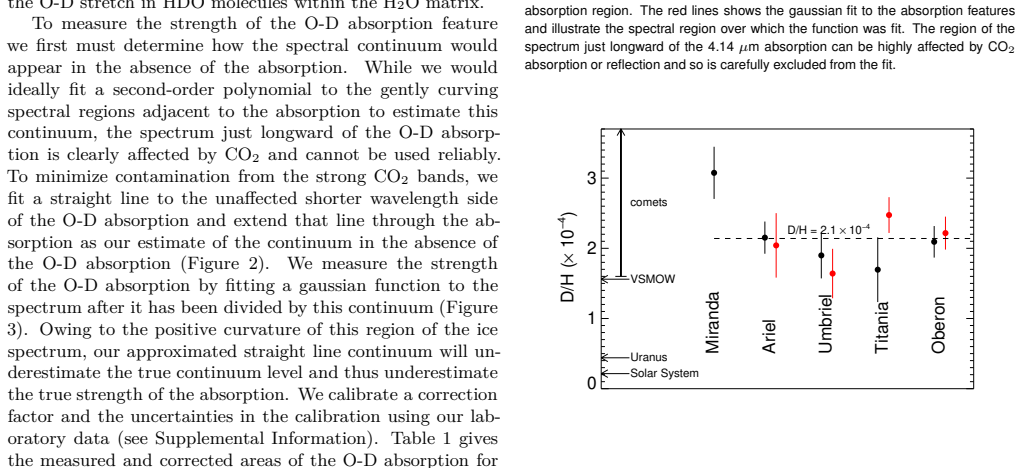
The observed D/H ratio of 2.1±0.2×10^{-4} is inconsistent with any formation scenario in which substantial Uranian material was incorporated into the satellites, thereby excluding models that require significant mixing in an impact-derived vapor disk. The ratios are compatible with accretion from material largely separate from Uranus, such as from a disrupted pre-existing satellite or a tidally captured outer solar system body. Miranda shows a marginally higher ratio, suggesting possible distinct history.
What carries the argument
deuterium-to-hydrogen (D/H) ratio in water ice, serving as a tracer to distinguish between incorporation of Uranian material versus external sources
If this is right
- Formation models requiring significant mixing in an impact-derived vapor disk are excluded.
- The satellites likely accreted from material that remained largely separate from Uranus.
- Debris from a disrupted pre-existing satellite system or a tidally captured outer solar system body are viable sources.
- Miranda's elevated D/H ratio may point to a distinct formation pathway among the satellites.
Where Pith is reading between the lines
- The giant impact that tilted Uranus probably did not create a vapor disk that mixed extensively with the satellite-forming material.
- Isotopic measurements like this could be applied to other planetary systems to trace satellite origins.
- Confirmation would require ruling out any post-formation processes that could alter D/H ratios in the ices.
Load-bearing premise
The D/H ratios measured in the satellite ices accurately reflect the composition of the original accreted material without significant later changes from fractionation or contamination.
What would settle it
Observing a D/H ratio in the satellites similar to that of Uranus, or finding clear evidence of post-accretion D/H alteration, would undermine the exclusion of mixed formation models.
Figures
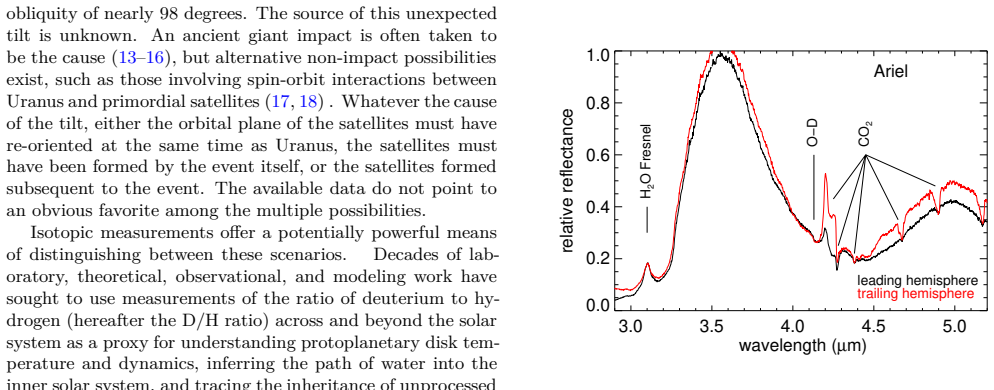
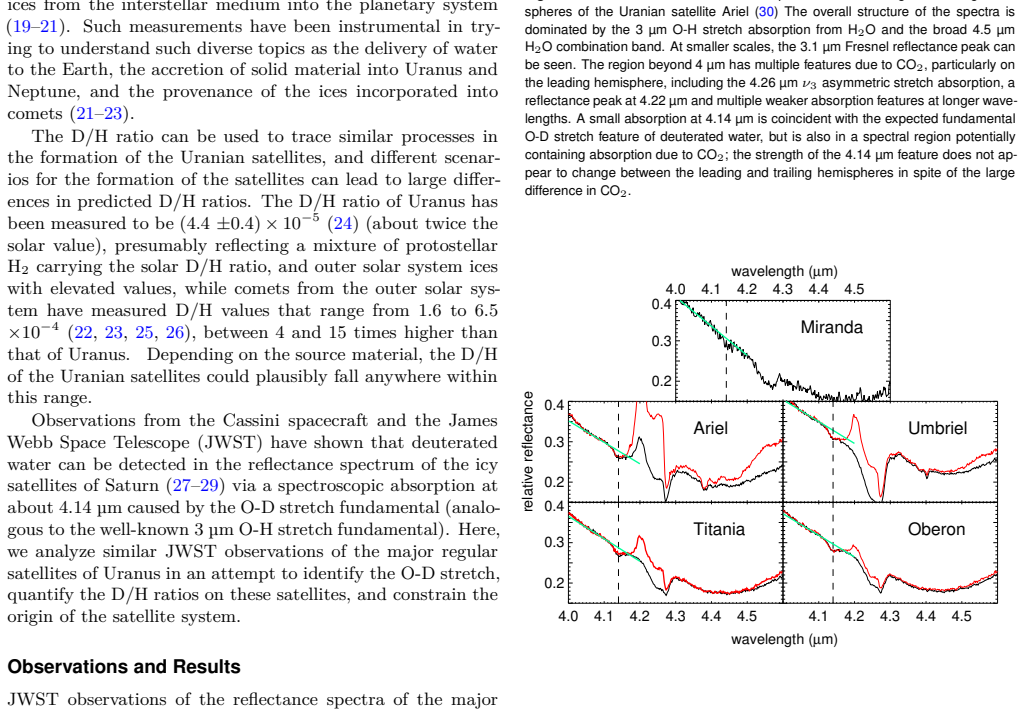
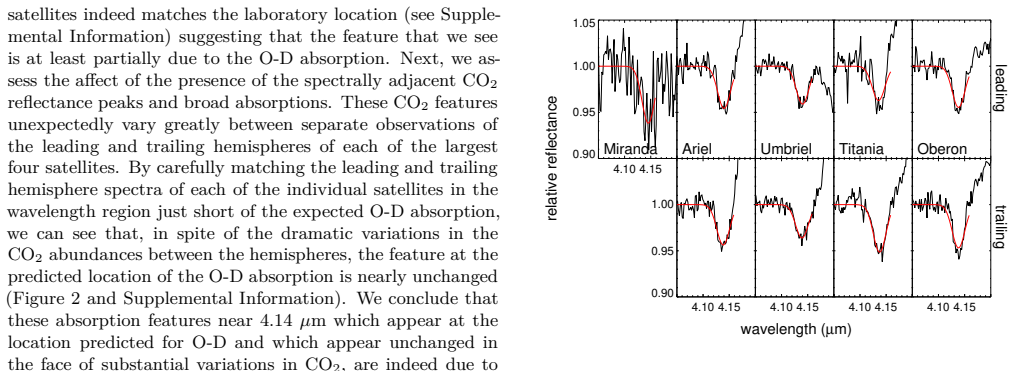
read the original abstract
The satellites of Uranus orbit in a low-eccentricity, equatorial plane that is tilted by 98 degrees relative to the solar system -- a geometry that mirrors Uranus's extreme axial tilt. Although a giant impact could have tipped Uranus, how the satellites came to share this orientation remains uncertain. Proposed formation pathways include primordial accretion followed by reorientation, formation from debris generated by the tilting impact, and reaccretion from a massive ring produced by the tidal disruption of passing bodies from the outer solar system. Current observations do not discriminate among these scenarios. Using the James Webb Space Telescope, we measured the deuterium-to-hydrogen (D/H) ration in the water ice of the five regular satellites of Uranus. We find an average D/H ratio of $2.1\pm 0.2 \times 10^{-4}$, nearly five times higher than that of Uranus and comparable to the values measured in comets. This enrichment is inconsistent with with any formation scenario in which substantial Uranian material was incorporated into the satellites, thereby excluding models that require significant mixing in an impact-derived vapor disk. The observed D/H ratios are instead compatible with models in which the satellites accreted from material that remained largely separate from Uranus, such as debris from a disrupted pre-existing satellite system or from a tidally captured outer solar system body. The innermost regular satellite, Miranda, exhibits a marginally elevated D/H ratio (2.8 $\sigma$ above the average of the other satellites), potentially indicating a distinct formation history or source of water and offering an important clue for distinguishing amount competing models.
Editorial analysis
A structured set of objections, weighed in public.
Referee Report
Summary. The paper reports JWST measurements of the D/H ratio in water ice on Uranus's five regular satellites, yielding an average value of 2.1 ± 0.2 × 10^{-4} that is comparable to cometary values and ~5× higher than Uranus. This is interpreted as excluding formation scenarios involving substantial mixing with Uranian material (e.g., in an impact-derived vapor disk) while remaining compatible with accretion from largely separate reservoirs such as disrupted satellites or captured outer solar system bodies. Miranda shows a marginal 2.8σ elevation above the other satellites.
Significance. If the measurement and no-fractionation premise hold, the result supplies a direct isotopic constraint that can discriminate among proposed Uranian satellite formation pathways tied to the planet's extreme obliquity. The approach of using D/H as a preserved tracer follows established practice in solar-system cosmochemistry and could falsify classes of impact-mixing models if the data reduction and interpretation are robust.
major comments (2)
- [Abstract] Abstract (final paragraph): The exclusion of 'any formation scenario in which substantial Uranian material was incorporated' rests on the premise that the measured D/H directly traces the bulk accreted source without post-accretion fractionation or contamination that could raise D/H from a mixed (Uranian + external) value to the observed cometary level. No quantitative bounds on fractionation factors, alteration processes, or contamination sources are supplied to support this mapping.
- [Abstract] Abstract and implied results section: The reported average D/H = 2.1 ± 0.2 × 10^{-4} and the 2.8σ Miranda offset cannot be independently assessed because the manuscript provides insufficient detail on spectral extraction, line fitting, continuum subtraction, and error propagation; without these the statistical significance and robustness of the central measurement remain unverifiable.
minor comments (2)
- [Abstract] Abstract contains typographical errors: 'D/H ration' should read 'D/H ratio'; 'inconsistent with with' should read 'inconsistent with'; 'amount competing models' should read 'among competing models'.
- [Abstract] The statement that the satellite value is 'nearly five times higher than that of Uranus' would be clearer if the exact Uranus D/H reference value and its source were stated explicitly in the abstract or introduction.
Simulated Author's Rebuttal
We thank the referee for their detailed and constructive report. The comments identify areas where the manuscript's interpretive claims and methodological transparency can be strengthened. We address each major comment below and will revise the manuscript accordingly.
read point-by-point responses
-
Referee: [Abstract] Abstract (final paragraph): The exclusion of 'any formation scenario in which substantial Uranian material was incorporated' rests on the premise that the measured D/H directly traces the bulk accreted source without post-accretion fractionation or contamination that could raise D/H from a mixed (Uranian + external) value to the observed cometary level. No quantitative bounds on fractionation factors, alteration processes, or contamination sources are supplied to support this mapping.
Authors: We agree that the abstract's exclusionary statement would be more robust with explicit support for the assumption that post-accretion processes did not significantly alter the D/H ratio. The main text relies on the general preservation of D/H in outer solar system ices, but does not provide quantitative bounds specific to possible fractionation or contamination on the Uranian satellites. In revision we will add a concise discussion subsection that reviews relevant processes (sublimation, photolysis, radiolytic alteration) and supplies order-of-magnitude estimates, drawing on laboratory data and cometary observations, to show that such effects are unlikely to bridge the factor-of-five gap relative to Uranus. This will be cross-referenced in the abstract. revision: yes
-
Referee: [Abstract] Abstract and implied results section: The reported average D/H = 2.1 ± 0.2 × 10^{-4} and the 2.8σ Miranda offset cannot be independently assessed because the manuscript provides insufficient detail on spectral extraction, line fitting, continuum subtraction, and error propagation; without these the statistical significance and robustness of the central measurement remain unverifiable.
Authors: The manuscript contains a Methods section describing the JWST observations and analysis, but we accept that the level of detail is insufficient for full independent verification of the reported value and significance. We will expand the Methods section with explicit step-by-step descriptions of spectral extraction, the line-fitting procedure and model choices, continuum subtraction approach, and complete error propagation. We will also add supplementary figures showing example spectra, fits, and residuals, and will make the reduced spectra available upon publication to allow direct assessment of the average D/H and the Miranda offset. revision: yes
Circularity Check
No circularity: direct JWST measurement compared to external D/H benchmarks
full rationale
The paper reports a new observational measurement of D/H = 2.1±0.2×10^{-4} in the Uranian satellites from JWST spectra. This value is compared to independently published D/H ratios for Uranus (lower) and comets (comparable), then used to exclude mixing models. No equations, fitted parameters, or derivations within the paper reduce the result to its own inputs by construction. External literature values and models serve as independent benchmarks; the central claim does not rely on self-citation chains or ansatzes defined inside the work. This is a standard observational comparison with no load-bearing self-referential steps.
Axiom & Free-Parameter Ledger
axioms (1)
- domain assumption D/H ratio in water ice directly reflects the origin of accreted material without substantial post-formation alteration or fractionation
Reference graph
Works this paper leans on
-
[2]
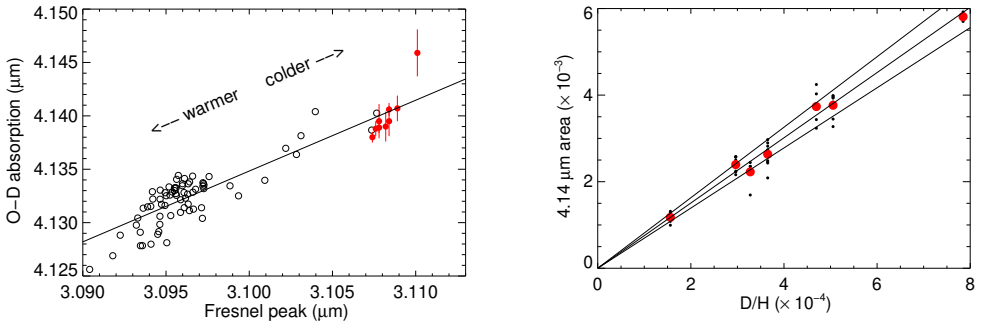
80 × 10− 4 (5× VSMOW). We find a linear relationship be- tween the area of the O-D line and the D/H ratio and apply this calibration and its associated uncertainties (see Sup ple- mental Information) to our measured and corrected band ar- eas to derive D/H ratios for the 5 Uranian satellites (Table 1). Figure 4 shows the D/H ratios for the 5 satellites. Th...
-
[4]
involved taking a ratio of the depth of the 4.14 and 2 µ m lines. This proposal was based on a theoretical spectral model and three laborato ry points and was expected to correct for variations due to grai n size which will affect band area. Our series of 72 experimental poi nts shows no evidence for the validity of this proposed calibrat ion and instead r...
-
[5]
Icarus 52, 14–39 (1982)
JI Lunine, DJ Stevenson, Formation of the galilean satell ites in a gaseous nebula. Icarus 52, 14–39 (1982)
1982
-
[6]
SJ Peale, Origin and Evolution of the Natural Satellites. Annu. Rev. Astron. Astrophys . 37, 533–602 (1999)
1999
-
[7]
The Astron
RM Canup, WR Ward, Formation of the Galilean Satellites: C onditions of Accretion. The Astron. J . 124, 3404–3423 (2002)
2002
-
[8]
Nature 441, 834–839 (2006)
RM Canup, WR Ward, A common mass scaling for satellite syst ems of gaseous planets. Nature 441, 834–839 (2006)
2006
-
[9]
Nature 468, 943–946 (2010)
RM Canup, Origin of Saturn’s rings and inner moons by mass r emoval from a lost Titan-sized satellite. Nature 468, 943–946 (2010)
2010
-
[10]
Icarus 216, 535–550 (2011)
S Charnoz, et al., Accretion of Saturn’s mid-sized moons d uring the viscous spreading of young massive rings: Solving the paradox of silicate-poor r ings versus silicate-rich moons. Icarus 216, 535–550 (2011)
2011
-
[11]
Icarus 223, 544–565 (2013)
E Asphaug, A Reufer, Late origin of the Saturn system. Icarus 223, 544–565 (2013)
2013
-
[12]
Space Sci
M Blanc, et al., Understanding the Formation of Saturn’s R egular Moons in the Context of Giant Planet Moons Formation Scenarios. Space Sci. Rev . 221, 35 (2025)
2025
-
[13]
Science 245, 500–504 (1989)
P Goldreich, N Murray , PY Longaretti, D Banfield, Neptune’ s Story. Science 245, 500–504 (1989)
1989
-
[14]
Icarus 99, 390– 401 (1992)
D Banfield, N Murray , A dynamical history of the inner Nept unian satellites. Icarus 99, 390– 401 (1992)
1992
-
[15]
Nature 441, 192–194 (2006)
CB Agnor, DP Hamilton, Neptune’s capture of its moon T rit on in a binary–planet gravitational encounter. Nature 441, 192–194 (2006)
2006
-
[16]
The Astron
R Rufu, RM Canup, T riton’s Evolution with a Primordial Ne ptunian Satellite System. The Astron. J . 154, 208 (2017)
2017
-
[17]
VS Safronov, Sizes of the largest bodies falling onto the planets during their formation. Sov. Astron. 9, 987–991 (1966) ADS Bibcode: 1966SvA.....9..987S
1966
-
[18]
Icarus 219, 737–740 (2012)
A Morbidelli, K Tsiganis, K Batygin, A Crida, R Gomes, Exp laining why the uranian satellites have equatorial prograde orbits despite the large planetar y obliquity . Icarus 219, 737–740 (2012)
2012
-
[19]
S Ida, S Ueta, T Sasaki, Y Ishizawa, Uranian satellite for mation by evolution of a water vapour disk generated by a giant impact. Nat. Astron. 4, 880–885 (2020)
2020
-
[20]
The Astrophys
J Salmon, RM Canup, Co-accretion + Giant Impact Origin of the Uranus System: Post-impact Evolution. The Astrophys. J . 924, 6 (2022)
2022
-
[21]
M Saillenfest, et al., Tilting Uranus via the migration o f an ancient satellite. Astron. & Astro- phys. 668, A108 (2022)
2022
-
[22]
The Astrophys
Z Rogoszinski, DP Hamilton, Tilting Ice Giants with a Spi n–Orbit Resonance. The Astrophys. J. 888, 60 (2020)
2020
-
[23]
K Furuya, et al., Water delivery from cores to disks: Deut eration as a probe of the prestellar inheritance of H 2 O. Astron. & Astrophys . 599, A40 (2017)
2017
-
[24]
ıcarus 226, 256–267 (2013)
L Y ang, FJ Ciesla, CMOD Alexander, The D/H ratio of water i n the solar nebula during its formation and evolution. ıcarus 226, 256–267 (2013)
2013
-
[25]
T Albertsson, D Semenov, T Henning, Chemodynamical Deut erium Fractionation in the Early Solar Nebula: The Origin of Water on Earth and in Asteroids an d Comets. Astrophys. J. 784, 39 (2014) _eprint: 1401.6035
Pith/arXiv arXiv 2014
-
[26]
ap Astronomy & Astrophysics, L5 (2019) _eprint: 1904.09175
DC Lis, et al., T errestrial deuterium-to-hydrogen rati o in water in hyperactive comets. ap Astronomy & Astrophysics, L5 (2019) _eprint: 1904.09175
Pith/arXiv arXiv 2019
-
[27]
Space Sci
D Bockelée-Morvan, et al., Cometary Isotopic Measureme nts. Space Sci. Rev . 197, 47–83 (2015)
2015
-
[28]
H Feuchtgruber, et al., The D/H ratio in the atmospheres o f Uranus and Neptune fromHerschel-P ACS observations. Astron. & Astrophys . 551, A126 (2013)
2013
-
[29]
N Biver, et al., Isotopic ratios of H, C, N, O, and S in comet s C/2012 F6 (Lemmon) and C/2014 Q2 (Lovejoy). Astron. & Astrophys . 589, A78 (2016)
2012
-
[30]
DR Müller, et al., High D/H ratios in water and alkanes in c omet 67P/Churyumov- Gerasimenko measured with Rosetta/ROSINA DFMS. Astron. & Astrophys . 662, A69 (2022) _eprint: 2202.03521
arXiv 2022
-
[31]
ıcarus 321, 791–802 (2019)
RN Clark, RH Brown, DP Cruikshank, GA Swayze, Isotopic ra tios of Saturn’s rings and satel- lites: Implications for the origin of water and Phoebe. ıcarus 321, 791–802 (2019)
2019
-
[32]
MM Hedman, et al., Water-Ice Dominated Spectra of Saturn ’s Rings and Small Moons From JWST. J. Geophys. Res. Planets 129, e2023JE008236 (2024)
2024
-
[33]
The Planet
ME Brown, SK T rumbo, MR Davis, S Chandra, Deuterated Wate r Ice on the Satellites of Saturn. The Planet. Sci. J . 6, 229 (2025)
2025
-
[34]
The Planet
RJ Cartwright, et al., Revealing Callisto’s Carbon-ric h Surface and CO 2 Atmosphere with JWST. The Planet. Sci. J . 5, 60 (2024)
2024
-
[35]
Icarus 84, 203–214 (1990)
B Buratti, F Wong, J Mosher, Surface properties and photo metry of the Uranian satellites. Icarus 84, 203–214 (1990)
1990
-
[36]
Icarus 90, 1–13 (1991)
BJ Buratti, JA Mosher, Comparative global albedo and col or maps of the Uranian satellites. Icarus 90, 1–13 (1991)
1991
-
[37]
WF Bottke, D Nesvorný, D Vokrouhlický, A Morbidelli, The Irregular Satellites: The Most Collisionally Evolved Populations in the Solar System. Astron. J. 139, 994–1014 (2010)
2010
-
[38]
GM Kennedy , MC Wyatt, Collisional evolution of irregula r satellite swarms: detectable dust around Solar system and extrasolar planets: Evolution of ir regular satellite swarms. Mon. Notices Royal Astron. Soc . 412, 2137–2153 (2011)
2011
-
[39]
Icarus 226, 655–662 (2013)
D T amayo, JA Burns, DP Hamilton, Chaotic dust dynamics an d implications for the hemi- spherical color asymmetries of the Uranian satellites. Icarus 226, 655–662 (2013)
2013
-
[40]
RJ Cartwright, et al., Red material on the large moons of U ranus: Dust from the irregular satellites? Icarus 314, 210–231 (2018)
2018
-
[41]
Icarus 163, 263–289 (2003)
K Zahnle, P Schenk, H Levison, L Dones, Cratering rates in the outer Solar System. Icarus 163, 263–289 (2003)
2003
-
[42]
The Planet
WF Bottke, et al., The Bombardment History of the Giant Pl anet Satellites. The Planet. Sci. J. 5, 88 (2024)
2024
-
[43]
The Astrophys
CJ Bierson, F Nimmo, Explaining the Galilean Satellites ’ Density Gradient by Hydrodynamic Escape. The Astrophys. J. Lett . 897, L43 (2020)
2020
-
[44]
Icarus 99, 167–174 (1992)
WL Slattery , W Benz, A Cameron, Giant impacts on a primiti ve Uranus. Icarus 99, 167–174 (1992)
1992
-
[45]
C Reinhardt, A Chau, J Stadel, R Helled, Bifurcation in th e history of Uranus and Neptune: the role of giant impacts. Mon. Notices Royal Astron. Soc . 492, 5336–5353 (2020)
2020
-
[46]
The Astrophys
JA Kegerreis, et al., Consequences of Giant Impacts on Ea rly Uranus for Rotation, Internal Structure, Debris, and Atmospheric Erosion. The Astrophys. J . 861, 52 (2018)
2018
-
[47]
JMY Woo, et al., Did Uranus’ regular moons form via a rocky giant impactor? Icarus 375, 114842 (2022)
2022
-
[48]
O Mousis, Modeling the thermodynamical conditions in th e Uranian subnebula – Implications for regular satellite composition. Astron. & Astrophys . 413, 373–380 (2004)
2004
-
[49]
Nature 465, 752–754 (2010)
S Charnoz, J Salmon, A Crida, The recent formation of Satu rn’s moonlets from viscous spreading of the main rings. Nature 465, 752–754 (2010)
2010
-
[50]
Science 338, 1196 (2012) ADS Bibcode: 2012Sci...338.1196C
A Crida, S Charnoz, Formation of Regular Satellites from Ancient Massive Rings in the Solar System. Science 338, 1196 (2012) ADS Bibcode: 2012Sci...338.1196C
2012
-
[51]
L Dones, A recent cometary origin for Saturn’s rings? Icarus 92, 194–203 (1991)
1991
-
[52]
Icarus 282, 195–213 (2017)
R Hyodo, S Charnoz, K Ohtsuki, H Genda, Ring formation aro und giant planets by tidal disruption of a single passing large Kuiper belt object. Icarus 282, 195–213 (2017)
2017
-
[53]
F Nimmo, Strong Tidal Dissipation at Uranus? The Planet. Sci. J . 4, 241 (2023)
2023
-
[54]
The Astron
RA Jacobson, RS Park, The Orbits of Uranus, Its Satellite s and Rings, the Gravity Field of the Uranian System, and the Orientation of the Poles of Uranus an d Its Satellites*. The Astron. J . 169, 65 (2025)
2025
-
[55]
Nature 460, 487–490 (2009)
JH Waite Jr, et al., Liquid water on Enceladus from observ ations of ammonia and 40Ar in the plume. Nature 460, 487–490 (2009)
2009
-
[56]
The Astron
AJ Hesselbrock, DA Minton, Three Dynamical Evolution Re gimes for Coupled Ring-satellite Systems and Implications for the Formation of the Uranian Sa tellite Miranda. The Astron. J . 157, 30 (2019)
2019
-
[57]
The Astrophys
R Rufu, RM Canup, Coaccretion + Giant-impact Origin of th e Uranus System: Tilting Impact. The Astrophys. J . 928, 123 (2022)
2022
-
[58]
ME Brown, WC Fraser, The State of CO and CO 2 Ices in the Kuiper Belt as Seen by JWST. The Planet. Sci. J . 4, 130 (2023) _eprint: 2306.17051
arXiv 2023
-
[59]
The Planet
ME Brown, SK T rumbo, M Belyakov, MR Davis, A Pandya, A JWST Study of CO 2 on the Satellites of Saturn. The Planet. Sci. J . 6, 180 (2025)
2025
-
[60]
G Filacchione, et al., Saturn’s icy satellites investig ated by Cassini-VIMS. IV. Daytime tem- perature maps. Icarus 271, 292–313 (2016)
2016
-
[61]
Science 233, 70–74 (1986)
R Hanel, et al., Infrared Observations of the Uranian Sys tem. Science 233, 70–74 (1986)
1986
-
[62]
H Detre, et al., Herschel-P ACS photometry of the five major moons of Uranus. Astron. & Astrophys. 641, A76 (2020)
2020
-
[63]
The Astrophys
RM Mastrapa, SA Sandford, TL Roush, DP Cruikshank, CM Dal le Ore, Optical Constants of Amorphous and Crystalline H 2 O-ice: 2.5-22 µ m (4000-455 cm -1 ) Optical Constants of H2O-ice. The Astrophys. J . 701, 1347–1356 (2009)
2009
-
[64]
The Astron
PD Fischer, ME Brown, SK T rumbo, KP Hand, SP A TIALL Y RESOL VED SPECTROSCOPY OF EUROP A’S LARGE-SCALE COMPOSITIONAL UNITS A T 3–4 µ m WITH KECK NIR- SPEC. The Astron. J . 153, 13 (2017). Brown et al. PNAS | June 30, 2026 | vol. XXX | no. XX | 9
2017
discussion (0)
Sign in with ORCID, Apple, or X to comment. Anyone can read and Pith papers without signing in.