Progressive Self-Supervised Learning with Individualized Community Assignment for Brain Network Analysis
Pith reviewed 2026-06-30 07:02 UTC · model grok-4.3
The pith
BrainPICM uses progressive individualized community assignment to produce more consistent brain network representations from fMRI.
A machine-rendered reading of the paper's core claim, the machinery that carries it, and where it could break.
Core claim
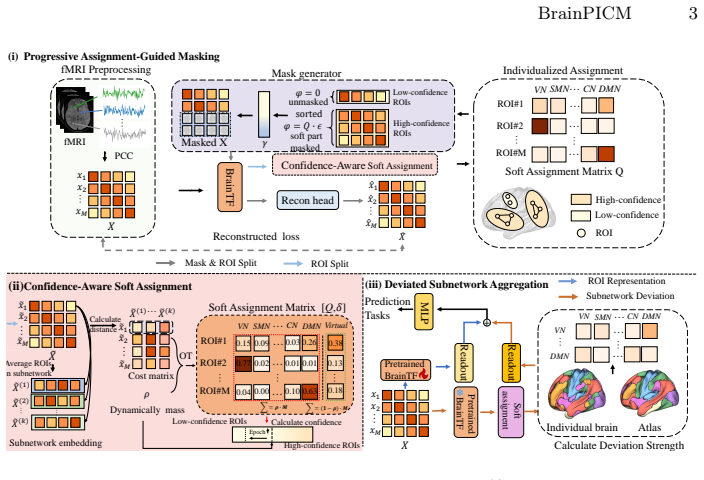
BrainPICM formulates ROI-to-community mapping as a progressive unbalanced optimal transport process, yielding soft assignments and per-ROI confidence scores. Guided by these confidence estimates, a curriculum-style masking strategy gradually incorporates low-confidence, potentially pathological regions into training, enabling the model to learn both stable modular structures and individual variations. Additionally, a deviation-aware aggregation module quantifies functional reorganization by measuring mass redistribution relative to a population template.
What carries the argument
Progressive unbalanced optimal transport that produces soft ROI-to-community assignments and per-ROI confidence scores to control curriculum-style masking.
If this is right
- Representations become more functionally consistent and generalizable across subjects.
- The model learns both stable modular structures and individual variations simultaneously.
- Functional reorganization is quantified as mass redistribution relative to a population template.
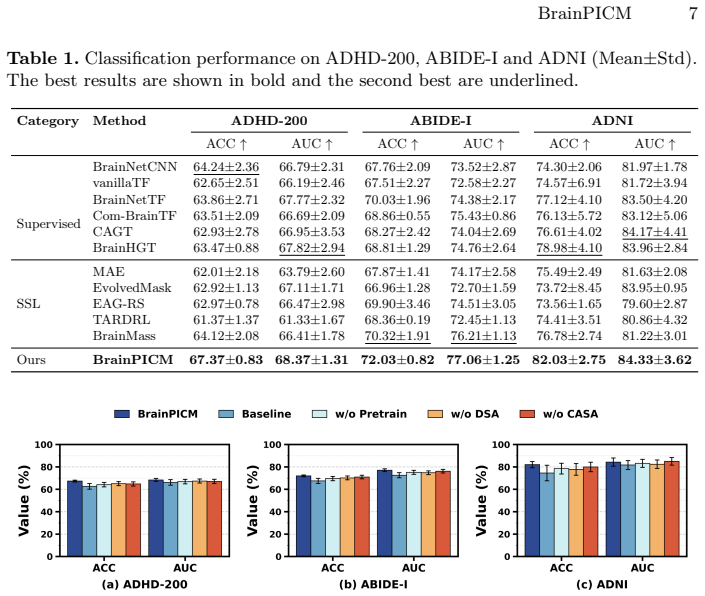
- Diagnostic accuracy rises on ABIDE-I, ADHD-200, and ADNI relative to prior supervised and SSL baselines.
Where Pith is reading between the lines
- The same progressive assignment mechanism could be tested on other graph data that exhibit community structure.
- Per-ROI confidence scores might be examined post hoc as candidate biomarkers for subject-specific pathology.
- The deviation-aware aggregation module could be applied independently to quantify reorganization in longitudinal studies.
- Replacing the optimal-transport assignment with an alternative clustering method would isolate whether the transport formulation itself drives the gains.
Load-bearing premise
Low per-ROI confidence scores from the transport step reliably mark regions whose inclusion should be delayed because they reflect genuine pathology or variability rather than noise or modeling error.
What would settle it
Retraining the model on the same three fMRI datasets after removing either the individualized assignment step or the progressive curriculum and observing whether diagnostic accuracy falls below the reported levels would refute the central claim.
Figures
read the original abstract
Brain networks exhibit a modular community structure that varies across individuals and neurological conditions. However, existing self-supervised learning (SSL) methods often overlook this heterogeneity, relying on generic masking strategies that fail to capture subject-specific functional organization. We propose BrainPICM, a self-supervised framework for brain network analysis via progressive individualized community aware masking. BrainPICM formulates ROI-to-community mapping as a progressive unbalanced optimal transport process, yielding soft assignments and per-ROI confidence scores. Guided by these confidence estimates, a curriculum-style masking strategy gradually incorporates low-confidence, potentially pathological regions into training, enabling the model to learn both stable modular structures and individual variations. Additionally, a deviation-aware aggregation module quantifies functional reorganization by measuring mass redistribution relative to a population template, enhancing interpretability and downstream prediction. Experiments on three fMRI datasets (ABIDE-I, ADHD-200, ADNI) show that BrainPICM consistently outperforms state-of-the-art supervised and SSL methods in diagnostic accuracy, indicating that explicitly injecting modular community structure into masked modeling yields more functionally consistent and generalizable representations. The source code for this approach will be released at https://github.com/Hrychen7/BrainPICM.
Editorial analysis
A structured set of objections, weighed in public.
Referee Report
Summary. The manuscript proposes BrainPICM, a self-supervised framework for brain network analysis from fMRI that formulates ROI-to-community mapping as a progressive unbalanced optimal transport process to produce soft assignments and per-ROI confidence scores; these scores guide a curriculum-style masking strategy that gradually incorporates low-confidence regions, combined with a deviation-aware aggregation module to quantify functional reorganization relative to a population template. Experiments on ABIDE-I, ADHD-200, and ADNI report consistent outperformance over state-of-the-art supervised and SSL baselines in diagnostic accuracy, with code to be released.
Significance. If the central claims hold, the work would advance SSL for heterogeneous brain networks by explicitly incorporating subject-specific modular community structure rather than generic masking, potentially yielding more interpretable and generalizable representations for neurological diagnosis. The public code release is a clear strength for reproducibility.
major comments (2)
- [Method (unbalanced OT and curriculum masking)] The central claim (abstract and method description) that the unbalanced OT confidence scores reliably identify regions whose inclusion should be delayed because they are 'potentially pathological or variable' rather than noise or modeling artifacts is load-bearing for the asserted advantage over standard SSL masking, yet no validation, correlation with clinical scores, or ablation isolating the curriculum component is provided to support this mapping.
- [Experiments] Experiments section: reported accuracy gains on the three datasets are presented without error bars, statistical significance tests, or ablations that remove the individualized OT component while retaining other elements (e.g., progressive masking with random scores), making it impossible to attribute improvements specifically to the claimed injection of modular community structure.
minor comments (1)
- [Method] Notation for the unbalanced OT objective and the deviation-aware aggregation could be clarified with explicit equations and variable definitions in the main text rather than relying solely on prose.
Simulated Author's Rebuttal
We thank the referee for the constructive feedback. We address each major comment point by point below and indicate revisions to strengthen the manuscript where the concerns are valid.
read point-by-point responses
-
Referee: [Method (unbalanced OT and curriculum masking)] The central claim (abstract and method description) that the unbalanced OT confidence scores reliably identify regions whose inclusion should be delayed because they are 'potentially pathological or variable' rather than noise or modeling artifacts is load-bearing for the asserted advantage over standard SSL masking, yet no validation, correlation with clinical scores, or ablation isolating the curriculum component is provided to support this mapping.
Authors: We acknowledge that the manuscript does not include direct validation such as correlation of the OT-derived confidence scores with clinical scores or an explicit ablation isolating the curriculum masking from random scores. The unbalanced OT formulation is motivated by its ability to produce soft, subject-specific assignments that quantify deviation from a population template via transport cost, with low-confidence ROIs intended to capture individual variability. The overall diagnostic gains provide indirect support, but we agree this mapping would be strengthened by targeted analysis. We will add an ablation replacing OT confidence with random scores (while retaining progressive masking) and, where metadata permits, report correlations with clinical variables. These changes will be incorporated. revision: yes
-
Referee: [Experiments] Experiments section: reported accuracy gains on the three datasets are presented without error bars, statistical significance tests, or ablations that remove the individualized OT component while retaining other elements (e.g., progressive masking with random scores), making it impossible to attribute improvements specifically to the claimed injection of modular community structure.
Authors: We agree that the experimental presentation lacks error bars, statistical tests, and component-specific ablations, which limits attribution of gains to the individualized OT. The reported results show consistent outperformance across ABIDE-I, ADHD-200, and ADNI, but to enable precise attribution we will add: (i) error bars from multiple random seeds, (ii) statistical significance testing (e.g., paired t-tests against baselines), and (iii) the requested ablation that retains progressive masking but substitutes random confidence scores for OT-derived ones. These elements will be added to the revised experiments section. revision: yes
Circularity Check
No significant circularity; derivation and evaluation remain independent
full rationale
The paper introduces BrainPICM as a progressive unbalanced optimal transport process for ROI-to-community mapping that produces soft assignments and per-ROI confidence scores, which then guide a curriculum masking strategy. These steps are defined by the method itself and evaluated for downstream diagnostic accuracy on three external fMRI datasets (ABIDE-I, ADHD-200, ADNI). No equation or claim reduces a prediction to a fitted parameter drawn from the same evaluation data, no self-citation is load-bearing for the central premise, and no uniqueness theorem or ansatz is smuggled in from prior author work. The reported outperformance is therefore not forced by construction from the inputs.
Axiom & Free-Parameter Ledger
Reference graph
Works this paper leans on
-
[1]
Frontiers in Systems Neuroscience6, 62 (2012)
ADHD-200 Consortium: The adhd-200 consortium: a model to advance the trans- lational potential of neuroimaging in clinical neuroscience. Frontiers in Systems Neuroscience6, 62 (2012)
2012
-
[2]
In: International conference on medical image computing and computer-assisted intervention
Bannadabhavi, A., Lee, S., Deng, W., Ying, R., Li, X.: Community-aware trans- former for autism prediction in fmri connectome. In: International conference on medical image computing and computer-assisted intervention. pp. 287–297. Springer (2023)
2023
-
[3]
Mathematics of computation87(314), 2563– 2609 (2018)
Chizat, L., Peyré, G., Schmitzer, B., Vialard, F.X.: Scaling algorithms for unbal- anced optimal transport problems. Mathematics of computation87(314), 2563– 2609 (2018)
2018
-
[4]
Frontiers in Neuroinformatics42(10.3389) (2013)
Craddock, C., Sikka, S., Cheung, B., Khanuja, R., Ghosh, S.S., Yan, C., Li, Q., Lurie, D., Vogelstein, J., Burns, R., et al.: Towards automated analysis of connec- tomes: The configurable pipeline for the analysis of connectomes (c-pac). Frontiers in Neuroinformatics42(10.3389) (2013)
2013
-
[5]
Human brain mapping33(8), 1914–1928 (2012)
Craddock, R.C., James, G.A., Holtzheimer III, P.E., Hu, X.P., Mayberg, H.S.: A whole brain fmri atlas generated via spatially constrained spectral clustering. Human brain mapping33(8), 1914–1928 (2012)
1914
-
[6]
Molecular Psychiatry19(6), 659–667 (2014) 10 H
Di Martino, A., Yan, C.G., Li, Q., Denio, E., Castellanos, F.X., Alaerts, K., An- derson, J.S., Assaf, M., Bookheimer, S.Y., Dapretto, M., et al.: The autism brain imaging data exchange: towards a large-scale evaluation of the intrinsic brain ar- chitecture in autism. Molecular Psychiatry19(6), 659–667 (2014) 10 H. Chen et al
2014
-
[7]
Nature medicine26(8), 1256–1263 (2020)
Dujardin, S., Commins, C., Lathuiliere, A., Beerepoot, P., Fernandes, A.R., Ka- math, T.V., De Los Santos, M.B., Klickstein, N., Corjuc, D.L., Corjuc, B.T., et al.: Tau molecular diversity contributes to clinical heterogeneity in alzheimer’s disease. Nature medicine26(8), 1256–1263 (2020)
2020
-
[8]
In: Proceed- ings of the IEEE/CVF Conference on Computer Vision and Pattern Recognition
Feng, Z., Zhang, S.: Evolved part masking for self-supervised learning. In: Proceed- ings of the IEEE/CVF Conference on Computer Vision and Pattern Recognition. pp. 10386–10395 (2023)
2023
-
[9]
Autism Research11(11), 1479– 1493 (2018)
He, C., Chen, Y., Jian, T., Chen, H., Guo, X., Wang, J., Wu, L., Chen, H., Duan, X.: Dynamic functional connectivity analysis reveals decreased variability of the default-mode network in developing autistic brain. Autism Research11(11), 1479– 1493 (2018)
2018
-
[10]
In: Proceedings of the IEEE/CVF conference on computer vision and pattern recognition
He, K., Chen, X., Xie, S., Li, Y., Dollár, P., Girshick, R.: Masked autoencoders are scalable vision learners. In: Proceedings of the IEEE/CVF conference on computer vision and pattern recognition. pp. 16000–16009 (2022)
2022
-
[11]
Nature communications10(1), 1022 (2019)
Hong, S.J., Vos de Wael, R., Bethlehem, R.A., Lariviere, S., Paquola, C., Valk, S.L., Milham, M.P., Di Martino, A., Margulies, D.S., Smallwood, J., et al.: Atypical functional connectome hierarchy in autism. Nature communications10(1), 1022 (2019)
2019
-
[12]
Journal of Magnetic Reso- nance Imaging27(4), 685–691 (2008)
Jack, Jr, C.R., Bernstein, M.A., Fox, N.C., Thompson, P., Alexander, G., Harvey, D., Borowski, B., Britson, P.J., Whitwell, J.L., Ward, C., et al.: The alzheimer’s disease neuroimaging initiative (adni): Mri methods. Journal of Magnetic Reso- nance Imaging27(4), 685–691 (2008)
2008
-
[13]
IEEE Transactions on Medical Imaging43(4), 1400–1411 (2023)
Jung, W., Jeon, E., Kang, E., Suk, H.I.: Eag-rs: a novel explainability-guided roi- selection framework for asd diagnosis via inter-regional relation learning. IEEE Transactions on Medical Imaging43(4), 1400–1411 (2023)
2023
-
[14]
Advances in Neural Information Processing Systems35, 25586–25599 (2022)
Kan, X., Dai, W., Cui, H., Zhang, Z., Guo, Y., Yang, C.: Brain network trans- former. Advances in Neural Information Processing Systems35, 25586–25599 (2022)
2022
-
[15]
NeuroImage146, 1038– 1049 (2017)
Kawahara, J., Brown, C.J., Miller, S.P., Booth, B.G., Chau, V., Grunau, R.E., Zwicker, J.G., Hamarneh, G.: Brainnetcnn: Convolutional neural networks for brain networks; towards predicting neurodevelopment. NeuroImage146, 1038– 1049 (2017)
2017
-
[16]
Nature communications14(1), 8411 (2023)
Keller, A.S., Pines, A.R., Shanmugan, S., Sydnor, V.J., Cui, Z., Bertolero, M.A., Barzilay, R., Alexander-Bloch, A.F., Byington, N., Chen, A., et al.: Personalized functional brain network topography is associated with individual differences in youth cognition. Nature communications14(1), 8411 (2023)
2023
-
[17]
In: Proceedings of the AAAI Con- ference on Artificial Intelligence
Ma, J., Zhang, Y., Zhang, C., Lv, Z., Pei, S.: Brainhgt: A hierarchical graph trans- former for interpretable brain network analysis. In: Proceedings of the AAAI Con- ference on Artificial Intelligence. vol. 40, pp. 17617–17625 (2026)
2026
-
[18]
In: Proceedings of the Thirty-Fourth International Joint Conference on Artificial Intelligence
Pei, S., Ma, J., Lv, Z., Zhang, C., Guan, J.: Community-aware graph transformer for brain disorder identification. In: Proceedings of the Thirty-Fourth International Joint Conference on Artificial Intelligence. pp. 4191–4199 (2025)
2025
-
[19]
Schaefer, A., Kong, R., Gordon, E.M., Laumann, T.O., Zuo, X.N., Holmes, A.J., Eickhoff, S.B., Yeo, B.T.: Local-global parcellation of the human cerebral cortex fromintrinsicfunctionalconnectivitymri.CerebralCortex28(9),3095–3114(2018)
2018
-
[20]
Nature Neuroscience26(9), 1613–1629 (2023)
Segal, A., Parkes, L., Aquino, K., Kia, S.M., Wolfers, T., Franke, B., Hoogman, M., Beckmann, C.F., Westlye, L.T., Andreassen, O.A., et al.: Regional, circuit and network heterogeneity of brain abnormalities in psychiatric disorders. Nature Neuroscience26(9), 1613–1629 (2023)
2023
-
[21]
Annual review of psychology 67(1), 613–640 (2016) BrainPICM 11
Sporns, O., Betzel, R.F.: Modular brain networks. Annual review of psychology 67(1), 613–640 (2016) BrainPICM 11
2016
-
[22]
In: International Conference on Medical Image Computing and Computer-Assisted Intervention
Yang,Y.,Chen,H.,Hu,J.,Guo,X.,Ma,T.:Advancingbrainimaginganalysisstep- by-step via progressive self-paced learning. In: International Conference on Medical Image Computing and Computer-Assisted Intervention. pp. 58–68. Springer (2024)
2024
-
[23]
In: International Conference on Medical Image Computing and Computer-Assisted Intervention
Yang, Y., Wolfers, T.: Hierarchical characterization of brain dynamics via state space-based vector quantization. In: International Conference on Medical Image Computing and Computer-Assisted Intervention. pp. 394–404. Springer (2025)
2025
-
[24]
Neural Networks164, 91–104 (2023)
Yang, Y., Ye, C., Ma, T.: A deep connectome learning network using graph con- volution for connectome-disease association study. Neural Networks164, 91–104 (2023)
2023
-
[25]
IEEE transactions on medical imaging43(11), 4004–4016 (2024)
Yang, Y., Ye, C., Su, G., Zhang, Z., Chang, Z., Chen, H., Chan, P., Yu, Y., Ma, T.: Brainmass: Advancing brain network analysis for diagnosis with large-scale self-supervised learning. IEEE transactions on medical imaging43(11), 4004–4016 (2024)
2024
-
[26]
NeuroImage: Clinical31, 102715 (2021)
Yang, Y., Ye, C., Sun, J., Liang, L., Lv, H., Gao, L., Fang, J., Ma, T., Wu, T.: Alteration of brain structural connectivity in progression of parkinson’s disease: a connectome-wide network analysis. NeuroImage: Clinical31, 102715 (2021)
2021
-
[27]
Journal of neurophysiology (2011)
Yeo, B.T., Krienen, F.M., Sepulcre, J., Sabuncu, M.R., Lashkari, D., Hollinshead, M., Roffman, J.L., Smoller, J.W., Zöllei, L., Polimeni, J.R., et al.: The organization of the human cerebral cortex estimated by intrinsic functional connectivity. Journal of neurophysiology (2011)
2011
-
[28]
arXiv preprint arXiv:2401.09266 (2024)
Zhang, C., Ren, H., He, X.: P2OT: Progressive partial optimal transport for deep imbalanced clustering. arXiv preprint arXiv:2401.09266 (2024)
-
[29]
In: International Conference on Medical Image Computing and Computer-Assisted Intervention
Zhao, Y., Nie, D., Chen, G., Wu, X., Zhang, D., Wen, X.: Tardrl: Task-aware recon- struction for dynamic representation learning of fmri. In: International Conference on Medical Image Computing and Computer-Assisted Intervention. pp. 700–710. Springer (2024)
2024
discussion (0)
Sign in with ORCID, Apple, or X to comment. Anyone can read and Pith papers without signing in.