REVIEW 2 major objections 5 minor
Quasibound states of a charged Dirac field around regular black holes
T0 review · 2 major / 5 minor · reviewed 2026-07-12 · grok-4.5
Pith's one-line read A charged regular black hole can make fermionic quasibound clouds much longer-lived than Reissner–Nordström, but still does not trigger a Dirac superradiant instability.
desk verdict Solid ABG–RN Dirac quasibound comparison: shared hydrogenic Re(ω), larger lifetime differences from the inner barrier, and no instability in the scanned window. read the letter →
The pith
A machine-rendered reading of the paper's core claim, the machinery that carries it, and where it could break.
The reading
What carries the argument
The far-field trapping condition Mμ² − qQω_R > 0 (weak-binding same-sign limit Mμ > qQ), obtained from the shared ABG/RN asymptotic potential and used to set the quasibound boundary-value problem whose complex roots are found by two-sided shooting and checked by characteristic time evolution.
What would settle it
Find a parameter point, still obeying the trapping condition, at which a quasibound Dirac root has positive imaginary part on the ABG background, or show that every ABG damping rate matches the Reissner–Nordström value once the same asymptotic charges are fixed.
Extended reading notes
Core claim
On the Ayón-Beato–García regular charged black hole, massive charged Dirac quasibound modes remain damped within the explored parameter range. The regular core and nonlinear electromagnetic structure can substantially lengthen (or, in some regimes, shorten) the cloud lifetime relative to Reissner–Nordström at the same mass and charge, yet they do not produce a Dirac superradiant instability.
Load-bearing premise
The claim that no Dirac instability appears rests on numerical roots found for selected angular branches and finite windows of mass, charge, and coupling, not on a general no-go theorem.
Editorial analysis
A structured set of objections, weighed in public.
Referee Report
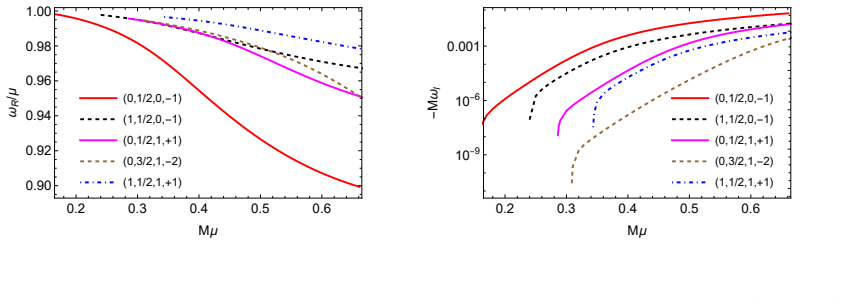
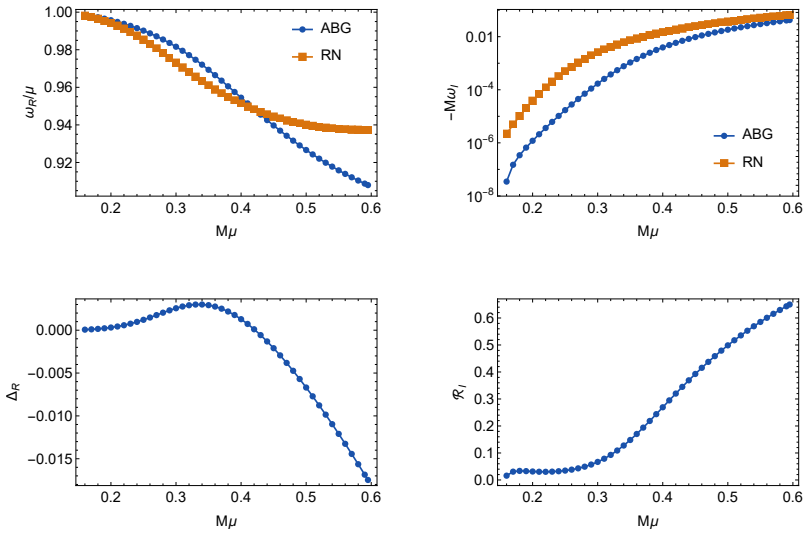
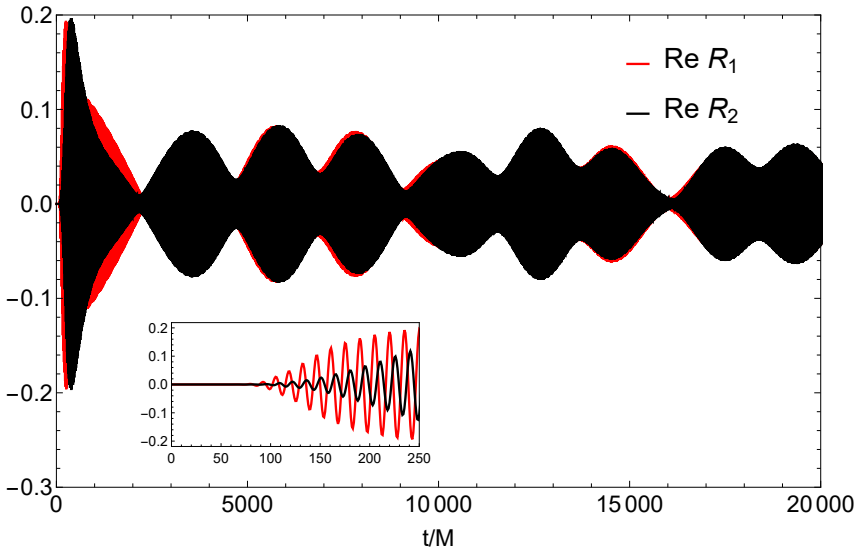
Summary. The manuscript computes quasibound spectra of a massive charged Dirac field on the Ayón-Beato–García (ABG) regular black-hole background and compares them pointwise with Reissner–Nordström (RN) at the same asymptotic mass and charge. After separating the Dirac equation, the authors derive the far-field trapping condition Mμ²−qQω_R>0 (weak-binding same-sign limit Mμ>qQ), obtain complex frequencies by two-sided shooting of the first-order radial system with ingoing/decaying boundary conditions, and cross-check selected modes by characteristic time evolution plus matrix-pencil extraction. Because ABG and RN share the same Newtonian and Coulomb tails, they share the leading hydrogenic real spectrum; differences appear in subleading real shifts and, more strongly, in damping rates controlled by the inner barrier. Within the scanned parameter windows the modes remain damped (ω_I<0): the regular geometry can change fermionic-cloud lifetimes substantially relative to RN but does not produce a Dirac superradiant instability.
Significance. The work cleanly isolates the effect of a regular charged core on fermionic quasibound states in a setting where single-particle Dirac fields do not admit black-hole superradiant amplification. Strengths include a careful separation and asymptotic analysis (including the Appendix A subleading ABG–RN shift), RN continued-fraction calibration of the shooting code, effective-potential diagnostics of horizon leakage (Fig. 5), and an independent time-domain check (Table 2). The no-instability statement is explicitly scoped to the explored range and to the minimally coupled test-field Dirac equation, which is the right standard for this class of calculation. If the numerical results hold under the stated caveats, the paper provides a useful baseline for how regular interiors modify fermionic cloud lifetimes without opening a Dirac instability channel, complementing the existing scalar/superradiance literature on charged regular black holes.
major comments (2)
- [§4.2, §6] §4.2 and §6: The central claim that Dirac quasibound modes remain damped is numerical and limited to selected (n_r,j,ℓ) branches and finite windows in Mμ, qQ, and Q/M. The paper already states this, but the manuscript should make the searched domain fully explicit and reproducible—e.g., a short table or paragraph listing the ranges of Mμ, qQ, Q/M, the branches continued, and the residual/tolerance criteria used to accept ω_I<0—so that the scope of “no root with ω_I>0” is unambiguous to the reader.
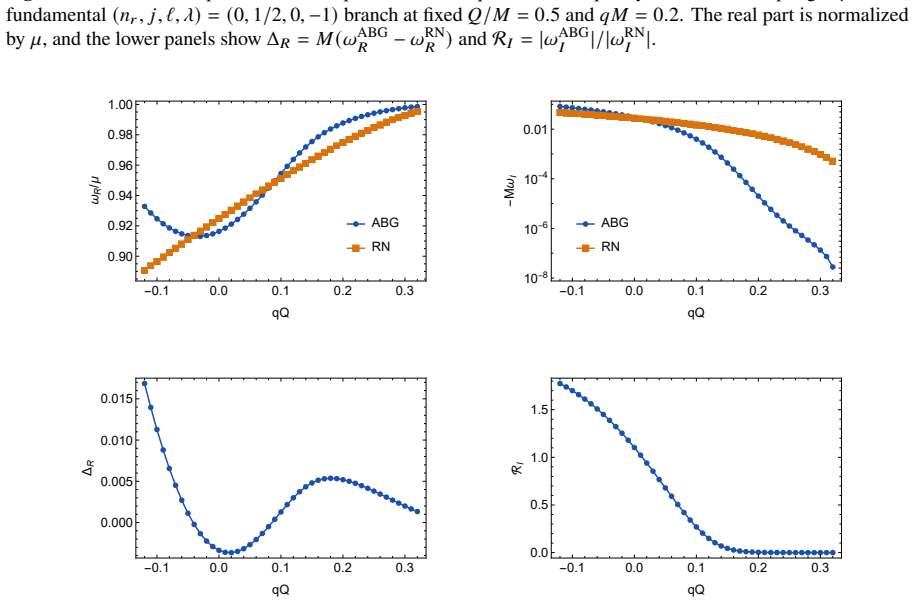
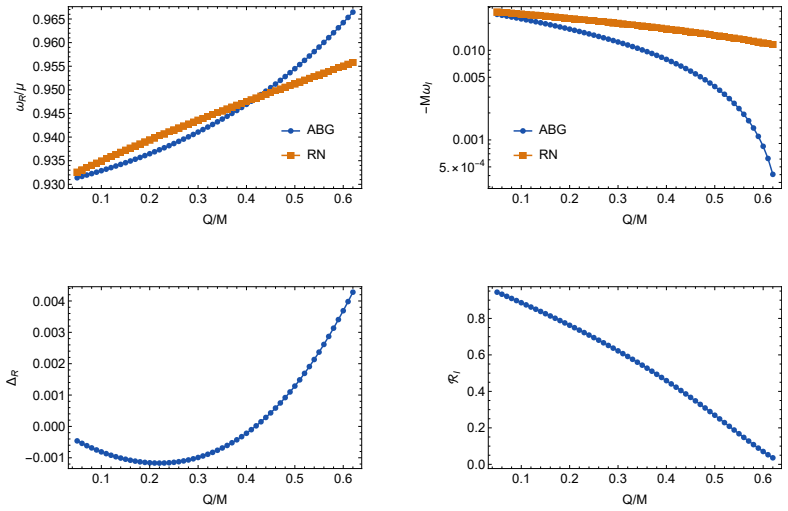
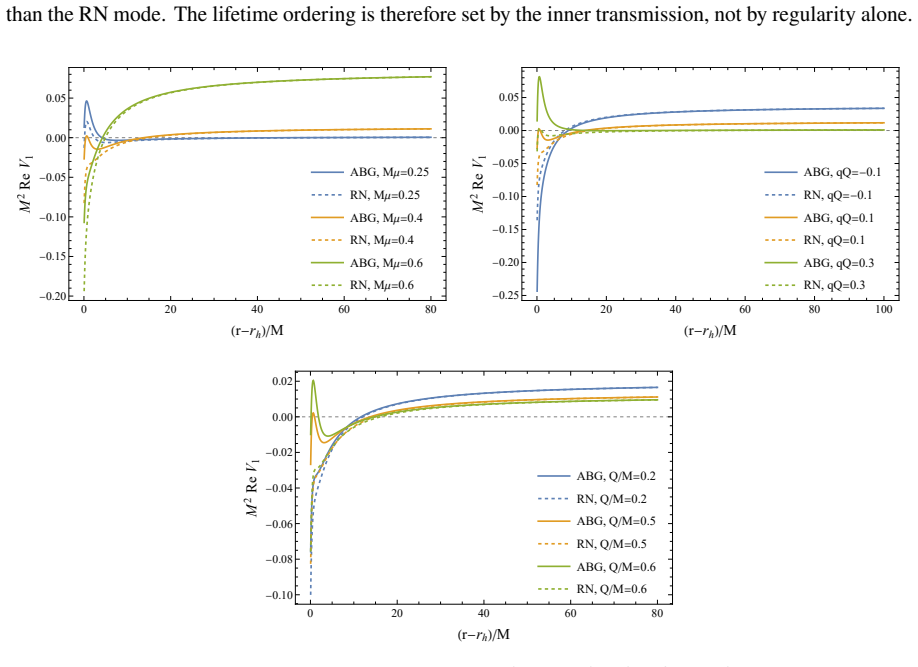
- [Abstract, §4.2, Fig. 3] §4.2, Figs. 2–4 and abstract: The lifetime ratio R_I is not uniformly less than one. For negative or weakly positive qQ the ABG mode can decay faster than RN (Fig. 3), while for larger positive qQ and larger Q/M the ABG inner barrier can strongly suppress |ω_I|. The abstract and summary currently emphasize longer-lived ABG modes; they should briefly acknowledge the parameter-dependent ordering so the main physical message matches the full scans.
minor comments (5)
- [§3.5, Table 1] §3.5 and Appendix A: The hydrogenic N labeling and the two λ branches are clear, but a one-line reminder in the table captions that N=n_r+ℓ+1 is branch-dependent would help readers comparing Table 1 to the analytic formulas.
- [Fig. 5, §4.2] Fig. 5: The caption correctly notes that V_1 is evaluated at the hydrogenic real frequency and is only a qualitative diagnostic. Consider adding a short sentence in the main text that the plotted barrier heights are not used as eigenvalue inputs, to avoid any misreading of the figure as an independent spectral calculation.
- [§5.2, Table 2] §5.2, Table 2: The n_r=3 imaginary part is already flagged as less reliable; stating the fitting-window range used for that entry (or omitting |ω_I| for n_r≥3 and reporting only Re ω) would tighten the time-domain comparison.
- [§6] §6: The SI conversion formulas are useful; a brief note that the quoted 10 M_⊙ / 10^6 M_⊙ estimates assume the moderate charge ratios of the numerical examples (not astrophysically small Q/M) would prevent over-reading the observability discussion.
- [References] References: The Dirac QBS and regular-BH QNM literature is well covered. If space allows, a pointer to any recent work on massive Dirac fields in other regular or NLED geometries (beyond the QNM papers already cited) would round out the context.
Circularity Check
No significant circularity: Dirac quasibound frequencies are independent eigenvalues of a standard linear test-field problem, not forced by fits or self-citation.
full rationale
The derivation chain is self-contained. The massive charged Dirac equation is written with minimal coupling on the fixed ABG metric; separation yields the first-order radial system (22) with standard quasibound BCs (ingoing at the horizon, exponential decay at infinity). The far-field trapping inequality Mμ²−qQω_R>0 and the shared hydrogenic Re(ω) follow from the common ABG/RN asymptotic tails (36)–(48), not from a fitted parameter. Complex frequencies are obtained by two-sided shooting of that BVP and cross-checked by characteristic time evolution plus matrix-pencil extraction; RN continued-fraction roots calibrate the code. Self-citations [37,38] supply only the scalar-superradiance contrast and unit conventions; they do not determine the Dirac eigenvalues. The no-instability claim is explicitly scoped to the scanned branches and windows, so it is not a uniqueness theorem smuggled in by citation. Nothing in the chain reduces by construction to its own inputs.
Assumptions & free parameters
free parameters (2)
- Reference scan point (Q/M, Mμ, qM) =
e.g. Q/M=0.5, Mμ=0.4, qM=0.2
- Numerical cutoffs (ε_h, r_∞, N_h, N_∞, r_m, Δx) =
e.g. Δx=Δt=0.5M, t_max=10^5 M in the TD benchmark
assumptions (5)
- domain assumption Classical Einstein gravity coupled to the ABG nonlinear-electrodynamics solution is an acceptable fixed background for linear Dirac perturbations.
- domain assumption The Dirac field is minimally coupled (tetrad + spin connection + qA_μ only); no Pauli or curvature nonminimal terms.
- domain assumption Quasibound boundary conditions: purely ingoing at the event horizon and exponentially decaying at infinity (Re k < 0).
- domain assumption Absence of single-particle Dirac black-hole superradiant amplification in standard settings (used as consistency context).
- standard math Standard separation of the Dirac equation on static spherical backgrounds and spin-1/2 angular eigenvalues |λ|=j+1/2.
Cite this review
Pith. "Pith review of Quasibound states of a charged Dirac field around regular black holes." pith.science (2026). https://pith.science/paper/W7JBFOJE
@misc{pith2026260629704,
  author       = {Pith},
  title        = {Pith review of: Quasibound states of a charged Dirac field around regular black holes},
  year         = {2026},
  howpublished = {\url{https://pith.science/paper/W7JBFOJE}},
  note         = {Machine review of arXiv:2606.29704}
}
abstract
Charged regular black holes can respond differently from Reissner--Nordstr\"om (RN) black holes to charged scalar perturbations, raising the question of whether their inner geometry also leaves a distinct imprint on fermionic fields, for which classical superradiant amplification is absent. We address this question by studying quasibound states of a massive charged Dirac field on the Ay\'on-Beato--Garc\'{\i}a (ABG) regular black-hole background. We derive the separated radial equations and the far-field trapping condition $M\mu^2-qQ\omega_R>0$, compute the complex spectrum by two-sided shooting and matching, and independently identify the long-lived modes in time-domain evolutions. The identical Newtonian and Coulomb tails of ABG and RN produce the same leading hydrogenic spectrum, so their real frequencies differ only through subleading corrections and full radial matching. The damping rates are much more sensitive to the inner geometry: changes in the near-horizon potential barrier suppress or enhance the leakage of the fermionic cloud into the horizon, and some ABG modes live more than an order of magnitude longer than their RN counterparts despite having nearly identical real frequencies. All modes found in the explored parameter range remain damped. Thus the regular geometry changes the lifetime, rather than the leading binding energy, of the fermionic cloud without generating a Dirac superradiant instability.
Figures

Figures from the paper (4 more)
Reviewed July 12, 2026 · model on record in the stance chip above.
Discussion (0). Continue with ORCID to comment.