Managing Map Cardinality in Automatic Disease Classification Mapping: Balancing Precision, Recall and Coverage
Pith reviewed 2026-06-30 06:29 UTC · model grok-4.3
The pith
A blocking step followed by LLM matching maps ICD codes across versions with higher precision, comparable recall and wider coverage than threshold or top-K baselines.
A machine-rendered reading of the paper's core claim, the machinery that carries it, and where it could break.
Core claim
The central claim is that a two-stage blocking-and-matching pipeline produces higher precision with comparable recall and broader mapping coverage than threshold-based or top-K selection when applied to ICD version pairs.
What carries the argument
The blocking-and-matching pipeline: blocking generates candidate sets and an LLM then identifies every valid mapping inside each set.
If this is right
- One-to-many mappings become feasible without the precision-recall trade-offs seen in single-choice methods.
- A larger fraction of source codes receive at least one target mapping.
- The same pipeline can be applied to additional ICD version transitions beyond the two pairs tested.
- Longitudinal health-data studies gain from mappings that preserve more information while reducing erroneous links.
Where Pith is reading between the lines
- The approach could extend to other medical terminologies or entity-resolution tasks outside ICD if suitable blocking rules are defined.
- Improvements in LLM accuracy would directly raise the ceiling on precision and coverage without altering the blocking component.
- Scalability limits may appear when blocks grow large or when the underlying LLM changes.
- The method's success depends on the quality of the initial blocking rules, which the paper treats as given.
Load-bearing premise
Every true mapping must appear inside the blocks produced by the first step, and the LLM must list all valid mappings inside those blocks without adding false positives or omitting true ones.
What would settle it
A controlled test in which known true mappings are deliberately left out of the generated blocks or the LLM is shown to miss valid mappings or add incorrect ones on a held-out ICD mapping set.
Figures

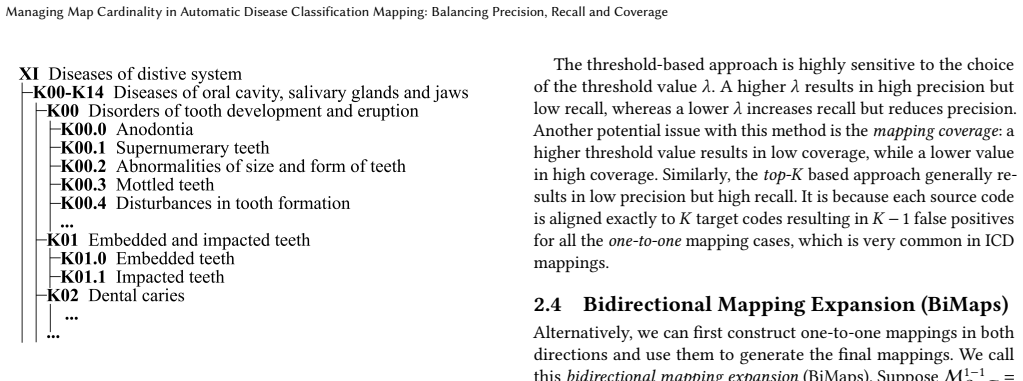
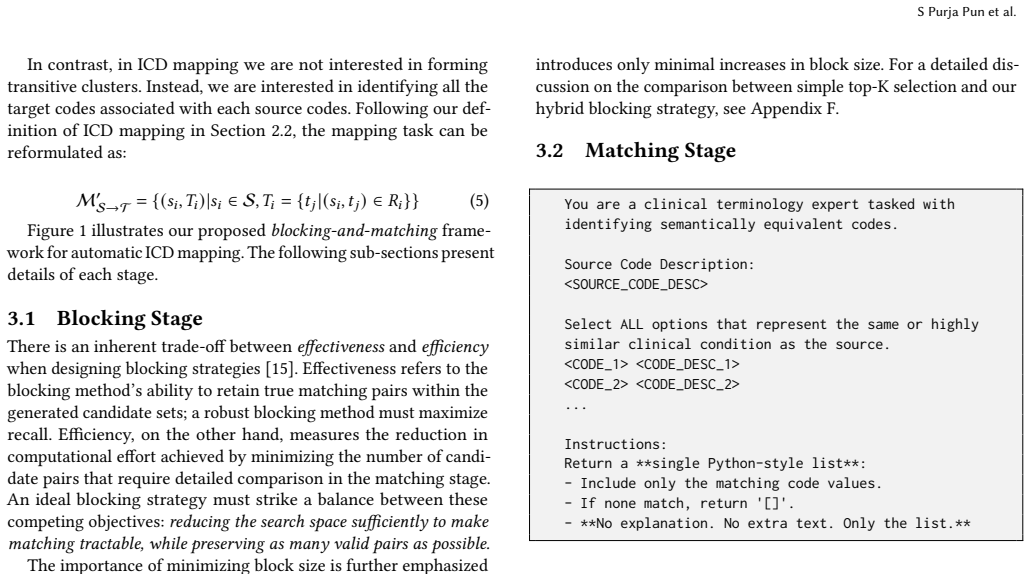

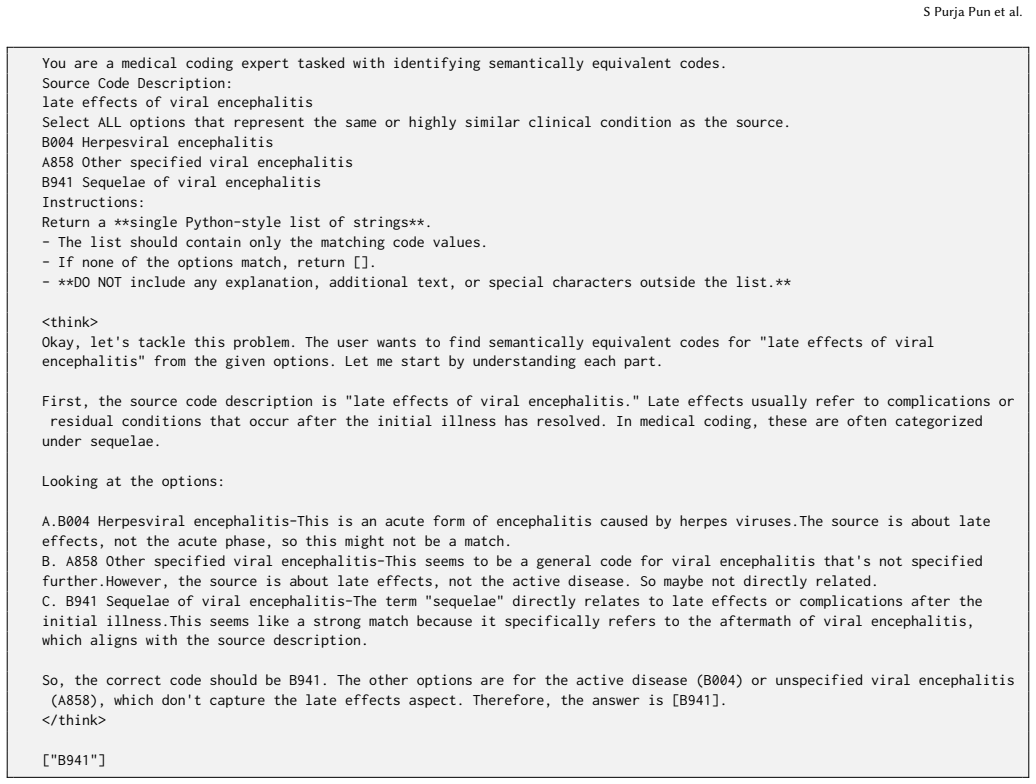
read the original abstract
Automatic mapping between disease classification systems, such as the International Classification of Diseases (ICD), is a challenging yet essential task for integrating health data and conducting longitudinal data analysis. Existing embedding-based methods primarily focus on \emph{one-to-one} mappings, overlooking more complex \emph{one-to-many} scenarios. The threshold-based and top-K methods offer natural extensions; however, they involve inherent trade-offs between \emph{precision}, \emph{recall} and \emph{mapping coverage} -- the proportion of source codes with at least one mapping to a target code. To address this challenge, we introduce a novel method, which is inspired by the \emph{blocking-and-matching} pipeline commonly used in \emph{entity resolution}. In particular, we first generate a block of candidate matches (\emph{blocking}) and then employ a large language model (LLM) to identify all valid mappings within each block (\emph{matching}). Empirically, we show that the proposed method achieves higher precision with comparable recall and broader coverage across multiple ICD version pairs (ICD-9-CM$\leftrightarrow$ICD-10-CM and ICD-10-AM$\leftrightarrow$ICD-11). Our source code and dataset is available at: https://tinyurl.com/46kyn7wp.
Editorial analysis
A structured set of objections, weighed in public.
Referee Report
Summary. The paper claims to introduce a blocking-and-matching pipeline inspired by entity resolution for mapping between ICD disease classification systems. It generates candidate blocks and uses an LLM to find all valid mappings within blocks to handle one-to-many scenarios, reporting higher precision, comparable recall, and broader coverage on ICD-9-CM↔ICD-10-CM and ICD-10-AM↔ICD-11 pairs compared to threshold and top-K methods.
Significance. If the empirical results are robustly validated with proper controls, the approach could advance automatic mapping of disease codes by addressing the precision-recall-coverage trade-off in health data integration. The public release of code and data is a positive for reproducibility.
major comments (2)
- Abstract: The abstract states that the proposed method achieves higher precision with comparable recall and broader coverage, but supplies no details on baselines, statistical tests, block-size choices, or error analysis. This prevents assessment of whether the gains stem from the method or from unverified assumptions about the blocking and LLM stages.
- Abstract: The central empirical claim depends on the blocking step producing candidate sets containing all true mappings and the LLM correctly identifying every valid mapping without false positives. No measurements of blocking recall or LLM false-positive/false-negative rates on the ICD pairs are reported, which is required to attribute improvements to the pipeline.
minor comments (1)
- The sentence 'Our source code and dataset is available' contains a subject-verb agreement error ('is' should be 'are').
Simulated Author's Rebuttal
We thank the referee for the constructive feedback on the abstract and the need for greater transparency in the empirical claims. We address each point below and indicate where revisions will be made.
read point-by-point responses
-
Referee: Abstract: The abstract states that the proposed method achieves higher precision with comparable recall and broader coverage, but supplies no details on baselines, statistical tests, block-size choices, or error analysis. This prevents assessment of whether the gains stem from the method or from unverified assumptions about the blocking and LLM stages.
Authors: We agree the abstract is concise and omits these specifics due to length limits. The full manuscript describes the threshold-based and top-K baselines in Section 3, reports statistical significance testing on the precision/recall/coverage results in Section 4, and details block-size selection in the experimental setup. We will revise the abstract to briefly name the baselines and add a pointer to the full experimental controls; a short error analysis subsection will also be added to the results. revision: partial
-
Referee: Abstract: The central empirical claim depends on the blocking step producing candidate sets containing all true mappings and the LLM correctly identifying every valid mapping without false positives. No measurements of blocking recall or LLM false-positive/false-negative rates on the ICD pairs are reported, which is required to attribute improvements to the pipeline.
Authors: This observation is correct and highlights a gap in the current presentation. To substantiate that gains arise from the pipeline rather than unverified assumptions, we will add explicit measurements of blocking recall (fraction of gold mappings retained in the candidate blocks) and per-stage LLM precision/recall on the ICD-9/10 and 10-AM/11 pairs. These will be reported alongside block-size sensitivity results in the revised experimental section. revision: yes
Circularity Check
No circularity: empirical pipeline on external data
full rationale
The paper describes an empirical blocking-plus-LLM pipeline evaluated on external ICD version pairs. No equations, fitted parameters, or self-citation chains appear in the provided text. The central claims rest on reported experimental outcomes rather than any derivation that reduces to its own inputs by construction. The method is presented as a practical pipeline whose performance is measured against held-out mappings; this structure is self-contained and does not trigger any of the enumerated circularity patterns.
Axiom & Free-Parameter Ledger
axioms (1)
- domain assumption Large language models can reliably identify all valid mappings within small candidate blocks generated by a blocking function.
Reference graph
Works this paper leans on
-
[1]
Juba Agoun and Mohand-Saïd Hacid. 2022. Access control based on entity matching for secure data sharing.Service Oriented Computing and Applications 16, 1 (2022), 31–44
2022
-
[2]
JL Allones, Diego Martinez, and Maria Taboada. 2014. Automated mapping of clinical terms into SNOMED-CT. An application to codify procedures in pathology.Journal of medical systems38 (2014), 1–14
2014
-
[3]
Omar Benjelloun, Hector Garcia-Molina, David Menestrina, Qi Su, Steven Eui- jong Whang, and Jennifer Widom. 2009. Swoosh: a generic approach to entity resolution.The VLDB Journal18, 1 (2009), 255–276
2009
-
[4]
Tom Brown, Benjamin Mann, Nick Ryder, Melanie Subbiah, Jared D Kaplan, Prafulla Dhariwal, Arvind Neelakantan, Pranav Shyam, Girish Sastry, Amanda Askell, et al. 2020. Language models are few-shot learners.Advances in neural information processing systems33 (2020), 1877–1901
2020
-
[5]
Ursin Brunner and Kurt Stockinger. 2020. Entity matching with transformer architectures-a step forward in data integration. In23rd International Conference on Extending Database Technology. 463–473
2020
-
[6]
arXiv preprint arXiv:2510.05381 , year=
Yufeng Du, Minyang Tian, Srikanth Ronanki, Subendhu Rongali, Sravan Bodapati, Aram Galstyan, Azton Wells, Roy Schwartz, Eliu A Huerta, and Hao Peng. 2025. Context length alone hurts LLM performance despite perfect retrieval.arXiv preprint arXiv:2510.05381(2025). 4The residual codes are categories used to classify clinical condition that is either non-spec...
-
[7]
Ivan P Fellegi and Alan B Sunter. 1969. A theory for record linkage.Journal of the American statistical association64, 328 (1969), 1183–1210
1969
-
[8]
Avigdor Gal. 2014. Uncertain entity resolution: Re-evaluating entity resolution in the big data era: Tutorial.Proceedings of the VLDB Endowment7, 13 (2014), 1711–1712
2014
- [9]
-
[10]
Kuo-Chuan Huang, James Geller, Michael Halper, Yehoshua Perl, and Junchuan Xu. 2009. Using WordNet synonym substitution to enhance UMLS source inte- gration.Artificial intelligence in medicine46, 2 (2009), 97–109
2009
-
[11]
Nelson F Liu, Kevin Lin, John Hewitt, Ashwin Paranjape, Michele Bevilacqua, Fabio Petroni, and Percy Liang. 2024. Lost in the middle: How language models use long contexts.Transactions of the Association for Computational Linguistics 12 (2024), 157–173
2024
-
[12]
Angelo Moretti and Natalie Shlomo. 2023. Improving probabilistic record linkage using statistical prediction models.International Statistical Review91, 3 (2023), 368–394
2023
-
[13]
Avanika Narayan, Ines Chami, Laurel Orr, Simran Arora, and Christopher Ré
- [14]
-
[15]
World Health Organization et al. 2021. WHO-FIC classifications and terminology mapping: principles and best practice
2021
-
[16]
George Papadakis, Dimitrios Skoutas, Emmanouil Thanos, and Themis Palpanas
-
[17]
Blocking and filtering techniques for entity resolution: A survey.ACM Computing Surveys (CSUR)53, 2 (2020), 1–42
2020
-
[18]
Santosh Purja Pun, Oliver Obst, Jim Basilakis, and Jeewani Anupama Ginige. 2025. Managing Data Uncertainty in Automatic Mapping of Clinical Classification Systems. InPacific-Asia Conference on Knowledge Discovery and Data Mining. 284–295
2025
-
[19]
Santosh Purja Pun, Oliver Obst, Jim Basilakis, and Jeewani Anupama Ginige. 2026. On embedding-based automatic mapping of clinical classification system: handling linguistic variations and granular incon- sistencies.Journal of the American Medical Informatics Association (01 2026), ocag004. arXiv:https://academic.oup.com/jamia/advance-article- pdf/doi/10.1...
work page doi:10.1093/jamia/ocag004/66645285/ocag004.pdf 2026
-
[20]
Nils Reimers and Iryna Gurevych. 2019. Sentence-BERT: Sentence Embeddings using Siamese BERT-Networks. InProceedings of the 2019 Conference on Em- pirical Methods in Natural Language Processing. Association for Computational Linguistics. https://arxiv.org/abs/1908.10084
work page internal anchor Pith review Pith/arXiv arXiv 2019
-
[21]
Vivek Sehgal, Lise Getoor, and Peter D Viechnicki. 2006. Entity resolution in geospatial data integration. InProceedings of the 14th annual ACM international symposium on Advances in geographic information systems. 83–90
2006
-
[22]
Aarush Sinha, OmKumar Chandra Umakanthan, and Sudhakaran Gajendran
-
[23]
DR-CoT: dynamic recursive chain of thought with meta reasoning for parameter efficient models.Scientific Reports15, 1 (2025), 34773
2025
- [24]
-
[25]
Yefeng Wang, Jon Patrick, Graeme Miller, and Julie O’Hallaran. 2008. A compu- tational linguistics motivated mapping of ICPC-2 PLUS to SNOMED CT. InBMC medical informatics and decision making, Vol. 8. 1–8
2008
-
[26]
Huiping Xu, Xiaochun Li, and Shaun Grannis. 2022. A simple two-step procedure using the Fellegi–Sunter model for frequency-based record linkage.Journal of Applied Statistics49, 11 (2022), 2789–2804
2022
-
[27]
Julia Xu, Kin Wah Fung, and Olivier Bodenreider. 2022. Sequential mapping–a novel approach to map from ICD-10-CM to ICD-11.Studies in health technology and informatics290 (2022), 96
2022
- [28]
-
[29]
An Yang, Anfeng Li, Baosong Yang, Beichen Zhang, Binyuan Hui, Bo Zheng, Bowen Yu, Chang Gao, Chengen Huang, Chenxu Lv, et al. 2025. Qwen3 technical report.arXiv preprint arXiv:2505.09388(2025)
work page internal anchor Pith review Pith/arXiv arXiv 2025
-
[30]
late effects of viral encephalitis
Puning Zhang and Xuyuan Kang. 2020. Similar physical entity matching strategy for mobile edge search.Digital Communications and Networks6, 2 (2020), 203– 209. A Dataset Details A.1 Source We used the ICD-9-CM (version 32) from the Centres for Medicare and Medicaid Services (CMS)5 and the ICD-10-CM (FY22 release) from the Centers for Disease Control and Pr...
2020
discussion (0)
Sign in with ORCID, Apple, or X to comment. Anyone can read and Pith papers without signing in.