Multipartite quantum resource distillation through local measurement programs
Pith reviewed 2026-06-30 06:18 UTC · model grok-4.3
The pith
Local measurement programs distill multipartite quantum resources from noisy states without extra copies.
A machine-rendered reading of the paper's core claim, the machinery that carries it, and where it could break.
Core claim
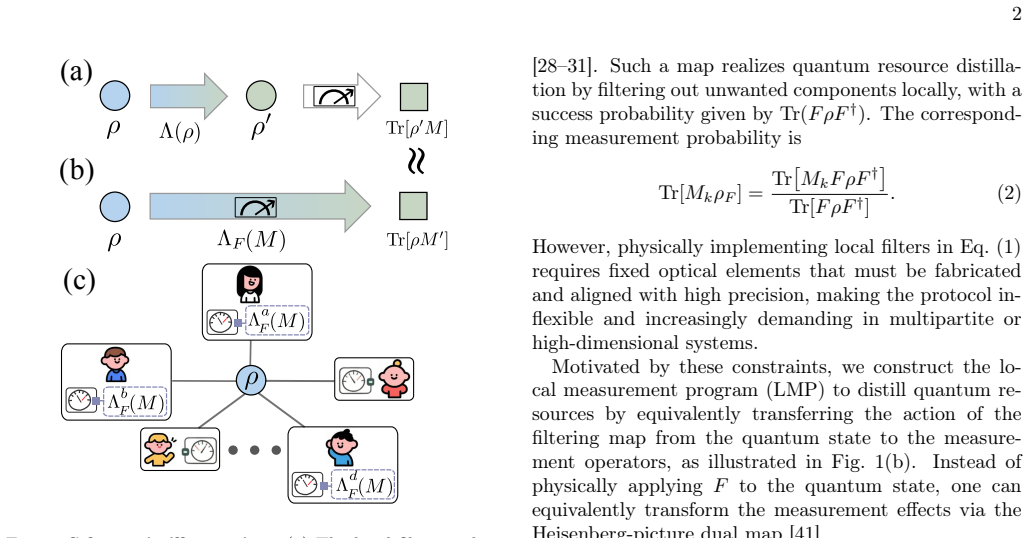
Quantum resource distillation is performed by local measurement programs that realize completely positive trace-preserving maps through programmable local measurements, with experimental demonstrations in photonic bipartite and tripartite systems that activate and enhance multipartite steering, and with virtual distillation naturally included in the same framework.
What carries the argument
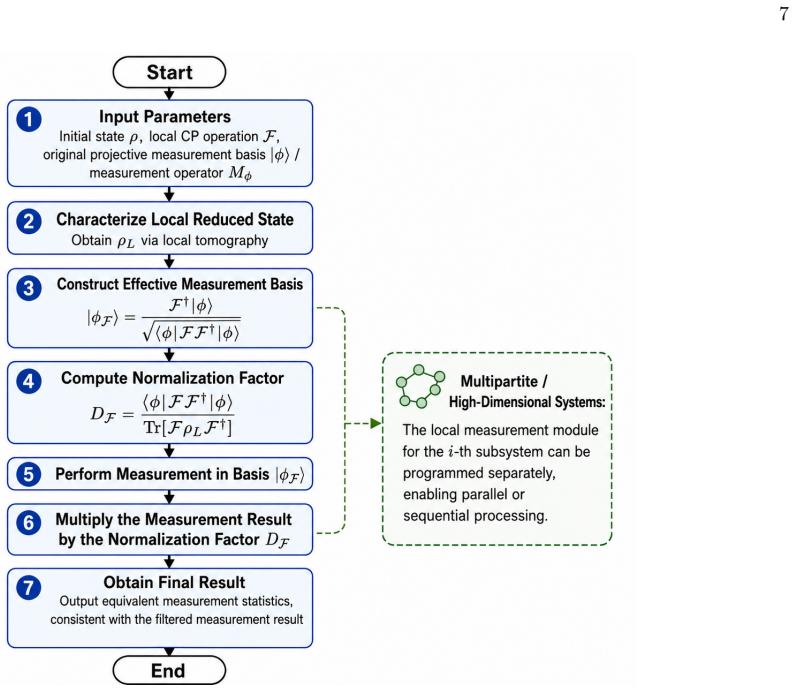
Local measurement program (LMP) that transfers completely positive maps into programmable measurement processes.
If this is right
- Distillation proceeds without requiring additional resource copies or physical filtering elements.
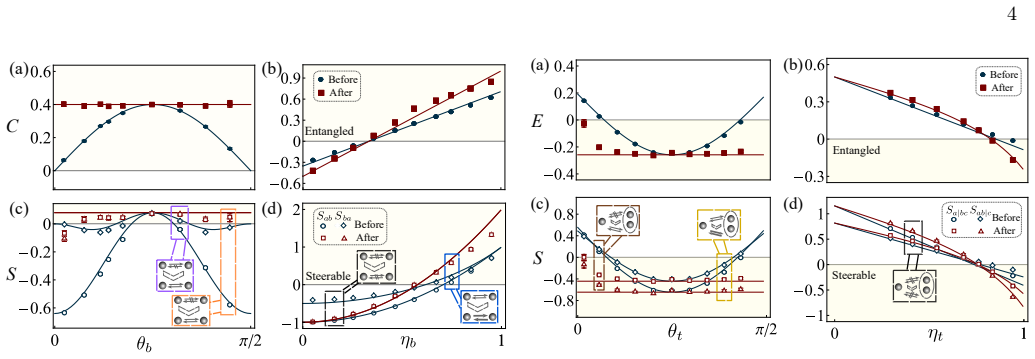
- Multipartite steering can be activated and enhanced in tripartite photonic systems.
- Virtual resource distillation fits inside the same LMP framework.
- The method scales to multipartite and higher-dimensional systems for network use.
Where Pith is reading between the lines
- Existing photonic hardware nodes could perform distillation locally with only measurement control.
- The approach may extend to distilling other resources such as coherence in similar network settings.
- Larger networks might use LMP sequences to counteract cumulative channel loss across multiple links.
Load-bearing premise
That the local measurement programs can be realized in photonic hardware with sufficient fidelity and without introducing unaccounted noise or loss that would negate the distillation gain.
What would settle it
An experiment in which the output state after the LMP sequence shows lower steering strength or fidelity than the input state due to accumulated experimental errors.
Figures
read the original abstract
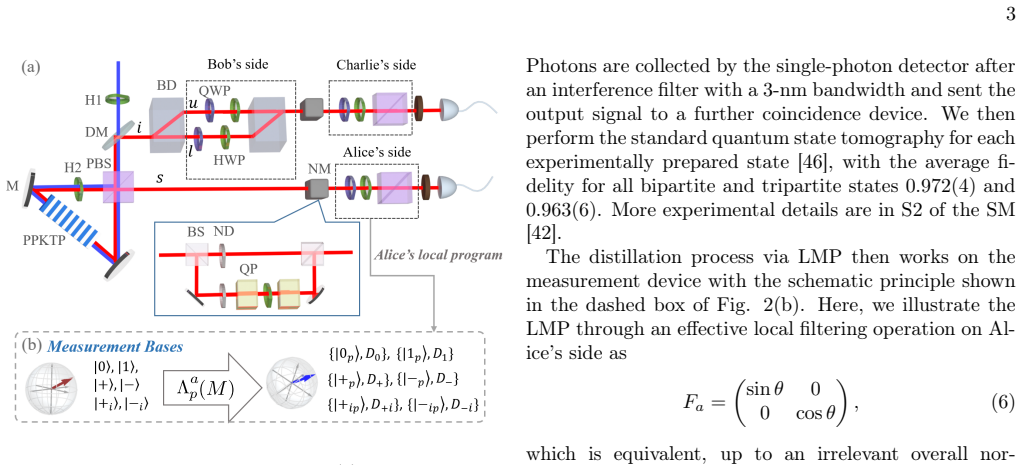
Distributed quantum resources in practical multi-user quantum networks are inevitably degraded by environmental noise, channel loss, and device-induced imperfections. To address these issues, quantum resource distillation offers a fundamental approach to recovering stronger resources from imperfect states. However, conventional implementations often require additional copies, dedicated physical filtering elements, or restrict to bipartite systems, posing challenges for scalable multipartite networks. Here, we introduce the method of quantum resource distillation based on the local measurement program (LMP), which transfers completely positive maps into programmable measurement processes. We experimentally demonstrate the performance of resource distillation through LMP in both bipartite and tripartite photonic systems, including the activation and enhancement of multipartite steering configurations. To demonstrate the flexibility and extensibility of the LMP framework, we also show that virtual resource distillation can be naturally reformulated within it. Our results establish a programmable and experimentally economical approach for distilling quantum resources in multipartite and higher-dimensional systems, thereby providing a practical route toward scalable quantum networks.
Editorial analysis
A structured set of objections, weighed in public.
Referee Report
Summary. The manuscript introduces local measurement programs (LMP) as a method to realize completely positive maps via programmable local measurements for distilling quantum resources. It experimentally demonstrates LMP-based distillation in bipartite and tripartite photonic systems, including quantitative improvements in resource quantifiers, activation and enhancement of multipartite steering, and reformulation of virtual resource distillation within the LMP framework.
Significance. If the experimental results hold, the LMP approach provides a flexible, programmable, and copy-efficient route to multipartite resource distillation that avoids dedicated filters or additional state copies, directly addressing scalability challenges in noisy quantum networks. The photonic implementations with explicit optical setups, post-selection, and reported before/after quantifiers with error bars constitute a concrete experimental validation; the natural inclusion of virtual distillation further demonstrates extensibility of the framework.
minor comments (3)
- [§3.2, Fig. 4] §3.2 and Fig. 4: the caption for the tripartite steering activation data should explicitly state the number of experimental runs and the precise definition of the steering quantifier used (e.g., whether it is the steering robustness or a normalized witness).
- [Eq. (7)] Eq. (7): the normalization factor in the definition of the LMP Kraus operators appears to depend on the input state; clarify whether this is by design or if an alternative state-independent normalization is possible.
- [Table 1] Table 1: the reported fidelity values for the distilled states lack a direct comparison column to the theoretical maximum achievable under the same loss model; adding this would strengthen the claim of near-optimal performance.
Simulated Author's Rebuttal
We thank the referee for the positive summary, significance assessment, and recommendation of minor revision. The report correctly identifies the core contributions of the LMP framework for programmable multipartite resource distillation and its experimental demonstration in photonic systems.
Circularity Check
No significant circularity
full rationale
The manuscript is an experimental demonstration of LMP-based resource distillation in photonic systems for bipartite and tripartite cases. LMP is introduced as a definition that maps CP maps to programmable measurements, with explicit optical setups, post-selection, and before/after quantifiers reported with error bars. No equations, fitted parameters renamed as predictions, or load-bearing self-citations appear in the provided text; the central claims rest on measured data rather than any derivation that reduces to its own inputs by construction.
Axiom & Free-Parameter Ledger
Reference graph
Works this paper leans on
-
[1]
Otfried Gühne, Erkka Haapasalo, Tristan Kraft, Juha- Pekka Pellonpää, and Roope Uola, Colloquium: Incom- patible measurements in quantum information science, Rev. Mod. Phys.95, 011003 (2023)
2023
-
[2]
Bennett, Gilles Brassard, Claude Crépeau, Richard Jozsa, Asher Peres, and William K
Charles H. Bennett, Gilles Brassard, Claude Crépeau, Richard Jozsa, Asher Peres, and William K. Wootters, Teleporting an unknown quantum state via dual classical and einstein-podolsky-rosen channels, Phys. Rev. Lett. 70, 1895–1899 (1993)
1993
-
[3]
Xiao-Min Hu, Yu Guo, Bi-Heng Liu, Chuan-Feng Li, and Guang-Can Guo, Progress in quantum teleportation, Nat. Rev. Phys.5, 339–353 (2023)
2023
-
[4]
C. L. Degen, F. Reinhard, and P. Cappellaro, Quantum sensing, Rev. Mod. Phys.89, 035002 (2017)
2017
-
[5]
Economou, David Elkouss, Paul Hilaire, Liang Jiang, Hoi-Kwong Lo, and Ilan Tzitrin, Quantum repeaters: From quantum networks to the quantum internet, Rev
Koji Azuma, Sophia E. Economou, David Elkouss, Paul Hilaire, Liang Jiang, Hoi-Kwong Lo, and Ilan Tzitrin, Quantum repeaters: From quantum networks to the quantum internet, Rev. Mod. Phys.95, 045006 (2023)
2023
-
[6]
Kottmann, Tim Menke, Wai-Keong Mok, Sukin Sim, 7 Fig
Kishor Bharti, Alba Cervera-Lierta, Thi Ha Kyaw, Tobias Haug, Sumner Alperin-Lea, Abhinav Anand, Matthias Degroote, Hermanni Heimonen, Jakob S. Kottmann, Tim Menke, Wai-Keong Mok, Sukin Sim, 7 Fig. 5.The process of LMP in a practical experiment. Leong-Chuan Kwek, and Alán Aspuru-Guzik, Noisy intermediate-scale quantum algorithms, Rev. Mod. Phys. 94, 015004 (2022)
2022
-
[7]
Lidar, Review of decoherence-free subspaces, noiseless subsystems, and dynamical decoupling, in Quantum Information and Computation for Chemistry (John Wiley, Sons, Ltd, 2014) pp
Daniel A. Lidar, Review of decoherence-free subspaces, noiseless subsystems, and dynamical decoupling, in Quantum Information and Computation for Chemistry (John Wiley, Sons, Ltd, 2014) pp. 295–354
2014
-
[8]
Ryszard Horodecki, Paweł Horodecki, Michał Horodecki, and Karol Horodecki, Quantum entanglement, Rev. Mod. Phys.81, 865 (2009)
2009
-
[9]
Roope Uola, Ana C. S. Costa, H. Chau Nguyen, and Otfried Gühne, Quantum steering, Rev. Mod. Phys.92, 015001 (2020)
2020
-
[10]
Bennett, Gilles Brassard, Sandu Popescu, Benjamin Schumacher, John A
Charles H. Bennett, Gilles Brassard, Sandu Popescu, Benjamin Schumacher, John A. Smolin, and William K. Wootters, Purification of noisy entanglement and faith- ful teleportation via noisy channels, Phys. Rev. Lett.76, 722–725 (1996)
1996
-
[11]
David Deutsch, Artur Ekert, Richard Jozsa, Chiara Mac- chiavello, Sandu Popescu, and Anna Sanpera, Quantum privacy amplification and the security of quantum cryp- tography over noisy channels, Phys. Rev. Lett.77, 2818– 2821 (1996)
1996
-
[12]
Daniel Gottesman and Isaac L Chuang, Demonstrating the viability of universal quantum computation using teleportation and single-qubit operations, Nature402, 390–393 (1999)
1999
-
[13]
Jian-Wei Pan, Sara Gasparoni, Rupert Ursin, Gregor Weihs, and Anton Zeilinger, Experimental entanglement purification of arbitrary unknown states, Nature423, 417–422 (2003)
2003
-
[14]
Yue-Yang Fei, Zhenhuan Liu, Rui Zhang, Zhenyu Cai, Xu-FeiYin, YingqiuMao, LiLi, Nai-LeLiu, Yu-AoChen, andJian-WeiPan, Experimentalquantumchannelpurifi- cation, Phys. Rev. Lett.136, 110804 (2026)
2026
- [15]
-
[16]
Photonics3, 687– 695 (2009)
Jeremy L O’brien, Akira Furusawa, and Jelena Vučković, Photonic quantum technologies, Nat. Photonics3, 687– 695 (2009)
2009
-
[17]
Vatshal Srivastav, Natalia Herrera Valencia, Will Mc- Cutcheon, Saroch Leedumrongwatthanakun, Sébastien Designolle, RoopeUola, NicolasBrunner, andMehulMa- lik, Quick quantum steering: Overcoming loss and noise with qudits, Phys. Rev. X12, 041023 (2022)
2022
-
[18]
G Wendin, Quantum information processing with su- perconducting circuits: a review, Rep. Prog. Phys.80, 106001 (2017)
2017
-
[19]
Nicolas Sangouard, Christoph Simon, Hugues de Ried- matten, and Nicolas Gisin, Quantum repeaters based on atomic ensembles and linear optics, Rev. Mod. Phys.83, 33–80 (2011)
2011
-
[20]
Commun.6, 6787 (2015)
Koji Azuma, Kiyoshi Tamaki, and Hoi-Kwong Lo, All- photonic quantum repeaters, Nat. Commun.6, 6787 (2015). 8
2015
-
[21]
Stephanie Wehner, David Elkouss, and Ronald Hanson, Quantum internet: A vision for the road ahead, Science 362, eaam9288 (2018a)
-
[22]
Dougal Main, Peter Drmota, David P Nadlinger, Ellis M Ainley, Ayush Agrawal, Bethan C Nichol, Raghaven- dra Srinivas, Gabriel Araneda, and David M Lucas, Dis- tributed quantum computing across an optical network link, Nature638, 383–388 (2025)
2025
-
[23]
Eric Chitambar and Gilad Gour, Quantum resource the- ories, Rev. Mod. Phys.91, 025001 (2019)
2019
-
[24]
Xiao-Min Hu, Cen-Xiao Huang, Yu-Bo Sheng, Lan Zhou, Bi-Heng Liu, Yu Guo, Chao Zhang, Wen-Bo Xing, Yun- FengHuang, Chuan-FengLi, andGuang-CanGuo, Long- distance entanglement purification for quantum commu- nication, Phys. Rev. Lett.126, 010503 (2021)
2021
-
[25]
Lan Zhou, Cen-Xiao Huang, Yu-Bo Sheng, Yu Guo, Xiao-Min Hu, Yun-Feng Huang, Chuan-Feng Li, Guang- Can Guo, and Bi-Heng Liu, Observation of residual entanglement in entanglement purification, Phys. Rev. Lett.135, 050801 (2025)
2025
-
[26]
Yuhang Li, Junjing Xing, Dengke Qu, Huixia Gao, Lei Xiao, Jin-Ming Liu, Yunlong Xiao, and Peng Xue, Tem- poral asymmetry in entanglement distillation, Phys. Rev. Lett.135, 170801 (2025)
2025
-
[27]
Bartosz Regula, Probabilistic transformations of quan- tum resources, Phys. Rev. Lett.128, 110505 (2022)
2022
-
[28]
Nicolas Gisin, Hidden quantum nonlocality revealed by local filters, Phys. Lett. A210, 151–156 (1996)
1996
-
[29]
Paul G Kwiat, Salvador Barraza-Lopez, Andre Stefanov, and Nicolas Gisin, Experimental entanglement distilla- tion and hidden non-locality, Nature409, 1014–1017 (2001)
2001
-
[30]
Res.12, 552–562 (2024a)
Qian-Xi Zhang, Xiao-Xu Fang, and He Lu, Experimental distillation of tripartite quantum steering with an opti- mal local filtering operation, Photon. Res.12, 552–562 (2024a)
-
[31]
Tabia, Kai-Siang Chen, Yeong-Cherng Liang, and He Lu, Experimental single- copy distillation of quantumness from higher-dimensional entanglement, Phys
Xiao-Xu Fang, Gelo Noel M. Tabia, Kai-Siang Chen, Yeong-Cherng Liang, and He Lu, Experimental single- copy distillation of quantumness from higher-dimensional entanglement, Phys. Rev. Lett.134, 150201 (2025)
2025
-
[32]
Tanumoy Pramanik, Young-Wook Cho, Sang-Wook Han, Sang-Yun Lee, Yong-Su Kim, and Sung Moon, Revealing hidden quantum steerability using local filtering opera- tions, Phys. Rev. A99, 030101 (2019)
2019
-
[33]
Dominy, Alireza Shabani, and Daniel A
Jason M. Dominy, Alireza Shabani, and Daniel A. Lidar, A general framework for complete positivity, Quantum Inf. Process.15, 465–494 (2016)
2016
-
[34]
R. V. Nery, M. M. Taddei, P. Sahium, S. P. Walborn, L. Aolita, and G. H. Aguilar, Distillation of quantum steering, Phys. Rev. Lett.124, 120402 (2020)
2020
-
[35]
Commun.13, 4973 (2022)
Huan-Yu Ku, Chung-Yun Hsieh, Shin-Liang Chen, Yueh- Nan Chen, and Costantino Budroni, Complete classifica- tion of steerability under local filters and its relation with measurement incompatibility, Nat. Commun.13, 4973 (2022)
2022
-
[36]
Yang Liu, Kaimin Zheng, Haijun Kang, Dongmei Han, Meihong Wang, Lijian Zhang, Xiaolong Su, and Kunchi Peng, Distillation of gaussian einstein-podolsky-rosen steering with noiseless linear amplification, npj Quantum Inf.8, 38 (2022)
2022
-
[37]
Ze-Yan Hao, Yan Wang, Jia-Kun Li, Yu Xiang, Qiong- Yi He, Zheng-Hao Liu, Mu Yang, Kai Sun, Jin-Shi Xu, Chuan-Feng Li, and Guang-Can Guo, Filtering one- way einstein-podolsky-rosen steering, Phys. Rev. A109, 022411 (2024)
2024
-
[38]
Ryuji Takagi, Xiao Yuan, Bartosz Regula, and Mile Gu, Virtual quantum resource distillation: General frame- work and applications, Phys. Rev. A109, 022403 (2024)
2024
-
[39]
Xiao Yuan, Bartosz Regula, Ryuji Takagi, and Mile Gu, Virtual quantum resource distillation, Phys. Rev. Lett. 132, 050203 (2024)
2024
-
[40]
Ting Zhang, Yukun Zhang, Lu Liu, Xiao-Xu Fang, Qian- Xi Zhang, Xiao Yuan, and He Lu, Experimental virtual distillation of entanglement and coherence, Phys. Rev. Lett.132, 180201 (2024b)
-
[41]
Neil Dowling, Pavel Kos, and Xhek Turkeshi, Magic re- sources of the heisenberg picture, Phys. Rev. Lett.135, 050401 (2025)
2025
-
[42]
See Supplemental Material for details of local program operation, experimental setup, criterions of quantum en- tanglement and steering in bipartite and tripartite sys- tems
-
[43]
Express15, 15377–15386 (2007)
Alessandro Fedrizzi, Thomas Herbst, Andreas Poppe, Thomas Jennewein, and Anton Zeilinger, A wavelength- tunable fiber-coupled source of narrowband entangled photons, Opt. Express15, 15377–15386 (2007)
2007
-
[44]
Ya Xiao, Xiang-Jun Ye, Kai Sun, Jin-Shi Xu, Chuan- Feng Li, and Guang-Can Guo, Demonstration of multi- setting one-way einstein-podolsky-rosen steering in two- qubit systems, Phys. Rev. Lett.118, 140404 (2017)
2017
-
[45]
Commun.6, 7941 (2015)
DanielCavalcanti, PaulSkrzypczyk, GHAguilar, Ranieri V Nery, PH Souto Ribeiro, and SP Walborn, Detection of entanglement in asymmetric quantum networks and multipartite quantum steering, Nat. Commun.6, 7941 (2015)
2015
-
[46]
Daniel F. V. James, Paul G. Kwiat, William J. Munro, and Andrew G. White, Measurement of qubits, Phys. Rev. A64, 052312 (2001)
2001
-
[47]
Wootters, Entanglement of formation of an arbitrary state of two qubits, Phys
William K. Wootters, Entanglement of formation of an arbitrary state of two qubits, Phys. Rev. Lett.80, 2245– 2248 (1998)
1998
-
[48]
Yi-Zheng Zhen, Yu-Lin Zheng, Wen-Fei Cao, Li Li, Zeng-Bing Chen, Nai-Le Liu, and Kai Chen, Certifying einstein-podolsky-rosen steering via the local uncertainty principle, Phys. Rev. A93, 012108 (2016)
2016
-
[49]
A. Acín, D. Bruß, M. Lewenstein, and A. Sanpera, Clas- sification of mixed three-qubit states, Phys. Rev. Lett. 87, 040401 (2001)
2001
-
[50]
J. I. Cirac, P. Zoller, H. J. Kimble, and H. Mabuchi, Quantum state transfer and entanglement distribution among distant nodes in a quantum network, Phys. Rev. Lett.78, 3221–3224 (1997)
1997
-
[51]
L-M Duan, Mikhail D Lukin, J Ignacio Cirac, and Pe- ter Zoller, Long-distance quantum communication with atomic ensembles and linear optics, Nature414, 413–418 (2001)
2001
-
[52]
Stephanie Wehner, David Elkouss, and Ronald Hanson, Quantum internet: A vision for the road ahead, Science 362, eaam9288 (2018b)
-
[53]
Filippo Caruso, Vittorio Giovannetti, Cosmo Lupo, and Stefano Mancini, Quantum channels and memory effects, Rev. Mod. Phys.86, 1203–1259 (2014)
2014
-
[54]
Becerra, Jian Fan, and Alan Migdall, Im- plementation of generalized quantum measurements for unambiguous discrimination of multiple non-orthogonal coherent states, Nat
Fernando E. Becerra, Jian Fan, and Alan Migdall, Im- plementation of generalized quantum measurements for unambiguous discrimination of multiple non-orthogonal coherent states, Nat. Commun.4, 2028 (2013)
2028
-
[55]
Reinhold A. Bertlmann and Nicolai Friis, Quantum chan- nels and quantum operations, in Modern Quantum The- 9 ory: From Quantum Mechanics to Entanglement and Quantum Information (Oxford University Press, Oxford, UK, 2023)
2023
-
[56]
Cerf, Miloslav Dušek, Norbert Lütkenhaus, and Momtchil Peev, The security of practical quantum key distribution, Rev
Valerio Scarani, Helle Bechmann-Pasquinucci, Nicolas J. Cerf, Miloslav Dušek, Norbert Lütkenhaus, and Momtchil Peev, The security of practical quantum key distribution, Rev. Mod. Phys.81, 1301–1350 (2009)
2009
-
[57]
Neng-Chun Chiu, Elias C Trapp, Jinen Guo, Mohamed H Abobeih, Luke M Stewart, Simon Hollerith, Pavel L Stroganov, Marcin Kalinowski, Alexandra A Geim, Si- mon J Evered, et al., Continuous operation of a coherent 3,000-qubit system, Nature646, 1075–1080 (2025)
2025
-
[58]
Appl.11, 203 (2022)
Kai Sun, Ze-Yan Hao, Yan Wang, Jia-Kun Li, Xiao- Ye Xu, Jin-Shi Xu, Yong-Jian Han, Chuan-Feng Li, and Guang-Can Guo, Optical demonstration of quantum fault-tolerant threshold, Light Sci. Appl.11, 203 (2022)
2022
discussion (0)
Sign in with ORCID, Apple, or X to comment. Anyone can read and Pith papers without signing in.