Optical Appearances of Accreting Ellis-Bronnikov Wormholes Observed from Both Sides of Throats
Pith reviewed 2026-06-30 05:37 UTC · model grok-4.3
The pith
Ellis-Bronnikov wormholes with small n can mimic EHT images when viewed from one side of the throat.
A machine-rendered reading of the paper's core claim, the machinery that carries it, and where it could break.
Core claim
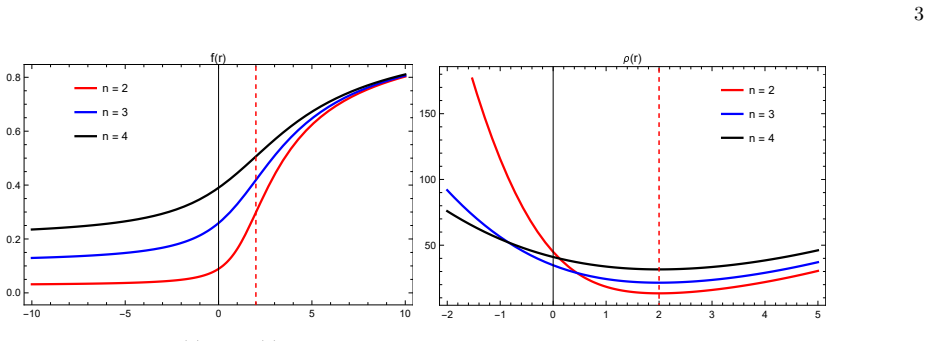
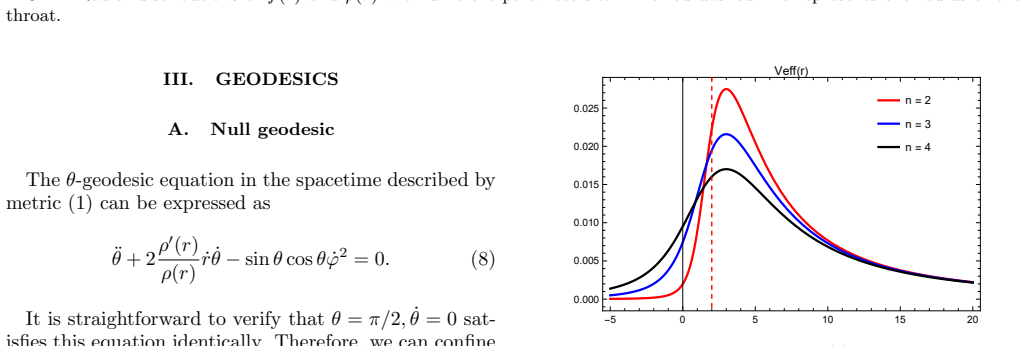
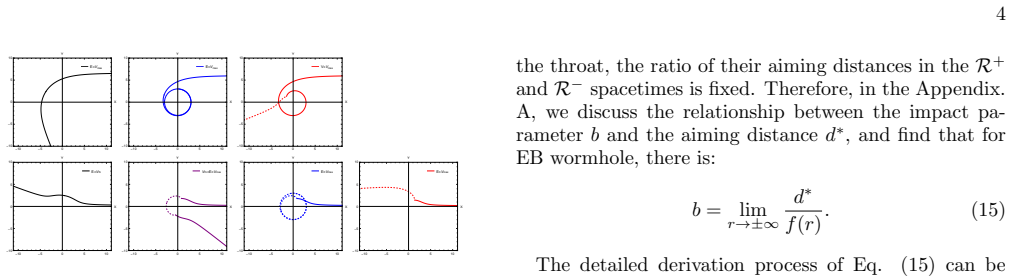
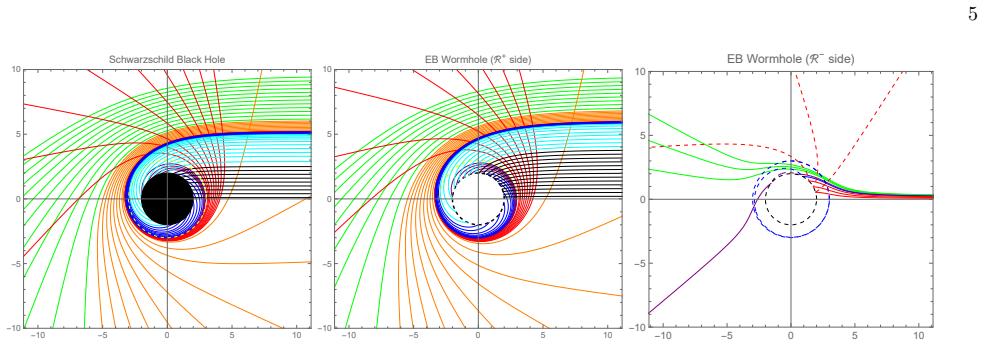
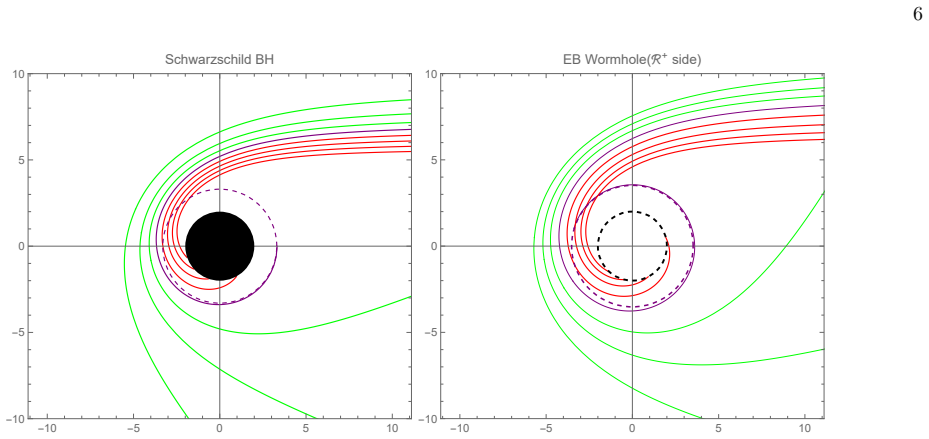
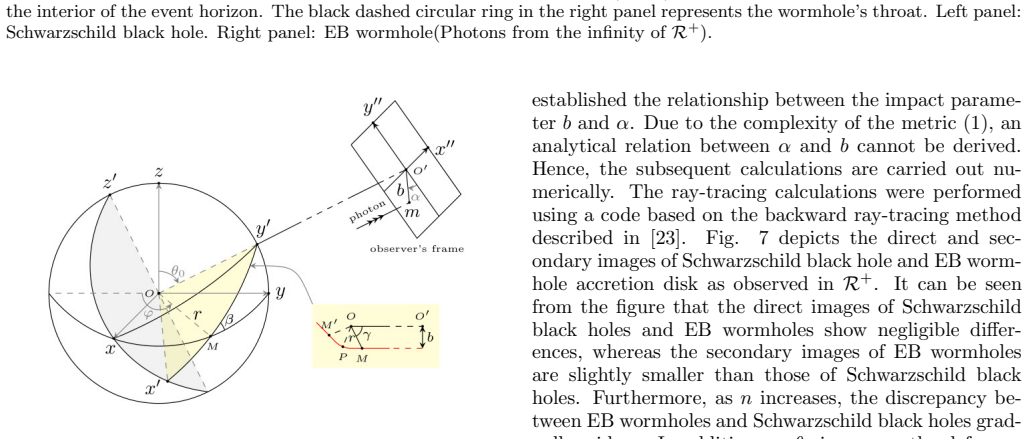
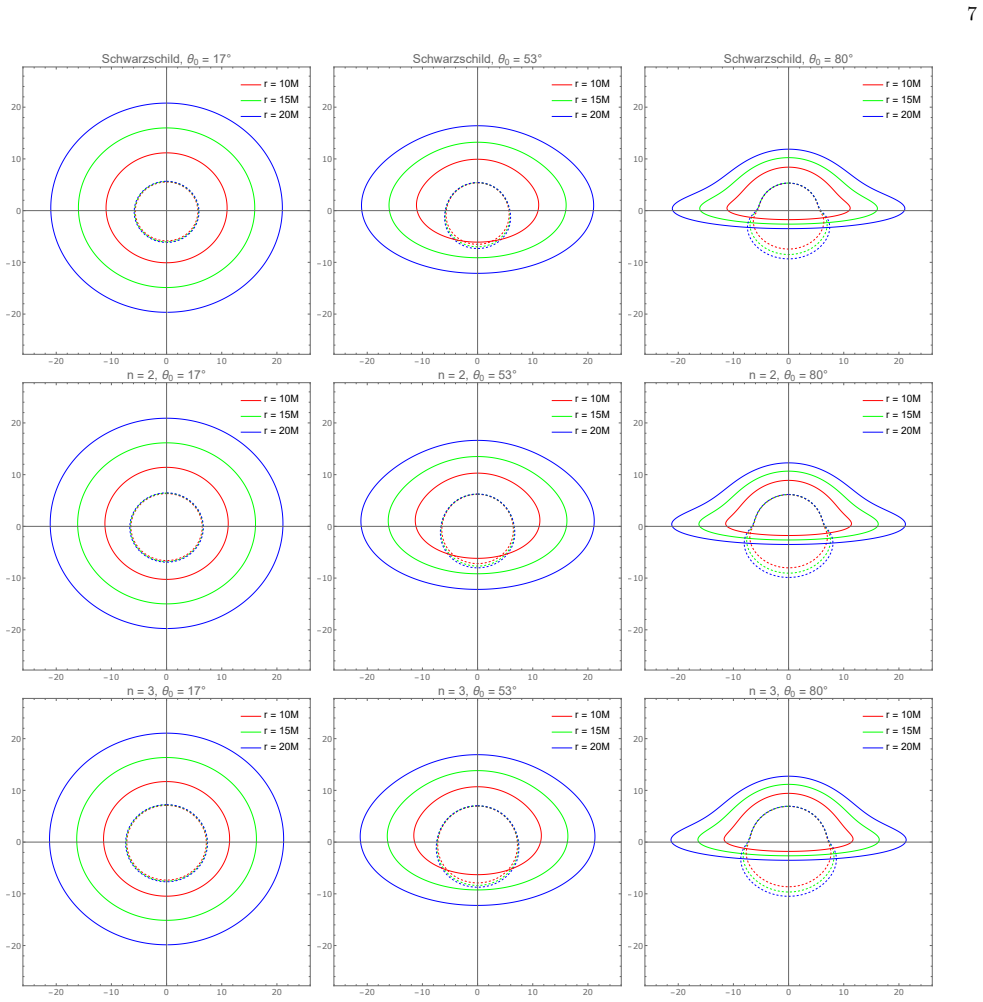
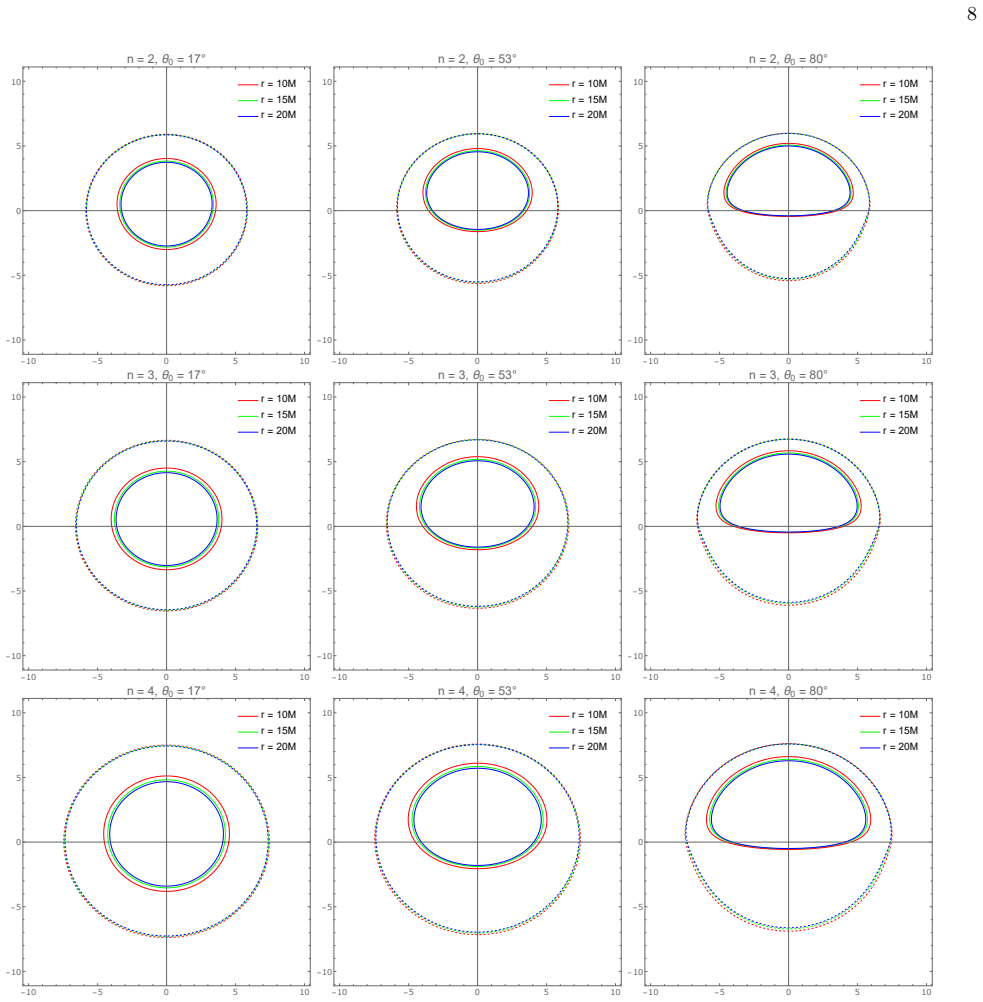
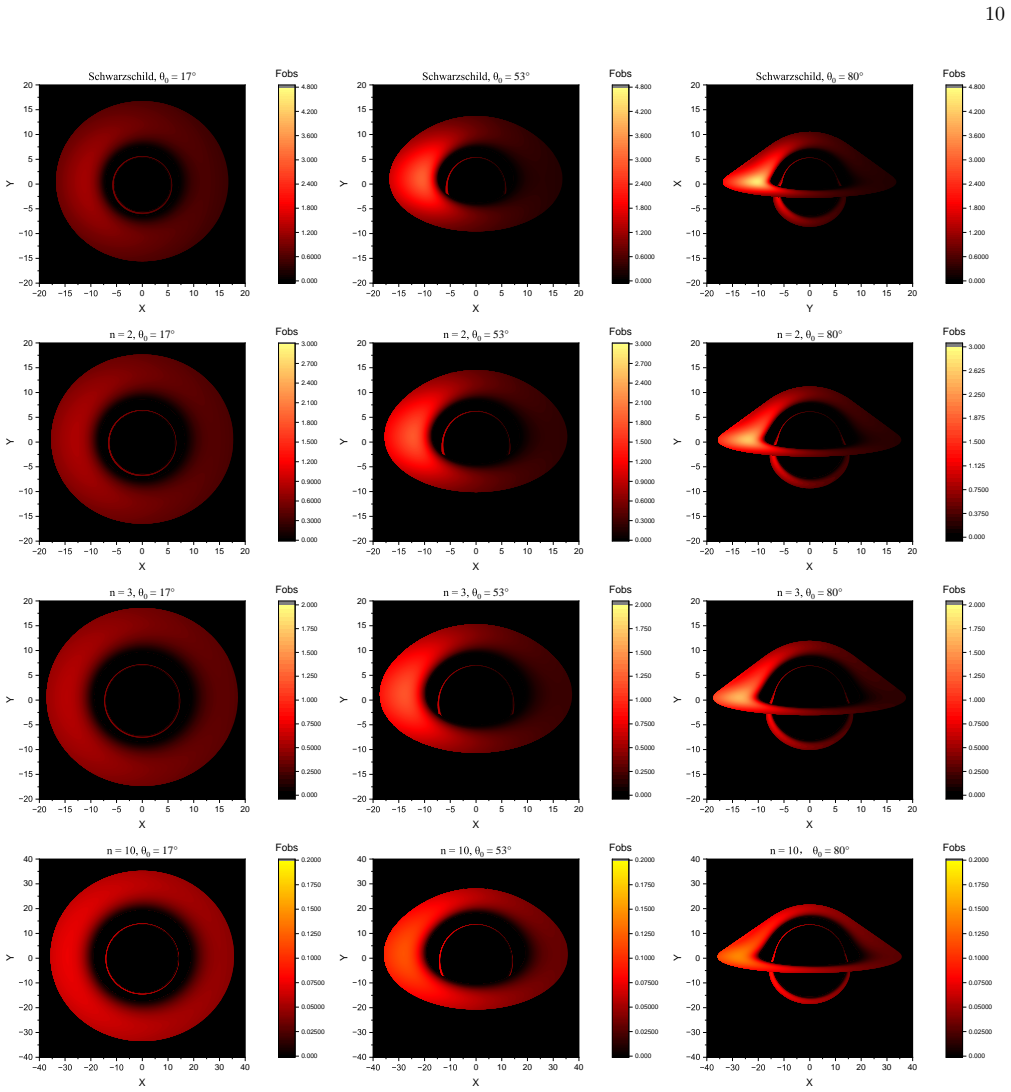
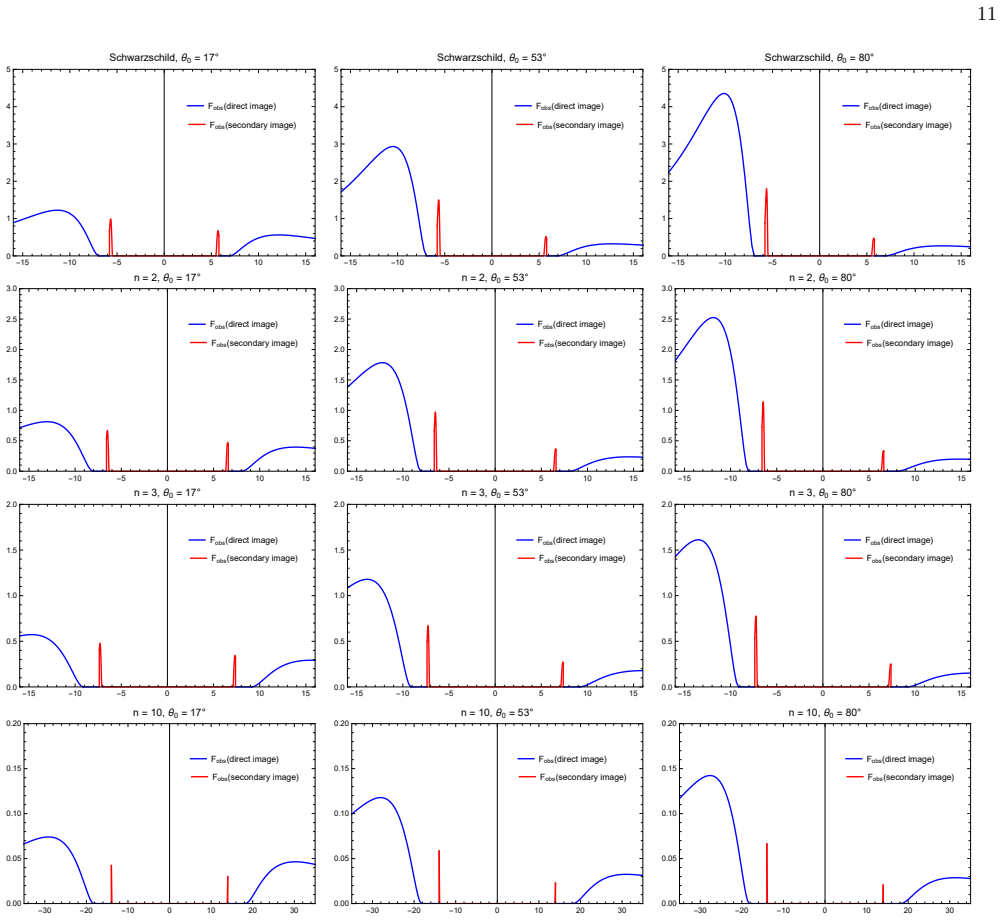
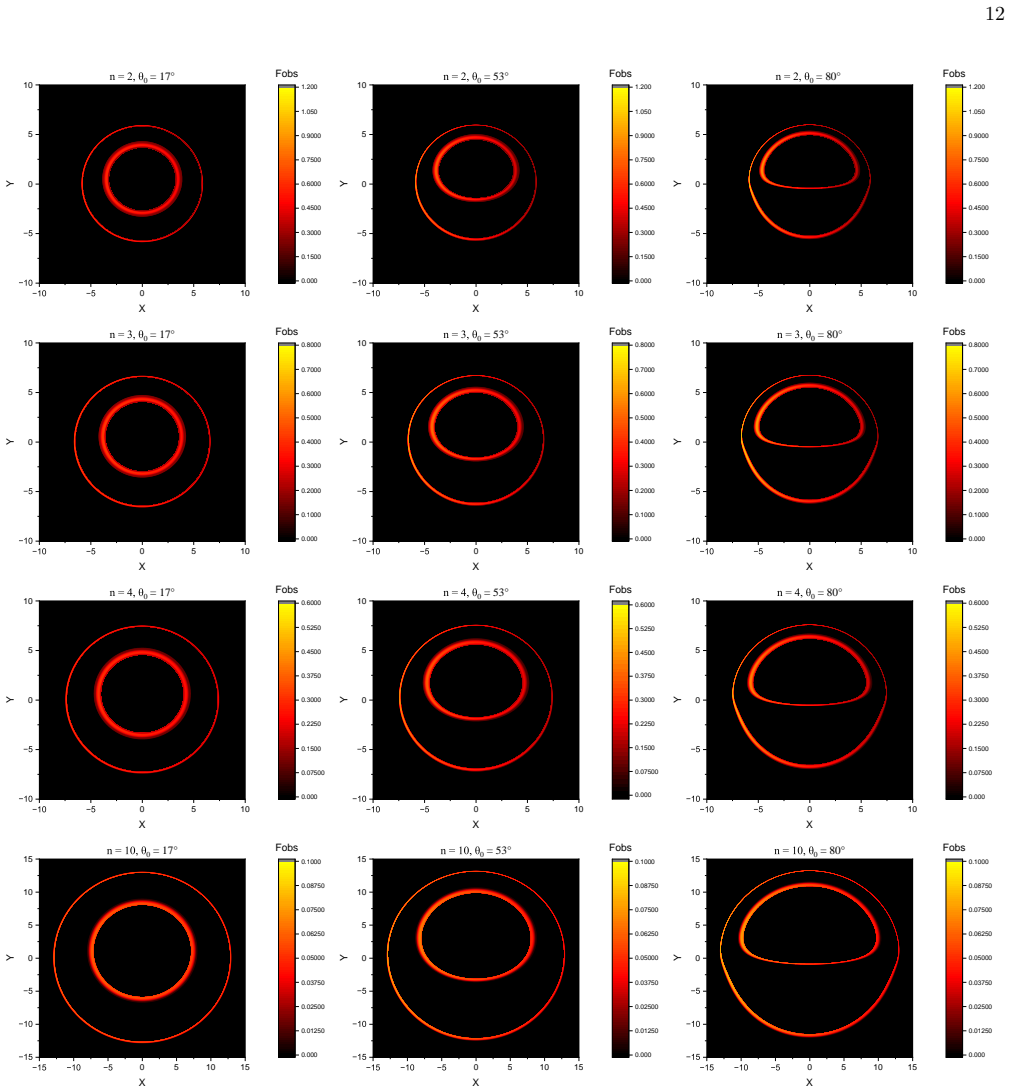
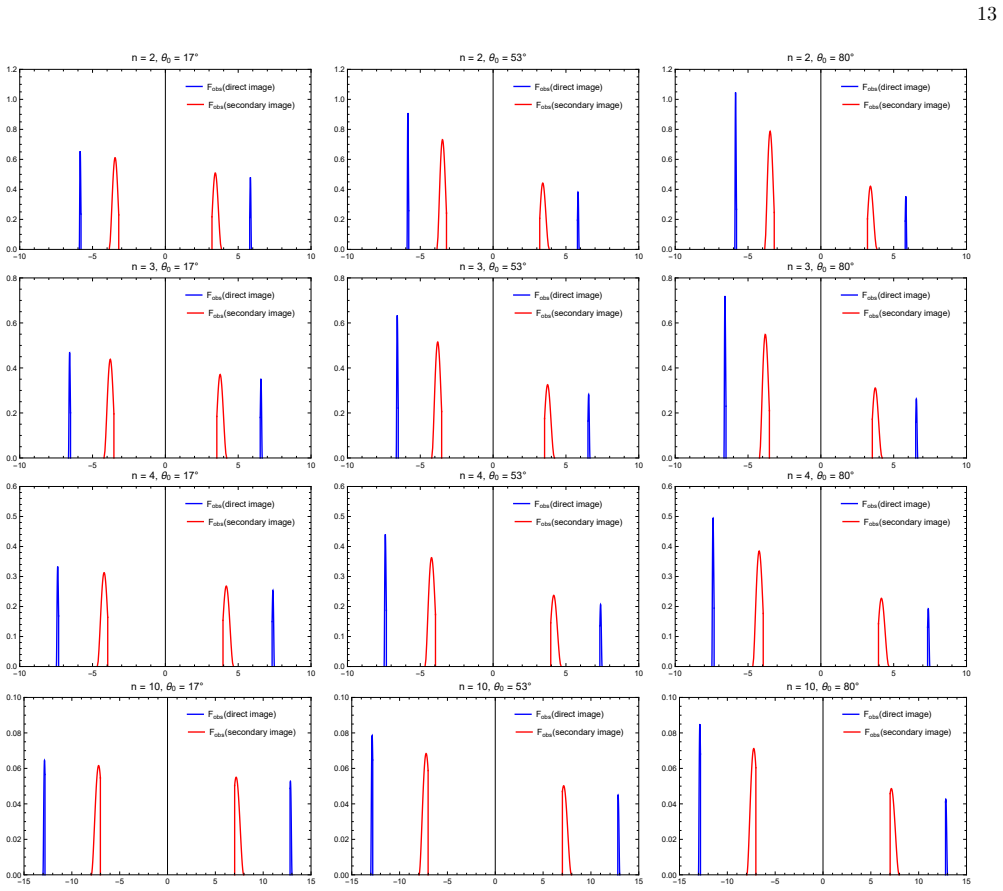
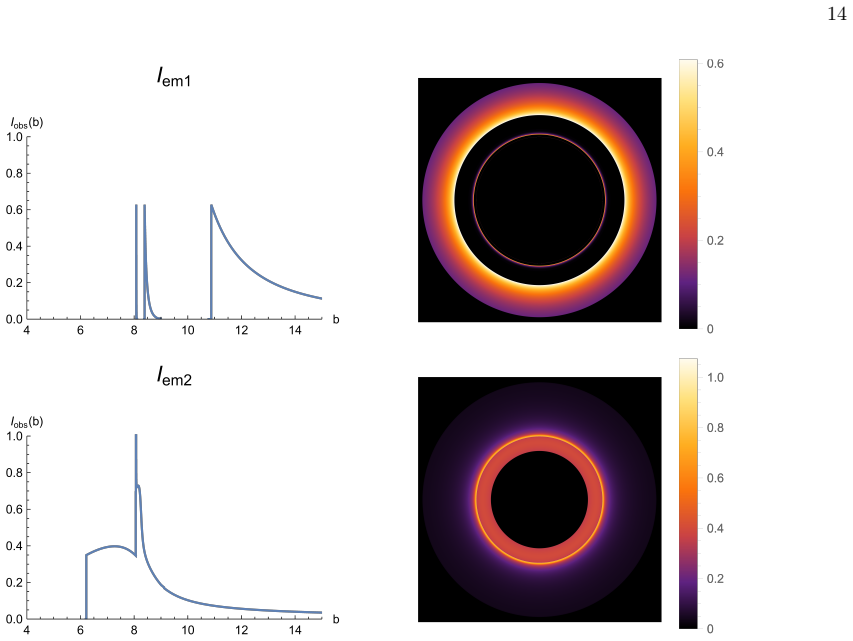
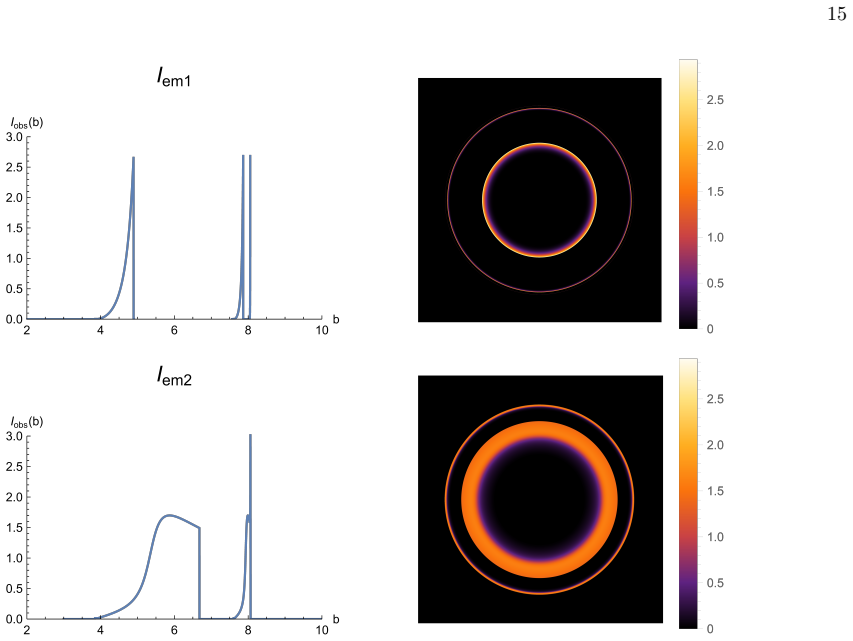
Solving the geodesic equation in the Ellis-Bronnikov metric yields a relation between impact parameter and aiming distance that is unequal when observer and accretion disk lie on opposite sides of the throat. Ray-tracing then produces synthetic images for both optically thick and thin disks. Larger n increases apparent size while decreasing brightness in the thick case. In the thin case the direct image does not occult higher-order images, so emission from regions close to the throat reaches the observer; the overall pattern is an internal-external inversion of the opposite-side view. The resulting images show that small-n wormholes observed from the R+ side can reproduce EHT-like features t
What carries the argument
Ray-tracing of null geodesics in the Ellis-Bronnikov metric parameterized by n, applied separately to optically thick and optically thin accretion flows viewed from each side of the throat.
If this is right
- Larger n enlarges the apparent size of the wormhole while lowering its surface brightness under optically thick accretion.
- Optically thin flows transmit higher-order images without occultation, exposing emission from near the throat.
- Views from the R- side produce images that cannot match current EHT data for any n.
- Only the combination of small n and an R+ observer yields partial agreement with observed black-hole shadows.
Where Pith is reading between the lines
- Higher-resolution future arrays could search for the predicted image inversion as a positive signature of a wormhole throat.
- The same ray-tracing pipeline could be rerun on other traversable wormhole metrics to test whether mimicry of EHT data is generic or specific to the Ellis-Bronnikov form.
- If independent observations constrain the accretion flow geometry, the allowed range of n could be narrowed without new telescope time.
Load-bearing premise
The Ellis-Bronnikov metric with free parameter n together with the specific optically thick and thin accretion distributions used here match the actual spacetime and matter around any real wormhole candidate.
What would settle it
A direct side-by-side comparison of the small-n R+ simulated images against existing EHT maps of M87* or Sgr A*; clear mismatches in shadow diameter, ring brightness profile, or absence of inversion features would rule out the claimed mimicry.
Figures
read the original abstract
This study investigates the optical appearance of the Ellis-Bronnikov wormhole as viewed from both sides of its throat, under conditions of optically thick and thin accretion. By solving the geodesic equation, we derive the relationship between the impact parameter and the aiming distance of photons, and found that if the observer and the accretion disk are located on both sides of the throat, these two quantities are not equal. The optical image of the wormhole observed from the other side of the throat is obtained through the ray-tracing method. For optically thick accretion, increases in the parameter $n$ lead to an increase in the apparent size of the wormhole but a decrease in its brightness. For optically thin accretion, the image is similar to the internal and external inversion of the image observed from the other side. Furthermore, for optically thin accretion flows, the direct image does not block the emission from higher-order images, allowing radiation emitted from regions much closer to the event horizon to reach the observer. Our simulation results show that when the observer is on the $\mathcal{R}^+$ side, EB wormholes with small $n$ can mimic the images taken by the EHT to some extent, while wormholes with large $n$ or with the observer on the $\mathcal{R}^-$ side can be ruled out.
Editorial analysis
A structured set of objections, weighed in public.
Referee Report
Summary. The manuscript numerically integrates null geodesics in the Ellis-Bronnikov wormhole spacetime (parameter n) and performs ray-tracing for both optically thick and optically thin accretion flows. It reports that the impact parameter and aiming distance differ when the observer and disk lie on opposite sides of the throat, that increasing n enlarges the apparent size while dimming the image for thick flows, and that thin-flow images exhibit internal-external inversion. The central claim is that small-n wormholes viewed from the R+ side can reproduce EHT images to some extent, whereas large-n cases or observations from the R- side are ruled out.
Significance. If the modeling assumptions hold, the work supplies concrete, side-dependent image predictions that could help observationally constrain or exclude a class of traversable wormholes against existing EHT data. The explicit treatment of both sides of the throat and the distinction between thick and thin flows are useful additions to the literature on exotic compact-object shadows.
major comments (2)
- [Results and Discussion (accretion modeling)] The mimicry and exclusion conclusions rest entirely on one specific choice of optically thick and optically thin accretion density-velocity-emissivity profiles. No comparison to alternative standard models (e.g., RIAF or thin-disk prescriptions) is shown; a change in these profiles can alter apparent size, brightness, and higher-order image visibility enough to modify the qualitative assessment that small-n R+ cases mimic EHT data.
- [Methods (geodesic integration and ray-tracing)] No numerical details, convergence tests, error estimates, or validation against known limits (e.g., Schwarzschild or Ellis wormhole n=0) are supplied for the geodesic integrator or ray-tracing code. Without these, it is impossible to assess whether the reported impact-parameter relations and image features are numerically reliable.
minor comments (2)
- [Introduction] Define the R+ and R- sides and the parameter n explicitly in the introduction rather than only in the abstract.
- [Metric section] Add a brief statement of the coordinate ranges and asymptotic flatness conditions used for the metric.
Simulated Author's Rebuttal
We thank the referee for the constructive feedback on our manuscript. We address each major comment below and outline the revisions we will make.
read point-by-point responses
-
Referee: [Results and Discussion (accretion modeling)] The mimicry and exclusion conclusions rest entirely on one specific choice of optically thick and optically thin accretion density-velocity-emissivity profiles. No comparison to alternative standard models (e.g., RIAF or thin-disk prescriptions) is shown; a change in these profiles can alter apparent size, brightness, and higher-order image visibility enough to modify the qualitative assessment that small-n R+ cases mimic EHT data.
Authors: The specific density-velocity-emissivity profiles adopted are standard choices from the compact-object imaging literature. The central geometric results—the inequality between impact parameter and aiming distance across the throat, the enlargement of apparent size with n for thick flows, and the internal-external inversion for thin flows—originate from the null geodesic structure of the Ellis-Bronnikov metric and are therefore independent of the emissivity details. Nevertheless, we agree that quantitative brightness contrasts and the precise visibility of higher-order images could shift under different prescriptions. In the revised manuscript we will add a short robustness subsection that (i) states the adopted profiles explicitly, (ii) notes the profile-independent nature of the side-dependent and inversion features, and (iii) presents one additional thin-disk calculation to illustrate that the qualitative exclusion of large-n and R−-side cases remains unchanged. revision: partial
-
Referee: [Methods (geodesic integration and ray-tracing)] No numerical details, convergence tests, error estimates, or validation against known limits (e.g., Schwarzschild or Ellis wormhole n=0) are supplied for the geodesic integrator or ray-tracing code. Without these, it is impossible to assess whether the reported impact-parameter relations and image features are numerically reliable.
Authors: We accept this criticism. The revised manuscript will contain a new Methods subsection that specifies the numerical integrator (fourth-order Runge-Kutta with adaptive step-size control), the termination criteria, and the error tolerance employed. We will also report convergence tests under successive step-size reductions and validation benchmarks: recovery of the Schwarzschild photon-sphere radius and critical impact parameter in the appropriate limit, together with the known n=0 Ellis-wormhole shadow size. These additions will allow readers to assess the numerical reliability of the reported impact-parameter relations and images. revision: yes
Circularity Check
No circularity: results from direct geodesic integration and ray-tracing
full rationale
The paper solves the geodesic equation to relate impact parameter and aiming distance, then applies ray-tracing to generate images under specified optically thick/thin accretion flows in the Ellis-Bronnikov metric. No parameters are fitted to EHT data and then relabeled as predictions; the mimicry statements are direct outputs of the numerical computation for chosen n values and flow profiles. No self-citations appear as load-bearing premises, and the metric plus flow assumptions are stated inputs rather than derived from the target images. The derivation chain is therefore self-contained against external benchmarks.
Axiom & Free-Parameter Ledger
free parameters (1)
- n
axioms (2)
- domain assumption The Ellis-Bronnikov metric describes a traversable wormhole spacetime.
- standard math Null geodesics govern photon trajectories in the spacetime.
Reference graph
Works this paper leans on
-
[1]
Akiyama et al
K. Akiyama et al. (Event Horizon Telescope Collabora- tion), First M87 event horizon telescope results. I. The shadow of the supermassive black hole, Astrophys. J. 16 875, L1 (2019)
2019
-
[2]
Akiyama et al
K. Akiyama et al. (Event Horizon Telescope Collabora- tion), First M87 event horizon telescope results. II. Array and instrumentation, Astrophys. J.875, L2 (2019)
2019
-
[3]
Akiyama et al
K. Akiyama et al. (Event Horizon Telescope Collabora- tion), First M87 event horizon telescope results. III. Data processing and calibration, Astrophys. J.875, L3 (2019)
2019
-
[4]
Akiyama et al
K. Akiyama et al. (Event Horizon Telescope Collabo- ration), First M87 event horizon telescope results. IV. Imaging the central super massive black hole, Astrophys. J.875, L4 (2019)
2019
-
[5]
Akiyama et al
K. Akiyama et al. (Event Horizon Telescope Collabora- tion), First M87 event horizon telescope results. V. Phys- ical Origin of the asymmetric ring, Astrophys. J.875, L5 (2019)
2019
-
[6]
Akiyama et al
K. Akiyama et al. (Event Horizon Telescope Collabora- tion), First M87 event horizon telescope results. VI. The shadow and mass of the central black hole, Astrophys. J. 875, L6 (2019)
2019
-
[7]
Akiyama et al
K. Akiyama et al. (Event Horizon Telescope Collabora- tion), First sagittarius A* event horizon telescope re- sults. I. The shadow of the supermassive black hole in the center of the Milky Way, Astrophys. J. Lett.930, L12 (2022)
2022
-
[8]
Akiyama et al
K. Akiyama et al. (Event Horizon Telescope Collabora- tion), First sagittarius A* event horizon telescope results. II. EHT and multiwavelength observations, data process- ing, and calibration, Astrophys. J. Lett.930, L13 (2022)
2022
-
[9]
Akiyama et al
K. Akiyama et al. (Event Horizon Telescope Collabora- tion), First sagittarius A* event horizon telescope results. III. Imaging of the galactic center supermassive black hole, Astrophys. J. Lett.930, L14 (2022)
2022
-
[10]
Akiyama et al
K. Akiyama et al. (Event Horizon Telescope Collabora- tion), First sagittarius A* event horizon telescope results. IV. Variability, morphology, and black hole mass, Astro- phys. J. Lett.930, L15 (2022)
2022
-
[11]
Akiyama et al
K. Akiyama et al. (Event Horizon Telescope Collabora- tion), First sagittarius A* event horizon telescope results. V. Testing astrophysical models of the galactic center black hole, Astrophys. J. Lett.930, L16 (2022)
2022
-
[12]
Akiyama et al
K. Akiyama et al. (Event Horizon Telescope Collabora- tion), First sagittarius A* event horizon telescope results. VI. Testing the black hole metric, Astrophys. J. Lett. 930, L17 (2022)
2022
-
[13]
Psaltis et al, Gravitational Test beyond the First Post- Newtonian Order with the Shadow of the M87 Black Hole, Phys
D. Psaltis et al, Gravitational Test beyond the First Post- Newtonian Order with the Shadow of the M87 Black Hole, Phys. Rev. Lett.125, 141104
-
[14]
Akiyama et al
K. Akiyama et al. (Event Horizon Telescope Collabora- tion), First M87 event horizon tele scope results. VII. Polarization of the ring, Astrophys. J.910, L12 (2021)
2021
-
[15]
Akiyama et al
K. Akiyama et al. (Event Horizon Telescope Collabora- tion), First M87 event horizon tele scope results. VIII. Magnetic field structure near the event horizon, Astro- phys. J. Lett.910, L13 (2021)
2021
-
[16]
Y. F. Chen, R. Ding, Y. X. Liu, Y. Mizuno, J. Shu, H. Y. Yu, and Y. J. Zeng, Illuminating Black Hole Shadows with Dark Matter Annihilation, Phys. Rev. Lett.135, 121001 (2025)
2025
-
[17]
Bronzwaer and H
T. Bronzwaer and H. Falcke, The Nature of Black Hole Shadows, Astrophys. J.920, 155 (2021)
2021
-
[18]
Luminet, Image of a spherical black hole with thin accretion disk, Astron
J.P. Luminet, Image of a spherical black hole with thin accretion disk, Astron. Astrophys.75, 228 (1979)
1979
-
[19]
S. E. Gralla, D. E. Holz, and R. M. Wald, Black Hole Shadows, Photon Rings, and Lensing Rings, Phys. Rev. D100, 024018 (2019)
2019
-
[20]
Y. X. Huang, S. Guo, Y. H. Cui, Q. Q.Jiang, and K. Lin, Influence of accretion disk on the optical appearance of the Kazakov-Solodukhin black hole, Phys. Rev. D107, 123009 (2023)
2023
-
[21]
S. Guo, Y. X. Huang, Y. H. Cui, Y. Han, Q. Q Jiang, E. W. Liang, and K. Lin, Unveiling the unconventional optical signatures of regular black holes within accretion disk, Eur. Phys. J. C83, 1059 (2023)
2023
-
[22]
Gyulchev, P
G. Gyulchev, P. Nedkova, T. Vetsov, and S. Yazadjiev, Image of the Janis-Newman-Winicour naked singularity with a thin accretion disk, Phys. Rev. D100, 024055 (2019)
2019
-
[23]
Y. H. Cui, S. Guo, Y.X. Huang, Y. Liang, and K. Lin, Optical appearance of numerical black hole solutions in higher derivative gravity, Eur. Phys. J. C84, 72 (2024)
2024
-
[24]
W. Q. Zhen, H. Guo, M. H. Wu, and X. M. Kuang, Or- bital precession and Lense-Thirring effect of Horndeski rotating spacetimes, Phys. Lett. B.862, 139307 (2025)
2025
-
[25]
S. Guo, Y. X. Huang, E. W. Liang, Y. Liang, Q. Q. Jiang, and K. Lin, Image of the Kerr–Newman Black Hole Surrounded by a Thin Accretion Disk, Astrophys. J.975, 237 (2024)
2024
-
[26]
X. Y. Wang, X. B. Wang, H. Q. Zhang, and M. Y. Guo, Is a photon ring invariably a closed structure? Eur. Phys. J. C84, 1168 (2024)
2024
-
[27]
S. Guo, E. W. Liang, Y. X. Huang, Y. Liang, Q. Q. Jiang, K. Lin, and L. F. Li, lmage of a time-dependent rotating regular black hole, Sci.China Phys.Mech.Astron. 68, 109512 (2025)
2025
-
[28]
Z. L. Zhang, S. B. Chen, and J. L. Jing, Constraining a disformal Schwarzschild black hole in DHOST theories with the orbit of the S2 star, Eur. Phys. J. C84, 827 (2024)
2024
-
[29]
Y. X. Ouyang, X. Zhou, S. B. Chen, and J. L. Jing, Thin accretion disk around a Kerr black hole immersed in swirling universes, JCAP08, 094 (2025)
2025
-
[30]
X. X. Zeng, C. Y. Yang, M. Israr Aslam, R. Saleem, and S. Aslam, Kerr-like Black Hole Surrounded by Cold Dark Matter Halo: The Shadow Images and EHT Constraints, JCAP08, 066 (2025)
2025
-
[31]
X. X. Zeng and K. Wang, Energy extraction from the Kerr-Bertotti-Robinson black hole via magnetic recon- nection in a circular and a plunging plasma, Phys. Rev. D112, 064032 (2025)
2025
-
[32]
J. A. Wheeler, Geons, Phys. Rev.97, 511 (1955)
1955
-
[33]
Einstein and N
A. Einstein and N. Rosen, The particle problem in the general theory of relativity, Phys. Rev.48, 73 (1935)
1935
-
[34]
M. D. Kruskal, Maximal Extension of Schwarzschild Met- ric, Phys. Rev.119, 1743 (1960)
1960
-
[35]
M. S. Morris and K. S. Thorne, Wormholes in spacetime and their use for interstellar travel: Atool for teaching general relativity, Am. J. Phys.56, 395 (1988)
1988
-
[36]
Kanti, B
P. Kanti, B. Kleihaus, and J. Kunz, Wormholes in Dila- tonic Einstein-Gauss-Bonnet Theory, Phys. Rev. Lett. textbf107, 271101 (2011)
2011
-
[37]
P. L. McFadden and N. Turok, Effective theory approach to brane world black holes, Phys. Rev. D71, 086004 (2005)
2005
-
[38]
Maldacena and A
J. Maldacena and A. Milekhin, Humanly traversable wormholes, Phys. Rev. D103, 066007 (2021)
2021
-
[39]
R. A. Konoplya and A. Zhidenko, Traversable Worm- holes in General Relativity, Phys. Rev. Lett.128, 091104 (2022)
2022
-
[40]
H. G. Ellis, Ether Flow Through a Drainhole: A Parti- cle Model in General Relativity, J. Math. Phys.14, 104 (1973). 17
1973
-
[41]
K. A. Bronnikov, Scalar-tensor theory and scalar charge, Acta. Phys. Polon. B4, 251 (1973)
1973
-
[42]
Lin and W
K. Lin and W. L. Qian, Ellis drainhole solution in Einstein-Æther gravity and the axial gravitational quasi- normal modes, Eur. Phys. J. C82, 529 (2022)
2022
-
[43]
X. Y. Chew, B. Kleihaus, and J. Kunz, Spinning Worm- holes in Scalar-Tensor Theory, Phys. Rev. D97, 064026 (2018)
2018
-
[44]
F. S. Khoo et al., Quasinormal modes of rapidly rotating Ellis-Bronnikov wormholes. Phys. Rev. D109, 084013 (2024)
2024
-
[45]
B. Azad, J. L. Bl´ azquez-Salcedo, F. S. Khoo, and J. Kunz, Are slowly rotatin Ellis-Bronnikov wormholes sta- ble?, Phys. Lett. B848, 138349 (2024)
2024
-
[46]
Chetouani and G
L. Chetouani and G. Cl´ ement, Geometrical Optics in the Ellis Geometry, Gen. Relativ. Gravit.16, 111-119 (1984)
1984
-
[47]
Nakajima and H
K. Nakajima and H. Asada, Deflection angle of light in an Ellis wormhole geometry, Phys. Rev. D85, 107501 (2012)
2012
-
[48]
Bronnikov and K.A
K.A. Bronnikov and K.A. Baleevskikh, On gravitational lensing by symmetric and asymmetric wormholes, Grav. Cosmol.25, 44-49 (2019)
2019
-
[49]
Damour and S
T. Damour and S. N. Solodukhin, Wormholes as Black Hole Foils, Phys. Rev. D76, 024016 (2007)
2007
-
[50]
Cardoso, E
V. Cardoso, E. Franzin, and P. Pani, Is the gravitational- wave ringdown a probe of the event horizon?, Phys. Rev. Lett.116, 171101 (2016)
2016
-
[51]
Tsukamoto, T
N. Tsukamoto, T. Harada, and K. Yajima, Can we dis- tinguish between black holes and wormholes by their Einstein-ring systems?, Phys Rev. D86, 104062 (2012)
2012
-
[52]
Visser, Traversable wormholes from surgically mod- ified Schwarzschild spacetimes, Nucl
M. Visser, Traversable wormholes from surgically mod- ified Schwarzschild spacetimes, Nucl. Phys. B328, 203 (1989)
1989
-
[53]
Visser, Traversable wormholes: Some simple exam- ples, Phys
M. Visser, Traversable wormholes: Some simple exam- ples, Phys. Rev. D39, 3182 (1989)
1989
-
[54]
X. B. Wang, P. C. Li, C.Y. Zhang, and M. Y. Guo, Novel shadows from the asymmetric thin-shell wormhole, Phys. Lett. B811, 135930 (2020)
2020
-
[55]
J. Peng, M. Y. Guo, and X. H. Feng, Observational Signature and Additional Photon Rings of Asymmetric Thin-shell Wormhole, Phys. Rev. D104, 124010 (2021)
2021
-
[56]
Wielgus, J
M. Wielgus, J. Horak, F. Vincent, and M. Abramowicz, Reflection-asymmetric wormholes and their double shad- ows, Phys. Rev. D102, 084044 (2020)
2020
-
[57]
S. Paul, R. Shaikh, P. Banerjee, and T. Sarkar, Observa- tional signatures of wormholes with thin accretion disks, JCAP03, 055 (2020)
2020
-
[58]
Saleem, M
R. Saleem, M. I. Aslam, and S, Shahid, Observational sig- natures of charged rotating traversable wormhole: shad- ows and light rings with different accretions, Eur. Phys. J. C84, 480 (2024)
2024
-
[59]
N. U. Molla, H. Chaudhary, U. Debnath, G. Mustafa, and S. K. Maurya, Shadow and strong gravitational lensing of new wormhole solutions supported by embedding Class-I condition, Eur. Phys. J. C85, 15 (2025)
2025
-
[60]
Yazadjiev, Uniqueness theorem for static wormholes in Einstein-phantom scalar field theory, Phys
S. Yazadjiev, Uniqueness theorem for static wormholes in Einstein-phantom scalar field theory, Phys. Rev. D96, 044045 (2017)
2017
-
[61]
Huang, J
H. Huang, J. Kunz, J. B. Yang, and C. Zhang, Light Ring behind Wormhole Throat: Geodesics, Images and Shadows, Phys. Rev. D107, 104060 (2023)
2023
-
[62]
V. A. Ishkaeva and S. V. Sushkov, Image of an accret- ing general Ellis-Bronnikov wormhole, Phys. Rev. D108, 084054 (2023)
2023
-
[63]
S. X. Tian and Z. H. Zhu, Testing the Schwarzschild met- ric in a strong field region with the Event Horizon Tele- scope, Phys. Rev. D100, 064011 (2019)
2019
-
[64]
D. N. Page and K. S. Thorne, Disk-accretion onto a black hole. Time averaged structure of accretion disk, Astro- phys. J.191, 499 (1974)
1974
-
[65]
G. F. R. Ellis, Relativistic cosmology, Gen. Relativ. Gravit.41, 575579 (2009)
2009
-
[66]
R. S. Lu et al, A ring-like accretion structure in M87 connecting its black hole and jet. Nature616, 686–690 (2023)
2023
-
[67]
M. D. Johnson et al., Key Science Goals for the Next Generation Event Horizon Telescope, Galaxies11, 61 (2023)
2023
discussion (0)
Sign in with ORCID, Apple, or X to comment. Anyone can read and Pith papers without signing in.