Node-to-Neighborhood Semantic Consistency: Text-Topology Alignment for TAGs Anomaly Detection
Pith reviewed 2026-06-30 06:22 UTC · model grok-4.3
The pith
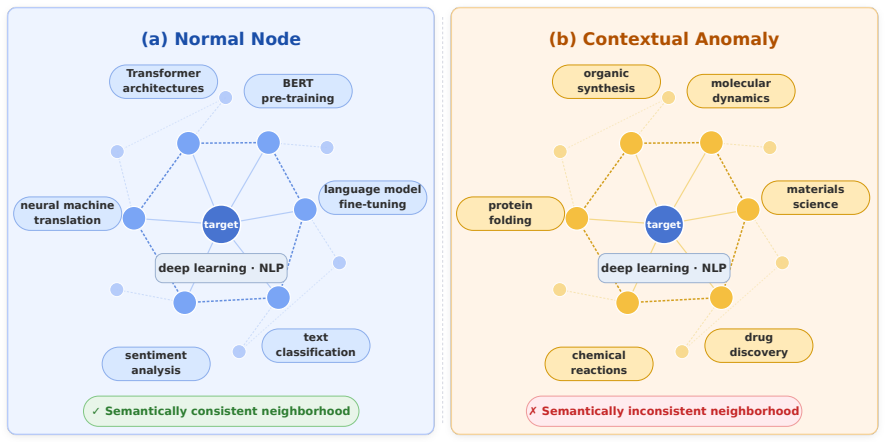
Anomalies in text-attributed graphs arise when a node's text semantics mismatch its neighborhood topology or content, and a new framework detects them by aligning the two via dual fusion paths.
A machine-rendered reading of the paper's core claim, the machinery that carries it, and where it could break.
Core claim
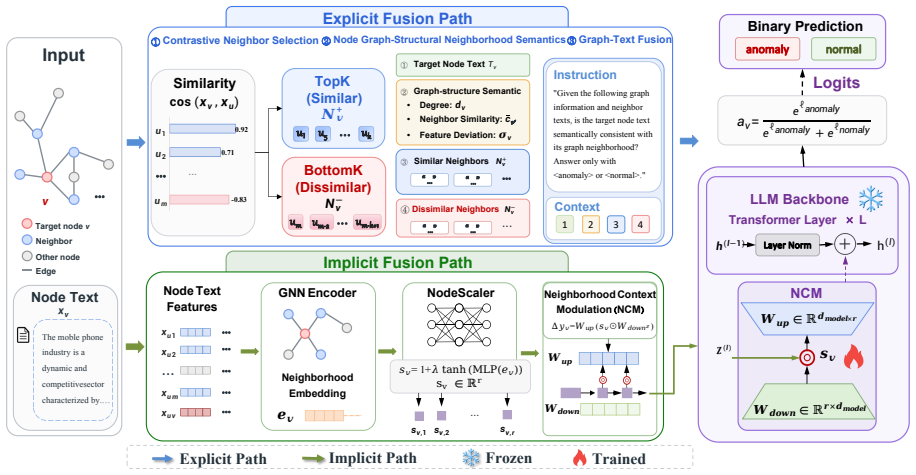
We formalize TAG anomaly detection as a node-to-neighborhood semantic consistency problem, where anomalies may arise from either textual semantic mismatch or topological deviation between a node and its neighbors. We propose N2NSC, a framework that captures the correspondence between graph topology and textual semantics through two complementary fusion paths. The two pathways work synergistically, enabling the LLM to fully leverage both textual and structural neighborhood information for anomaly detection.
What carries the argument
N2NSC framework using two complementary fusion paths that align each node's textual semantics with its neighborhood topology and content.
If this is right
- GNN-based methods gain fine-grained textual semantics when paired with the dual fusion paths.
- LLM-graph integration methods gain explicit modeling of topological relationships among neighbors.
- The method identifies nodes whose text is inconsistent with neighborhood structure on real TAG datasets.
- Consistent performance gains appear across eight different TAG anomaly detection benchmarks.
Where Pith is reading between the lines
- The same consistency check could be applied to dynamic graphs by updating neighborhood alignments over time.
- Synthetic test cases that isolate pure semantic mismatches versus pure topological mismatches would clarify which fusion path contributes most.
- The approach may transfer to recommendation graphs where user-item text must remain consistent with interaction topology.
Load-bearing premise
Anomalies arise specifically from textual semantic mismatch or topological deviation between a node and its neighbors, and prior methods fail mainly because they overlook this correspondence.
What would settle it
A controlled dataset of text-attributed graphs in which anomalies are defined by properties unrelated to any node-neighborhood mismatch, such as global label flips with no local inconsistency, on which N2NSC does not outperform the prior best methods.
Figures
read the original abstract
Graph anomaly detection (GAD) on text-attributed graphs (TAGs) is vital for applications such as fraud detection and academic integrity verification. Existing approaches generally fall into two paradigms. GNN-based methods effectively capture structural patterns but struggle to capture fine-grained textual semantics. Methods integrating LLMs with graphs improve semantic understanding yet fail to fully comprehend topological relationships among neighboring nodes. Moreover, both paradigms overlook the correspondence between textual semantics and graph topological relationships, limiting their ability to identify nodes whose semantics are inconsistent with their neighborhoods. In this paper, we formalize TAG anomaly detection as a node-to-neighborhood semantic consistency problem, where anomalies may arise from either textual semantic mismatch or topological deviation between a node and its neighbors. We propose N2NSC (Node-to-Neighborhood Semantic Consistency), a framework that captures the correspondence between graph topology and textual semantics through two complementary fusion paths. The two pathways work synergistically, enabling the LLM to fully leverage both textual and structural neighborhood information for anomaly detection. Extensive experiments across eight datasets demonstrate that N2NSC consistently outperforms current state-of-the-art methods.
Editorial analysis
A structured set of objections, weighed in public.
Referee Report
Summary. The manuscript formalizes anomaly detection on text-attributed graphs (TAGs) as a node-to-neighborhood semantic consistency problem and introduces the N2NSC framework. N2NSC employs two complementary fusion paths to align graph topology with textual semantics, enabling an LLM to leverage both neighborhood structure and content; the abstract claims this yields consistent outperformance over state-of-the-art methods across eight datasets.
Significance. If the reported gains are reproducible and the two-path design is shown to be responsible for the improvement, the work would meaningfully advance TAG anomaly detection by explicitly modeling the text-topology correspondence that prior GNN-only and LLM+graph paradigms overlook. The empirical framing makes the central claim directly falsifiable.
major comments (1)
- Abstract: the central claim that N2NSC 'consistently outperforms current state-of-the-art methods across eight datasets' is asserted without any mention of the datasets, baselines, metrics, controls, or statistical tests. Because the outperformance result is the primary evidence offered for the utility of the two fusion paths, the absence of these details renders the claim unverifiable from the provided text.
Simulated Author's Rebuttal
We thank the referee for highlighting this issue with the abstract. We address the comment below and will revise the manuscript accordingly.
read point-by-point responses
-
Referee: [—] Abstract: the central claim that N2NSC 'consistently outperforms current state-of-the-art methods across eight datasets' is asserted without any mention of the datasets, baselines, metrics, controls, or statistical tests. Because the outperformance result is the primary evidence offered for the utility of the two fusion paths, the absence of these details renders the claim unverifiable from the provided text.
Authors: We agree that the abstract's brevity leaves the central empirical claim without sufficient context for verification from the abstract alone. The full manuscript provides these details in the Experiments section (datasets, baselines, metrics including AUC-ROC and AP, controls, and statistical tests). To address the concern directly, we will revise the abstract to include a concise mention of the evaluation metrics and note the use of standard benchmarks, while keeping within length limits. This change will make the claim more verifiable at the abstract level without altering the manuscript's core content. revision: yes
Circularity Check
No significant circularity detected
full rationale
The manuscript presents an empirical framework for TAG anomaly detection by defining the task as a node-to-neighborhood semantic consistency problem and introducing two complementary fusion paths whose synergy is validated through experiments on eight datasets. No equations, derivations, fitted parameters renamed as predictions, or load-bearing self-citations appear in the text; the central claims remain falsifiable via reported performance gains rather than reducing to definitional inputs or prior author work by construction. The argument is therefore self-contained.
Axiom & Free-Parameter Ledger
Reference graph
Works this paper leans on
-
[1]
arXiv preprint arXiv:2510.21131 , year=
Large Language Models Meet Text-Attributed Graphs: A Survey of Integration Frameworks and Applications , author=. arXiv preprint arXiv:2510.21131 , year=
-
[2]
2025 , url =
Zhu, Xi and Xue, Haochen and Zhao, Ziwei and Xu, Wujiang and Huang, Jingyuan and Guo, Minghao and Wang, Qifan and Zhou, Kaixiong and Razzak, Imran and Zhang, Yongfeng , journal =. 2025 , url =
2025
-
[3]
Out-of-Distribution Detection via
Lv, Xiangwei and Li, Mengze and Chen, Jingyuan and Dong, Zhiang and Han, Sirui and Liao, Beishui , journal =. Out-of-Distribution Detection via. 2025 , doi =
2025
-
[4]
Graph attention networks , author=. arXiv preprint arXiv:1710.10903 , year=
work page internal anchor Pith review Pith/arXiv arXiv
-
[5]
Semi-Supervised Classification with Graph Convolutional Networks
Semi-supervised classification with graph convolutional networks , author=. arXiv preprint arXiv:1609.02907 , year=
work page internal anchor Pith review Pith/arXiv arXiv
-
[6]
Advances in Neural Information Processing Systems , year =
Inductive Representation Learning on Large Graphs , author =. Advances in Neural Information Processing Systems , year =
-
[7]
How Powerful are Graph Neural Networks?
How powerful are graph neural networks? , author=. arXiv preprint arXiv:1810.00826 , year=
work page internal anchor Pith review Pith/arXiv arXiv
-
[8]
, author=
Lora: Low-rank adaptation of large language models. , author=. Iclr , volume=. 2022 , url =
2022
-
[9]
International conference on machine learning , pages=
Rethinking graph neural networks for anomaly detection , author=. International conference on machine learning , pages=. 2022 , organization=
2022
-
[10]
Proceedings of the ACM web conference 2023 , pages=
Addressing heterophily in graph anomaly detection: A perspective of graph spectrum , author=. Proceedings of the ACM web conference 2023 , pages=. 2023 , url=
2023
-
[11]
Proceedings of the web conference 2021 , pages=
Pick and choose: a GNN-based imbalanced learning approach for fraud detection , author=. Proceedings of the web conference 2021 , pages=. 2021 , url=
2021
-
[12]
Proceedings of the 2019 SIAM international conference on data mining , pages=
Deep anomaly detection on attributed networks , author=. Proceedings of the 2019 SIAM international conference on data mining , pages=. 2019 , organization=
2019
-
[13]
Proceedings of the 47th International ACM SIGIR Conference on Research and Development in Information Retrieval , pages =
C-Pack: Packed Resources for General Chinese Embeddings , author =. Proceedings of the 47th International ACM SIGIR Conference on Research and Development in Information Retrieval , pages =. 2024 , url =
2024
-
[14]
2019 , doi =
Devlin, Jacob and Chang, Ming-Wei and Lee, Kenton and Toutanova, Kristina , booktitle =. 2019 , doi =
2019
-
[15]
2016 , doi =
Chen, Tianqi and Guestrin, Carlos , booktitle =. 2016 , doi =
2016
-
[16]
International conference on learning representations , volume=
Harnessing explanations: Llm-to-lm interpreter for enhanced text-attributed graph representation learning , author=. International conference on learning representations , volume=. 2024 , url =
2024
-
[17]
Qwen3 Technical Report , author =. 2025 , eprint =. doi:10.48550/arXiv.2505.09388 , url =
work page internal anchor Pith review Pith/arXiv arXiv doi:10.48550/arxiv.2505.09388 2025
-
[18]
arXiv preprint arXiv:2508.00513 , year =
Text-Attributed Graph Anomaly Detection via Multi-Scale Cross- and Uni-Modal Contrastive Learning , author =. arXiv preprint arXiv:2508.00513 , year =. doi:10.48550/arXiv.2508.00513 , url =
-
[19]
Proceedings of the AAAI Conference on Artificial Intelligence , volume=
LLM-Enhanced Energy Contrastive Learning for Out-of-Distribution Detection in Text-Attributed Graphs , author=. Proceedings of the AAAI Conference on Artificial Intelligence , volume=. 2026 , url=
2026
-
[20]
arXiv preprint arXiv:2409.01980 , year =
Large Language Models for Anomaly and Out-of-Distribution Detection: A Survey , author =. arXiv preprint arXiv:2409.01980 , year =. 2409.01980 , archivePrefix =
-
[21]
arXiv preprint arXiv:2302.02914 , year =
Energy-based Out-of-Distribution Detection for Graph Neural Networks , author =. arXiv preprint arXiv:2302.02914 , year =. 2302.02914 , archivePrefix =
-
[22]
IEEE transactions on knowledge and data engineering , volume=
A comprehensive survey on graph anomaly detection with deep learning , author=. IEEE transactions on knowledge and data engineering , volume=. 2021 , publisher=
2021
-
[23]
Advances in Neural Information Processing Systems , volume=
A comprehensive study on text-attributed graphs: Benchmarking and rethinking , author=. Advances in Neural Information Processing Systems , volume=. 2023 , url=
2023
-
[24]
IEEE Transactions on Pattern Analysis and Machine Intelligence , year=
A survey of graph neural networks in real world: Imbalance, noise, privacy and ood challenges , author=. IEEE Transactions on Pattern Analysis and Machine Intelligence , year=
-
[25]
Proceedings of the 28th
Learning on Graphs with Out-of-Distribution Nodes , author =. Proceedings of the 28th. 2022 , doi =
2022
-
[26]
arXiv preprint arXiv:2406.00806 , year =
Envisioning Outlier Exposure by Large Language Models for Out-of-Distribution Detection , author =. arXiv preprint arXiv:2406.00806 , year =. 2406.00806 , archivePrefix =
-
[27]
arXiv preprint arXiv:2504.13429 , year =
Bounded and Uniform Energy-based Out-of-Distribution Detection for Graphs , author =. arXiv preprint arXiv:2504.13429 , year =. 2504.13429 , archivePrefix =
-
[28]
Proceedings of the 30th
An Energy-Centric Framework for Category-Free Out-of-Distribution Node Detection in Graphs , author =. Proceedings of the 30th. 2024 , doi =
2024
-
[29]
Advances in Neural Information Processing Systems , volume=
Glbench: A comprehensive benchmark for graph with large language models , author=. Advances in Neural Information Processing Systems , volume=. 2024 , url=
2024
-
[30]
ACM computing surveys (CSUR) , volume=
Anomaly detection: A survey , author=. ACM computing surveys (CSUR) , volume=. 2009 , doi =
2009
-
[31]
Advances in Neural Information Processing Systems , volume =
A Comprehensive Study on Text-Attributed Graphs: Benchmarking and Rethinking , author =. Advances in Neural Information Processing Systems , volume =
-
[32]
Proceedings of the 2024 Conference on Empirical Methods in Natural Language Processing , pages=
Bridging local details and global context in text-attributed graphs , author=. Proceedings of the 2024 Conference on Empirical Methods in Natural Language Processing , pages=. 2024 , url=
2024
-
[33]
IEEE Transactions on knowledge and Data Engineering , volume=
Conditional anomaly detection , author=. IEEE Transactions on knowledge and Data Engineering , volume=. 2007 , publisher=
2007
-
[34]
Proceedings of the 29th ACM International Conference on Information and Knowledge Management , year =
Enhancing Graph Neural Network-based Fraud Detectors against Camouflaged Fraudsters , author =. Proceedings of the 29th ACM International Conference on Information and Knowledge Management , year =
-
[35]
Proceedings of the 17th ACM international conference on web search and data mining , pages=
Gad-nr: Graph anomaly detection via neighborhood reconstruction , author=. Proceedings of the 17th ACM international conference on web search and data mining , pages=. 2024 , url=
2024
-
[36]
IEEE transactions on neural networks and learning systems , volume=
Anomaly detection on attributed networks via contrastive self-supervised learning , author=. IEEE transactions on neural networks and learning systems , volume=. 2021 , publisher=
2021
-
[37]
Proceedings of the 30th ACM international conference on information & knowledge management , pages=
Anemone: Graph anomaly detection with multi-scale contrastive learning , author=. Proceedings of the 30th ACM international conference on information & knowledge management , pages=. 2021 , doi =
2021
-
[38]
IEEE Transactions on Knowledge and Data Engineering , volume=
Gccad: Graph contrastive coding for anomaly detection , author=. IEEE Transactions on Knowledge and Data Engineering , volume=. 2022 , doi=
2022
-
[39]
2024 , url =
Chen, Runjin and Zhao, Tong and Jaiswal, Ajay Kumar and Shah, Neil and Wang, Zhangyang , booktitle =. 2024 , url =
2024
-
[40]
Proceedings of the 47th International ACM SIGIR Conference on Research and Development in Information Retrieval , pages=
Graphgpt: Graph instruction tuning for large language models , author=. Proceedings of the 47th International ACM SIGIR Conference on Research and Development in Information Retrieval , pages=. 2024 , url=
2024
-
[41]
Proceedings of the 31st ACM SIGKDD Conference on Knowledge Discovery and Data Mining V
Guard: Effective anomaly detection through a text-rich and graph-informed language model , author=. Proceedings of the 31st ACM SIGKDD Conference on Knowledge Discovery and Data Mining V. 2 , pages=. 2025 , url=
2025
-
[42]
Court of
Xu, Yiming and Chen, Jiarun and Peng, Zhen and Chen, Zihan and Lin, Qika and Ma, Lan and Shi, Bin and Dong, Bo , journal =. Court of. 2025 , url =
2025
-
[43]
arXiv preprint arXiv:2410.14886 , year=
Zero-shot generalist graph anomaly detection with unified neighborhood prompts , author=. arXiv preprint arXiv:2410.14886 , year=
-
[44]
2024 , url =
Lv, Chuancheng and Li, Lei and Zhang, Shitou and Chen, Gang and Qi, Fanchao and Zhang, Ningyu and Zheng, Hai-Tao , booktitle =. 2024 , url =
2024
-
[45]
Advances in Neural Information Processing Systems , year =
Customizing Language Model Responses with Contrastive In-Context Learning , author =. Advances in Neural Information Processing Systems , year =
-
[46]
Advances in neural information processing systems , volume=
Open graph benchmark: Datasets for machine learning on graphs , author=. Advances in neural information processing systems , volume=. 2020 , url=
2020
-
[47]
Findings of the association for computational linguistics: EACL 2024 , pages=
Language is all a graph needs , author=. Findings of the association for computational linguistics: EACL 2024 , pages=. 2024 , url=
2024
-
[48]
The twelfth international conference on learning representations , year=
Consistency training with learnable data augmentation for graph anomaly detection with limited supervision , author=. The twelfth international conference on learning representations , year=
-
[49]
Proceedings of the AAAI Conference on Artificial Intelligence , volume=
Global attribute-association pattern aggregation for graph fraud detection , author=. Proceedings of the AAAI Conference on Artificial Intelligence , volume=. 2025 , url=
2025
-
[50]
arXiv preprint arXiv:2412.00020 , year=
Partitioning message passing for graph fraud detection , author=. arXiv preprint arXiv:2412.00020 , year=
-
[51]
OpenReview preprint , year =
Towards Anomaly Detection on Text-Attributed Graphs , author =. OpenReview preprint , year =
-
[52]
IEEE Transactions on Knowledge and Data Engineering , volume =
A Comprehensive Survey on Graph Anomaly Detection with Deep Learning , author =. IEEE Transactions on Knowledge and Data Engineering , volume =. 2023 , doi =
2023
-
[53]
Advances in Neural Information Processing Systems , volume=
Gadbench: Revisiting and benchmarking supervised graph anomaly detection , author=. Advances in Neural Information Processing Systems , volume=. 2023 , url=
2023
-
[54]
arXiv preprint arXiv:2310.11829 , year =
Towards Graph Foundation Models: A Survey and Beyond , author =. arXiv preprint arXiv:2310.11829 , year =
-
[55]
Proceedings of the AAAI Conference on Artificial Intelligence , volume=
Dgp: A dual-granularity prompting framework for fraud detection with graph-enhanced llms , author=. Proceedings of the AAAI Conference on Artificial Intelligence , volume=. 2026 , url=
2026
discussion (0)
Sign in with ORCID, Apple, or X to comment. Anyone can read and Pith papers without signing in.