REVIEW 2 major objections 1 minor 49 references
A pressure-gradient wall model combined with the fifth-order compact gas-kinetic scheme reproduces separated compressible flows on near-wall meshes twenty times coarser than wall-resolved requirements.
Reviewed by Pith at T0; open to challenge. T0 means a machine referee read the full paper against a public rubric. the ladder, T0–T4 →
T0 review · grok-4.3
2026-06-30 03:54 UTC pith:5RMRUV7D
load-bearing objection The paper couples a pressure-gradient non-equilibrium wall model to CGKS-5th and demonstrates usable accuracy on 20x-coarsened near-wall grids for two separated-flow cases, but the model itself is validated only indirectly through overall flow agreement. the 2 major comments →
Efficient Wall-Modeled High-Order Compact Gas-Kinetic Scheme for Compressible Turbulent Flows
The pith
A machine-rendered reading of the paper's core claim, the machinery that carries it, and where it could break.
Core claim
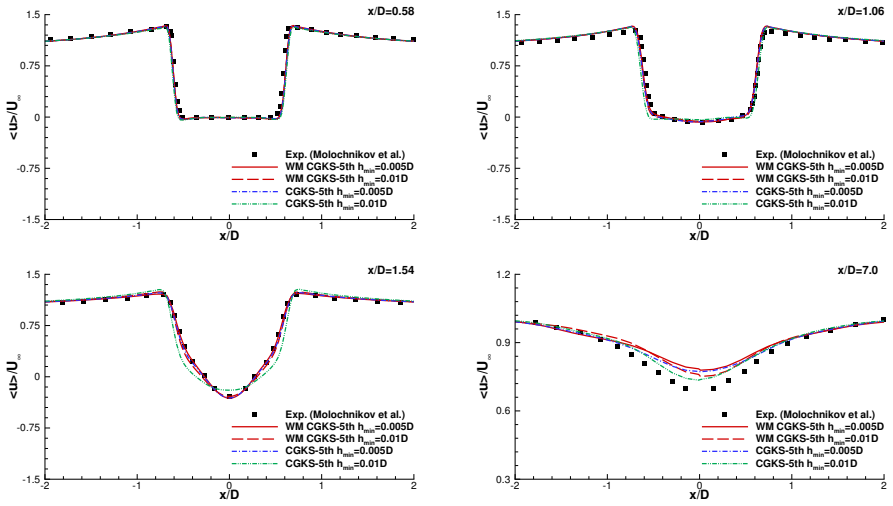
The wall-modeled CGKS-5th framework, which uses the outer solver to provide data at an exchange location to a pressure-gradient-based non-equilibrium wall model that reconstructs viscous wall stress while the scheme supplies inviscid flux, reproduces separated flow structures and improves near-wall predictions such as skin-friction coefficient on meshes far coarser than those needed for wall-resolved simulations.
What carries the argument
The pressure-gradient-based non-equilibrium wall model that retains a pressure-gradient source term and a corrected damping function, coupled to CGKS-5th at the exchange location to form the wall momentum flux.
Load-bearing premise
The pressure-gradient-based non-equilibrium wall model accurately reconstructs the under-resolved viscous wall stress when given data from the outer solver, even in adverse pressure gradient and separated regions.
What would settle it
A direct comparison where the wall-modeled scheme's predicted skin-friction coefficient on the coarse mesh deviates substantially from experimental or high-resolution reference values in the RAE 2822 or cylinder cases.
If this is right
- Reproduces separated flow structures in bluff-body and shock-induced separation cases.
- Markedly improves skin-friction coefficient predictions over wall-model-free CGKS-5th.
- Maintains accuracy with twentyfold coarsening in wall-normal direction for the airfoil case.
- Adds less than 1% runtime overhead in multi-GPU implementation.
Where Pith is reading between the lines
- If the model generalizes, it could enable routine high-fidelity simulations of aircraft or turbomachinery at flight Reynolds numbers.
- Further tests on other geometries with stronger separation might reveal limits of the pressure-gradient correction.
- The lightweight coupling suggests easy integration into other high-order compressible solvers.
Editorial analysis
A structured set of objections, weighed in public.
Referee Report
Summary. The paper develops a wall-modeled extension of the fifth-order compact gas-kinetic scheme (CGKS-5th) for compressible turbulent flows. A pressure-gradient-based non-equilibrium wall model supplies the viscous wall stress on coarse near-wall meshes while the outer CGKS-5th solver supplies the inviscid flux; the two are combined at the wall. The framework is tested on bluff-body separation past a circular cylinder and shock-induced separation on the RAE 2822 airfoil, using meshes coarsened by a factor of approximately 20 in the wall-normal direction. The authors report that the wall-modeled scheme reproduces separated flow structures and markedly improves skin-friction predictions relative to the wall-model-free CGKS-5th.
Significance. If the central claim holds, the work would offer a practical route to reducing the near-wall resolution cost of high-order scale-resolving simulations of compressible separated flows while retaining the accuracy and robustness of CGKS-5th in the outer region. The reported <1% runtime overhead of the coupling is a concrete practical advantage. The absence of direct verification of the wall-model reconstruction in non-equilibrium regions, however, limits the strength of the evidence for the claimed accuracy on coarsened meshes.
major comments (2)
- [Abstract and numerical-results sections] The central claim that the pressure-gradient-based wall model correctly reconstructs the viscous wall stress from exchange-location data supplied by CGKS-5th in adverse-pressure-gradient and separated regions rests on indirect evidence only. No direct comparison is shown between the wall-model-predicted τ_w and the corresponding value extracted from a wall-resolved reference simulation at identical exchange points inside the cylinder separation or the RAE 2822 shock bubble (see Abstract and the two test-case sections).
- [Abstract and numerical-results sections] Quantitative error norms (e.g., L2 or L∞ errors in skin friction or velocity profiles), explicit grid dimensions, and direct comparison baselines against wall-resolved CGKS-5th or other reference data are not reported. This makes it impossible to quantify the improvement or to confirm that the observed skin-friction gains are not artifacts of the particular coarsening chosen (Abstract).
minor comments (1)
- [Implementation and performance] The statement that the coupling adds less than 1% runtime overhead would benefit from a brief description of the measurement (number of GPUs, problem size, timing method).
Simulated Author's Rebuttal
We thank the referee for the constructive review and for recognizing the practical advantages of the proposed wall-modeled CGKS-5th framework, including the low runtime overhead. We address each major comment below and agree that additional direct evidence will strengthen the manuscript.
read point-by-point responses
-
Referee: [Abstract and numerical-results sections] The central claim that the pressure-gradient-based wall model correctly reconstructs the viscous wall stress from exchange-location data supplied by CGKS-5th in adverse-pressure-gradient and separated regions rests on indirect evidence only. No direct comparison is shown between the wall-model-predicted τ_w and the corresponding value extracted from a wall-resolved reference simulation at identical exchange points inside the cylinder separation or the RAE 2822 shock bubble (see Abstract and the two test-case sections).
Authors: We agree that direct comparison of the wall-model-predicted τ_w with reference values extracted at identical exchange locations from wall-resolved simulations would constitute stronger validation of the non-equilibrium wall model. The current evidence is indeed indirect, relying on integrated quantities such as skin-friction distributions and overall flow structures. In the revised manuscript we will post-process the wall-resolved reference fields to obtain τ_w at the precise exchange locations employed in the wall-modeled runs and include these direct comparisons for both the cylinder and RAE 2822 cases. revision: yes
-
Referee: [Abstract and numerical-results sections] Quantitative error norms (e.g., L2 or L∞ errors in skin friction or velocity profiles), explicit grid dimensions, and direct comparison baselines against wall-resolved CGKS-5th or other reference data are not reported. This makes it impossible to quantify the improvement or to confirm that the observed skin-friction gains are not artifacts of the particular coarsening chosen (Abstract).
Authors: We concur that the absence of quantitative error norms and explicit grid specifications limits the ability to assess the magnitude and robustness of the reported improvements. The manuscript currently presents results through figures and qualitative statements. We will revise the abstract and numerical-results sections to report L2 and L∞ error norms for skin-friction coefficient and selected velocity profiles (where reference data exist), provide the precise grid dimensions for all meshes, and include direct quantitative comparisons against wall-resolved CGKS-5th solutions. revision: yes
Circularity Check
No significant circularity detected; derivation is self-contained.
full rationale
The manuscript presents a new wall-modeled CGKS-5th framework whose central elements—the pressure-gradient-based non-equilibrium wall model and its coupling to the outer solver—are introduced as physically motivated extensions rather than reductions of prior fitted quantities or self-citations. No equation chain shows a prediction (e.g., skin-friction or separation structures) being recovered by construction from parameters fitted to the same data. Self-citations to earlier CGKS work supply the base high-order scheme but do not carry the load-bearing claim about wall-stress reconstruction on coarse meshes. The reported improvements are empirical outcomes on cylinder and RAE 2822 cases, not tautological restatements of inputs. This satisfies the default expectation of an independent derivation.
Axiom & Free-Parameter Ledger
axioms (1)
- standard math Compressible Navier-Stokes equations govern the flow
read the original abstract
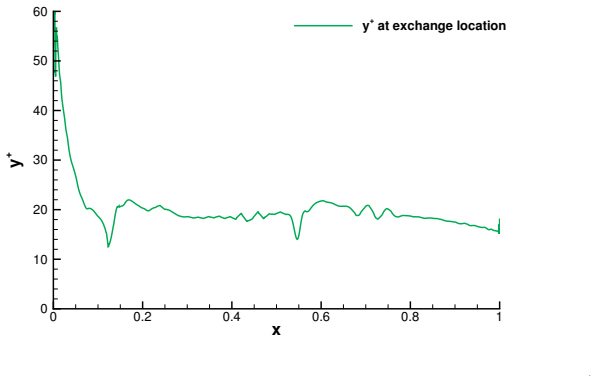
Scale-resolving simulations of wall-bounded turbulent flows remain prohibitively expensive at high Reynolds numbers, owing to the stringent near-wall resolution requirements. High-order compact gas-kinetic schemes (CGKS) are accurate, robust, and efficient for compressible flows, making them an attractive foundation for reducing this cost. Building on the fifth-order scheme CGKS-5th, we develop a wall-modeled CGKS framework that alleviates the near-wall resolution burden through a pressure-gradient-based non-equilibrium wall model while preserving the resolving power of the outer solver. CGKS-5th resolves the outer flow and supplies the wall model with data at the exchange location. On coarse near-wall meshes, the wall model reconstructs the under-resolved viscous wall stress, while CGKS-5th provides the inviscid wall flux directly; the two combine to form the wall momentum flux. To capture non-equilibrium effects in adverse-pressure-gradient and separated regions, the wall model retains a pressure-gradient source term together with a pressure-gradient-corrected near-wall damping function. We assess the framework on two distinct flows: bluff-body separation past a circular cylinder, and a shock-induced separation bubble on the transonic RAE 2822 airfoil, using near-wall meshes far coarser than wall-resolved simulations require. For the RAE 2822 case, this corresponds to a twentyfold coarsening in the wallnormal direction, with comparable coarsening in other directions. In both cases, the wall-modeled CGKS-5th reproduces the separated flow structures and markedly improves near-wall predictions over its wall-model-free counterpart, most notably the skin-friction coefficient. The framework thus delivers accurate predictions of these separated flows at substantially reduced near-wall cost, while its lightweight coupling adds less than 1% runtime overhead in a multi-GPU implementation.
Figures






Reference graph
Works this paper leans on
-
[1]
Lele, S. K. (1992). Compact finite difference schemes with spectral-like resolution. Journal of compu- tational physics, 103(1), 16-42
1992
-
[2]
Mahesh, K. (1998). A family of high order finite difference schemes with good spectral resolution. Journal of Computational Physics, 145(1), 332-358
1998
-
[3]
Harten, A., Engquist, B., Osher, S., & Chakravarthy, S. R. (1987). Uniformly high order accurate essentially non-oscillatory schemes, III. Journal of computational physics, 131(1), 3-47
1987
-
[4]
W., & Osher, S
Shu, C. W., & Osher, S. (1988). Efficient implementation of essentially non-oscillatory shock-capturing schemes. Journal of computational physics, 77(2), 439-471
1988
-
[5]
D., Osher, S., & Chan, T
Liu, X. D., Osher, S., & Chan, T. (1994). Weighted essentially non-oscillatory schemes. Journal of computational physics, 115(1), 200-212
1994
-
[6]
S., & Shu, C
Jiang, G. S., & Shu, C. W. (1996). Efficient implementation of weighted ENO schemes. Journal of computational physics, 126(1), 202-228
1996
-
[7]
Qiu, J., & Shu, C. W. (2004). Hermite WENO schemes and their application as limiters for Runge–Kutta discontinuous Galerkin method: one-dimensional case. Journal of Computational Physics, 193(1), 115-135
2004
-
[8]
H., & Hill, T
Reed, W. H., & Hill, T. R. (1973). Triangular mesh methods for the neutron transport equation (No. LA-UR–73-479; CONF-730414–2). Los Alamos Scientific Lab., N. Mex. (USA)
1973
-
[9]
Cockburn, B., & Shu, C. W. (1989). TVB Runge-Kutta local projection discontinuous Galerkin finite element method for conservation laws. II. General framework. Mathematics of computation, 52(186), 411-435
1989
-
[10]
Huynh, H. T. (2007). A flux reconstruction approach to high-order schemes including discontinuous Galerkin methods. In 18th AIAA computational fluid dynamics conference (p. 4079)
2007
-
[11]
J., & Gao, H
Wang, Z. J., & Gao, H. (2009). A unifying lifting collocation penalty formulation including the discon- tinuous Galerkin, spectral volume/difference methods for conservation laws on mixed grids. Journal of Computational Physics, 228(21), 8161-8186
2009
-
[12]
Pan, L., Xu, K., Li, Q., & Li, J. (2016). An efficient and accurate two-stage fourth-order gas-kinetic scheme for the Euler and Navier-Stokes equations. Journal of Computational Physics, 326, 197-221
2016
-
[13]
Zhao, F., Ji, X., Shyy, W., & Xu, K. (2019). Compact higher-order gas-kinetic schemes with spectral-like resolution for compressible flow simulations. Advances in Aerodynamics, 1(1), 13
2019
-
[14]
Ji, X., Shyy, W., & Xu, K. (2021). A gradient compression-based compact high-order gas-kinetic scheme on 3D hybrid unstructured meshes. International Journal of Computational Fluid Dynamics, 35(7), 485-509
2021
-
[15]
Zhao, F., Ji, X., Shyy, W., & Xu, K. (2023). High-order compact gas-kinetic schemes for three- dimensional flow simulations on tetrahedral mesh. Advances in Aerodynamics, 5(1), 1
2023
-
[16]
Yang, Y., Zhao, F., & Xu, K. (2026). An effective implementation of high-order compact gas-kinetic scheme on structured meshes for compressible flows. Journal of Computational Physics, 114729
2026
-
[17]
Xu, K. (2001). A gas-kinetic BGK scheme for the Navier-Stokes equations and its connection with artificial dissipation and Godunov method. Journal of Computational Physics, 171(1), 289-335
2001
-
[18]
Xu, K. (2015). Direct modeling for computational fluid dynamics: construction and application of unified gas-kinetic schemes. World Scientific
2015
-
[19]
Xu, K. (2021). A unified computational fluid dynamics framework from rarefied to continuum regimes. Cambridge University Press
2021
-
[20]
E., & Spalding, D
Launder, B. E., & Spalding, D. B. (1983). The numerical computation of turbulent flows. In Numerical prediction of flow, heat transfer, turbulence and combustion (pp. 96-116). Pergamon. 27
1983
-
[21]
Spalart, P. R. (2009). Detached-eddy simulation. Annual review of fluid mechanics, 41(1), 181-202
2009
-
[22]
Piomelli, U., & Balaras, E. (2002). Wall-layer models for large-eddy simulations. Annual review of fluid mechanics, 34(1), 349-374
2002
-
[23]
T., & Park, G
Bose, S. T., & Park, G. I. (2018). Wall-modeled large-eddy simulation for complex turbulent flows. Annual review of fluid mechanics, 50, 535-561
2018
-
[24]
Schumann, U. (1975). Subgrid scale model for finite difference simulations of turbulent flows in plane channels and annuli. Journal of computational physics, 18(4), 376-404
1975
-
[25]
Shi, J., Yan, H., & Wang, Z. J. (2020). Flux reconstruction implementation of an algebraic wall model for large-eddy simulation. AIAA Journal, 58(7), 3051-3062
2020
-
[26]
Balaras, E., Benocci, C., & Piomelli, U. (1996). Two-layer approximate boundary conditions for large- eddy simulations. AIAA journal, 34(6), 1111-1119
1996
-
[27]
Cabot, W., & Moin, P. (2000). Approximate wall boundary conditions in the large-eddy simulation of high Reynolds number flow. Flow, Turbulence and Combustion, 63(1), 269-291
2000
-
[28]
Wang, M., & Moin, P. (2002). Dynamic wall modeling for large-eddy simulation of complex turbulent flows. Physics of Fluids, 14(7), 2043-2051
2002
-
[29]
R., & Subbareddy, P
Mettu, B. R., & Subbareddy, P. K. (2022). Wall-modeled large eddy simulation of high speed flows. AIAA journal, 60(7), 4302-4324
2022
-
[30]
M., & Brugi` ere, O
Duprat, C., Balarac, G., M´ etais, O., Congedo, P. M., & Brugi` ere, O. (2011). A wall-layer model for large-eddy simulations of turbulent flows with/out pressure gradient. Physics of fluids, 23(1)
2011
-
[31]
L., Gross, E
Bhatnagar, P. L., Gross, E. P., & Krook, M. (1954). A model for collision processes in gases. I. Small amplitude processes in charged and neutral one-component systems. Physical review, 94(3), 511
1954
-
[32]
Chapman, S., & Cowling, T. G. (1990). The mathematical theory of non-uniform gases: an account of the kinetic theory of viscosity, thermal conduction and diffusion in gases. Cambridge university press
1990
-
[33]
Zhao, F., Ji, X., Shyy, W., & Xu, K. (2022). A compact high-order gas-kinetic scheme on unstructured mesh for acoustic and shock wave computations. Journal of Computational Physics, 449, 110812
2022
-
[34]
Zhao, F., & Xu, K. (2025). A generalized ENO reconstruction in compact GKS for compressible flow simulations. Journal of Computational Physics, 114612
2025
-
[35]
C., G¨ u¸ cl¨ u, Y., & Christlieb, A
Seal, D. C., G¨ u¸ cl¨ u, Y., & Christlieb, A. J. (2014). High-order multiderivative time integrators for hyperbolic conservation laws. Journal of Scientific Computing, 60(1), 101-140
2014
-
[36]
Li, J., & Du, Z. (2016). A two-stage fourth order time-accurate discretization for Lax–Wendroff type flow solvers I. Hyperbolic conservation laws. SIAM Journal on Scientific Computing, 38(5), A3046- A3069
2016
-
[37]
Li, J. (2019). Two-stage fourth order: temporal-spatial coupling in computational fluid dynamics (CFD). Advances in Aerodynamics, 1(1), 3
2019
-
[38]
Zhao, F., Ji, X., Shyy, W., & Xu, K. (2023). Direct modeling for computational fluid dynamics and the construction of high-order compact scheme for compressible flow simulations. Journal of Computational Physics, 477, 111921
2023
-
[39]
Norberg, C. (1993). Pressure forces on a circular cylinder in cross flow. In Bluff-Body Wakes, Dynamics and Instabilities: IUTAM Symposium, Springer Berlin Heidelberg
1993
-
[40]
S., & Karniadakis, G
Ma, X., Karamanos, G. S., & Karniadakis, G. E. (2000). Dynamics and low-dimensionality of a turbu- lent near wake. Journal of fluid mechanics, 410, 29-65
2000
-
[41]
I., Samtaney, R., Zhang, W., & Gao, W
Cheng, W., Pullin, D. I., Samtaney, R., Zhang, W., & Gao, W. (2017). Large-eddy simulation of flow over a cylinder withRe D from 3.9×10 3 to 8.5×10 5: A skin-friction perspective. Journal of Fluid Mechanics, 820, 121-158
2017
-
[42]
S., Matsuno, K
Song, H., Ghate, A. S., Matsuno, K. V., West, J. R., Subramaniam, A., & Lele, S. K. (2024). A robust compact finite difference framework for simulations of compressible turbulent flows. Journal of Computational Physics, 519, 113419
2024
-
[43]
M., Mikheev, N
Molochnikov, V. M., Mikheev, N. I., Mikheev, A. N., Paereliy, A. A., Dushin, N. S., & Dushina, O. A. (2019). SIV measurements of flow structure in the near wake of a circular cylinder at Re= 3900. Fluid Dynamics Research, 51(5), 055505
2019
-
[44]
Norberg, C. (1994). An experimental investigation of the flow around a circular cylinder: influence of 28 aspect ratio. Journal of Fluid Mechanics, 258, 287-316
1994
-
[45]
Parnaudeau, P., Carlier, J., Heitz, D., & Lamballais, E. (2008). Experimental and numerical studies of the flow over a circular cylinder at Reynolds number 3900. Physics of fluids, 20(8)
2008
-
[46]
H., Firmin, M
Cook, P. H., Firmin, M. C. P., & McDonald, M. A. (1977). Aerofoil RAE 2822: pressure distributions, and boundary layer and wake measurements. RAE
1977
-
[47]
Haase, W., Bradsma, F., Elsholz, E., Leschziner, M., & Schwamborn, D. (1993). EUROVAL-An Eu- ropean Initiative on Validation of CFD Codes. Notes on Numerical Fluid Mechanics, Vol. 42. Vieweg, Braunschweig/Wiebaden
1993
-
[48]
J., & She, Z
Xiao, M. J., & She, Z. S. (2020). Precise drag prediction of airfoil flows by a new algebraic model. Acta Mechanica Sinica, 36(1), 35
2020
-
[49]
L., Fu, D
Liang, X., Li, X. L., Fu, D. X., & Ma, Y. W. (2011). Ten thousand order cores expandable CFD software and its application. Journal of Huazhong University of Science and Technology (Natural Science Edition), 39(Sup. I), 67-70. (in Chinese) 29
2011
discussion (0)
Sign in with ORCID, Apple, or X to comment. Anyone can read and Pith papers without signing in.