Programmable generation of flying cat-qubits
Pith reviewed 2026-06-30 06:12 UTC · model grok-4.3
The pith
Time-dependent two-photon drives in nonlinear bosonic systems generate flying cat-qubit states from vacuum while enabling logical control during emission.
A machine-rendered reading of the paper's core claim, the machinery that carries it, and where it could break.
Core claim
By engineering Kerr nonlinearity, two-photon driving, and dissipation, logical control of a cat qubit is demonstrated during its generation and emission, while its quantum information is simultaneously shared between the nonlinear system and the propagating output field, with the process remaining robust under realistic noise conditions.
What carries the argument
Time-dependent two-photon drives combined with Kerr nonlinearity or two-photon dissipation in nonlinear bosonic systems, which produce cat states from vacuum and allow logical operations during emission.
If this is right
- Logical control occurs simultaneously with generation and emission of the cat qubit.
- Quantum information is shared between the nonlinear system and the propagating output field.
- State generation and logical control stay robust against photon loss and pure dephasing.
- The method supplies a route to programmable bosonic quantum networks.
- It supports future propagating error-correctable encodings.
Where Pith is reading between the lines
- Such flying cat qubits could serve as links in distributed quantum processors that move error-protected information between nodes.
- The shared information between system and field may allow real-time monitoring or feedback without destroying the logical state.
- The approach might extend to other bosonic encodings beyond cat states if similar drive engineering is applied.
- Implementation in circuit QED devices would test whether the required time-dependent drives can be realized with current hardware.
Load-bearing premise
Time-dependent two-photon drives can be applied together with Kerr nonlinearity or dissipation to create the desired states without leaving the regime where the model holds.
What would settle it
An experiment that applies the described drives but finds the output field lacks the expected superposition properties or shows no evidence of logical control during emission.
Figures
read the original abstract
We propose a framework for the direct generation of flying cat-qubit states from vacuum using time-dependent two-photon drives in nonlinear bosonic systems. We study both Kerr-based and two-photon-dissipation-based generation. By engineering Kerr nonlinearity, two-photon driving, and dissipation, we demonstrate logical control of a cat qubit during its generation and emission, while its quantum information is simultaneously shared between the nonlinear system and the propagating output field. We further analyze the effects of photon loss and pure dephasing, showing that both the state generation and logical control remain robust under realistic noise conditions. These results provide a route toward programmable bosonic quantum networks and future propagating error-correctable encodings.
Editorial analysis
A structured set of objections, weighed in public.
Referee Report
Summary. The manuscript proposes a framework for the direct generation of flying cat-qubit states from vacuum using time-dependent two-photon drives in nonlinear bosonic systems. It examines both Kerr-based and two-photon-dissipation-based approaches, claiming to demonstrate logical control of a cat qubit during generation and emission while the quantum information is shared between the nonlinear system and the propagating output field. The work further analyzes robustness to photon loss and pure dephasing under realistic noise conditions, positioning the results as a route to programmable bosonic quantum networks and propagating error-correctable encodings.
Significance. If the proposed time-dependent engineering of drives, Kerr nonlinearity, and dissipation can be realized while remaining inside the effective-model regime, the approach could enable direct generation of flying logical qubits with built-in control and noise tolerance. This would be a concrete step toward bosonic quantum networks, but the significance is currently limited by the absence of explicit validation for the drive waveforms and regime conditions.
major comments (2)
- [Abstract] Abstract: the claims that 'both the state generation and logical control remain robust under realistic noise conditions' are stated without any derivations, simulations, or quantitative evidence, preventing assessment of whether the underlying math supports the robustness assertions.
- [framework paragraph] Framework paragraph: the central assumption that time-dependent two-photon drives can be chosen (combined with Kerr nonlinearity or two-photon dissipation) so that cat-state generation and logical operations occur while the system remains inside the regime of validity for the effective model (rotating-wave approximation, adiabatic conditions, strong nonlinearity relative to drive) is asserted but not supported by explicit bounds, instantaneous checks, or validation that the required waveforms satisfy these conditions at every time.
minor comments (1)
- The abstract would benefit from a brief statement of the specific logical operations (e.g., which gates or encodings) that are demonstrated during generation.
Simulated Author's Rebuttal
We thank the referee for the careful reading of our manuscript and the constructive comments. We address the two major comments point by point below, indicating where revisions have been made to strengthen the presentation.
read point-by-point responses
-
Referee: [Abstract] Abstract: the claims that 'both the state generation and logical control remain robust under realistic noise conditions' are stated without any derivations, simulations, or quantitative evidence, preventing assessment of whether the underlying math supports the robustness assertions.
Authors: The abstract is a summary; the derivations, numerical simulations of photon loss and pure dephasing, and quantitative fidelity results under realistic noise strengths are contained in Sections IV and V of the main text. To make the abstract self-contained and directly responsive to this point, we have added a short clause citing the observed robustness thresholds (e.g., fidelity retention above 95% for loss rates up to 1% of the dissipation rate). revision: yes
-
Referee: [framework paragraph] Framework paragraph: the central assumption that time-dependent two-photon drives can be chosen (combined with Kerr nonlinearity or two-photon dissipation) so that cat-state generation and logical operations occur while the system remains inside the regime of validity for the effective model (rotating-wave approximation, adiabatic conditions, strong nonlinearity relative to drive) is asserted but not supported by explicit bounds, instantaneous checks, or validation that the required waveforms satisfy these conditions at every time.
Authors: We agree that explicit validation of the effective-model regime is essential. In the revised manuscript we have inserted a new subsection (III.C) that supplies (i) analytical bounds on the instantaneous drive amplitude relative to the Kerr or two-photon-dissipation rate and (ii) numerical checks of the rotating-wave and adiabatic conditions evaluated at multiple time slices across the full protocol duration, confirming that all chosen waveforms remain inside the stated regime. revision: yes
Circularity Check
No circularity; proposal is self-contained engineering analysis
full rationale
The manuscript proposes a framework for generating flying cat-qubits via time-dependent two-photon drives in Kerr or two-photon-dissipative systems, with analysis of logical control and noise robustness. No equations, fitted parameters, or derivation steps are visible that reduce by construction to inputs. No self-citations are invoked as load-bearing uniqueness theorems or ansatzes. The central claims rest on engineering assumptions about drive waveforms and regime validity, which are external to any definitional loop and remain open to external validation or simulation. This matches the default expectation of a non-circular forward-looking proposal.
Axiom & Free-Parameter Ledger
Reference graph
Works this paper leans on
-
[1]
(A1) are even and odd cat states|C ±(α)⟩built from the coher- ent states|±α⟩withα= p Ω(t)/K
Approximate cat states Forε(t) = 0, the eigenstates of ˆHKPO from Eq. (A1) are even and odd cat states|C ±(α)⟩built from the coher- ent states|±α⟩withα= p Ω(t)/K. In the presence of a weak single-photon drive, we assume that the eigenstates of ˆHKPO are built from approximate coherent states on the form|˜α ±(t)⟩=|±α(t) +δα(t)⟩. By applying the variational...
-
[2]
(11) are discarded as they diverge att= 0
STA Hamiltonian The contributions from| ˜C−⟩in Eq. (11) are discarded as they diverge att= 0. Retaining only the positive cat terms gives us that, ˆHSTA = i 2 | ˙˜C+⟩ ⟨ ˜C+| − | ˜C+⟩ ⟨ ˙˜C+| =− i 2 | ˜C+⟩ ⟨ ˙˜C+|+ h.c. (A13) 10 Now we will evaluate ˆHSTA acting on| ˜C+⟩by using that ⟨ ˜C−|ˆa|˜C+⟩=α r tanh Ω(t) K , ⟨ ˜C+|ˆa|˜C+⟩=δα. (A14) one finds that ˆH...
-
[3]
B. M. Terhal, J. Conrad, and C. Vuillot, Quantum Sci- ence and Technology5, 043001 (2020)
2020
-
[4]
Li, C.-L
L. Li, C.-L. Zou, V. V. Albert, S. Muralidharan, S. M. Girvin, and L. Jiang, Phys. Rev. Lett.119, 030502 (2017)
2017
-
[5]
Joshi, K
A. Joshi, K. Noh, and Y. Y. Gao, Quantum Science & Technology6, 033001 (2021)
2021
-
[6]
M. H. Devoret and J. M. Martinis, Quantum Information Processing3, 163 (2004)
2004
-
[7]
A. Z. Ding, B. L. Brock, A. Eickbusch, A. Koottan- davida, N. E. Frattini, R. G. Corti˜ nas, V. R. Joshi, S. J. de Graaf, B. J. Chapman, S. Ganjam,et al., Nature Com- munications16, 5279 (2025)
2025
-
[8]
Lescanne, M
R. Lescanne, M. Villiers, T. Peronnin, A. Sarlette, M. Delbecq, B. Huard, T. Kontos, M. Mirrahimi, and Z. Leghtas, Nature Physics16, 509 (2020)
2020
-
[9]
C. J. Axline, L. D. Burkhart, W. Pfaff, M. Zhang, K. Chou, P. Campagne-Ibarcq, P. Reinhold, L. Frunzio, S. Girvin, L. Jiang,et al., Nature Physics14, 705 (2018)
2018
-
[10]
Pfaff, C
W. Pfaff, C. J. Axline, L. D. Burkhart, U. Vool, P. Rein- hold, L. Frunzio, L. Jiang, M. H. Devoret, and R. J. Schoelkopf, Nature Physics13, 882 (2017)
2017
-
[11]
M. Khanahmadi and K. Mølmer, arXiv preprint arXiv:2504.04513 (2025)
-
[12]
Khanahmadi, M
M. Khanahmadi, M. M. Lund, K. Mølmer, and G. Jo- hansson, Phys. Rev. Res.5, 043071 (2023)
2023
-
[13]
A. M. Eriksson, T. S´ epulcre, M. Kervinen, T. Hillmann, M. Kudra, S. Dupouy, Y. Lu, M. Khanahmadi, J. Yang, C. Castillo-Moreno,et al., Nature Communications15, 2512 (2024)
2024
-
[14]
S. Puri, L. St-Jean, J. A. Gross, A. Grimm, N. E. Frat- tini, P. S. Iyer, A. Krishna, S. Touzard, L. Jiang, A. Blais, et al., Science advances6, eaay5901 (2020)
2020
-
[15]
Mirrahimi, Comptes Rendus
M. Mirrahimi, Comptes Rendus. Physique17, 778 (2016)
2016
-
[16]
R´ eglade, A
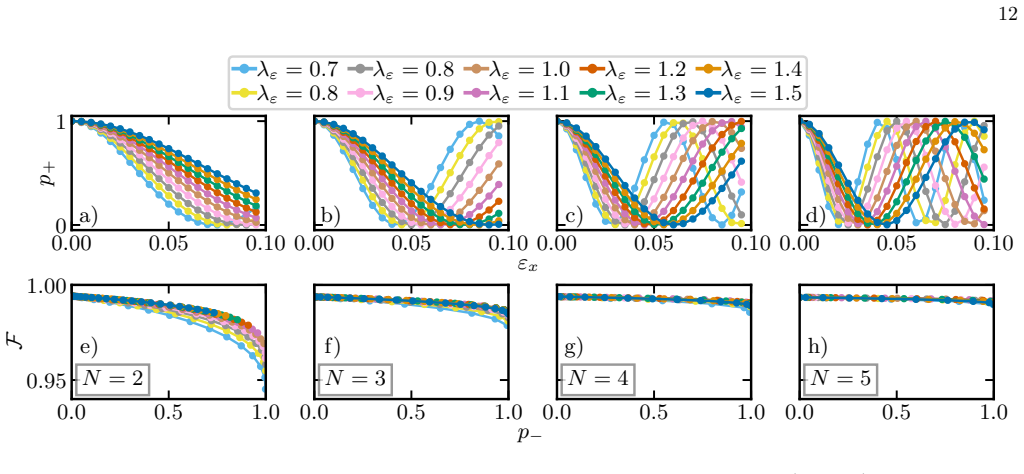
U. R´ eglade, A. Bocquet, R. Gautier, J. Cohen, A. Marquet, E. Albertinale, N. Pankratova, M. Hall´ en, F. Rautschke, L.-A. Sellem,et al., Nature629, 778 12 0.00 0.05 0.10 0 1p+ a) 0.0 0.5 1.0 0.95 1.00 F e) N = 2 0.00 0.05 0.10 b) 0.0 0.5 1.0 f) N = 3 0.00 0.05 0.10 c) 0.0 0.5 1.0 g) N = 4 0.00 0.05 0.10 d) 0.0 0.5 1.0 h) N = 5 εx p− λε = 0.7 λε = 0.8 λε...
2024
-
[17]
R. Gautier, A. Sarlette, and M. Mirrahimi, PRX Quan- tum3, 10.1103/prxquantum.3.020339 (2022)
-
[18]
X. He, Y. Lu, D. Bao, H. Xue, W. Jiang, Z. Wang, A. Roudsari, P. Delsing, J. Tsai, and Z. Lin, Nature com- munications14, 6358 (2023)
2023
-
[19]
A. Hajr, B. Qing, K. Wang, G. Koolstra, Z. Pedramrazi, Z. Kang, L. Chen, L. B. Nguyen, C. J¨ unger, N. Goss, I. Huang, B. Bhandari, N. E. Frattini, S. Puri, J. Dressel, A. N. Jordan, D. I. Santiago, and I. Siddiqi, Phys. Rev. X14, 041049 (2024)
2024
-
[20]
Leghtas, G
Z. Leghtas, G. Kirchmair, B. Vlastakis, R. J. Schoelkopf, M. H. Devoret, and M. Mirrahimi, Phys. Rev. Lett.111, 120501 (2013)
2013
-
[21]
Guillaud and M
J. Guillaud and M. Mirrahimi, Phys. Rev. X9, 041053 (2019)
2019
-
[22]
Putterman, K
H. Putterman, K. Noh, C. T. Hann, G. S. MacCabe, S. Aghaeimeibodi, R. N. Patel, M. Lee, W. M. Jones, H. Moradinejad, R. Rodriguez,et al., Nature638, 927 (2025)
2025
-
[23]
Chamberland, K
C. Chamberland, K. Noh, P. Arrangoiz-Arriola, E. T. Campbell, C. T. Hann, J. Iverson, H. Putterman, T. C. Bohdanowicz, S. T. Flammia, A. Keller, G. Refael, J. Preskill, L. Jiang, A. H. Safavi-Naeini, O. Painter, and F. G. Brand˜ ao, PRX Quantum3, 010329 (2022)
2022
-
[24]
Khanahmadi and K
M. Khanahmadi and K. Mølmer, Phys. Rev. A107, 013705 (2023)
2023
-
[25]
Krisnanda, F
T. Krisnanda, F. Valadares, K. T. N. Chu, P. Song, A. Copetudo, C. Y. Fontaine, L. c. v. Lachman, R. Filip, and Y. Y. Gao, Phys. Rev. Res.8, 023026 (2026)
2026
- [26]
-
[27]
H. Goto, Z. Lin, T. Yamamoto, and Y. Nakamura, Phys. Rev. A99, 023838 (2019)
2019
-
[28]
Mirrahimi, Z
M. Mirrahimi, Z. Leghtas, V. V. Albert, S. Touzard, R. J. Schoelkopf, L. Jiang, and M. H. Devoret, New Journal of Physics16, 045014 (2014)
2014
-
[29]
S. Puri, S. Boutin, and A. Blais, npj Quantum Informa- tion3, 18 (2017)
2017
-
[30]
Grimm, N
A. Grimm, N. E. Frattini, S. Puri, S. O. Mundhada, S. Touzard, M. Mirrahimi, S. M. Girvin, S. Shankar, and M. H. Devoret, Nature584, 205 (2020)
2020
-
[31]
Z. Wang, M. Pechal, E. A. Wollack, P. Arrangoiz-Arriola, M. Gao, N. R. Lee, and A. H. Safavi-Naeini, Physical Review X9, 10.1103/physrevx.9.021049 (2019)
-
[32]
P. Krantz, M. Kjaergaard, F. Yan, T. P. Orlando, S. Gus- tavsson, and W. D. Oliver, Applied Physics Reviews6, 10.1063/1.5089550 (2019)
-
[33]
D. Ruiz, R. Gautier, J. Guillaud, and M. Mirrahimi, Phys. Rev. A107, 042407 (2023)
2023
-
[34]
Gautier, M
R. Gautier, M. Mirrahimi, and A. Sarlette, PRX Quan- tum4, 040316 (2023)
2023
-
[35]
A Wave Function approach to dissipative processes
Y. Castin, J. Dalibard, and K. Molmer, A wave function approach to dissipative processes (2008), arXiv:0805.4002 [quant-ph]
work page internal anchor Pith review Pith/arXiv arXiv 2008
-
[36]
A. H. Kiilerich and K. Mølmer, Phys. Rev. Lett.123, 123604 (2019)
2019
-
[37]
A. H. Kiilerich and K. Mølmer, Phys. Rev. A102, 023717 (2020)
2020
-
[38]
Combes, J
J. Combes, J. Kerckhoff, and M. Sarovar, Advances in Physics: X2, 784 (2017)
2017
-
[39]
Kanao and H
T. Kanao and H. Goto, Phys. Rev. Res.6, 013192 (2024)
2024
-
[40]
Bartolo, F
N. Bartolo, F. Minganti, W. Casteels, and C. Ciuti, Phys. Rev. A94, 033841 (2016)
2016
-
[41]
del Campo, Phys
A. del Campo, Phys. Rev. Lett.111, 100502 (2013)
2013
-
[42]
V. V. Albert, S. O. Mundhada, A. Grimm, S. Touzard, M. H. Devoret, and L. Jiang, Quantum Science and Tech- nology4, 035007 (2019)
2019
-
[43]
M. Yuan, Q. Xu, and L. Jiang, Phys. Rev. A106, 062422 (2022)
2022
-
[44]
J. M. Gertler, S. van Geldern, S. Shirol, L. Jiang, and C. Wang, PRX Quantum4, 020319 (2023)
2023
discussion (0)
Sign in with ORCID, Apple, or X to comment. Anyone can read and Pith papers without signing in.