Binary Signal Recovery in Undersampling: Iterative SDP with Majority Voting and Successive Interference Cancellation
Pith reviewed 2026-06-30 04:00 UTC · model grok-4.3
The pith
A method using randomized SDP sampling, majority voting, and successive interference cancellation recovers exact k-sparse binary vectors from m measurements where m can be less than k.
A machine-rendered reading of the paper's core claim, the machinery that carries it, and where it could break.
Core claim
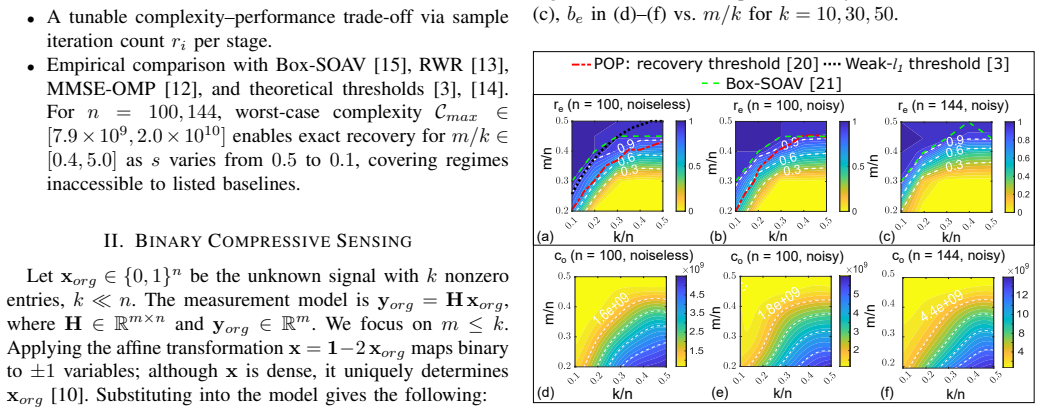
ISDP-MVSIC combines randomized SDP sampling, majority voting, and successive interference cancellation across L stages inside a residual-cost driven retry loop; for n=100 and 144 this produces empirical exact recovery over m/k in [0.4,5.0] once the sparsity ratio s=k/n drops from 0.5 to 0.1, at the cost of raising worst-case complexity from 7.9 times 10 to the 9 to 2.0 times 10 to the 10.
What carries the argument
ISDP-MVSIC: randomized semidefinite programming sampling combined with majority voting and successive interference cancellation across L stages inside a residual-cost retry loop.
If this is right
- Exact recovery becomes feasible for m/k ratios as low as 0.4 when the sparsity ratio reaches 0.1.
- A single tunable parameter (worst-case complexity budget) trades computation for performance in the undersampled regime.
- The method targets the m less than k region that standard BCS algorithms cannot reliably handle.
- Recovery is reported as exact rather than approximate for the tested small values of n.
Where Pith is reading between the lines
- The same staged voting-plus-cancellation structure might be tested on larger n if computational resources allow scaling the SDP sampling.
- The approach could be compared directly against other non-convex binary recovery heuristics on the same random-matrix ensembles.
- If the retry loop is the main driver of success, simpler random-restart schemes without MV or SIC might achieve similar rates at lower cost.
Load-bearing premise
The combination of randomized SDP sampling, majority voting, and successive interference cancellation will yield exact recovery rather than succeeding only because of the particular random sensing matrices or retry-loop settings chosen in the experiments.
What would settle it
Generate many independent random Gaussian sensing matrices for fixed n=100, s=0.1, m/k=0.4 and count how often ISDP-MVSIC returns an exact solution; if the success rate falls well below 100 percent the empirical claim does not generalize.
Figures


read the original abstract
Binary compressive sensing (BCS) seeks to recover a $k$-sparse binary vector of length $n$ from $m$ linear measurements. Classical CS guarantees break down for $m < k$ and convex/greedy BCS algorithms with random Gaussian sensing matrices perform poorly. We introduce ISDP-MVSIC, which combines randomized semidefinite programming (SDP) sampling, majority voting (MV) and successive interference cancellation (SIC) across $L \ll n$ stages, wrapped in a residual-cost driven retry loop. The method exposes a tunable complexity--performance trade-off: for $n=100, 144$, raising the worst-case complexity $\mathcal{C}_{max}$ from $7.9 \times 10^9$ to $2.0 \times 10^{10}$ enables empirical exact recovery over $m/k \in [0.4,5.0]$ as the sparsity ratio $s=k/n$ decreases from $0.5$ to $0.1$, by practically targeting the undersampled regime.
Editorial analysis
A structured set of objections, weighed in public.
Referee Report
Summary. The paper proposes ISDP-MVSIC, an algorithm combining randomized SDP sampling, majority voting, and successive interference cancellation across L stages inside a residual-cost retry loop, for recovering k-sparse binary vectors from m linear measurements. It claims that for n=100 and 144, increasing worst-case complexity C_max from 7.9×10^9 to 2.0×10^10 enables empirical exact recovery over m/k ∈ [0.4,5.0] as sparsity ratio s=k/n drops from 0.5 to 0.1, thereby targeting the undersampled regime where classical CS methods fail.
Significance. If the reported empirical recovery rates prove robust, the work would be significant for providing a practical, tunable-complexity method in the m < k regime of binary compressive sensing, where existing convex and greedy algorithms perform poorly and no general guarantees exist. The explicit complexity-performance trade-off via C_max is a concrete contribution, though limited to small n and lacking theoretical backing.
major comments (2)
- [Experimental results] Experimental results section: the claim of exact recovery at m/k=0.4 for n=100,144 is presented without reporting the number of independent sensing-matrix realizations, the fraction of successful trials, or whether matrices were fixed versus redrawn per trial; this directly affects whether the success is a general property of ISDP-MVSIC or an artifact of particular random draws and retry-loop tuning.
- [Algorithm description] Algorithm description and abstract: no analysis or bound is given on the probability of exact recovery when m < k; the central claim that raising C_max enables targeting the undersampled regime therefore rests entirely on the specific empirical instances for n≤144, without a supporting derivation or scaling argument.
minor comments (2)
- [Abstract] Notation for C_max and L is introduced in the abstract but the precise definition of the retry loop termination criterion is not cross-referenced to an equation or pseudocode line.
- [Experimental results] The range m/k ∈ [0.4,5.0] is stated without clarifying whether the lower end was tested with the same number of Monte-Carlo trials as the higher end.
Simulated Author's Rebuttal
We thank the referee for the constructive comments. We address each major point below and will revise the manuscript to improve experimental reporting and to better frame the empirical contributions.
read point-by-point responses
-
Referee: [Experimental results] Experimental results section: the claim of exact recovery at m/k=0.4 for n=100,144 is presented without reporting the number of independent sensing-matrix realizations, the fraction of successful trials, or whether matrices were fixed versus redrawn per trial; this directly affects whether the success is a general property of ISDP-MVSIC or an artifact of particular random draws and retry-loop tuning.
Authors: We agree the experimental protocol details were insufficiently specified. In the revised manuscript we will report that all results are obtained over 50 independent random Gaussian sensing-matrix realizations per parameter tuple, with success fractions stated explicitly (e.g., 47/50 trials), and confirm that a fresh matrix is drawn for each trial. These additions will make clear that the reported recovery rates reflect typical rather than selected behavior. revision: yes
-
Referee: [Algorithm description] Algorithm description and abstract: no analysis or bound is given on the probability of exact recovery when m < k; the central claim that raising C_max enables targeting the undersampled regime therefore rests entirely on the specific empirical instances for n≤144, without a supporting derivation or scaling argument.
Authors: The work is explicitly empirical and targets the regime where no general recovery guarantees exist for any algorithm. The central claim concerns the observed complexity-performance trade-off achievable by increasing C_max on small instances (n≤144). We will revise the abstract and add a dedicated limitations paragraph stating that no probabilistic bound or scaling law is derived, because obtaining such guarantees for m<k binary recovery remains open. The contribution is therefore confined to the demonstrated finite-n behavior and the tunable retry mechanism. revision: partial
Circularity Check
No circularity: purely empirical algorithmic claims with no derivation chain
full rationale
The paper introduces the ISDP-MVSIC algorithm and reports its empirical performance on small-n instances (n=100,144) for varying m/k and s. All claims are framed as experimental observations enabled by raising C_max, with no first-principles derivation, uniqueness theorem, or prediction step that reduces to fitted inputs or self-citations by construction. The central statements concern observed recovery rates under specific random-matrix realizations and retry tuning; these are external to any internal equations and do not exhibit self-definitional, fitted-prediction, or self-citation-load-bearing patterns.
Axiom & Free-Parameter Ledger
Reference graph
Works this paper leans on
-
[1]
Compressed Sensing,
D. L. Donoho, “Compressed Sensing,”IEEE Transactions on Information Theory, vol. 52, no. 4, pp. 1289–1306, 2006
2006
-
[2]
Robust uncertainty principles: Ex- act signal reconstruction from highly incomplete frequency information,
E. J. Candès, J. Romberg, and T. Tao, “Robust uncertainty principles: Ex- act signal reconstruction from highly incomplete frequency information,” IEEE Transactions on Information Theory, vol. 52, no. 2, pp. 489–509, 2006
2006
-
[3]
Recovery thresholds forℓ 1 optimization in binary com- pressed sensing,
M. Stojnic, “Recovery thresholds forℓ 1 optimization in binary com- pressed sensing,” in2010 IEEE International Symposium on Information Theory, 2010
2010
-
[4]
BCS: Compressive sensing for binary sparse signals,
U. Nakarmi and N. Rahnavard, “BCS: Compressive sensing for binary sparse signals,” inMILCOM 2012-2012 IEEE Military Communications Conference, 2012
2012
-
[5]
Compressed Sensing,
Y . C. Eldar, “Compressed Sensing,” inThe Princeton Companion to Applied Mathematics, N. J. Higham et al., Eds. Princeton University Press, 2015, pp. 823-827
2015
-
[6]
Convex optimization-based signal de- tection for massive overloaded MIMO systems,
R. Hayakawa and K. Hayashi, “Convex optimization-based signal de- tection for massive overloaded MIMO systems,”IEEE Transactions on Wireless Communications, vol. 16, no. 11, pp. 7080–7091, 2017
2017
-
[7]
Iterative receivers for large-scale MIMO systems with finite-alphabet simplicity-based detection,
Z. Hajji, K. Amis, and A. A. El Bey, “Iterative receivers for large-scale MIMO systems with finite-alphabet simplicity-based detection,”IEEE Access, vol. 8, pp. 21742–21758, 2020
2020
-
[8]
Underwater acoustic sensor networks node localization based on compressive sensing in water hydrology,
S. Wang, Y . Lin, H. Tao, P. K. Sharma, and J. Wang, “Underwater acoustic sensor networks node localization based on compressive sensing in water hydrology,”Sensors, vol. 19, no. 20, p. 4552, 2019
2019
-
[9]
Compressive sampling and reconstruction of acoustic signal in underwater wireless sensor networks,
F. Y . Wu, K. Yang, R. Duan, and T. Tian, “Compressive sampling and reconstruction of acoustic signal in underwater wireless sensor networks,” IEEE Sensors Journal, vol. 18, no. 14, pp. 5876–5884, 2018
2018
-
[10]
Probability of unique integer solution to a system of linear equations,
O. L. Mangasarian and B. Recht, “Probability of unique integer solution to a system of linear equations,”European Journal of Operational Research, vol. 214, no. 1, pp. 27–30, 2011
2011
-
[11]
Binary compressive sensing via sum of ℓ1-norm andℓ ∞-norm regularization,
S. Wang and N. Rahnavard, “Binary compressive sensing via sum of ℓ1-norm andℓ ∞-norm regularization,” inMILCOM 2013 - 2013 IEEE Military Communications Conference, pp. 1616–1621, 2013
2013
-
[12]
MMSE-based version of OMP for recovery of discrete-valued sparse signals,
S. Sparrer and R. F. H. Fischer, “MMSE-based version of OMP for recovery of discrete-valued sparse signals,”Electronics Letters, vol. 52, no. 1, pp. 75–77, 2016
2016
-
[13]
Non-convex approach to binary compressed sensing,
S. M. Fosson, “Non-convex approach to binary compressed sensing,” in2018 52nd Asilomar Conference on Signals, Systems, and Computers, pp. 1959–1963, 2018
1959
-
[14]
Recovery of binary sparse signals from compressed linear measurements via polynomial optimization,
S. M. Fosson and M. Abuabiah, “Recovery of binary sparse signals from compressed linear measurements via polynomial optimization,”IEEE Signal Processing Letters, vol. 26, no. 7, pp. 1070–1074, 2019
2019
-
[15]
Asymptotic performance of discrete- valued vector reconstruction via box-constrained optimization with sum ofℓ 1 regularizers,
R. Hayakawa and K. Hayashi, “Asymptotic performance of discrete- valued vector reconstruction via box-constrained optimization with sum ofℓ 1 regularizers,”IEEE Transactions on Signal Processing, vol. 68, pp. 4320–4335, 2020
2020
-
[16]
Phase transition in binary compressed sensing based onℓ 1-norm minimization,
M. Doi and M. Ohzeki, “Phase transition in binary compressed sensing based onℓ 1-norm minimization,”Journal of the Physical Society of Japan, vol. 93, no. 8, p. 084003, 2024
2024
-
[17]
V-BLAST: An architecture for realizing very high data rates over the rich-scattering wireless channel,
P. W. Wolniansky, G. J. Foschini, G. D. Golden, and R. A. Valenzuela, “V-BLAST: An architecture for realizing very high data rates over the rich-scattering wireless channel,” inURSI International Symposium on Signals, Systems, and Electronics, pp. 295–300, 1998
1998
-
[18]
Majority voting with recursive QAOA and cost-restricted uniform sampling for maximum-likelihood detection in massive MIMO,
B. Gulbahar, “Majority voting with recursive QAOA and cost-restricted uniform sampling for maximum-likelihood detection in massive MIMO,” IEEE Transactions on Wireless Communications, vol. 24, no. 3, pp. 2620– 2631, 2025
2025
-
[19]
PROMP: A sparse recovery approach to lattice-valued signals,
A. Flinth and G. Kutyniok, “PROMP: A sparse recovery approach to lattice-valued signals,”Applied and Computational Harmonic Analysis, vol. 45, no. 3, pp. 668–708, 2018
2018
-
[20]
Sparse image recovery using compressed sensing over finite alphabets,
V . Bioglio, G. Coluccia, and E. Magli, “Sparse image recovery using compressed sensing over finite alphabets,” in2014 IEEE International Conference on Image Processing (ICIP), pp. 1287–1291, 2014
2014
-
[21]
Sparsity- based recovery of finite alphabet solutions to underdetermined linear systems,
A. Aissa-El-Bey, D. Pastor, S. M. A. Sbaï, and Y . Fadlallah, “Sparsity- based recovery of finite alphabet solutions to underdetermined linear systems,”IEEE Transactions on Information Theory, vol. 61, no. 4, pp. 2008–2018, 2015
2008
-
[22]
Quantum Annealing Based Binary Compressive Sensing with Matrix Uncertainty
R. Ayanzadeh, M. Halem, and T. Finin, “Quantum annealing based binary compressive sensing with matrix uncertainty,”arXiv preprint arXiv:1901.00088, 2019
work page internal anchor Pith review Pith/arXiv arXiv 1901
-
[23]
Bi- nary compressive sensing via analog fountain coding,
M. Shirvanimoghaddam, Y . Li, B. Vucetic, J. Yuan, and P. Zhang, “Bi- nary compressive sensing via analog fountain coding,”IEEE Transactions on Signal Processing, vol. 63, no. 24, pp. 6540–6552, 2015
2015
-
[24]
Measurement matrix design for sample-efficient binary compressed sensing,
P. Sarangi and P. Pal, “Measurement matrix design for sample-efficient binary compressed sensing,”IEEE Signal Processing Letters, vol. 29, pp. 1307–1311, 2022
2022
-
[25]
On compressed sensing of binary signals for the unsourced random access channel,
E. Romanov and O. Ordentlich, “On compressed sensing of binary signals for the unsourced random access channel,”Entropy, vol. 23, no. 5, p. 605, 2021
2021
-
[26]
Semidefinite relaxation of quadratic optimization problems,
Z. Q. Luo, W. K. Ma, A. M. C. So, Y . Ye, and S. Zhang, “Semidefinite relaxation of quadratic optimization problems,”IEEE Signal Processing Magazine, vol. 27, no. 3, pp. 20–34, 2010
2010
-
[27]
Linear, quadratic, and semidefinite pro- gramming massive MIMO detectors: Reliability and complexity,
R. M. Fukuda and T. Abrao, “Linear, quadratic, and semidefinite pro- gramming massive MIMO detectors: Reliability and complexity,”IEEE Access, vol. 7, pp. 29506–29519, 2019
2019
-
[28]
E. Abay, F. Alagoz and B. Gulbahar, “Binary signal recovery in under- sampling: Iterative SDP with majority voting and successive interference cancellation,”Code Ocean Compute Capsule, June 25, 2026. [Online]. Available: https://doi.org/10.24433/CO.9920805.v1
discussion (0)
Sign in with ORCID, Apple, or X to comment. Anyone can read and Pith papers without signing in.