A Dual-domain Refinement Network with FBP-based Jacobian Learning for Sparse-view Dual-Energy CT Material Decomposition
Pith reviewed 2026-06-30 06:35 UTC · model grok-4.3
The pith
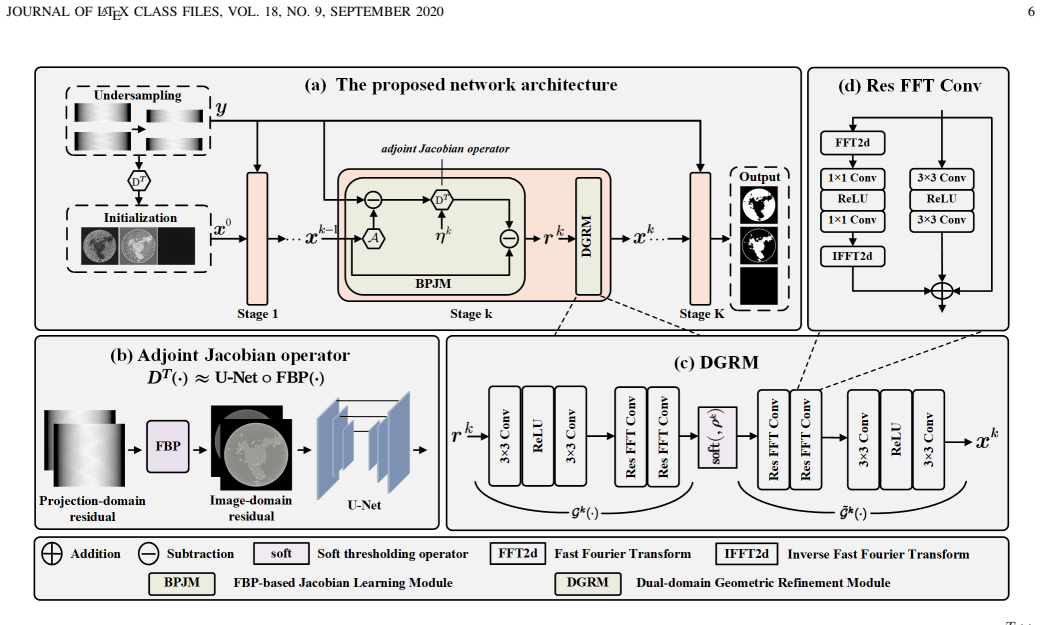
DECT-DRNet refines material maps from sparse dual-energy projections by approximating the nonlinear Jacobian with FBP plus U-Net and adding Fourier residual regularization.
A machine-rendered reading of the paper's core claim, the machinery that carries it, and where it could break.
Core claim
Representing DECT material decomposition as a sparse-regularized nonlinear least-squares problem and solving it via an iterative dual-domain refinement network that inserts a learnable FBP-U-Net approximation of the adjoint Jacobian followed by Fourier convolutional residual blocks for dual-domain regularization produces more accurate material-specific images from sparsely sampled dual-energy projections.
What carries the argument
The FBP-based Jacobian approximation module, which builds a learnable approximation to the adjoint Jacobian of the nonlinear material-decomposition operator by combining the FBP algorithm with a U-Net in the backward pass.
If this is right
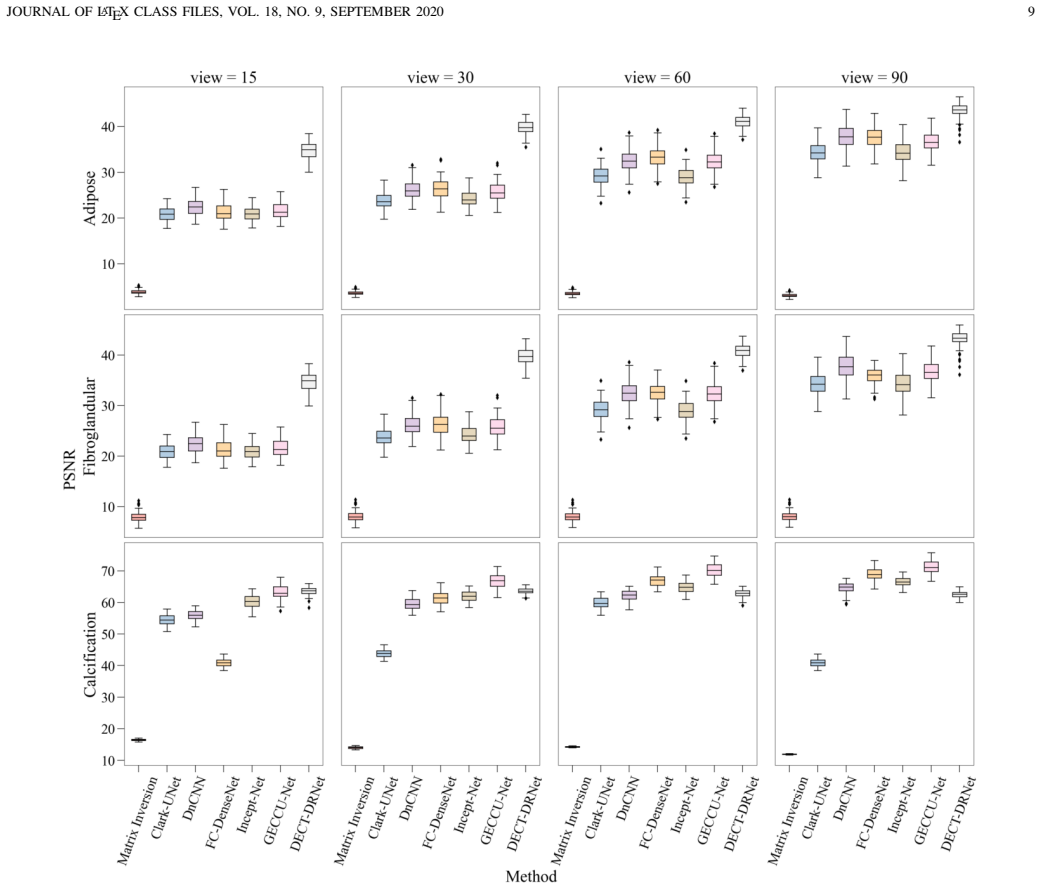
- Material decomposition error decreases under reduced projection counts compared with standard deep-unrolling baselines.
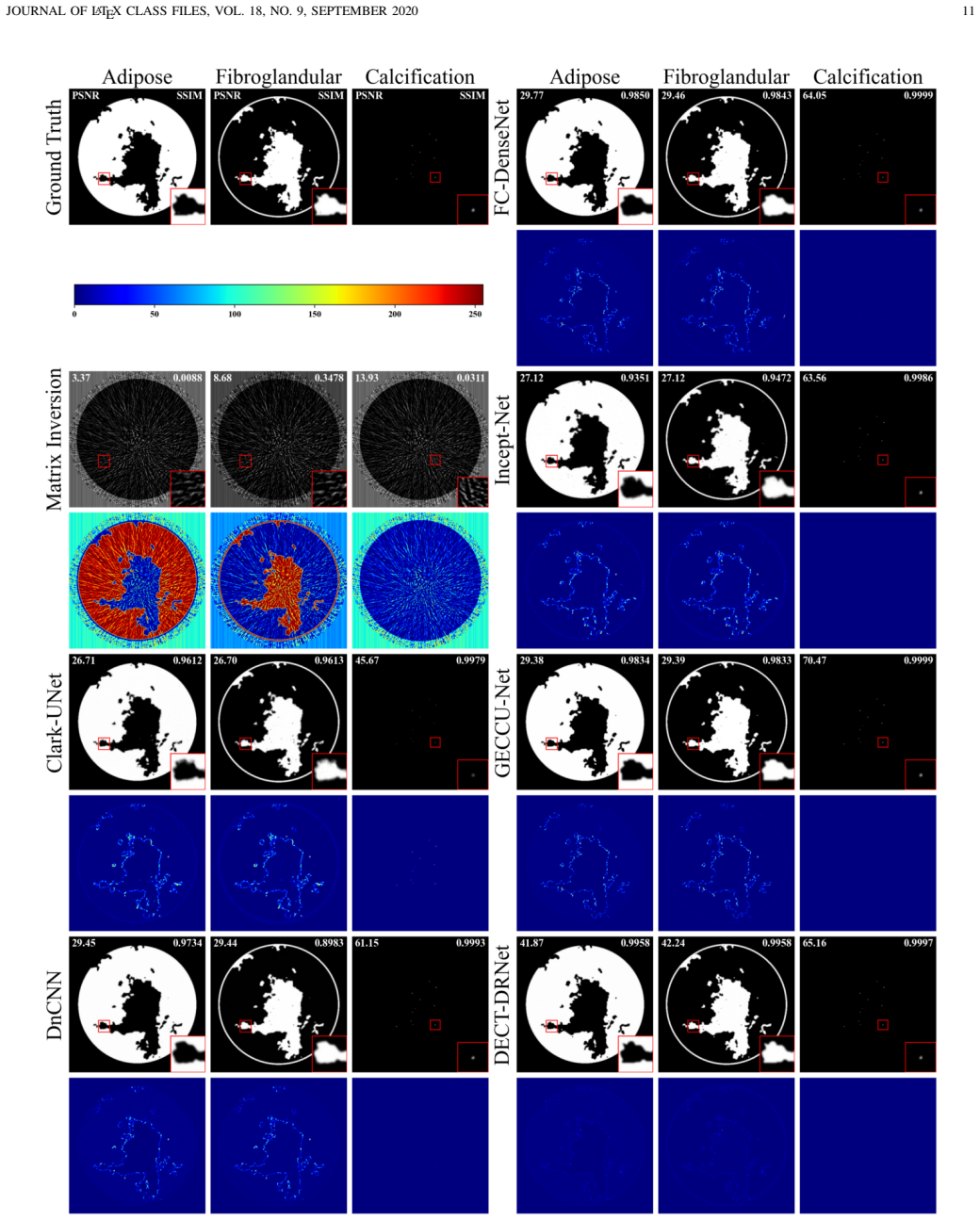
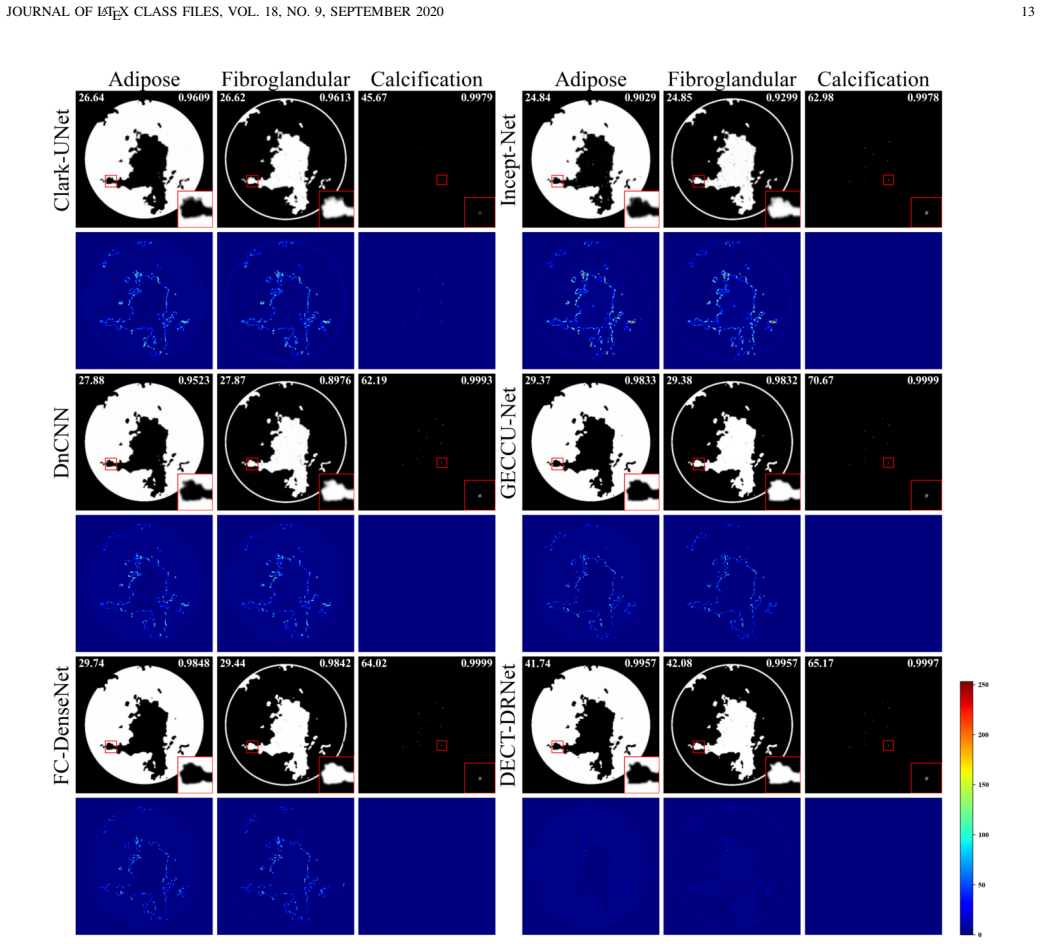
- Both local geometric features and global frequency content are jointly regularized, reducing streak artifacts while preserving edges.
- The iterative structure allows successive refinement of the solution to the nonlinear inverse problem.
Where Pith is reading between the lines
- The same FBP-U-Net Jacobian construction could be tested on other nonlinear tomography problems such as spectral CT or phase-contrast imaging.
- Replacing the Fourier blocks with other global operators might further improve performance on data with structured noise.
Load-bearing premise
A U-Net-augmented FBP operator supplies a sufficiently accurate and stable approximation to the true adjoint Jacobian of the nonlinear material-decomposition forward model.
What would settle it
Measure decomposition error on synthetic phantoms when the learned FBP-U-Net Jacobian is replaced by the exact computed Jacobian; a large gap would falsify the claim that the approximation is adequate.
Figures
read the original abstract
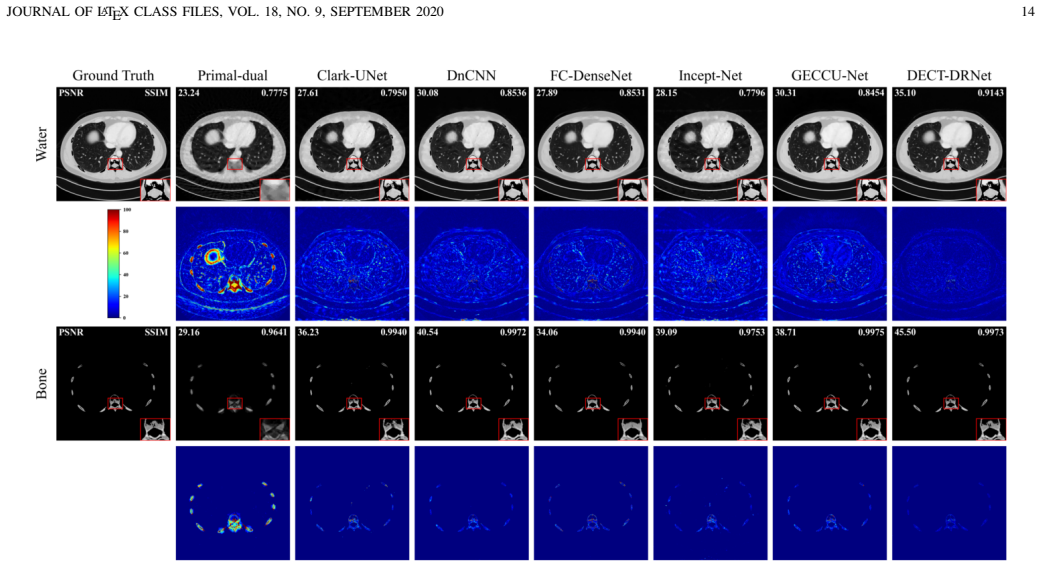
Dual-energy CT (DECT) exploits attenuation differences across different X-ray spectra to provide richer material information and has been widely used in medical imaging. While sparse-view acquisition can lower radiation exposure, it makes DECT material decomposition even more challenging, as the problem is nonlinear and ill-posed. Existing deep unrolling approaches generally do not explicitly incorporate the Jacobian operator induced by the nonlinear forward model, and their sparsity priors are still mainly built on conventional convolutions, which are insufficient for modeling global structural information. This study addresses the challenge of DECT multi-material decomposition in sparse-view settings by representing it as a sparse-regularized nonlinear least-squares problem. To solve it, we propose an iterative dual-domain refinement network (DECT-DRNet). In each iteration, the filtered back-projection (FBP)-based Jacobian approximation module is used first to generate an intermediate material decomposition result. Here, we characterize the forward process of material decomposition using a nonlinear operator, and then construct a theoretically grounded learnable approximation of the adjoint Jacobian operator by integrating the FBP algorithm with a U-Net into the backward process. In addition, to address the limitation of existing deep learning-based decomposition methods in globally suppressing noise and artifacts, we introduce a learnable sparse dual domain regularization term that incorporates Fourier convolutional residual blocks. This refinement block combines geometric feature extraction in the image domain with noise suppression in the frequency domain, allowing the model to capture both global and local features while maintaining structural details. DECT-DRNet demonstrates its ability to achieve more accurate material decomposition under sparse-view conditions.
Editorial analysis
A structured set of objections, weighed in public.
Referee Report
Summary. The paper claims that DECT-DRNet solves sparse-view DECT material decomposition by casting it as a sparse-regularized nonlinear least-squares problem and iterating with an FBP+U-Net module that supplies a learnable approximation to the adjoint Jacobian of the nonlinear forward operator, together with a dual-domain regularization block that combines image-domain geometric features and Fourier-domain noise suppression via convolutional residual blocks.
Significance. If the Jacobian approximation remains stable and the dual-domain term demonstrably improves global artifact suppression, the work would strengthen deep-unrolling approaches for nonlinear inverse problems by explicitly embedding the forward-model Jacobian rather than treating it as a black box; the Fourier residual blocks also offer a concrete mechanism for combining local and global priors that is reproducible in principle.
major comments (1)
- [iterative refinement step] Description of the iterative refinement step: the claim that the FBP+U-Net construction supplies a 'theoretically grounded' approximation to the adjoint Jacobian of the nonlinear material-decomposition operator lacks an explicit error bound, consistency proof, or numerical verification (e.g., comparison against autodiff or finite-difference Jacobians on the nonlinear operator). Because the iterative updates rely on this approximation remaining contractive, the absence of such verification is load-bearing for the central accuracy claim under sparse views.
Simulated Author's Rebuttal
We thank the referee for the constructive feedback on our manuscript. We address the single major comment point-by-point below and commit to revisions that directly respond to the concern about verification of the Jacobian approximation.
read point-by-point responses
-
Referee: Description of the iterative refinement step: the claim that the FBP+U-Net construction supplies a 'theoretically grounded' approximation to the adjoint Jacobian of the nonlinear material-decomposition operator lacks an explicit error bound, consistency proof, or numerical verification (e.g., comparison against autodiff or finite-difference Jacobians on the nonlinear operator). Because the iterative updates rely on this approximation remaining contractive, the absence of such verification is load-bearing for the central accuracy claim under sparse views.
Authors: We agree that the manuscript does not supply an explicit error bound, consistency proof, or numerical verification of the FBP+U-Net approximation against autodiff or finite differences. The grounding we claim rests on the fact that FBP is the exact adjoint of the (linear) Radon transform, with the U-Net trained end-to-end to supply a learned correction for the nonlinearity induced by the material-decomposition forward operator; this construction is described in Section 3.2. However, we recognize that the absence of direct verification leaves the contractivity claim untested in the current text. In the revision we will insert a new subsection (tentatively 3.2.1) that (i) derives the approximation step-by-step from the linearized adjoint and (ii) reports finite-difference Jacobian comparisons on a controlled nonlinear toy problem matching the DECT forward model. These additions will be placed before the experimental results so that readers can assess stability under sparse-view conditions. We therefore mark this point as addressed by revision. revision: yes
Circularity Check
No significant circularity detected
full rationale
The paper constructs DECT-DRNet by defining an FBP+U-Net module as a learnable approximation to the adjoint Jacobian of the nonlinear material-decomposition operator and adding Fourier convolutional residual blocks for dual-domain regularization. These are presented as architectural choices to solve the stated sparse-regularized nonlinear least-squares problem. No step reduces a claimed prediction or result to its own inputs by construction, no self-citation chain supplies a load-bearing uniqueness theorem or ansatz, and no fitted parameter is relabeled as an independent derivation. The performance claims rest on end-to-end training and evaluation rather than a closed derivation loop.
Axiom & Free-Parameter Ledger
free parameters (1)
- U-Net and Fourier residual block weights
axioms (1)
- domain assumption The nonlinear forward model of material decomposition admits a useful FBP-based adjoint approximation that can be refined by a U-Net.
Reference graph
Works this paper leans on
-
[1]
Image decomposition algorithm for dual-energy computed tomography via fully convolutional network,
Y . Xu, B. Yan, J. K. Zhang, J. Chen, L. Zeng, and L. Wang, “Image decomposition algorithm for dual-energy computed tomography via fully convolutional network,”Computational and Mathematical Methods in Medicine, vol. 2018, 2018
2018
-
[2]
Protocol analysis of dual-energy CT for optimization of kidney stone detection in virtual non-contrast reconstructions,
M. Lazar, H. Ringl, P. Baltzer, D. Toth, C. Seitz, B. Krauss, E. Unger, S. Polanec, D. Tamandl, C. Herold, and M. Toepker, “Protocol analysis of dual-energy CT for optimization of kidney stone detection in virtual non-contrast reconstructions,”European Radiology, vol. 30, 04 2020
2020
-
[3]
Role of dual-energy CT in the diagnosis and follow-up of gout: systematic analysis of the literature,
A. Ramon, A. Bohm-Sigrand, P. Pottecher, P. Richette, J.-F. Maillefert, D. Herv ´e, and P. Ornetti, “Role of dual-energy CT in the diagnosis and follow-up of gout: systematic analysis of the literature,”Clinical Rheumatology, vol. 37, 01 2018
2018
-
[4]
Material density iodine images in dual-energy ct: Detection and characterization of hypervascular liver lesions compared to magnetic resonance imaging.,
D. Muenzel, G. C. Lo, H. Yu, A. Parakh, M. Pati ˇno, A. R. Kambadakone, E. J. Rummeny, and D. V . Sahani, “Material density iodine images in dual-energy ct: Detection and characterization of hypervascular liver lesions compared to magnetic resonance imaging.,”European journal of radiology, vol. 95, pp. 300–306, 2017
2017
-
[5]
Image reconstruc- tion and scan configurations enabled by optimization-based algorithms in multispectral CT,
B. Chen, Z. Zhang, E. Y . Sidky, D. Xia, and X. Pan, “Image reconstruc- tion and scan configurations enabled by optimization-based algorithms in multispectral CT,”Physics in Medicine & Biology, vol. 62, no. 22, p. 8763, 2017
2017
-
[6]
Analysis of solution existence, unique- ness, and stability of discrete basis sinograms in multispectral ct,
Y . Gao, X. Pan, and C. Chen, “Analysis of solution existence, unique- ness, and stability of discrete basis sinograms in multispectral ct,” Journal of Mathematical Imaging and Vision, vol. 66, no. 4, pp. 741– 757, 2024
2024
-
[7]
Gao and C
Y . Gao and C. Chen, “Convergence analysis of the nonlinear kaczmarz method for systems of nonlinear equations with componentwise convex mappings and applications to image reconstruction in multispectral CT,” SIAM Journal on Imaging Sciences, vol. 18, no. 1, pp. 120–151, 2025
2025
-
[8]
One-step in- verse generation network for sparse-view dual-energy CT reconstruction and material imaging,
X. Zhang, L. Li, S. Wang, N. Liang, A. Cai, and B. Yan, “One-step in- verse generation network for sparse-view dual-energy CT reconstruction and material imaging,”Physics in Medicine & Biology, vol. 69, no. 14, p. 145012, 2024
2024
-
[9]
Noise sup- pression for dual-energy CT via penalized weighted least-square opti- mization with similarity-based regularization,
J. Harms, T. Wang, M. Petrongolo, T. Niu, and L. Zhu, “Noise sup- pression for dual-energy CT via penalized weighted least-square opti- mization with similarity-based regularization,”Medical physics, vol. 43, no. 5, pp. 2676–2686, 2016
2016
-
[10]
Iterative material decomposition with gradient l0-norm minimization for dual-energy CT,
Q. Wang, H. Xie, T. Wang, J. Roper, X. Tang, J. D. Bradley, T. Liu, and X. Yang, “Iterative material decomposition with gradient l0-norm minimization for dual-energy CT,” inMedical Imaging 2022: Image Processing, vol. 12032, pp. 550–555, SPIE, 2022
2022
-
[11]
Virtual monochromatic image guided denoising algorithm based on expectation maximization global self-similarity for dual-energy CT,
X. Fang and J. Zou, “Virtual monochromatic image guided denoising algorithm based on expectation maximization global self-similarity for dual-energy CT,”X-Ray Spectrometry, 2025
2025
-
[12]
Gauss-newton- krylov for reconstruction of polychromatic x-ray ct images,
N. Six, J. Renders, J. Sijbers, and J. De Beenhouwer, “Gauss-newton- krylov for reconstruction of polychromatic x-ray ct images,”IEEE Transactions on Computational Imaging, vol. 7, pp. 1304–1313, 2021
2021
-
[13]
Projection domain decomposition denois- ing algorithm based on low rank and similarity-based regularization,
C. Lu, Z. Han, and J. Zou, “Projection domain decomposition denois- ing algorithm based on low rank and similarity-based regularization,” Journal of X-Ray Science and Technology, vol. 32, no. 3, pp. 549–568, 2024
2024
-
[14]
Image-domain multimate- rial decomposition for dual-energy CT based on prior information of material images,
Q. Ding, T. Niu, X. Zhang, and Y . Long, “Image-domain multimate- rial decomposition for dual-energy CT based on prior information of material images,”Medical physics, vol. 45, no. 8, pp. 3614–3626, 2018
2018
-
[15]
Algorithm- enabled partial-angular-scan configurations for dual-energy CT,
B. Chen, Z. Zhang, D. Xia, E. Y . Sidky, and X. Pan, “Algorithm- enabled partial-angular-scan configurations for dual-energy CT,”Medi- cal physics, vol. 45, no. 5, pp. 1857–1870, 2018
2018
-
[16]
Multi-material decomposition using statisti- cal image reconstruction for spectral CT,
Y . Long and J. A. Fessler, “Multi-material decomposition using statisti- cal image reconstruction for spectral CT,”IEEE transactions on medical imaging, vol. 33, no. 8, pp. 1614–1626, 2014
2014
-
[17]
Using edge-preserving algorithm with non-local mean for significantly improved image-domain material decomposition in dual-energy CT,
W. Zhao, T. Niu, L. Xing, Y . Xie, G. Xiong, K. Elmore, J. Zhu, L. Wang, and J. K. Min, “Using edge-preserving algorithm with non-local mean for significantly improved image-domain material decomposition in dual-energy CT,”Physics in Medicine & Biology, vol. 61, no. 3, p. 1332, 2016
2016
-
[18]
Statistical image-domain multimaterial decomposition for dual-energy CT,
Y . Xue, R. Ruan, X. Hu, Y . Kuang, J. Wang, Y . Long, and T. Niu, JOURNAL OF LATEX CLASS FILES, VOL. 18, NO. 9, SEPTEMBER 2020 16 “Statistical image-domain multimaterial decomposition for dual-energy CT,”Medical physics, vol. 44, no. 3, pp. 886–901, 2017
2020
-
[19]
An extended primal-dual algorithm framework for nonconvex problems: application to image reconstruction in spectral CT,
Y . Gao, X. Pan, and C. Chen, “An extended primal-dual algorithm framework for nonconvex problems: application to image reconstruction in spectral CT,”Inverse problems, vol. 38, no. 8, p. 085011, 2022
2022
-
[20]
Prototyping optimization-based image reconstructions from limited-angular-range data in dual-energy CT,
B. Chen, Z. Zhang, D. Xia, E. Y . Sidky, and X. Pan, “Prototyping optimization-based image reconstructions from limited-angular-range data in dual-energy CT,”Medical Image Analysis, vol. 91, p. 103025, 2024
2024
-
[21]
Iterative image-domain decomposition for dual-energy CT,
T. Niu, X. Dong, M. Petrongolo, and L. Zhu, “Iterative image-domain decomposition for dual-energy CT,”Medical physics, vol. 41, no. 4, p. 041901, 2014
2014
-
[22]
DIRECT-Net: A unified mutual-domain material decomposition network for quantitative dual-energy CT imag- ing,
T. Su, X. Sun, J. Yang, D. Mi, Y . Zhang, H. Wu, S. Fang, Y . Chen, H. Zheng, D. Liang,et al., “DIRECT-Net: A unified mutual-domain material decomposition network for quantitative dual-energy CT imag- ing,”Medical physics, vol. 49, no. 2, pp. 917–934, 2022
2022
-
[23]
A material decom- position method for dual-energy CT via dual interactive wasserstein generative adversarial networks.,
Z. Shi, H. Li, Q. Cao, Z. Wang, and M. Cheng, “A material decom- position method for dual-energy CT via dual interactive wasserstein generative adversarial networks.,”Medical physics, 2020
2020
-
[24]
Multi-energy CT de- composition using convolutional neural networks,
D. P. Clark, M. D. Holbrook, and C. T. Badea, “Multi-energy CT de- composition using convolutional neural networks,” inMedical Imaging, 2018
2018
-
[25]
Deep-learning-based direct inversion for material decomposi- tion,
H. Gong, S. Tao, K. Rajendran, W. Zhou, C. H. McCollough, and S. Leng, “Deep-learning-based direct inversion for material decomposi- tion,”Medical Physics, vol. 47, no. 12, pp. 6294–6309, 2020
2020
-
[26]
Multi- energy CT material decomposition using graph model improved CNN,
Z. Shi, F. Kong, M. Cheng, H. Cao, S. Ouyang, and Q. Cao, “Multi- energy CT material decomposition using graph model improved CNN,” Medical & Biological Engineering & Computing, vol. 62, no. 4, pp. 1213–1228, 2024
2024
-
[27]
Clip-driven universal model for multi-material de- composition in dual-energy CT,
X. Wang, J. Xiang, A. Mao, J. Xie, P. Jin, M. Ding, Y . Yuan, Y . Lu, L. Yu, H. Cai,et al., “Clip-driven universal model for multi-material de- composition in dual-energy CT,”IEEE Transactions on Computational Imaging, 2025
2025
-
[28]
Image domain dual material decomposition for dual-energy CT using butterfly network,
W. Zhang, H. Zhang, L. Wang, X. Wang, X. Hu, A. Cai, L. Li, T. Niu, and B. Yan, “Image domain dual material decomposition for dual-energy CT using butterfly network,”Medical Physics, vol. 46, no. 5, pp. 2037– 2051, 2019
2037
-
[29]
Image-domain material decompo- sition for dual-energy CT using unsupervised learning with data-fidelity loss,
J. Peng, C.-W. Chang, H. Xie, R. L. J. Qiu, J. Roper, T. Wang, B. Ghavidel, X. Tang, and X. Yang, “Image-domain material decompo- sition for dual-energy CT using unsupervised learning with data-fidelity loss,”Medical Physics, vol. 51, no. 9, pp. 6185–6195, 2024
2024
-
[30]
Multi-material decomposition using spectral diffusion posterior sampling,
X. Jiang, G. J. Gang, and J. W. Stayman, “Multi-material decomposition using spectral diffusion posterior sampling,”IEEE Transactions on Biomedical Engineering, 2025
2025
-
[31]
Material decomposition in photon-counting computed tomography with diffusion models: Com- parative study and hybridization with variational regularizers,
C. Vazia, T. Dassow, A. Bousse, J. Froment, B. Vedel, F. Vermet, A. Perelli, J.-P. Tasu, and D. Visvikis, “Material decomposition in photon-counting computed tomography with diffusion models: Com- parative study and hybridization with variational regularizers,”IEEE Transactions on Radiation and Plasma Medical Sciences, 2026
2026
-
[32]
Learned primal-dual reconstruction,
J. Adler and O. ¨Oktem, “Learned primal-dual reconstruction,”IEEE transactions on medical imaging, vol. 37, no. 6, pp. 1322–1332, 2018
2018
-
[33]
FISTA-Net: Learning a fast iterative shrinkage thresholding network for inverse problems in imaging,
J. Xiang, Y . Dong, and Y . Yang, “FISTA-Net: Learning a fast iterative shrinkage thresholding network for inverse problems in imaging,”IEEE Transactions on Medical Imaging, vol. 40, no. 5, pp. 1329–1339, 2021
2021
-
[34]
AMP-Net: Denoising- based deep unfolding for compressive image sensing,
Z. Zhang, Y . Liu, J. Liu, F. Wen, and C. Zhu, “AMP-Net: Denoising- based deep unfolding for compressive image sensing,”IEEE Transac- tions on Image Processing, vol. 30, pp. 1487–1500, 2020
2020
-
[35]
Nest-dgil: Nesterov- optimized deep geometric incremental learning for CS image reconstruc- tion,
X. Fan, Y . Yang, K. Chen, Y . Feng, and J. Zhang, “Nest-dgil: Nesterov- optimized deep geometric incremental learning for CS image reconstruc- tion,”IEEE Transactions on Computational Imaging, vol. 9, pp. 819– 833, 2023
2023
-
[36]
Deep unrolling networks with re- current momentum acceleration for nonlinear inverse problems,
Q. Zhou, J. Qian, J. Tang, and J. Li, “Deep unrolling networks with re- current momentum acceleration for nonlinear inverse problems,”Inverse Problems, vol. 40, no. 5, p. 055014, 2024
2024
-
[37]
Deep learning for material decomposition in photon-counting CT,
A. Eguizabal, O. ¨Oktem, and M. U. Persson, “Deep learning for material decomposition in photon-counting CT,”arXiv preprint arXiv:2208.03360, 2022
-
[38]
An improved iterative neural network for high-quality image-domain material decomposition in dual-energy CT,
Z. Li, Y . Long, and I. Y . Chun, “An improved iterative neural network for high-quality image-domain material decomposition in dual-energy CT,”Medical Physics, vol. 50, no. 4, pp. 2195–2211, 2023
2023
-
[39]
Learning-based material decomposition in dual energy CT using an unrolled estimator,
M. Lantz and G. Ongie, “Learning-based material decomposition in dual energy CT using an unrolled estimator,” in2023 IEEE 20th International Symposium on Biomedical Imaging (ISBI), pp. 1–5, 2023
2023
-
[40]
Dual-domain joint learning reconstruction method (jlrm) combined with physical process for spectral computed tomography (sct),
G. Ma, P. Yang, and X. Zhao, “Dual-domain joint learning reconstruction method (jlrm) combined with physical process for spectral computed tomography (sct),”Symmetry, vol. 17, no. 7, p. 1165, 2025
2025
-
[41]
Learning to distill global representation for sparse-view CT,
Z. Li, C. Ma, J. Chen, J. Zhang, and H. Shan, “Learning to distill global representation for sparse-view CT,” in2023 IEEE/CVF International Conference on Computer Vision (ICCV), pp. 21139–21150, 2023
2023
-
[42]
Freeseed: Frequency- band-aware and self-guided network for sparse-view CT reconstruction,
C. Ma, Z. Li, J. Zhang, Y . Zhang, and H. Shan, “Freeseed: Frequency- band-aware and self-guided network for sparse-view CT reconstruction,” inMedical Image Computing and Computer Assisted Intervention – MICCAI 2023(H. Greenspan, A. Madabhushi, P. Mousavi, S. Salcudean, J. Duncan, T. Syeda-Mahmood, and R. Taylor, eds.), (Cham), pp. 250– 259, Springer Natu...
2023
-
[43]
Afire: Accurate and fast image reconstruction algorithm for geometric-inconsistent multispectral ct,
Y . Gao and C. Chen, “Afire: Accurate and fast image reconstruction algorithm for geometric-inconsistent multispectral ct,”arXiv preprint arXiv:2505.24793, 2025
-
[44]
P. L. Combettes and J.-C. Pesquet,Proximal Splitting Methods in Signal Processing, pp. 185–212. New York, NY: Springer New York, 2011
2011
-
[45]
Fused analytical and iterative reconstruction (air) via modified proximal forward–backward splitting: a fdk-based iterative image recon- struction example for CBCT,
H. Gao, “Fused analytical and iterative reconstruction (air) via modified proximal forward–backward splitting: a fdk-based iterative image recon- struction example for CBCT,”Physics in Medicine & Biology, vol. 61, no. 19, p. 7187, 2016
2016
-
[46]
Airnet: fused analytical and iterative reconstruction with deep neural network regularization for sparse-data CT,
G. Chen, X. Hong, Q. Ding, Y . Zhang, H. Chen, S. Fu, Y . Zhao, X. Zhang, H. Ji, G. Wang,et al., “Airnet: fused analytical and iterative reconstruction with deep neural network regularization for sparse-data CT,”Medical physics, vol. 47, no. 7, pp. 2916–2930, 2020
2020
-
[47]
U-net: Convolutional networks for biomedical image segmentation,
O. Ronneberger, P. Fischer, and T. Brox, “U-net: Convolutional networks for biomedical image segmentation,” inMedical Image Computing and Computer-Assisted Intervention – MICCAI 2015(N. Navab, J. Horneg- ger, W. M. Wells, and A. F. Frangi, eds.), (Cham), pp. 234–241, Springer International Publishing, 2015
2015
-
[48]
Batch Normalization: Accelerating Deep Network Training by Reducing Internal Covariate Shift
S. Ioffe and C. Szegedy, “Batch normalization: Accelerating deep network training by reducing internal covariate shift,”ArXiv, vol. abs/1502.03167, 2015
work page internal anchor Pith review Pith/arXiv arXiv 2015
-
[49]
ISTA-Net: Interpretable optimization-inspired deep network for image compressive sensing,
J. Zhang and B. Ghanem, “ISTA-Net: Interpretable optimization-inspired deep network for image compressive sensing,” in2018 IEEE/CVF Conference on Computer Vision and Pattern Recognition, pp. 1828– 1837, 2018
2018
-
[50]
Intriguing findings of frequency selection for image deblurring,
X. Mao, Y . Liu, F. Liu, Q. Li, W. lei Shen, and Y . Wang, “Intriguing findings of frequency selection for image deblurring,” inAAAI Confer- ence on Artificial Intelligence, 2021
2021
-
[51]
Report on the AAPM deep-learning spectral CT grand challenge,
E. Y . Sidky and X. Pan, “Report on the AAPM deep-learning spectral CT grand challenge,”Medical physics, vol. 51, no. 2, pp. 772–785, 2024
2024
-
[52]
Low-dose ct for the detection and classification of metastatic liver lesions: results of the 2016 low dose ct grand challenge,
C. H. McCollough, A. C. Bartley, R. E. Carter, B. Chen, T. A. Drees, P. Edwards, D. R. Holmes III, A. E. Huang, F. Khan, S. Leng,et al., “Low-dose ct for the detection and classification of metastatic liver lesions: results of the 2016 low dose ct grand challenge,”Medical physics, vol. 44, no. 10, pp. e339–e352, 2017
2016
-
[53]
Direct dual-energy ct material decomposition using model-based denoising diffusion model,
H. Xu, A. Bousse, and A. Perelli, “Direct dual-energy ct material decomposition using model-based denoising diffusion model,”arXiv preprint arXiv:2507.18012, 2025
-
[54]
Efficient inference in fully connected crfs with gaussian edge potentials,
P. Kr ¨ahenb¨uhl and V . Koltun, “Efficient inference in fully connected crfs with gaussian edge potentials,”Advances in neural information processing systems, vol. 24, 2011
2011
-
[55]
Tables of x-ray mass attenuation coefficients and mass energy-absorption coefficients 1 kev to 20 mev for elements z= 1 to 92 and 48 additional substances of dosimetric interest,
J. H. Hubbell and S. M. Seltzer, “Tables of x-ray mass attenuation coefficients and mass energy-absorption coefficients 1 kev to 20 mev for elements z= 1 to 92 and 48 additional substances of dosimetric interest,” 1995
1995
-
[56]
A validation of spekpy: A software toolkit for modelling x-ray tube spectra,
R. Bujila, A. Omar, and G. Poludniowski, “A validation of spekpy: A software toolkit for modelling x-ray tube spectra,”Physica Medica, vol. 75, pp. 44–54, 2020
2020
-
[57]
A learning-based material de- composition pipeline for multi-energy x-ray imaging,
Y . Lu, M. Kowarschik, X. Huang, Y . Xia, J.-H. Choi, S. Chen, S. Hu, Q. Ren, R. Fahrig, J. Hornegger,et al., “A learning-based material de- composition pipeline for multi-energy x-ray imaging,”Medical physics, vol. 46, no. 2, pp. 689–703, 2019
2019
-
[58]
Multi-material decomposition of spectral CT images via fully convolutional densenets,
X. Wu, P. He, Z. Long, X. Guo, M. Chen, X. Ren, P. Chen, L. Deng, K. An, P. Li,et al., “Multi-material decomposition of spectral CT images via fully convolutional densenets,”Journal of X-Ray Science and Technology, vol. 27, no. 3, pp. 461–471, 2019
2019
-
[59]
Material composition characterization from computed tomography via self-supervised learning promotes pulmonary disease diagnosis,
J. Liu, W. Zhao, Y . Liu, Y . Chen, and X. Bai, “Material composition characterization from computed tomography via self-supervised learning promotes pulmonary disease diagnosis,”Cell Reports Physical Science, vol. 5, no. 5, 2024
2024
discussion (0)
Sign in with ORCID, Apple, or X to comment. Anyone can read and Pith papers without signing in.